1. Project: AODA Follow-Up Improvements in Wood County
This project aims to reduce the wait time for outpatient AODA follow-up appointments post-discharge in Wood County. Through data collection and analysis, the team discovered various challenges and potential solutions for enhancing the follow-up process and ensuring timely access to care for residents.

Download Presentation

Please find below an Image/Link to download the presentation.
The content on the website is provided AS IS for your information and personal use only. It may not be sold, licensed, or shared on other websites without obtaining consent from the author.If you encounter any issues during the download, it is possible that the publisher has removed the file from their server.
You are allowed to download the files provided on this website for personal or commercial use, subject to the condition that they are used lawfully. All files are the property of their respective owners.
The content on the website is provided AS IS for your information and personal use only. It may not be sold, licensed, or shared on other websites without obtaining consent from the author.
E N D
Presentation Transcript
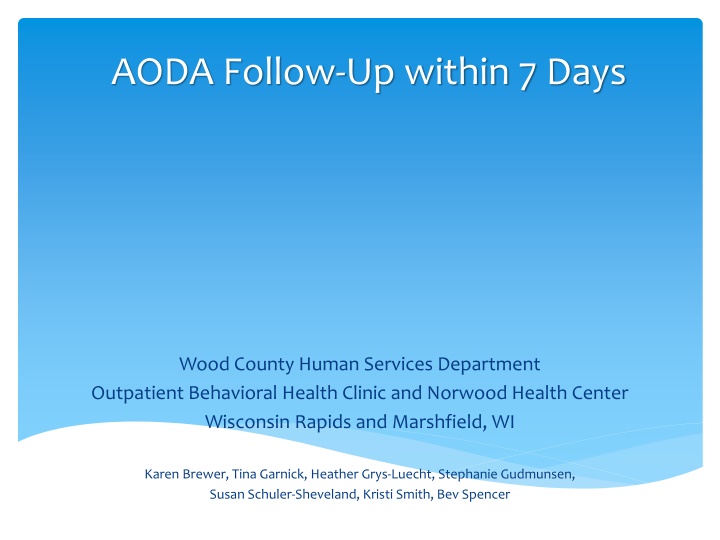
AODA Follow-Up within 7 Days Wood County Human Services Department Outpatient Behavioral Health Clinic and Norwood Health Center Wisconsin Rapids and Marshfield, WI Karen Brewer, Tina Garnick, Heather Grys-Luecht, Stephanie Gudmunsen, Susan Schuler-Sheveland, Kristi Smith, Bev Spencer
AIM: What are we trying to accomplish? Reduce wait time to outpatient AODA follow-up appointment from 5 weeks (estimated) to 1 week post-discharge. Target Population: All Wood County residents hospitalized on the Admissions Unit at Norwood Health Center (Wood County inpatient behavioral health unit) that require follow-up primary AODA treatment and who will be receiving follow-up care through outpatient services at Wood County Human Services Outpatient Clinic.
Changes made Steps taken Brainstorming and nominal group technique applied to generate change ideas and prioritize ideas to test Rapid Cycle 1 (8/1/16-9/30/16): Assign a point person to manage appointments for the target population Negotiate with front desk, billing, counselors to find an appointment and schedule within 7 days post-discharge Talk to discharge planners/social workers to ensure transportation or learn of any other barriers Follow-up with reminder call and encouragement to patient prior to appointment
How does your project grow? Results: Cycle was planned to last from 2 to 4 weeks Cycle lasted 8 weeks due to limited data being captured From the four data points gathered, it was determined that 75% of target population was scheduled for first follow-up appointment within 7 days Far too small a sample to understand if this change was really effective
Discoveries Just like non-farm kids digging potatoes for the first time we discovered many hidden nuggets of wonder and learning 1) There aren t really that many primary AODA diagnosed patients in the target population 2) May not really have a problem in the target population. The baseline of 5 weeks was an estimate and are only now really seeking a true baseline of the broader population, which will include the target as a subset 3) May have a customer service process problem because we don t know how or if possible to bill for concurrent dual intake. Haven t had many dual certified therapists so clients needed to see two clinicians; most clients are coming in with dual dx, but process requires a choice of one over the other hence the discovery of the limited primary AODA population 4) The bigger problem is getting people to come to their appointments rather than scheduling the first f/u within 7 days
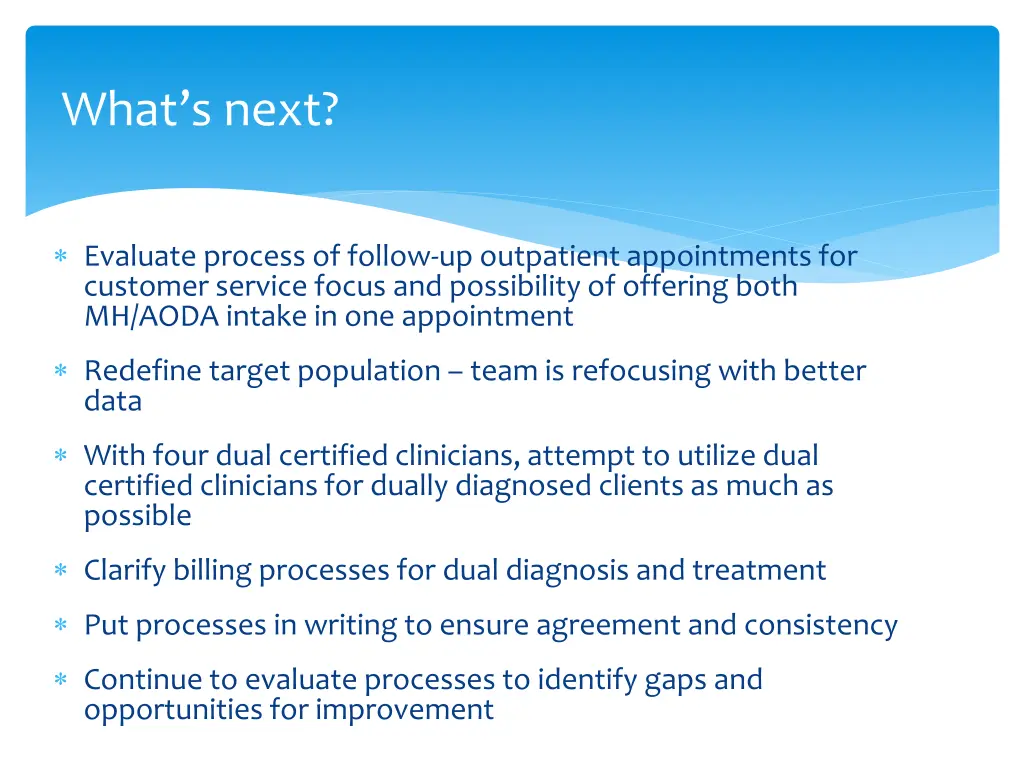
Whats next? Evaluate process of follow-up outpatient appointments for customer service focus and possibility of offering both MH/AODA intake in one appointment Redefine target population team is refocusing with better data With four dual certified clinicians, attempt to utilize dual certified clinicians for dually diagnosed clients as much as possible Clarify billing processes for dual diagnosis and treatment Put processes in writing to ensure agreement and consistency Continue to evaluate processes to identify gaps and opportunities for improvement