Discover the rules and guidelines for the 2015 Entomology (B&C) event featuring insect identification, taxonomy, process skills, and event parameters. Explore training materials, competition content, and the official national insect list.
Please find below an Image/Link to download the presentation.
The content on the website is provided AS IS for your information and personal use only. It may not be sold, licensed, or shared on other websites without obtaining consent from the author. If you encounter any issues during the download, it is possible that the publisher has removed the file from their server.
You are allowed to download the files provided on this website for personal or commercial use, subject to the condition that they are used lawfully. All files are the property of their respective owners.
The content on the website is provided AS IS for your information and personal use only. It may not be sold, licensed, or shared on other websites without obtaining consent from the author.
E N D
Presentation Transcript
2015 Entomology (B&C) KAREN LANCOUR National Rules Committee Chairman- Life Sciences
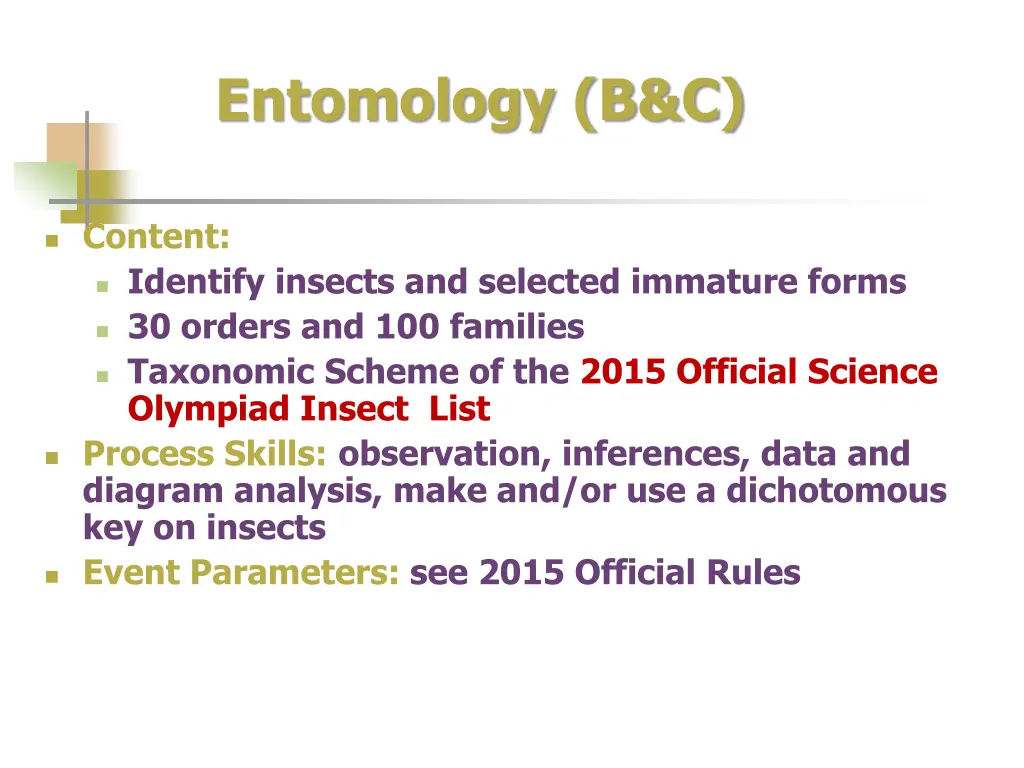
Entomology (B&C) Content: Identify insects and selected immature forms 30 orders and 100 families Taxonomic Scheme of the 2015 Official Science Olympiad Insect List Process Skills: observation, inferences, data and diagram analysis, make and/or use a dichotomous key on insects Event Parameters: see 2015 Official Rules
Event Rules 2015 DISCLAIMER This presentation was prepared using draft rules. There may be some changes in the final copy of the rules. The rules which will be in your Coaches Manual and Student Manuals will be the official rules.
Event Rules 2015 BE SURE TO CHECK THE 2015 EVENT RULES FOR EVENT PARAMETERS AND TOPICS FOR EACH COMPETITION LEVEL The National Insect List is at www.soinc.org under Event Information
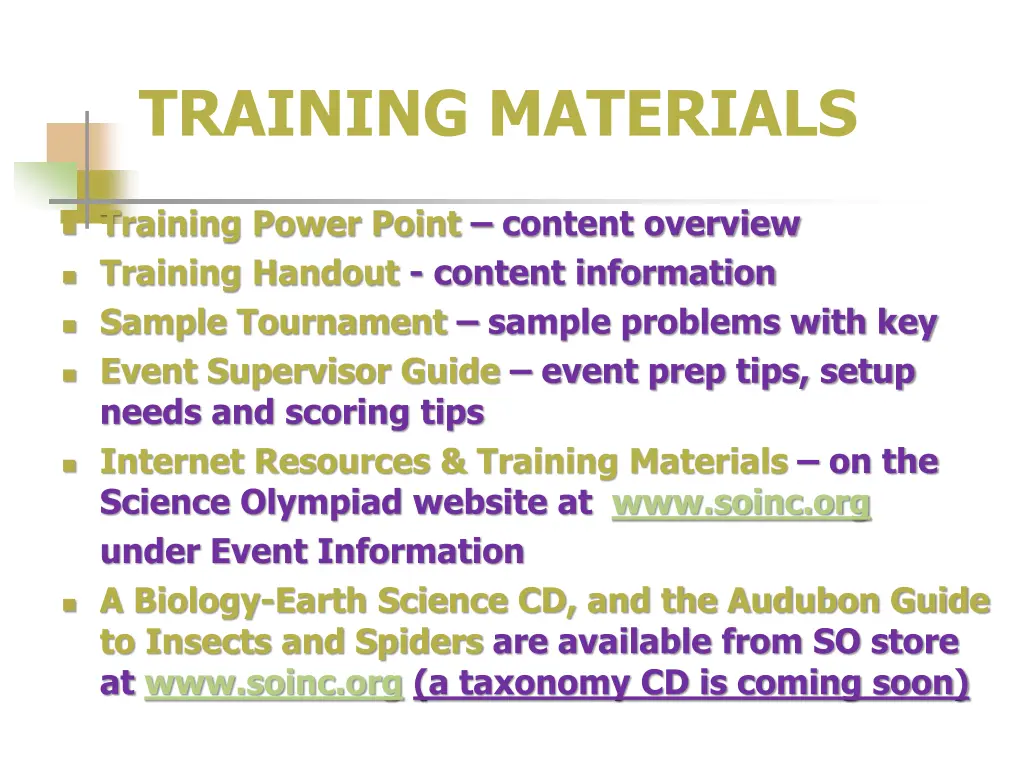
TRAINING MATERIALS Training Power Point content overview Training Handout - content information Sample Tournament sample problems with key Event Supervisor Guide event prep tips, setup needs and scoring tips Internet Resources & Training Materials on the Science Olympiad website at www.soinc.org under Event Information A Biology-Earth Science CD, and the Audubon Guide to Insects and Spiders are available from SO store at www.soinc.org (a taxonomy CD is coming soon)
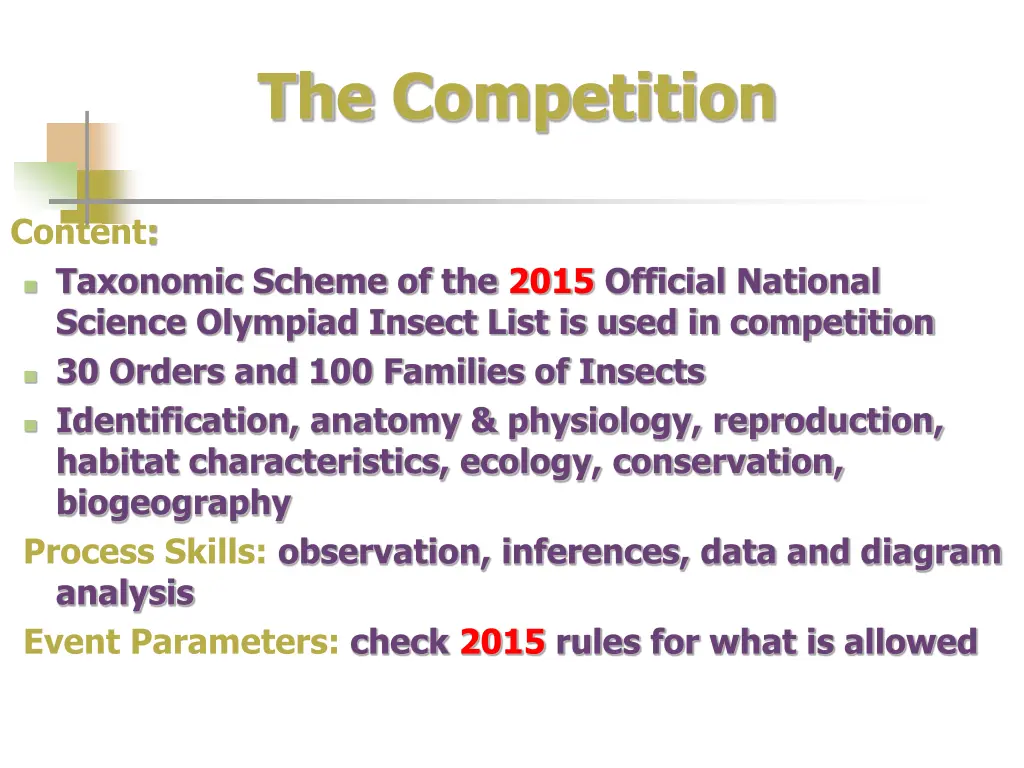
The Competition Content: Taxonomic Scheme of the 2015 Official National Science Olympiad Insect List is used in competition 30 Orders and 100 Families of Insects Identification, anatomy & physiology, reproduction, habitat characteristics, ecology, conservation, biogeography Process Skills: observation, inferences, data and diagram analysis Event Parameters: check 2015 rules for what is allowed
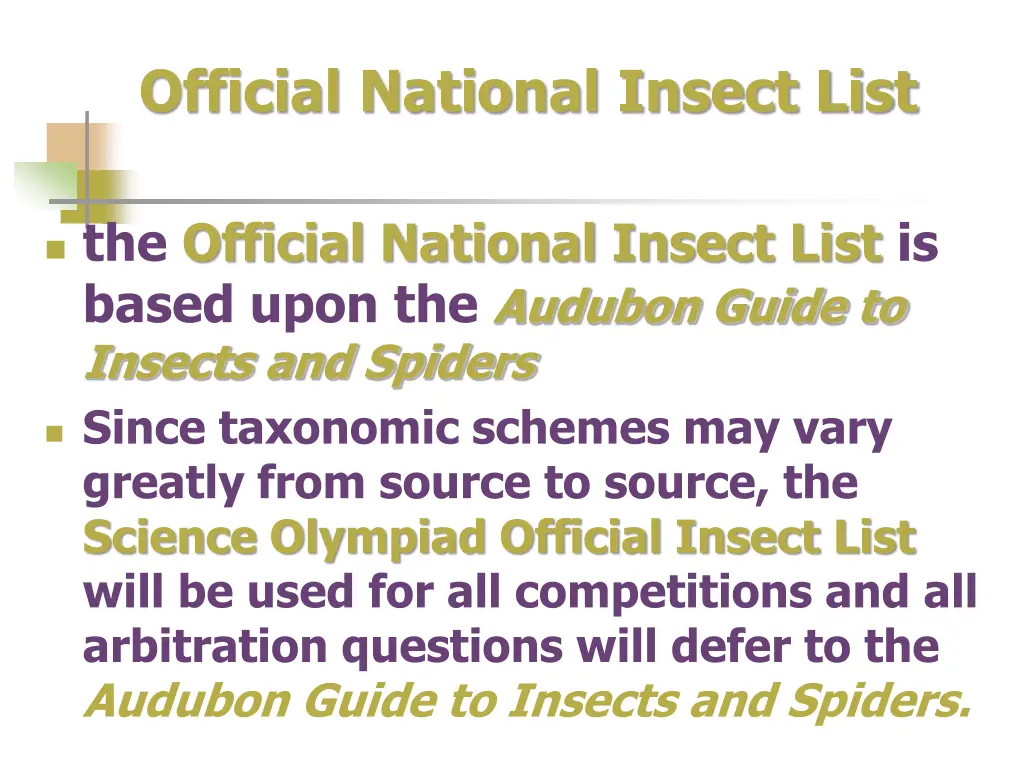
Official National Insect List the Official National Insect List is based upon the Audubon Guide to Insects and Spiders Since taxonomic schemes may vary greatly from source to source, the Science Olympiad Official Insect List will be used for all competitions and all arbitration questions will defer to the Audubon Guide to Insects and Spiders.
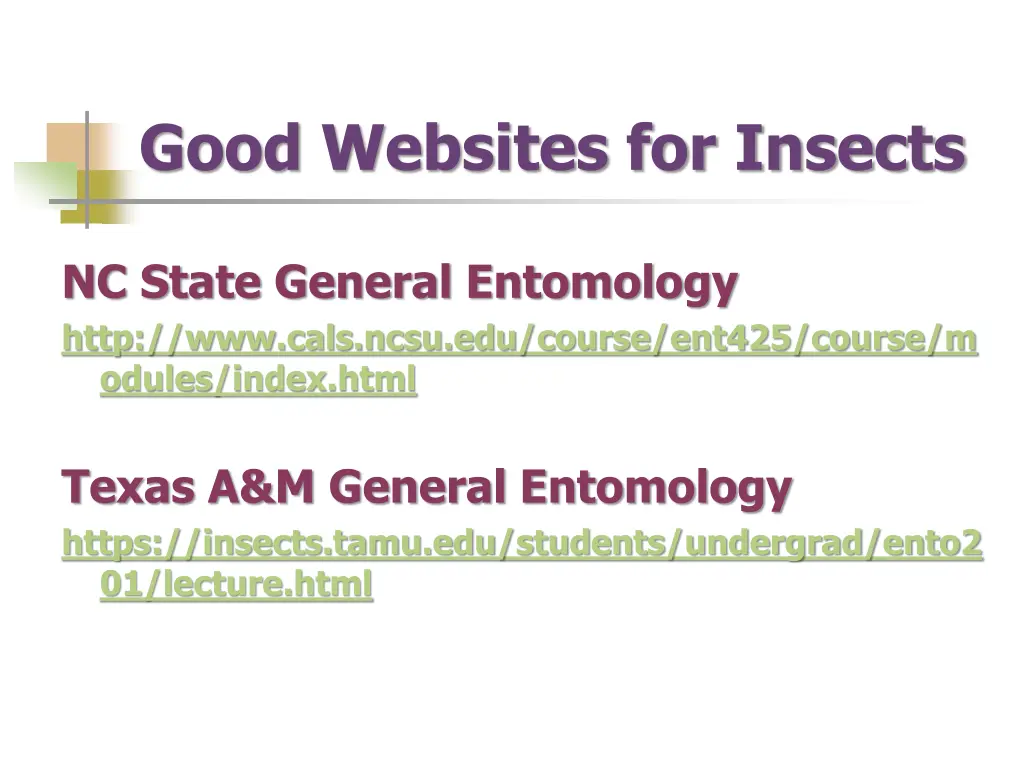
Good Websites for Insects NC State General Entomology http://www.cals.ncsu.edu/course/ent425/course/m odules/index.html Texas A&M General Entomology https://insects.tamu.edu/students/undergrad/ento2 01/lecture.html
The Competition Specimens or images (nymph or larva for selected orders and families) will be exhibited usually as stations. For any individual specimen, questions may also concern economic or health impact of specimens on humans. Topics may include structure and function of internal and external anatomy, ecology, behavior & history. One of the stations may involve using or formulating a simple dichotomous key to identify insects.
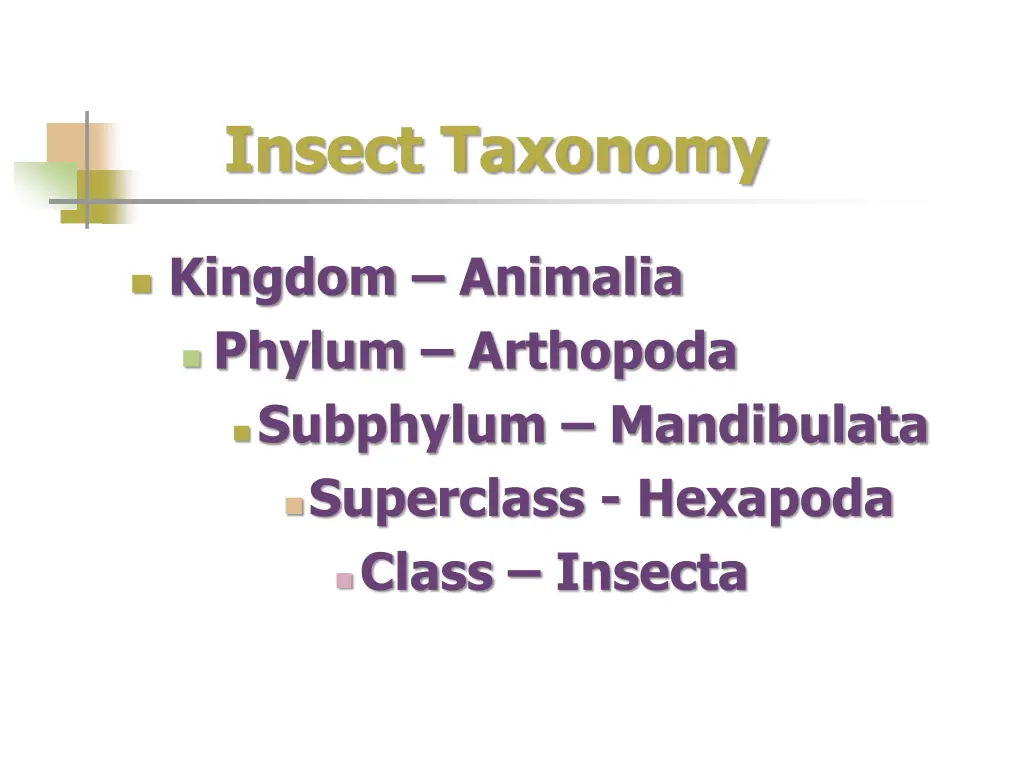
Insect Taxonomy Kingdom Animalia Phylum Arthopoda Subphylum Mandibulata Superclass - Hexapoda Class Insecta
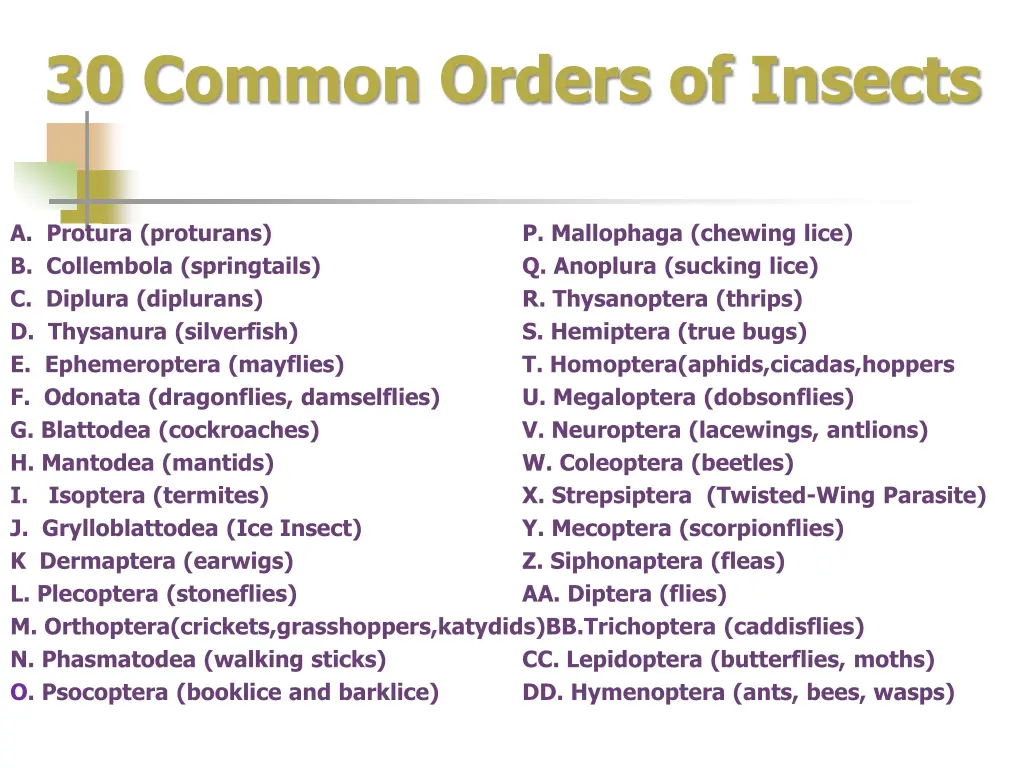
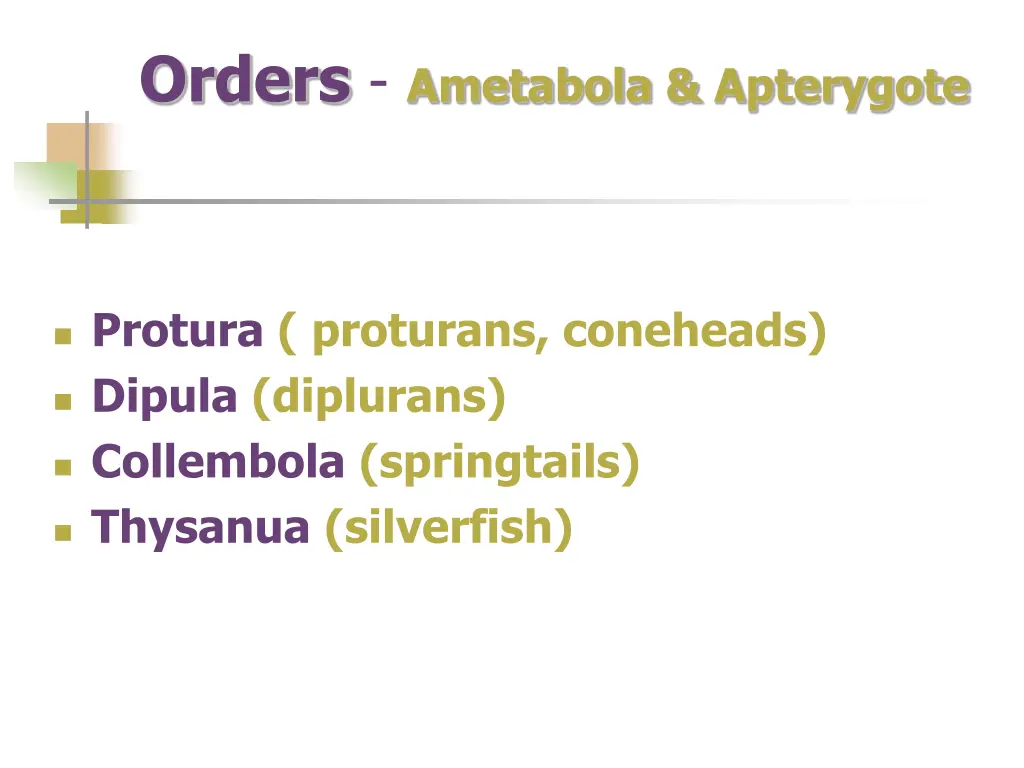
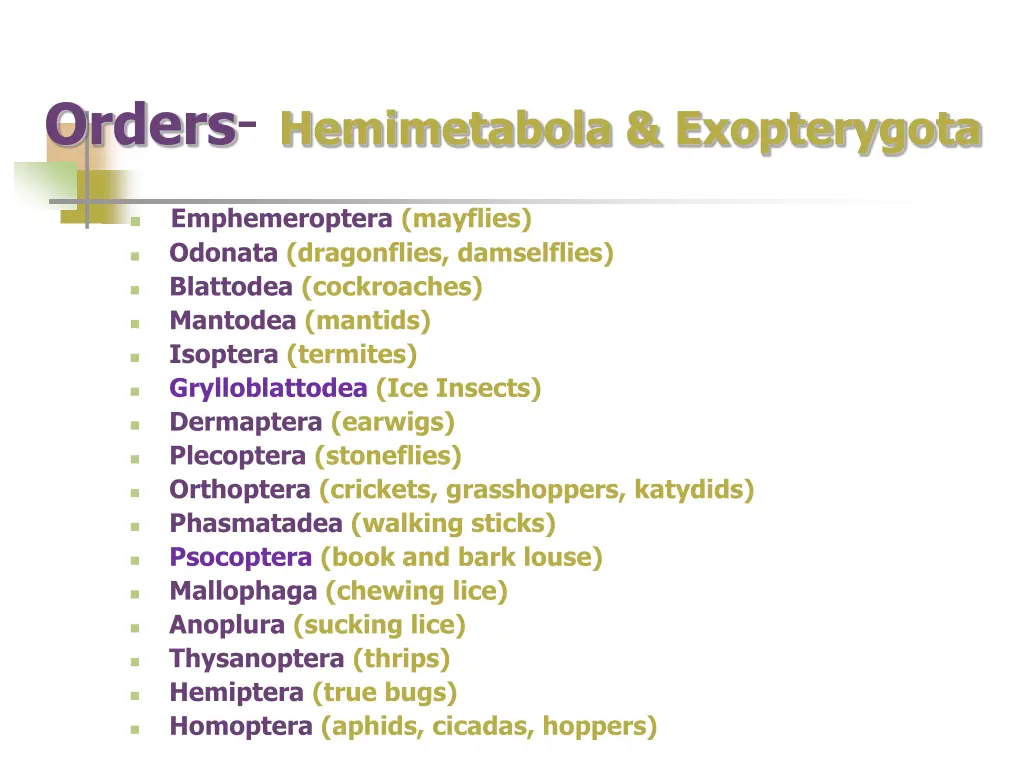
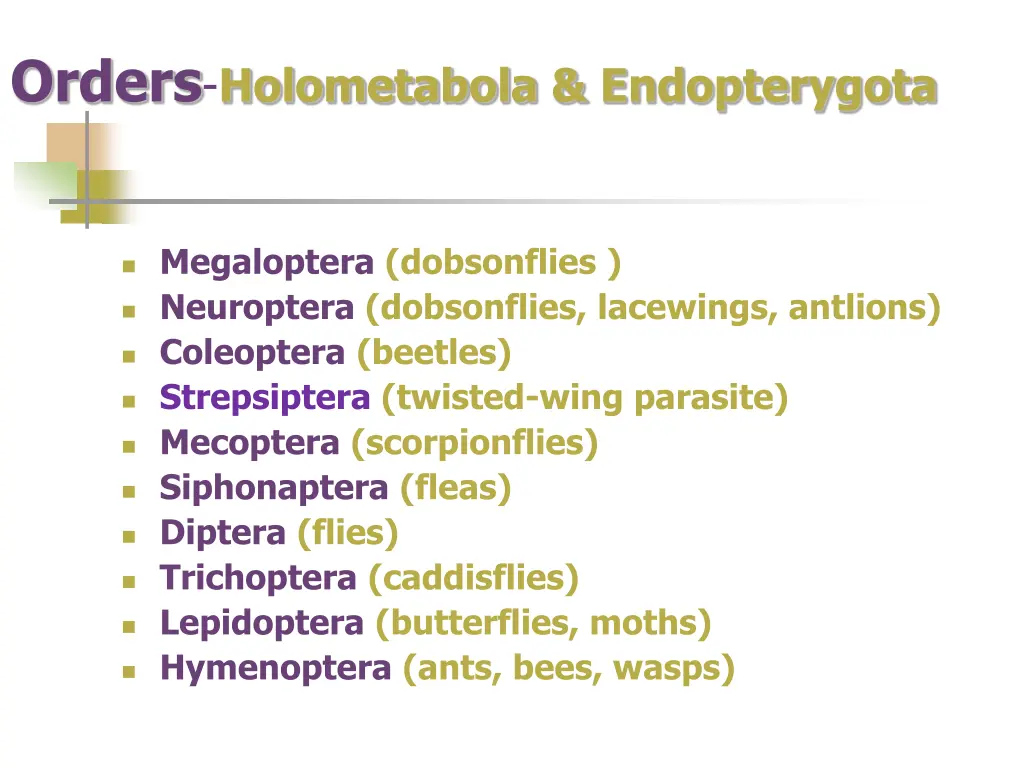
30 Common Orders of Insects A. Protura (proturans) B. Collembola (springtails) C. Diplura (diplurans) D. Thysanura (silverfish) E. Ephemeroptera (mayflies) F. Odonata (dragonflies, damselflies) G. Blattodea (cockroaches) H. Mantodea (mantids) I. Isoptera (termites) J. Grylloblattodea (Ice Insect) K Dermaptera (earwigs) L. Plecoptera (stoneflies) M. Orthoptera(crickets,grasshoppers,katydids)BB.Trichoptera (caddisflies) N. Phasmatodea (walking sticks) O. Psocoptera (booklice and barklice) P. Mallophaga (chewing lice) Q. Anoplura (sucking lice) R. Thysanoptera (thrips) S. Hemiptera (true bugs) T. Homoptera(aphids,cicadas,hoppers U. Megaloptera (dobsonflies) V. Neuroptera (lacewings, antlions) W. Coleoptera (beetles) X. Strepsiptera (Twisted-Wing Parasite) Y. Mecoptera (scorpionflies) Z. Siphonaptera (fleas) AA. Diptera (flies) CC. Lepidoptera (butterflies, moths) DD. Hymenoptera (ants, bees, wasps)
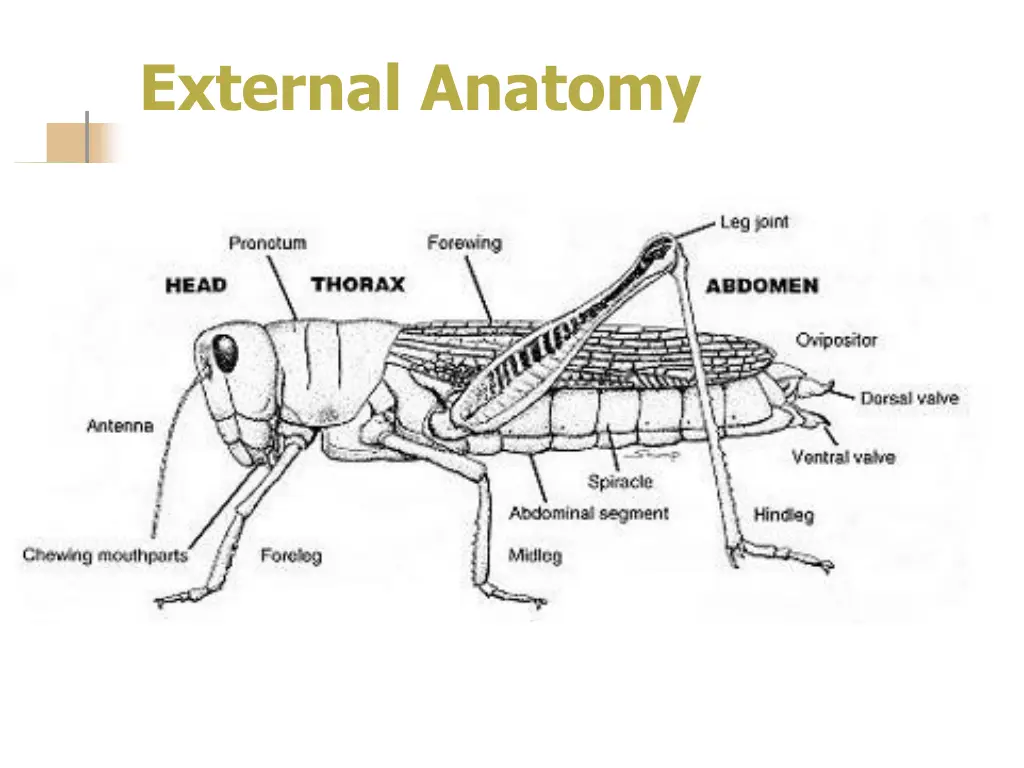
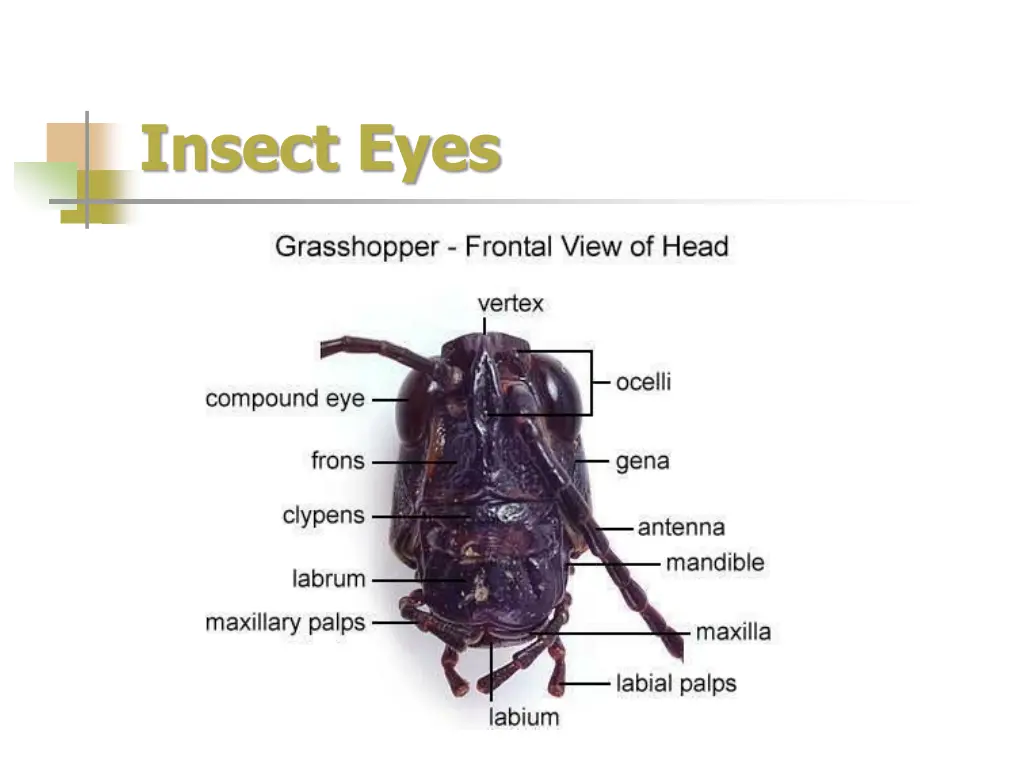
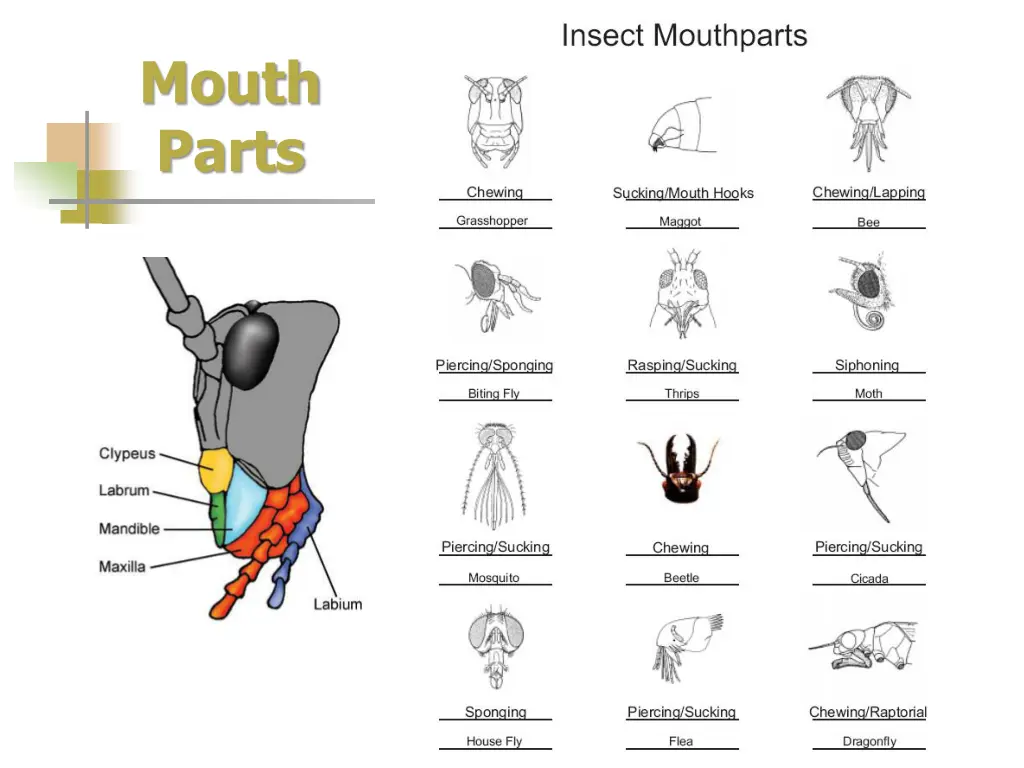
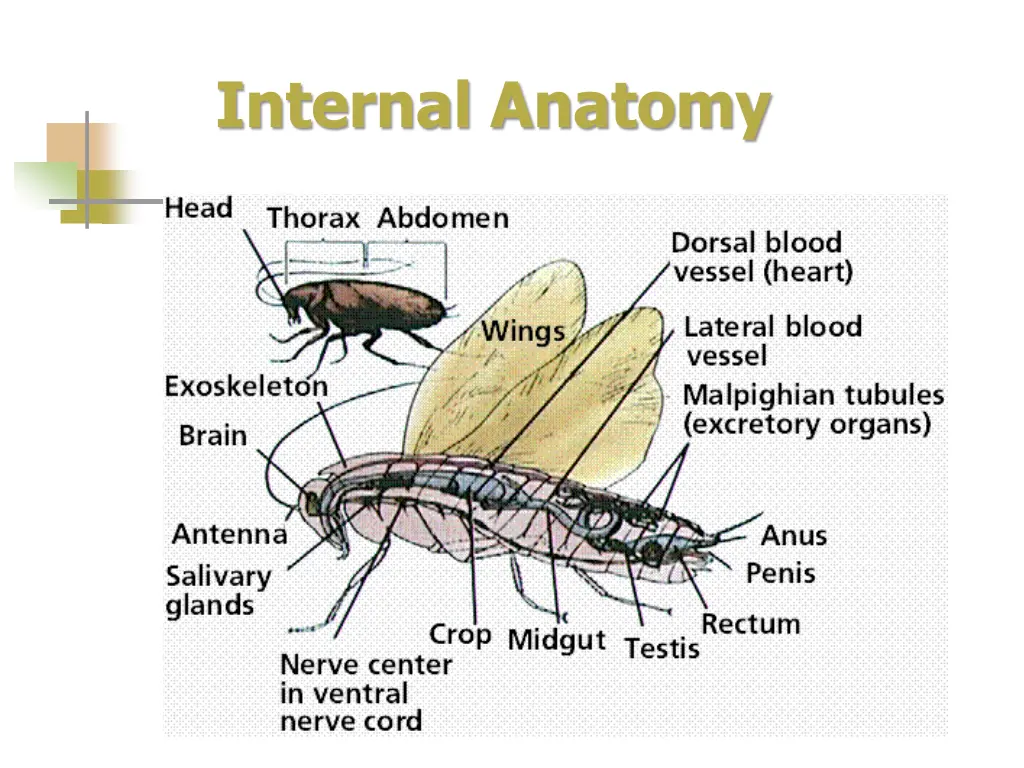
Insect Morphology Segmented body divided into three sections: head, thorax, abdomen Mouth including mandibles Three pairs of legs attached to the thorax One pair of antennae. External skeleton (exoskeleton) Usually, one or two pairs of wings attached to the thorax
Insect Wings Apterygota adults like immature without wings Pterygota adults have wings Exopterygota -the wings develop externally on the nymph body Endopterygote wings develop inside of body in immature insects and not visible until adult immerges from pupa
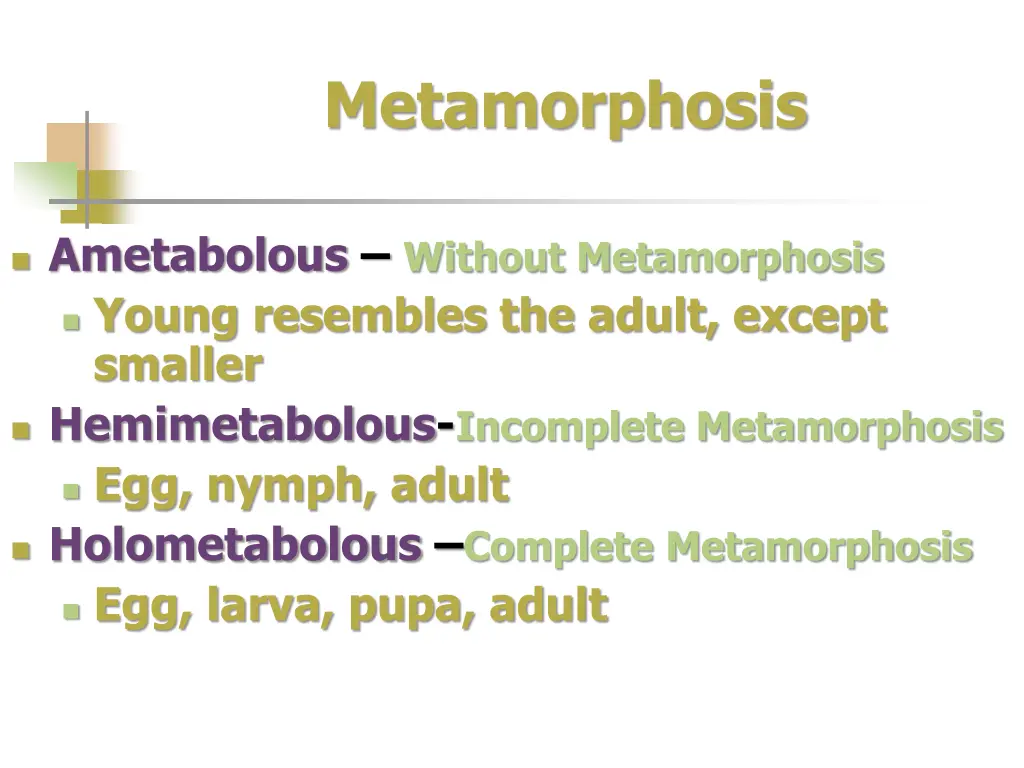
Metamorphosis Ametabolous Without Metamorphosis Young resembles the adult, except smaller Hemimetabolous-Incomplete Metamorphosis Egg, nymph, adult Holometabolous Complete Metamorphosis Egg, larva, pupa, adult
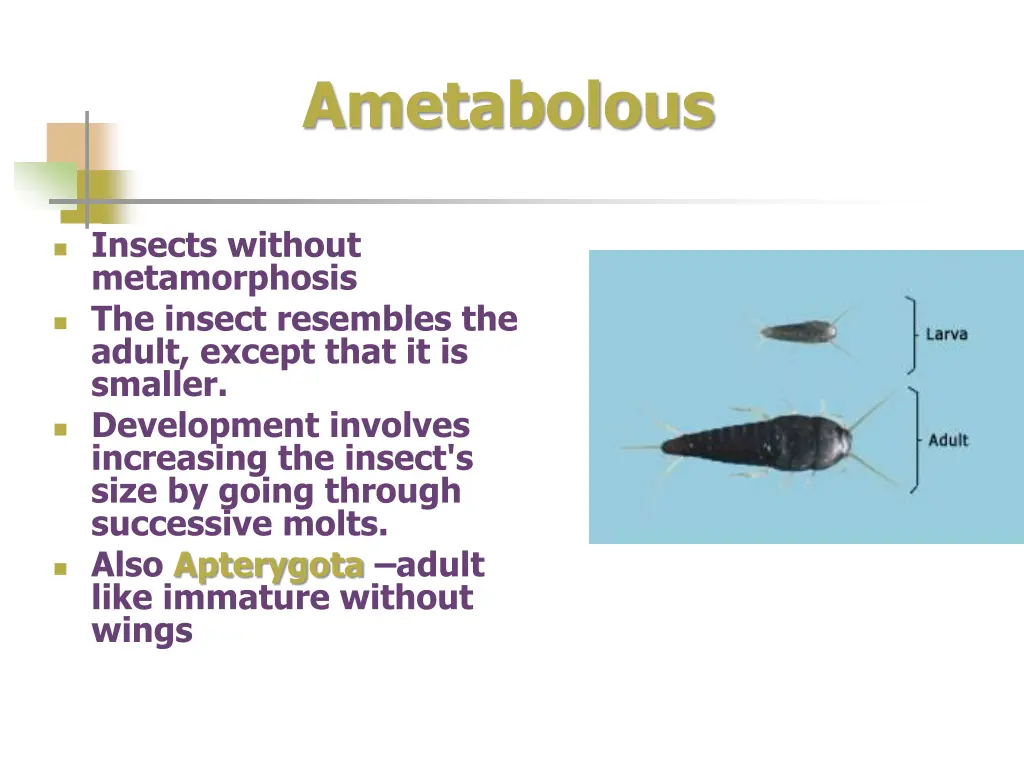
Ametabolous Insects without metamorphosis The insect resembles the adult, except that it is smaller. Development involves increasing the insect's size by going through successive molts. Also Apterygota adult like immature without wings
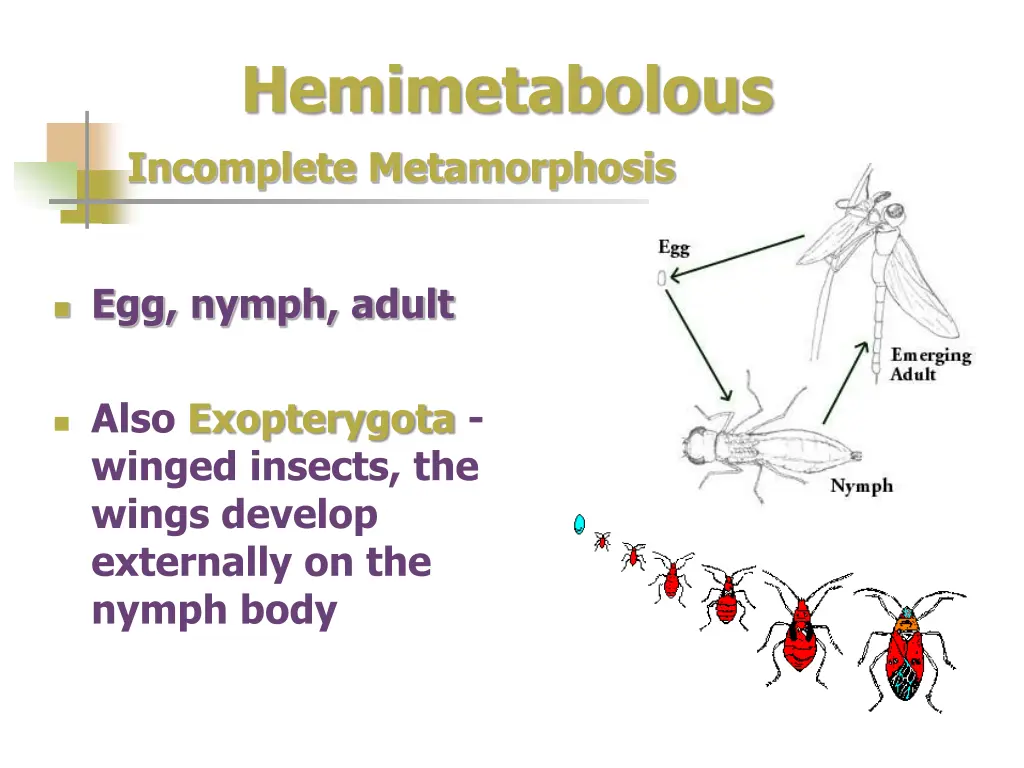
Hemimetabolous Incomplete Metamorphosis Egg, nymph, adult Also Exopterygota - winged insects, the wings develop externally on the nymph body
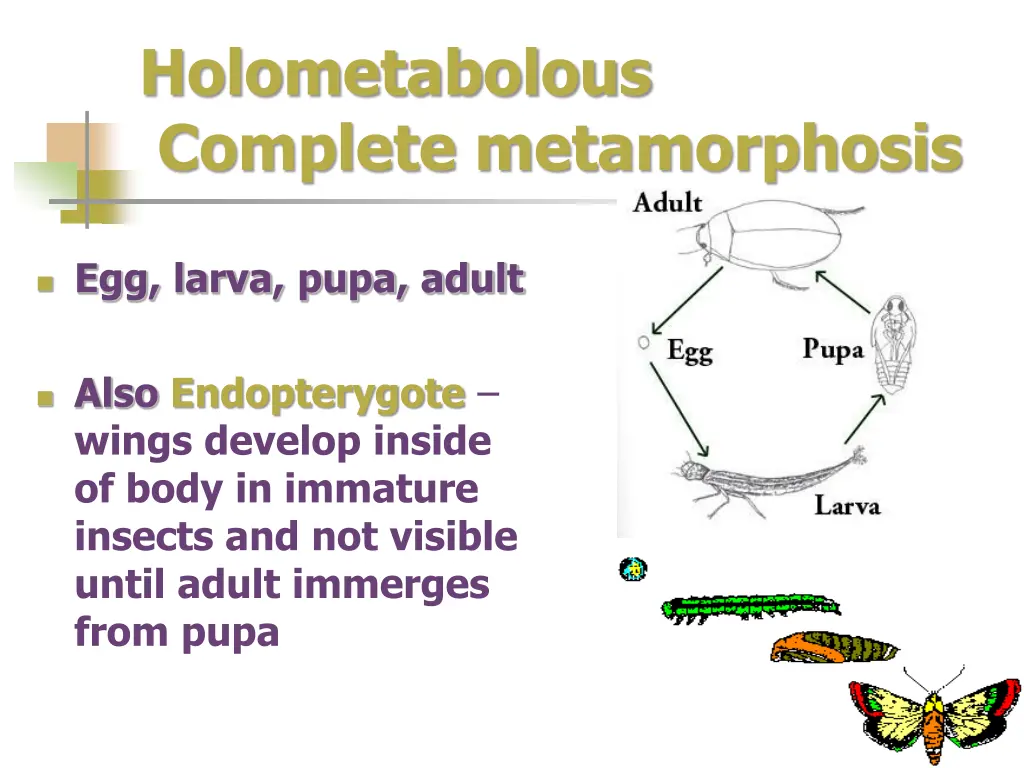
Holometabolous Complete metamorphosis Egg, larva, pupa, adult Also Endopterygote wings develop inside of body in immature insects and not visible until adult immerges from pupa
Beneficial Insects Pollination of many flowering plants Decomposition of organic materials Recycling of carbon, nitrogen, and other essential nutrients Control of populations of harmful invertebrates including other insects Direct production of foods as honey Manufacture of products as silk
Insect Pests 10,000 species Damage Crops Household Pests Parasites Biting and Stinging Insects Prey on domestic animals Eat human food, clothing & possessions Destroy trees, wood, paper
Disease Vectors Mosquitoes malaria, arboviral encephalitides, dengue fever, Rift Valley fever, West Nile encephalitis viral infection Fleas - plague Lice lice infestation
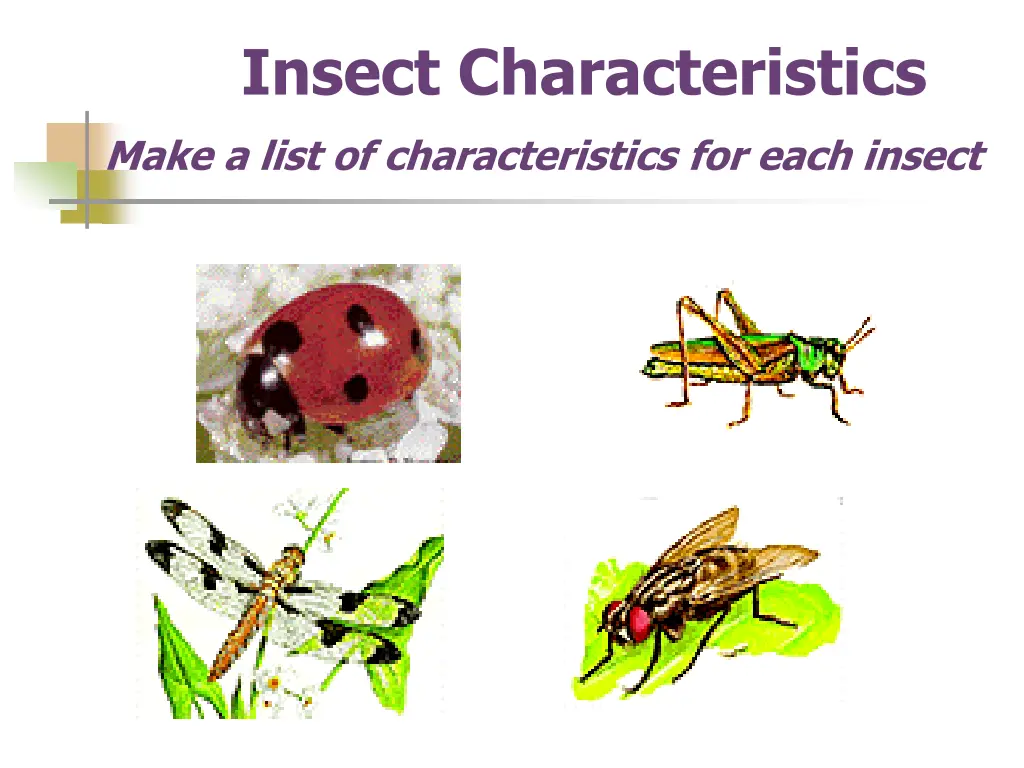
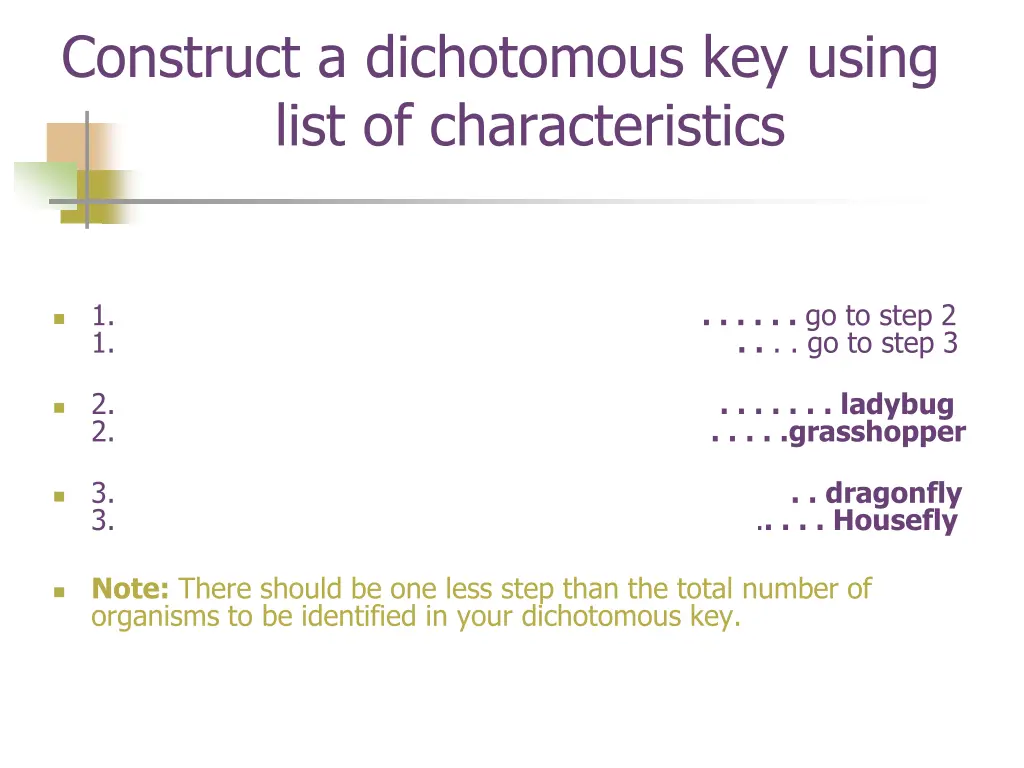
Construct a dichotomous key using list of characteristics 1. . . . . . . go to step 2 1. . . . . go to step 3 2. . . . . . . . ladybug 2. . . . . .grasshopper 3. . . dragonfly 3. .. . . . Housefly Note: There should be one less step than the total number of organisms to be identified in your dichotomous key.
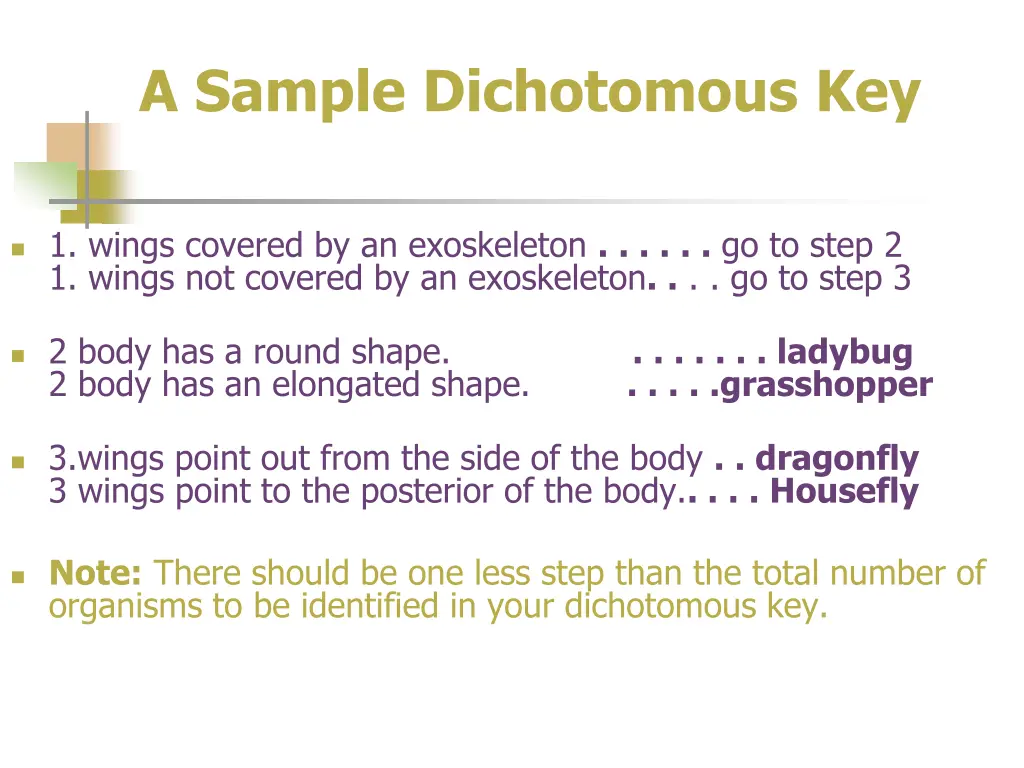
A Sample Dichotomous Key 1. wings covered by an exoskeleton . . . . . . go to step 2 1. wings not covered by an exoskeleton. . . . go to step 3 2 body has a round shape. . . . . . . . ladybug 2 body has an elongated shape. . . . . .grasshopper 3.wings point out from the side of the body . . dragonfly 3 wings point to the posterior of the body.. . . . Housefly Note: There should be one less step than the total number of organisms to be identified in your dichotomous key.
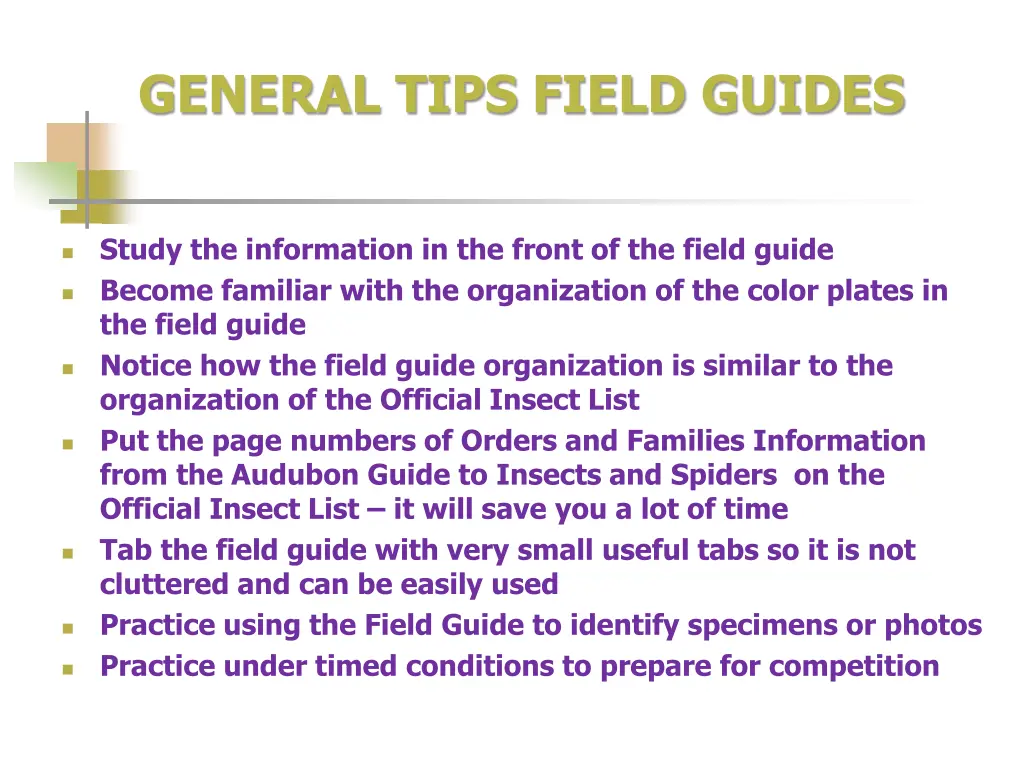
GENERAL TIPS FIELD GUIDES Study the information in the front of the field guide Become familiar with the organization of the color plates in the field guide Notice how the field guide organization is similar to the organization of the Official Insect List Put the page numbers of Orders and Families Information from the Audubon Guide to Insects and Spiders on the Official Insect List it will save you a lot of time Tab the field guide with very small useful tabs so it is not cluttered and can be easily used Practice using the Field Guide to identify specimens or photos Practice under timed conditions to prepare for competition
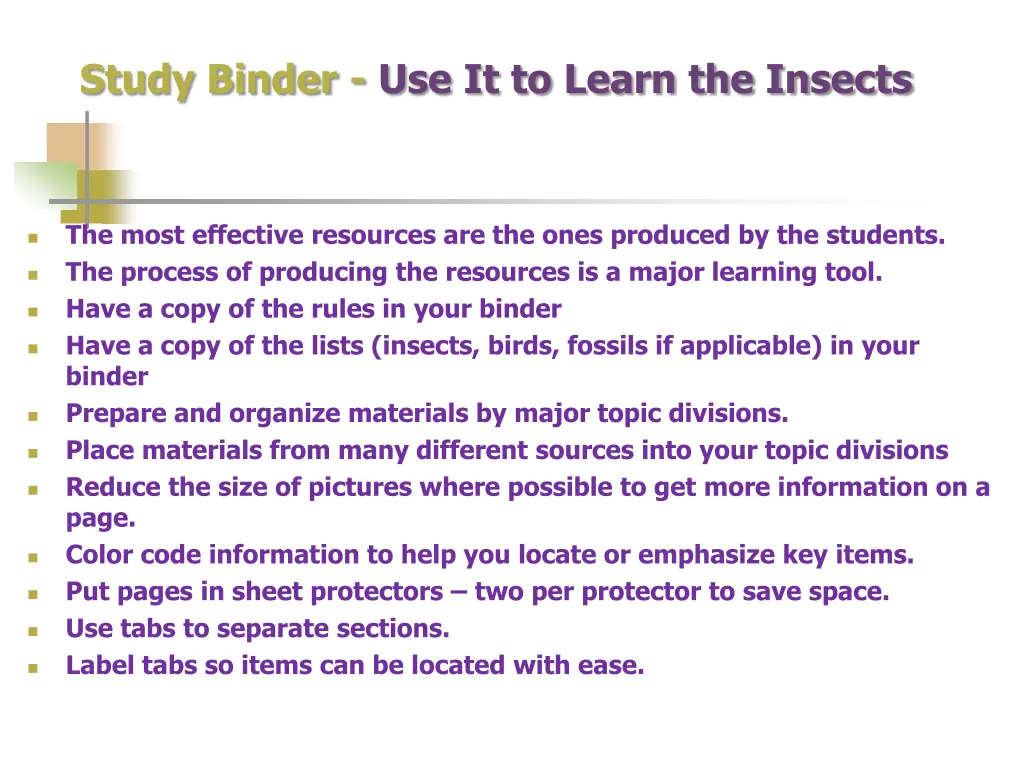
Study Binder - Use It to Learn the Insects The most effective resources are the ones produced by the students. The process of producing the resources is a major learning tool. Have a copy of the rules in your binder Have a copy of the lists (insects, birds, fossils if applicable) in your binder Prepare and organize materials by major topic divisions. Place materials from many different sources into your topic divisions Reduce the size of pictures where possible to get more information on a page. Color code information to help you locate or emphasize key items. Put pages in sheet protectors two per protector to save space. Use tabs to separate sections. Label tabs so items can be located with ease.
Power Point Slides Make power point slides for each species Make them so information can they can be used for practice Prepare them so they can be reorganized to make practice competitions for study
Flash Cards Make flash cards with pictures on one side and information on the back Use the flash cards to make up sample competitions Use the flash cards to learn the insects
Actual Specimens Collect and preserve insects Note that preserved specimens may not look exactly like live specimens texture and color changes may occur Use specimens to learn the insects Timer prepare practice stations and use the timer to improve efficiency of your teamwork skills
Doing the Competition Place information in appropriate place on answer sheet Print legibly so information is understandable Work as a team use time effectively Use Notes and Field Guide effectively Identify to Order and then to Family if needed Be sure to spell names correctly Carefully read all questions and use common sense in answering Relax, Do your best, and Have Fun!!