2022 Employment Law Update: Minimum Wage, Exempt Employees, Wage and Safety Enforcement
Stay informed with the latest updates in employment law for 2022 by Robert A. Hufnagel Resnick & Louis, P.C. Learn about the increased minimum wage, salary requirements for exempt employees, wage enforcement laws under AB1003 and SB572, as well as safety enforcement regulations like SB606. Understand what constitutes an egregious violation and the potential consequences.

Download Presentation

Please find below an Image/Link to download the presentation.
The content on the website is provided AS IS for your information and personal use only. It may not be sold, licensed, or shared on other websites without obtaining consent from the author. If you encounter any issues during the download, it is possible that the publisher has removed the file from their server.
You are allowed to download the files provided on this website for personal or commercial use, subject to the condition that they are used lawfully. All files are the property of their respective owners.
The content on the website is provided AS IS for your information and personal use only. It may not be sold, licensed, or shared on other websites without obtaining consent from the author.
E N D
Presentation Transcript
Employment Law Update for 2022 by Robert A. Hufnagel Resnick & Louis, P.C. 3350 Shelby Street, Suite 200 Ontario, California 91764 (909) 906-1277 rhufnagel@rlattorneys.com rlattorneys.com
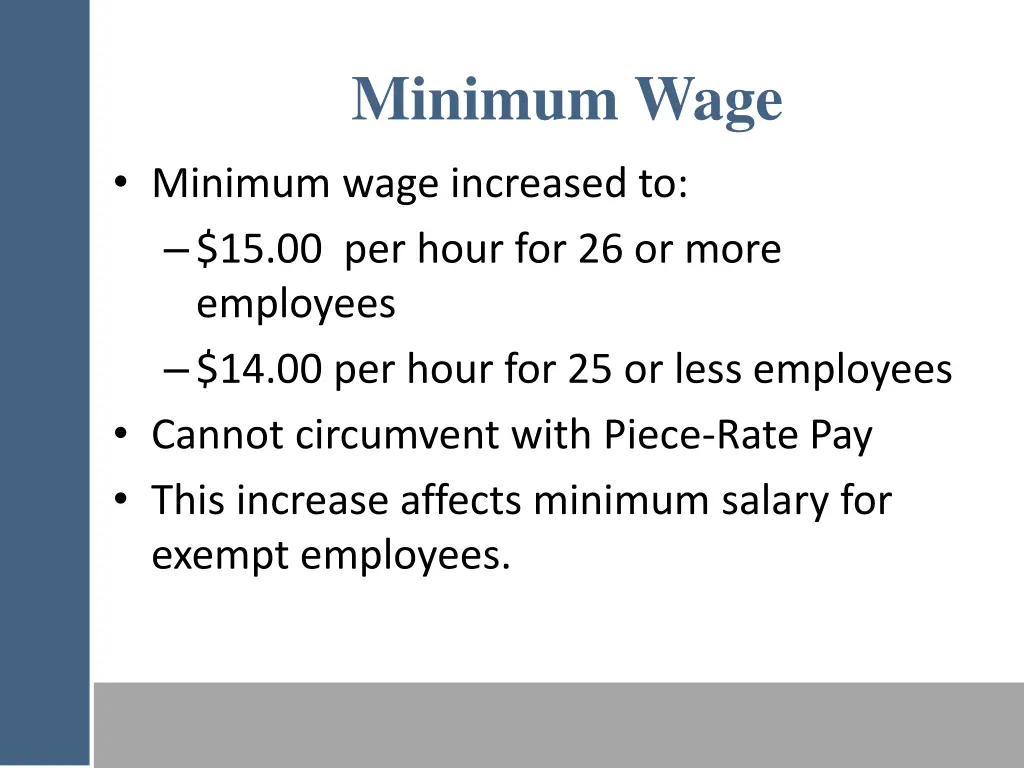
Minimum Wage Minimum wage increased to: $15.00 per hour for 26 or more employees $14.00 per hour for 25 or less employees Cannot circumvent with Piece-Rate Pay This increase affects minimum salary for exempt employees.
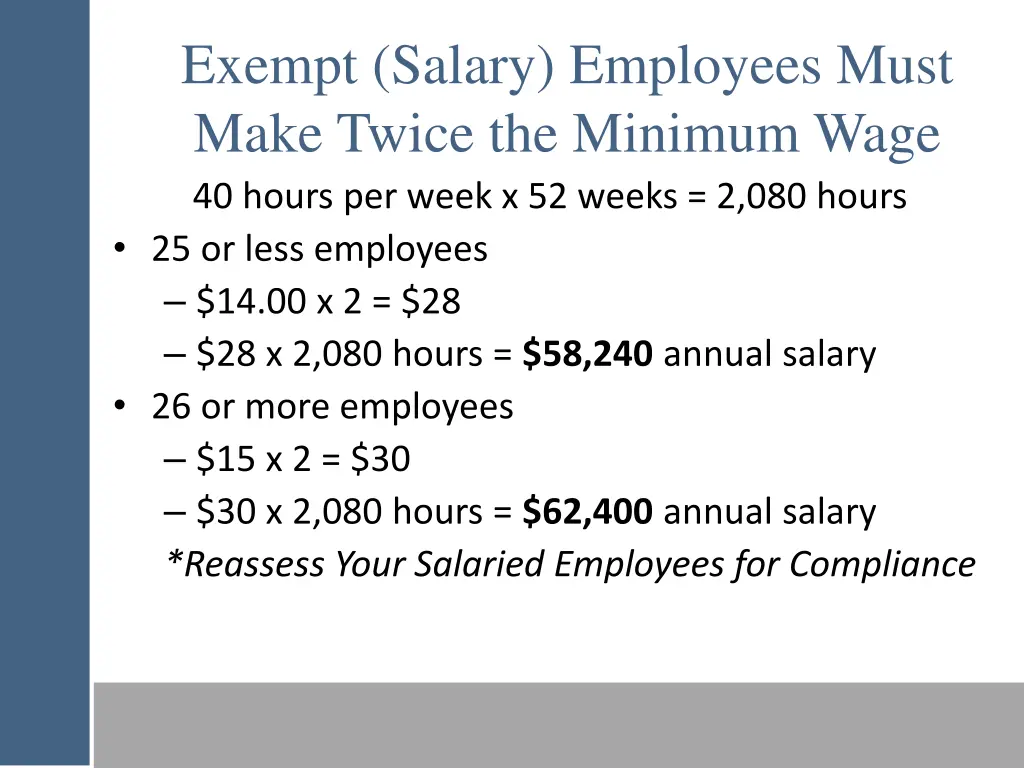
Exempt (Salary) Employees Must Make Twice the Minimum Wage 40 hours per week x 52 weeks = 2,080 hours 25 or less employees $14.00 x 2 = $28 $28 x 2,080 hours = $58,240 annual salary 26 or more employees $15 x 2 = $30 $30 x 2,080 hours = $62,400 annual salary *Reassess Your Salaried Employees for Compliance
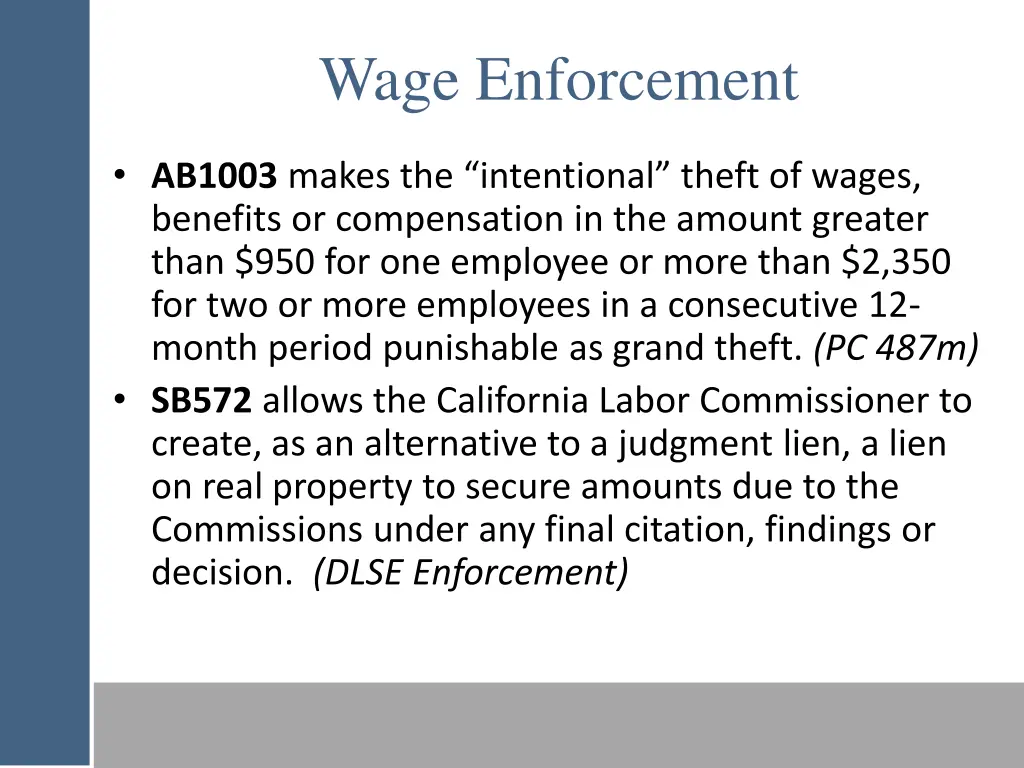
Wage Enforcement AB1003 makes the intentional theft of wages, benefits or compensation in the amount greater than $950 for one employee or more than $2,350 for two or more employees in a consecutive 12- month period punishable as grand theft. (PC 487m) SB572 allows the California Labor Commissioner to create, as an alternative to a judgment lien, a lien on real property to secure amounts due to the Commissions under any final citation, findings or decision. (DLSE Enforcement)
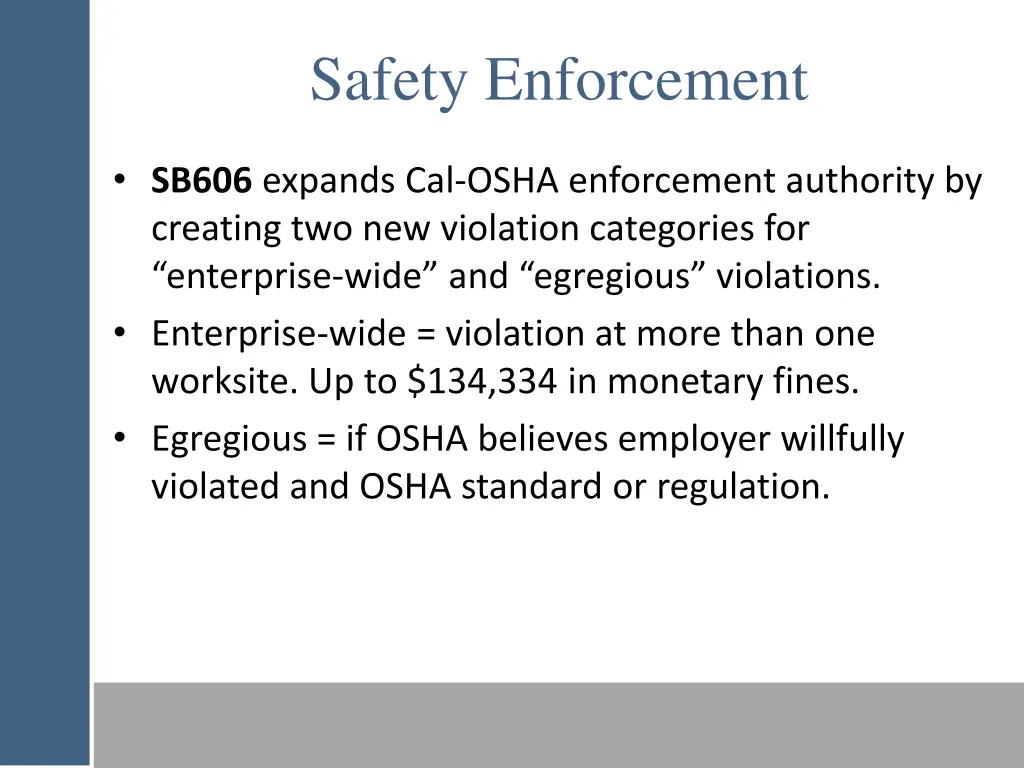
Safety Enforcement SB606 expands Cal-OSHA enforcement authority by creating two new violation categories for enterprise-wide and egregious violations. Enterprise-wide = violation at more than one worksite. Up to $134,334 in monetary fines. Egregious = if OSHA believes employer willfully violated and OSHA standard or regulation.
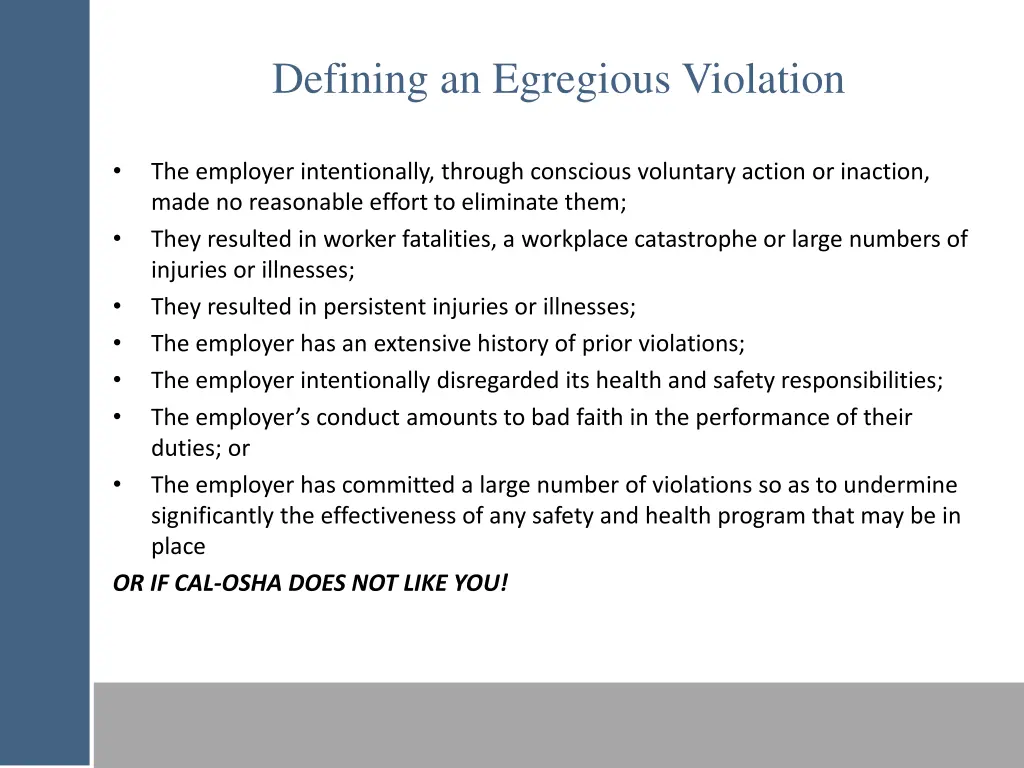
Defining an Egregious Violation The employer intentionally, through conscious voluntary action or inaction, made no reasonable effort to eliminate them; They resulted in worker fatalities, a workplace catastrophe or large numbers of injuries or illnesses; They resulted in persistent injuries or illnesses; The employer has an extensive history of prior violations; The employer intentionally disregarded its health and safety responsibilities; The employer s conduct amounts to bad faith in the performance of their duties; or The employer has committed a large number of violations so as to undermine significantly the effectiveness of any safety and health program that may be in place OR IF CAL-OSHA DOES NOT LIKE YOU!
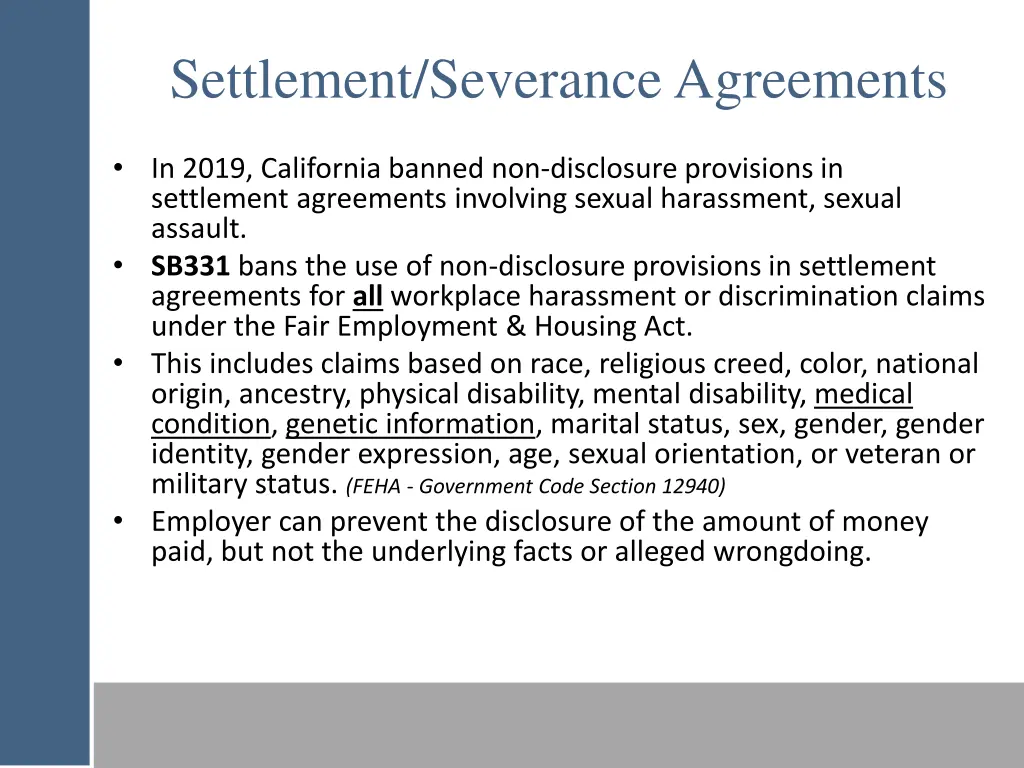
Settlement/Severance Agreements In 2019, California banned non-disclosure provisions in settlement agreements involving sexual harassment, sexual assault. SB331 bans the use of non-disclosure provisions in settlement agreements for all workplace harassment or discrimination claims under the Fair Employment & Housing Act. This includes claims based on race, religious creed, color, national origin, ancestry, physical disability, mental disability, medical condition, genetic information, marital status, sex, gender, gender identity, gender expression, age, sexual orientation, or veteran or military status. (FEHA - Government Code Section 12940) Employer can prevent the disclosure of the amount of money paid, but not the underlying facts or alleged wrongdoing.
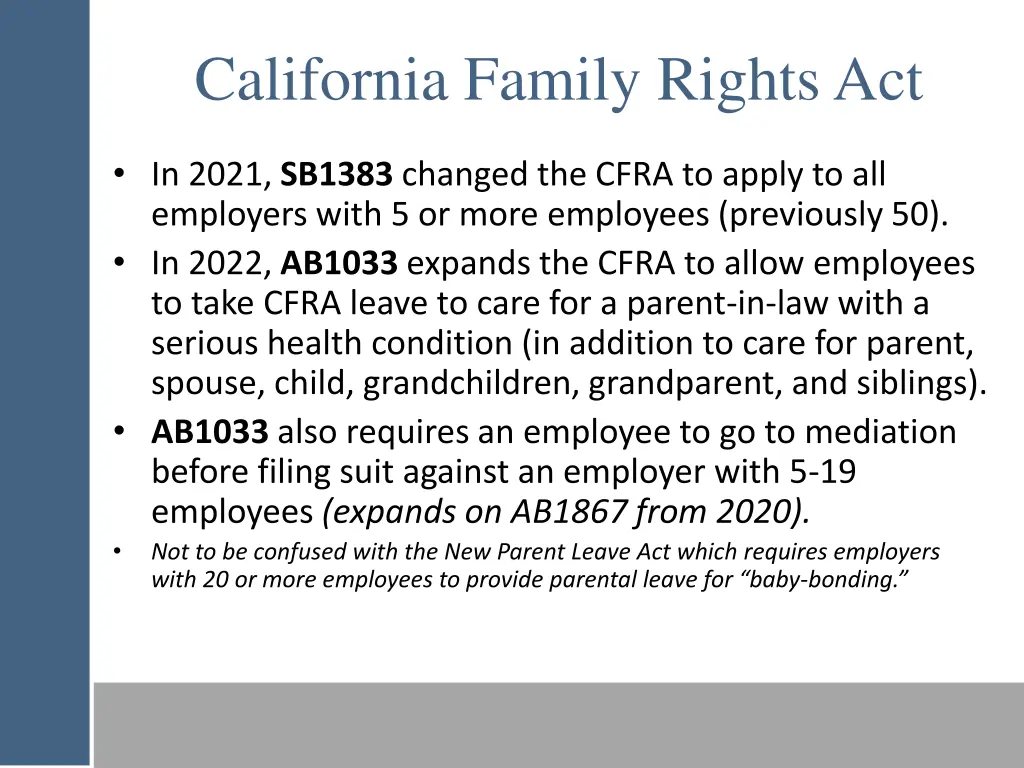
California Family Rights Act In 2021, SB1383 changed the CFRA to apply to all employers with 5 or more employees (previously 50). In 2022, AB1033 expands the CFRA to allow employees to take CFRA leave to care for a parent-in-law with a serious health condition (in addition to care for parent, spouse, child, grandchildren, grandparent, and siblings). AB1033 also requires an employee to go to mediation before filing suit against an employer with 5-19 employees (expands on AB1867 from 2020). Not to be confused with the New Parent Leave Act which requires employers with 20 or more employees to provide parental leave for baby-bonding.
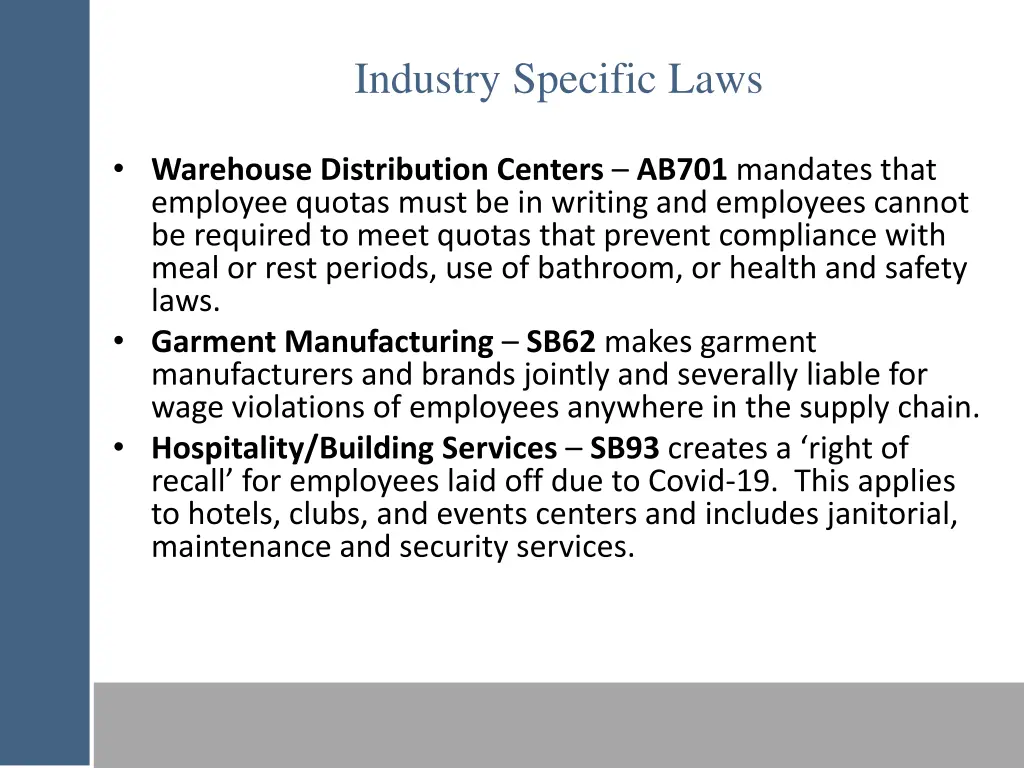
Industry Specific Laws Warehouse Distribution Centers AB701 mandates that employee quotas must be in writing and employees cannot be required to meet quotas that prevent compliance with meal or rest periods, use of bathroom, or health and safety laws. Garment Manufacturing SB62 makes garment manufacturers and brands jointly and severally liable for wage violations of employees anywhere in the supply chain. Hospitality/Building Services SB93 creates a right of recall for employees laid off due to Covid-19. This applies to hotels, clubs, and events centers and includes janitorial, maintenance and security services.
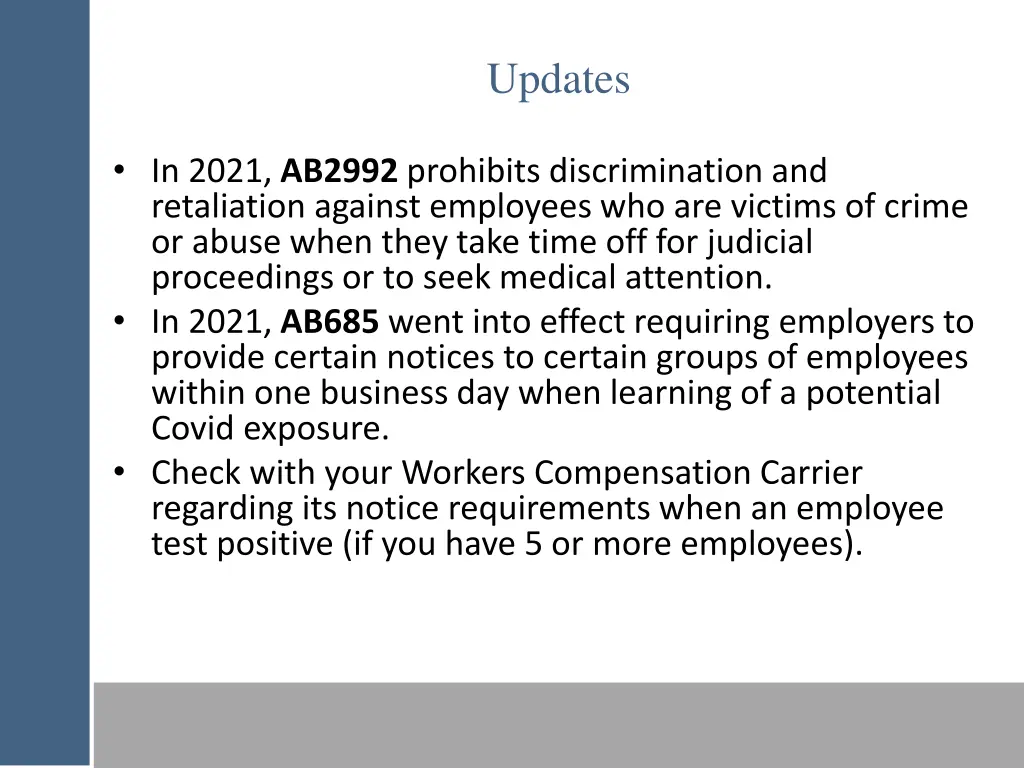
Updates In 2021, AB2992 prohibits discrimination and retaliation against employees who are victims of crime or abuse when they take time off for judicial proceedings or to seek medical attention. In 2021, AB685 went into effect requiring employers to provide certain notices to certain groups of employees within one business day when learning of a potential Covid exposure. Check with your Workers Compensation Carrier regarding its notice requirements when an employee test positive (if you have 5 or more employees).
Minimizing Liability Have an Employee Handbook Conduct annual employee training Update your Labor Law Posters Maintain accurate records of attendance, performance, discipline and pay Review wage statements for accuracy Do not do business as a sole proprietor Keep business and personal matters separate Know your enemy: DFEH, DOL, EEOC, and OSHA
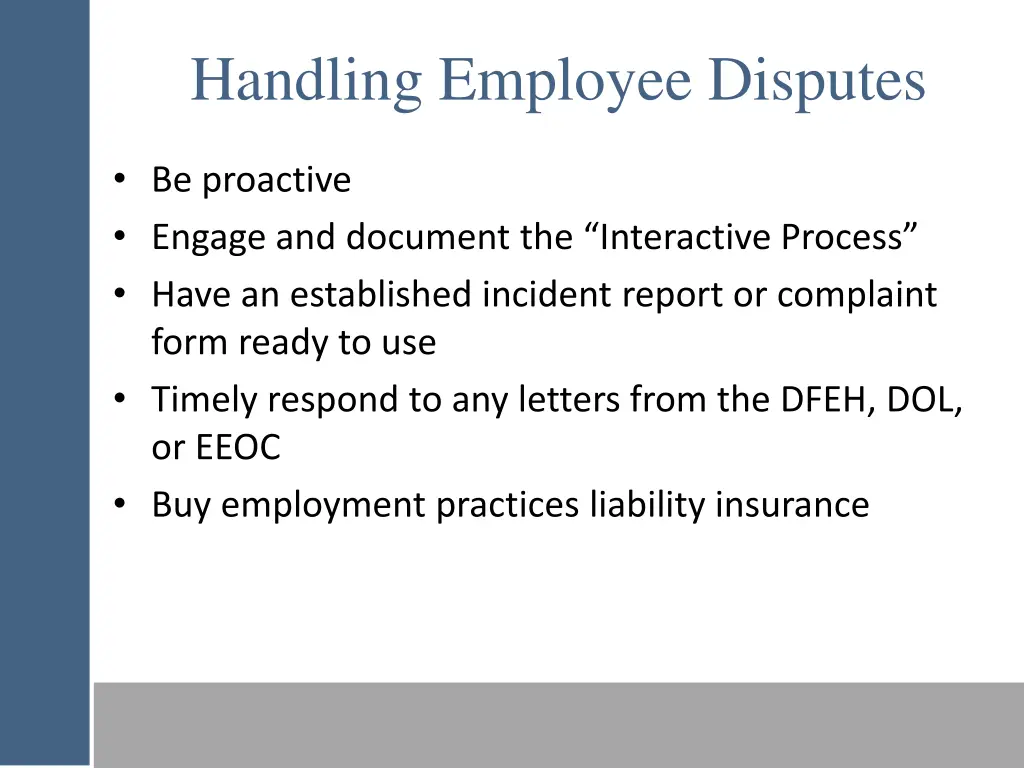
Handling Employee Disputes Be proactive Engage and document the Interactive Process Have an established incident report or complaint form ready to use Timely respond to any letters from the DFEH, DOL, or EEOC Buy employment practices liability insurance
Questions? E-mail Robert A. Hufnagel, Esq. at rhufnagel@rlattorneys.com