2023 Mathematics, Science, and Computer Science Professional Learning Grant Request for Applications
The California Department of Education hosted a webinar on March 23, 2023, to discuss the Professional Learning Grant Request for Applications (RFA) in Mathematics, Science, and Computer Science. Participants learned about the grant's purpose, which is to support professional development in these subjects from preschool through 12th grade. Key speakers included Shannon Gordon and Mindi Parsons, who emphasized the importance of family engagement and educator training, facilitated by Assembly Bill 185's funding.

Uploaded on Feb 17, 2025 | 0 Views
Download Presentation

Please find below an Image/Link to download the presentation.
The content on the website is provided AS IS for your information and personal use only. It may not be sold, licensed, or shared on other websites without obtaining consent from the author.If you encounter any issues during the download, it is possible that the publisher has removed the file from their server.
You are allowed to download the files provided on this website for personal or commercial use, subject to the condition that they are used lawfully. All files are the property of their respective owners.
The content on the website is provided AS IS for your information and personal use only. It may not be sold, licensed, or shared on other websites without obtaining consent from the author.
E N D
Presentation Transcript
2023 Mathematics, Science, and Computer Science Professional Learning Grant Request for Applications Application Webinar March 23, 2023 CALIFORNIA DEPARTMENT OF EDUCATION Tony Thurmond, State Superintendent of Public Instruction
Housekeeping Webinar participants have been placed on mute. Question/Answer session toward the end of the webinar. The PowerPoint slides will be available on the California Department of Education (CDE) 2023 Mathematics, Science and Computer Science Professional Learning Grant (MSCS PL Grant) Request For Applications (RFA) web page. 2
Introductions Shannon Gordon, Education Programs Consultant, Educator Excellence and Equity Division Mindi Parsons, Education Administrator, Educator Excellence and Equity Division Olivia DeMarais, Education Programs Consultant, Early Education Division Carolyn Pfister, Education Administrator and State Board of Education Liaison 3
Request for Applications Web Page Refer to the 2023 MSCS PL Grant RFA web page at https://www.cde.ca.gov/fg/fo/r12/mscspl23rfa.asp for the most up-to-date information and timeline. 4
Assembly Bill 185 Assembly Bill 185, Chapter 571, Statutes of 2022, Section 53 of the Education Omnibus Budget Trailer Bill for the 2022 23 California State Budget appropriated the sum of $85 million to allocate to county offices of education (COEs) to provide professional development and support family engagement in mathematics, science, and computer science for pupils in preschool, transitional kindergarten, kindergarten, and grades one to twelve, inclusive.
Assembly Bill 185 (2) Of the $85 million, $50 million will be allocated to a Lead COE who will serve as the lead of a COE-led consortium to support grades four through twelve, inclusive. The Lead COE will work with Fresno County Superintendent of Schools that has been allocated $35 million to support preschool, transitional kindergarten, kindergarten, and grades one to three, and augment the work of the existing Early Math Initiative. 6
Assembly Bill 185 (3) See Appendix A in the 2023 MSCS PL Grant RFA for the full legislative text for this grant allocation. 7
Goals of the Grant Program The Lead COE who receives the $50 million MSCS PL Grant will partner with the Fresno County Superintendent of Schools Early Math Initiative and collaborate with other state-sponsored and nonprofit mathematics, science, and computer science educator training initiatives to develop a comprehensive system of support for children birth to grade twelve. 8
Goals of the Grant Program (2) The MSCS PL Grant Project will expand existing statewide infrastructure and capacity to provide educator professional learning in mathematics, science, and computer science for grades four to twelve, inclusive. The professional learning will be designed to enable local implementation of state standards and frameworks. 9
Goals of the Grant Program (3) The grant project will support local efforts to improve family and community engagement in mathematics and science education, and positively engage families and communities in implementing the Mathematics, Science and Computer Science Standards. The Lead COE will facilitate, to the greatest extent practicable, coordination among the grantees of other mathematics, science, and computer science educator professional development initiatives. 10
Goals of the Grant Program (4) The MSCS PL Grant Project will generate and disseminate professional learning opportunities for grades four to twelve, inclusive, educators designed to enable local implementation efforts of the Mathematics, Science and Computer Science Standards. The professional learning opportunities must conform to the best evidence regarding effective learning for educators. This includes, but is not limited to, the Quality Professional Learning Standards. 11
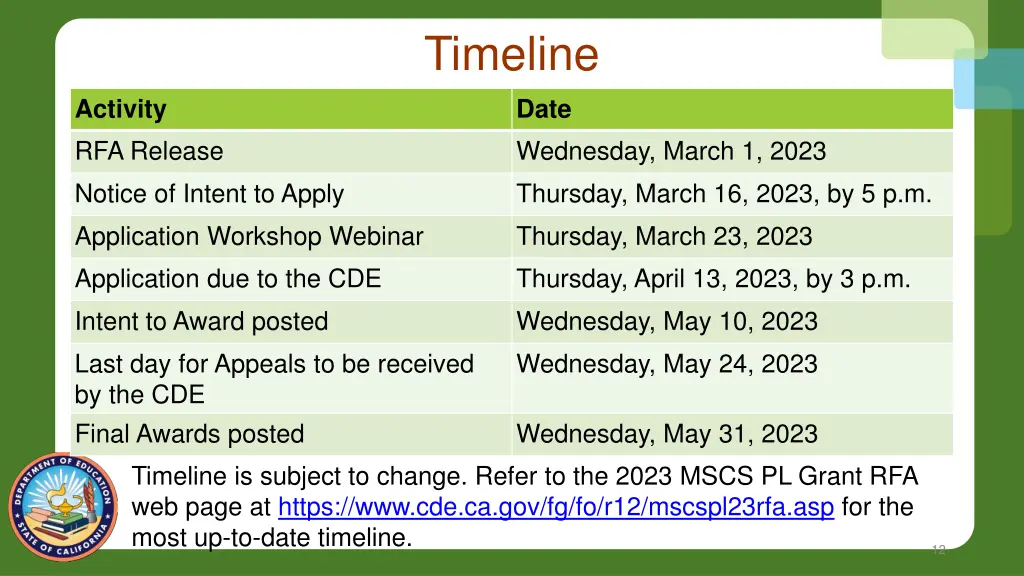
Timeline Activity RFA Release Notice of Intent to Apply Application Workshop Webinar Application due to the CDE Intent to Award posted Last day for Appeals to be received by the CDE Final Awards posted Timeline is subject to change. Refer to the 2023 MSCS PL Grant RFA web page at https://www.cde.ca.gov/fg/fo/r12/mscspl23rfa.asp for the most up-to-date timeline. Date Wednesday, March 1, 2023 Thursday, March 16, 2023, by 5 p.m. Thursday, March 23, 2023 Thursday, April 13, 2023, by 3 p.m. Wednesday, May 10, 2023 Wednesday, May 24, 2023 Wednesday, May 31, 2023 12
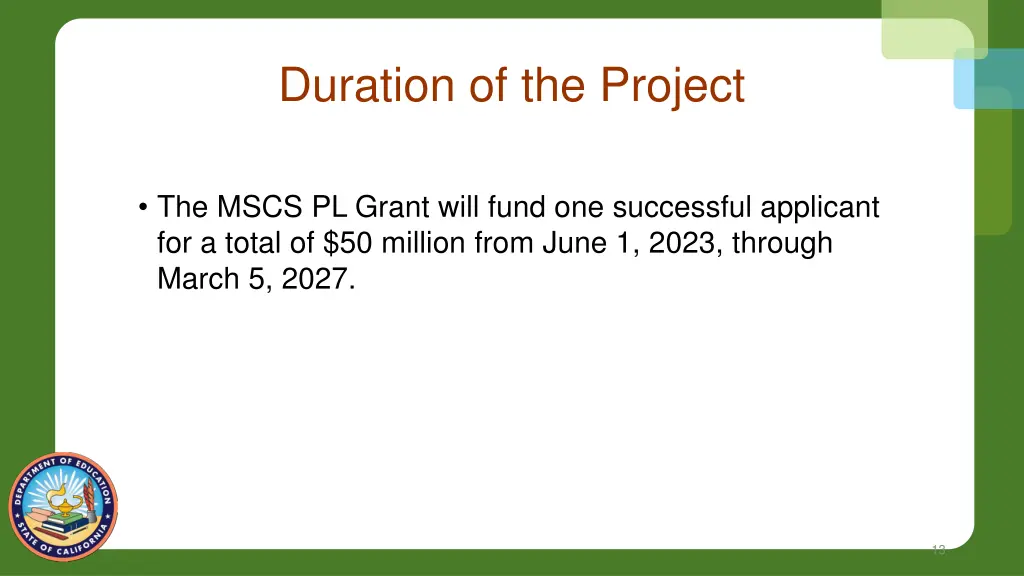
Duration of the Project The MSCS PL Grant will fund one successful applicant for a total of $50 million from June 1, 2023, through March 5, 2027. 13
Eligibility Any COE is eligible to apply for the grant as the Lead COE. To form a consortium, the Lead COE must partner with one or more nonprofit entities or institutions of higher education (IHEs), or both, and may include other COEs. Applications that do not contain a Letter of Commitment from a nonprofit entity or IHE named as a partner in the consortium will be considered incomplete and will not be considered for the grant award. 14
Collaboration and Coordination The Lead COE will work with Fresno County Superintendent of Schools and augment the work of the existing Early Math Initiative. 15
Early Math Initiative and Expansion Information about the Early Math Initiative is also provided in the RFA document beginning on page 7. The Early Math Initiative began with a grant award in 2018 and then an allocation of $45 million from the 2021 Budget Act to Fresno County Superintendent of Schools which is currently funding the Early Math Initiative through June 30, 2024. The allocation of $35 million will be used for expansion of the work. 16
Current Early Math Initiative Efforts (1) Early Math Events o Provide professional development and collaboration-based opportunities for early childhood educators, care providers, and families to improve children's early math education and development, including the annual Early Math Symposium and ongoing forums. Professional Learning and Coaching o Planning and implementation of professional learning and coaching in local communities o Demonstration lessons o Development of online suites for facilitators and educators o Ongoing Community of Practice sessions
Current Early Math Initiative Efforts (2) Demonstration Site and Innovation Lab o Developing and piloting of materials and resources, including interactive exhibits, math packs, and family math nights The materials created by California Early Math Initiative meet 508 accessibility standards and are translated to Spanish. The content focuses on inclusive practices that focus on the diverse needs of all students between the ages birth to eight.
Current Early Math Initiative Efforts (3) Development of the Count Play Explore (CPE) Web-Based Application oOver 30 short videos focus on ways to include math in everyday activities. Resources for Families and Educators oDiscovering the Math: Book Guides oEarly Math Activities oCPE issues oResearch briefs 19
Current Early Math Initiative Efforts (4) Family Engagement Social Media Campaign oReaching families across the state and bringing them to the CPE Web-Based Applications Independent Evaluation 20
Expansion (1) On the following slides titled Expansion , the content developed during the expansion will build off the lessons learned from current work with the Early Math Initiative. Many items that have been created or are being developed will also include early science and computer science content. Please note, computer science is embedded in early science throughout the expansion activities.
Expansion (2) Professional Learning Opportunities and Coaching o Engage additional agencies across California Expand development on online suites for facilitators and educators o Strengths and needs assessment of early science efforts in California o Develop literature reviews on effective pedagogical practices that support early science and computer science development from birth to third grade
Expansion (3) Family and Community Engagement o Create videos that showcase families using early math and science resources and activities to promote ways to include early science at home o Connect early science and math to the library setting o Disseminate implementation guides on how to recreate interactive early math and science exhibits in other community spaces
Expansion (4) Educator Resources and Engagement o Development of Discovering the Math and Science Book Guides and related activities o Research briefs that include relevant findings and how they connect to science standards
Expansion (5) Publish children s literature that showcases early science and math in everyday activities o Research fellows conducting studies associated with Early Math Initiative activities o Doctoral students who can advance rigor and innovation in early math and science Independent Evaluation
Requirements of the 2023 Mathematics, Science, and Computer Science Professional Learning Grant Application 26
Application Procedures Applicants must submit an application electronically through an online application system; a link to this is available on the 2023 MSCS PL Grant RFA web page at https://www.cde.ca.gov/fg/fo/r12/mscspl23rfa.asp. The online application system will require the applicant to enter responses to prompts requesting information including: oContact information for the Lead COE and a Project Director oA list of the partners that make up the consortium oAnswers to application questions Refer to the scoring rubric (Appendix B) to understand how responses will be evaluated by the reading panel. 27
Application Procedures (2) A single zip file is to be uploaded into the online application system that includes a Project Plan, Five-year Budget (spreadsheet), and Letter of Commitment. Only one file may be uploaded per applicant; size limit is 20MB. Additional Letters of Commitment or Letters of Support can be included in the zip file. 28
Saving Responses Select the Save Responses button on the first page of the online application if you do not intend to complete the application in one session. Ensure the email address you provide is accurate. Check your email system s junk folder in case the email is automatically sent there. Use the link in the email (your unique web address) for entrance back into the application. 29
Completing the Application Budget A Proposed Budget should cover the entire duration of the grant. A template is available for download on the 2023 MSCS PL Grant RFA web page; some cells are locked and contain formulas. The spreadsheet includes an instruction tab and seven tabs for completion. The application budget will be reviewed and scored. Submit as an Excel file in the application s zip file. 30
Application Budget Detail Proposed Budget Detail must include a detailed budget description for each line item within the grant period. oProvide sufficient detail and a breakdown/calculation that justifies each line item. oGroup line items by the Object Code services. oProvide lines for Object Code totals. Proposed Budget Summary must provide totals for each Object Code and must align with the Proposed Budget Details. Applicant must use the administrative indirect costs to the Lead COEs CDE-approved indirect cost rate for fiscal year 2022 23. 31
Review Process Only completed applications will be considered eligible for consideration and advanced for scoring. A panel of reviewers selected for their expertise will read, review, and score each eligible application using a scoring rubric (see Appendix B in the MSCS PL Grant RFA). Application reviewers will be instructed to take a holistic approach in the review of the application. 32
Rubric The Rubric is divided into six sections (A F). Reviewers will consider the Proposed Project Plan when evaluating the applicant s responses to the application questions.
Evaluating How the Project Will Expand Existing Statewide Infrastructure and Capacity 1. Provide educator professional learning and coaching in mathematics, science, and computer science for grades four to twelve, inclusive. 2. Work in collaboration with existing infrastructure or efforts to build a coherent and comprehensive system of statewide supports for all children from birth to grade twelve, inclusive. 3. Coordinate with other mathematics and science educator professional learning initiatives, including, but not limited to, all of the following: California Subject Matter Project, Early Math Initiative, 21st Century California School Leadership Academy, and the Learning Acceleration System Grant recipients.
Evaluating the Professional Learning Plan 1. How the project will generate (create) professional learning opportunities for grades four to twelve, inclusive, educators designed to enable local implementation efforts of Mathematics, Science and Computer Science Standards 2. How the project will disseminate (implement) professional learning opportunities for grades four to twelve, inclusive, educators designed to enable local implementation efforts of the Mathematics, Science and Computer Science Standards
Evaluating Efforts to Improve Family and Community Engagement How the project will support local efforts to improve family and community engagement in mathematics and science education, and positively engage families and communities in implementing Mathematics, Science and Computer Science Standards for pupils in grades four to twelve, inclusive
Evaluating Project Staff Experience 1. Lead COE s experience collaborating with partners to provide professional learning and implement a multi- subject and multi-year grant project statewide 2. Project staff s experience and ability to build leadership capacity and actively involve and support teachers and administrators in local planning 3. Project staff s experience implementing and evaluating outcomes and align the response with the Project Plan
Evaluating Outcomes 1. How the project will implement key outcomes that will be evaluated and align the response with the Project Plan 2. How the project will evaluate outcomes and make improvements as needed and align the response with the Project Plan
Questions? Place all questions in the chat. 39
After Todays Webinar If you have questions about this grant and/or the Fresno County Superintendent of Schools; allocation of $35 million to support preschool, transitional kindergarten, kindergarten, and grades one to three; and augment the work of the existing Early Math Initiative, please submit questions to PLSMO@cde.ca.gov. We anticipate posting a document containing questions in the chat and answers on the on the 2023 MSCS PL Grant RFA web page at https://www.cde.ca.gov/fg/fo/r12/mscspl23rfa.asp. 40
Educator Excellence and Equity Division For additional information about the 2023 MSCS PL Grant RFA, contact: Program Questions: Shannon Gordon, Education Programs Consultant Fiscal Questions: Alyssa Khan, Associate Governmental Program Analyst Email: PLSMO@cde.ca.gov 41