To provide practical tools and approaches in building and maintaining state-of-the-art CRVS systems tailored to local contexts. Modules cover importance of CRVS, institutional arrangements, legal frameworks, birth registration, vital statistics analysis, and more. Each module includes lessons with key messages, country examples, self-tests, and interactive exercises.
Please find below an Image/Link to download the presentation.
The content on the website is provided AS IS for your information and personal use only. It may not be sold, licensed, or shared on other websites without obtaining consent from the author. If you encounter any issues during the download, it is possible that the publisher has removed the file from their server.
You are allowed to download the files provided on this website for personal or commercial use, subject to the condition that they are used lawfully. All files are the property of their respective owners.
The content on the website is provided AS IS for your information and personal use only. It may not be sold, licensed, or shared on other websites without obtaining consent from the author.
E N D
Presentation Transcript
Module on Legal Frameworks CRVS eLearning course Technical Seminar on Legal Framework for Civil Registration, Vital Statistics and Identity Management Systems 17 - 19 July 2017, Manila, Philippines Samuel Mills, MD DrPH World Bank Group
State-of-the-art CRVS eLearning course Launched at a high-level event in Seoul, Republic of Korea, May 22-23, 2017 Major collaboration effort Global CRVS Group (which comprises organizations that support CRVS systems at the global, regional, and national level) World Bank Group Open Learning Campus in partnership with the Korea Ministry of Strategy and Finance
21st Century CRVS eLearning Course To provide practical tools and approaches in building and maintaining state-of-the-art CRVS systems linked to identity management systems and tailored to local contexts Target Audience Policy makers and personnel working on civil registration and national statistics & Identity management systems University students interested in pursuing a career in CRVS Others such as epidemiologists, statisticians, demographers, public administrators, and researchers Personnel working in nongovernmental organizations and multilateral and bilateral development organizations
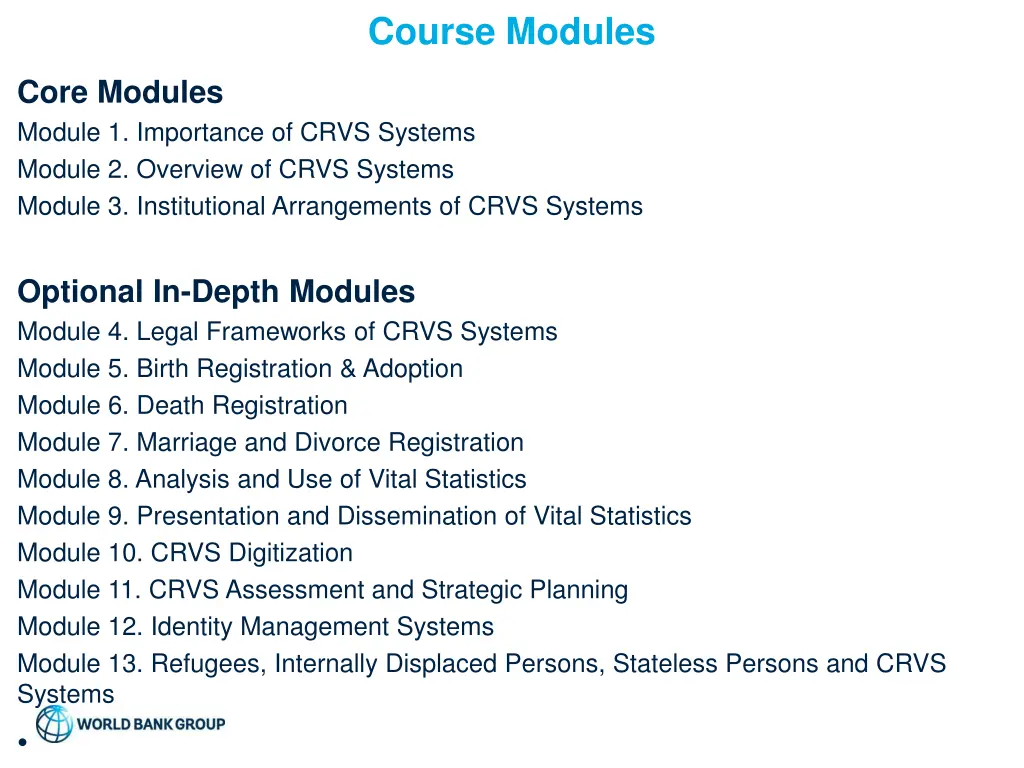
Course Modules Core Modules Module 1. Importance of CRVS Systems Module 2. Overview of CRVS Systems Module 3. Institutional Arrangements of CRVS Systems Optional In-Depth Modules Module 4. Legal Frameworks of CRVS Systems Module 5. Birth Registration & Adoption Module 6. Death Registration Module 7. Marriage and Divorce Registration Module 8. Analysis and Use of Vital Statistics Module 9. Presentation and Dissemination of Vital Statistics Module 10. CRVS Digitization Module 11. CRVS Assessment and Strategic Planning Module 12. Identity Management Systems Module 13. Refugees, Internally Displaced Persons, Stateless Persons and CRVS Systems
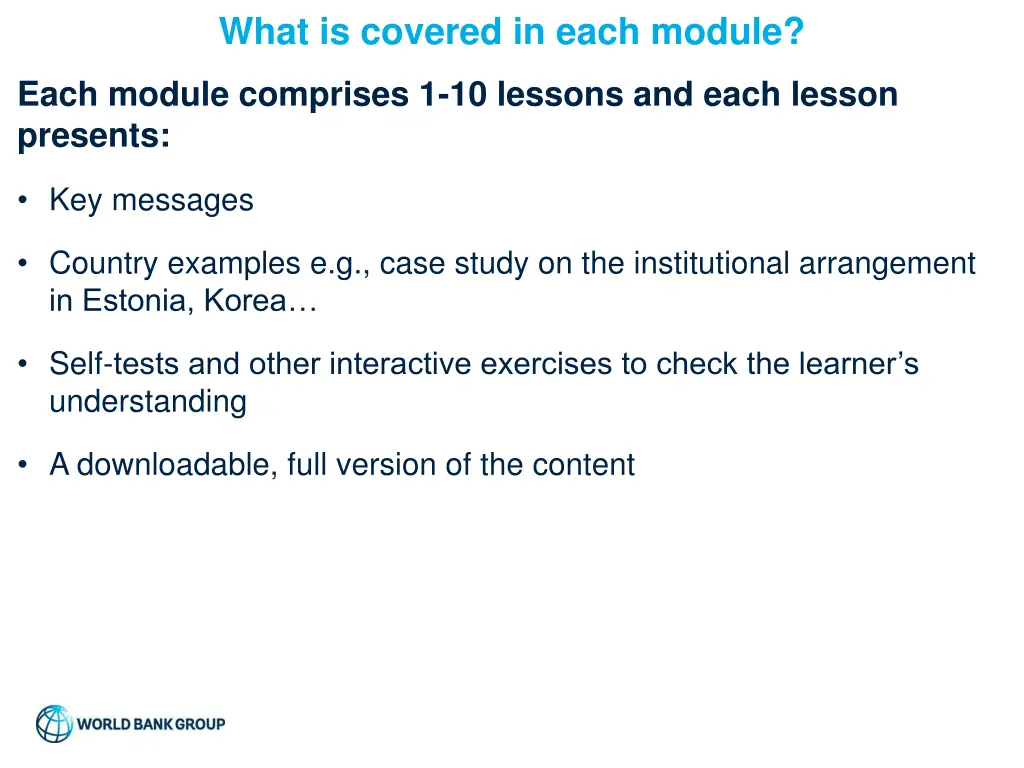
What is covered in each module? Each module comprises 1-10 lessons and each lesson presents: Key messages Country examples e.g., case study on the institutional arrangement in Estonia, Korea Self-tests and other interactive exercises to check the learner s understanding A downloadable, full version of the content
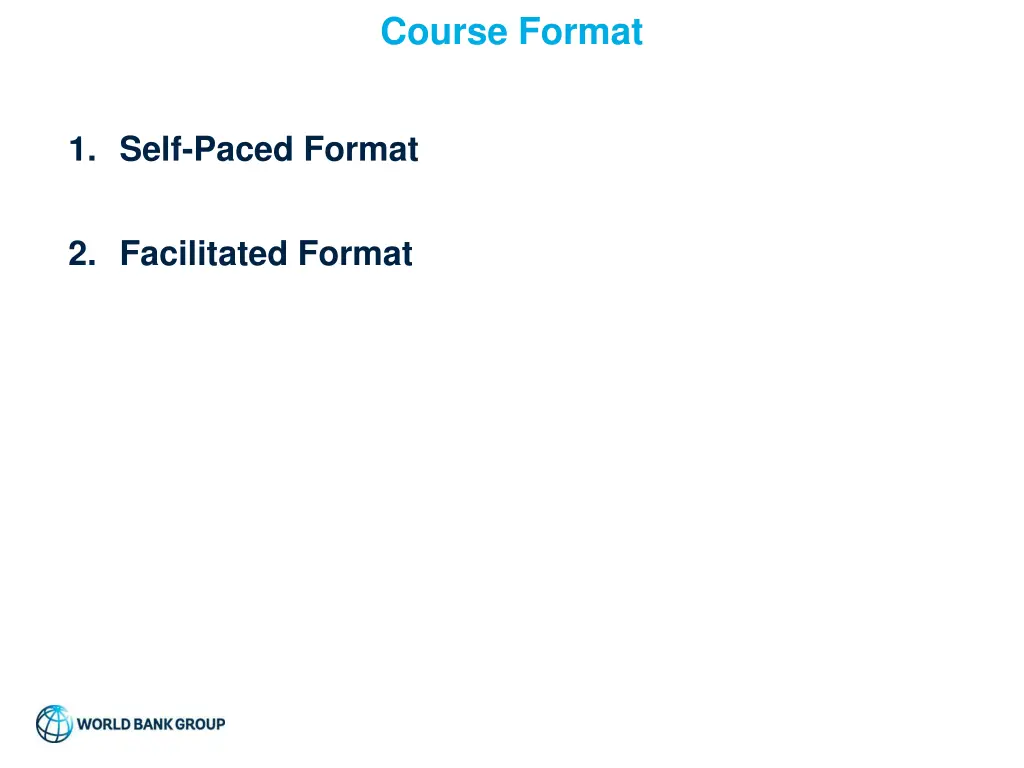
Course Format 1. Self-Paced Format 2. Facilitated Format
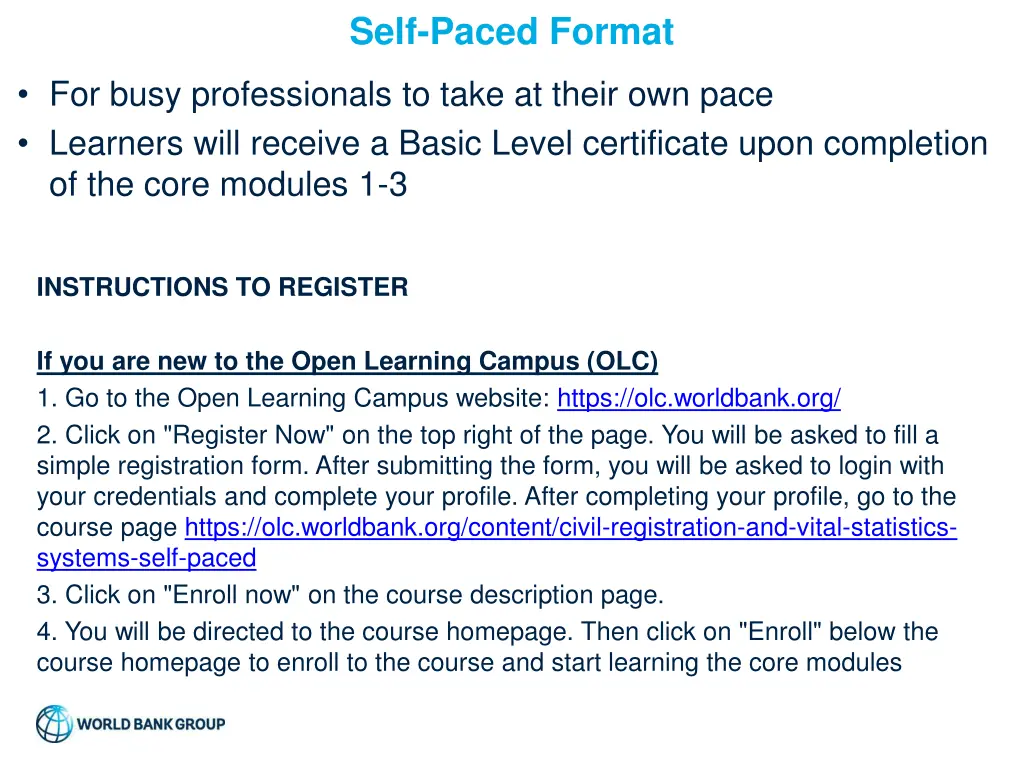
Self-Paced Format For busy professionals to take at their own pace Learners will receive a Basic Level certificate upon completion of the core modules 1-3 INSTRUCTIONS TO REGISTER If you are new to the Open Learning Campus (OLC) 1. Go to the Open Learning Campus website: https://olc.worldbank.org/ 2. Click on "Register Now" on the top right of the page. You will be asked to fill a simple registration form. After submitting the form, you will be asked to login with your credentials and complete your profile. After completing your profile, go to the course page https://olc.worldbank.org/content/civil-registration-and-vital-statistics- systems-self-paced 3. Click on "Enroll now" on the course description page. 4. You will be directed to the course homepage. Then click on "Enroll" below the course homepage to enroll to the course and start learning the core modules
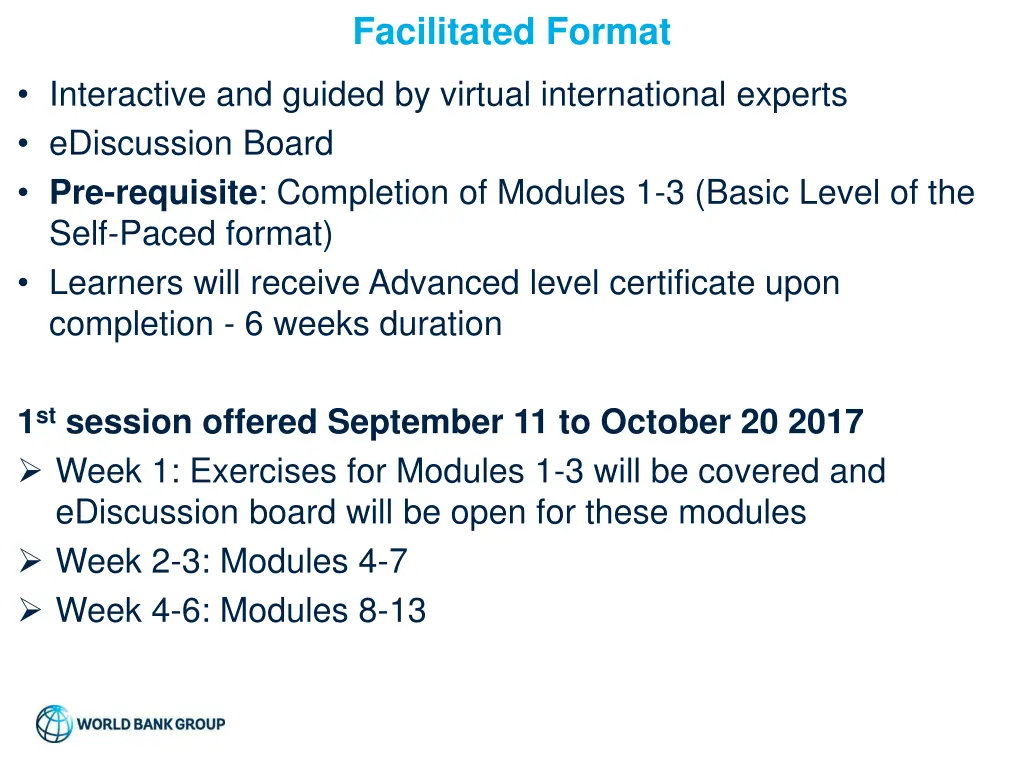
Facilitated Format Interactive and guided by virtual international experts eDiscussion Board Pre-requisite: Completion of Modules 1-3 (Basic Level of the Self-Paced format) Learners will receive Advanced level certificate upon completion - 6 weeks duration 1stsession offered September 11 to October 20 2017 Week 1: Exercises for Modules 1-3 will be covered and eDiscussion board will be open for these modules Week 2-3: Modules 4-7 Week 4-6: Modules 8-13
Module 4 Legal Framework of CRVS Systems Module Objectives By the end of Module 4, the learner will be able to: State the importance of CRVS-related laws Describe the hierarchical structure of the sources of formal law and state the key elements of the CRVS legal framework Describe the process for assessing CRVS laws and the legislative process for making a new law or amending existing laws Module is presented in 3 Lessons
Module 4 Lesson 1 Objectives 1. Define CRVS 2. State the primary functions of a CRVS system A. Legal and Protective Advantages to Individuals including major International Declarations and Conventions on Human Rights pertaining to CRVS B. Administrative Advantages C. Statistical Advantages 3. Describe the institutional arrangement of CRVS systems and Identity Management Systems
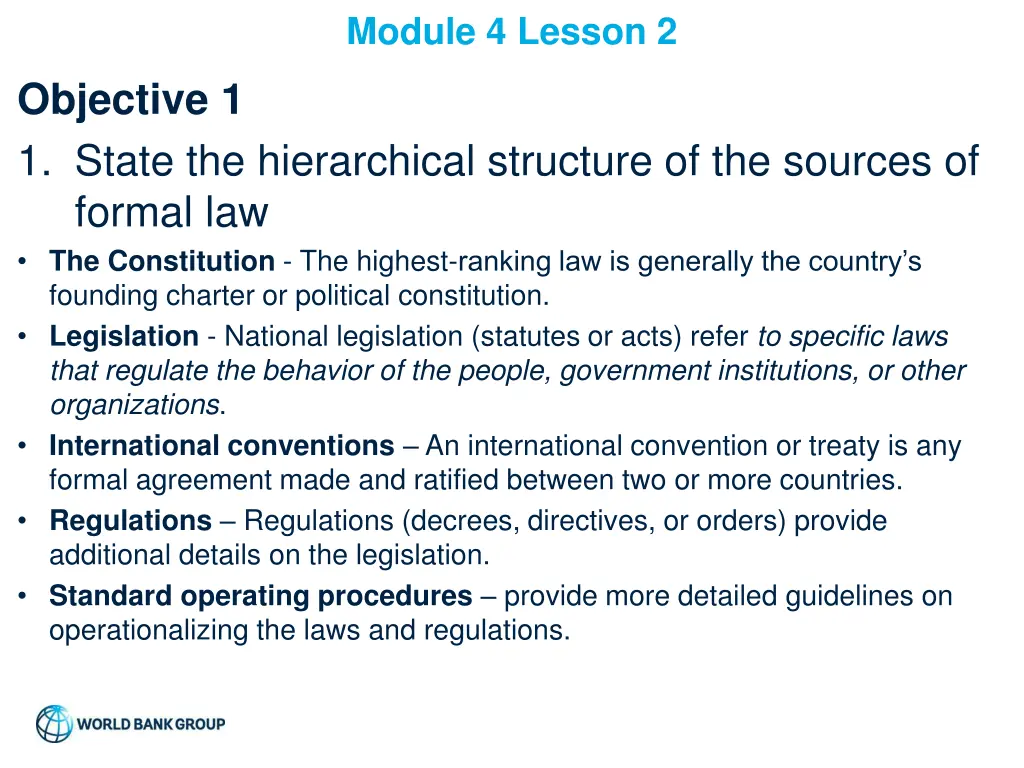
Module 4 Lesson 2 Objective 1 1. State the hierarchical structure of the sources of formal law The Constitution - The highest-ranking law is generally the country s founding charter or political constitution. Legislation - National legislation (statutes or acts) refer to specific laws that regulate the behavior of the people, government institutions, or other organizations. International conventions An international convention or treaty is any formal agreement made and ratified between two or more countries. Regulations Regulations (decrees, directives, or orders) provide additional details on the legislation. Standard operating procedures provide more detailed guidelines on operationalizing the laws and regulations.
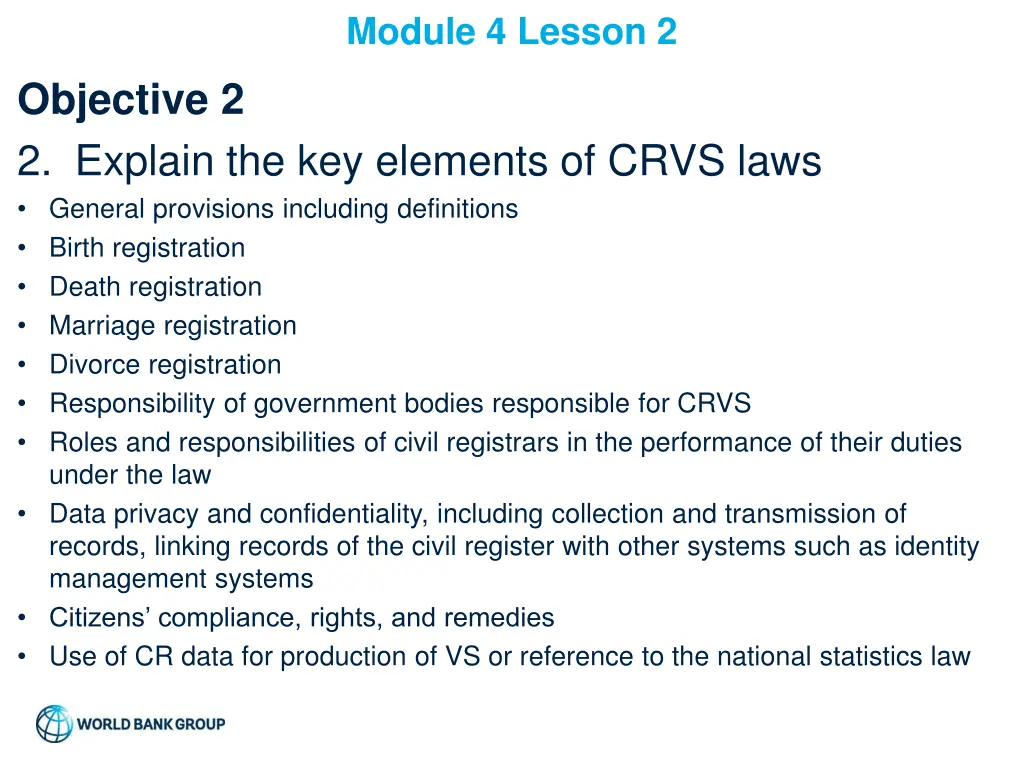
Module 4 Lesson 2 Objective 2 2. Explain the key elements of CRVS laws General provisions including definitions Birth registration Death registration Marriage registration Divorce registration Responsibility of government bodies responsible for CRVS Roles and responsibilities of civil registrars in the performance of their duties under the law Data privacy and confidentiality, including collection and transmission of records, linking records of the civil register with other systems such as identity management systems Citizens compliance, rights, and remedies Use of CR data for production of VS or reference to the national statistics law
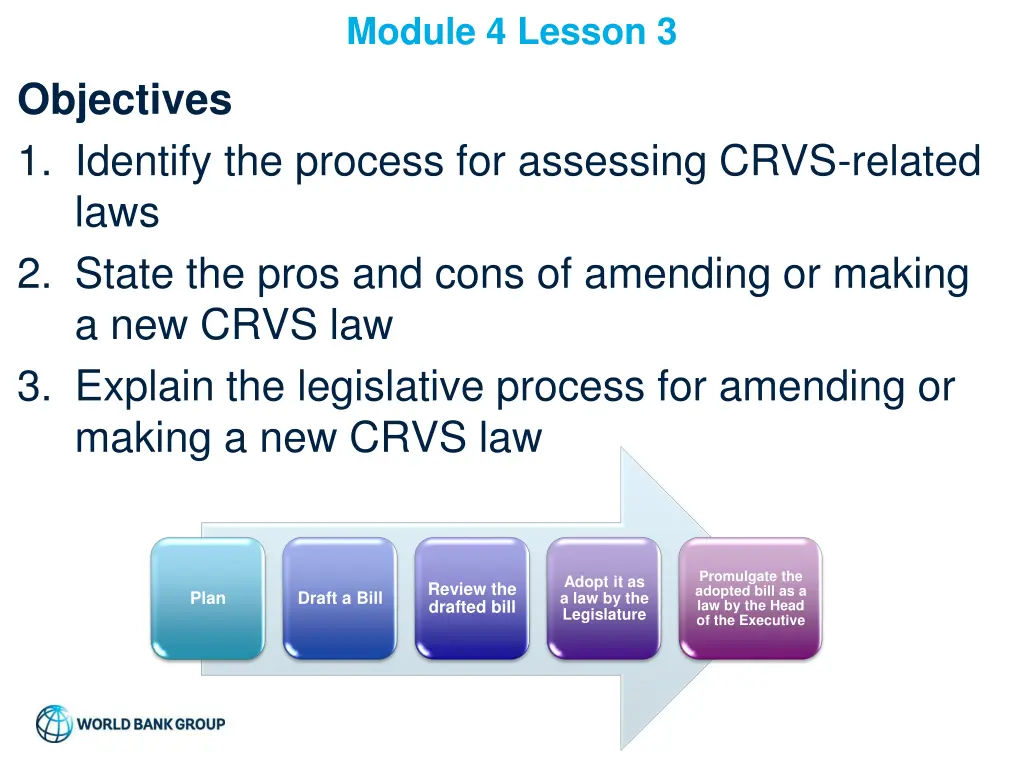
Module 4 Lesson 3 Objectives 1. Identify the process for assessing CRVS-related laws 2. State the pros and cons of amending or making a new CRVS law 3. Explain the legislative process for amending or making a new CRVS law Promulgate the adopted bill as a law by the Head of the Executive Adopt it as a law by the Legislature Review the drafted bill Plan Draft a Bill