A.A. Church: Remarks on Calvin's Life and Thought
This content delves into the reflections of A.A. Church on the life and thoughts of John Calvin. It presents the concept of creation, scripture, and law as mirrors that reveal the glory of God and our own nature. The insights emphasize our connection to the divine and our responsibility to help one another as rooted in our shared humanity. The reflections encourage contemplation of God through the lens of Calvin’s theology and scriptures, urging believers to consider their role in the world.

Download Presentation

Please find below an Image/Link to download the presentation.
The content on the website is provided AS IS for your information and personal use only. It may not be sold, licensed, or shared on other websites without obtaining consent from the author.If you encounter any issues during the download, it is possible that the publisher has removed the file from their server.
You are allowed to download the files provided on this website for personal or commercial use, subject to the condition that they are used lawfully. All files are the property of their respective owners.
The content on the website is provided AS IS for your information and personal use only. It may not be sold, licensed, or shared on other websites without obtaining consent from the author.
E N D
Presentation Transcript
A A church church that looks in the mirror? that looks in the mirror? Remarks in the light of Calvin s life and thought Remarks in the light of Calvin s life and thought Robert Vosloo
Creation as mirror: You cannot in one glance survey this most vast and beautiful system of the universe, in its wide expanse, without being completely overwhelmed by its brightness this skillful ordering of the universe is for us a sort of mirror in which we can contemplate God, who is otherwise invisible. Scripture as mirror: In short, let us remember that that invisible God, whose wisdom, power, and righteousness are incomprehensible, set before us Scripture as a mirror in which his living likeness glows.
The law as mirror: The law is like a mirror. In it we contemplate our weakness, then the iniquity arising from this just as a mirror shows us the spots on our face. The risen Christ as mirror: in this mirror the living image of the resurrection is visible to us, so it is a firm foundation to support our minds. The sacraments as mirror: we might call the sacraments mirrors in which we may contemplate the richness of God s grace, which he lavishes upon us.
John Calvin looked into the mirror of creation, the Word, and the Word made flesh and beheld the splendour of the invisible God (John Keesecker)
Galatians 6:9-11 Let us not be weary of well doing: for in convenient season we shall reap without weariness. Therefore while we have time let us do good to all men, but chiefly to them that are of the household of faith. You see how large a letter I have written to you with mine own hand.
For we must not look what every man is, nor what he deserves: but we must mount up higher and consider that God has set us in this world to the end we should be united and knit together: and that forasmuch he has imprinted his image in us, and we have all one common nature: the same ought to move us to help one another.
(F)or so long as we be of humankind, we cannot but behold our own face as it were in a mirror in the person that is poor and despised though he were the furthest stranger in the world. Let a Moor or a Barbarian come among us, and yet inasmuch as he is a human being, he brings with him a mirror wherein we may see that he is our brother and our neighbour.
Commentary on Isaiah 58:7 Here we ought to observe that the term flesh, by which he means all men universally, not a single one of whom we can behold, without seeing, as in a mirror, our own flesh. It is therefore a proof of the greatest inhumanity, to despise those in whom we are constrained to recognise our own likeness.
Therefore the furthest strangers in the world are neighbours near enough unto us, though they be neither our parents, our kinsfolk, nor our acquaintance. And why? For we be all of one flesh, and we bear all one mark, which ought to persuade us to do what we possibly can for another.
Therefore, whatever man you meet who needs your aid, you have no reason to refuse to help him. Say, He is a stranger ; but the Lord has given him a mark that ought to be familiar to you by virtue of the fact that he forbids you to despise your own flesh [Isa. 58:7]. Say, he is contemptible and worthless ; but the Lord shows him to be one whom he has deigned to give the beauty of his image.
Assuredly there is but one way in which to achieve what is not merely difficult but utterly against human nature: to love those who hate us, to repay their evil deeds with benefits, to return blessings for reproaches [Matt. 5:44]. It is that we remember not to consider men s evil intentions but to look upon the image of God in them, which cancels and effaces their transgressions, and with its beauty and dignity allures us to love and embrace them.
Human beings are united not only by a common flesh, but also by the image of God, with is imprinted on all. (John Leith)
Calvin did not serve a parish, a territory, or a country. He did not understand his own position as that of the people s priest of the Genevan city state. He did not receive his calling from the city council Reading the scriptures as an exiled refugee in the light of his own experiences, he addressed his listeners and readers not as citizens of Geneva or any other European region, but rather as uprooted wayfarers who had signed up for the hazardous trek to the Eternal city (Heiko Oberman)
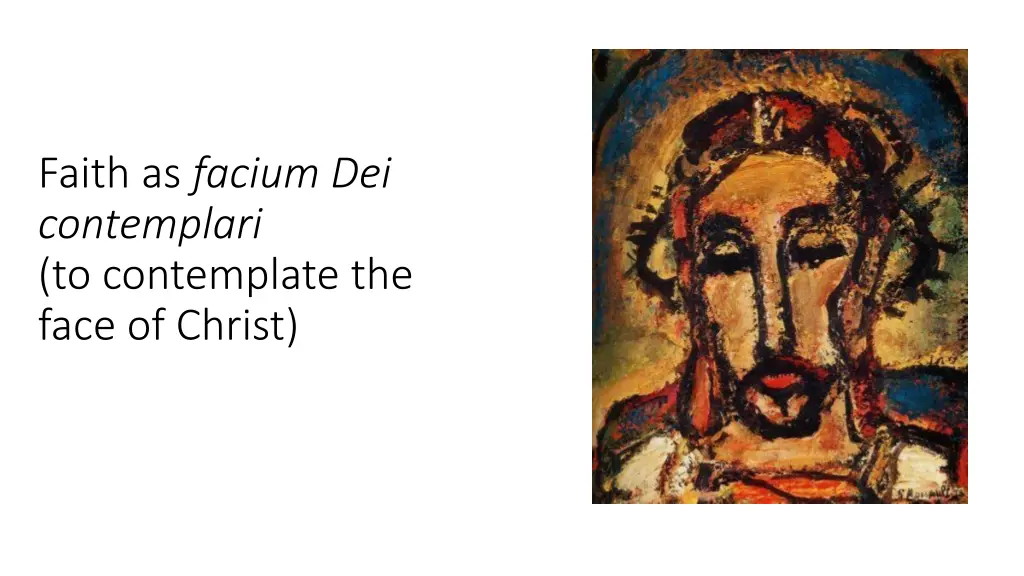
Faith as facium Dei contemplari (to contemplate the face of Christ)