Discover the latest motions from the Academic Freedom & Standards Committee regarding the expansion of the grading system to include +/- modifiers. Learn about the updated grading scales and regulations for both undergraduate and graduate students, as well as the new grade replacement policy for students with C- or lower grades. Stay informed about the motivation behind these changes to maintain the integrity of course grades and GPA calculations.
Please find below an Image/Link to download the presentation.
The content on the website is provided AS IS for your information and personal use only. It may not be sold, licensed, or shared on other websites without obtaining consent from the author. If you encounter any issues during the download, it is possible that the publisher has removed the file from their server.
You are allowed to download the files provided on this website for personal or commercial use, subject to the condition that they are used lawfully. All files are the property of their respective owners.
The content on the website is provided AS IS for your information and personal use only. It may not be sold, licensed, or shared on other websites without obtaining consent from the author.
E N D
Presentation Transcript
+/- Grading Issue 21 February 2019 K. Kosbar Chair, Academic Freedom & Standards Committee
Motion from Academic Freedom & Standards Starting with fall semester 2020, S&T will expand its current A through F course grading system, to include the use of + and - modifiers, as described below. Courses can use either an A through F system, or a satisfactory / unsatisfactory (S/U) system. The A through F grading system is appropriate for those subjects and situations that allow discrimination in quality of achievement and performance. The S/U system is more appropriate for students wishing to take elective courses in a subject matter field in which they will be competing with majors, for mastery learning situations, and for courses graded primarily on the basis of attendance. The grades available in the expanded A through F system, and their effect on grade point average calculations, will be: A (4.0), A- (3.7), B+ (3.3), B (3.0), B- (2.7), C+ (2.3), C (2.0), C- (1.7), D+ (1.3), D (1.0), D- (0.7), F (0.0). Graduate students will not be allowed to earn grades of D+, D or D-. (Continued on next page)
Motion from Academic Freedom & Standards (Continued from previous page) The S and U grades will not be incorporated in the grade point average calculations. All courses which currently specify a prerequisite with a grade of C or better will be changed to C- or better". This change to C- or better may be subsequently altered through the normal curriculum modification process. All regulations currently tied to a specific grade average will be interpreted to mean the numerical average currently associated with that specific grade. Hence, a required C average or better on all courses will be a 2.000 average or better. (Continued on next page)
Motion (for Feb 2019 Faculty Senate Meeting) (Continued from previous page) Students will be allowed to replace grades in all courses in which they have obtained a C- or lower. The first sentence of Section VIII.G of the S&T Student Academic Regulations will be changed from: Effective with Missouri S&T coursework repeated Fall of 2001 or later, when a grade of "D" or "F" is received in a Missouri S&T course, the grade may be replaced in the calculation of the GPA if the course is repeated at Missouri S&T. to: When a grade of C-, D+, D, D- or F is received in a Missouri S&T course, the grade may be replaced in the calculation of the GPA if the course is repeated at Missouri S&T.
AF&S Motivation > Use well recognized grading system to protect perceived integrity of course grades and GPA calculations > Use grading scheme that allows instructors to describe student performance as accurately as possible > Any new system must be backwards compatible with existing grades, so there is no need to modify any existing course grade or GPA
History > Spring 2018 FS officers request AF&S consider two issues > Removing transfer course grades from cumulative GPA > Adding +/- modifiers to course grades > June 2018 AF&S makes motion at FS to implement +/- grades FS debates, but does not vote on motion FS refers matter Student Affairs committee > September 2018 Faculty Senate sends referral back to AF&S > Solicit more comments > Remove dependence on Mizzou policy
History > January 2019 AF&S reports to FS Similar to June 2018 motion, with changes in C- grades, D+ and D- grades, and grade replacement policy Motion not put on floor for debate > February 2019 AF&S modifies motion to clarify C- grade issue
Student Affairs Committee > Received written comments > Generally, but not universally, in favor of +/- grades Freshman Engineering > In favor of +/- grades
Student Council > Strongly opposed to summer 2018 AF&S motion at FS in October 2018 > Strongest objections seemed to be that C- would not satisfy the C or better prerequisite requirement > Concerned about impact on academic standing > Concerned that +/- grades create a barrier to graduation > Passed resolution on 2/19/19 opposing AF&S motion
Student Council Resolution (2/19/19, paraphrased) > Whereas, the Faculty Senate is considering a plus/minus grading system proposed by the AF&S committee > Whereas, a grade of C- would be a 1.7 GPA, which is not good enough to remain in good academic standing > Whereas, the imbalance of pluses and minuses is felt to negatively impact GPA > Whereas, when polled at a general body meeting, the majority of representatives of the S&T student body were not in favor of the motion
Student Council Resolution (2/19/19, paraphrased) > Whereas, the student body does not feel that sufficient research has been done on possible impact on GPA > Whereas, the student body would feel it fair and balanced should an A+ option be added which correlates to a 4.3 grade points, while capping cumulative GPA at 4.0 > Therefore be it resolved: the S&T student body does not support the plus/minus system for implementation as currently proposed
Council of Graduate Students > Mixed comments > More opposed to change than favoring it > Concerned about cost of implementation > Concerned that +/- grades may lower average GPA
S&T Athletics > Opposes +/- grades > Concerned about lowering GPA > May impact Eligibility to compete Eligibility for some awards Financial assistance > Failed to show how change will positively impact student outcomes
Registrar > Difficult to implement new system prior to fall 2020 > Primary cost of implementation would be C- grade policy > Estimate 200 person-hours to implement > +/- grades may lower long-term software development and maintenance costs, as they would bring us in line with other UM system campuses > Recommends not using A+ grades
Widely Recognized Grading Systems > Reviewed grading policies at approximately 160 colleges and universities Top 100 national universities, as defined by US News & World Report (USN&WR) in Sept 2018 Top 100 engineering (doctorate) universities Top 10 engineering (non-doctorate) universities Mizzou, UMSL, UMKC, Wash U., SLU Missouri State universities Missouri community colleges
Other Universities and Colleges - Summary > Top 100 national + top 100 Engineering (doctorate) 86% Use finer granularity in grades than S&T 78% use +/- grades from A through at least C- 33% use A+ grades > 72% of A+ grades have same numeric value as A grade > Top 11 Engineering non-doctorate 9 use +/- grades > UM System, Wash U, SLU All use +/- grades, except S&T > Missouri State Universities Most do not use +/- grades (MSU, Harris Stowe exceptions) > Missouri Community Colleges None use +/- grades
Definition of Grades > S&T does not specify how a percentage grade in a class should be translated to a letter grade. > Letter grades are defined by a single word A = Excellent B = Superior C = Medium D = Inferior F = Failure > AF&S does not propose changing this
No Requirement to Use +/- Modifiers > S&T does not currently require, encourage, or discourage the use of any grades > AF&S does not propose changing this > Under a +/- grading scheme, instructors who believe the current grading system is most appropriate, would be welcome to continue using it > Instructors who like their grading system, can keep their grading system (sorry, I couldn t resist)
C or Better > Motion mandates all course prerequisites currently listed as C or better would be changed to C- or better > Maintains the current practice that performance closer to C than D is sufficient for advancement to next course > Departments can petition to have individual prerequisites changed in future > Changes will require submission of CC form to Curriculum Committee, and ultimately approval by Faculty Senate
Grade Replacement > Students may currently replace up to 15 credit hours of D or F grades in GPA calculations by retaking the course(s) at S&T > A, B, C grades may not be replaced in GPA calculations > Under AF&S proposal, students may replace C-, D+, D, D-, F grades, but not A, A-, B+, B, B-, C+ or C grades > Maintains concept that grade replacement is intended to help students with GPAs below 2.0
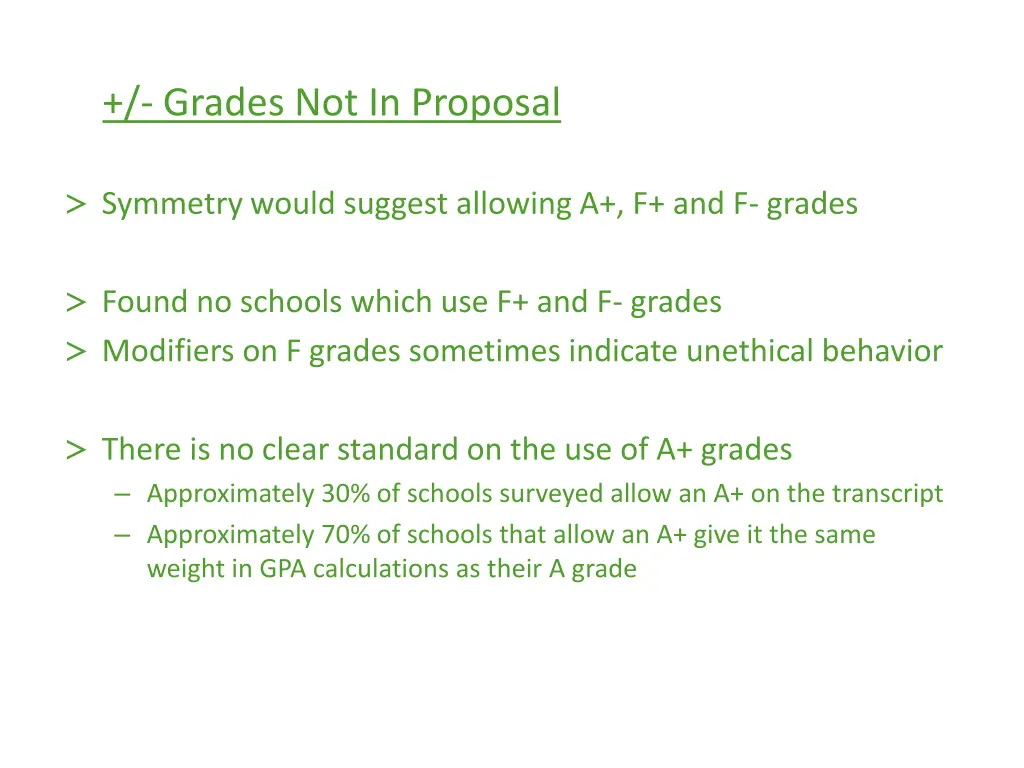
+/- Grades Not In Proposal > Symmetry would suggest allowing A+, F+ and F- grades > Found no schools which use F+ and F- grades > Modifiers on F grades sometimes indicate unethical behavior > There is no clear standard on the use of A+ grades Approximately 30% of schools surveyed allow an A+ on the transcript Approximately 70% of schools that allow an A+ give it the same weight in GPA calculations as their A grade
A+ Conundrum > Some perceive the AF&S proposed system as creating a negative bias, since it introduces A- grades at 3.7 grade points, but no A+ grade at 4.3 grade points > An A+ at 4.3 grade points would allow students to achieve a 4.0 GPA even if they have a few grades below A.
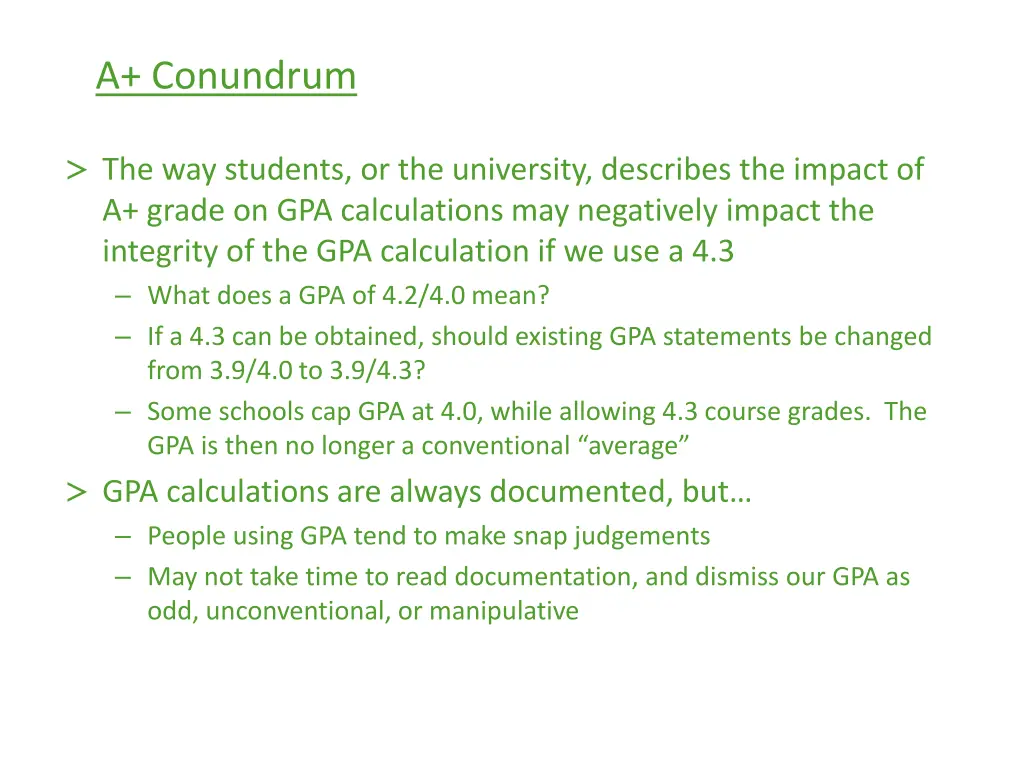
A+ Conundrum > The way students, or the university, describes the impact of A+ grade on GPA calculations may negatively impact the integrity of the GPA calculation if we use a 4.3 What does a GPA of 4.2/4.0 mean? If a 4.3 can be obtained, should existing GPA statements be changed from 3.9/4.0 to 3.9/4.3? Some schools cap GPA at 4.0, while allowing 4.3 course grades. The GPA is then no longer a conventional average > GPA calculations are always documented, but People using GPA tend to make snap judgements May not take time to read documentation, and dismiss our GPA as odd, unconventional, or manipulative
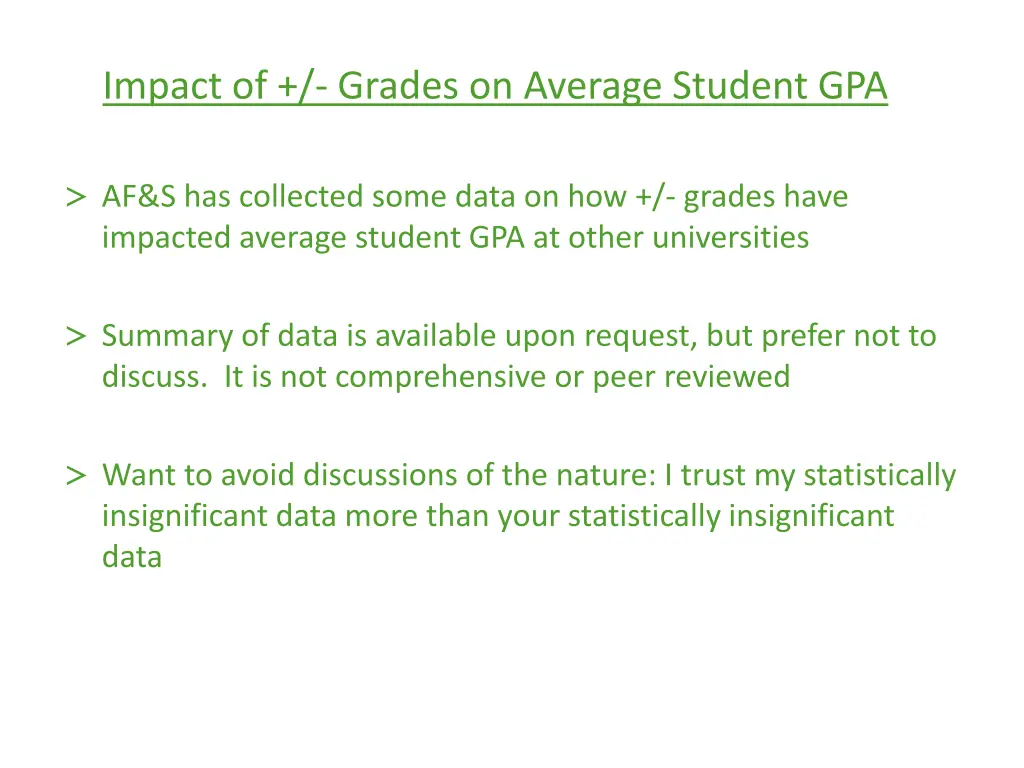
Impact of +/- Grades on Average Student GPA > AF&S has collected some data on how +/- grades have impacted average student GPA at other universities > Summary of data is available upon request, but prefer not to discuss. It is not comprehensive or peer reviewed > Want to avoid discussions of the nature: I trust my statistically insignificant data more than your statistically insignificant data
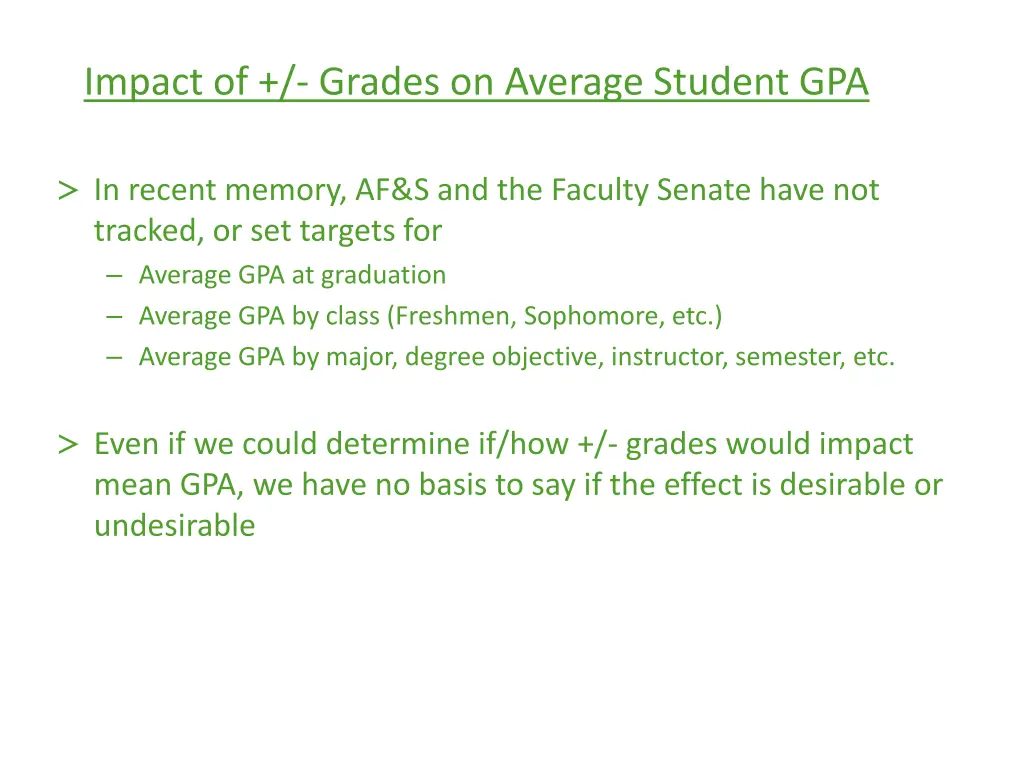
Impact of +/- Grades on Average Student GPA > In recent memory, AF&S and the Faculty Senate have not tracked, or set targets for Average GPA at graduation Average GPA by class (Freshmen, Sophomore, etc.) Average GPA by major, degree objective, instructor, semester, etc. > Even if we could determine if/how +/- grades would impact mean GPA, we have no basis to say if the effect is desirable or undesirable
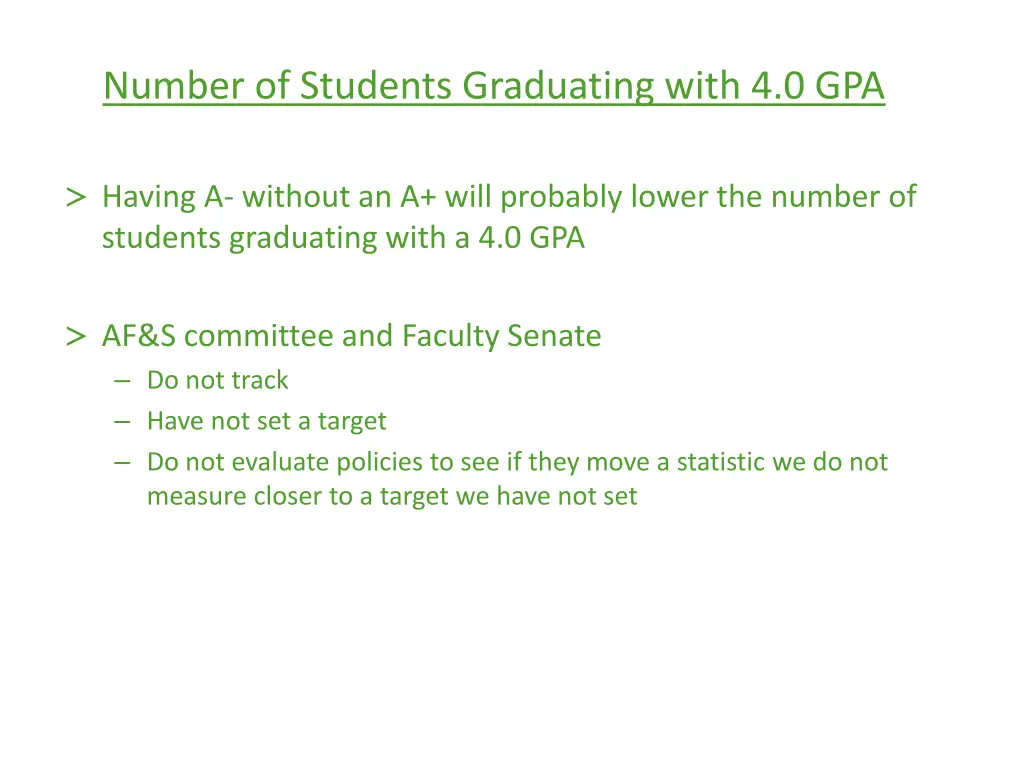
Number of Students Graduating with 4.0 GPA > Having A- without an A+ will probably lower the number of students graduating with a 4.0 GPA > AF&S committee and Faculty Senate Do not track Have not set a target Do not evaluate policies to see if they move a statistic we do not measure closer to a target we have not set
Costs > There is some cost to changing grading system, current estimate from Registrar is 200 person-hours > There is some cost to maintain our current system, or any system, that is different from the other three UM campuses
Sharing / Transferring Courses > Some students transfer courses to S&T from schools that have +/- grades. Since community colleges do not use +/- grades, this is probably not a large number of students. > S&T students could have more opportunities if the UM system offers more cross-campus course > Having all UM system students graded on the same scale helps facilitate cross-campus course sharing Is it fair to give a Mizzou student a B+ in a class where an S&T student performed slightly better, but is receiving a B?
Motion Starting with fall semester 2020, S&T will expand its current A through F course grading system, to include the use of + and - modifiers, as described below. Courses can use either an A through F system, or a satisfactory / unsatisfactory (S/U) system. The A through F grading system is appropriate for those subjects and situations that allow discrimination in quality of achievement and performance. The S/U system is more appropriate for students wishing to take elective courses in a subject matter field in which they will be competing with majors, for mastery learning situations, and for courses graded primarily on the basis of attendance. The grades available in the expanded A through F system, and their effect on grade point average calculations, will be: A (4.0), A- (3.7), B+ (3.3), B (3.0), B- (2.7), C+ (2.3), C (2.0), C- (1.7), D+ (1.3), D (1.0), D- (0.7), F (0.0). Graduate students will not be allowed to earn grades of D+, D or D-. The S and U grades will not be incorporated in the grade point average calculations. All courses which currently specify a prerequisite with a grade of C or better will be changed to C- or better". This change to C- or better may be subsequently altered through the normal curriculum modification process. All regulations currently tied to a specific grade average will be interpreted to mean the numerical average currently associated with that specific grade. Hence, a required C average or better on all courses will be a 2.000 average or better. Students will be allowed to replace grades in all courses in which they have obtained a C- or lower. The first sentence of Section VIII.G of the S&T Student Academic Regulations will be changed from: Effective with Missouri S&T coursework repeated Fall of 2001 or later, when a grade of "D" or "F" is received in a Missouri S&T course, the grade may be replaced in the calculation of the GPA if the course is repeated at Missouri S&T. to: When a grade of C-, D+, D, D- or F is received in a Missouri S&T course, the grade may be replaced in the calculation of the GPA if the course is repeated at Missouri S&T.
Disclaimer The following slides contain excerpts from documents describing the impact +/- grades have on cumulative GPA calculations. Note that many of the comments are second-hand, and reference non-archived source documents Most comments are from committees who appear to have been charged with evaluating the impact of using plus/minus grades in college settings Emphasis was given to comments that appear to be based on measurements rather than speculation and simulations. However raw data for those observations is typically not available
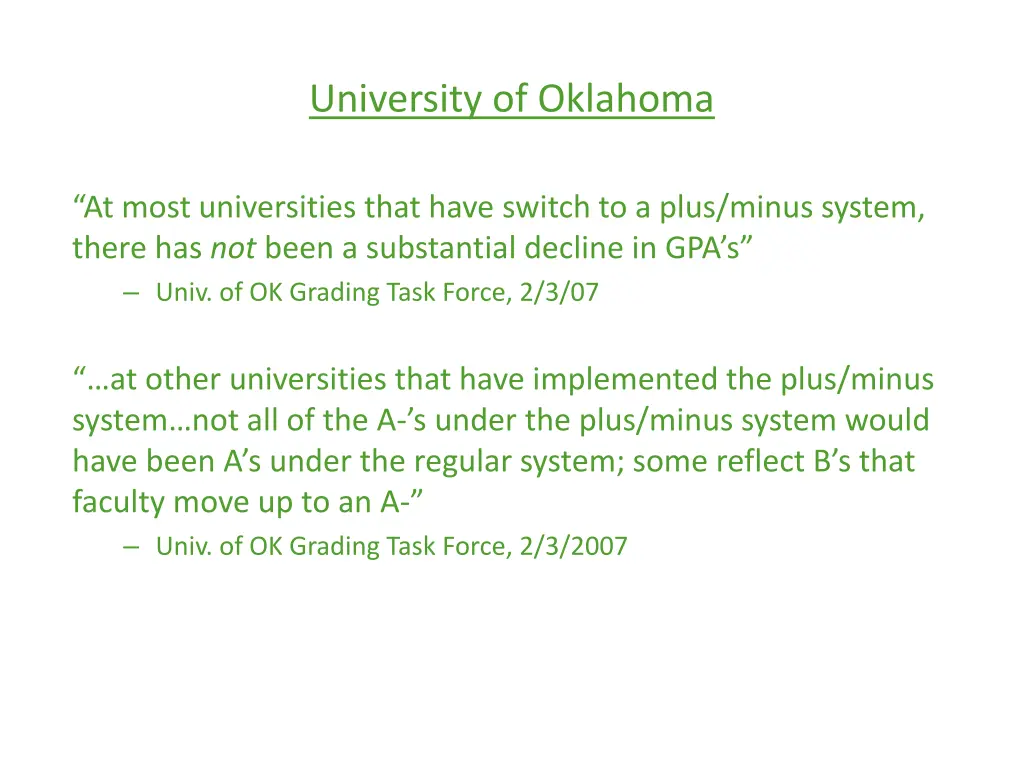
University of Oklahoma At most universities that have switch to a plus/minus system, there has notbeen a substantial decline in GPA s Univ. of OK Grading Task Force, 2/3/07 at other universities that have implemented the plus/minus system not all of the A- s under the plus/minus system would have been A s under the regular system; some reflect B s that faculty move up to an A- Univ. of OK Grading Task Force, 2/3/2007
American Journal of Pharmaceutical Education The type of grading scale used did not affect the mean cumulative GPA The Effect of Various Grading Scales on Student Grade Point Averages, K. Barnes and S. Buring, American Journal of Pharmaceutical Education, 2012; 76 (3) Article 41
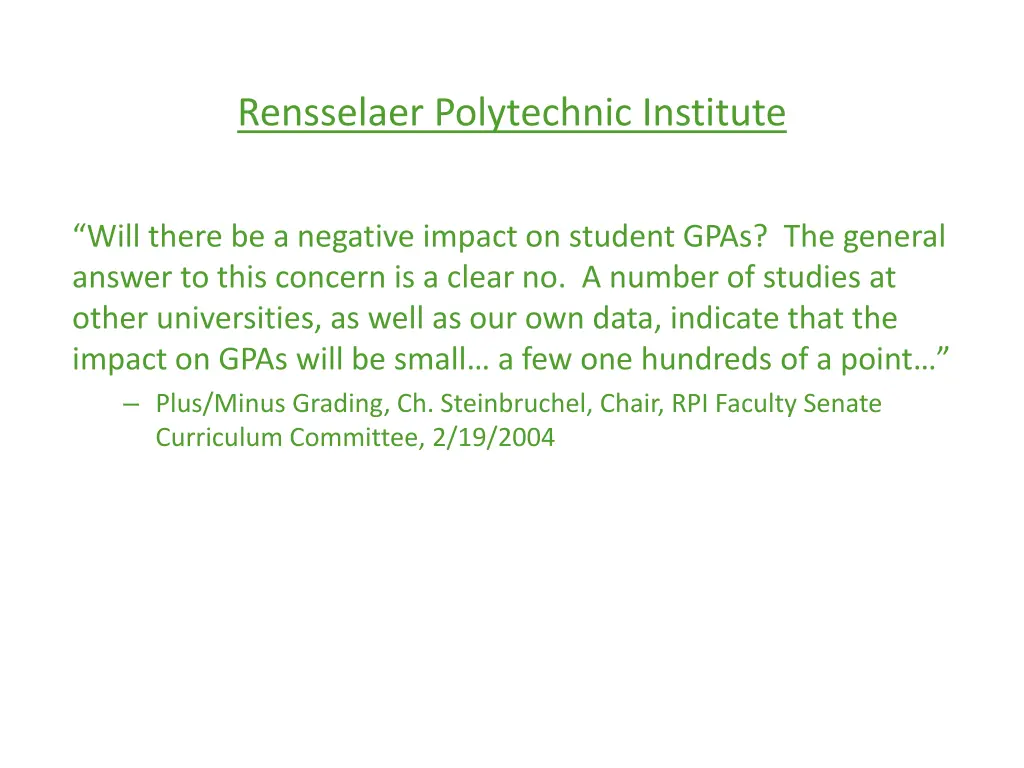
Rensselaer Polytechnic Institute Will there be a negative impact on student GPAs? The general answer to this concern is a clear no. A number of studies at other universities, as well as our own data, indicate that the impact on GPAs will be small a few one hundreds of a point Plus/Minus Grading, Ch. Steinbruchel, Chair, RPI Faculty Senate Curriculum Committee, 2/19/2004
University of California, Los Angeles University of Maryland Based on a quarter century of experience with +/- grading, UCLA administrators have suggested that over time, say ten years or more, the effect of plus/minus grading on overall grade distribution patterns is inflationary, or uplifting. Report to the Faculty Senate, Office of the Registrar, University of Maryland, 11/2003, referencing email received from UCLA Registrar, 5/7/2002
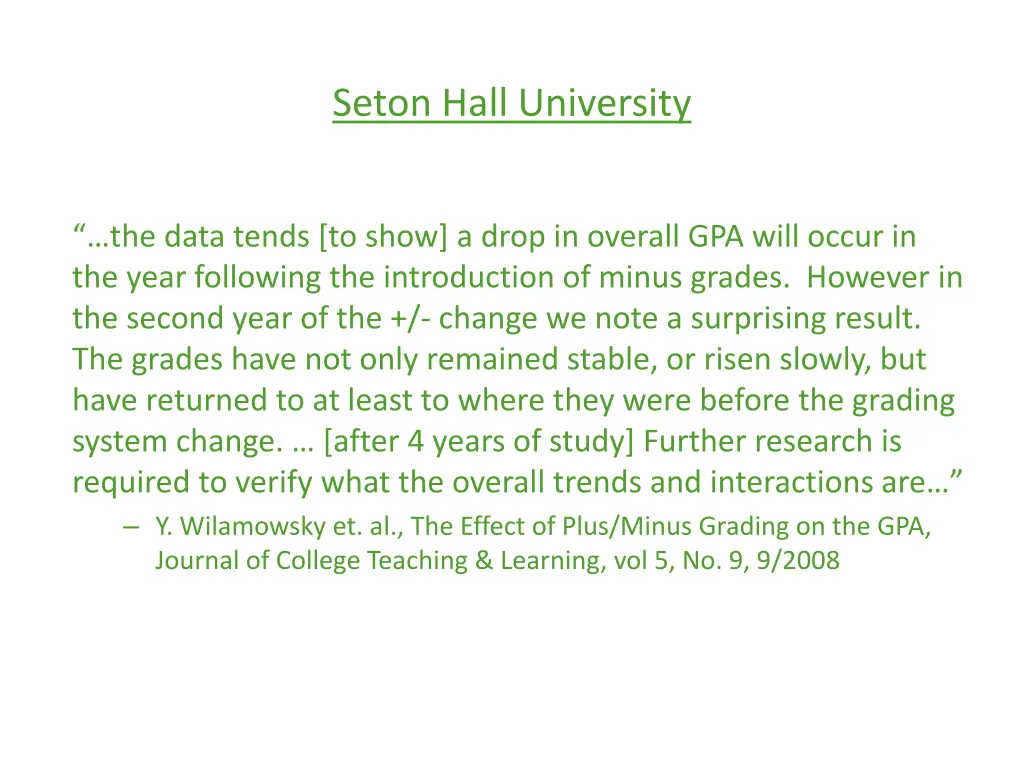
Seton Hall University the data tends [to show] a drop in overall GPA will occur in the year following the introduction of minus grades. However in the second year of the +/- change we note a surprising result. The grades have not only remained stable, or risen slowly, but have returned to at least to where they were before the grading system change. [after 4 years of study] Further research is required to verify what the overall trends and interactions are Y. Wilamowsky et. al., The Effect of Plus/Minus Grading on the GPA, Journal of College Teaching & Learning, vol 5, No. 9, 9/2008
Washington State University after the implementation of +/- grading [at Washington State University], the overall GPA essentially decreased on average by 0.012 in the first year the overall drop in GPA was 0.026 A. Bressette, Arguments for Plus/Minus Grading: A case Study, Educational Research Quarterly, Vol 25.3, 2002 (Prior to implementation of +/- grading the GPA variation per year was on the order of 0.02 to 0.06)