Accelerator Performance Optimization Strategies
Explore innovative methods to enhance performance and reduce impedance in particle accelerators. Cover topics such as performance degradation, beam stabilization, and beam improvement techniques.

Download Presentation

Please find below an Image/Link to download the presentation.
The content on the website is provided AS IS for your information and personal use only. It may not be sold, licensed, or shared on other websites without obtaining consent from the author. If you encounter any issues during the download, it is possible that the publisher has removed the file from their server.
You are allowed to download the files provided on this website for personal or commercial use, subject to the condition that they are used lawfully. All files are the property of their respective owners.
The content on the website is provided AS IS for your information and personal use only. It may not be sold, licensed, or shared on other websites without obtaining consent from the author.
E N D
Presentation Transcript
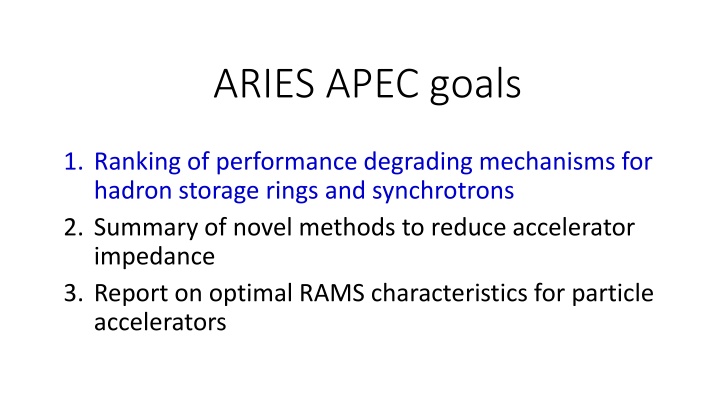
ARIES APEC goals 1. Ranking of performance degrading mechanisms for hadron storage rings and synchrotrons 2. Summary of novel methods to reduce accelerator impedance 3. Report on optimal RAMS characteristics for particle accelerators
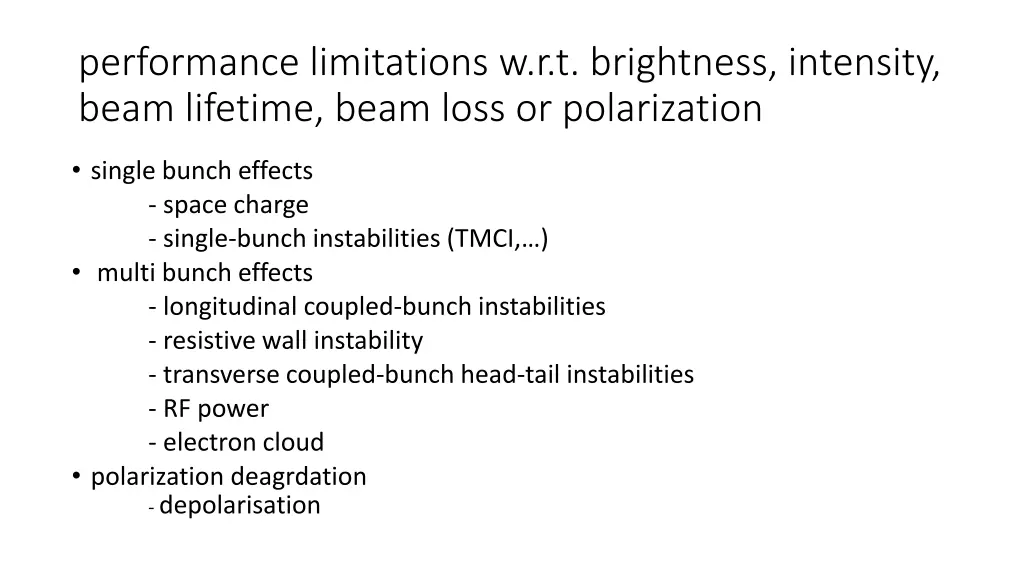
performance limitations w.r.t. brightness, intensity, beam lifetime, beam loss or polarization single bunch effects - space charge - single-bunch instabilities (TMCI, ) multi bunch effects - longitudinal coupled-bunch instabilities - resistive wall instability - transverse coupled-bunch head-tail instabilities - RF power - electron cloud polarization deagrdation -depolarisation
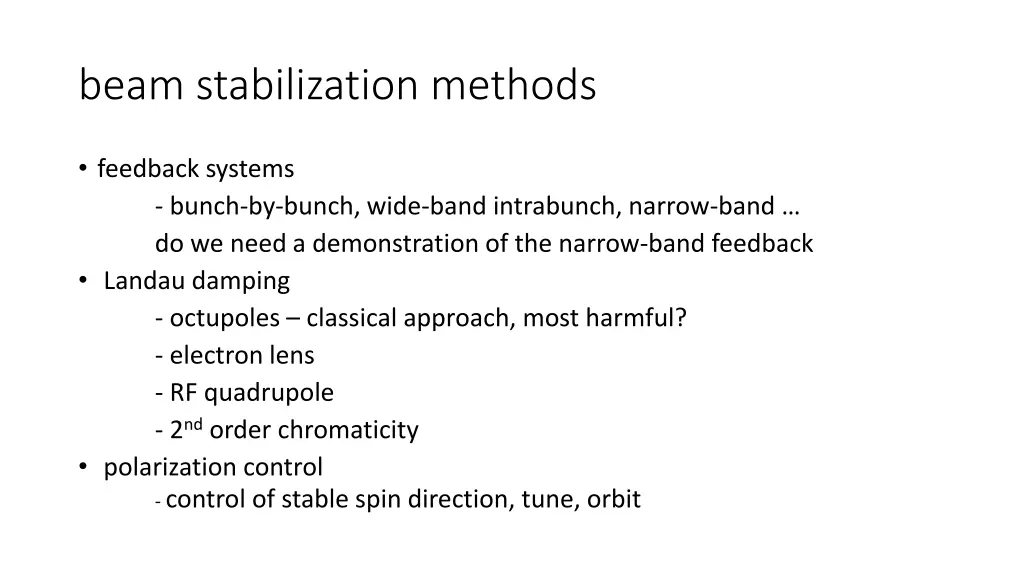
beam stabilization methods feedback systems - bunch-by-bunch, wide-band intrabunch, narrow-band do we need a demonstration of the narrow-band feedback Landau damping - octupoles classical approach, most harmful? - electron lens - RF quadrupole - 2ndorder chromaticity polarization control -control of stable spin direction, tune, orbit
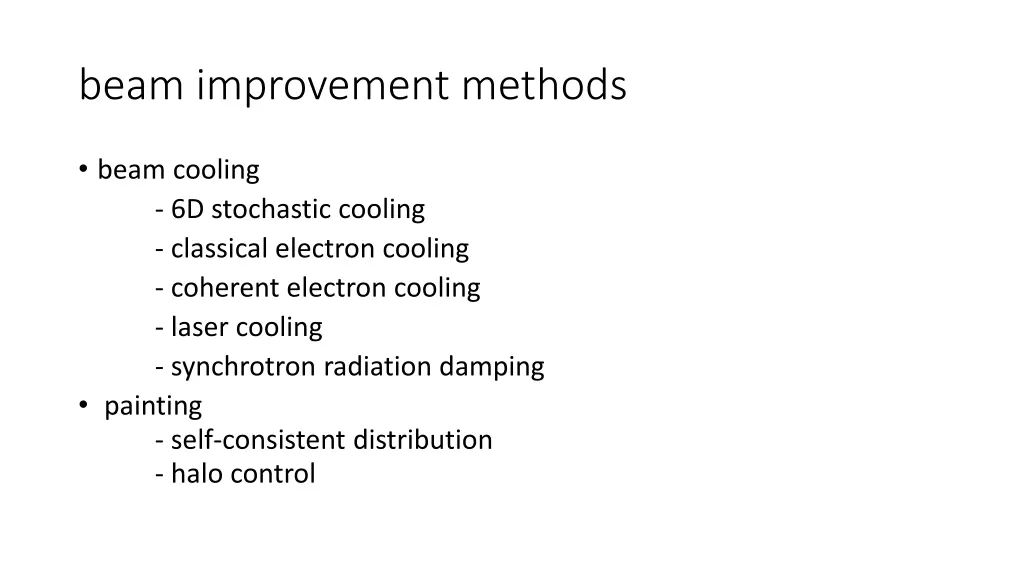
beam improvement methods beam cooling - 6D stochastic cooling - classical electron cooling - coherent electron cooling - laser cooling - synchrotron radiation damping painting - self-consistent distribution - halo control