Act,Unite,Empower for Mental Health

This initiative aims to build the capacity to understand and promote human rights and recovery for individuals with psychosocial disabilities. It focuses on empowering those affected, fostering respect among family members and care partners, and encouraging health workers to enhance their practices. It also emphasizes community-based, recovery-oriented services in accordance with the CRPD, providing individualized peer support and improving overall service quality through WHO QualityRights guidance.

Download Presentation

Please find below an Image/Link to download the presentation.
The content on the website is provided AS IS for your information and personal use only. It may not be sold, licensed, or shared on other websites without obtaining consent from the author.If you encounter any issues during the download, it is possible that the publisher has removed the file from their server.
You are allowed to download the files provided on this website for personal or commercial use, subject to the condition that they are used lawfully. All files are the property of their respective owners.
The content on the website is provided AS IS for your information and personal use only. It may not be sold, licensed, or shared on other websites without obtaining consent from the author.
E N D
Presentation Transcript
Act, Unite, Empower for Mental Health WHO QualityRights Michelle Funk & Natalie Drew Mental Health Policy and Service Development
Objectives 1 Build capacity to understand and promote human rights and recovery People with psychosocial disabilities - so that they can claim their rights Family members/care partners - so that they respect rights and support their relative to claim rights Health workers so that they can change their practices
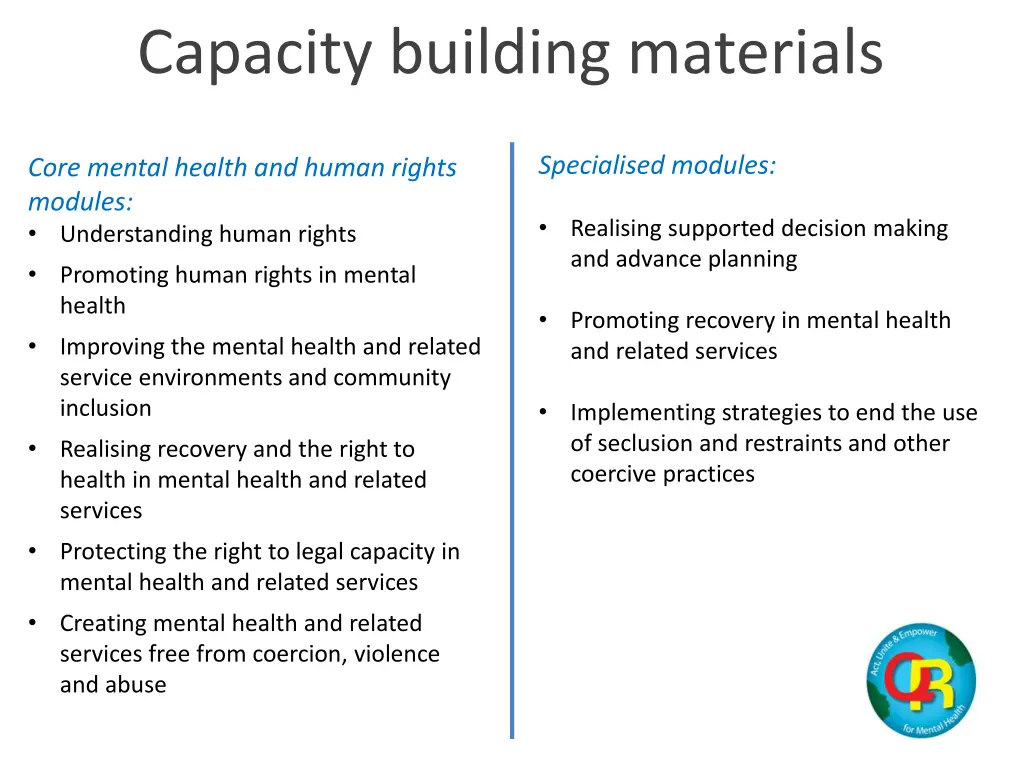
Capacity building materials Specialised modules: Core mental health and human rights modules: Understanding human rights Promoting human rights in mental health Improving the mental health and related service environments and community inclusion Realising recovery and the right to health in mental health and related services Protecting the right to legal capacity in mental health and related services Creating mental health and related services free from coercion, violence and abuse Realising supported decision making and advance planning Promoting recovery in mental health and related services Implementing strategies to end the use of seclusion and restraints and other coercive practices
E-training E-training version of 6 core modules on mental health and human rights Reach, engage and train more people Identify champions and build stronger movement to advocate for quality & HR in services Change in cultural norms in mental health sector
Objectives 2 Create community based & recovery oriented services and supports in line with CRPD Guidance on CRPD compliant community based services Eg. Personal Ombudsperson (Sweden), Open Dialogue (Finland), Soteria Houses (US and UK), and Circles of Support (UK), home support services Guidance on peer support Providing individualised peer support within services and the community Setting up and running peer support groups
Objectives 3 Improve the quality of services and human rights conditions in services WHO QualityRights Assessment Toolkit Guidance on how to plan for service change
Objectives 4 Develop a civil society movement to conduct advocacy and influence policy-making Setting up and operating a civil society organization Conducting advocacy campaigns to integrate human rights in mental health
Objectives 5 Reform national policies and legislation in line with the CRPD and other international human rights standards. Policy and law that promotes: Deinstitutionalisation Services and supports for community inclusion Legal capacity Liberty and security of the person
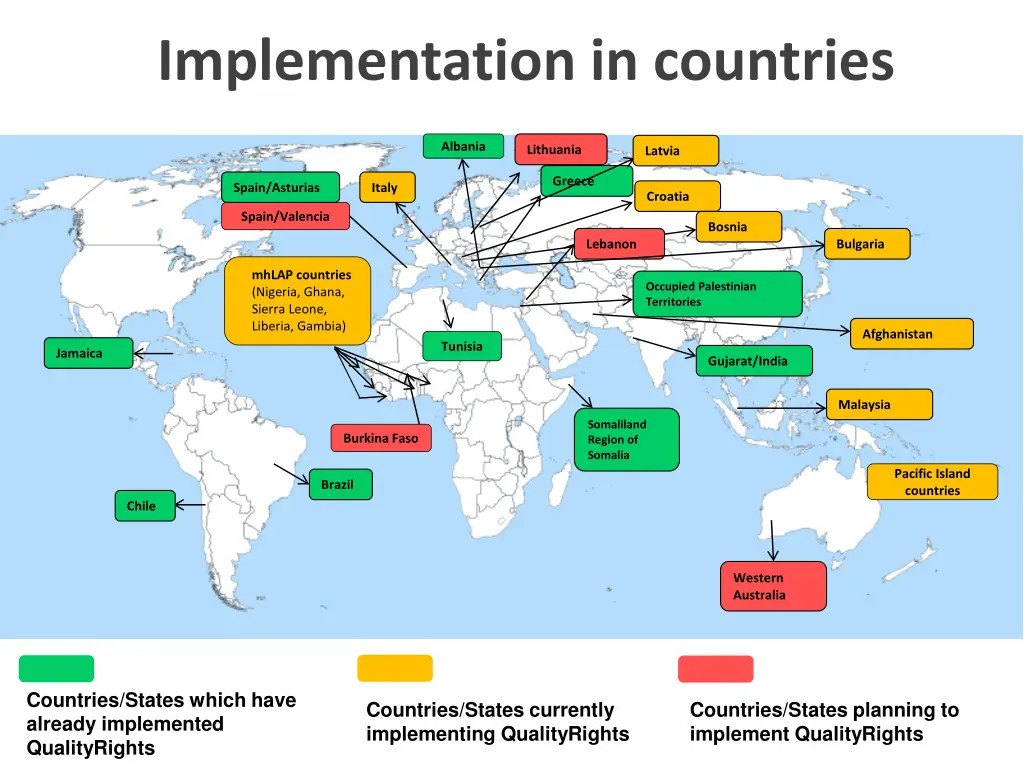
QualityRights Implementation in countries
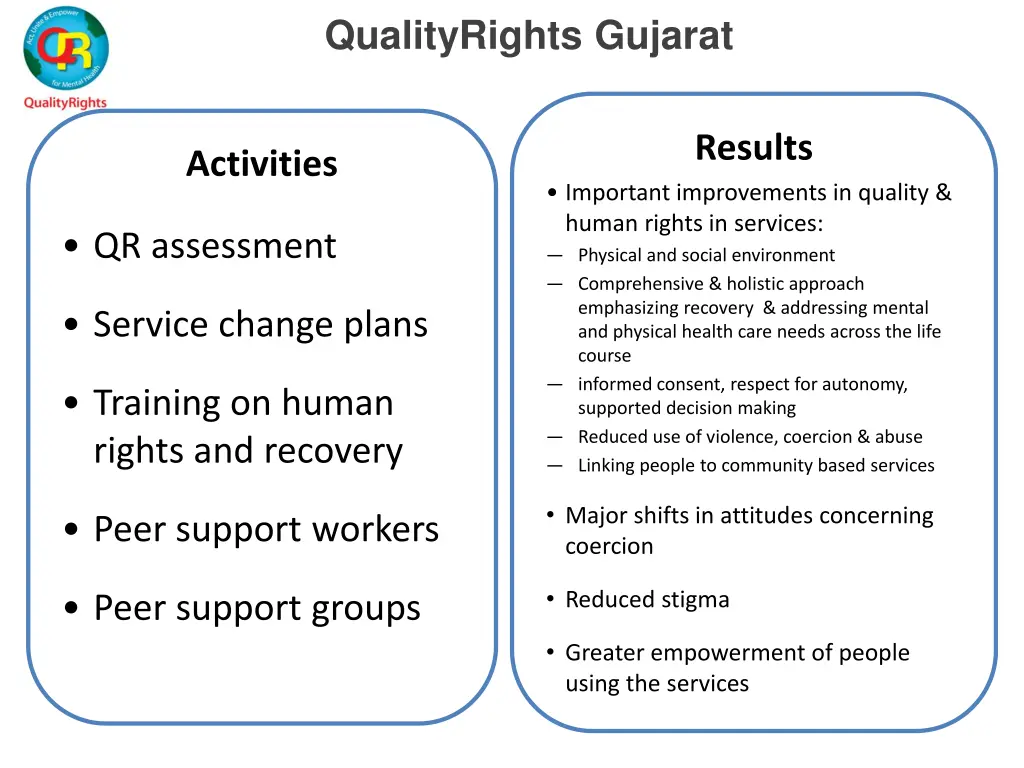
QualityRights Gujarat Results Activities Important improvements in quality & human rights in services: Physical and social environment Comprehensive & holistic approach emphasizing recovery & addressing mental and physical health care needs across the life course informed consent, respect for autonomy, supported decision making Reduced use of violence, coercion & abuse Linking people to community based services QR assessment Service change plans Training on human rights and recovery Major shifts in attitudes concerning coercion Peer support workers Reduced stigma Peer support groups Greater empowerment of people using the services
Implementation in countries Albania Lithuania Latvia Greece Spain/Asturias Italy Croatia Spain/Valencia Bosnia Lebanon Bulgaria mhLAP countries (Nigeria, Ghana, Sierra Leone, Liberia, Gambia) Occupied Palestinian Territories Afghanistan Tunisia Jamaica Gujarat/India Malaysia Somaliland Region of Somalia Burkina Faso Pacific Island countries Brazil Chile Western Australia Countries/States which have already implemented QualityRights Countries/States currently implementing QualityRights Countries/States planning to implement QualityRights