Adaptive Learning Systems: Evolution and Impact
The evolution of adaptive learning systems, from the origins of intelligent tutoring systems in the 1970s to their widespread use today. Discover the impact of AI Winter on the field and how scaling has transformed learning experiences for hundreds of thousands of students. Learn about key milestones, such as the introduction of Cognitive Tutor and the scaling experiments in urban schools. Uncover the history, challenges, and successes of adaptive learning systems in education.

Download Presentation

Please find below an Image/Link to download the presentation.
The content on the website is provided AS IS for your information and personal use only. It may not be sold, licensed, or shared on other websites without obtaining consent from the author.If you encounter any issues during the download, it is possible that the publisher has removed the file from their server.
You are allowed to download the files provided on this website for personal or commercial use, subject to the condition that they are used lawfully. All files are the property of their respective owners.
The content on the website is provided AS IS for your information and personal use only. It may not be sold, licensed, or shared on other websites without obtaining consent from the author.
E N D
Presentation Transcript
Foundations of Teaching and Learning October 29, 2021
Adaptive Learning What is an adaptive learning system?
Intelligent Tutoring System What is an intelligent tutoring system?
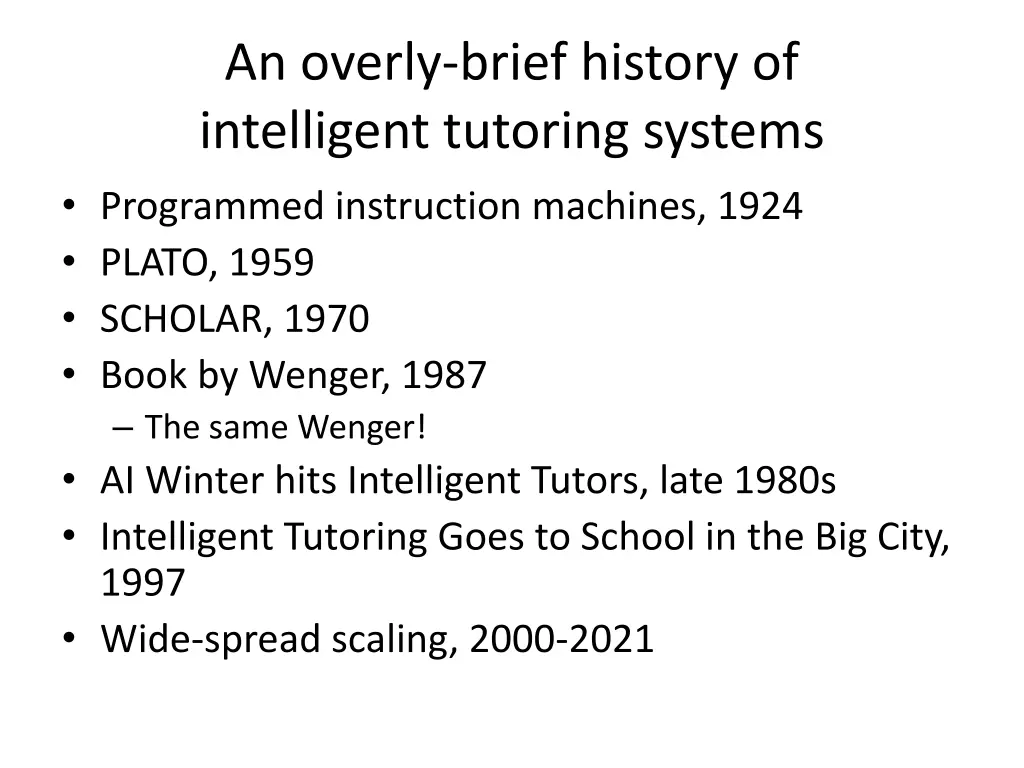
An overly-brief history of intelligent tutoring systems Programmed instruction machines, 1924 PLATO, 1959 SCHOLAR, 1970 Book by Wenger, 1987 The same Wenger! AI Winter hits Intelligent Tutors, late 1980s Intelligent Tutoring Goes to School in the Big City, 1997 Wide-spread scaling, 2000-2021
AI Winter A period when the AI methods of the 1970s and early 1980s were largely agreed to have failed Based on formal logic and formal reasoning Replaced by more statistical, bottom-up approaches Aka machine learning
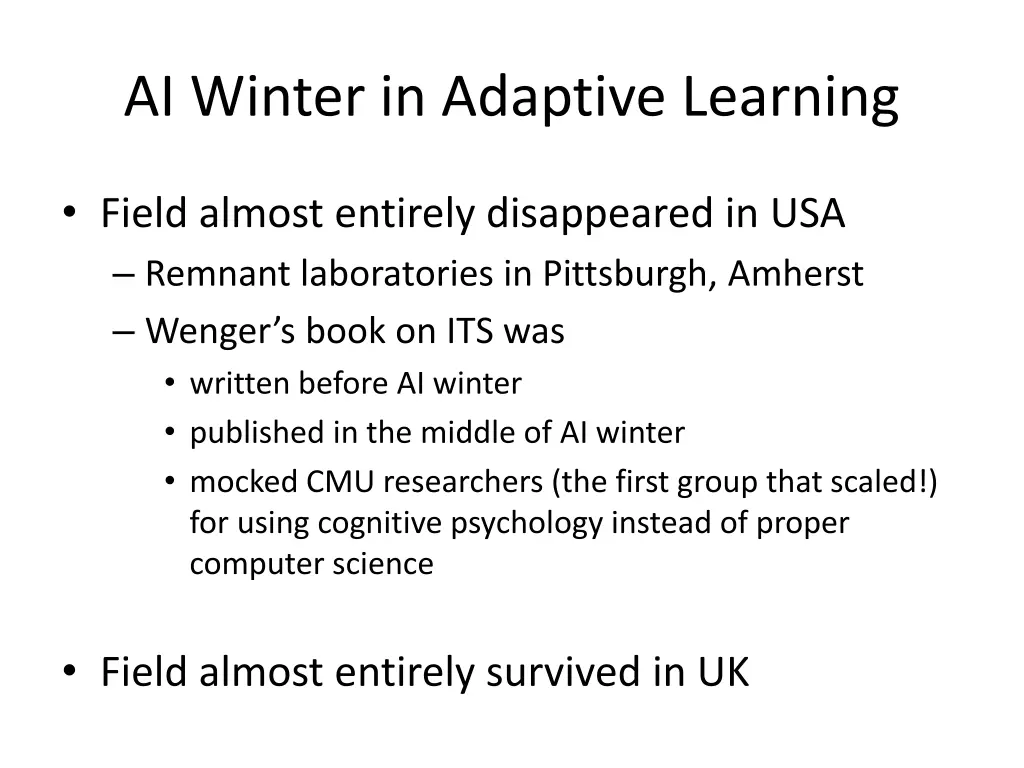
AI Winter in Adaptive Learning Field almost entirely disappeared in USA Remnant laboratories in Pittsburgh, Amherst Wenger s book on ITS was written before AI winter published in the middle of AI winter mocked CMU researchers (the first group that scaled!) for using cognitive psychology instead of proper computer science Field almost entirely survived in UK
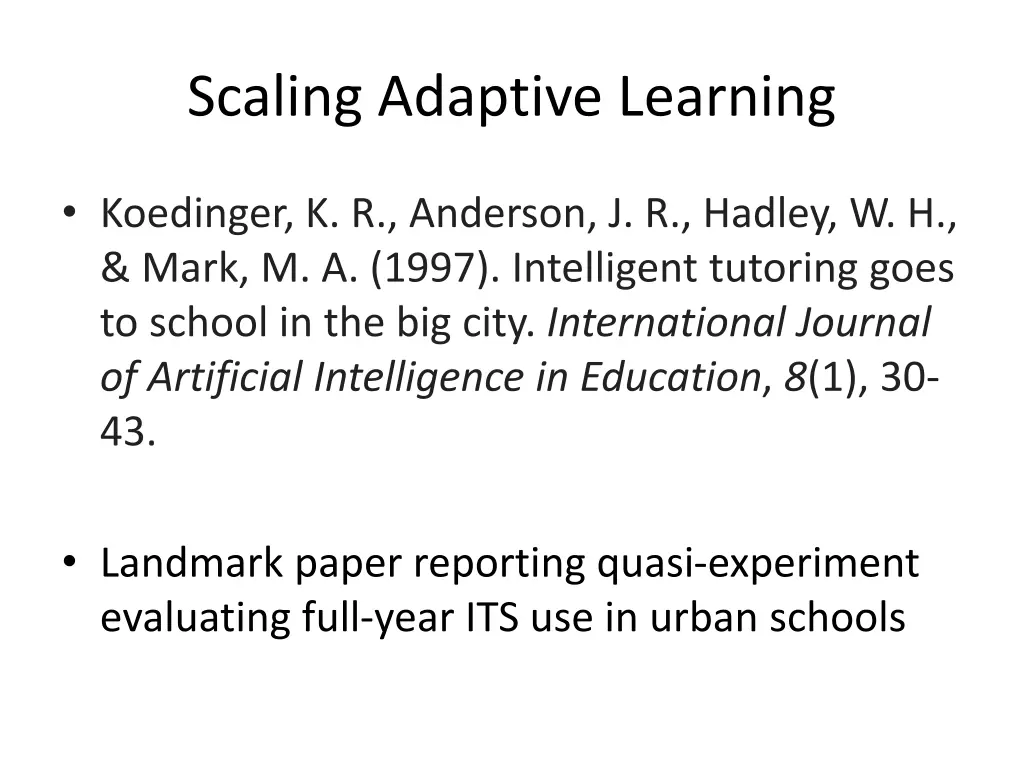
Scaling Adaptive Learning Koedinger, K. R., Anderson, J. R., Hadley, W. H., & Mark, M. A. (1997). Intelligent tutoring goes to school in the big city. International Journal of Artificial Intelligence in Education, 8(1), 30- 43. Landmark paper reporting quasi-experiment evaluating full-year ITS use in urban schools
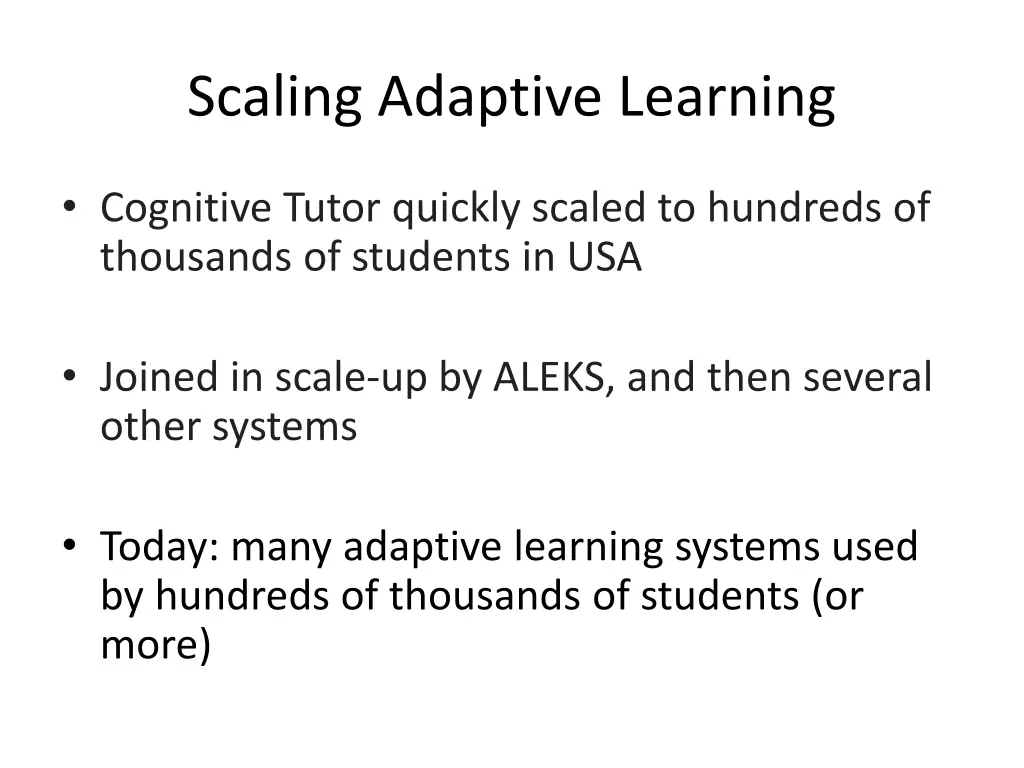
Scaling Adaptive Learning Cognitive Tutor quickly scaled to hundreds of thousands of students in USA Joined in scale-up by ALEKS, and then several other systems Today: many adaptive learning systems used by hundreds of thousands of students (or more)
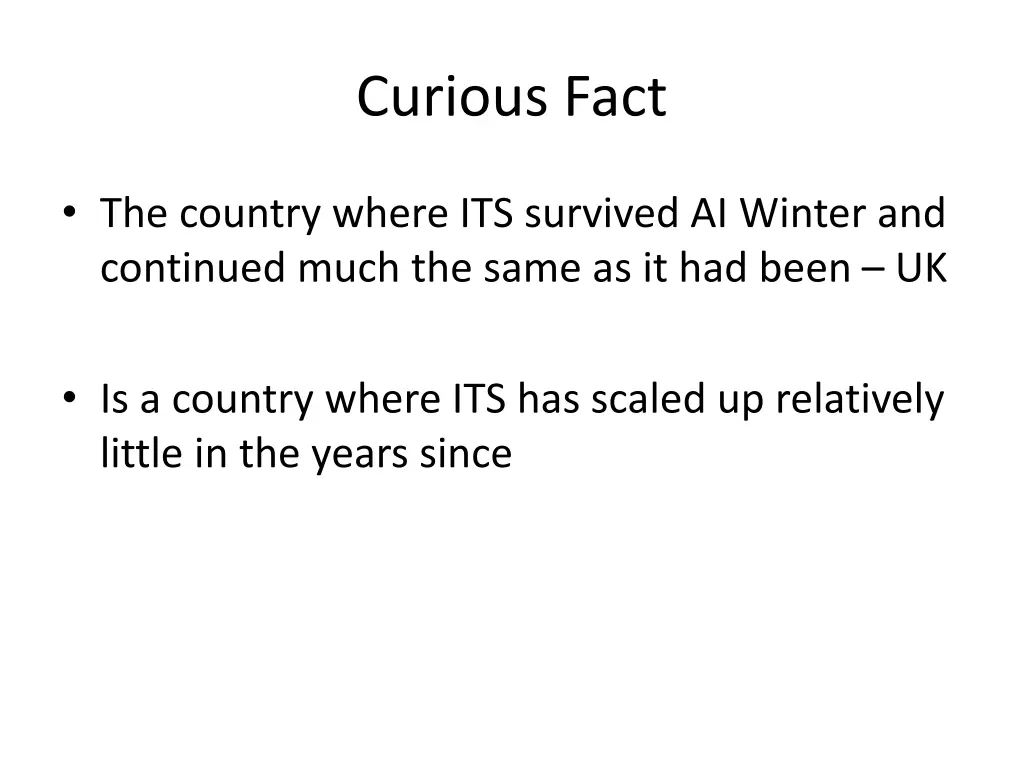
Curious Fact The country where ITS survived AI Winter and continued much the same as it had been UK Is a country where ITS has scaled up relatively little in the years since
Kurt Van Lehn One of the few survivors of AI Winter Designed several influential intelligent tutoring systems Key theoretician of intelligent tutoring systems
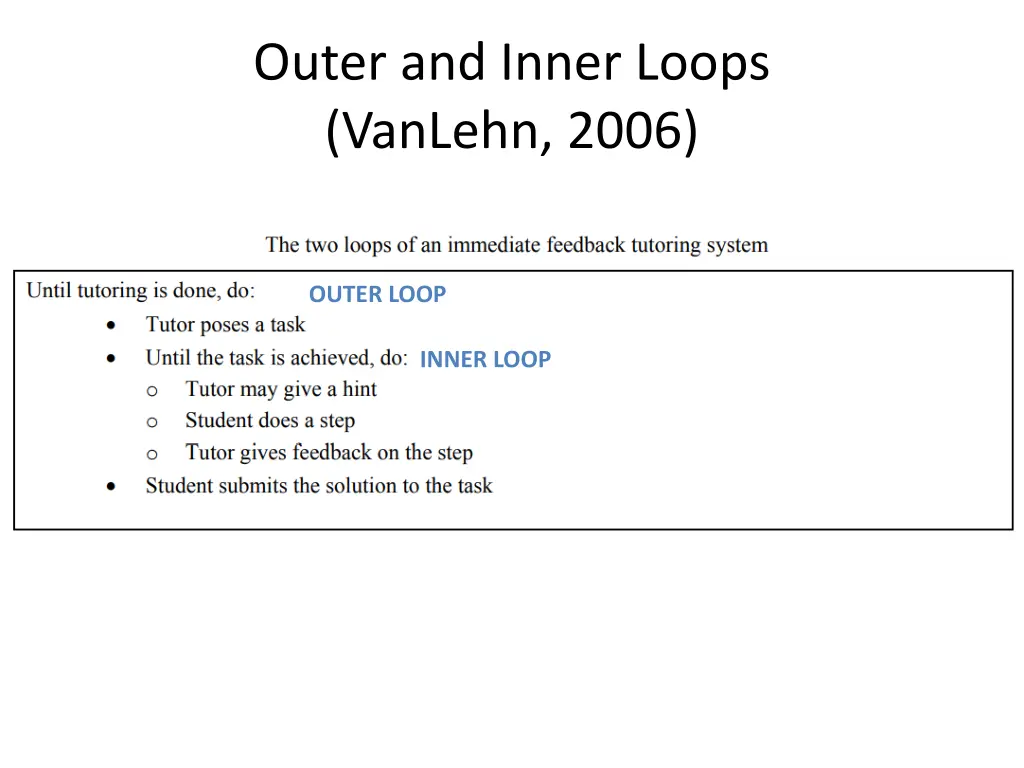
Outer and Inner Loops (VanLehn, 2006) OUTER LOOP INNER LOOP
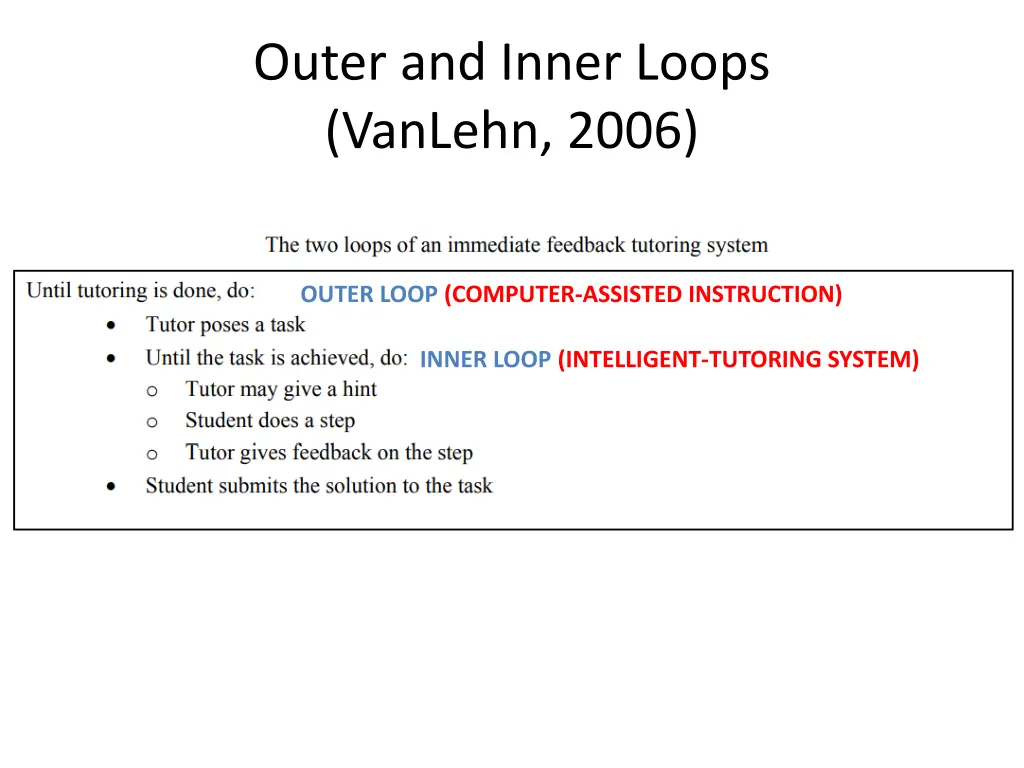
Outer and Inner Loops (VanLehn, 2006) OUTER LOOP (COMPUTER-ASSISTED INSTRUCTION) INNER LOOP (INTELLIGENT-TUTORING SYSTEM)
A lot of possibilities buried in this model A lot of ways to hint A lot of ways to adjust items and content A lot of ways to select items
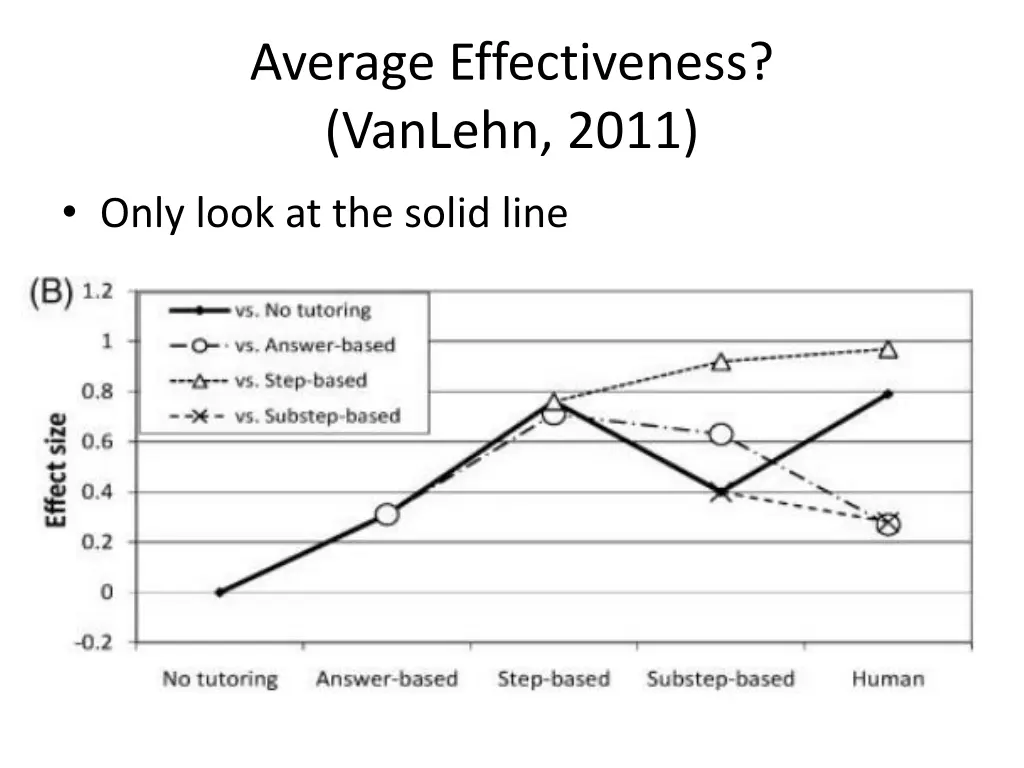
Going even deeper (VanLehn, 2011) Answer-based tutoring Student only gives final answers Step-based tutoring Lets students express steps towards solving problem Can give hints or feedback on steps Substep-based tutoring Dives into reasoning underlying steps Can shift problem based on wrong answer on step Can scaffold process involved in a step
Average Effectiveness? (VanLehn, 2011) Only look at the solid line
Lets categorize the systems in the readings How would VanLehn classify each system? Outer loop/inner loop adaptation Answer-based/step-based/substep-based
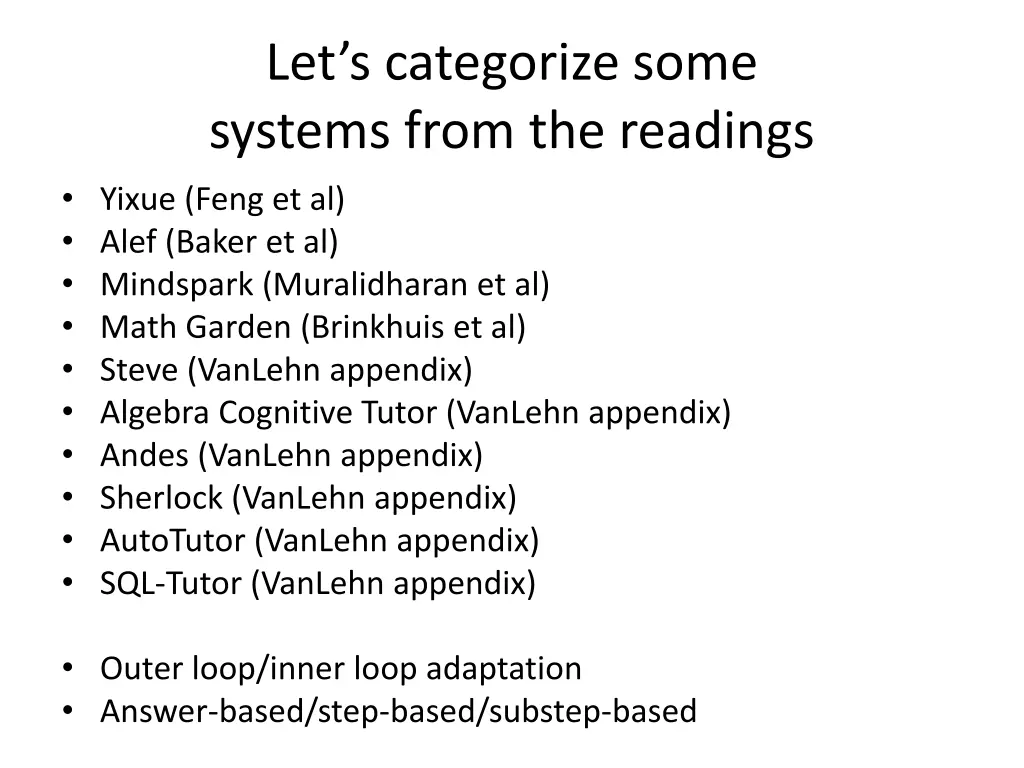
Lets categorize some systems from the readings Yixue (Feng et al) Alef (Baker et al) Mindspark (Muralidharan et al) Math Garden (Brinkhuis et al) Steve (VanLehn appendix) Algebra Cognitive Tutor (VanLehn appendix) Andes (VanLehn appendix) Sherlock (VanLehn appendix) AutoTutor (VanLehn appendix) SQL-Tutor (VanLehn appendix) Outer loop/inner loop adaptation Answer-based/step-based/substep-based
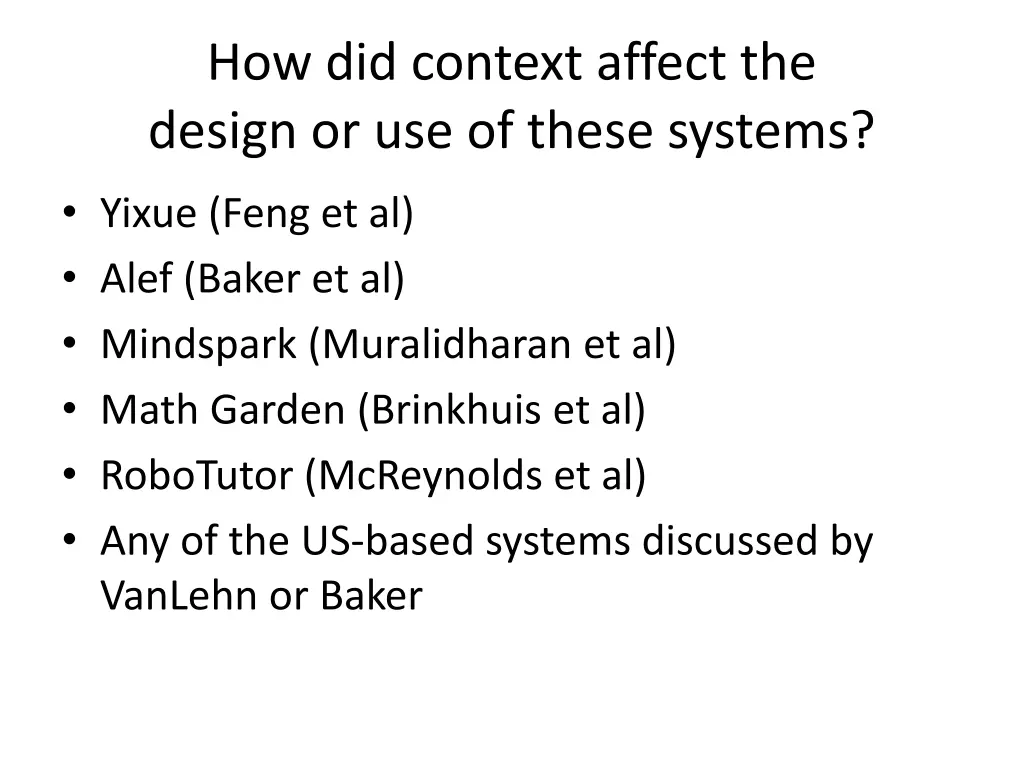
How did context affect the design or use of these systems? Yixue (Feng et al) Alef (Baker et al) Mindspark (Muralidharan et al) Math Garden (Brinkhuis et al) RoboTutor (McReynolds et al) Any of the US-based systems discussed by VanLehn or Baker
What is the role of the teacher in using adaptive learning technologies?
What strategies can/should teachers use when using these technologies?
Guide classroom discussion of homework Teachers use the information in the reports to facilitate their daily homework review time in the classroom including focusing attention on the homework problems that students had the most difficulty with, reviewing correct solution procedures for those problems as well as the common wrong answers to address underlying misunderstandings. (Murphy et al., 2020)
Make instructional decisions in real-time Students using adaptive learning in class Teacher uses real-time data on student performance to select students for proactive remediation, individually or in small groups While rest of class keeps working (Miller et al., 2015)
Make instructional interventions faster Intervening with a student who is struggling or disengaged earlier than otherwise possible (Wise & Jung, 2019)
Identify inactive students Identify which students aren t actually working on an activity (Dickler et al., 2021) Not always easy to tell from across the room
Revise homework materials and activities Identify specific questions or parts of activities that are harder than expected Fix them for next time It tells us we might need to look at a question again. For example, is this written well? or do we need to change the question? (Wise & Jung, 2019)
Intelligent Tutoring Systems versus Stupid Tutoring Systems Stupid Tutoring Systems = Tutors that do not, themselves, behave very intelligently. But tutors that are designed intelligently, and that leverage human intelligence
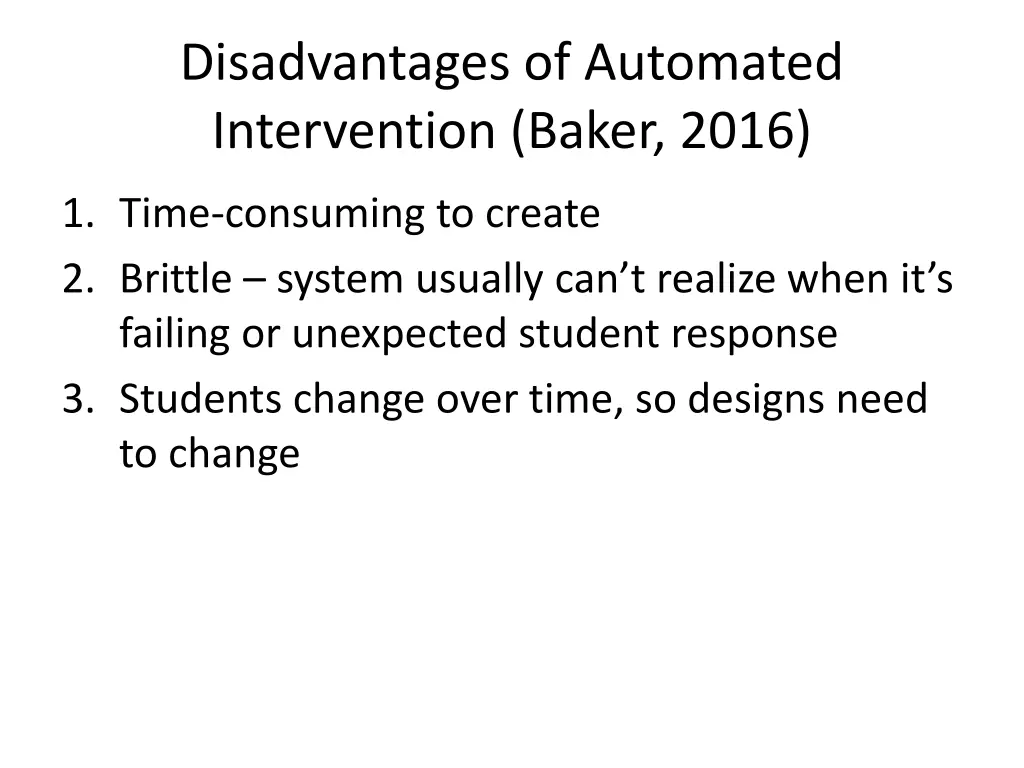
Disadvantages of Automated Intervention (Baker, 2016) 1. Time-consuming to create 2. Brittle system usually can t realize when it s failing or unexpected student response 3. Students change over time, so designs need to change
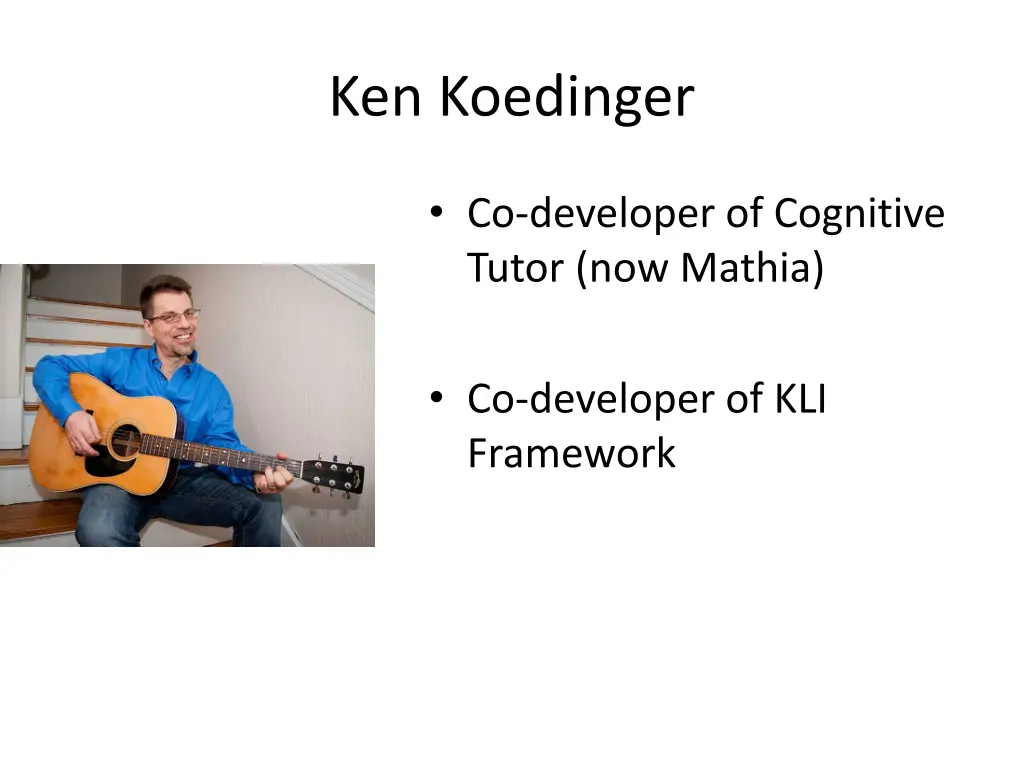
Ken Koedinger Co-developer of Cognitive Tutor (now Mathia) Co-developer of KLI Framework
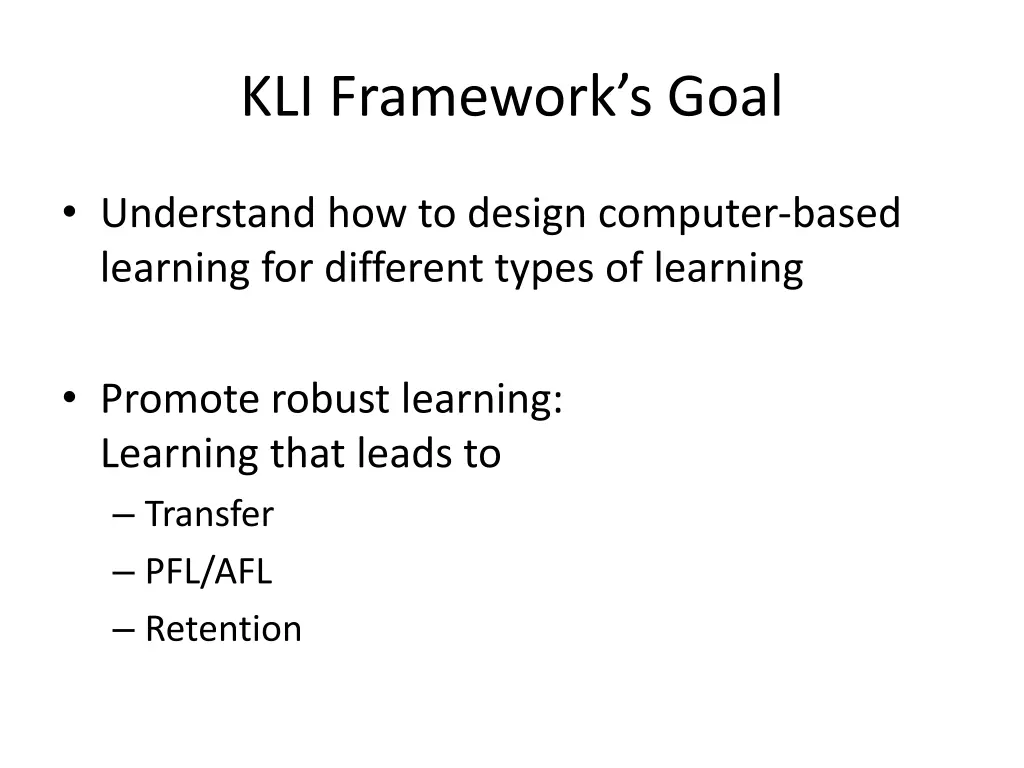
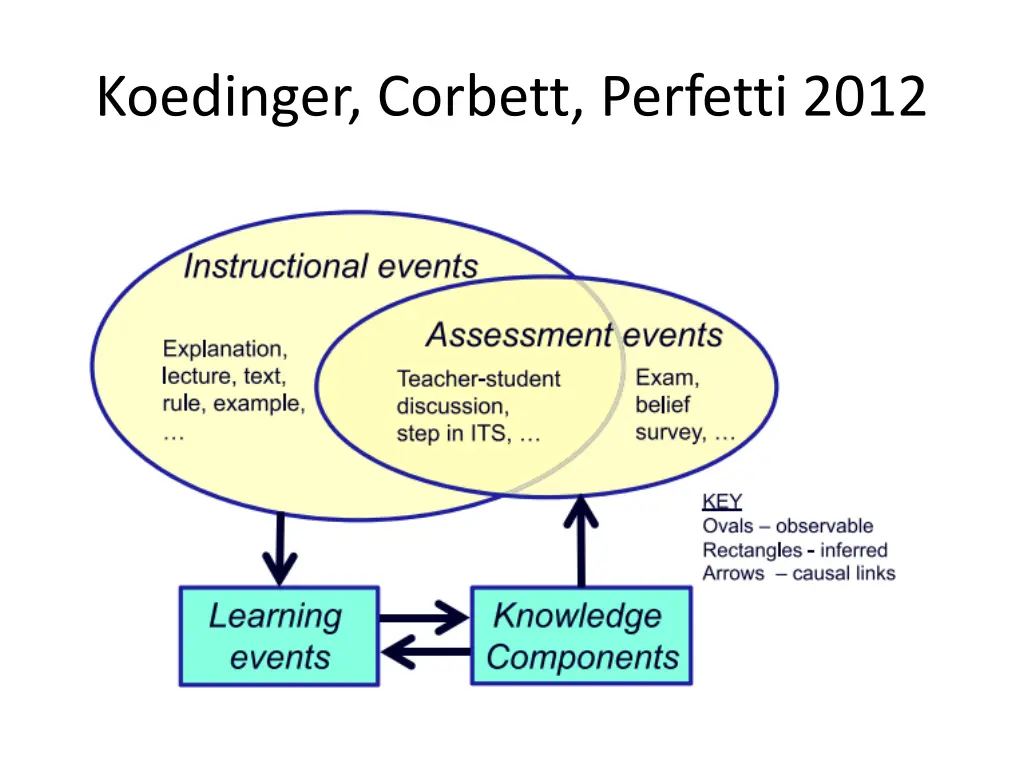
KLI Frameworks Goal Understand how to design computer-based learning for different types of learning Promote robust learning: Learning that leads to Transfer PFL/AFL Retention
Goals (a)identify mechanisms of student learning that lead to instructional principles (b) communicate instructional principles that are general over contexts and provide guidance to instructional designers
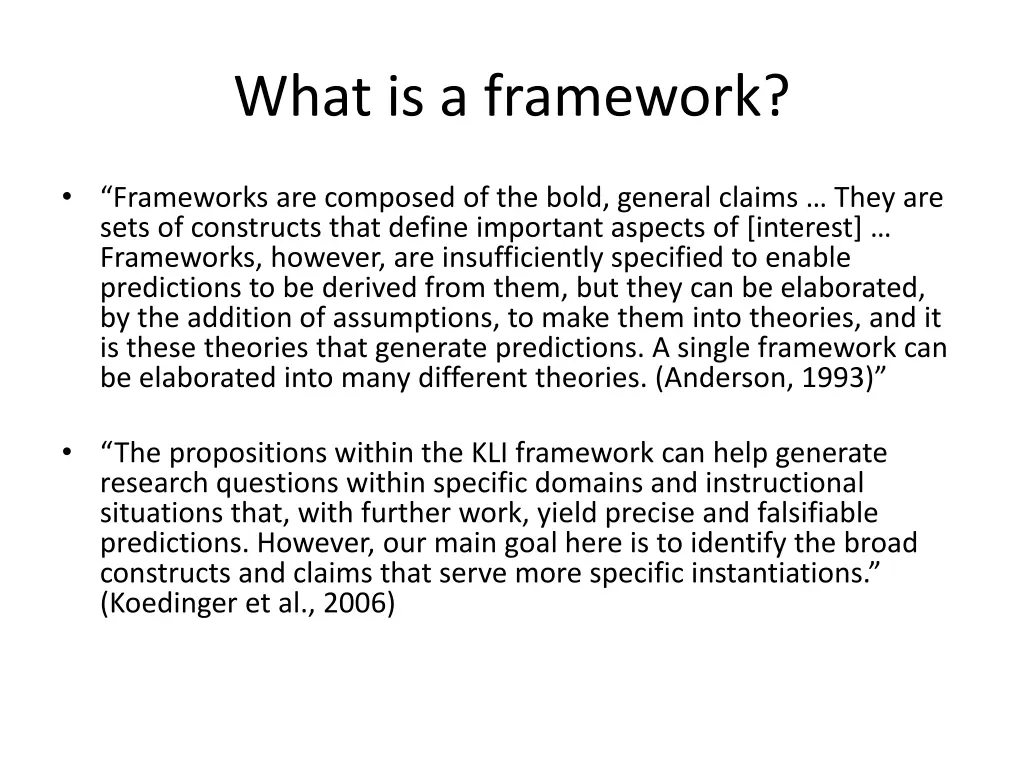
What is a framework? Frameworks are composed of the bold, general claims They are sets of constructs that define important aspects of [interest] Frameworks, however, are insufficiently specified to enable predictions to be derived from them, but they can be elaborated, by the addition of assumptions, to make them into theories, and it is these theories that generate predictions. A single framework can be elaborated into many different theories. (Anderson, 1993) The propositions within the KLI framework can help generate research questions within specific domains and instructional situations that, with further work, yield precise and falsifiable predictions. However, our main goal here is to identify the broad constructs and claims that serve more specific instantiations. (Koedinger et al., 2006)
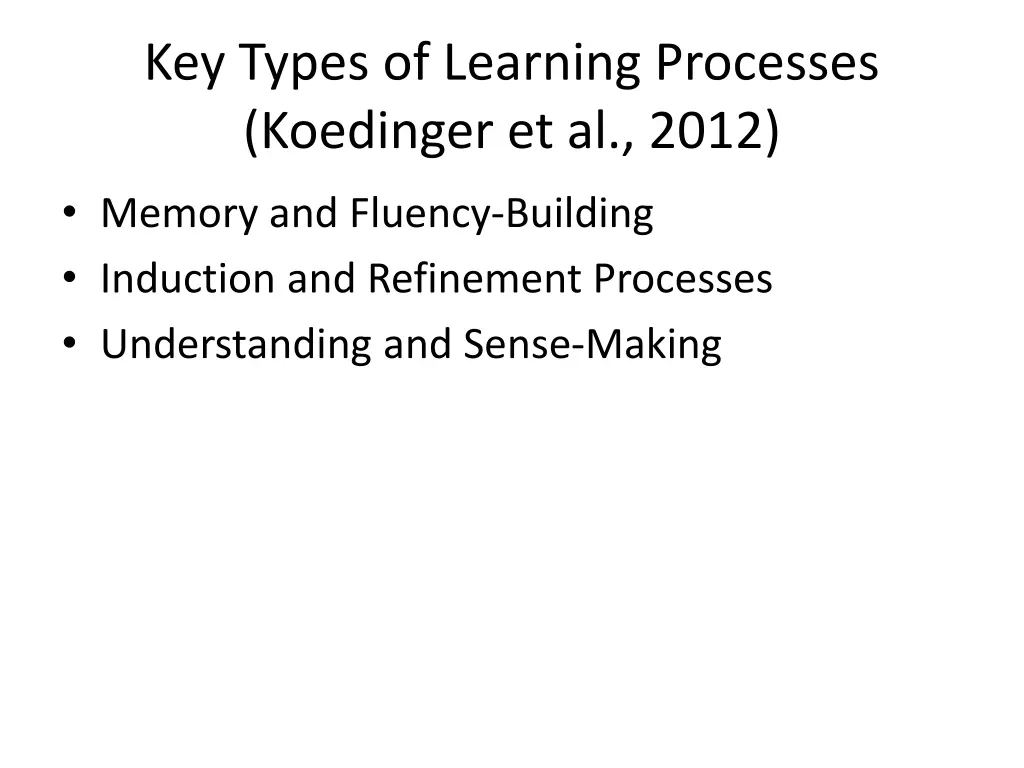
Key Types of Learning Processes (Koedinger et al., 2012) Memory and Fluency-Building Induction and Refinement Processes Understanding and Sense-Making
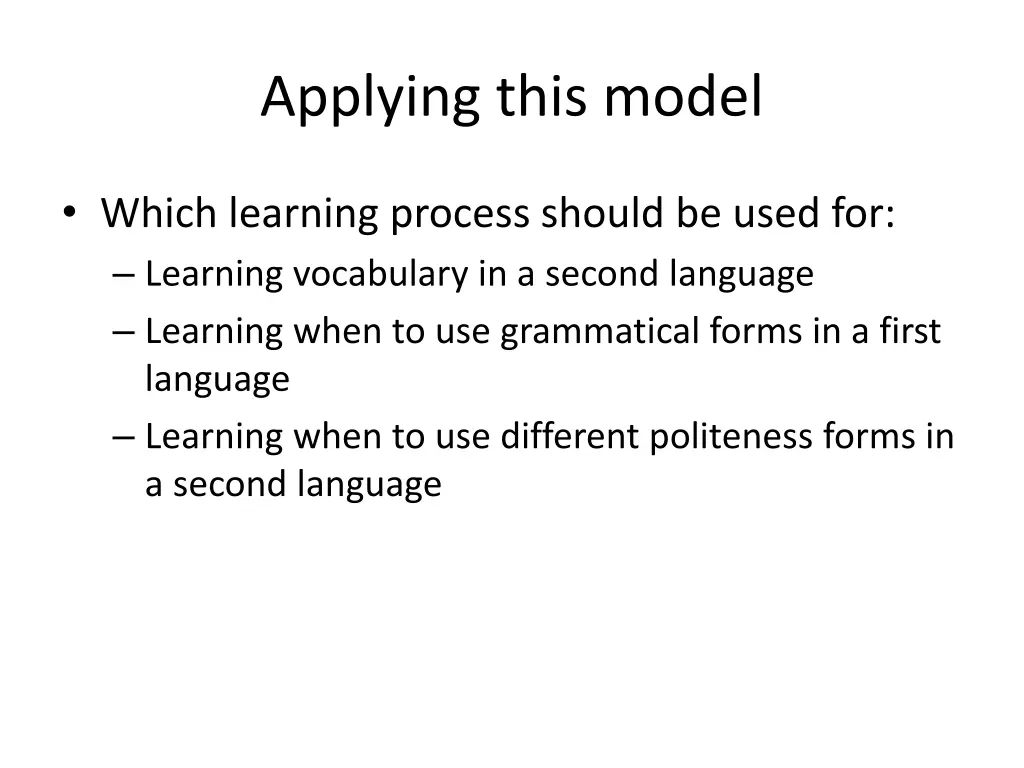
Applying this model Which learning process should be used for: Learning vocabulary in a second language Learning when to use grammatical forms in a first language Learning when to use different politeness forms in a second language
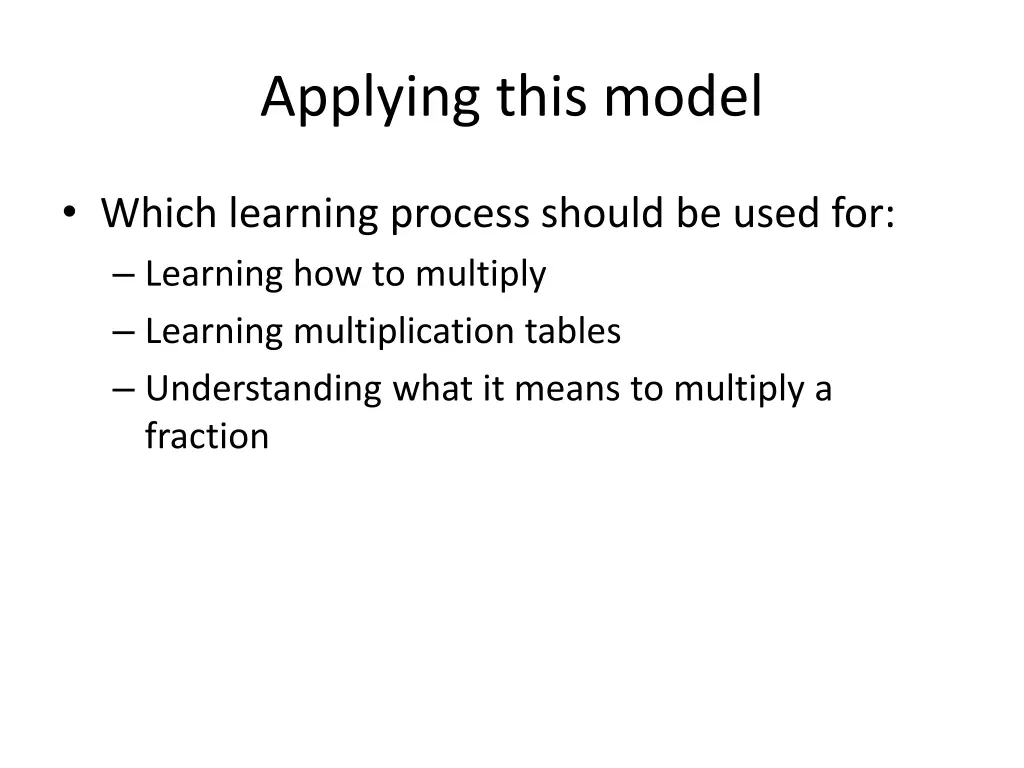
Applying this model Which learning process should be used for: Learning how to multiply Learning multiplication tables Understanding what it means to multiply a fraction
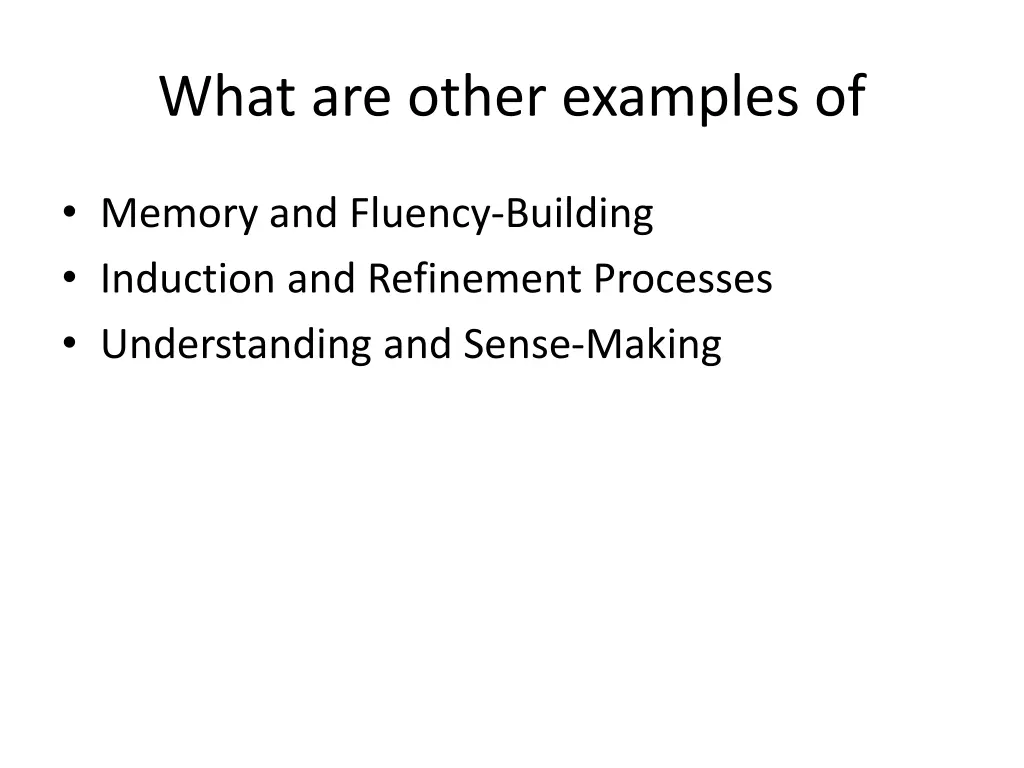
What are other examples of Memory and Fluency-Building Induction and Refinement Processes Understanding and Sense-Making
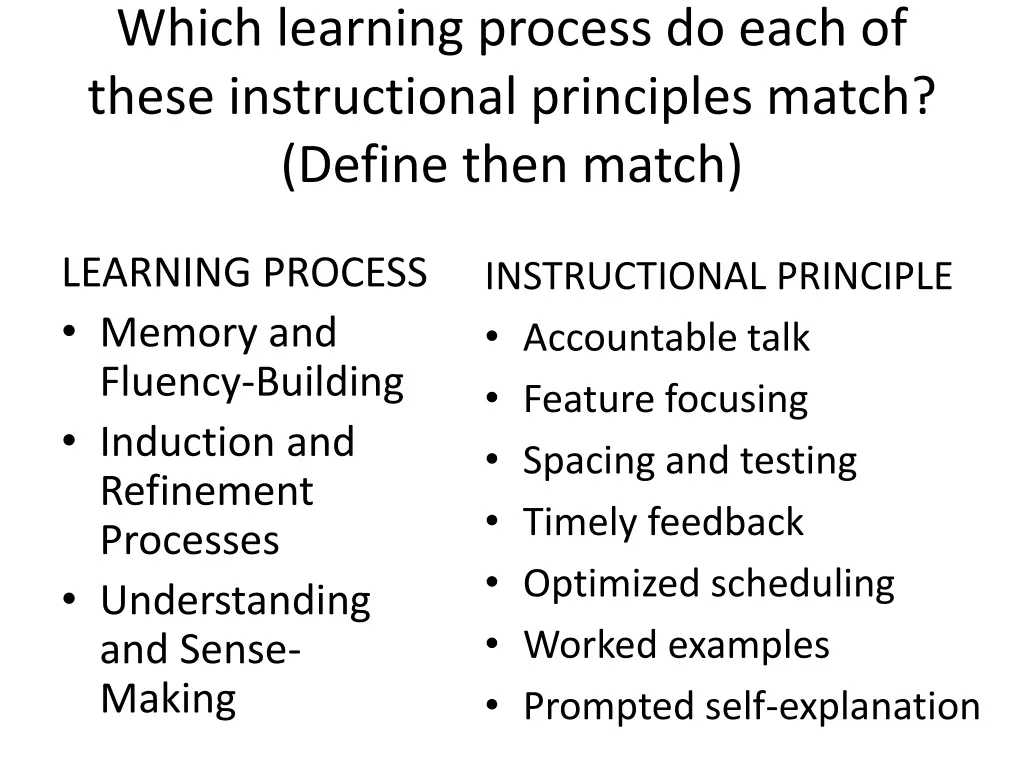
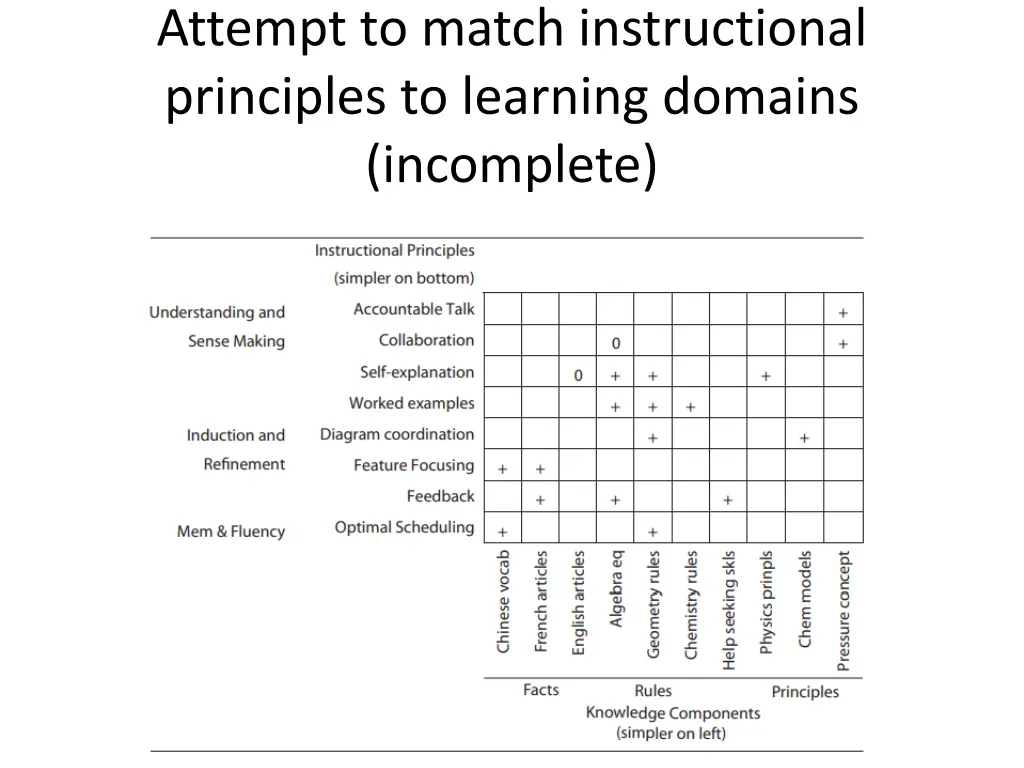
Which learning process do each of these instructional principles match? (Define then match) LEARNING PROCESS Memory and Fluency-Building Induction and Refinement Processes Understanding and Sense- Making INSTRUCTIONAL PRINCIPLE Accountable talk Feature focusing Spacing and testing Timely feedback Optimized scheduling Worked examples Prompted self-explanation
Attempt to match instructional principles to learning domains (incomplete)
Why incomplete? The center grant ended A lot of people have used the ideas in this paper But no one has really tried to continue or take forward the framework Why?
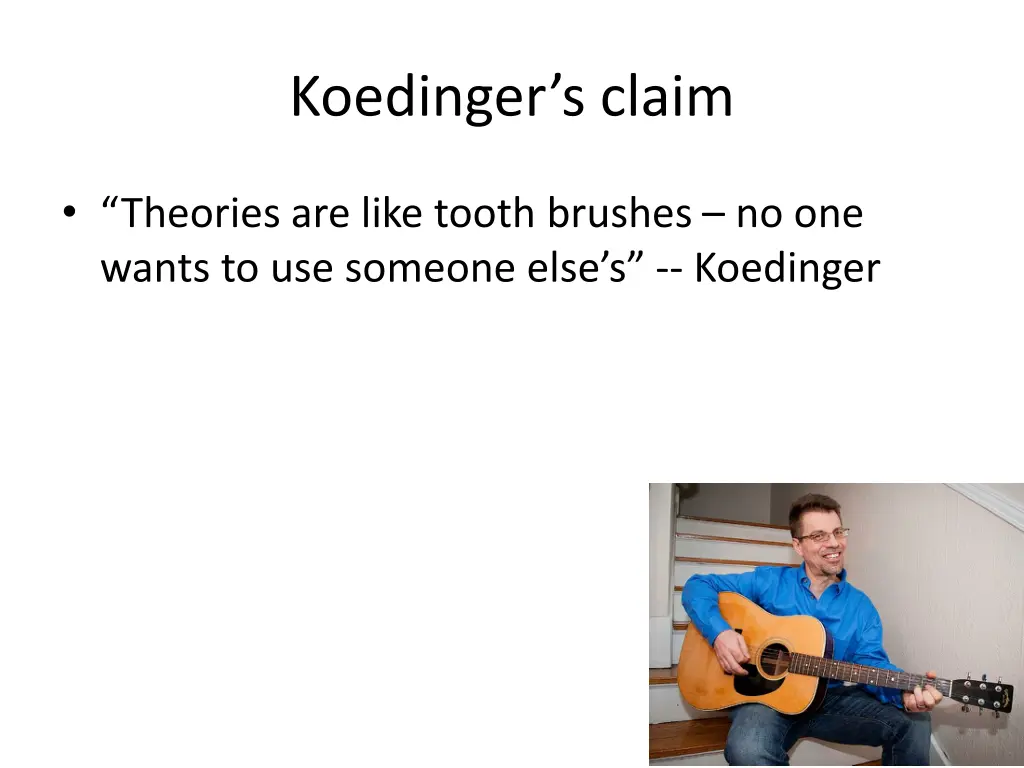
Koedingers claim Theories are like tooth brushes no one wants to use someone else s -- Koedinger
Is a framework like KLI useful for instructional design? Your thoughts?