Addressing Global Food Insecurity through Biodiversity
Hunger and malnutrition are growing concerns exacerbated by economic crises and climate change. Emphasizing biodiversity in food production, promoting neglected species, and fostering local agricultural diversity are vital steps towards sustainable food security and improved nutrition. Initiatives like promoting African leafy vegetables in Kenya and exploring nutritious minor millets in India showcase the potential for enhancing food diversity and health worldwide.

Download Presentation

Please find below an Image/Link to download the presentation.
The content on the website is provided AS IS for your information and personal use only. It may not be sold, licensed, or shared on other websites without obtaining consent from the author.If you encounter any issues during the download, it is possible that the publisher has removed the file from their server.
You are allowed to download the files provided on this website for personal or commercial use, subject to the condition that they are used lawfully. All files are the property of their respective owners.
The content on the website is provided AS IS for your information and personal use only. It may not be sold, licensed, or shared on other websites without obtaining consent from the author.
E N D
Presentation Transcript
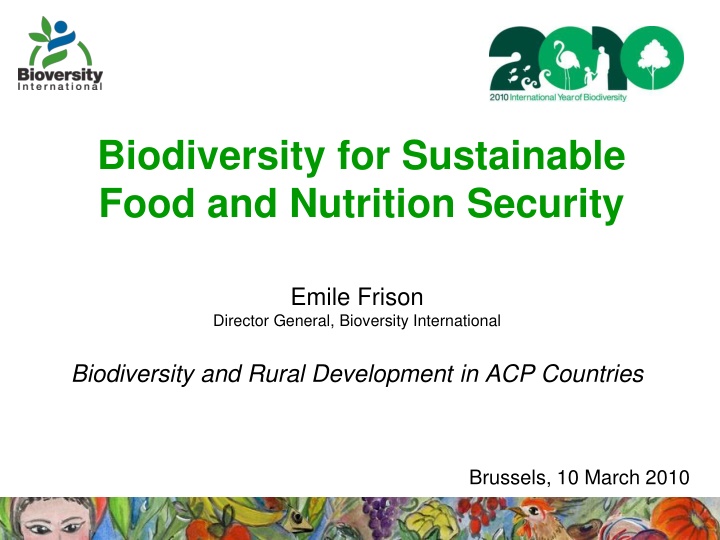
Biodiversity for Sustainable Food and Nutrition Security Emile Frison Director General, Bioversity International Biodiversity and Rural Development in ACP Countries Brussels, 10 March 2010
Hunger is increasing With the current global economic crisis, the food price crisis of 2007-2008 and climate change, reversing this trend will be a significant challenge
Malnutrition and famine 1020 million people hungry 1100 million people Overweight More than 1 person out of 3 is malnourished
Nutrition Hidden hunger: missing micronutrients More than 2 billion worldwide Mostly women and children Double burden: diseases of affluence Type 2 diabetes, obesity, heart disease, cancers
Diversity of Diet Diverse diet protects Indigenous/traditional species/varieties offer nutritional advantages Promote local agricultural biodiversity for improved diets and health Also more sustainable
Focus on neglected species Wide range of species, not all cultivated Indigenous, locally adapted, environmentally friendly, nutritious Perceived as backward Abandoned by scientists and ignored by policy makers Bioversity has slowly promoted and expanded to build a global project
African leafy vegetables Amaranth (leaf) Cleome Nightshade Cabbage Per 100 gm 8.9 6.0 1.0 0.7 Iron mg 410 288 442 47 Calcium mg carotene 5716 10452 3660 100 g
Kenya Partnered with Family Concern (NGO) and Uchumi Supermarkets Traditional leafy vegetables Seed supply and agronomy Training for cleaner, high- quality produce Leaflets to educate shoppers Sales increase 1100% in two years
Other Studies India: Nutritious minor millets Small mills to reduce drudgery Local entrepreneurs develop snacks and biscuits with low GI Bolivia Andean grains
Climate Change
Adaptability 2025 2050 2075 0% Overlap with historical climate 100% Selection and adaptation require diversity New climates New varieties start breeding now New crops social factors unknown
Safeguard the diversity we will need tomorrow: crop wild relatives Use existing data for accessions Combine with climate change GIS data Gap analysis to target collection in endangered areas
Intensification without Simplification
Resilience and Stability perturbation ecosystem property (e.g. production) stability resistance resilience time
Many examples Barley in East Germany Hay meadows in UK Prairie productivity in US Rice blast in China Hanfetz (barley-wheat) in Eritrea