Adler Planetarium and Near-Earth Object Research
The Adler Planetarium, in collaboration with researchers such as Mark Hammergren, conducts observational research and outreach programs to study star formation and confirm basaltic asteroids. Additionally, they engage in near-Earth object follow-up and characterization using the ARC 3.5-m telescope. Through various instruments and methodologies, they strive to understand the nature and behavior of these celestial bodies. Furthermore, the institution emphasizes the importance of viewing resources beyond mere hazards, aligning with initiatives like the NASA Asteroid Redirect Mission.

Download Presentation

Please find below an Image/Link to download the presentation.
The content on the website is provided AS IS for your information and personal use only. It may not be sold, licensed, or shared on other websites without obtaining consent from the author.If you encounter any issues during the download, it is possible that the publisher has removed the file from their server.
You are allowed to download the files provided on this website for personal or commercial use, subject to the condition that they are used lawfully. All files are the property of their respective owners.
The content on the website is provided AS IS for your information and personal use only. It may not be sold, licensed, or shared on other websites without obtaining consent from the author.
E N D
Presentation Transcript
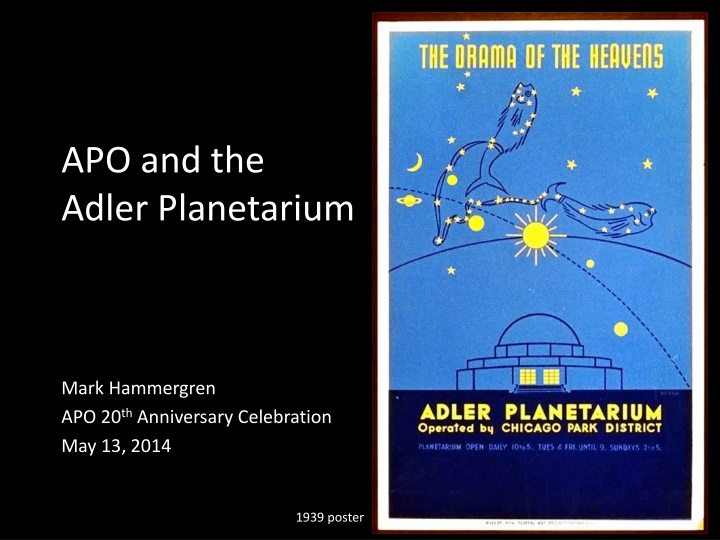
APO and the Adler Planetarium Mark Hammergren APO 20thAnniversary Celebration May 13, 2014 1939 poster
Adler Research and Outreach Molinari 11 Twilight observing during extended evening hours (ended mid-2000s), observing classes Two major research programs: Star formation (led by Grace Wolf-Chase) Confirmation of basaltic asteroids (led by Mark Hammergren)
Near-Earth Object Follow-up and Characterization with ARC 3.5-m Two year, $1.3M grant from NASA Near-Earth Object Observations (ROSES 2013) Lease 17% share of 3.5-m (ex U Chicago) Frequent, brief sessions for astrometric follow-up Regularly scheduled half-nights, and infrequent Target-of-Opportunity runs on high-priority targets, for physical characterization
Public Law No. 109-155, enacted 2005 (part of NASA Authorization Act of 2005)
ARC 3.5-m telescope: a uniquely capable facility Remote observing (partial night and ToO scheduling) Full, rapid-swap suite of instrumentation Relatively large aperture (for asteroid work)
SPIcam, DIS, ARCTIC imaging Astrometric follow-up, multicolor photometry DIS, TripleSpec Reflectance spectroscopy (surface mineral comp.) Agile high speed imager Rotational lightcurves (rotation rate; tumbling?)
NEO 2013 JC, g ~ 22.6, r ~ 23.0 1 x 5 minute exposure with DIS
NEO 2013 JM22, predicted V~17.6 1 x 20 minute exposure with DIS (low-res)