Adolescents' Interpersonal Attitudes and Media Products Perception Study
Explore the impact of interpersonal attitudes on adolescents' perception of media products in the context of the film industry. The study delves into the significance of promoting healthy relationships in the media and aims to understand teenagers' responses to different interpersonal scenarios portrayed in media content. Research methods, including psychodiagnostic techniques and statistical analyses, were used to evaluate teenagers' relationship patterns and role expectations. This study sheds light on the importance of fostering psychologically healthy interactions among adolescents in modern Russian society.

Download Presentation

Please find below an Image/Link to download the presentation.
The content on the website is provided AS IS for your information and personal use only. It may not be sold, licensed, or shared on other websites without obtaining consent from the author. If you encounter any issues during the download, it is possible that the publisher has removed the file from their server.
You are allowed to download the files provided on this website for personal or commercial use, subject to the condition that they are used lawfully. All files are the property of their respective owners.
The content on the website is provided AS IS for your information and personal use only. It may not be sold, licensed, or shared on other websites without obtaining consent from the author.
E N D
Presentation Transcript
Media Products Perception by Adolescents with Different Interpersonal Attitudes Tatiana S. Pilishvili pilishvili-ts@rudn.ru Candidate of psychological sciences, associate professor, the Department of psychology and pedagogics Peoples' Friendship University of Russia named after Patrice Lumumba
The Social significance of this study is based on: The State Program Information Society , https://digital.gov.ru/ru/activity/programs/1/ the Decree of the Russian Federation President dated May 9, 2017 No. 203 On Strategies for the development of the information society in the Russian Federation on 2017 2030 , http://www.kremlin.ru/acts/bank/41919 the Decree on the 2024 Year of the Family, http://www.kremlin.ru/events/president/news/72792 in modern Russian society there is an acute question improving the quality of citizens life, countering the spread of violence and promoting healthy personal development of Russians including families. Relevance of the study: The issue of improving families and children life quality, countering the spread of media violence and promoting healthy personal development is acute. The purpose is to identify teenagers relationship with various interpersonal attitudes to media products (using the example of the film industry). Interpersonal relationships, broadcast to teenagers as normal in the media and cinema, can have a significant impact on psychological health and personal sovereignty. 2
Research methods: to evaluate interpersonal relationships actively promoted in the media, Osgood's semantic differential (11 points) was used. Interpersonal relationships were evaluated: with a tendency towards romanticization; with a tendency to abandon their own sovereignty and absorb the partner s psychological territory; with a tendency to violate the both participants psychological territory; quite psychologically healthy and safe relationships. Psychodiagnostic techniques were used to assess role expectations and attitudes in a potential couple: 1) Relationship profile test (R. Bornstein) (adaptation by O.P. Makushina, 2005); 2) Interpersonal Adjective Check List Diagnosis of Personality (adaptation of L.N. Sobchik, 1970). A gender-balanced study sample was made up of 102 high school teenagers from Moscow schools who took part in RUDN University educational activities (age 15-16 years). Statistics: Mann-Whitney U test, Spearman R coefficient, factorial analysis. 3
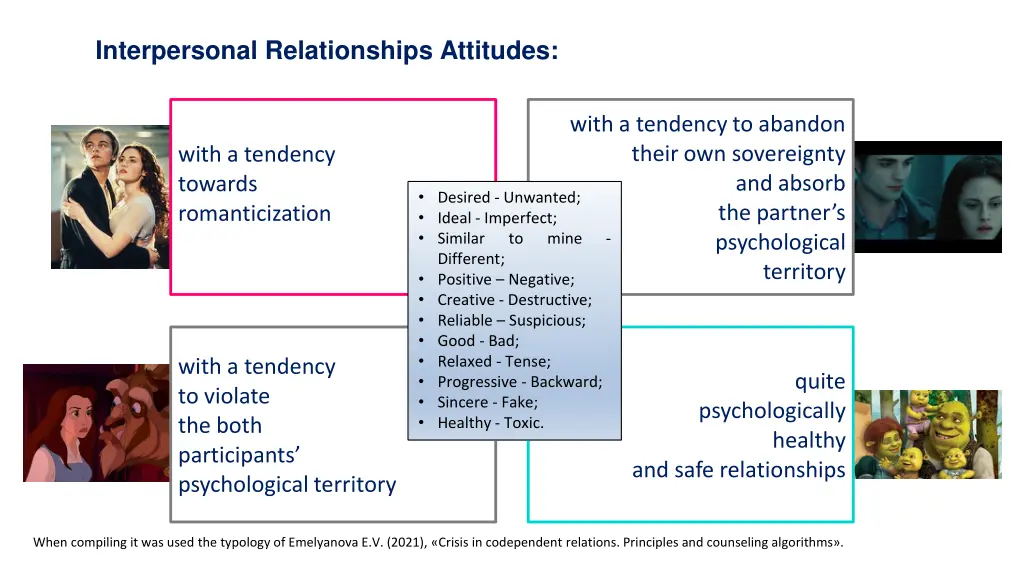
Interpersonal Relationships Attitudes: with a tendency to abandon their own sovereignty with a tendency towards romanticization and absorb the partner s psychological territory Desired - Unwanted; Ideal - Imperfect; Similar Different; Positive Negative; Creative - Destructive; Reliable Suspicious; Good - Bad; Relaxed - Tense; Progressive - Backward; Sincere - Fake; Healthy - Toxic. to mine - with a tendency to violate the both participants psychological territory quite psychologically healthy and safe relationships When compiling it was used the typology of Emelyanova E.V. (2021), Crisis in codependent relations. Principles and counseling algorithms .
Main results of the study: In a comparative analysis (Mann-Whitney U test), differences by gender were obtained. Young men showed a greater predisposition to relationships: with a tendency to sovereignty and absorb territory of the partner, as well as with a tendency to violate the psychological territory of both participants. ! Reliable-suspiciousU = 537, p = 0.022, m (girls) = 4.2, m (boys) = 3.18; relationships with a tendency to collapse are seen as reliable ! Progressive-retardedU = 555, p = 0.034, m (girls) = 4.29, m (boys) = 3.38; tendency to violate the psychological territory progressive Girls are characterized by being more dependent on the others opinions, as well as the personal boundaries blurring. abandon the their psychological own ! Destructiveover-dependenceU = 590, p = 0.01, m girls = 30.5, m boys = 26.9; less stable boundaries ! Dependent-obedient U = 647, p = 0.037, m (girls) = 4.58, m (boys) = 3.44; tendency to adjust ! Good-bad U = 631, p = 0.039, m (girls) = 2.07, m (boys)= 1,72; healthy relationships are perceived not as good but as neutral Healthy-toxic U = 543, p = 0.025, m (girls) = 4.6, m (boys) = 3.82; perceive the violation of both participants territory as toxicity of participants as 5
Main results of the study: Spearman R coefficient Girls Correlation between distrust, skepticism, suspicion and desire control others, manipulate, confirm their significance. Girls with a tendency to addiction in relationships, blurred personal boundaries, there is a positive tendency towards touchiness, suspicion and distrust. The less expressed the desire control, manipulate, depend on others, the less pronounced and skepticism as well as distrust. Girls, not wishing to shift responsibility for their own well-being to a partner, have a negative view of relationships in which there is a refusal in their own interests, values. Young men Young criticism, discontent, more autonomous, distrustful, prone to losing their "I" in close relationships and co-dependencies. Young men who consider romanticizing love through a reliable relationship model shifting responsibility for their own well-being onto the partner, dogmatism, intolerance of criticism and overestimation are observed own capabilities. Creativity, psychologically healthy relationships significantly correlate interpersonal relationships, love idealization. men with more touchiness, distrust, heavy-handedness, with the sincerity of 6
Main results of the study: Factor analysis Young men Factor 1. Perception as setting to relative psychologically healthy relationships, taking into account their creative character, sincerity and desire; Factor 2. Perception as setting on relationships that can lead to a violation of the participants psychological territory; Factor 3. Perception as setting a romanticized love for Other as meeting the Ideal-I standard; Factor 4. Perception incorporation psychological interpersonal relationships. Girls Factor 1. Perception as setting to relatively psychologically healthy relationships, taking idealization and progressiveness; Factor 2. Perception as setting on relationships that can lead to a violation of the participants psychological territory taking into account their domination; Factor 3. Perception as setting on romanticizing risk interpersonal relationships incorporation of partners psychological territory. interpersonal interpersonal account into their as installation territory for in 7
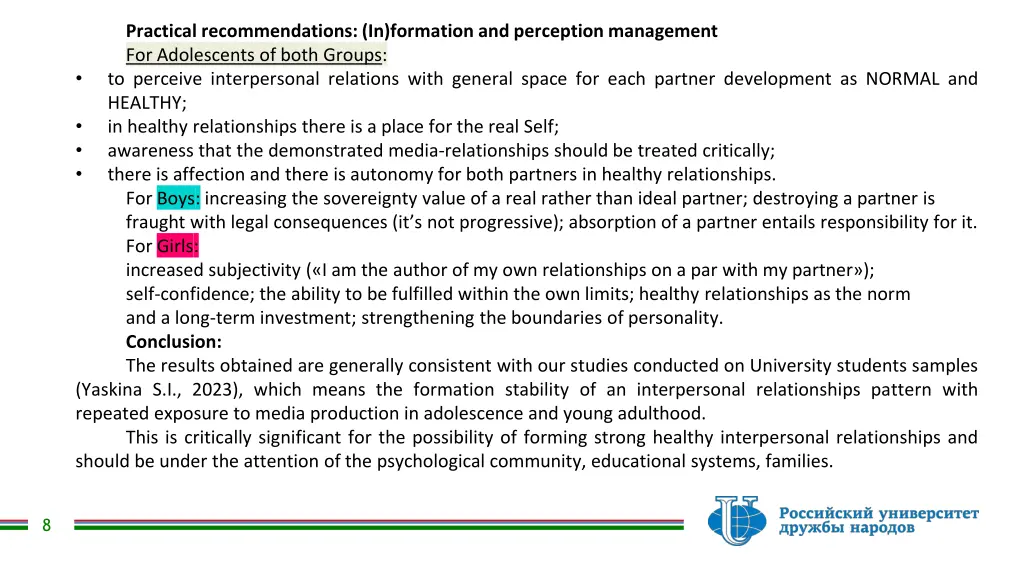
Practical recommendations:(In)formation and perception management For Adolescents of both Groups: to perceive interpersonal relations with general space for each partner development as NORMAL and HEALTHY; in healthy relationships there is a place for the real Self; awareness that the demonstrated media-relationships should be treated critically; there is affection and there is autonomy for both partners in healthy relationships. For Boys: increasing the sovereignty value of a real rather than ideal partner; destroying a partner is fraught with legal consequences (it s not progressive); absorption of a partner entails responsibility for it. For Girls: increased subjectivity ( I am the author of my own relationships on a par with my partner ); self-confidence; the ability to be fulfilled within the own limits; healthy relationships as the norm and a long-term investment; strengthening the boundaries of personality. Conclusion: The results obtained are generally consistent with our studies conducted on University students samples (Yaskina S.I., 2023), which means the formation stability of an interpersonal relationships pattern with repeated exposure to media production in adolescence and young adulthood. This is critically significant for the possibility of forming strong healthy interpersonal relationships and should be under the attention of the psychological community, educational systems, families. 8
References 1. 2. Anderson M., Jiang J. Teens, social media and technology 2018. Pew Res. Center. 2018;31:1673 1689. Bozzola E., Spina G., Ruggiero M., Vecchio D., Caruso C., Bozzola M., Staiano A.M., Agostiniani R., Del Vecchio A., Banderali G., et al. Media use during adolescence: The recommendations of the Italian Pediatric Society. Ital. J. Pediatrics. 2019;45:149. doi: 10.1186/s13052-019-0725-8. Chassiakos Y.L.R., Radesky J., Christakis D., Moreno M.A., Cross C. Children and adolescents and digital media. Am. Acad. Pediatrics. 2016;138:e20162593. doi: 10.1542/peds.2016-2593. Embodied Metaphors in Film, Television, and Video Games: Cognitive Approaches / Ed. K. Fahlenbrach N.Y.: Routledge, 2016. XIV, 300 p. (Routledge Research in Cultural and Media Studies. Vol. 76). Emel`yanova E. V. Krizis v sozavisimy`x otnosheniyax. Principy` I algoritmy` konsul`tirovaniya / E. V. Emel`yanova. spb.: Rech`, 2014. 320 s. Itzchakov G and DeMarree KG (2022) Attitudes in an interpersonal context: Psychological safety as a route to attitude change. Front. Psychol. 13:932413. doi: 10.3389/fpsyg.2022.932413. Venevskaya I.A. O social'noj situacii razvitiya sovremennyhpodrostkov // Aktual'nye problemy i tekhnologii yuridicheskoj psihologii detstva: ot deviantnogo razvitiya k normativnomupovedeniyu. https://psyjournals.ru/nonserialpublications/cjp2017/contents/Venevskaya 3. 4. 5. 6. 7. Thank you for your attention!