Advanced Algorithms: Polynomial Identity Testing and Applications
Explore polynomial identity testing and its applications in advanced algorithms. Learn about the Schwartz-Zippel Lemma, perfect matching in bipartite graphs, and more. Join the course to dive into these topics and enhance your algorithmic skills.

Download Presentation

Please find below an Image/Link to download the presentation.
The content on the website is provided AS IS for your information and personal use only. It may not be sold, licensed, or shared on other websites without obtaining consent from the author. If you encounter any issues during the download, it is possible that the publisher has removed the file from their server.
You are allowed to download the files provided on this website for personal or commercial use, subject to the condition that they are used lawfully. All files are the property of their respective owners.
The content on the website is provided AS IS for your information and personal use only. It may not be sold, licensed, or shared on other websites without obtaining consent from the author.
E N D
Presentation Transcript
CMPT 409/815 Advanced Algorithms September 28, 2020
Announcements First assignment is online. Submit your solutions to Coursys by October 7, 2020 Office hours: Wednesdays 11:30, after the lecture. Link to zoom on course homepage
Plan for today Polynomial identity testing Applications: Finding perfect matching in bipartite graphs
Polynomial Identity Testing
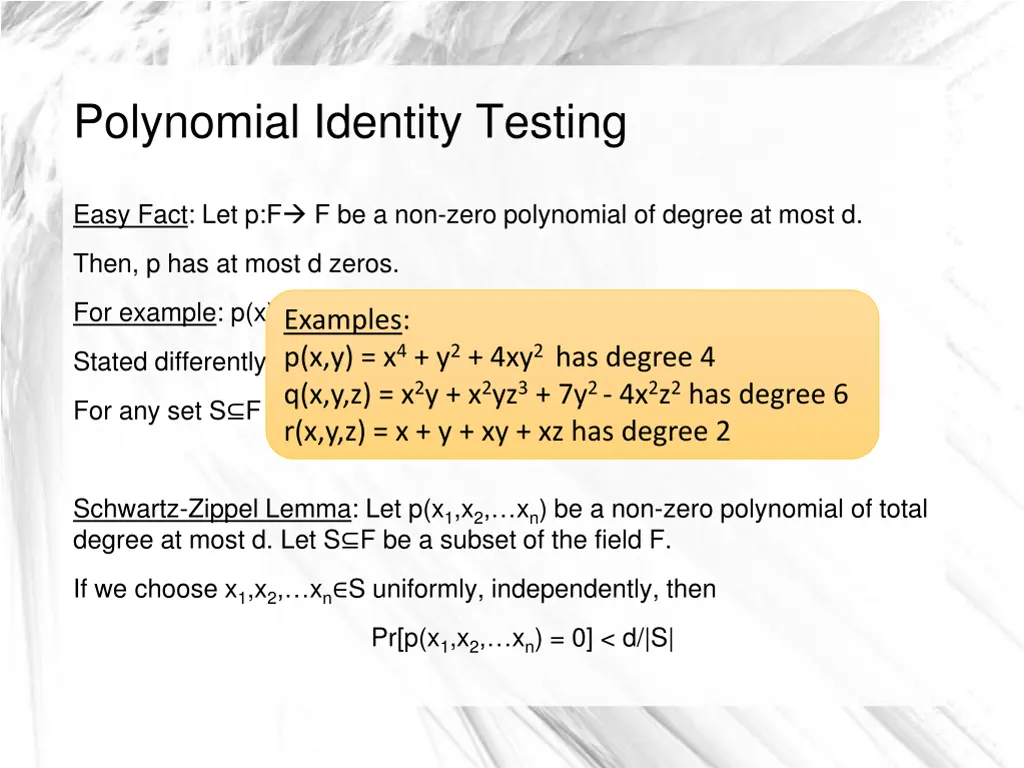
Polynomial Identity Testing Easy Fact: Let p:F F be a non-zero polynomial of degree at most d. Then, p has at most d zeros. For example: p(x) = x3+ 4x+1 has at most 3 zeros. Examples: p(x,y) = x4 + y2 + 4xy2 has degree 4 q(x,y,z) = x2y + x2yz3 + 7y2 - 4x2z2 has degree 6 r(x,y,z) = x + y + xy + xz has degree 2 Stated differently: For any set S F if we choose x S uniformly, then Pr[p(x) = 0] <= d/|S| Schwartz-Zippel Lemma: Let p(x1,x2, xn) be a non-zero polynomial of total degree at most d. Let S F be a subset of the field F. If we choose x1,x2, xn S uniformly, independently, then Pr[p(x1,x2, xn) = 0] < d/|S|
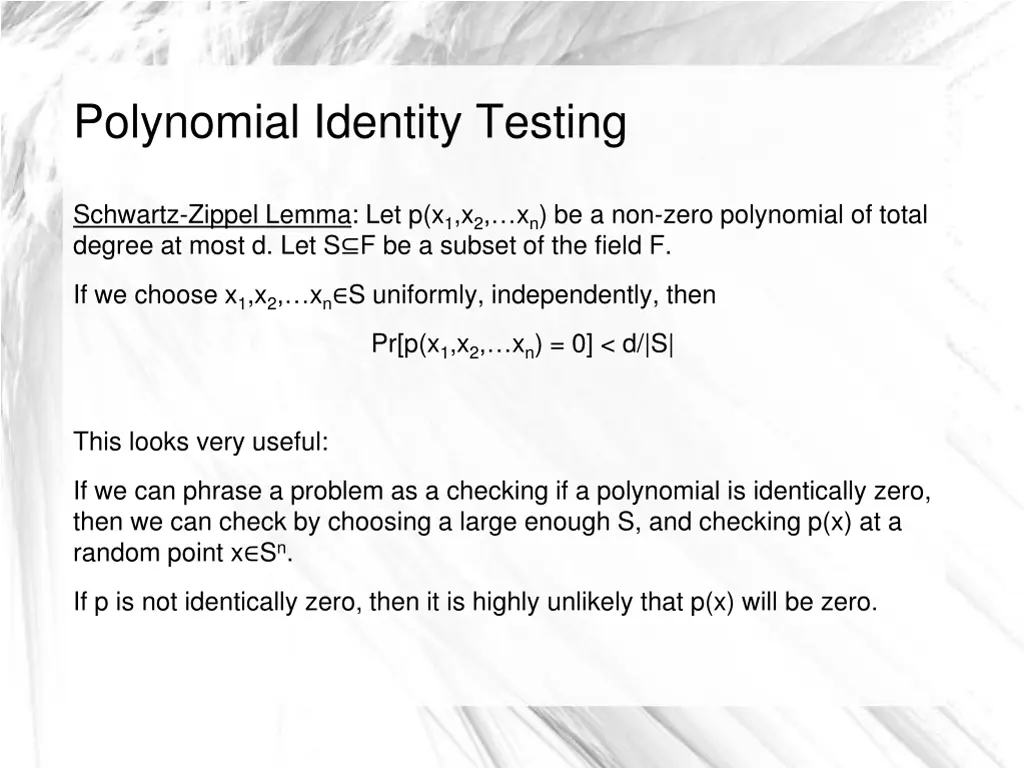
Polynomial Identity Testing Schwartz-Zippel Lemma: Let p(x1,x2, xn) be a non-zero polynomial of total degree at most d. Let S F be a subset of the field F. If we choose x1,x2, xn S uniformly, independently, then Pr[p(x1,x2, xn) = 0] < d/|S| This looks very useful: If we can phrase a problem as a checking if a polynomial is identically zero, then we can check by choosing a large enough S, and checking p(x) at a random point x Sn. If p is not identically zero, then it is highly unlikely that p(x) will be zero.
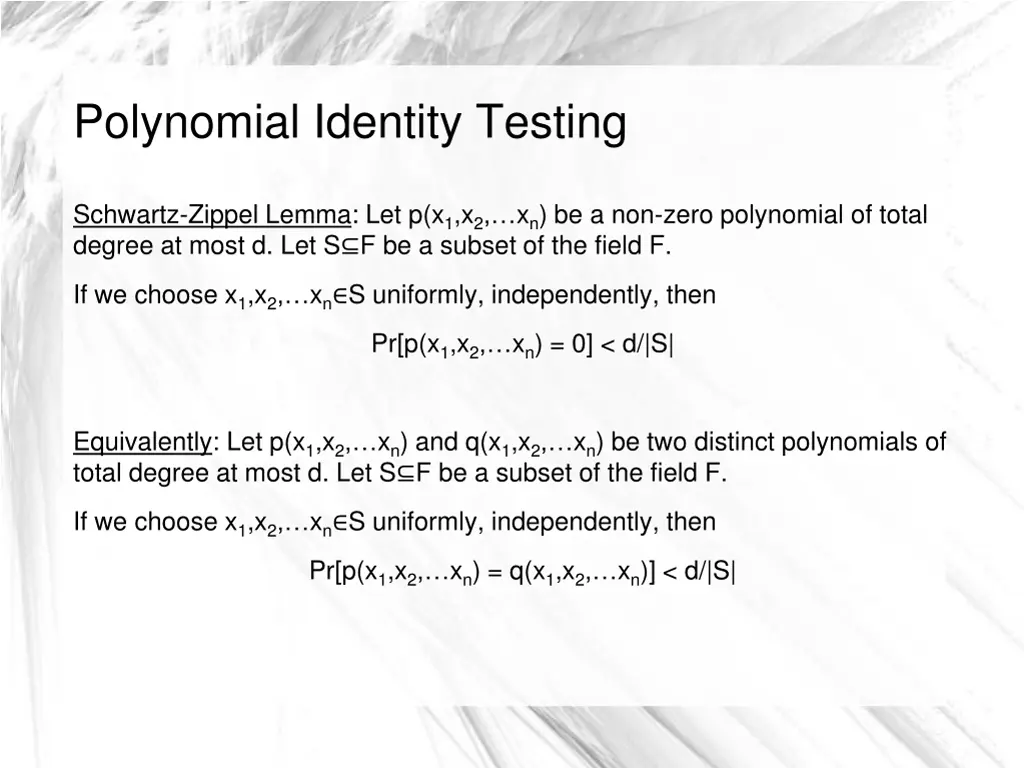
Polynomial Identity Testing Schwartz-Zippel Lemma: Let p(x1,x2, xn) be a non-zero polynomial of total degree at most d. Let S F be a subset of the field F. If we choose x1,x2, xn S uniformly, independently, then Pr[p(x1,x2, xn) = 0] < d/|S| Equivalently: Let p(x1,x2, xn) and q(x1,x2, xn) be two distinct polynomials of total degree at most d. Let S F be a subset of the field F. If we choose x1,x2, xn S uniformly, independently, then Pr[p(x1,x2, xn) = q(x1,x2, xn)] < d/|S|
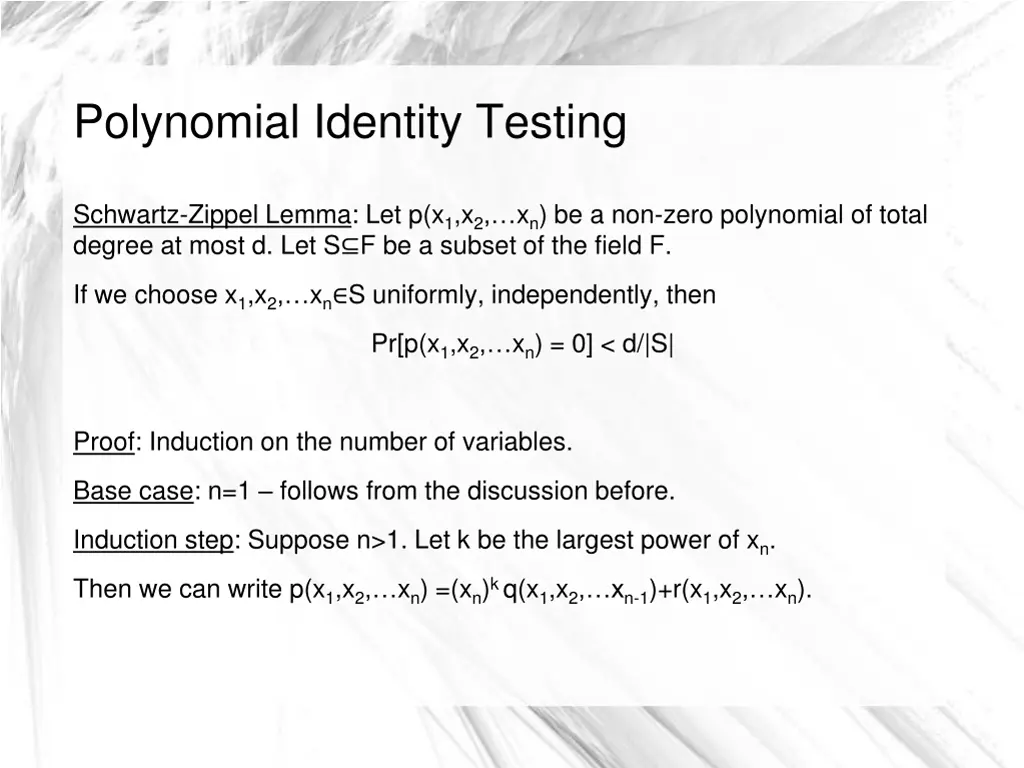
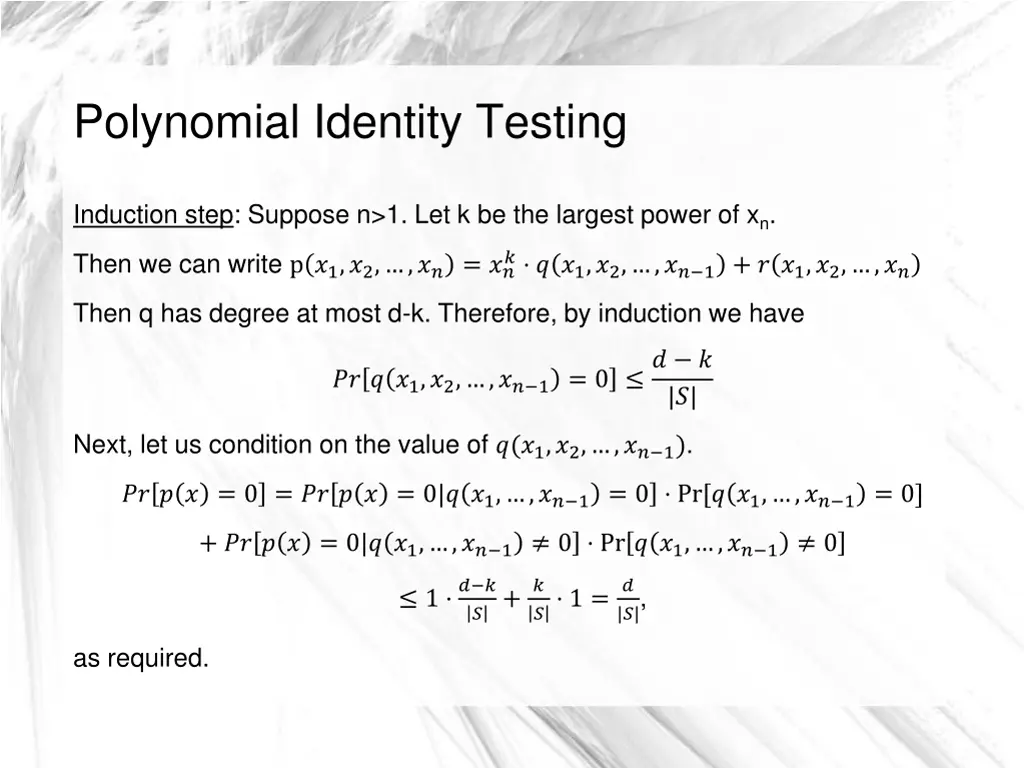
Polynomial Identity Testing Schwartz-Zippel Lemma: Let p(x1,x2, xn) be a non-zero polynomial of total degree at most d. Let S F be a subset of the field F. If we choose x1,x2, xn S uniformly, independently, then Pr[p(x1,x2, xn) = 0] < d/|S| Proof: Induction on the number of variables. Base case: n=1 follows from the discussion before. Induction step: Suppose n>1. Let k be the largest power of xn. Then we can write p(x1,x2, xn) =(xn)k q(x1,x2, xn-1)+r(x1,x2, xn).
Polynomial Identity Testing Induction step: Suppose n>1. Let k be the largest power of xn. Then we can write p ?1,?2, ,?? = ?? ? ? ?1,?2, ,?? 1 + ? ?1,?2, ,?? Then q has degree at most d-k. Therefore, by induction we have ?? ? ?1,?2, ,?? 1 = 0 ? ? |?| Next, let us condition on the value of ?(?1,?2, ,?? 1). ?? ? ? = 0 = ?? ? ? = 0|? ?1, ,?? 1 = 0 Pr[? ?1, ,?? 1 = 0] + ?? ? ? = 0|? ?1, ,?? 1 0 Pr ? ?1, ,?? 1 0 1 ? ? ? ? 1 = ? |?|, + ? as required.
Verifying matrix multiplication - revisited
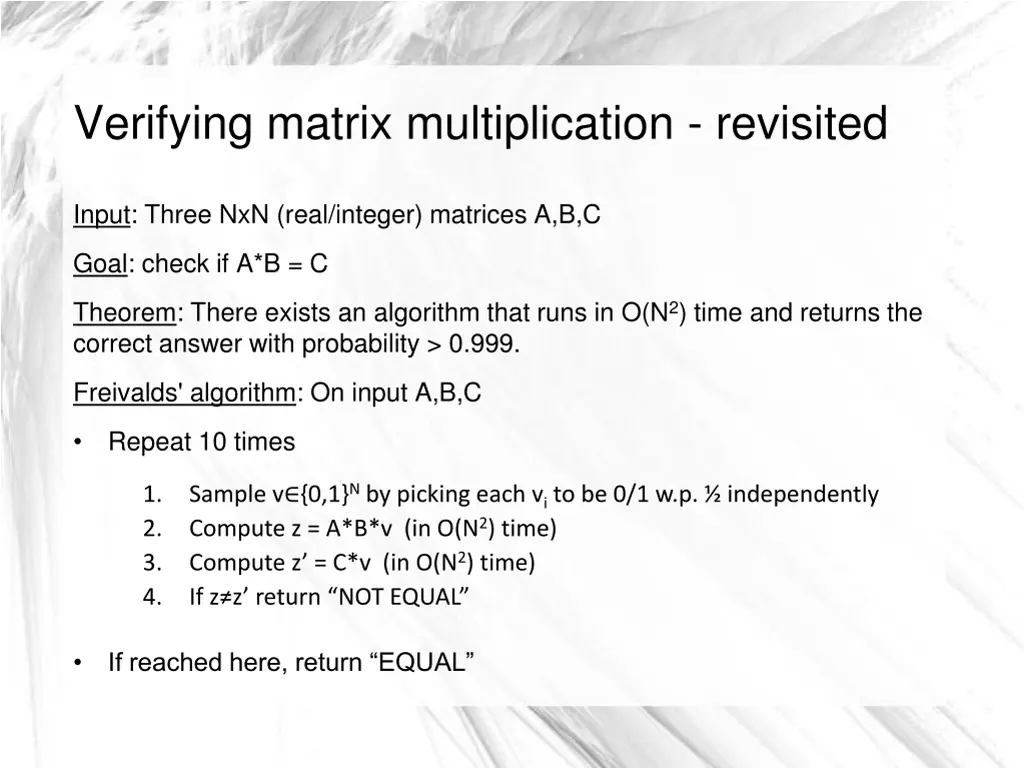
Verifying matrix multiplication - revisited Input: Three NxN (real/integer) matrices A,B,C Goal: check if A*B = C Theorem: There exists an algorithm that runs in O(N2) time and returns the correct answer with probability > 0.999. Freivalds' algorithm: On input A,B,C Repeat 10 times Sample v {0,1}N by picking each vi to be 0/1 w.p. independently Compute z = A*B*v (in O(N2) time) Compute z = C*v (in O(N2) time) If z z return NOT EQUAL 1. 2. 3. 4. If reached here, return EQUAL
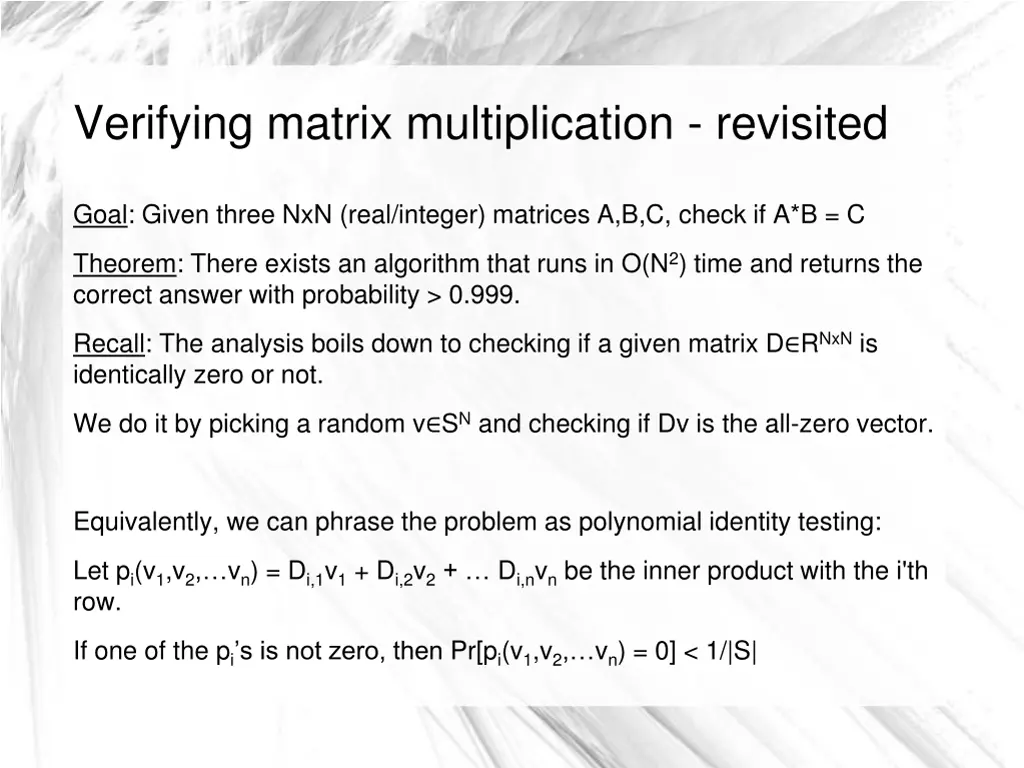
Verifying matrix multiplication - revisited Goal: Given three NxN (real/integer) matrices A,B,C, check if A*B = C Theorem: There exists an algorithm that runs in O(N2) time and returns the correct answer with probability > 0.999. Recall: The analysis boils down to checking if a given matrix D RNxN is identically zero or not. We do it by picking a random v SN and checking if Dv is the all-zero vector. Equivalently, we can phrase the problem as polynomial identity testing: Let pi(v1,v2, vn) = Di,1v1 + Di,2v2+ Di,nvn be the inner product with the i'th row. If one of the pi s is not zero, then Pr[pi(v1,v2, vn) = 0] < 1/|S|
Finding a perfect matching in a bipartite graph
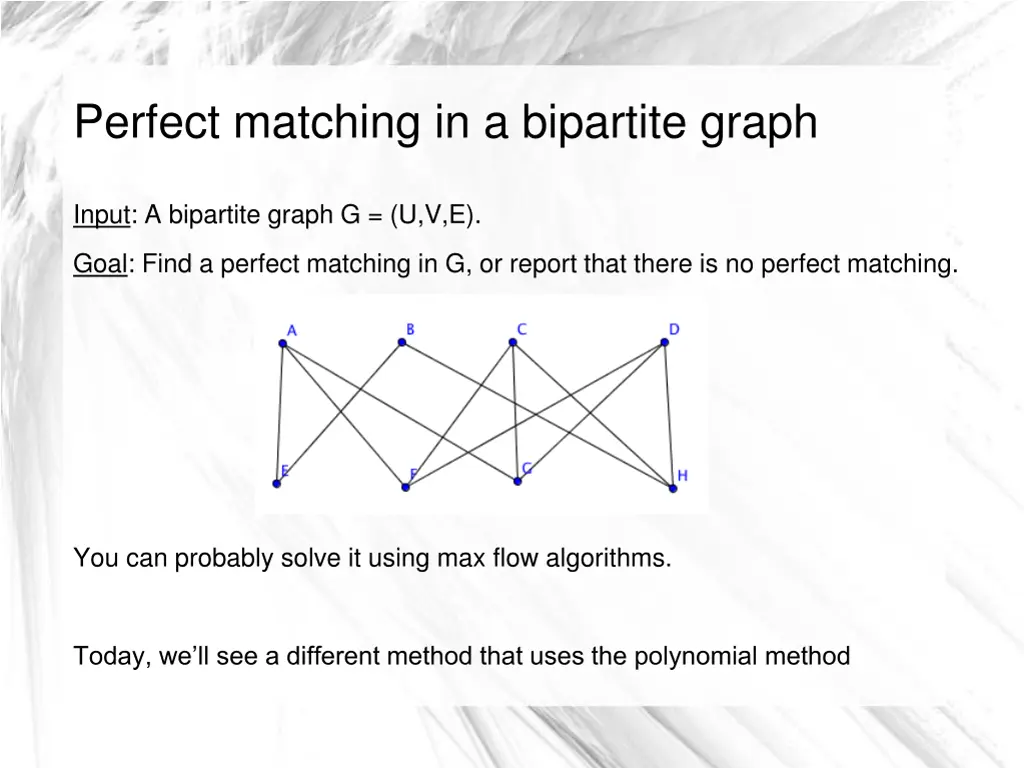
Perfect matching in a bipartite graph Input: A bipartite graph G = (U,V,E). Goal: Find a perfect matching in G, or report that there is no perfect matching. You can probably solve it using max flow algorithms. Today, we ll see a different method that uses the polynomial method
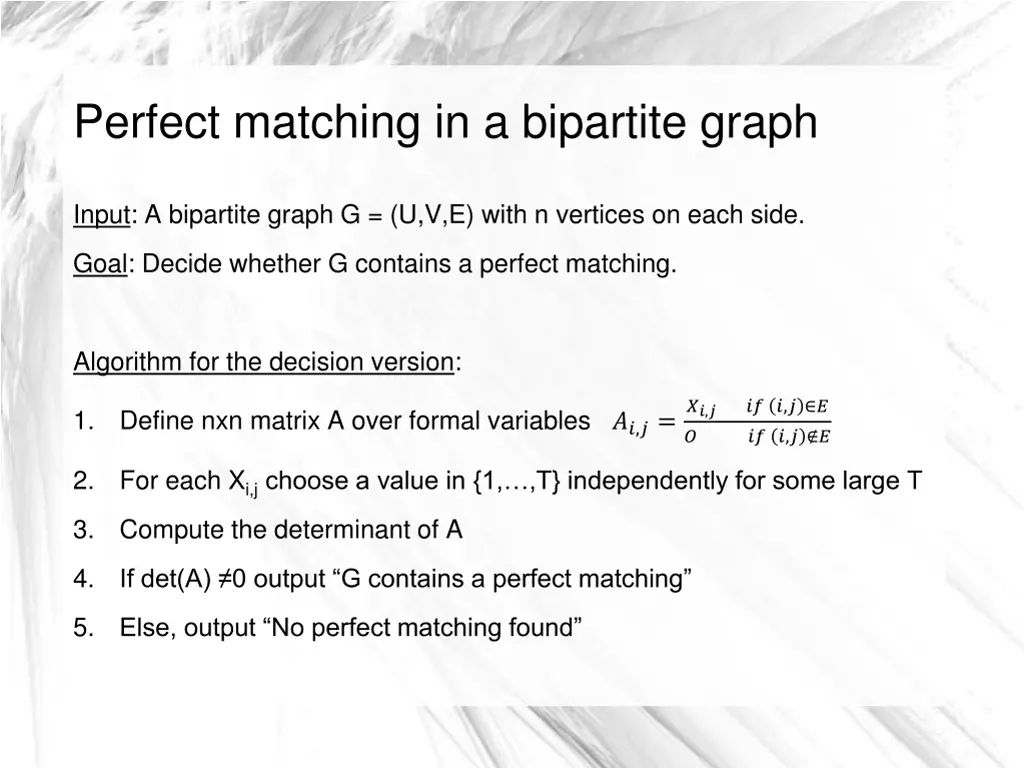
Perfect matching in a bipartite graph Input: A bipartite graph G = (U,V,E) with n vertices on each side. Goal: Find a perfect matching in G, or report that there is no perfect matching. A decision version: Decide whether G contains a perfect matching. What is the runtime of this algorithm? Algorithm for the decision version: ??,? ? ?? ?,? ? 1. Define nxn matrix A over formal variables ??,?= ?? ?,? ? 2. For each Xi,jchoose a value in {1, ,T} independently for some large T 3. Compute the determinant of A 4. If det(A) 0 output G contains a perfect matching 5. Else, output No perfect matching found
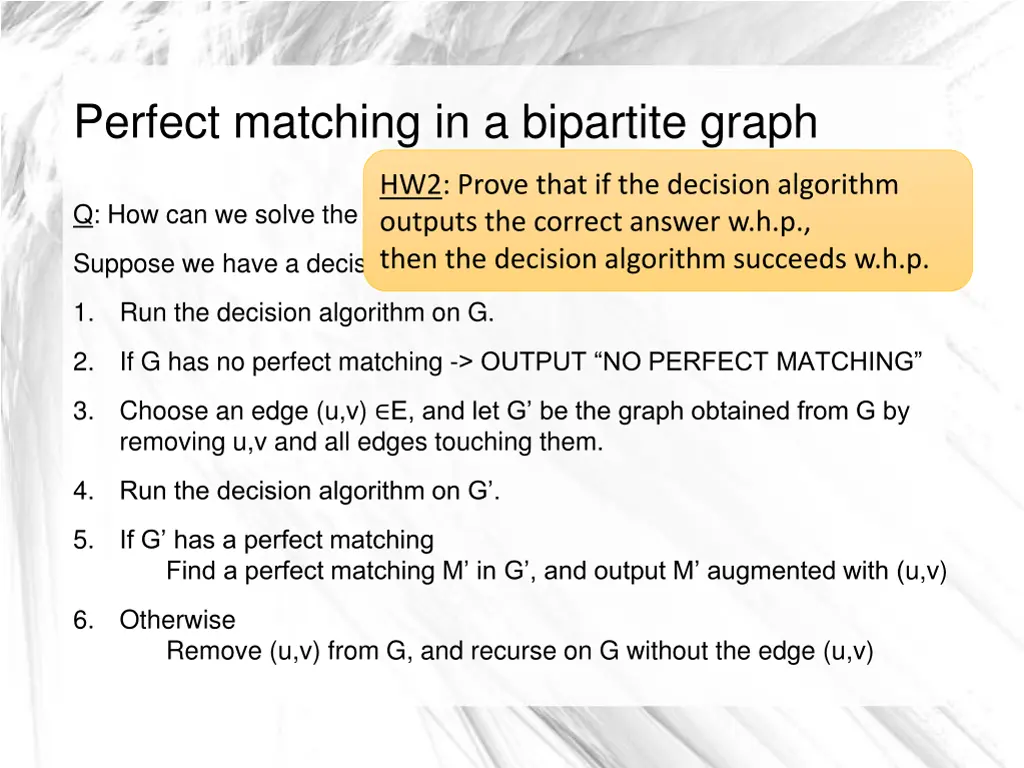
Perfect matching in a bipartite graph HW2: Prove that if the decision algorithm Q: How can we solve the search version using the decision version? outputs the correct answer w.h.p., then the decision algorithm succeeds w.h.p. Suppose we have a decision version outputs the correct answer w.h.p. 1. Run the decision algorithm on G. 2. If G has no perfect matching -> OUTPUT NO PERFECT MATCHING 3. Choose an edge (u,v) E, and let G be the graph obtained from G by removing u,v and all edges touching them. 4. Run the decision algorithm on G . 5. If G has a perfect matching Find a perfect matching M in G , and output M augmented with (u,v) 6. Otherwise Remove (u,v) from G, and recurse on G without the edge (u,v)
Perfect matching in a bipartite graph Input: A bipartite graph G = (U,V,E) with n vertices on each side. Goal: Decide whether G contains a perfect matching. What s going on here??? Algorithm : ??,? ? ?? ?,? ? 1. Define nxn matrix A over formal variables ??,?= ?? ?,? ? 2. For each Xi,jchoose a value in {1, ,T} independently for some large T 3. Compute the determinant of A 4. If det(A) 0 output G contains a perfect matching 5. Else, output No perfect matching found
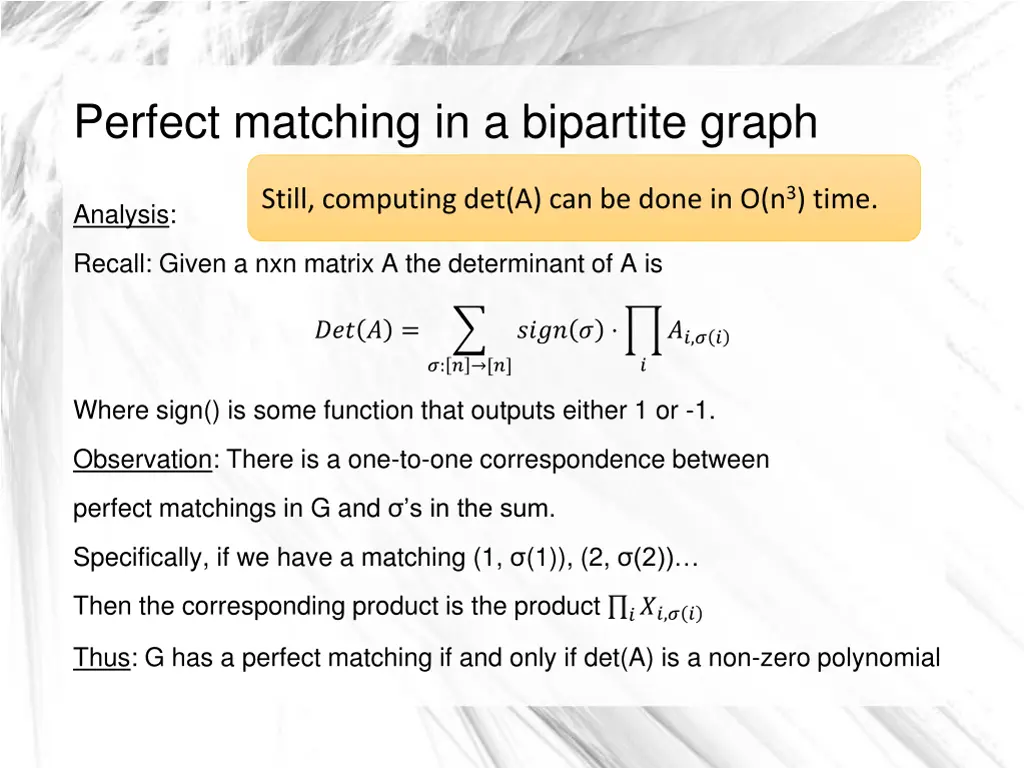
Perfect matching in a bipartite graph Still, computing det(A) can be done in O(n3) time. Analysis: Recall: Given a nxn matrix A the determinant of A is ??? ? = ???? ? ??,? ? ? ?: ? [?] Where sign() is some function that outputs either 1 or -1. Observation: There is a one-to-one correspondence between perfect matchings in G and s in the sum. Specifically, if we have a matching (1, (1)), (2, (2)) Then the corresponding product is the product ???,? ? Thus: G has a perfect matching if and only if det(A) is a non-zero polynomial
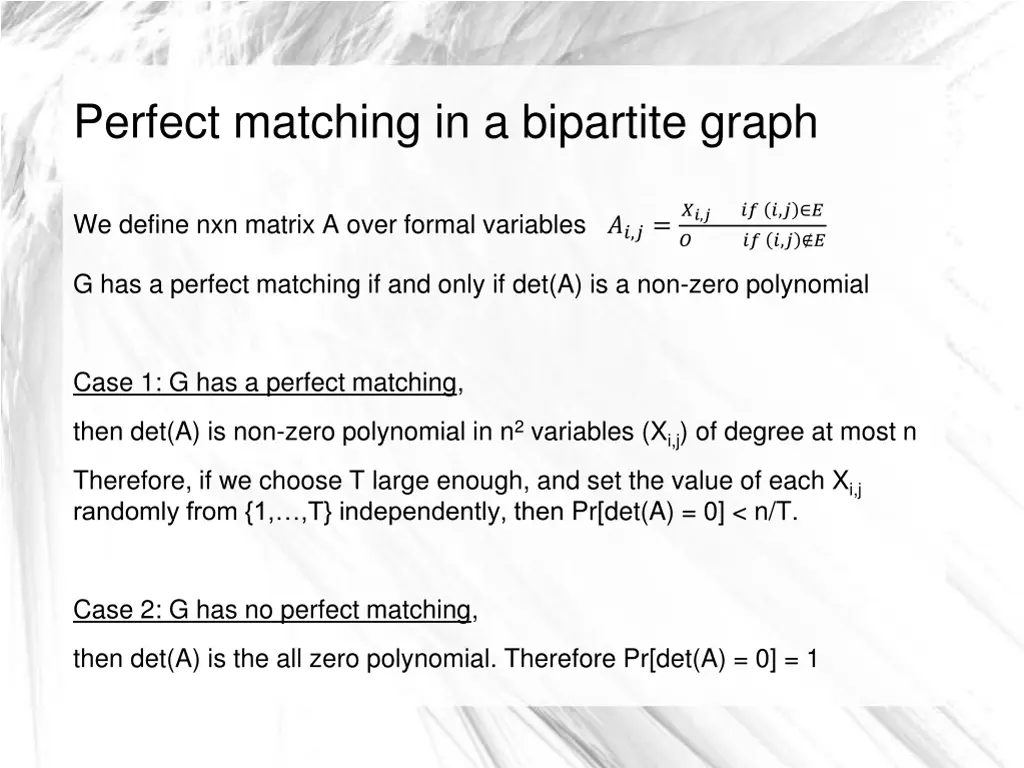
Perfect matching in a bipartite graph ??,? ? ?? ?,? ? We define nxn matrix A over formal variables ??,?= ?? ?,? ? G has a perfect matching if and only if det(A) is a non-zero polynomial Case 1: G has a perfect matching, then det(A) is non-zero polynomial in n2 variables (Xi,j) of degree at most n Therefore, if we choose T large enough, and set the value of each Xi,j randomly from {1, ,T} independently, then Pr[det(A) = 0] < n/T. Case 2: G has no perfect matching, then det(A) is the all zero polynomial. Therefore Pr[det(A) = 0] = 1
Perfect matching in a bipartite graph Input: A bipartite graph G = (U,V,E) with n vertices on each side. Goal: Decide whether G contains a perfect matching. Algorithm for the decision version: ??,? ? ?? ?,? ? 1. Define nxn matrix A over formal variables ??,?= ?? ?,? ? 2. For each Xi,jchoose a value in {1, ,T} independently for some large T 3. Compute the determinant of A 4. If det(A) 0 output G contains a perfect matching 5. Else, output No perfect matching found
Finding a minimum weight perfect matching in bipartite graphs
Min-weight perfect matchings Input: A bipartite graph G = (U,V,E) with weights on the edges. Goal: Find a perfect matching in G of minimal weight. We may assume that the graph is a complete bipartite graph, and missing edges have some huge weight.
Min-weight perfect matchings Input: A bipartite graph G = (U,V,E) with |U| = |V| = n and integer weights wi,j>0 Goal (min value version): Output the weight of a min-weight perfect matching. A simplifying (though weird) assumption: Suppose that G has a unique perfect matching of minimal weight. Algorithm for the min value version: What s going on here??? Define nxn matrix A over reals as Ai,j = 10wij 1. 2. Compute the determinant of A 3. Output the largest k such that det(A) is divisible by 10k Example, if det(A) = 41507000, then we output 3 (because 103 divides det(A))
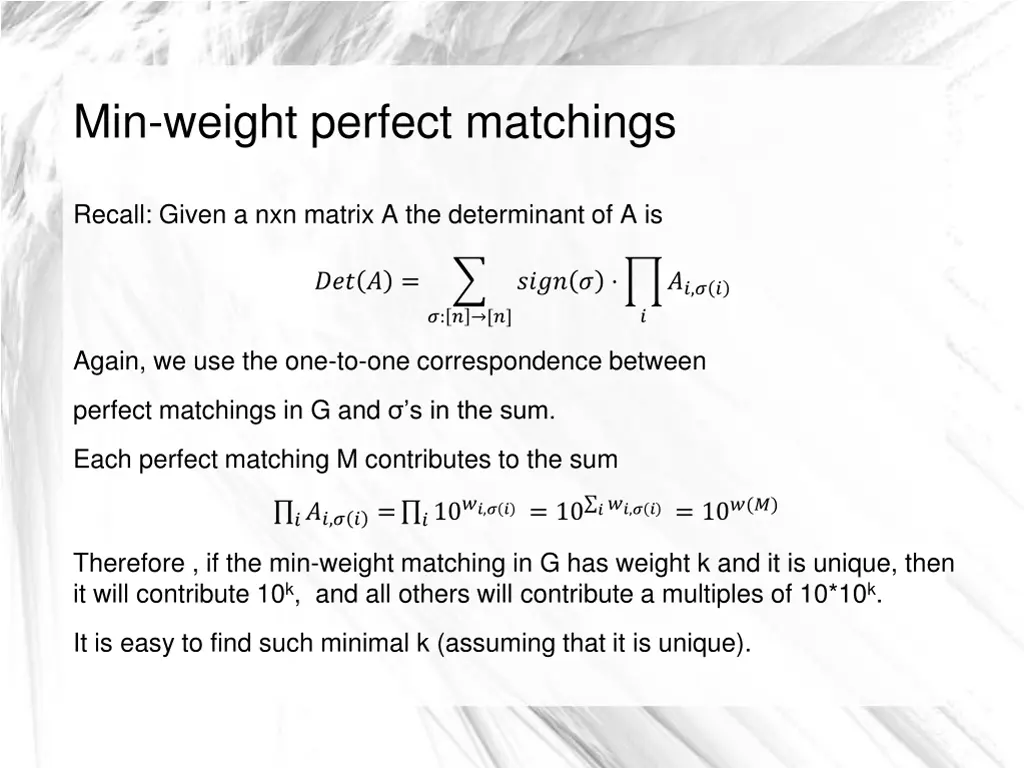
Min-weight perfect matchings Recall: Given a nxn matrix A the determinant of A is ??? ? = ???? ? ??,? ? ? ?: ? [?] Again, we use the one-to-one correspondence between perfect matchings in G and s in the sum. Each perfect matching M contributes to the sum ???,? ? = ?10??,? ?= 10 ???,? ?= 10?(?) Therefore , if the min-weight matching in G has weight k and it is unique, then it will contribute 10k, and all others will contribute a multiples of 10*10k. It is easy to find such minimal k (assuming that it is unique).
Min-weight perfect matchings Next time: we ll see how to get rid of the assumption that the min-weight matching is unique. We ll do it by adding to the weight of each edge some O(1/n2) random noise. Since the weight of each matching is a sum of n integers, the weight of the noisy graph will allow us to recover the weight of the original graph. Isolation lemma: we ll see a lemma saying that with high probability we will isolate one min-weight perfect matching. Then we ll apply the algorithm on this graph with noisy weights
Questions? Comments?