Advanced Event Timing System for Synchrotron Injection Control
Explore the sophisticated Event Timing System designed for precise synchronization and control in synchrotron injection processes, ensuring efficient operation and management of multiple rings and beamlines. Discover the innovative strategies and technical requirements for optimal performance and maintenance of SuperKEKB and KEKB facilities.

Download Presentation

Please find below an Image/Link to download the presentation.
The content on the website is provided AS IS for your information and personal use only. It may not be sold, licensed, or shared on other websites without obtaining consent from the author. If you encounter any issues during the download, it is possible that the publisher has removed the file from their server.
You are allowed to download the files provided on this website for personal or commercial use, subject to the condition that they are used lawfully. All files are the property of their respective owners.
The content on the website is provided AS IS for your information and personal use only. It may not be sold, licensed, or shared on other websites without obtaining consent from the author.
E N D
Presentation Transcript
Timing System Hiroshi Kaji
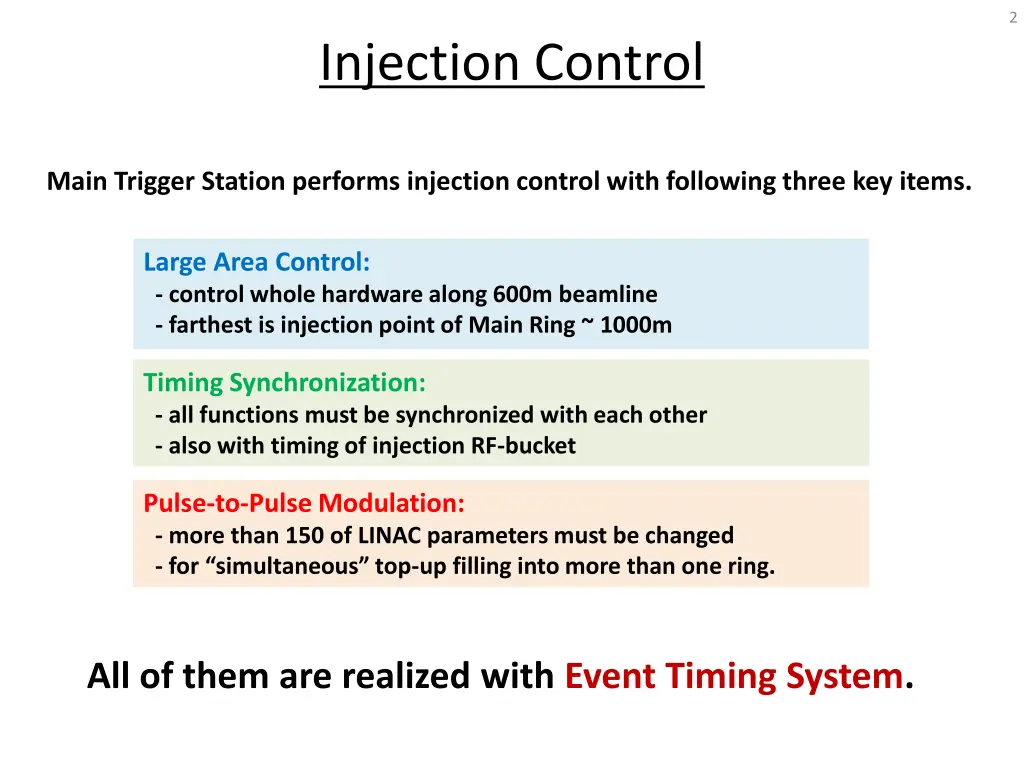
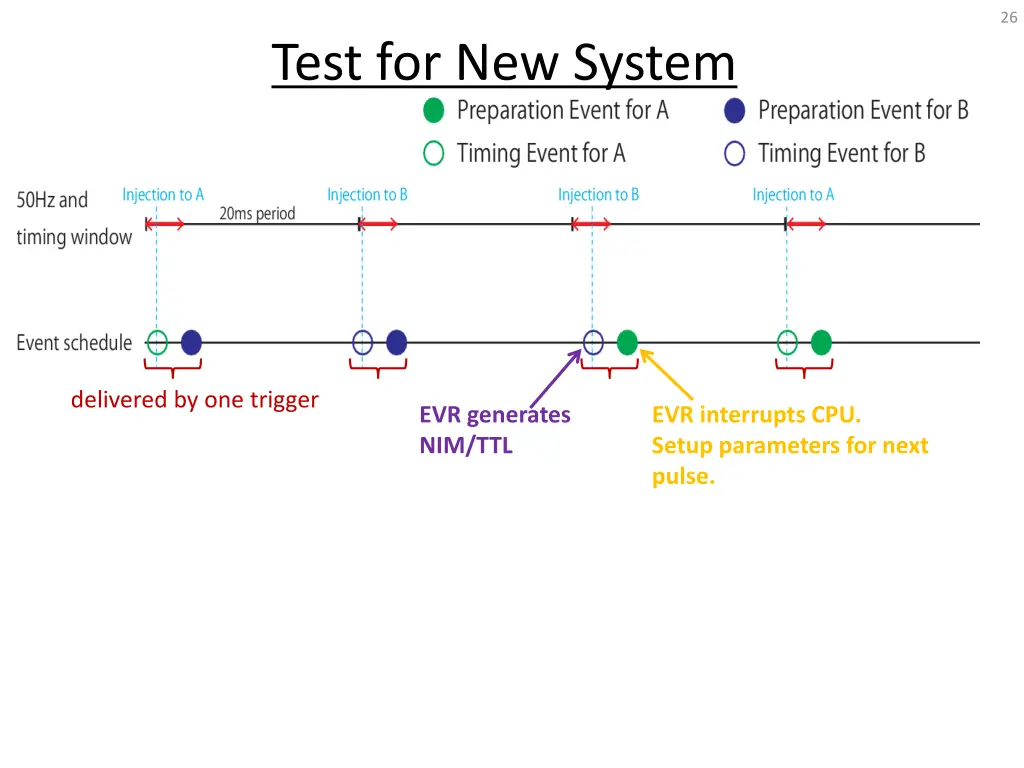
2 Injection Control Main Trigger Station performs injection control with following three key items. Large Area Control: - control whole hardware along 600m beamline - farthest is injection point of Main Ring ~ 1000m Timing Synchronization: - all functions must be synchronized with each other - also with timing of injection RF-bucket Pulse-to-Pulse Modulation: - more than 150 of LINAC parameters must be changed - for simultaneous top-up filling into more than one ring. All of them are realized with Event Timing System.
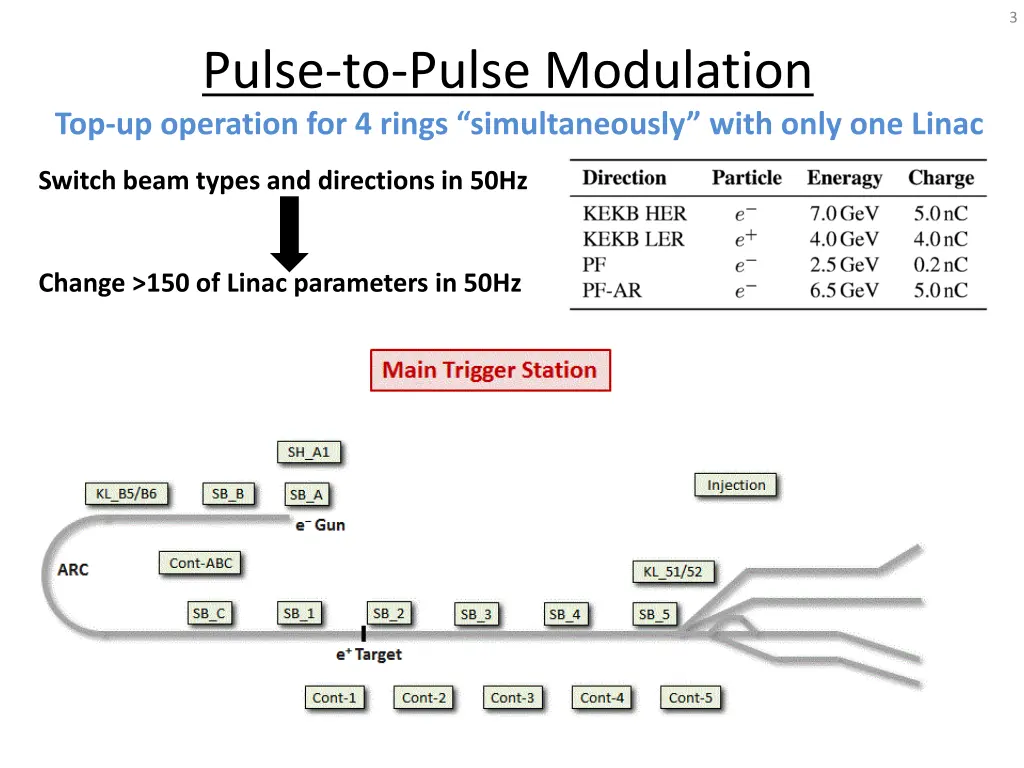
3 Pulse-to-Pulse Modulation Top-up operation for 4 rings simultaneously with only one Linac Switch beam types and directions in 50Hz Change >150 of Linac parameters in 50Hz
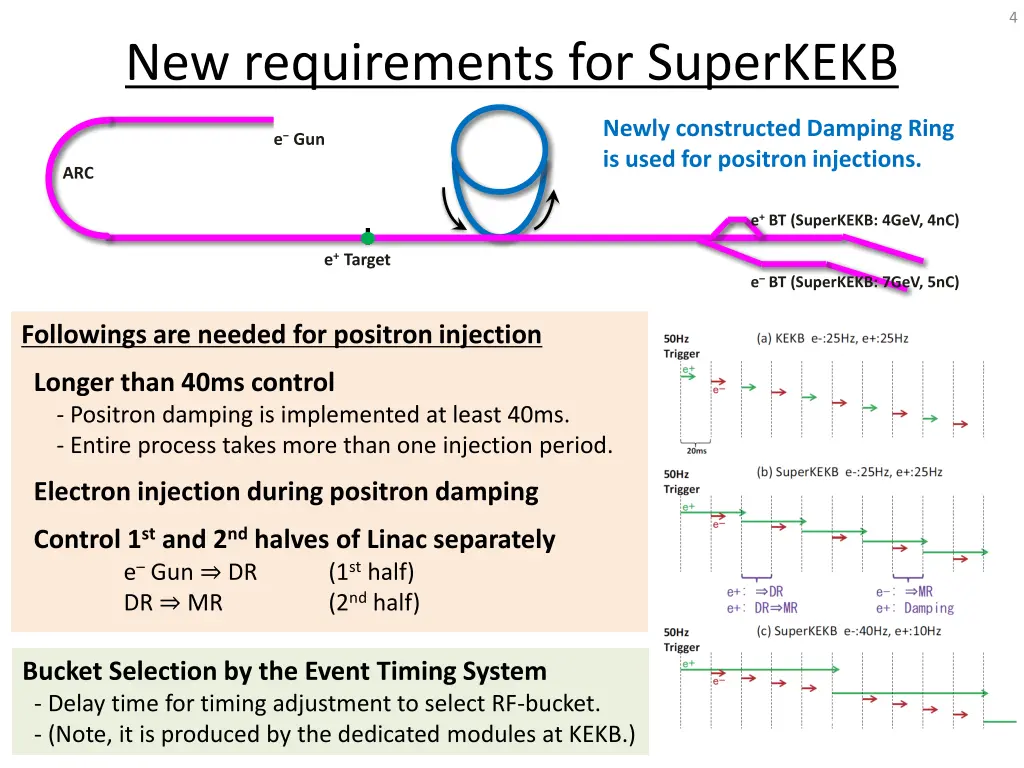
4 New requirements for SuperKEKB Newly constructed Damping Ring is used for positron injections. e Gun ARC e+BT (SuperKEKB: 4GeV, 4nC) e+Target e BT (SuperKEKB: 7GeV, 5nC) Followings are needed for positron injection Longer than 40ms control - Positron damping is implemented at least 40ms. - Entire process takes more than one injection period. Electron injection during positron damping Control 1stand 2ndhalves of Linac separately e Gun DR DR MR (1sthalf) (2ndhalf) Bucket Selection by the Event Timing System - Delay time for timing adjustment to select RF-bucket. - (Note, it is produced by the dedicated modules at KEKB.)
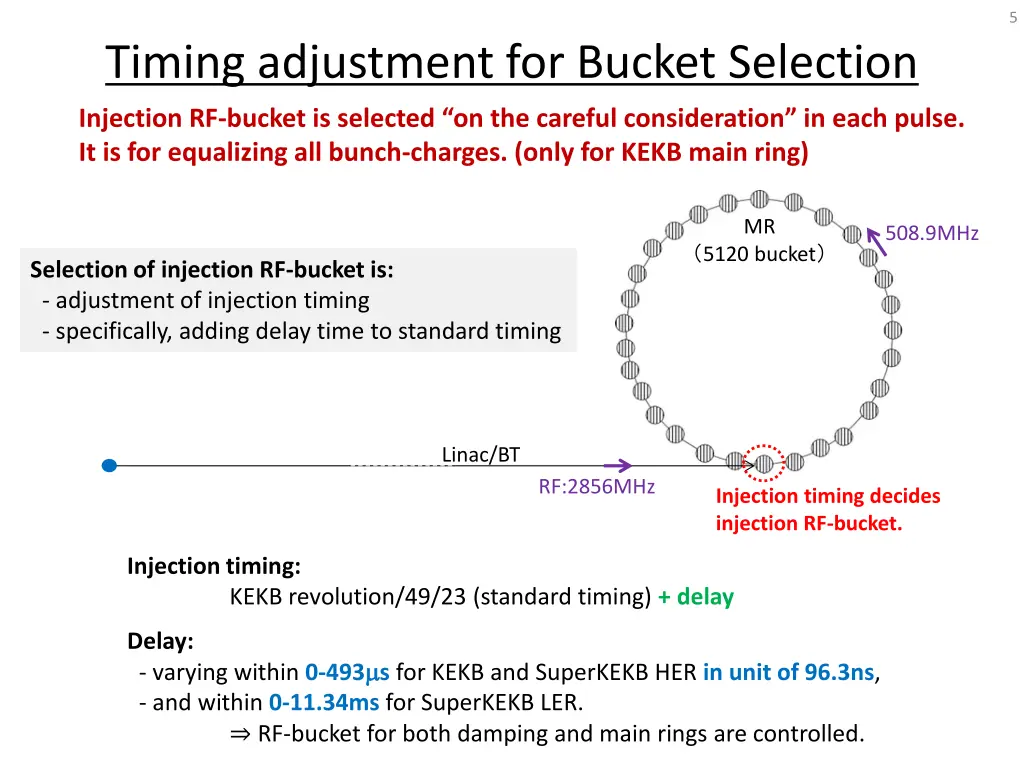
5 Timing adjustment for Bucket Selection Injection RF-bucket is selected on the careful consideration in each pulse. It is for equalizing all bunch-charges. (only for KEKB main ring) MR 508.9MHz 5120 bucket Selection of injection RF-bucket is: - adjustment of injection timing - specifically, adding delay time to standard timing Linac/BT RF:2856MHz Injection timing decides injection RF-bucket. Injection timing: KEKB revolution/49/23 (standard timing) + delay Delay: - varying within 0-493 s for KEKB and SuperKEKB HER in unit of 96.3ns, - and within 0-11.34ms for SuperKEKB LER. RF-bucket for both damping and main rings are controlled.
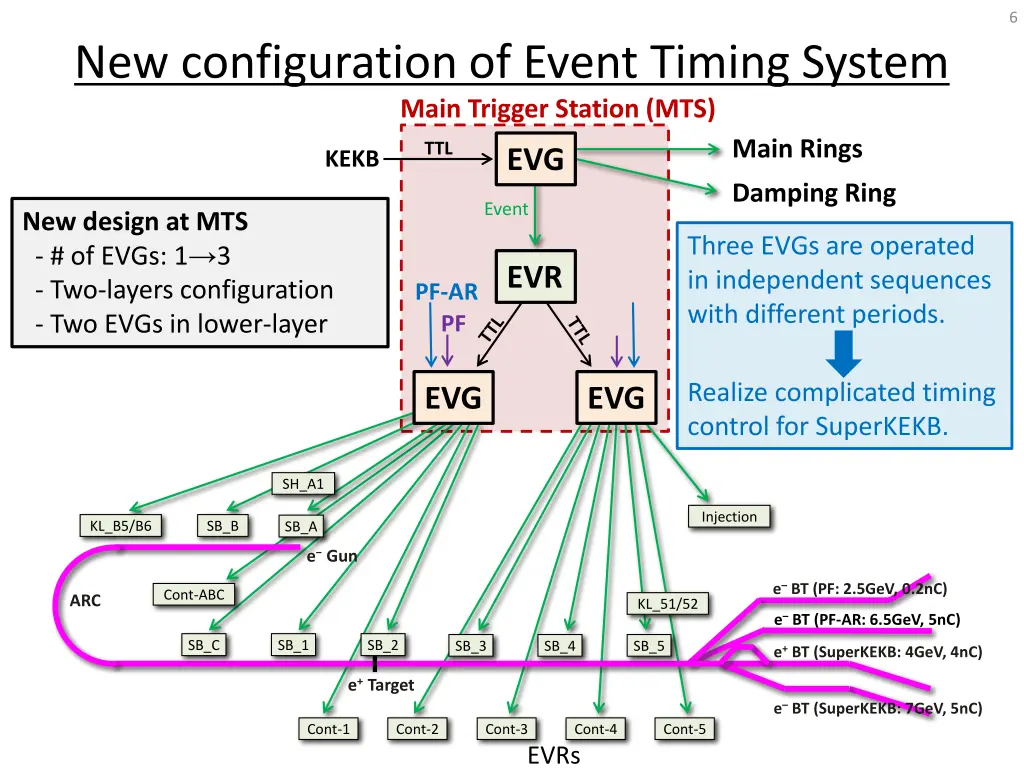
6 New configuration of Event Timing System Main Trigger Station (MTS) Main Rings TTL EVG KEKB Damping Ring Event New design at MTS - # of EVGs: 1 3 - Two-layers configuration - Two EVGs in lower-layer Three EVGs are operated in independent sequences with different periods. EVR PF-AR PF Realize complicated timing control for SuperKEKB. EVG EVG SH_A1 Injection KL_B5/B6 SB_B SB_A e Gun e BT (PF: 2.5GeV, 0.2nC) Cont-ABC ARC KL_51/52 e BT (PF-AR: 6.5GeV, 5nC) SB_C SB_1 SB_2 SB_3 SB_4 SB_5 e+BT (SuperKEKB: 4GeV, 4nC) e+Target e BT (SuperKEKB: 7GeV, 5nC) Cont-1 Cont-2 Cont-3 Cont-4 Cont-5 EVRs
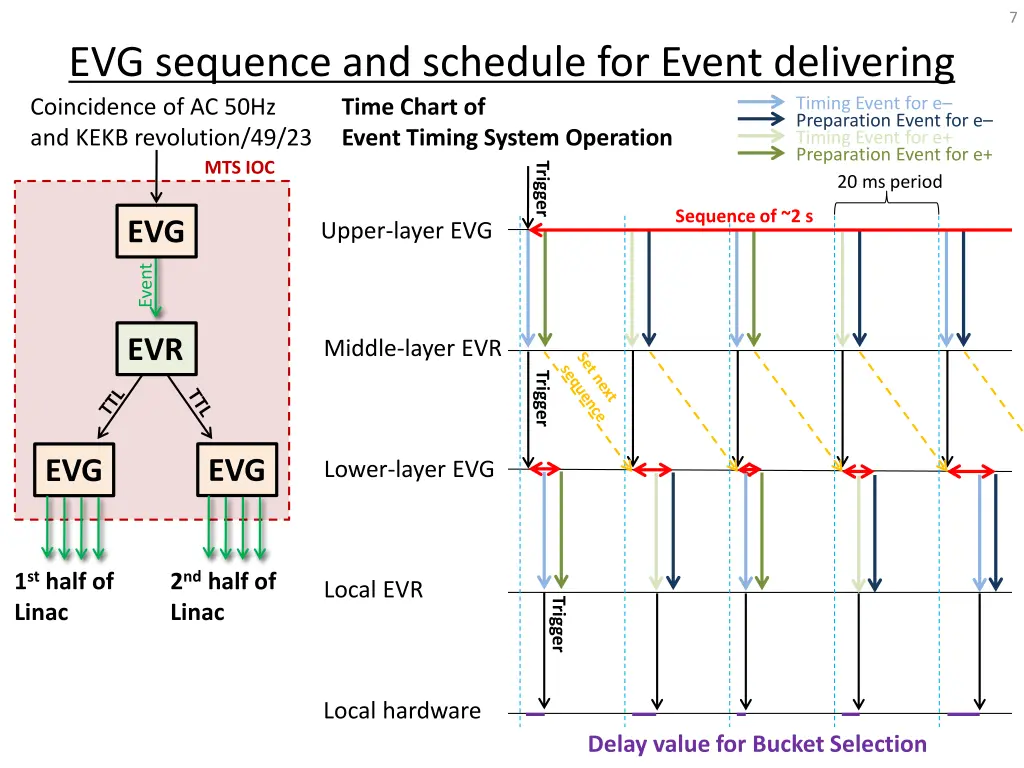
7 EVG sequence and schedule for Event delivering Coincidence of AC 50Hz and KEKB revolution/49/23 Event Timing System Operation Timing Event for e Preparation Event for e Timing Event for e+ Preparation Event for e+ Time Chart of MTS IOC Trigger 20 ms period Sequence of ~2 s EVG Upper-layer EVG Event EVR Middle-layer EVR Trigger EVG EVG Lower-layer EVG 1sthalf of Linac 2ndhalf of Linac Local EVR Trigger Local hardware Delay value for Bucket Selection
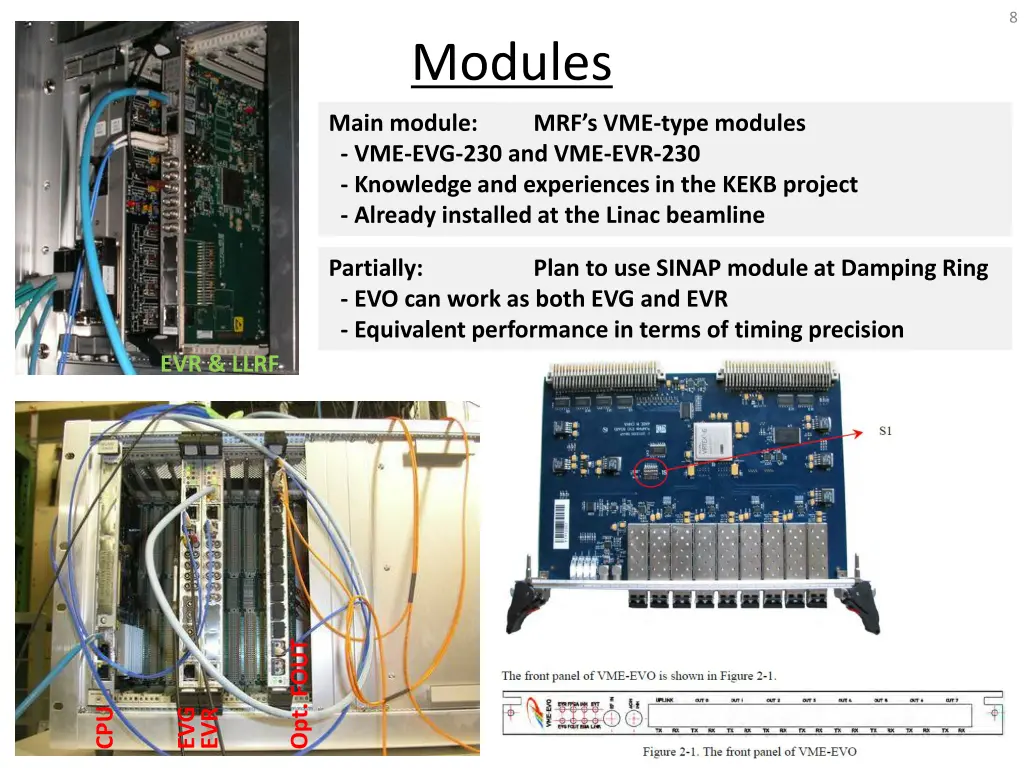
8 Modules Main module: - VME-EVG-230 and VME-EVR-230 - Knowledge and experiences in the KEKB project - Already installed at the Linac beamline MRF s VME-type modules Partially: - EVO can work as both EVG and EVR - Equivalent performance in terms of timing precision Plan to use SINAP module at Damping Ring EVR & LLRF Opt. FOUT CPU EVG EVR
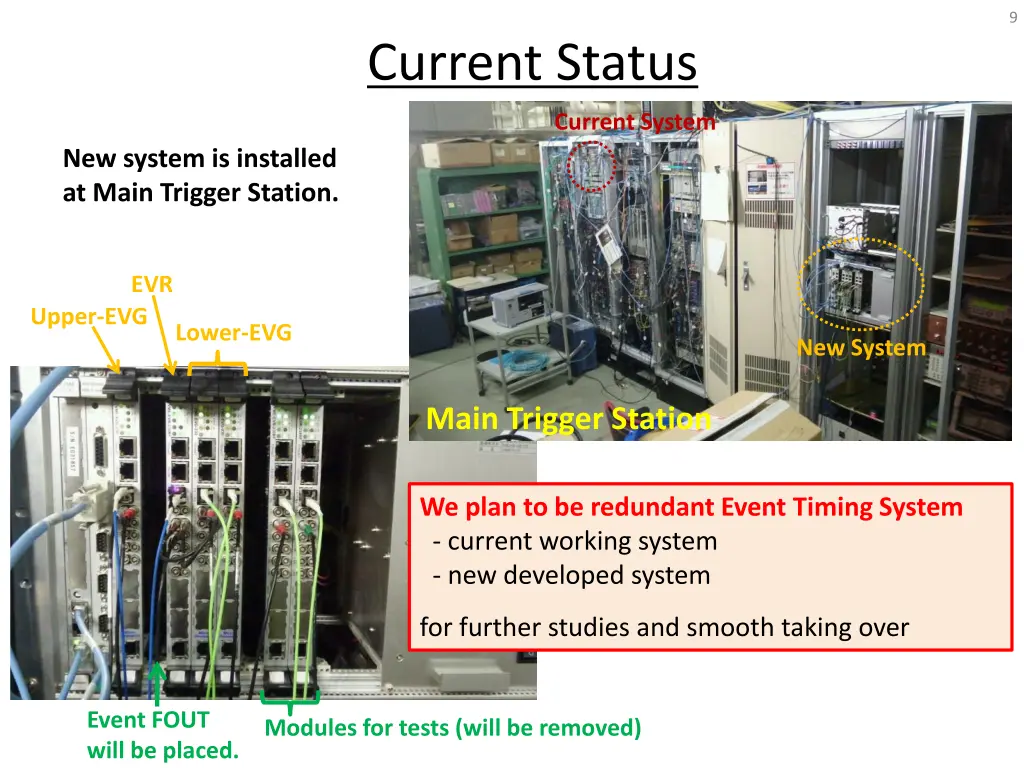
9 Current Status Current System New system is installed at Main Trigger Station. EVR Upper-EVG Lower-EVG New System Main Trigger Station We plan to be redundant Event Timing System - current working system - new developed system for further studies and smooth taking over Event FOUT will be placed. Modules for tests (will be removed)
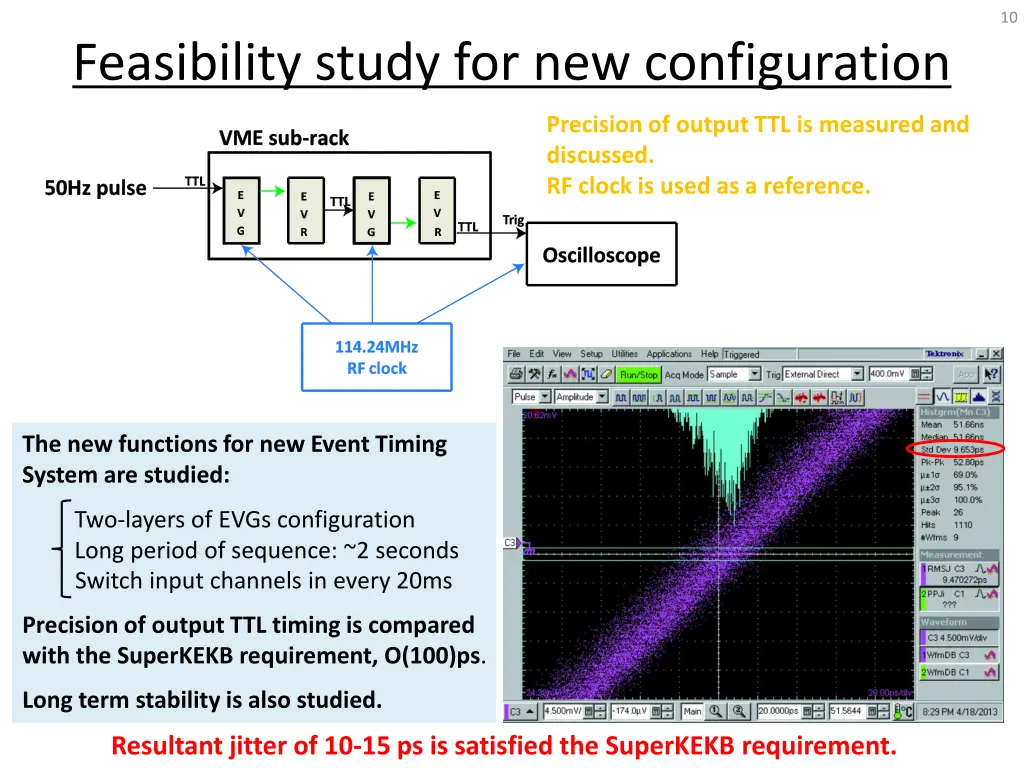
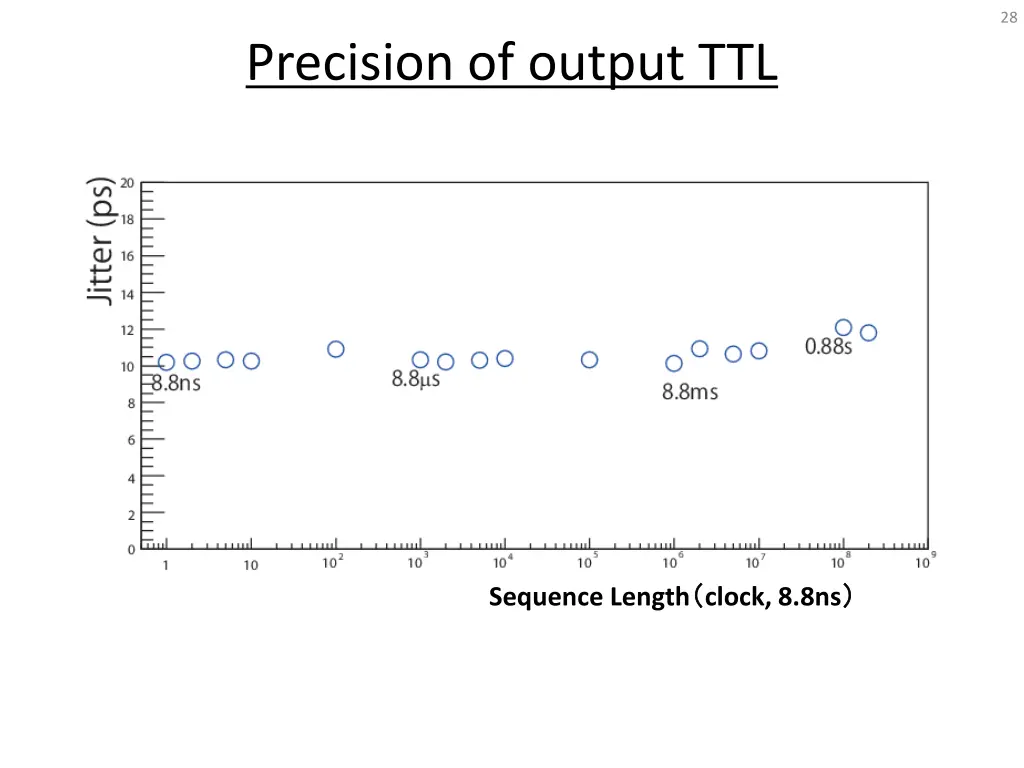
10 Feasibility study for new configuration Precision of output TTL is measured and discussed. RF clock is used as a reference. The new functions for new Event Timing System are studied: Two-layers of EVGs configuration Long period of sequence: ~2 seconds Switch input channels in every 20ms Precision of output TTL timing is compared with the SuperKEKB requirement, O(100)ps. Long term stability is also studied. Resultant jitter of 10-15 ps is satisfied the SuperKEKB requirement.
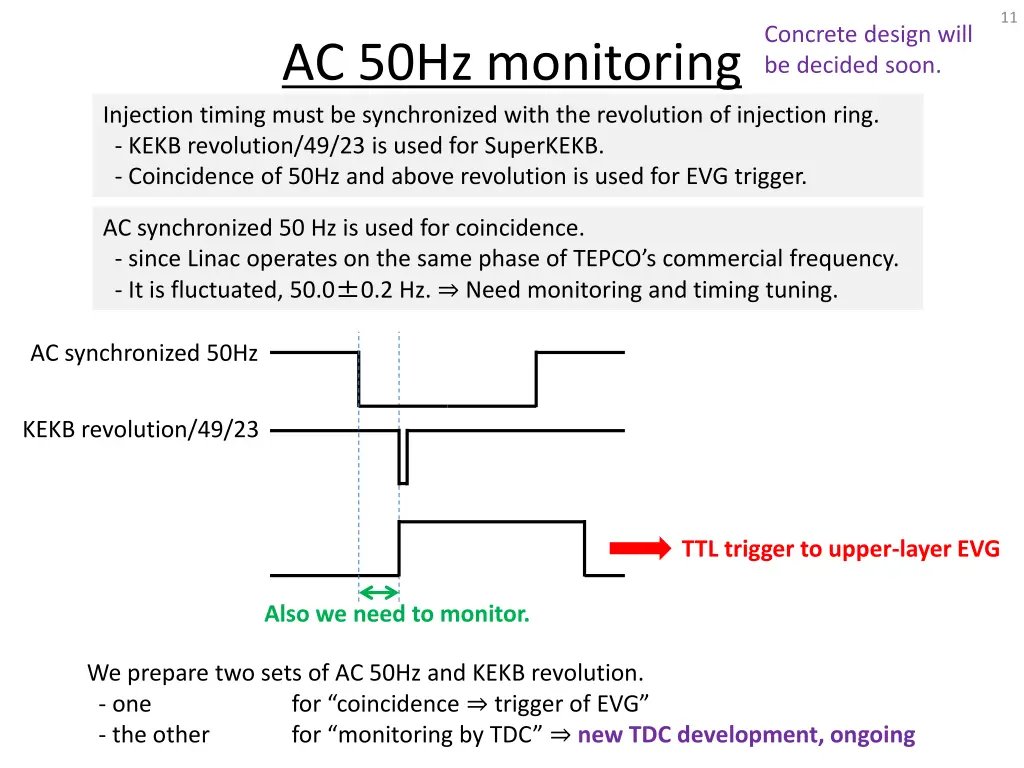
11 Concrete design will be decided soon. AC 50Hz monitoring Injection timing must be synchronized with the revolution of injection ring. - KEKB revolution/49/23 is used for SuperKEKB. - Coincidence of 50Hz and above revolution is used for EVG trigger. AC synchronized 50 Hz is used for coincidence. - since Linac operates on the same phase of TEPCO s commercial frequency. - It is fluctuated, 50.0 0.2 Hz. Need monitoring and timing tuning. AC synchronized 50Hz KEKB revolution/49/23 TTL trigger to upper-layer EVG Also we need to monitor. We prepare two sets of AC 50Hz and KEKB revolution. - one for coincidence trigger of EVG - the other for monitoring by TDC new TDC development, ongoing
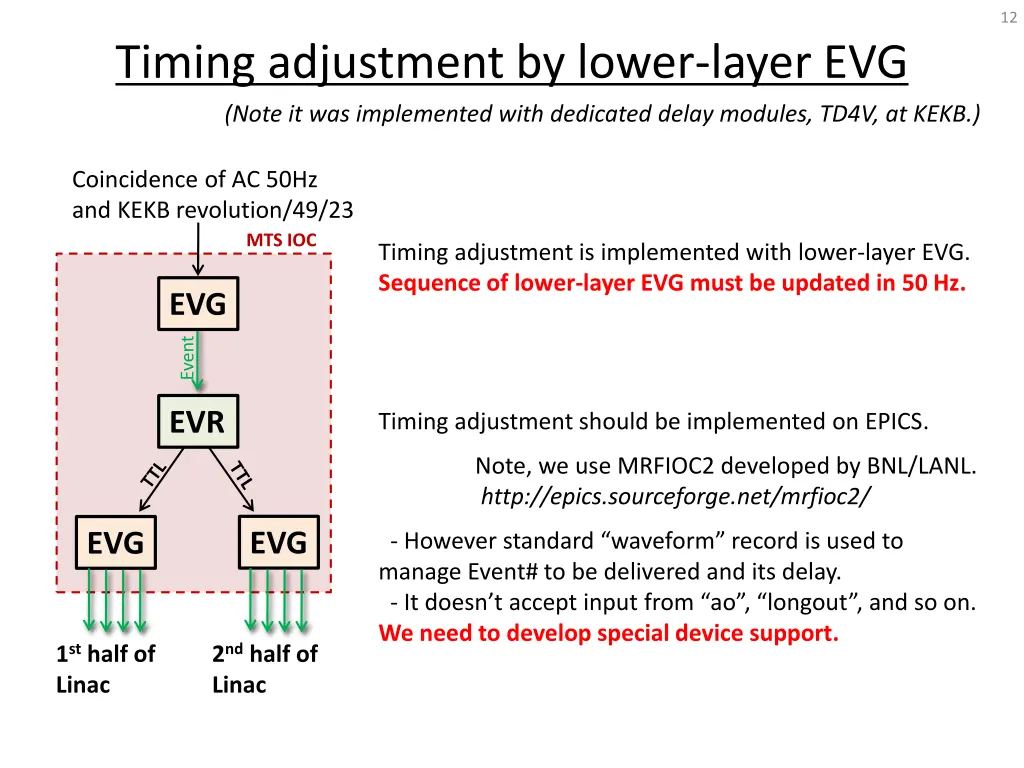
12 Timing adjustment by lower-layer EVG (Note it was implemented with dedicated delay modules, TD4V, at KEKB.) Coincidence of AC 50Hz and KEKB revolution/49/23 MTS IOC Timing adjustment is implemented with lower-layer EVG. Sequence of lower-layer EVG must be updated in 50 Hz. EVG Event EVR Timing adjustment should be implemented on EPICS. Note, we use MRFIOC2 developed by BNL/LANL. http://epics.sourceforge.net/mrfioc2/ EVG EVG - However standard waveform record is used to manage Event# to be delivered and its delay. - It doesn t accept input from ao , longout , and so on. We need to develop special device support. 1sthalf of Linac 2ndhalf of Linac
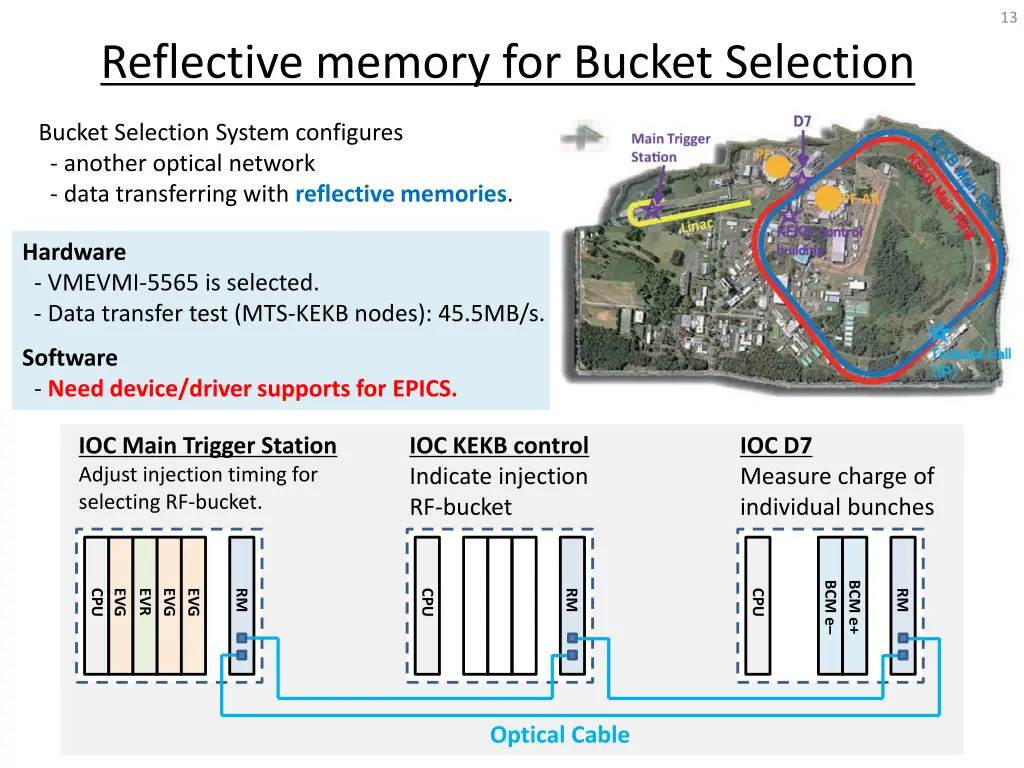
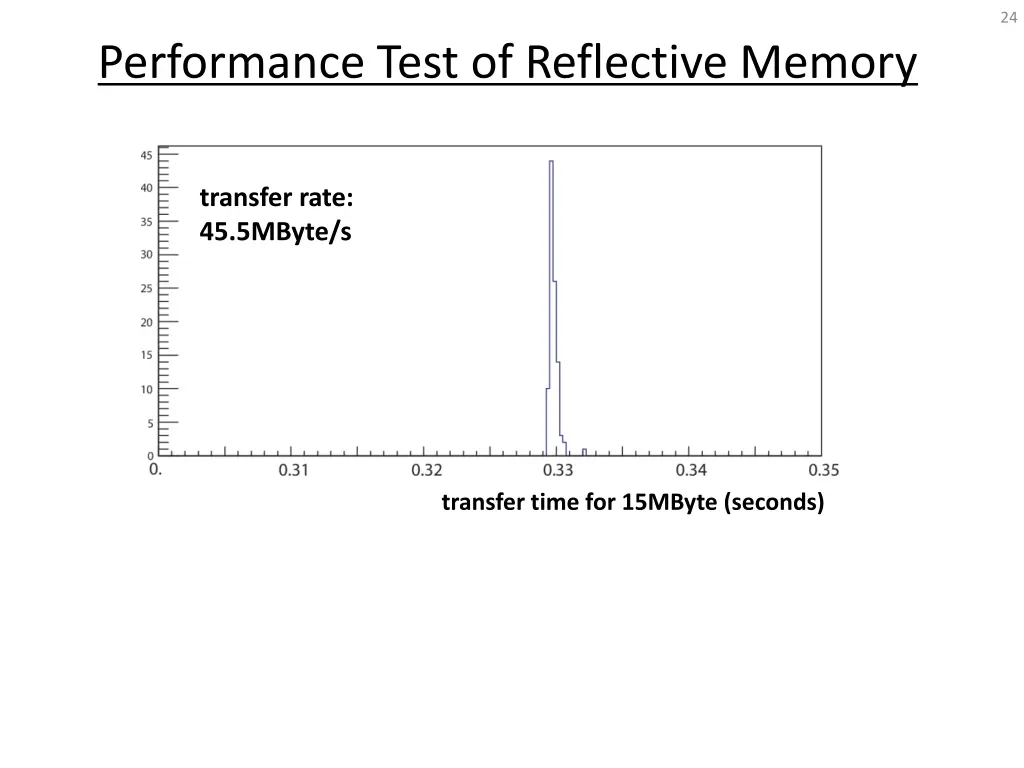
13 Reflective memory for Bucket Selection Bucket Selection System configures - another optical network - data transferring with reflective memories. Hardware - VMEVMI-5565 is selected. - Data transfer test (MTS-KEKB nodes): 45.5MB/s. Software - Need device/driver supports for EPICS. IOC Main Trigger Station Adjust injection timing for selecting RF-bucket. IOC KEKB control Indicate injection RF-bucket IOC D7 Measure charge of individual bunches : 45.5MByte/s BCM e BCM e+ CPU EVG EVR EVG EVG RM CPU RM CPU RM Optical Cable
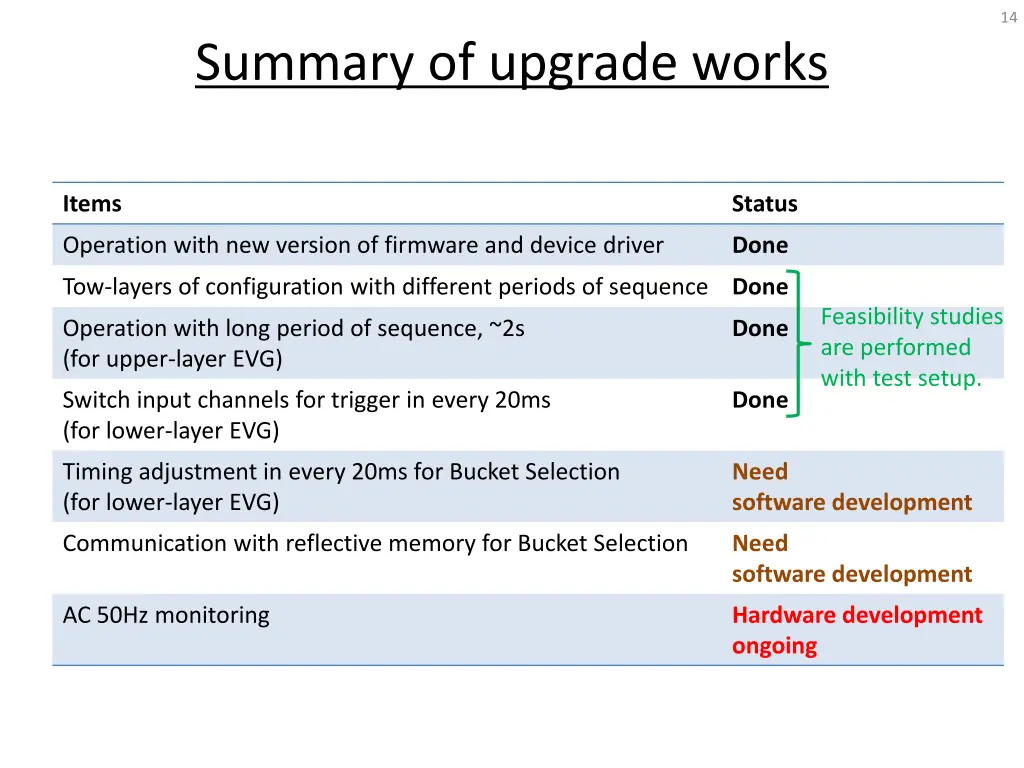
14 Summary of upgrade works Items Status Operation with new version of firmware and device driver Done Tow-layers of configuration with different periods of sequence Done Feasibility studies are performed with test setup. Operation with long period of sequence, ~2s (for upper-layer EVG) Done Switch input channels for trigger in every 20ms (for lower-layer EVG) Done Timing adjustment in every 20ms for Bucket Selection (for lower-layer EVG) Need software development Communication with reflective memory for Bucket Selection Need software development AC 50Hz monitoring Hardware development ongoing
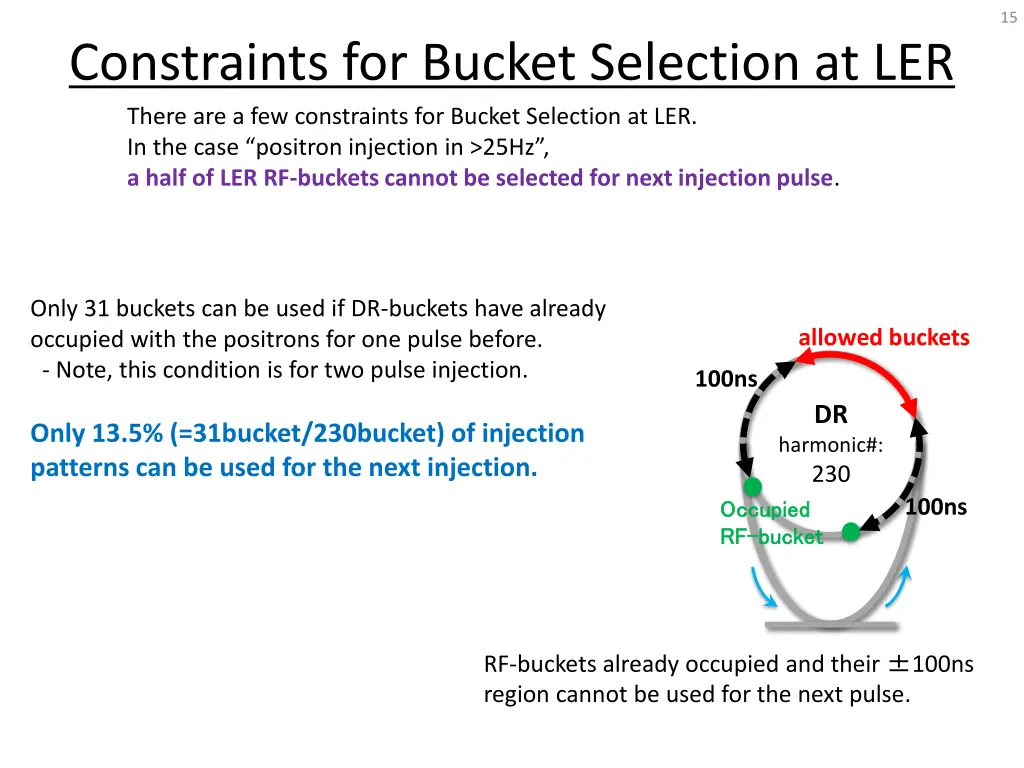
15 Constraints for Bucket Selection at LER There are a few constraints for Bucket Selection at LER. In the case positron injection in >25Hz , a half of LER RF-buckets cannot be selected for next injection pulse. Only 31 buckets can be used if DR-buckets have already occupied with the positrons for one pulse before. - Note, this condition is for two pulse injection. allowed buckets 100ns DR Only 13.5% (=31bucket/230bucket) of injection patterns can be used for the next injection. harmonic#: 230 100ns Occupied Occupied RF RF- -bucket bucket RF-buckets already occupied and their 100ns region cannot be used for the next pulse.
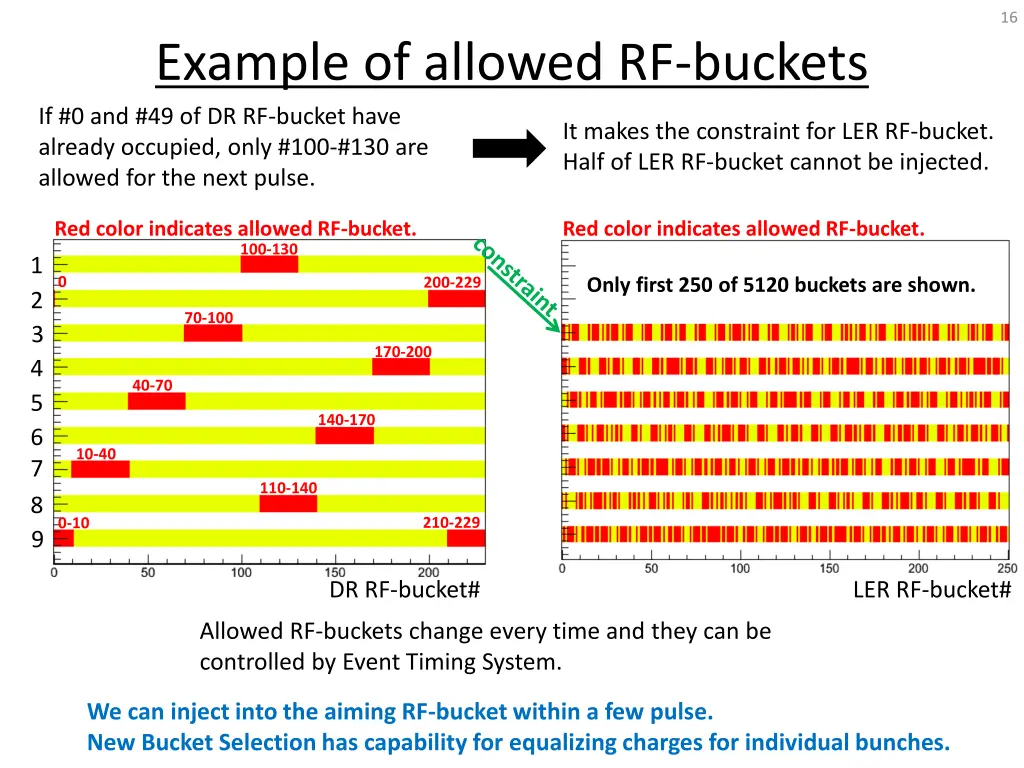
16 Example of allowed RF-buckets If #0 and #49 of DR RF-bucket have already occupied, only #100-#130 are allowed for the next pulse. It makes the constraint for LER RF-bucket. Half of LER RF-bucket cannot be injected. Red color indicates allowed RF-bucket. Red color indicates allowed RF-bucket. 100-130 1 2 3 4 5 6 7 8 9 0 200-229 Only first 250 of 5120 buckets are shown. 70-100 170-200 40-70 140-170 10-40 110-140 210-229 0-10 DR RF-bucket# LER RF-bucket# Allowed RF-buckets change every time and they can be controlled by Event Timing System. We can inject into the aiming RF-bucket within a few pulse. New Bucket Selection has capability for equalizing charges for individual bunches.
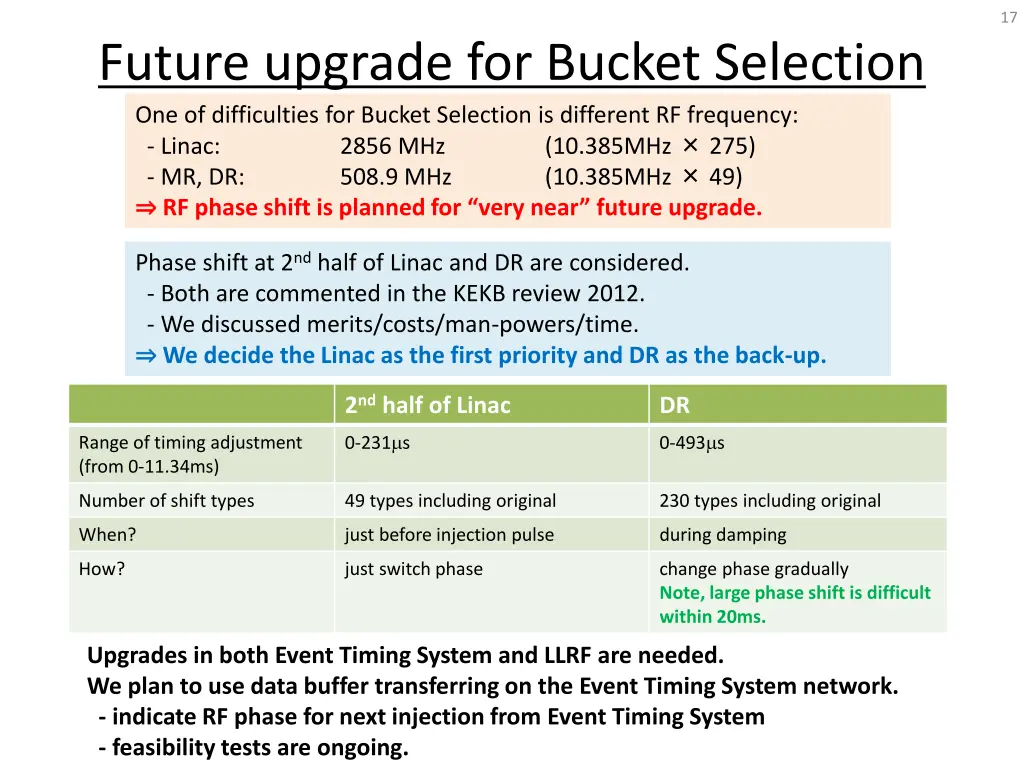
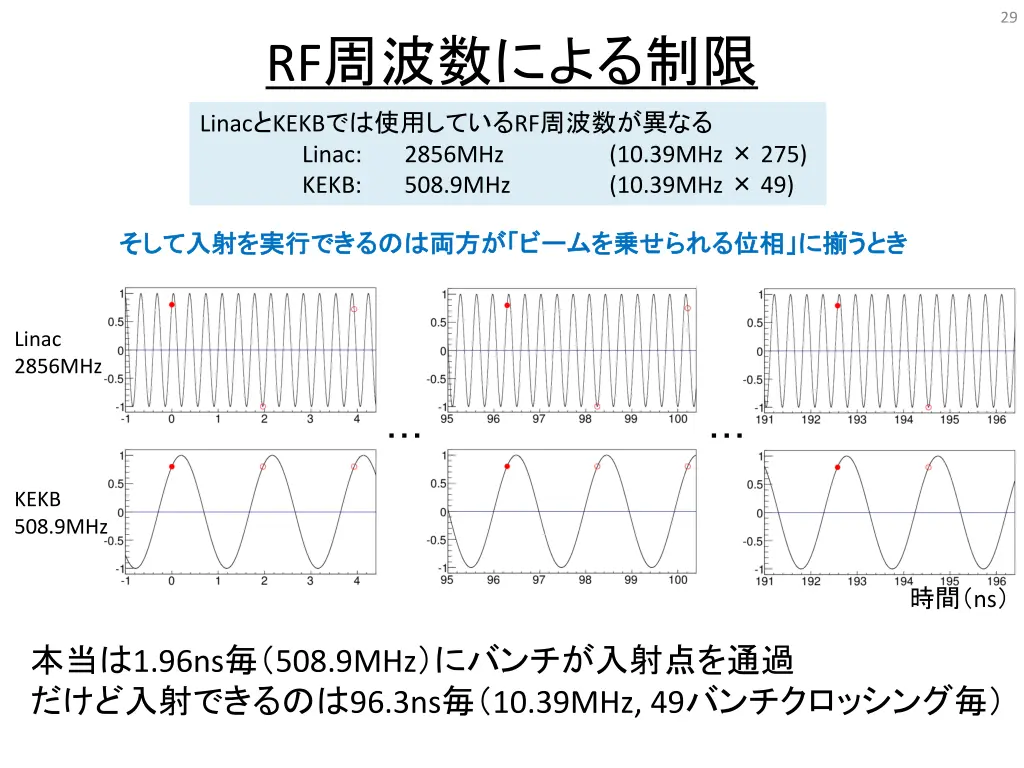
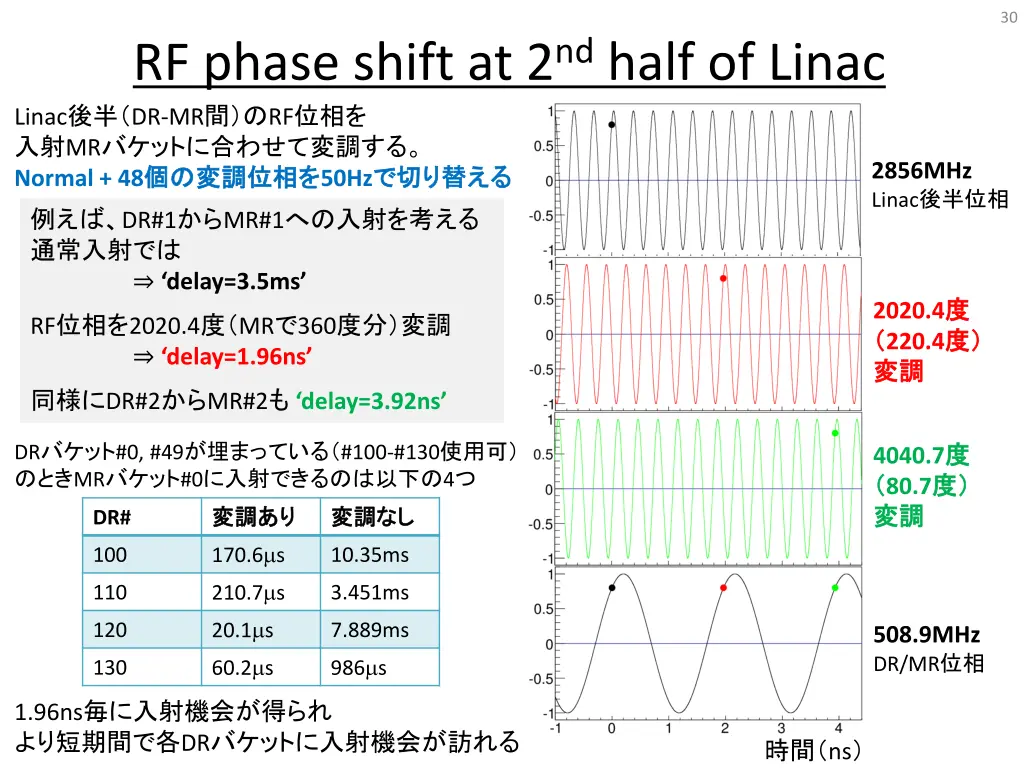
17 Future upgrade for Bucket Selection One of difficulties for Bucket Selection is different RF frequency: - Linac: 2856 MHz - MR, DR: 508.9 MHz RF phase shift is planned for very near future upgrade. (10.385MHz 275) (10.385MHz 49) Phase shift at 2ndhalf of Linac and DR are considered. - Both are commented in the KEKB review 2012. - We discussed merits/costs/man-powers/time. We decide the Linac as the first priority and DR as the back-up. 2ndhalf of Linac 0-231 s DR 0-493 s Range of timing adjustment (from 0-11.34ms) Number of shift types 49 types including original 230 types including original When? just before injection pulse during damping How? just switch phase change phase gradually Note, large phase shift is difficult within 20ms. Upgrades in both Event Timing System and LLRF are needed. We plan to use data buffer transferring on the Event Timing System network. - indicate RF phase for next injection from Event Timing System - feasibility tests are ongoing.
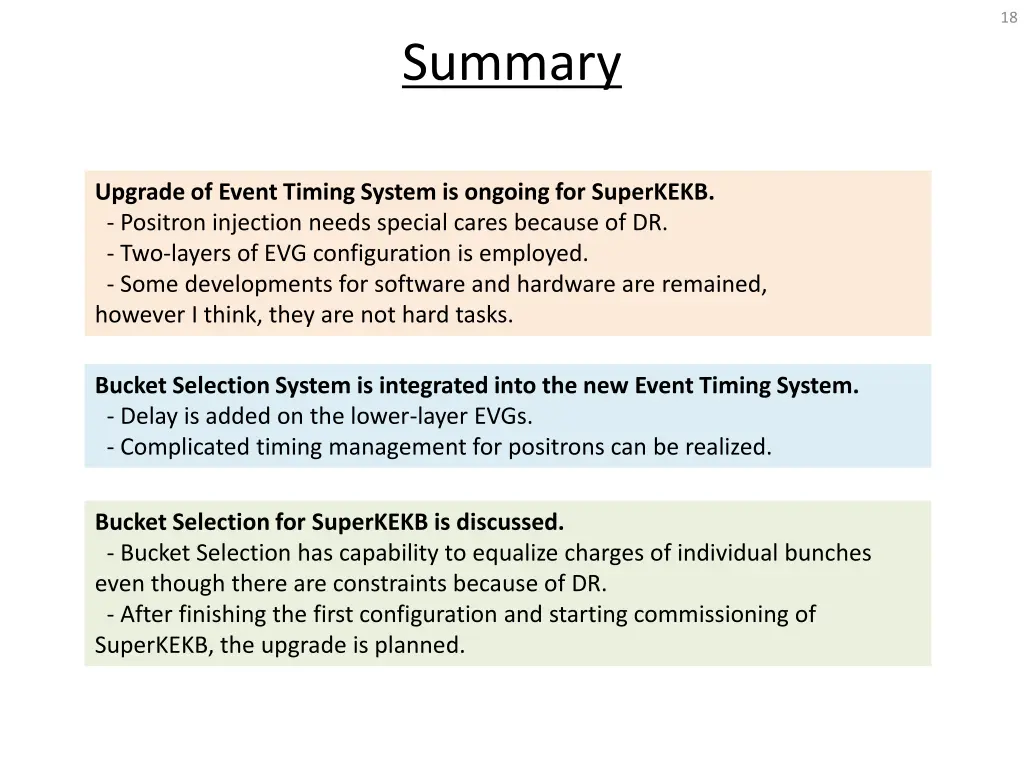
18 Summary Upgrade of Event Timing System is ongoing for SuperKEKB. - Positron injection needs special cares because of DR. - Two-layers of EVG configuration is employed. - Some developments for software and hardware are remained, however I think, they are not hard tasks. Bucket Selection System is integrated into the new Event Timing System. - Delay is added on the lower-layer EVGs. - Complicated timing management for positrons can be realized. Bucket Selection for SuperKEKB is discussed. - Bucket Selection has capability to equalize charges of individual bunches even though there are constraints because of DR. - After finishing the first configuration and starting commissioning of SuperKEKB, the upgrade is planned.
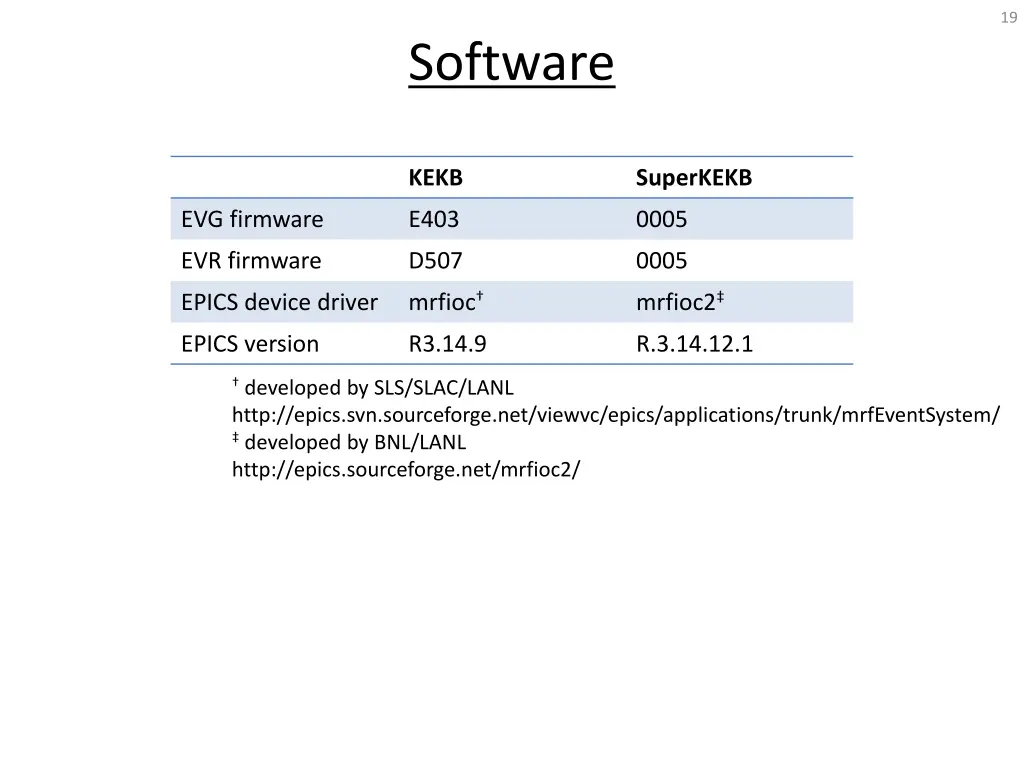
19 Software KEKB SuperKEKB EVG firmware E403 0005 EVR firmware D507 0005 mrfioc mrfioc2 EPICS device driver EPICS version R3.14.9 R.3.14.12.1 developed by SLS/SLAC/LANL http://epics.svn.sourceforge.net/viewvc/epics/applications/trunk/mrfEventSystem/ developed by BNL/LANL http://epics.sourceforge.net/mrfioc2/
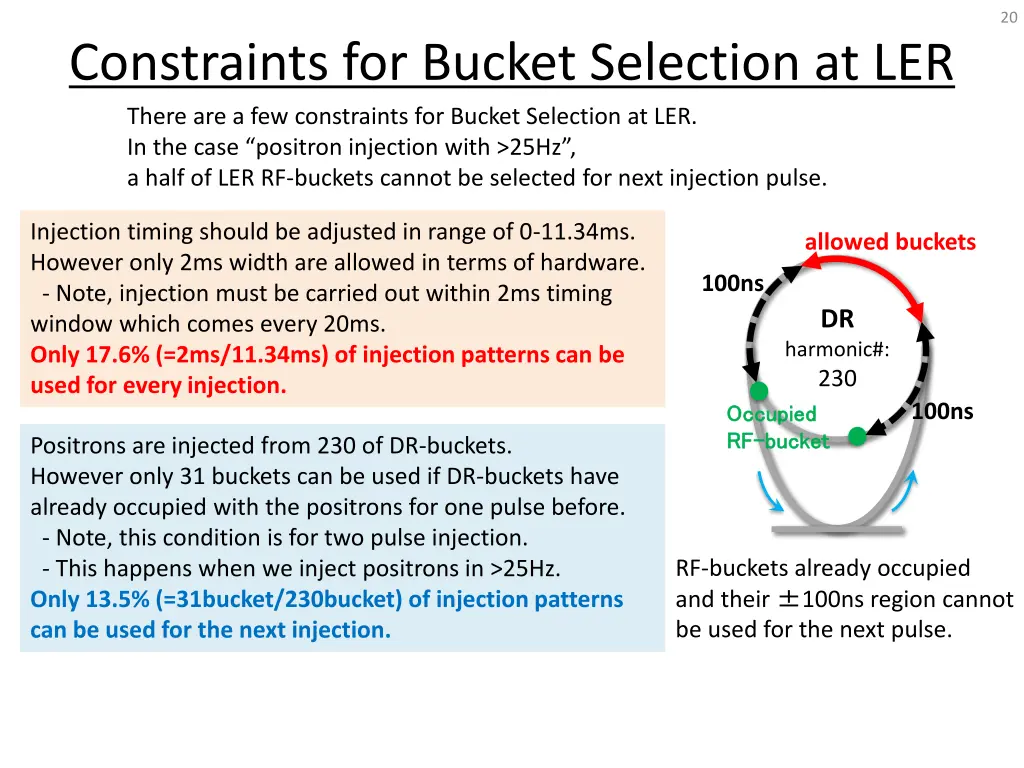
20 Constraints for Bucket Selection at LER There are a few constraints for Bucket Selection at LER. In the case positron injection with >25Hz , a half of LER RF-buckets cannot be selected for next injection pulse. Injection timing should be adjusted in range of 0-11.34ms. However only 2ms width are allowed in terms of hardware. - Note, injection must be carried out within 2ms timing window which comes every 20ms. Only 17.6% (=2ms/11.34ms) of injection patterns can be used for every injection. allowed buckets 100ns DR harmonic#: 230 100ns Occupied Occupied RF RF- -bucket bucket Positrons are injected from 230 of DR-buckets. However only 31 buckets can be used if DR-buckets have already occupied with the positrons for one pulse before. - Note, this condition is for two pulse injection. - This happens when we inject positrons in >25Hz. Only 13.5% (=31bucket/230bucket) of injection patterns can be used for the next injection. RF-buckets already occupied and their 100ns region cannot be used for the next pulse.
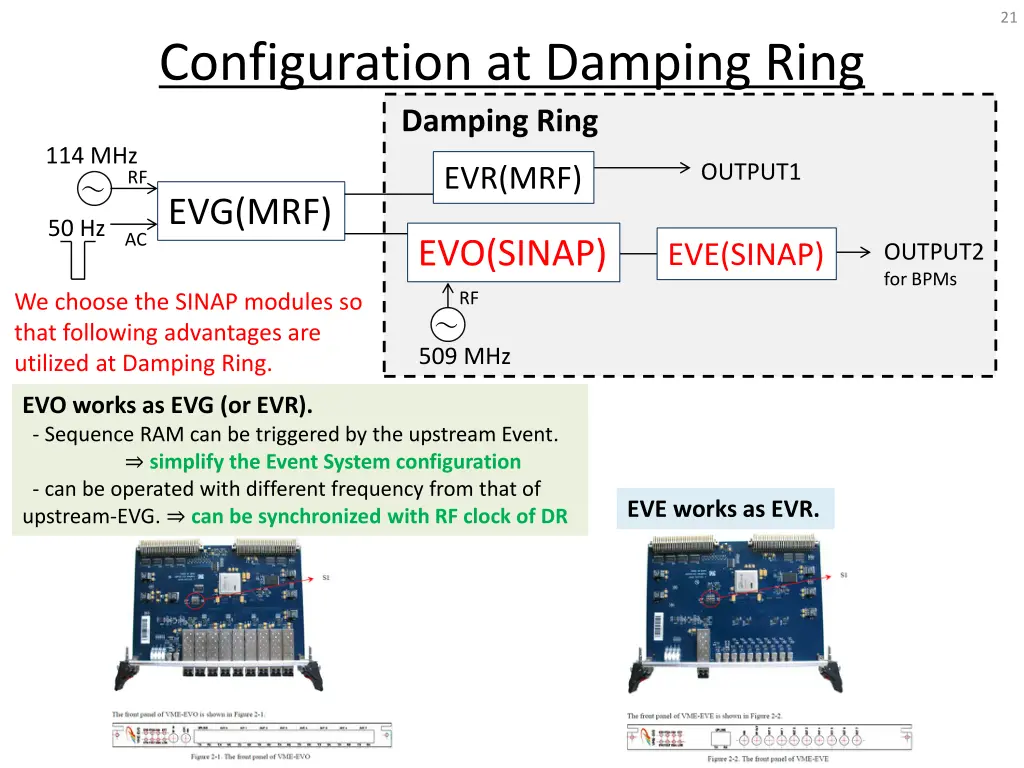
21 Configuration at Damping Ring Damping Ring 114 MHz OUTPUT1 EVR(MRF) RF EVG(MRF) 50 Hz AC EVO(SINAP) EVE(SINAP) OUTPUT2 for BPMs RF We choose the SINAP modules so that following advantages are utilized at Damping Ring. 509 MHz EVO works as EVG (or EVR). - Sequence RAM can be triggered by the upstream Event. simplify the Event System configuration - can be operated with different frequency from that of upstream-EVG. can be synchronized with RF clock of DR EVE works as EVR.
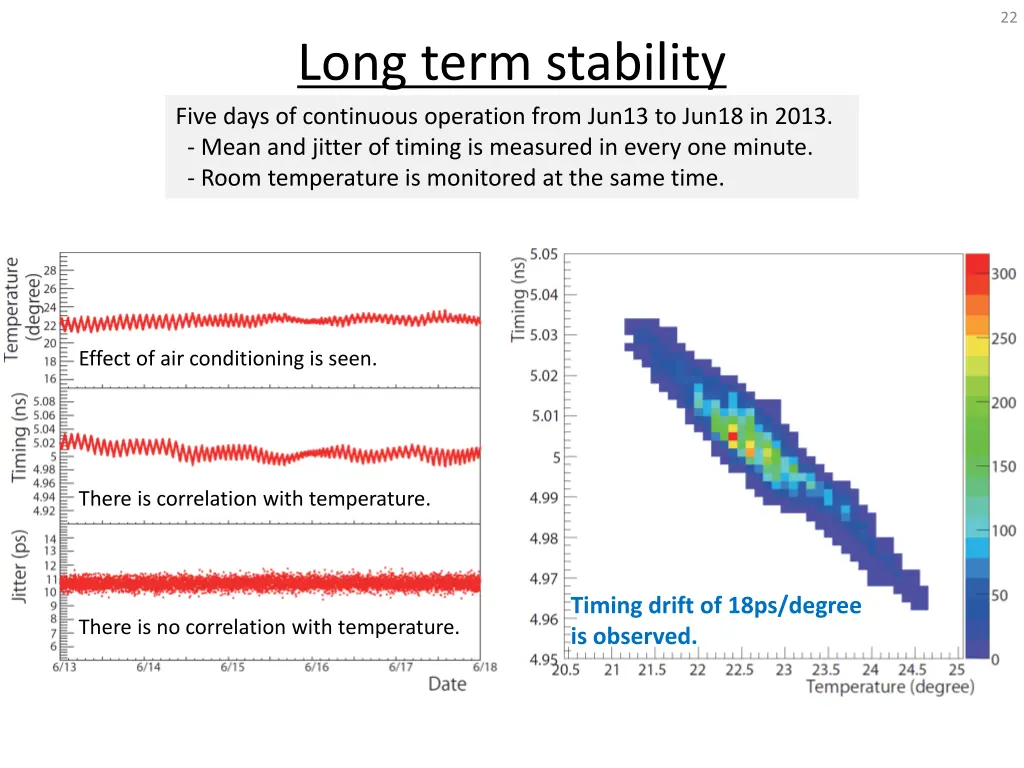
22 Long term stability Five days of continuous operation from Jun13 to Jun18 in 2013. - Mean and jitter of timing is measured in every one minute. - Room temperature is monitored at the same time. Effect of air conditioning is seen. There is correlation with temperature. Timing drift of 18ps/degree is observed. There is no correlation with temperature.
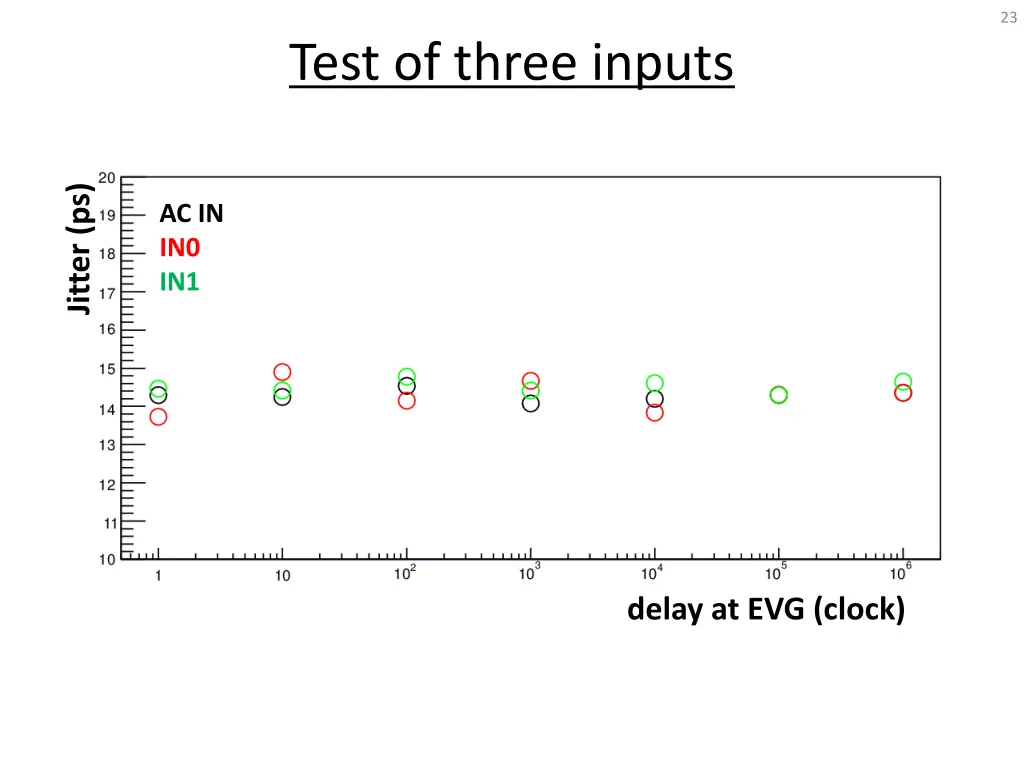
23 Test of three inputs Jitter (ps) AC IN IN0 IN1 delay at EVG (clock)
24 Performance Test of Reflective Memory transfer rate: 45.5MByte/s transfer time for 15MByte (seconds)
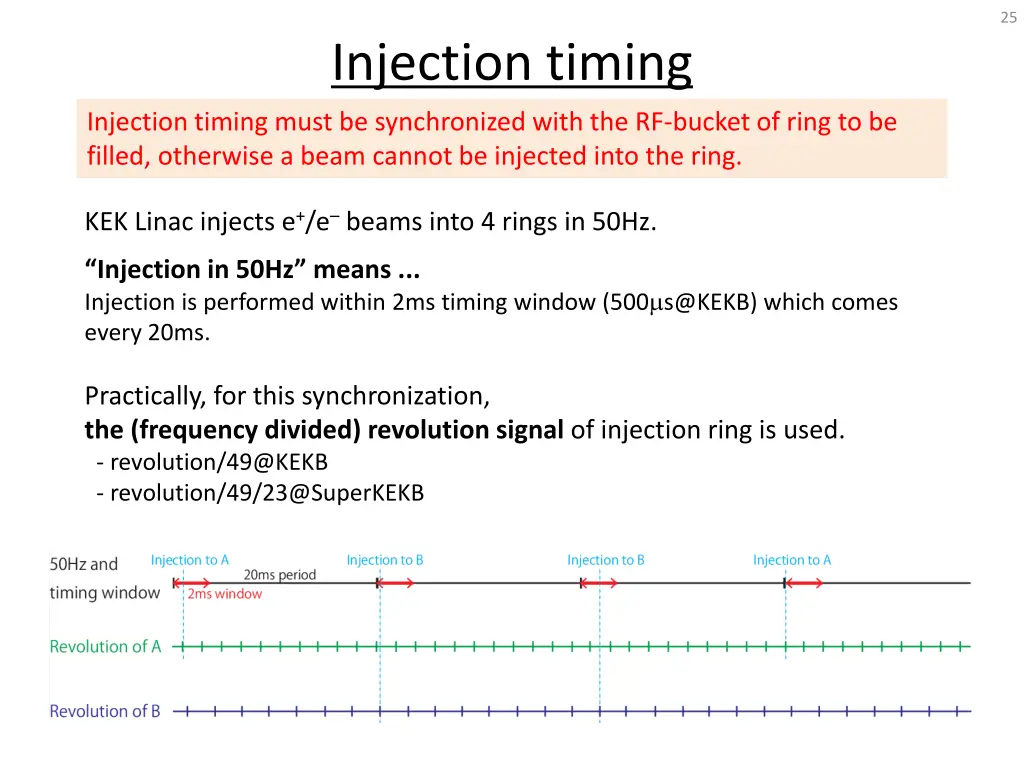
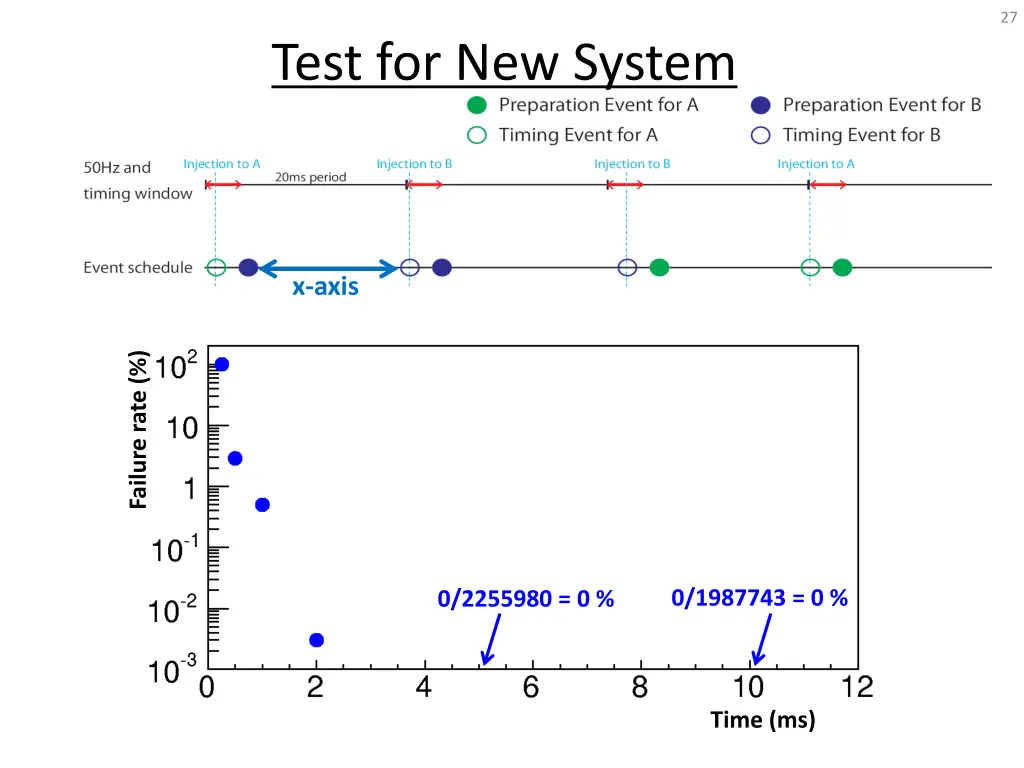
25 Injection timing Injection timing must be synchronized with the RF-bucket of ring to be filled, otherwise a beam cannot be injected into the ring. KEK Linac injects e+/e beams into 4 rings in 50Hz. Injection in 50Hz means ... Injection is performed within 2ms timing window (500 s@KEKB) which comes every 20ms. Practically, for this synchronization, the (frequency divided) revolution signal of injection ring is used. - revolution/49@KEKB - revolution/49/23@SuperKEKB
26 Test for New System delivered by one trigger EVR generates NIM/TTL EVR interrupts CPU. Setup parameters for next pulse.
27 Test for New System x-axis Failure rate (%) 0/1987743 = 0 % 0/2255980 = 0 % Time (ms)
28 Precision of output TTL Sequence Length clock, 8.8ns
29 RF Linac KEKB RF Linac: 2856MHz KEKB: 508.9MHz (10.39MHz 275) (10.39MHz 49) Linac 2856MHz KEKB 508.9MHz ns 1.96ns 508.9MHz 96.3ns 10.39MHz, 49
30 RF phase shift at 2ndhalf of Linac Linac DR-MR RF MR Normal + 48 50Hz 2856MHz Linac DR#1 MR#1 delay=3.5ms 2020.4 220.4 RF 2020.4 MR 360 delay=1.96ns DR#2 MR#2 delay=3.92ns DR #0, #49 #100-#130 MR #0 4 4040.7 80.7 DR# 170.6 s 210.7 s 20.1 s 60.2 s 100 10.35ms 110 3.451ms 120 7.889ms 986 s 508.9MHz DR/MR 130 1.96ns DR ns
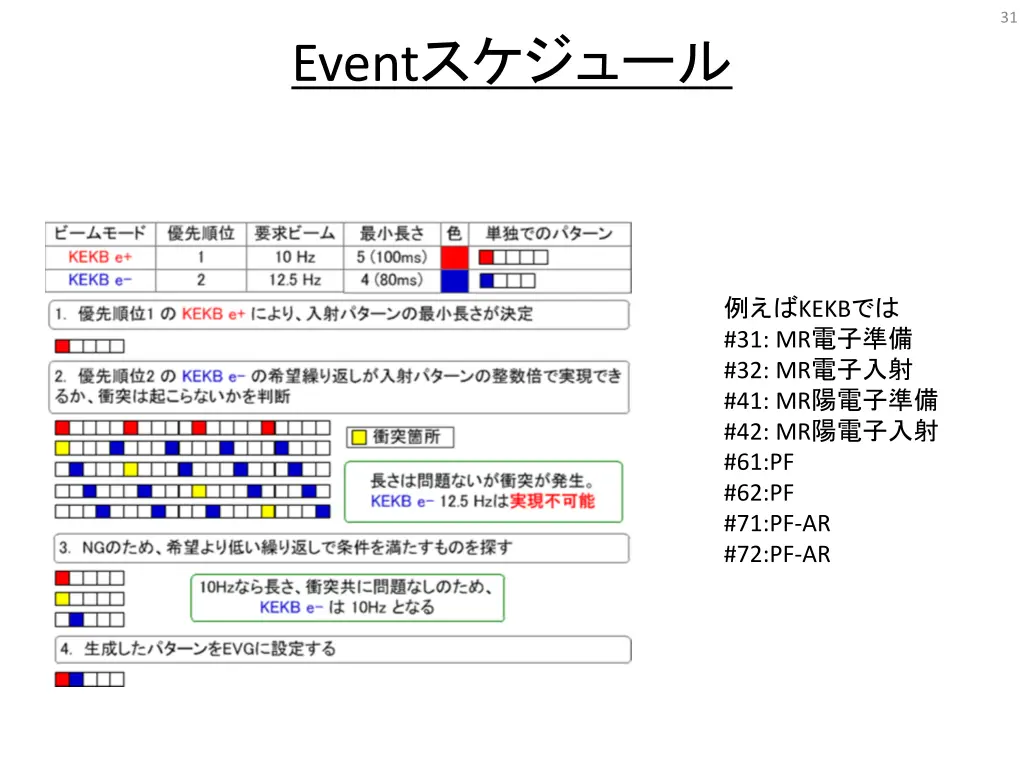
31 Event KEKB #31: MR #32: MR #41: MR #42: MR #61:PF #62:PF #71:PF-AR #72:PF-AR