Advanced Networking Concepts: IPv4 vs IPv6, IP Addressing, Routing Protocols
Explore the key concepts of IP addressing, subnet design, static vs dynamic IP addresses, and routing protocols. Learn about the importance of unique IP addresses for network security and efficient data transmission. Understand how routing facilitates data transfer between devices on a network, with a focus on the differences between IPv4 and IPv6 addresses.

Download Presentation

Please find below an Image/Link to download the presentation.
The content on the website is provided AS IS for your information and personal use only. It may not be sold, licensed, or shared on other websites without obtaining consent from the author. If you encounter any issues during the download, it is possible that the publisher has removed the file from their server.
You are allowed to download the files provided on this website for personal or commercial use, subject to the condition that they are used lawfully. All files are the property of their respective owners.
The content on the website is provided AS IS for your information and personal use only. It may not be sold, licensed, or shared on other websites without obtaining consent from the author.
E N D
Presentation Transcript
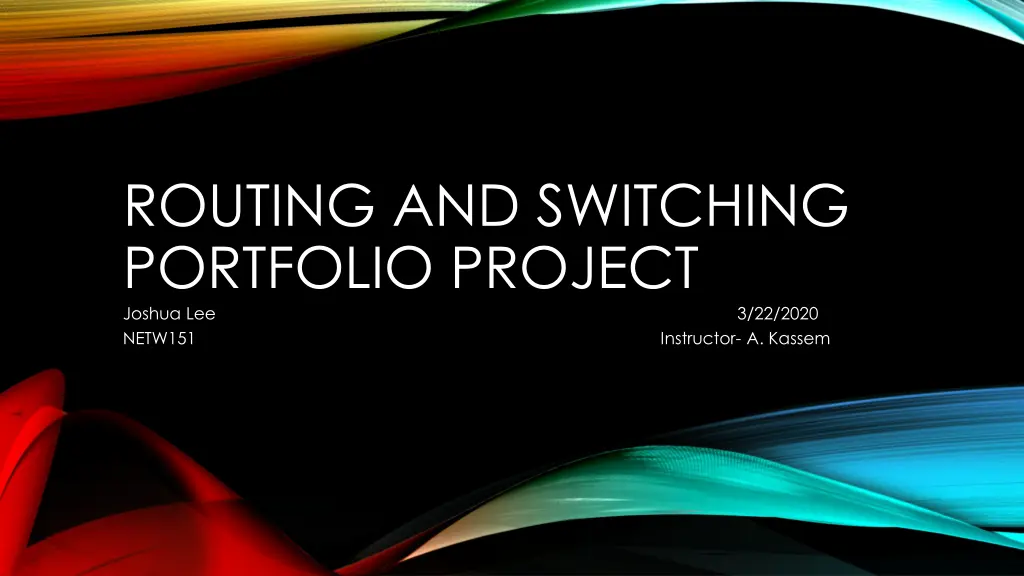
ROUTING AND SWITCHING PORTFOLIO PROJECT Joshua Lee NETW151 3/22/2020 Instructor- A. Kassem
INTRODUCTION IP Addressing IP Classes Subnetting Static and Dynamic IP addressing Routing Routing Protocols Routing Troubleshooting
IMPORTANCE OF IP ADDRESSING IP address is a string of numbers separated by periods or colons IP address provides unique Identification for devices on a network IP addressing allows data to be sent correctly to its destination Having a unique IP address provides a level of security on a network
IPV4 VS. IPV6 IPv4 is a 32-bit digit address IPv4 is only made up of numbers IPv4 is separated by periods IP is configured using DHCP or manual configuration IPv6 is 128-bit address IPv6 is hexadecimal (using both letters and numbers) IPv6 is separated by colons IPv6 is able to autoconfigure
SUBNET DESIGN Subnets will be separated by department Ex. HR, Research and Development, Marketing etc. Each subnet will be assigned their own class Ex. HR- Class A, Research and Development- Class B, Marketing-Class- C etc. Each device per subnet will be assigned their own IPv4 address.
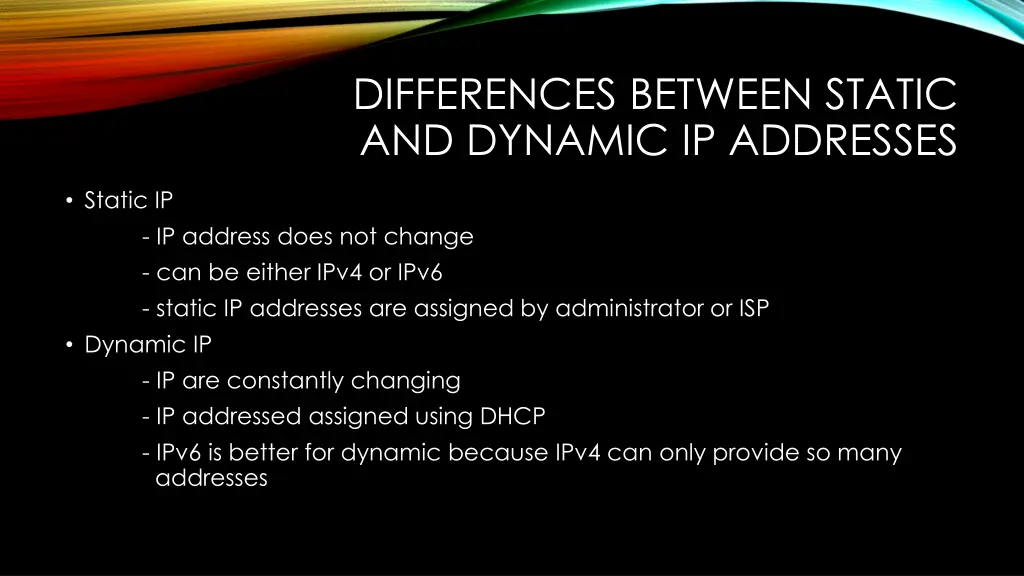
DIFFERENCES BETWEEN STATIC AND DYNAMIC IP ADDRESSES Static IP - IP address does not change - can be either IPv4 or IPv6 - static IP addresses are assigned by administrator or ISP Dynamic IP - IP are constantly changing - IP addressed assigned using DHCP - IPv6 is better for dynamic because IPv4 can only provide so many addresses
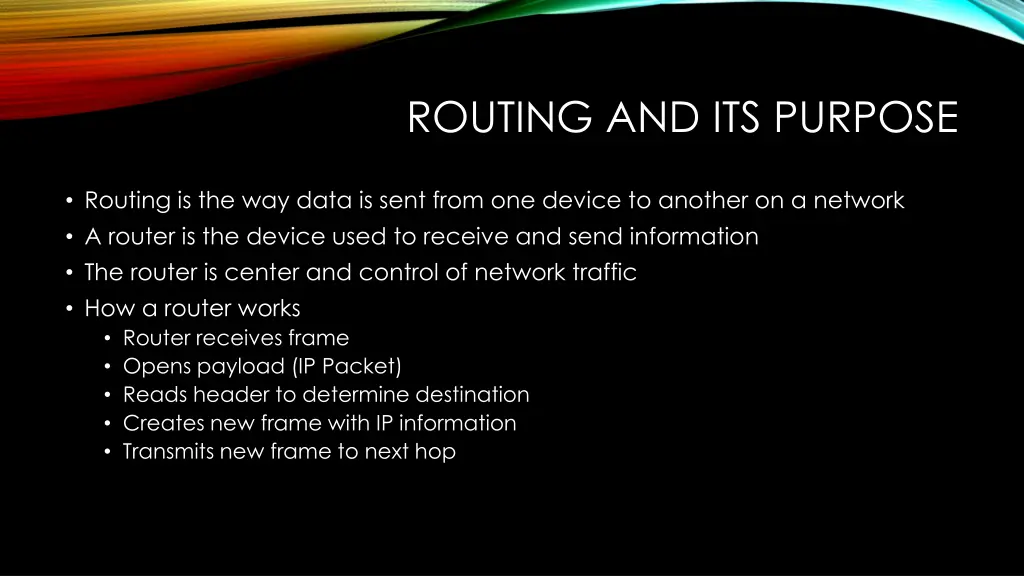
ROUTING AND ITS PURPOSE Routing is the way data is sent from one device to another on a network A router is the device used to receive and send information The router is center and control of network traffic How a router works Router receives frame Opens payload (IP Packet) Reads header to determine destination Creates new frame with IP information Transmits new frame to next hop
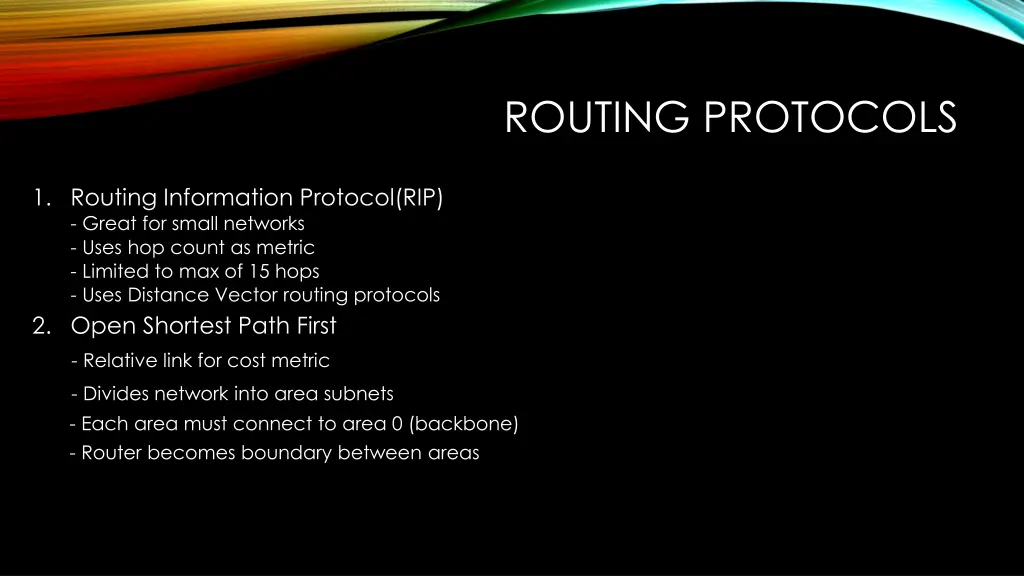
ROUTING PROTOCOLS 1. Routing Information Protocol(RIP) - Great for small networks - Uses hop count as metric - Limited to max of 15 hops - Uses Distance Vector routing protocols 2. Open Shortest Path First - Relative link for cost metric - Divides network into area subnets - Each area must connect to area 0 (backbone) - Router becomes boundary between areas
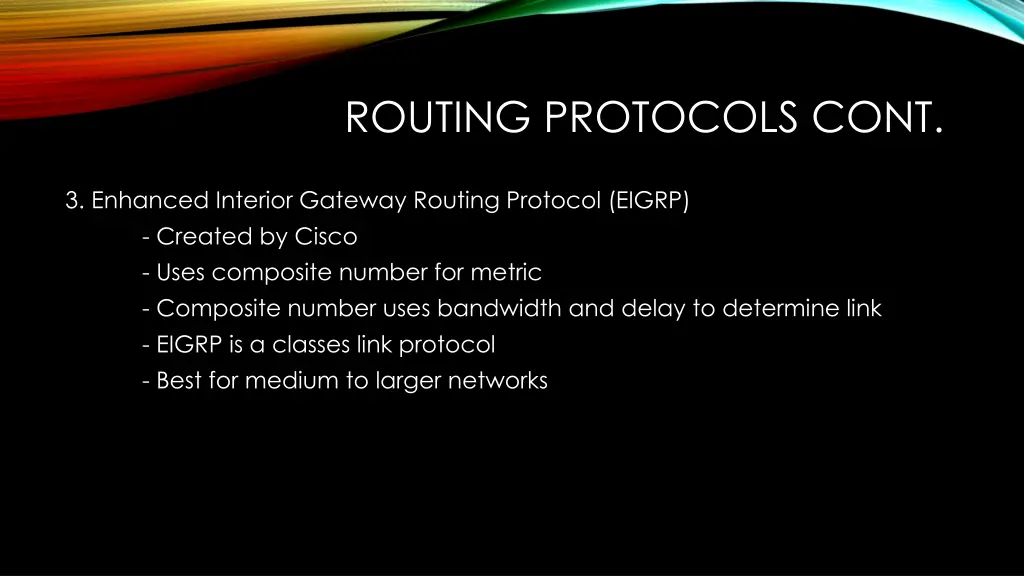
ROUTING PROTOCOLS CONT. 3. Enhanced Interior Gateway Routing Protocol (EIGRP) - Created by Cisco - Uses composite number for metric - Composite number uses bandwidth and delay to determine link - EIGRP is a classes link protocol - Best for medium to larger networks
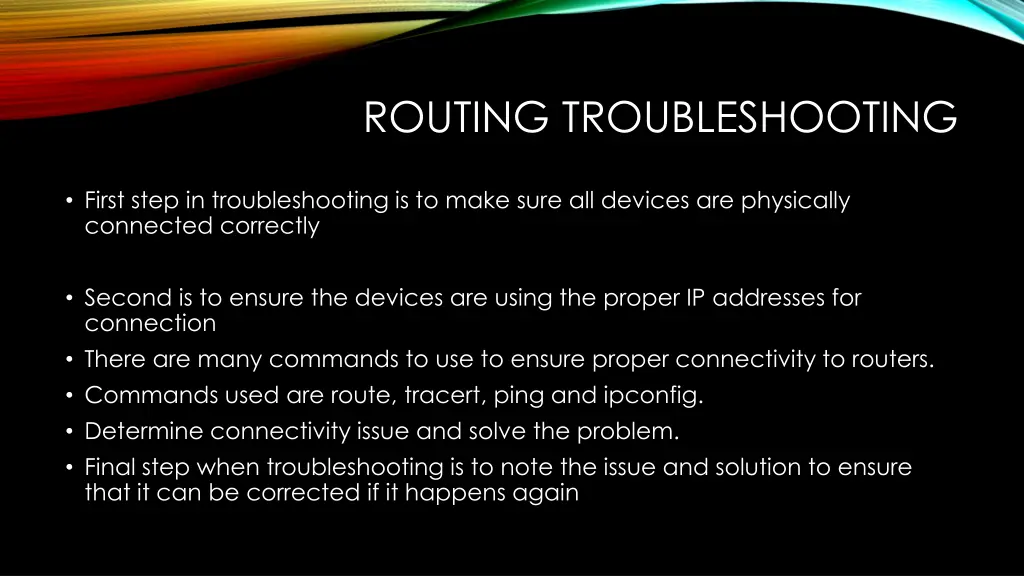
ROUTING TROUBLESHOOTING First step in troubleshooting is to make sure all devices are physically connected correctly Second is to ensure the devices are using the proper IP addresses for connection There are many commands to use to ensure proper connectivity to routers. Commands used are route, tracert, ping and ipconfig. Determine connectivity issue and solve the problem. Final step when troubleshooting is to note the issue and solution to ensure that it can be corrected if it happens again
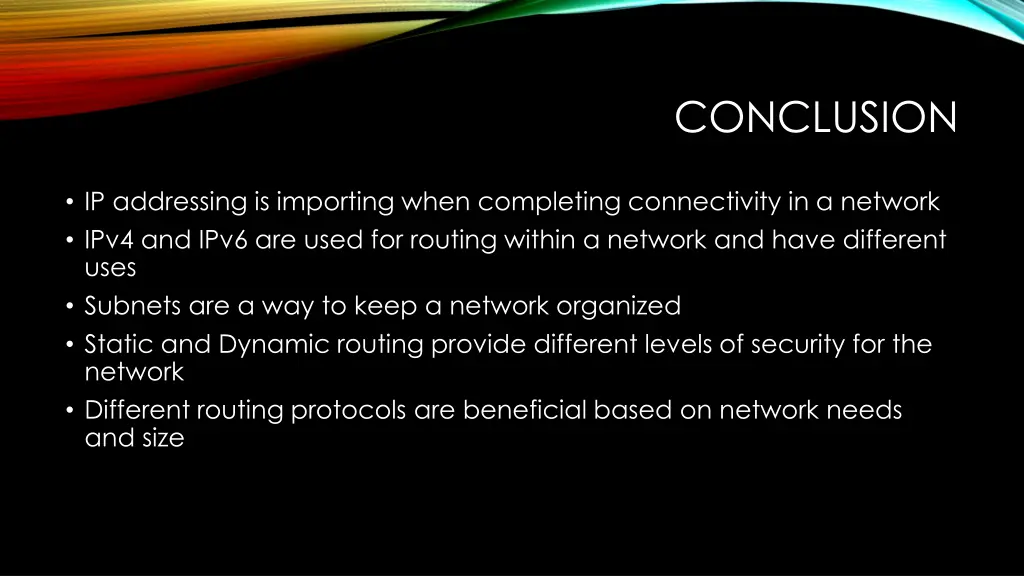
CONCLUSION IP addressing is importing when completing connectivity in a network IPv4 and IPv6 are used for routing within a network and have different uses Subnets are a way to keep a network organized Static and Dynamic routing provide different levels of security for the network Different routing protocols are beneficial based on network needs and size