Advanced Strategies in Transfer Learning and Active Learning
Explore various transfer learning and active learning strategies such as pre-training, feature extraction, domain adaptation, and instance weighting. Dive into the prototypical situation of active learning where machine learning algorithms seek assistance to label data points efficiently.

Download Presentation

Please find below an Image/Link to download the presentation.
The content on the website is provided AS IS for your information and personal use only. It may not be sold, licensed, or shared on other websites without obtaining consent from the author. If you encounter any issues during the download, it is possible that the publisher has removed the file from their server.
You are allowed to download the files provided on this website for personal or commercial use, subject to the condition that they are used lawfully. All files are the property of their respective owners.
The content on the website is provided AS IS for your information and personal use only. It may not be sold, licensed, or shared on other websites without obtaining consent from the author.
E N D
Presentation Transcript
Week 3 Video 7 Transfer Learning and Active Learning
Transfer Learning Applying knowledge gained from one task to another task Most commonly: Build classifier in one context, find a way to use classifier in another context
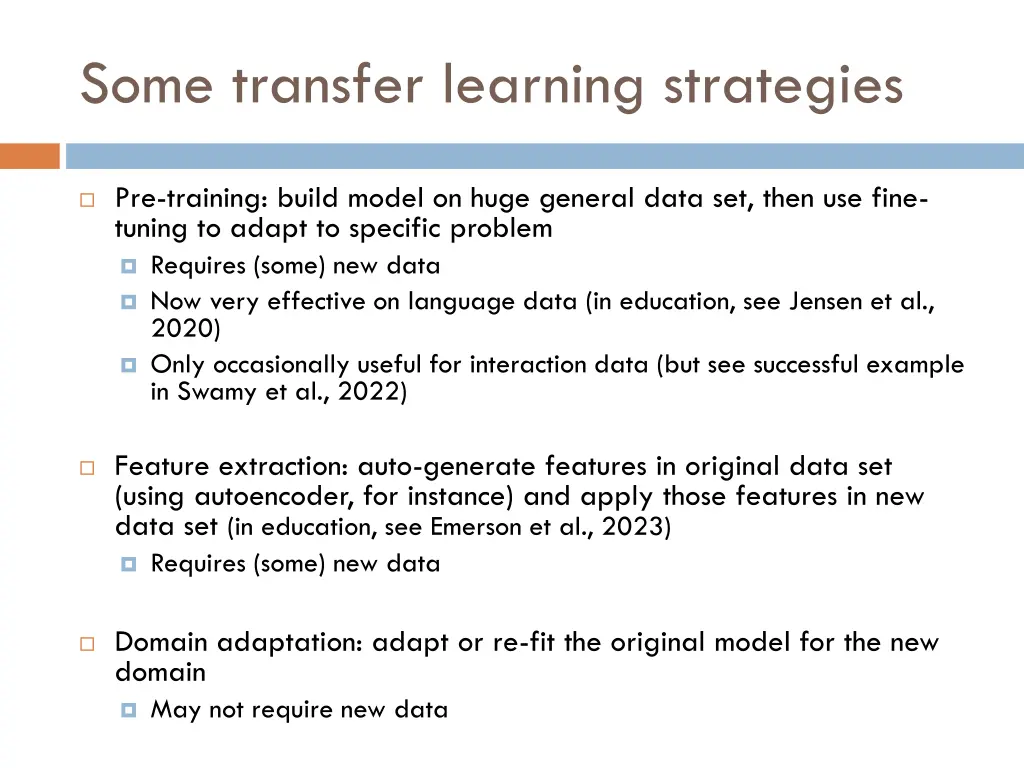
Some transfer learning strategies Pre-training: build model on huge general data set, then use fine- tuning to adapt to specific problem Requires (some) new data Now very effective on language data (in education, see Jensen et al., 2020) Only occasionally useful for interaction data (but see successful example in Swamy et al., 2022) Feature extraction: auto-generate features in original data set (using autoencoder, for instance) and apply those features in new data set (in education, see Emerson et al., 2023) Requires (some) new data Domain adaptation: adapt or re-fit the original model for the new domain May not require new data
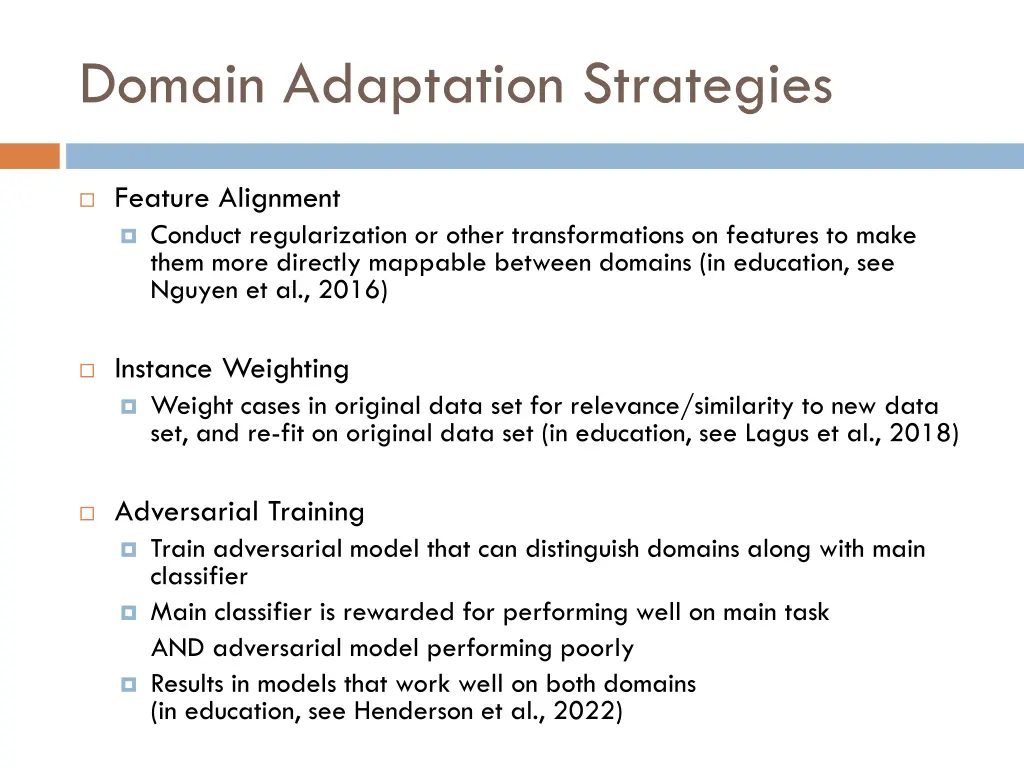
Domain Adaptation Strategies Feature Alignment Conduct regularization or other transformations on features to make them more directly mappable between domains (in education, see Nguyen et al., 2016) Instance Weighting Weight cases in original data set for relevance/similarity to new data set, and re-fit on original data set (in education, see Lagus et al., 2018) Adversarial Training Train adversarial model that can distinguish domains along with main classifier Main classifier is rewarded for performing well on main task AND adversarial model performing poorly Results in models that work well on both domains (in education, see Henderson et al., 2022)
Active Learning Where a machine learning algorithm identifies what it does not know and asks for assistance
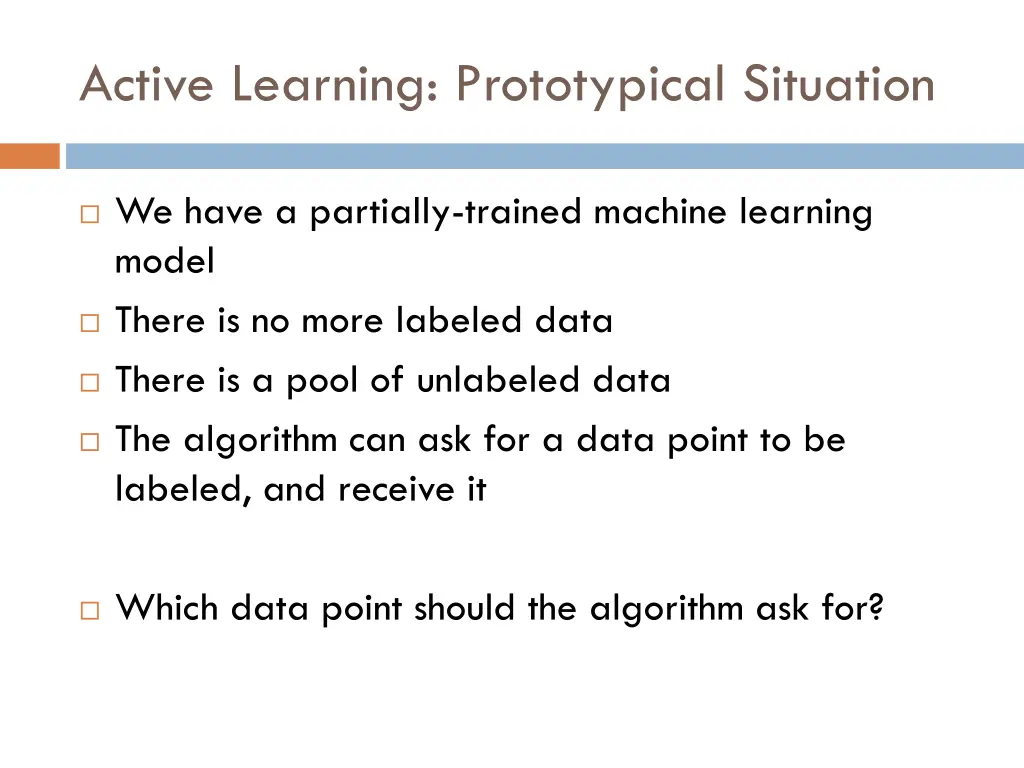
Active Learning: Prototypical Situation We have a partially-trained machine learning model There is no more labeled data There is a pool of unlabeled data The algorithm can ask for a data point to be labeled, and receive it Which data point should the algorithm ask for?
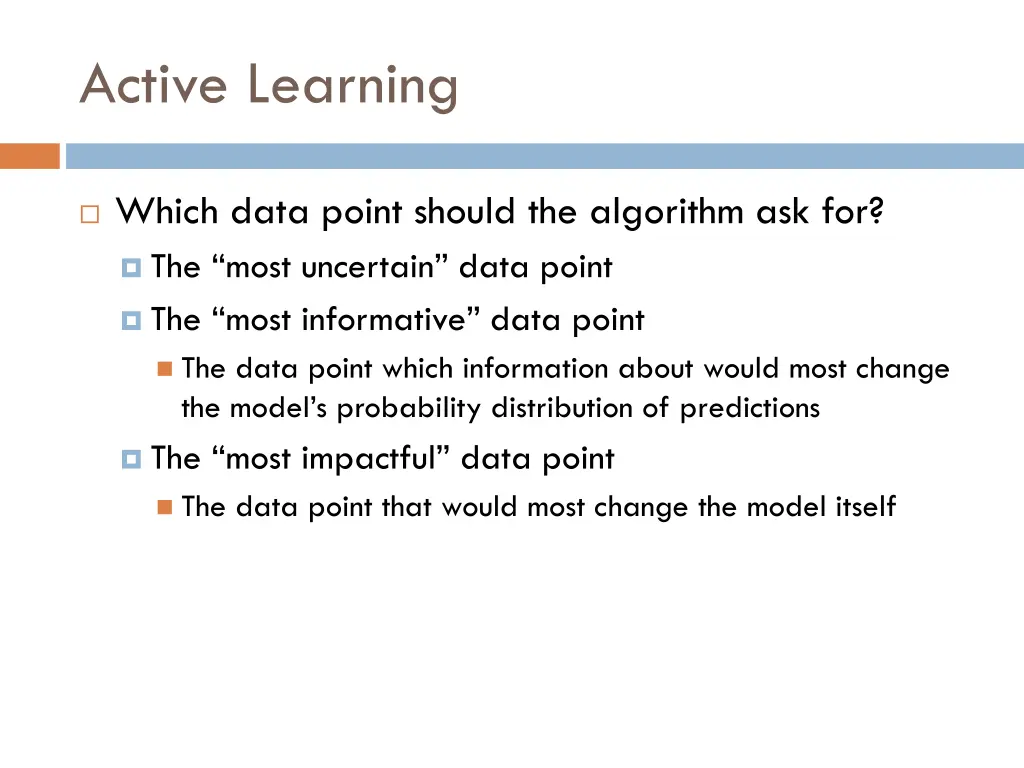
Active Learning Which data point should the algorithm ask for? The most uncertain data point The most informative data point The data point which information about would most change the model s probability distribution of predictions The most impactful data point The data point that would most change the model itself
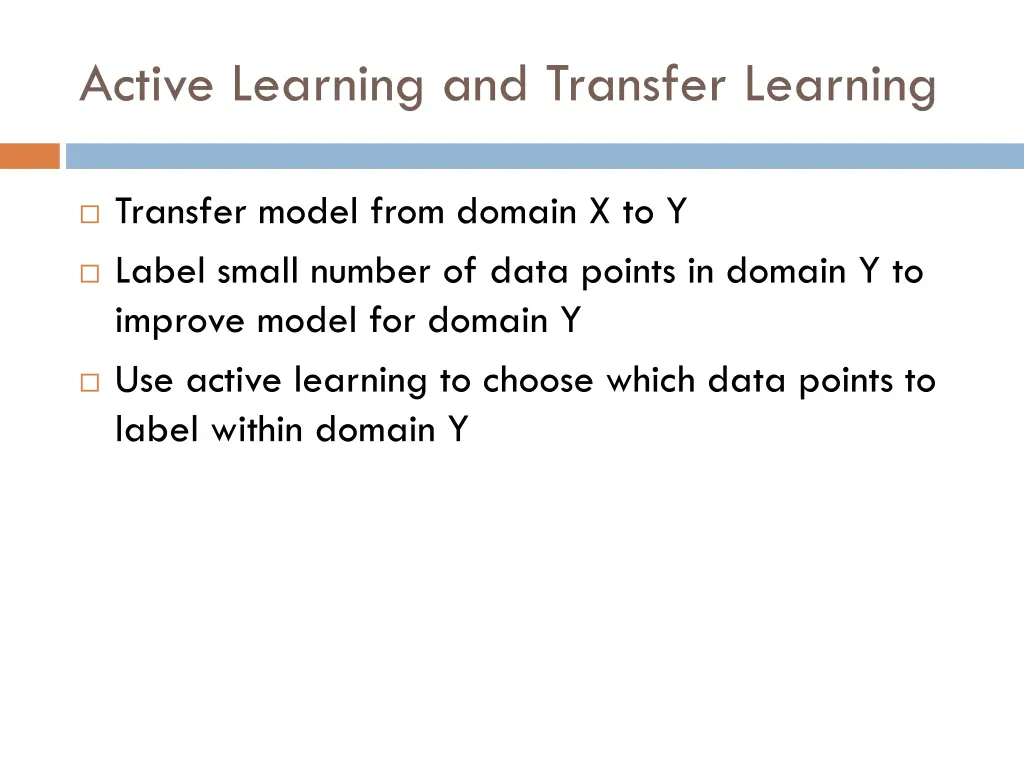
Active Learning and Transfer Learning Transfer model from domain X to Y Label small number of data points in domain Y to improve model for domain Y Use active learning to choose which data points to label within domain Y
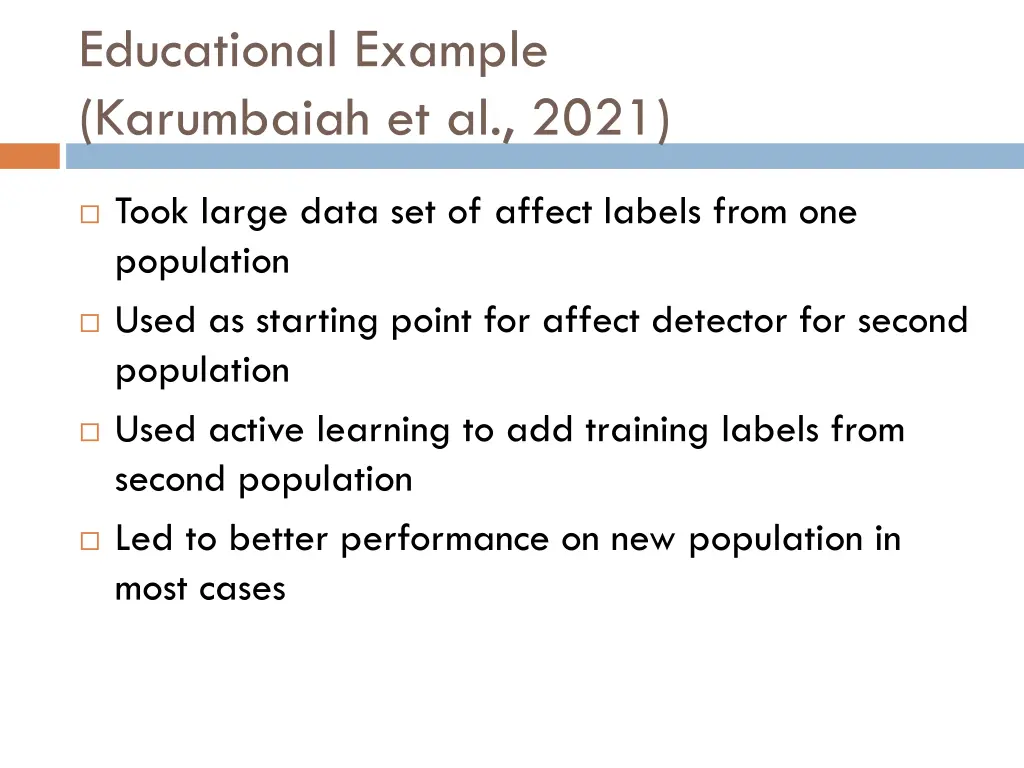
Educational Example (Karumbaiah et al., 2021) Took large data set of affect labels from one population Used as starting point for affect detector for second population Used active learning to add training labels from second population Led to better performance on new population in most cases
Mixed-Initiative Learning User can choose which data point to label next, or system can propose which data point to label next User can choose labels/categories, or system can use unsupervised methods to propose categories Example: Codey/nCoder (Choi et al., 2022)
Transfer Learning and Active Learning Essential contemporary methods for making classifiers general across contexts and efficient to transfer/develop
End of Week 3 Next Up: Knowledge Tracing