Explore cutting-edge methods in spoken content management, including automatic summarization, semantic structuring, and key term extraction. Learn how multi-modal dialogue and information extraction enhance user-content interaction for spoken archives.
Please find below an Image/Link to download the presentation.
The content on the website is provided AS IS for your information and personal use only. It may not be sold, licensed, or shared on other websites without obtaining consent from the author. If you encounter any issues during the download, it is possible that the publisher has removed the file from their server.
You are allowed to download the files provided on this website for personal or commercial use, subject to the condition that they are used lawfully. All files are the property of their respective owners.
The content on the website is provided AS IS for your information and personal use only. It may not be sold, licensed, or shared on other websites without obtaining consent from the author.
E N D
Presentation Transcript
11.0 Spoken Document Understanding and Organization for User-content Interaction References: 1. Spoken Document Understanding and Organization , IEEE Signal Processing Magazine, Sept. 2005, Special Issue on Speech Technology in Human-Machine Communication 2. Multi-layered Summarization of Spoken Document Archives by Information Extraction and Semantic Structuring , Interspeech 2006, Pittsburg, USA
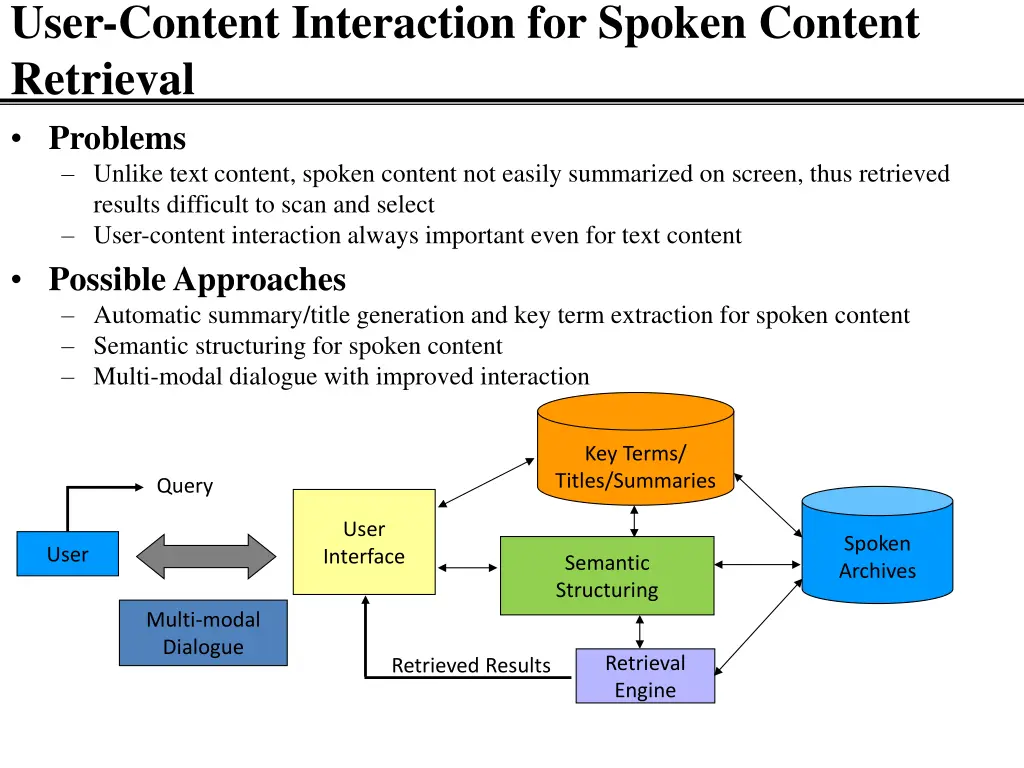
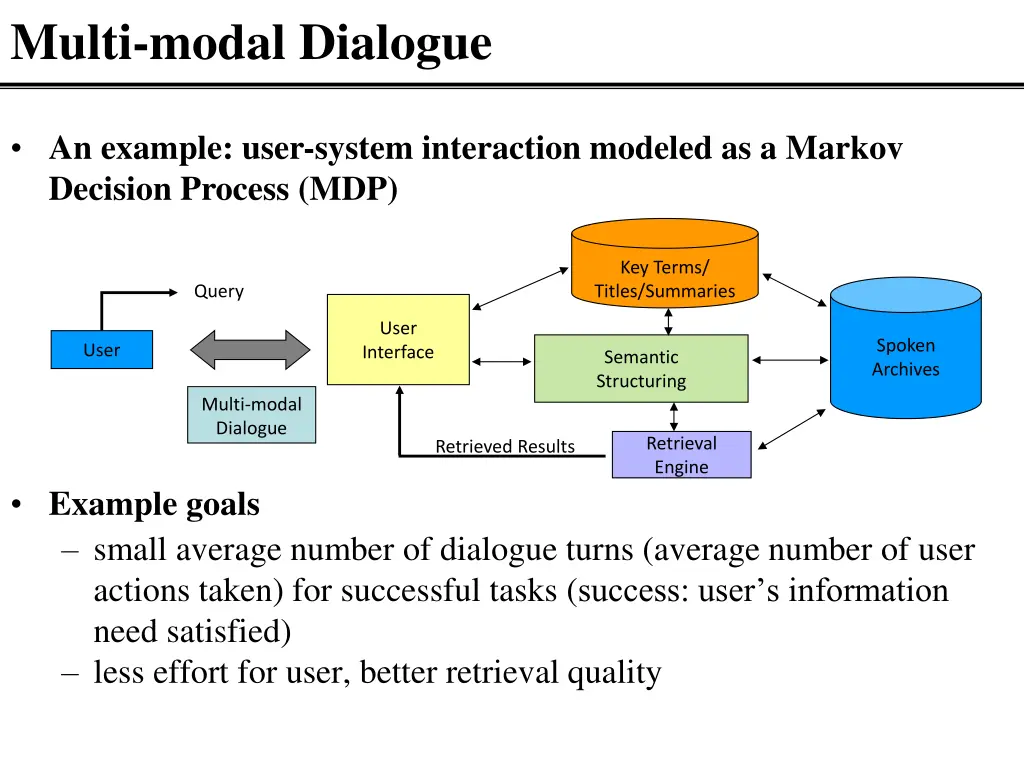
User-Content Interaction for Spoken Content Retrieval Problems Unlike text content, spoken content not easily summarized on screen, thus retrieved results difficult to scan and select User-content interaction always important even for text content Possible Approaches Automatic summary/title generation and key term extraction for spoken content Semantic structuring for spoken content Multi-modal dialogue with improved interaction Key Terms/ Titles/Summaries Query User Interface Spoken Archives User Semantic Structuring Multi-modal Dialogue Retrieval Engine Retrieved Results
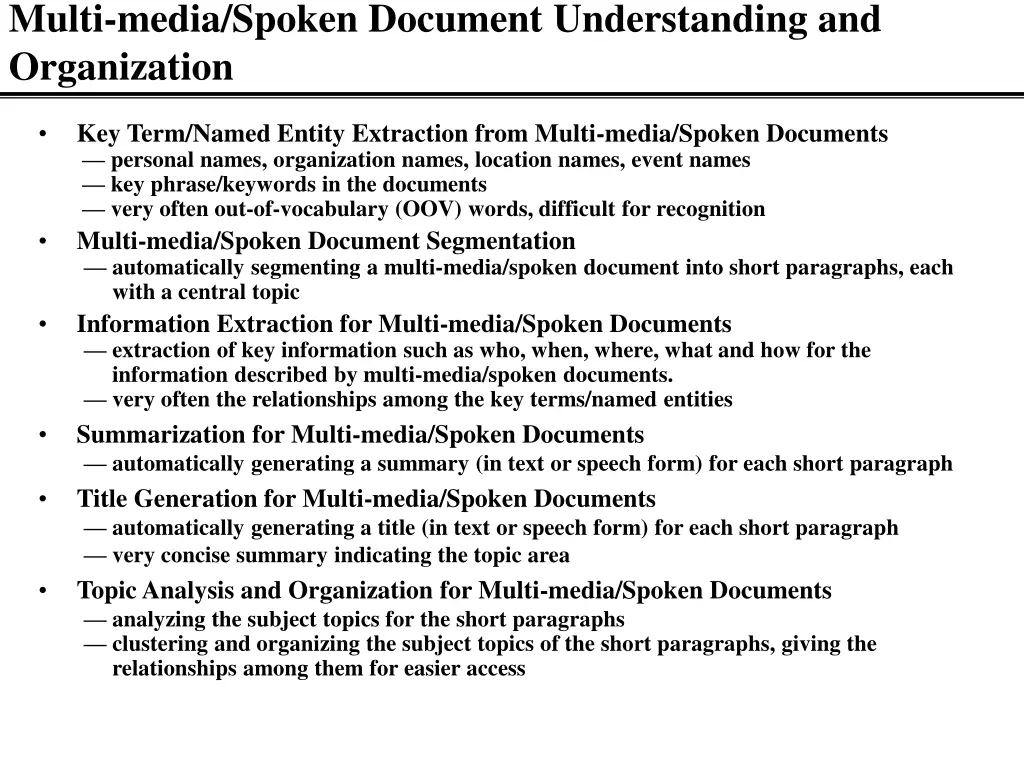
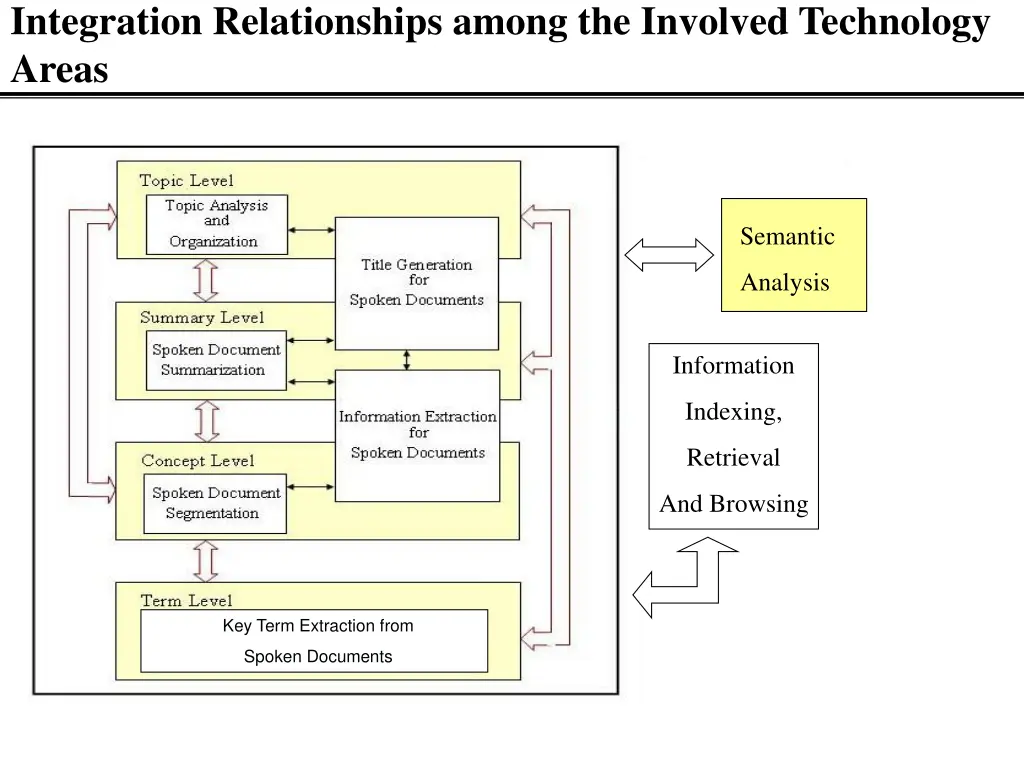
Multi-media/Spoken Document Understanding and Organization Key Term/Named Entity Extraction from Multi-media/Spoken Documents personal names, organization names, location names, event names key phrase/keywords in the documents very often out-of-vocabulary (OOV) words, difficult for recognition Multi-media/Spoken Document Segmentation automatically segmenting a multi-media/spoken document into short paragraphs, each with a central topic Information Extraction for Multi-media/Spoken Documents extraction of key information such as who, when, where, what and how for the information described by multi-media/spoken documents. very often the relationships among the key terms/named entities Summarization for Multi-media/Spoken Documents automatically generating a summary (in text or speech form) for each short paragraph Title Generation for Multi-media/Spoken Documents automatically generating a title (in text or speech form) for each short paragraph very concise summary indicating the topic area Topic Analysis and Organization for Multi-media/Spoken Documents analyzing the subject topics for the short paragraphs clustering and organizing the subject topics of the short paragraphs, giving the relationships among them for easier access
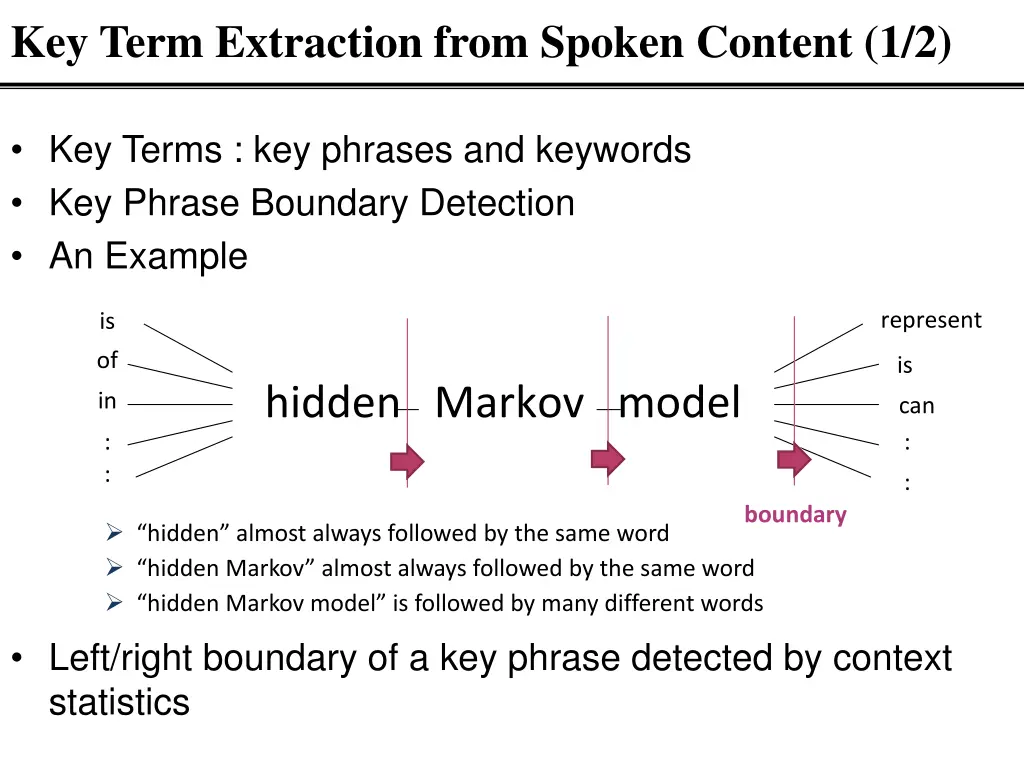
Key Term Extraction from Spoken Content (1/2) Key Terms : key phrases and keywords Key Phrase Boundary Detection An Example represent is of is hidden Markov model in can : : : : boundary hidden almost always followed by the same word hidden Markov almost always followed by the same word hidden Markov model is followed by many different words Left/right boundary of a key phrase detected by context statistics
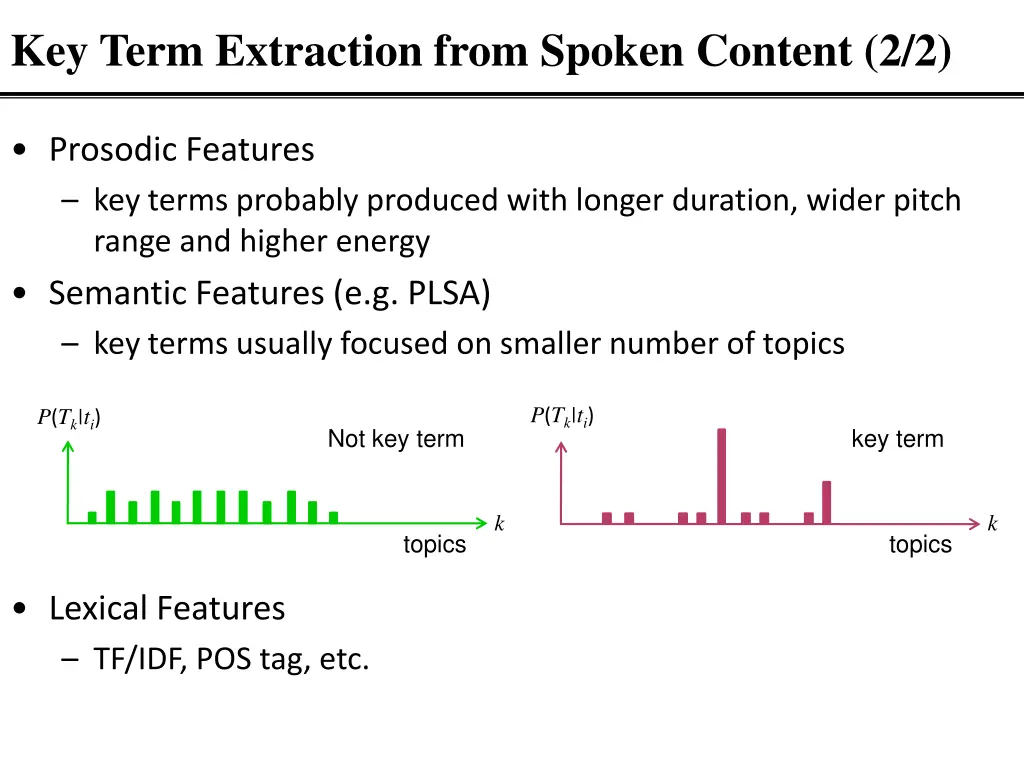
Key Term Extraction from Spoken Content (2/2) Prosodic Features key terms probably produced with longer duration, wider pitch range and higher energy Semantic Features (e.g. PLSA) key terms usually focused on smaller number of topics P(Tk|ti) P(Tk|ti) Not key term key term k k topics topics Lexical Features TF/IDF, POS tag, etc.
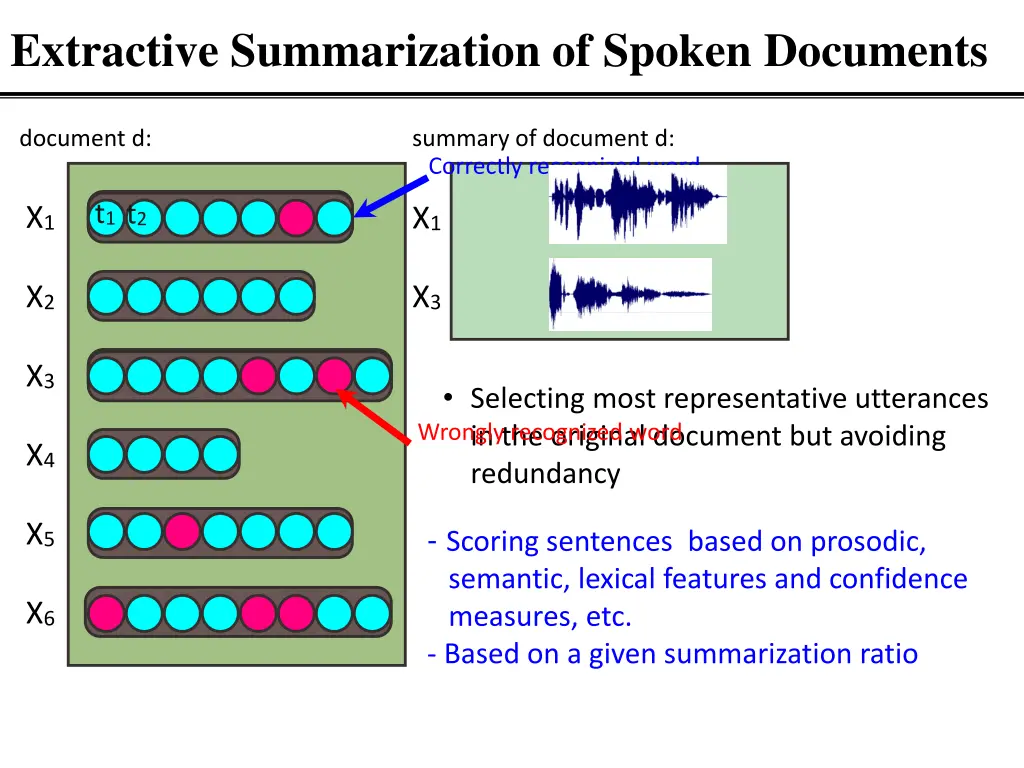
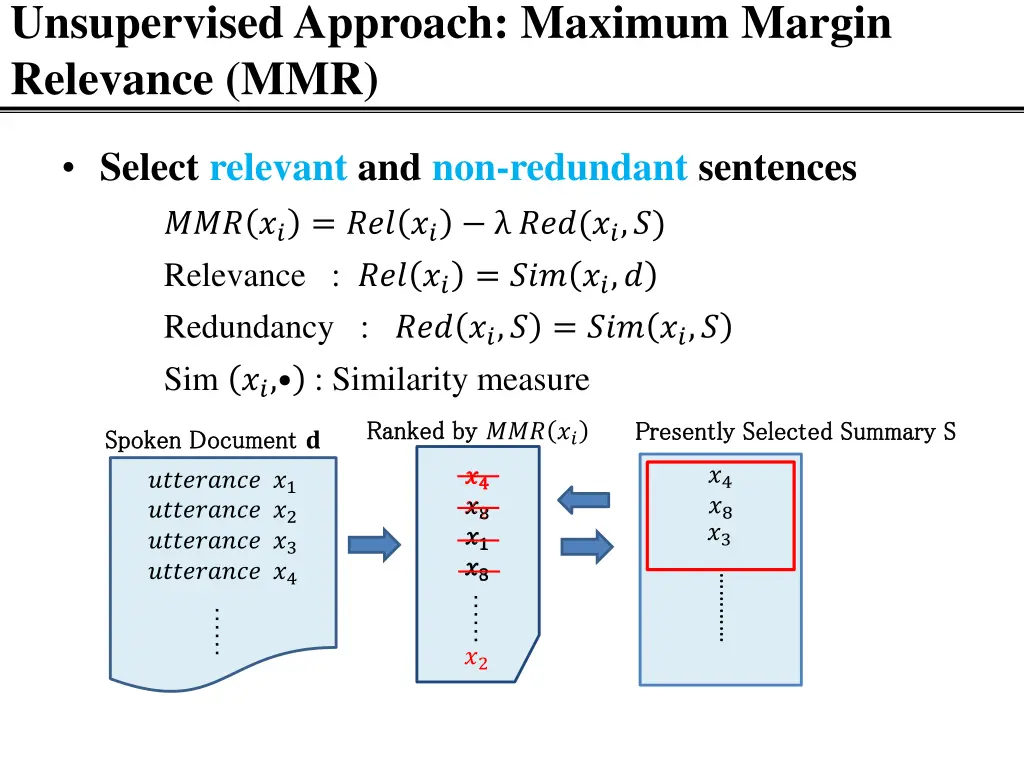
Extractive Summarization of Spoken Documents document d: summary of document d: Correctly recognized word t1 t2 X1 X1 X2 X3 X3 Selecting most representative utterances in the original document but avoiding redundancy Wrongly recognized word X4 X5 - Scoring sentences based on prosodic, semantic, lexical features and confidence measures, etc. - Based on a given summarization ratio X6
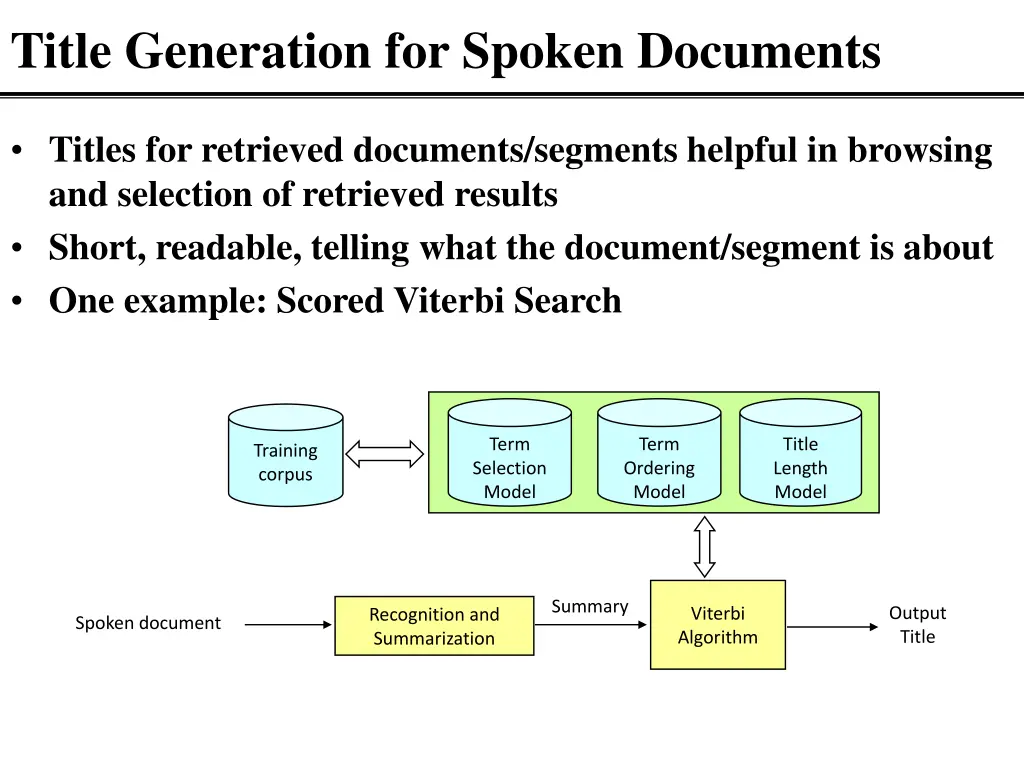
Title Generation for Spoken Documents Titles for retrieved documents/segments helpful in browsing and selection of retrieved results Short, readable, telling what the document/segment is about One example: Scored Viterbi Search Term Selection Model Term Ordering Model Title Length Model Training corpus Summary Output Title Viterbi Algorithm Recognition and Summarization Spoken document
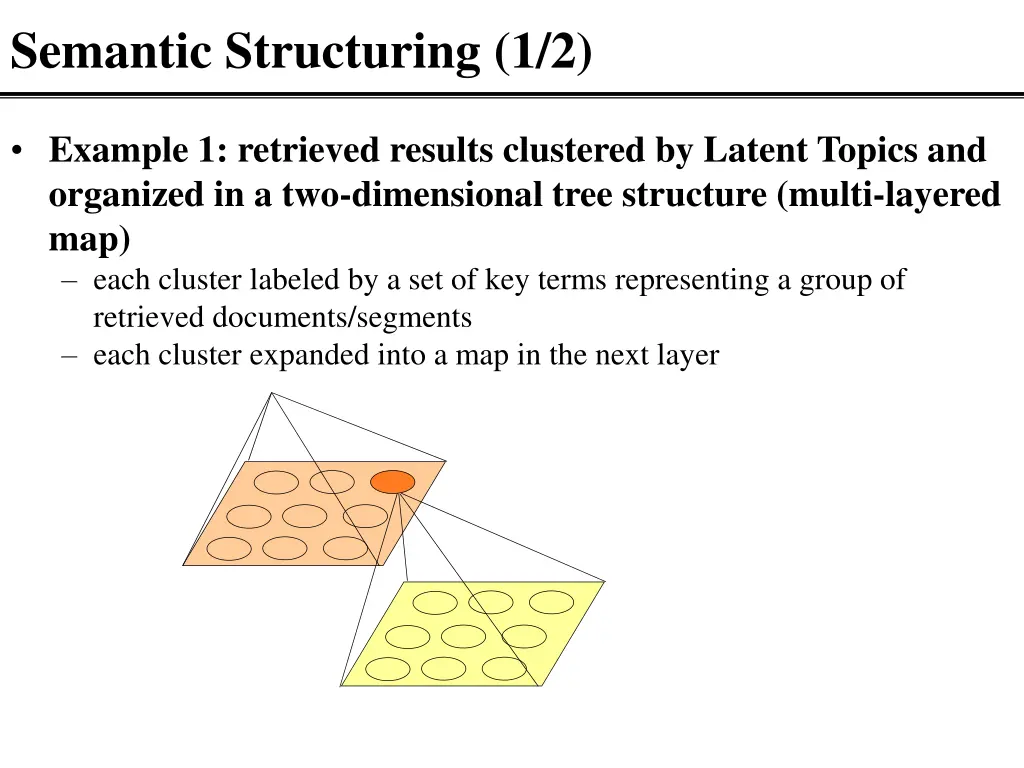
Semantic Structuring (1/2) Example 1: retrieved results clustered by Latent Topics and organized in a two-dimensional tree structure (multi-layered map) each cluster labeled by a set of key terms representing a group of retrieved documents/segments each cluster expanded into a map in the next layer
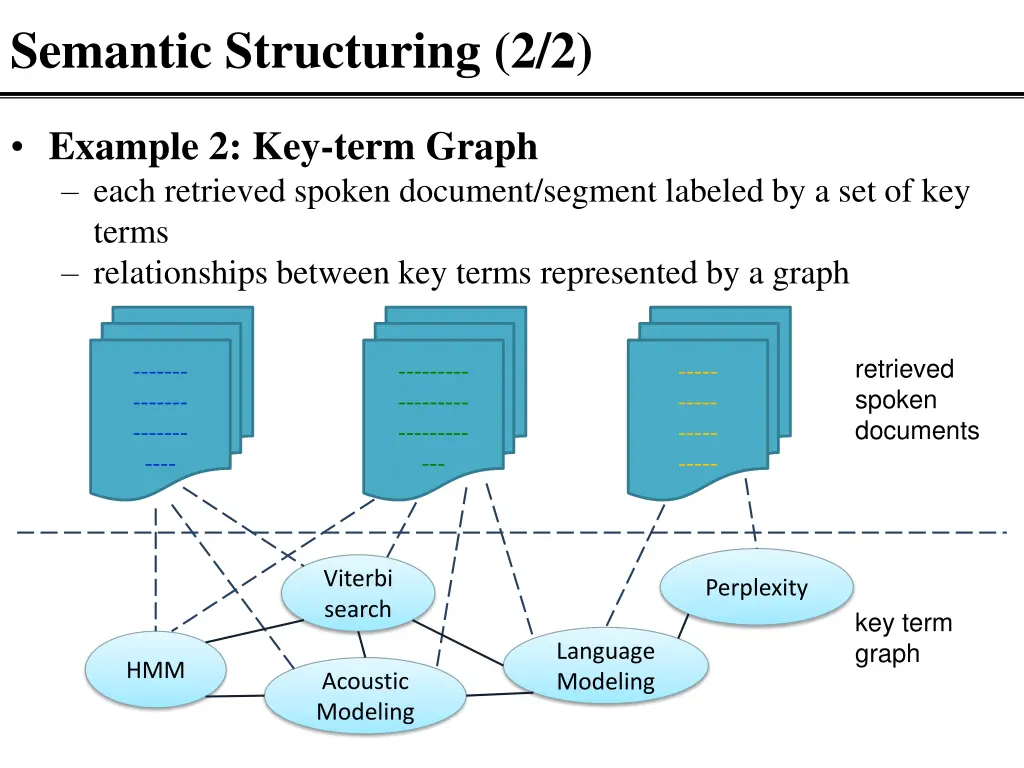
Semantic Structuring (2/2) Example 2: Key-term Graph each retrieved spoken document/segment labeled by a set of key terms relationships between key terms represented by a graph retrieved spoken documents ------- ------- ------- ---- --------- --------- --------- --- ----- ----- ----- ----- Viterbi search Perplexity key term graph Language Modeling HMM Acoustic Modeling
Multi-modal Dialogue An example: user-system interaction modeled as a Markov Decision Process (MDP) Key Terms/ Titles/Summaries Query User Interface Spoken Archives User Semantic Structuring Multi-modal Dialogue Retrieval Engine Retrieved Results Example goals small average number of dialogue turns (average number of user actions taken) for successful tasks (success: user s information need satisfied) less effort for user, better retrieval quality
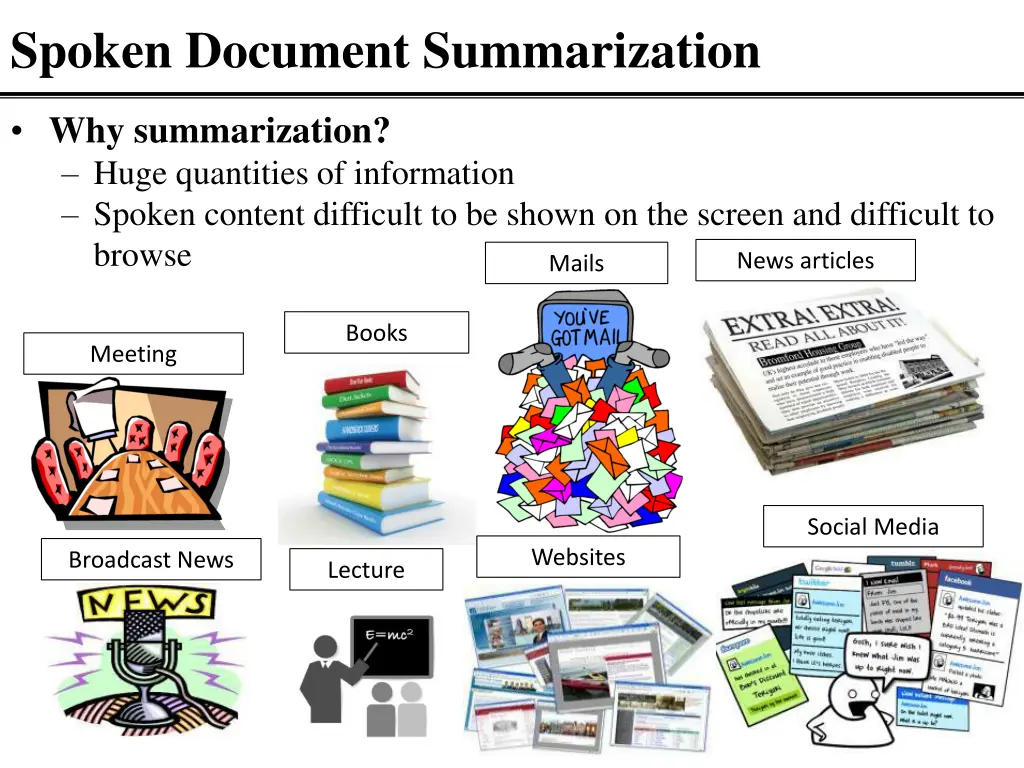
Spoken Document Summarization Why summarization? Huge quantities of information Spoken content difficult to be shown on the screen and difficult to browse News articles Mails Books Meeting Social Media Websites Broadcast News Lecture
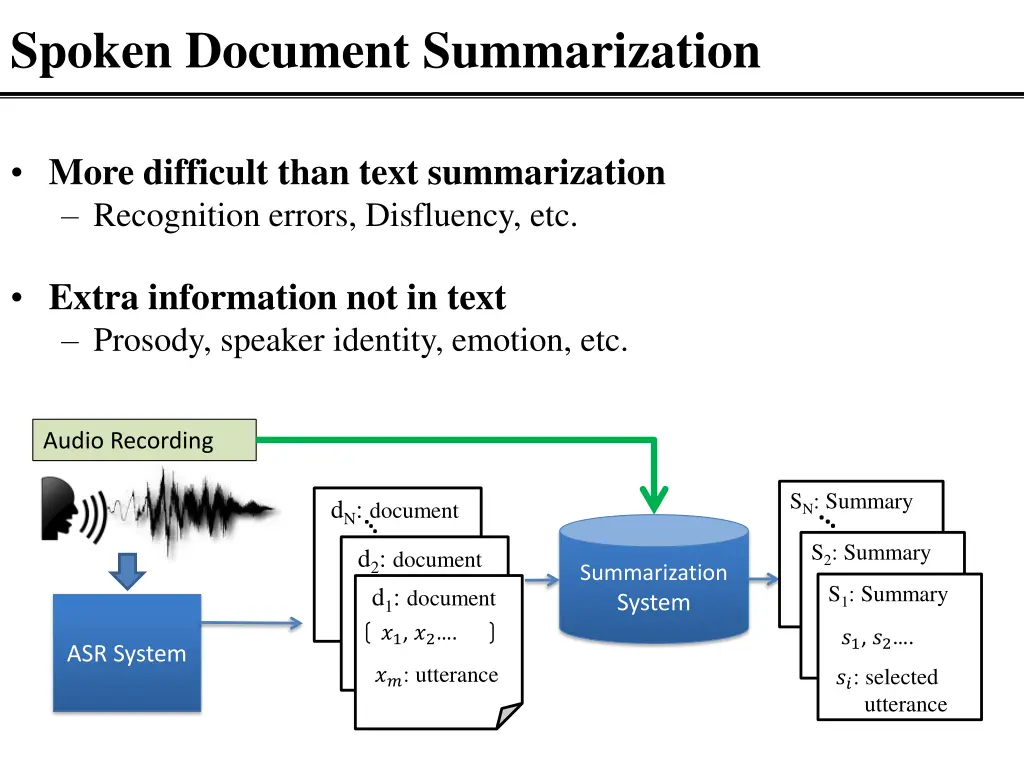
Spoken Document Summarization More difficult than text summarization Recognition errors, Disfluency, etc. Extra information not in text Prosody, speaker identity, emotion, etc. Audio Recording SN: Summary ... dN: document . .. ?1, ?2 . ?1, ?2 . d2: document ?1, ?2 . ?1, ?2 . ?1, ?2 . S2: Summary ?1, ?2 . ?1, ?2 . Summarization System ?1, ?2 . d1: document ?1, ?2 . ?1, ?2 . S1: Summary ??: utterance ??: utterance ??: utterance ?1, ?2 . ?1, ?2 . ??: selected utterance utterance ??: selected utterance ??: selected ?1, ?2 . ??: utterance ??: utterance ??: utterance ??: utterance ??: utterance ??: utterance ASR System
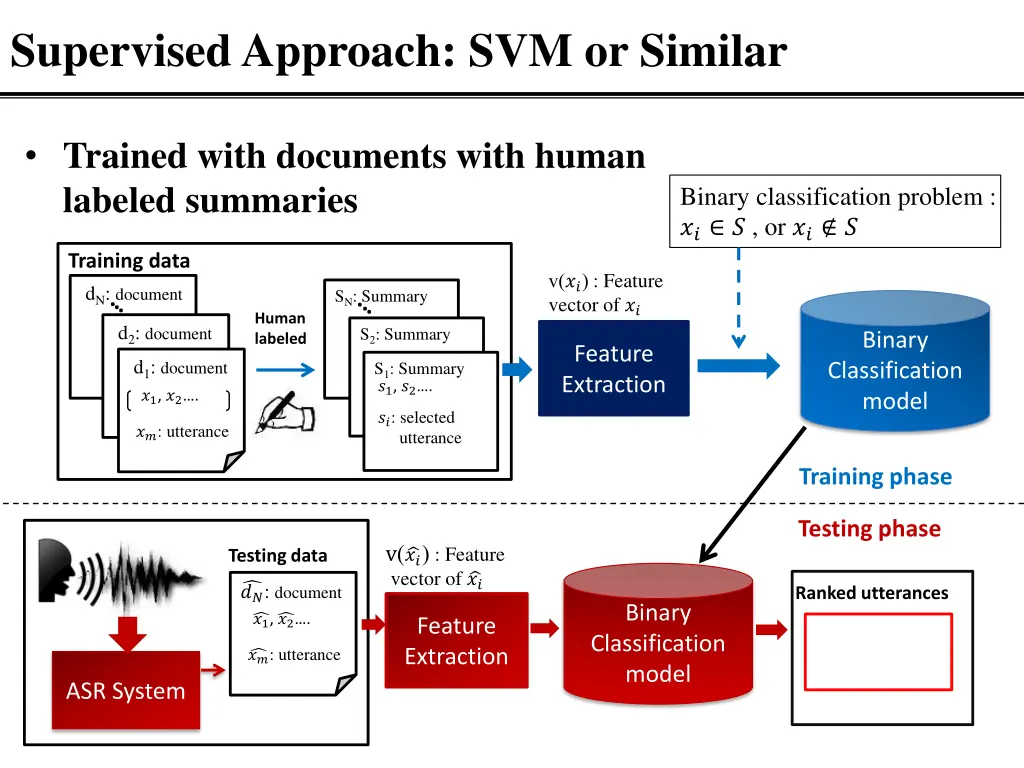
Supervised Approach: SVM or Similar Trained with documents with human labeled summaries Binary classification problem : ?? ? , or ?? ? Training data v(??) : Feature vector of ?? dN: document ... SN: Summary ... Human labeled d2: document d1: document ?1, ?2 . S2: Summary Binary Classification model Feature Extraction S1: Summary ?1, ?2 . ??: selected utterance ??: utterance Training phase Testing phase v( ??) : Feature vector of ?? Testing data ??: document ?1, ?2 . Ranked utterances Binary Classification model Feature Extraction ??: utterance ASR System
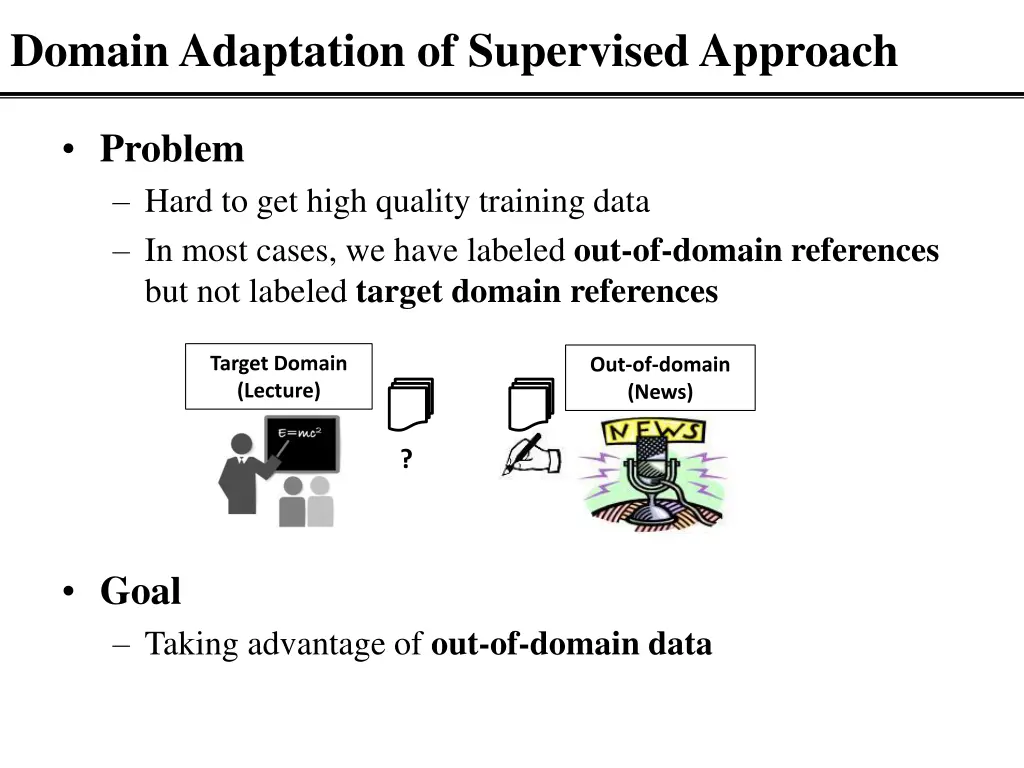
Domain Adaptation of Supervised Approach Problem Hard to get high quality training data In most cases, we have labeled out-of-domain references but not labeled target domain references Target Domain (Lecture) Out-of-domain (News) ? Goal Taking advantage of out-of-domain data
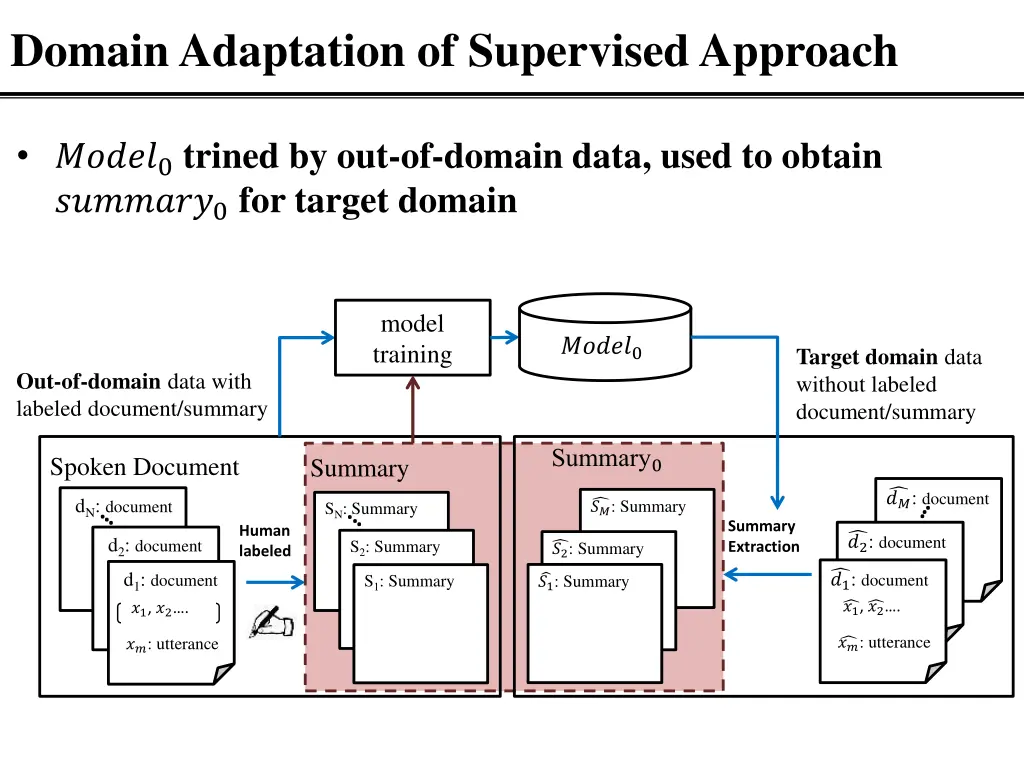
Domain Adaptation of Supervised Approach ?????0trined by out-of-domain data, used to obtain ???????0for target domain model training ?????0 Target domain data without labeled document/summary Out-of-domain data with labeled document/summary Summary0 Spoken Document Summary ??: document ... dN: document ... ??: Summary SN: Summary ... Summary Extraction Human labeled ?2: document d2: document d1: document ?1, ?2 . S2: Summary ?2: Summary ?1: document ?1, ?2 . ?1: Summary S1: Summary ??: utterance ??: utterance
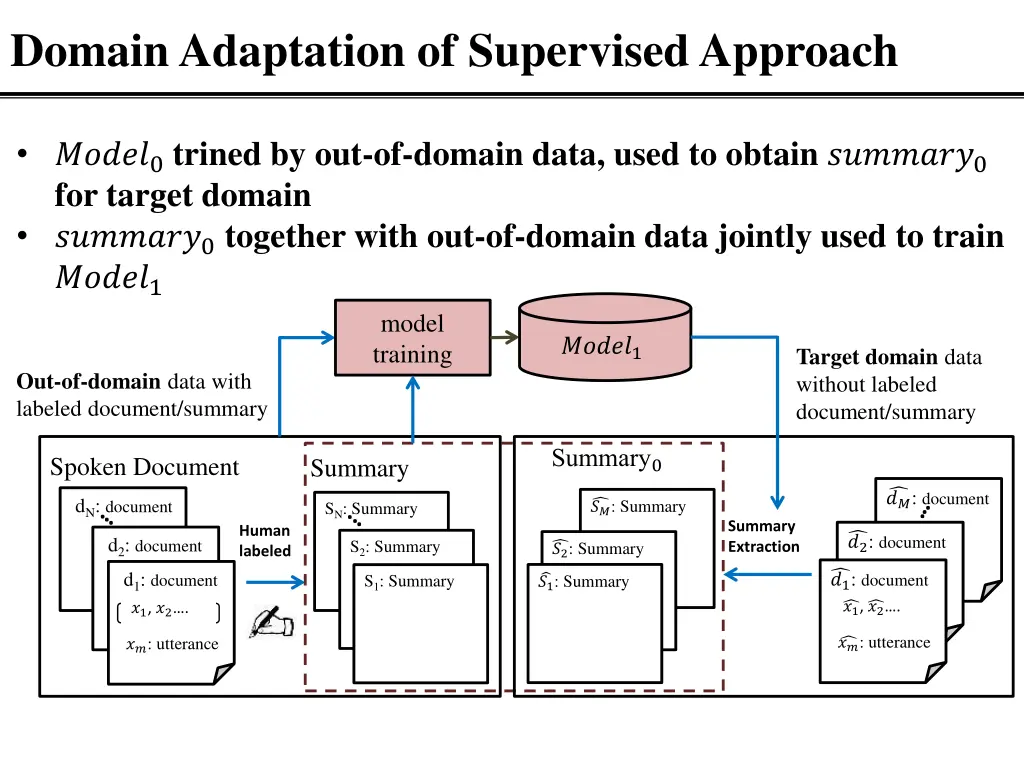
Domain Adaptation of Supervised Approach ?????0trined by out-of-domain data, used to obtain ???????0 for target domain ???????0together with out-of-domain data jointly used to train ?????1 model training ?????1 Target domain data without labeled document/summary Out-of-domain data with labeled document/summary Summary0 Spoken Document Summary ??: document ... dN: document ... ??: Summary SN: Summary ... Summary Extraction Human labeled ?2: document d2: document d1: document ?1, ?2 . S2: Summary ?2: Summary ?1: document ?1, ?2 . ?1: Summary S1: Summary ??: utterance ??: utterance
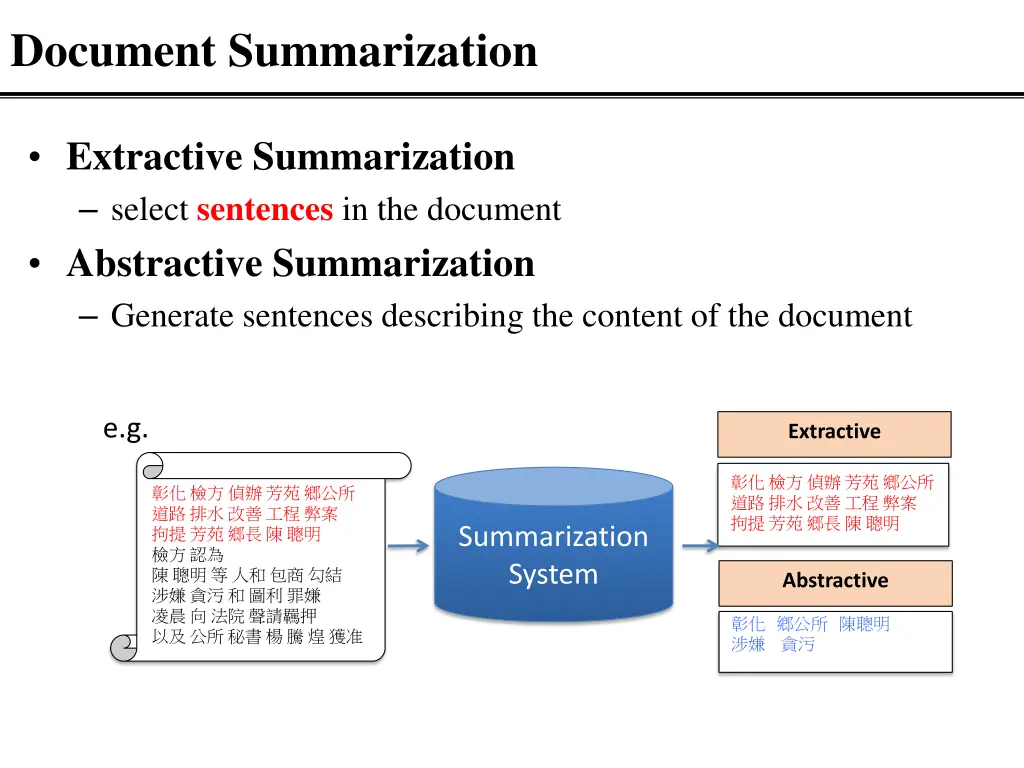
Document Summarization Extractive Summarization select sentences in the document Abstractive Summarization Generate sentences describing the content of the document e.g. Extractive Summarization System Abstractive
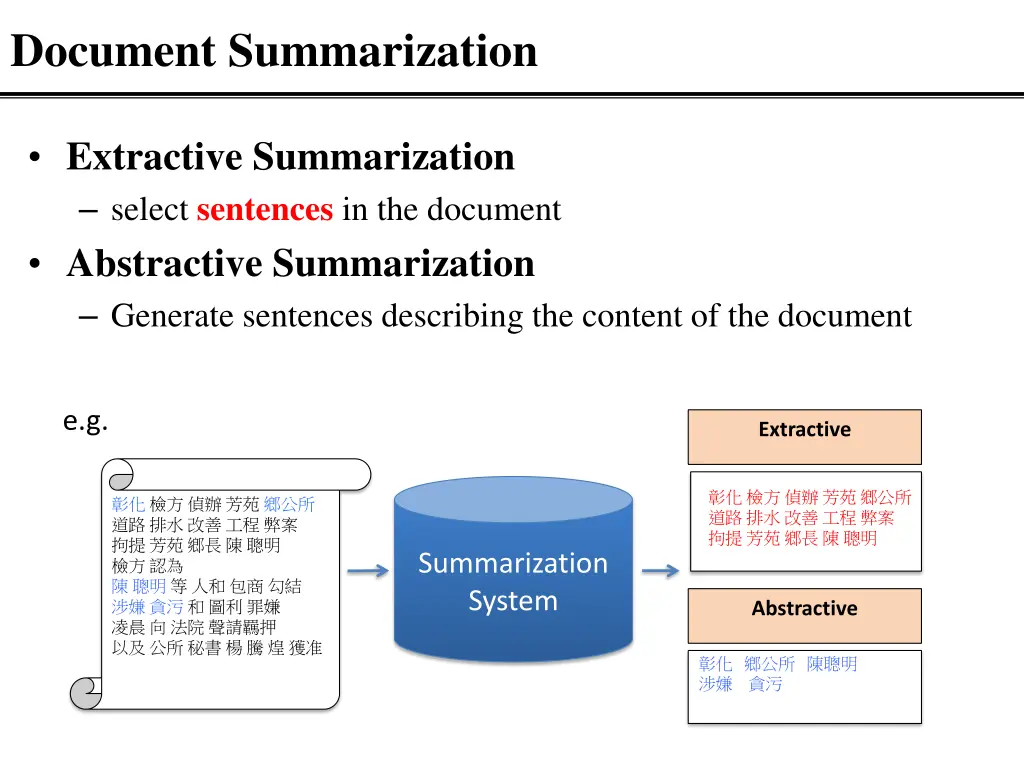
Document Summarization Extractive Summarization select sentences in the document Abstractive Summarization Generate sentences describing the content of the document e.g. Extractive Summarization System Abstractive
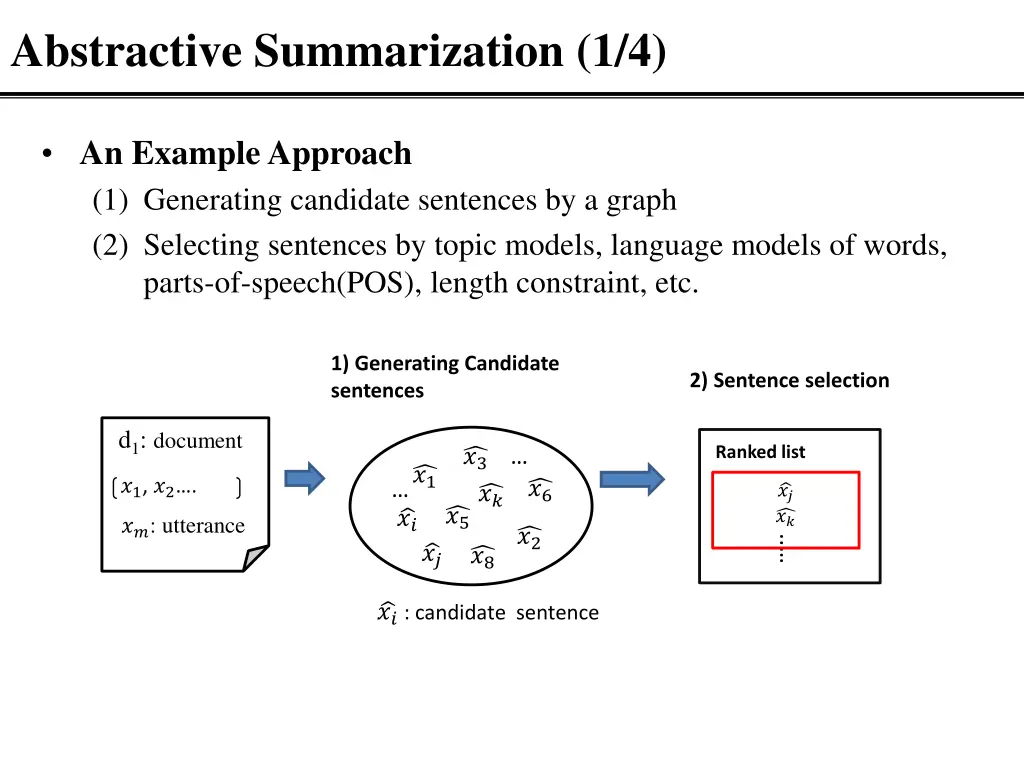
Abstractive Summarization (1/4) An Example Approach (1) Generating candidate sentences by a graph (2) Selecting sentences by topic models, language models of words, parts-of-speech(POS), length constraint, etc. 1) Generating Candidate sentences 2) Sentence selection d1: document Ranked list ?3 ?1 ?1, ?2 . ??: utterance ?6 ?? ??.. ?? ?5 ?? ?2 ?? ?8 ??: candidate sentence
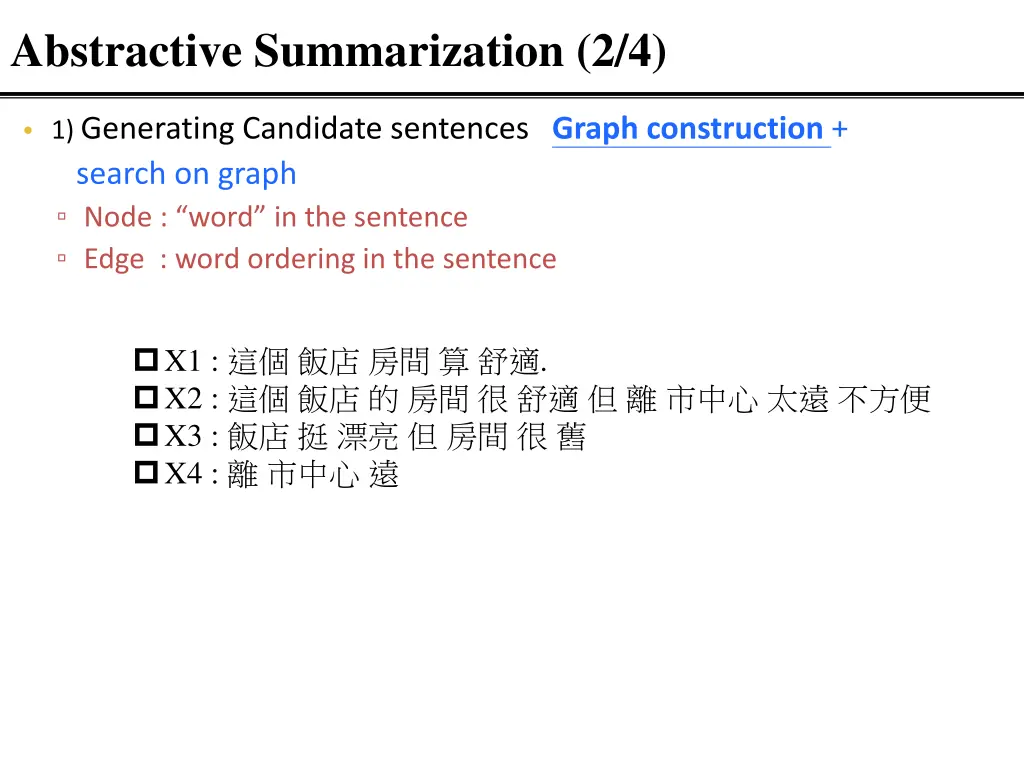
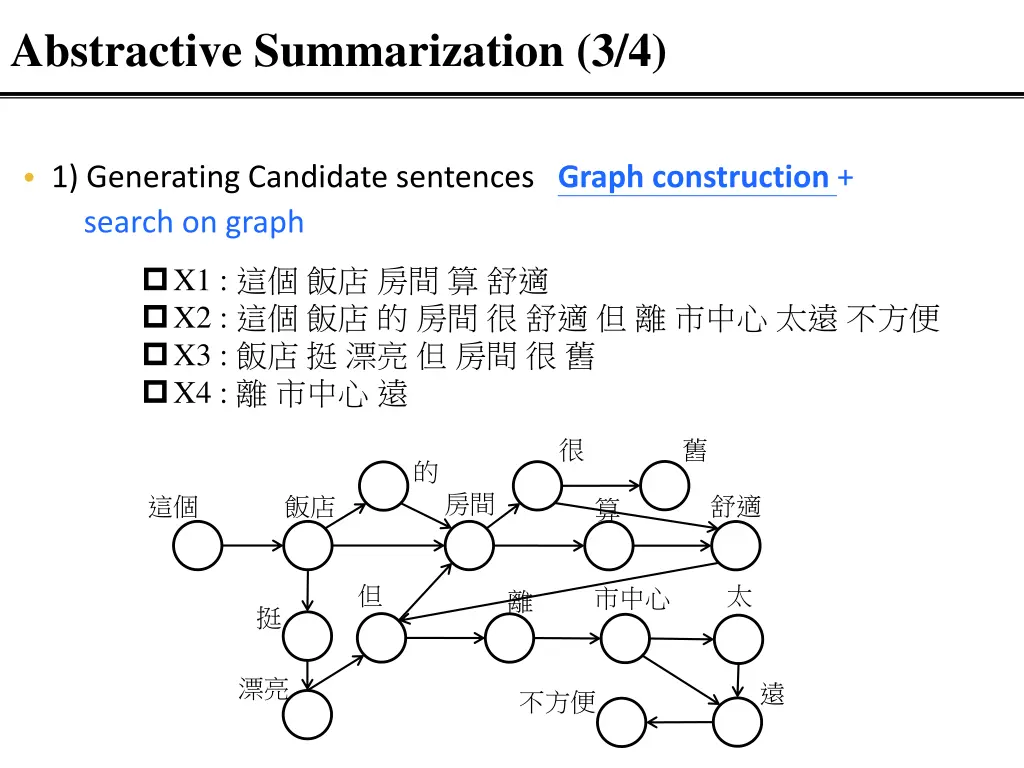
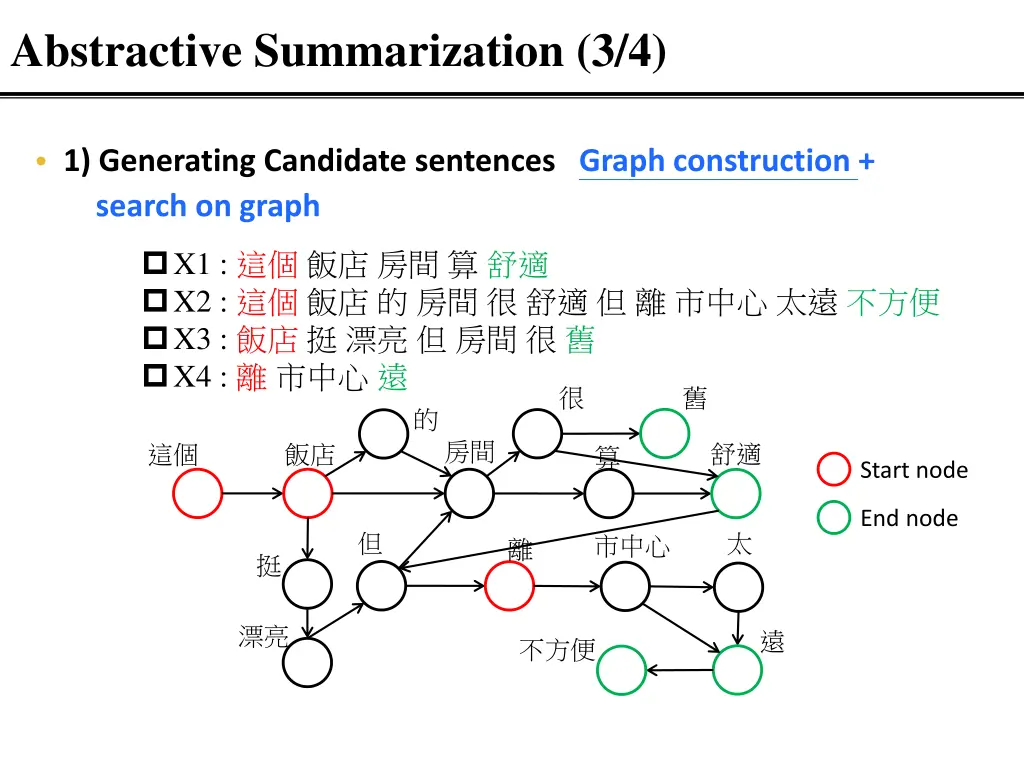
Abstractive Summarization (2/4) 1) Generating Candidate sentences Graph construction + search on graph Node : word in the sentence Edge : word ordering in the sentence X1 : . X2 : X3 : X4 :
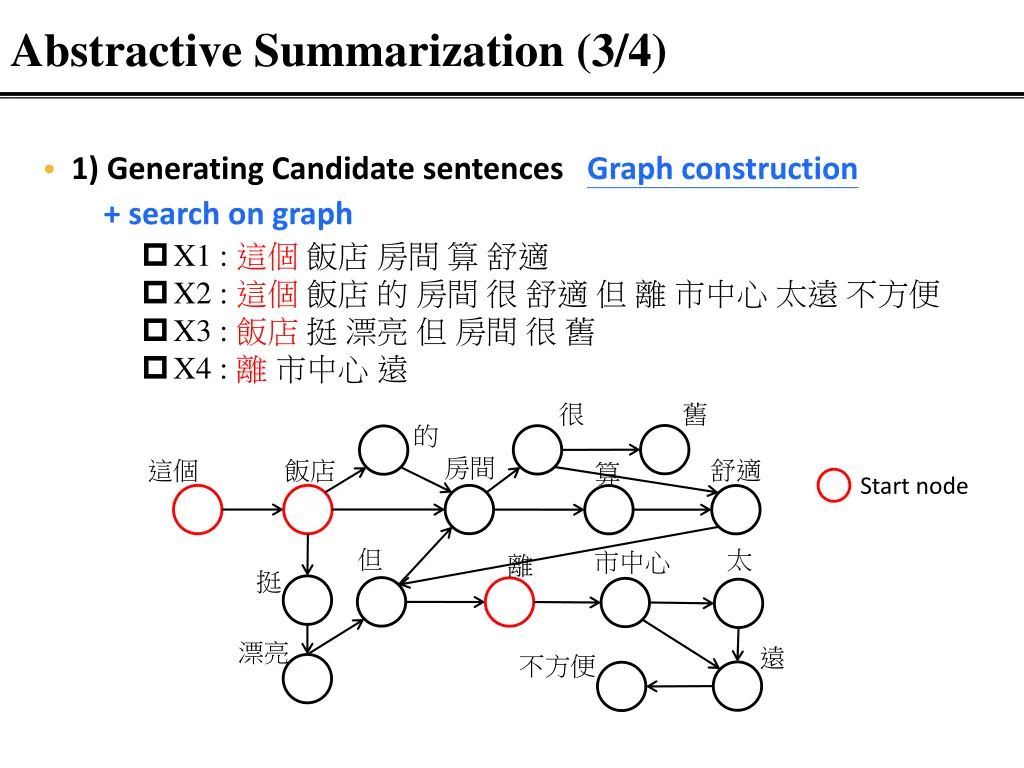
Abstractive Summarization (3/4) 1) Generating Candidate sentences Graph construction + search on graph X1 : X2 : X3 : X4 : Start node End node
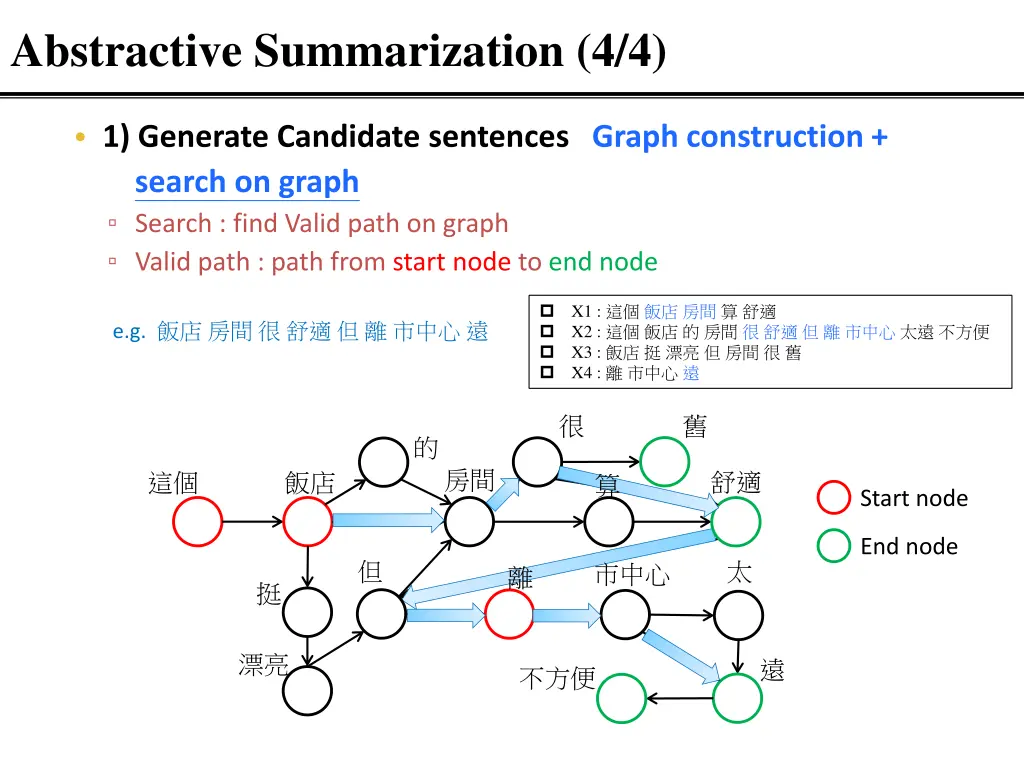
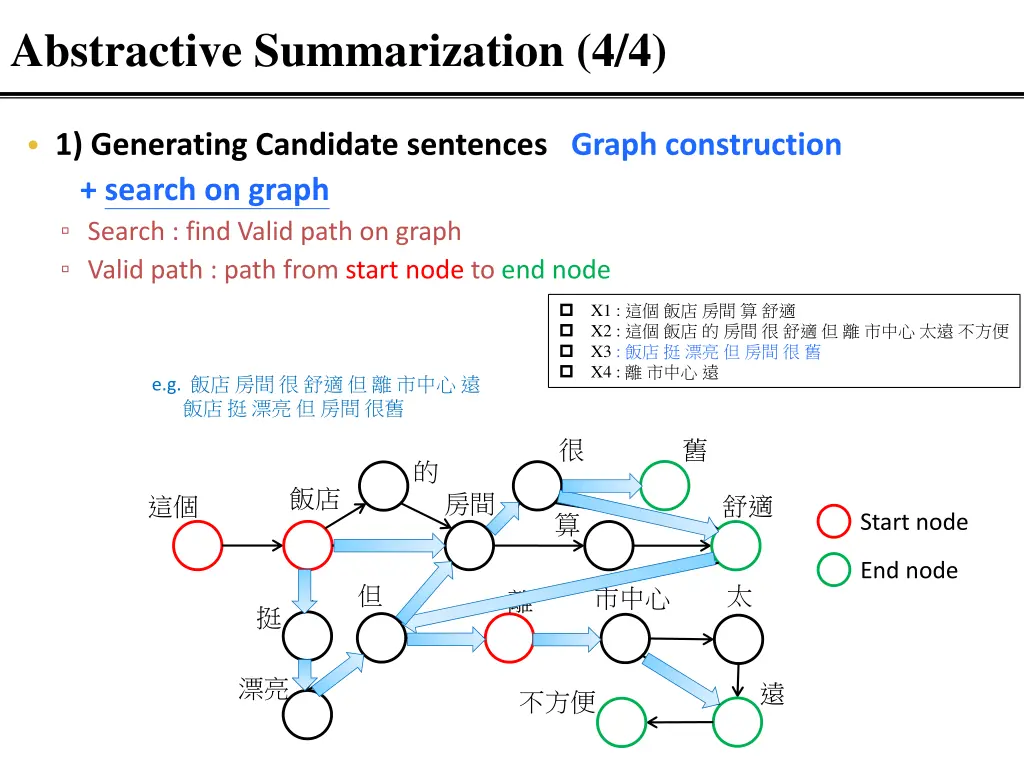
Abstractive Summarization (4/4) 1) Generate Candidate sentences Graph construction + search on graph Search : find Valid path on graph Valid path : path from start node to end node X1 : X2 : X3 : X4 : e.g. Start node End node
Abstractive Summarization (4/4) 1) Generating Candidate sentences Graph construction + search on graph Search : find Valid path on graph Valid path : path from start node to end node X1 : X2 : X3 : X4 : e.g. Start node End node
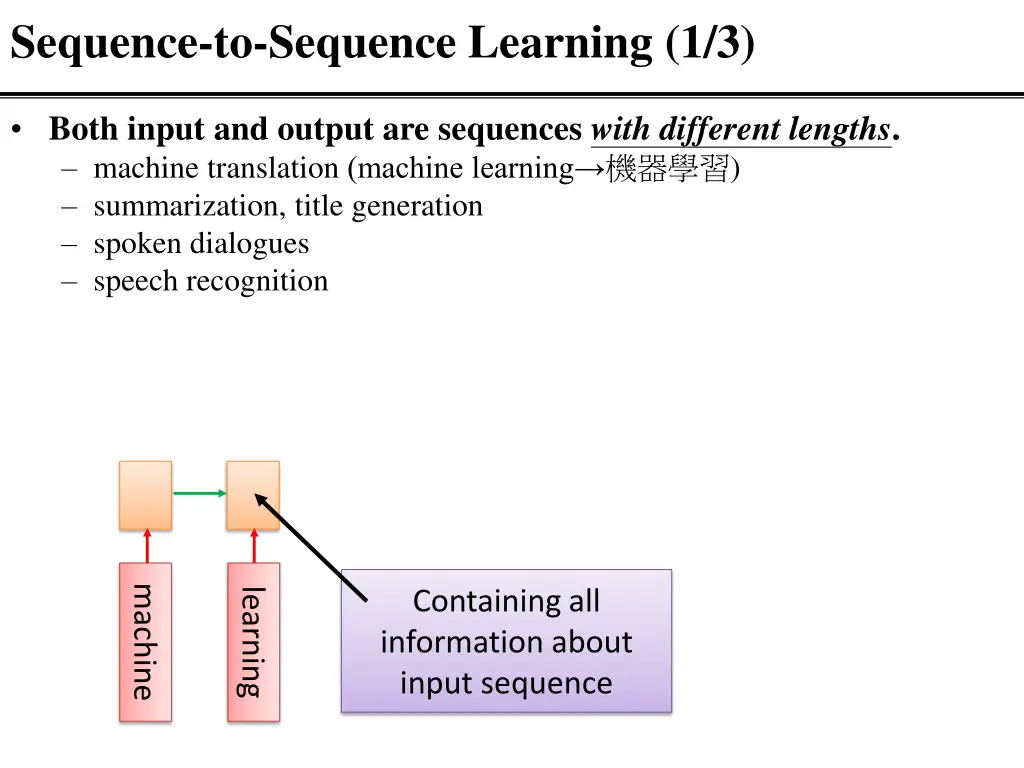
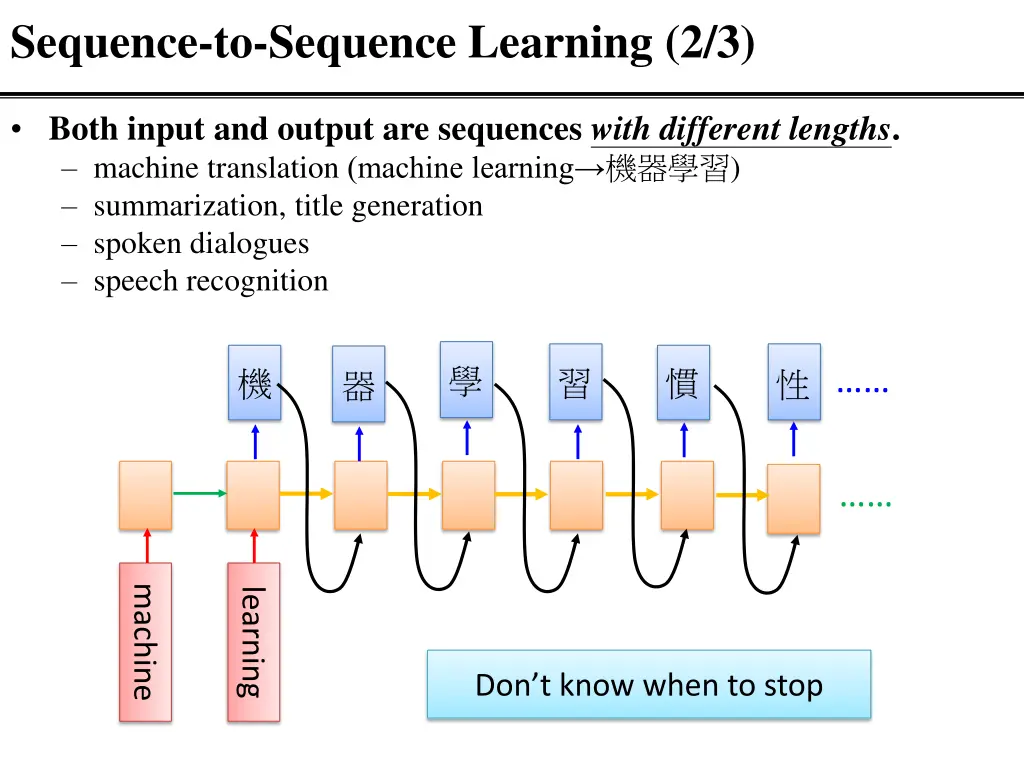
Sequence-to-Sequence Learning (1/3) Both input and output are sequences with different lengths. machine translation (machine learning ) summarization, title generation spoken dialogues speech recognition machine learning Containing all information about input sequence
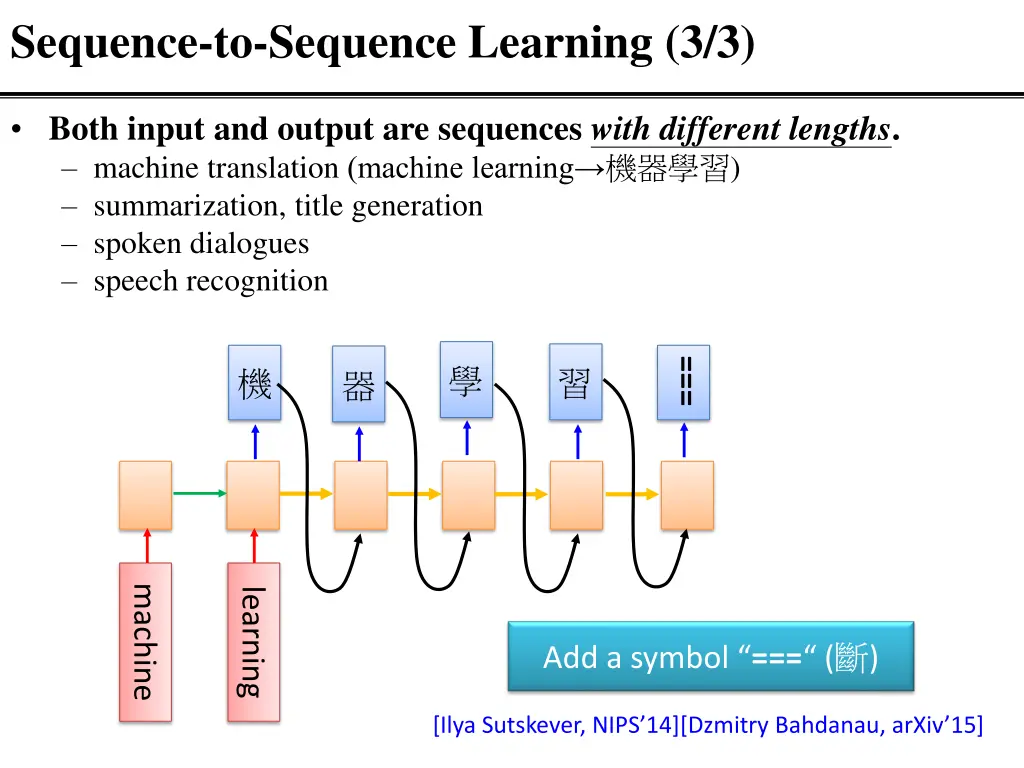
Sequence-to-Sequence Learning (2/3) Both input and output are sequences with different lengths. machine translation (machine learning ) summarization, title generation spoken dialogues speech recognition machine learning Don t know when to stop
Sequence-to-Sequence Learning (3/3) Both input and output are sequences with different lengths. machine translation (machine learning ) summarization, title generation spoken dialogues speech recognition === machine learning Add a symbol === ( ) [Ilya Sutskever, NIPS 14][Dzmitry Bahdanau, arXiv 15]
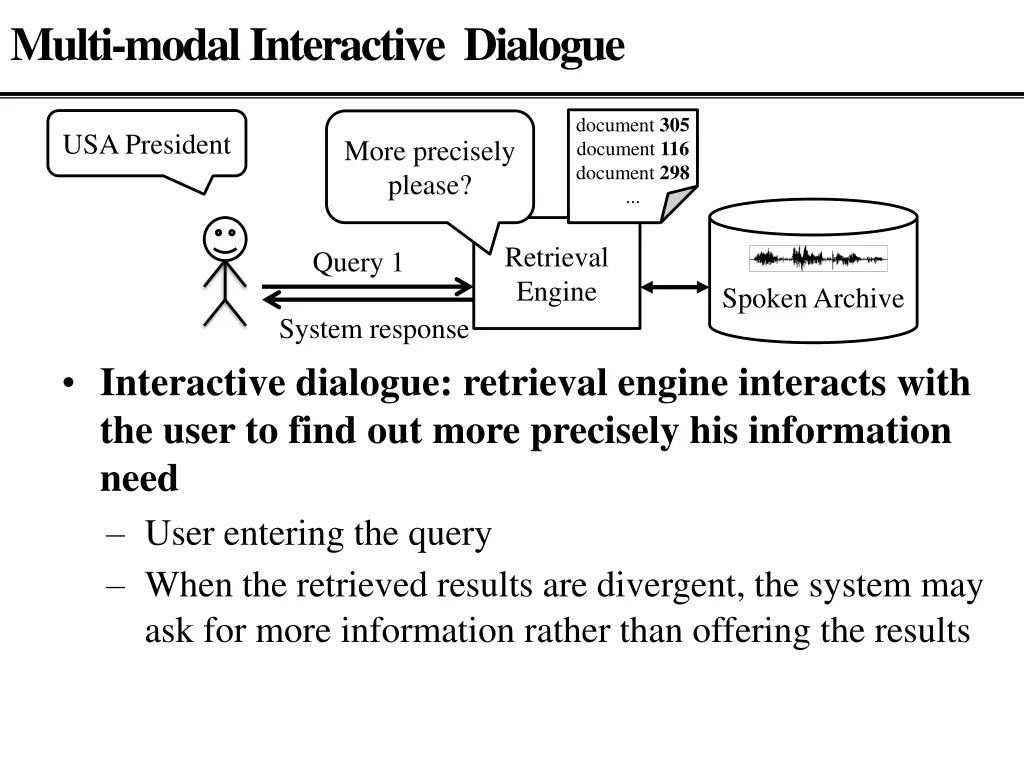
Multi-modal Interactive Dialogue document 305 document 116 document 298 ... USA President More precisely please? Retrieval Engine Query 1 Spoken Archive System response Interactive dialogue: retrieval engine interacts with the user to find out more precisely his information need User entering the query When the retrieved results are divergent, the system may ask for more information rather than offering the results
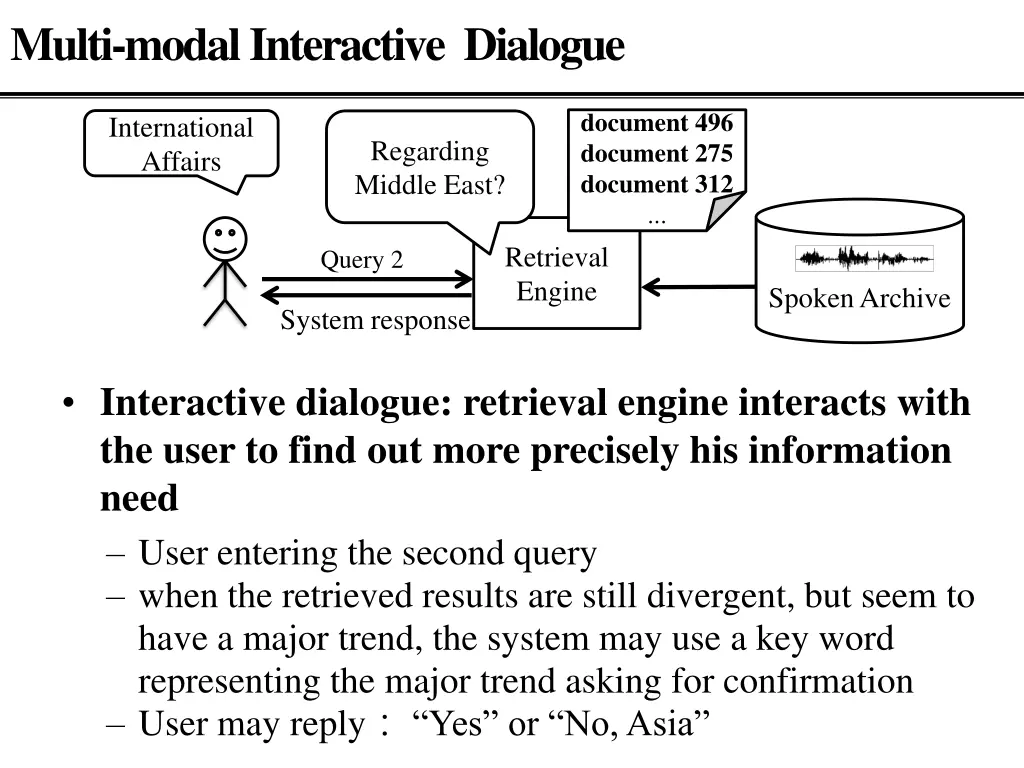
Multi-modal Interactive Dialogue document 496 document 275 document 312 ... International Affairs Regarding Middle East? Retrieval Engine Query 2 Spoken Archive System response Interactive dialogue: retrieval engine interacts with the user to find out more precisely his information need User entering the second query when the retrieved results are still divergent, but seem to have a major trend, the system may use a key word representing the major trend asking for confirmation User may reply Yes or No, Asia
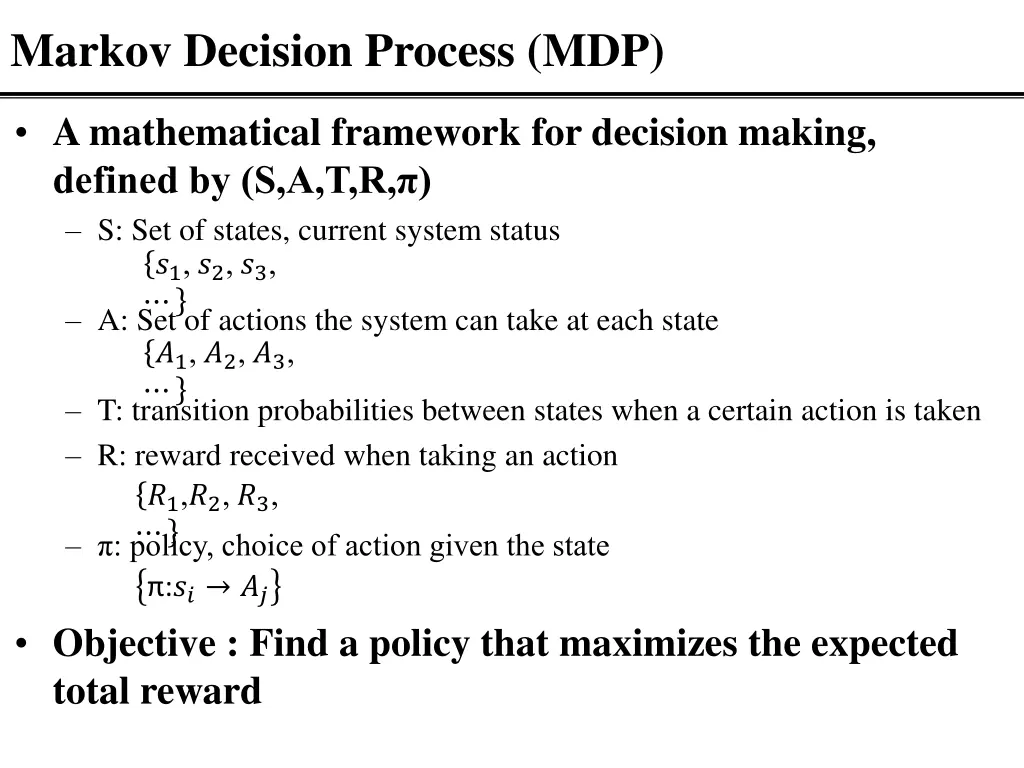
Markov Decision Process (MDP) A mathematical framework for decision making, defined by (S,A,T,R, ) S: Set of states, current system status ?1, ?2, ?3, A: Set of actions the system can take at each state ?1, ?2, ?3, T: transition probabilities between states when a certain action is taken R: reward received when taking an action ?1,?2, ?3, : policy, choice of action given the state :?? ?? Objective : Find a policy that maximizes the expected total reward
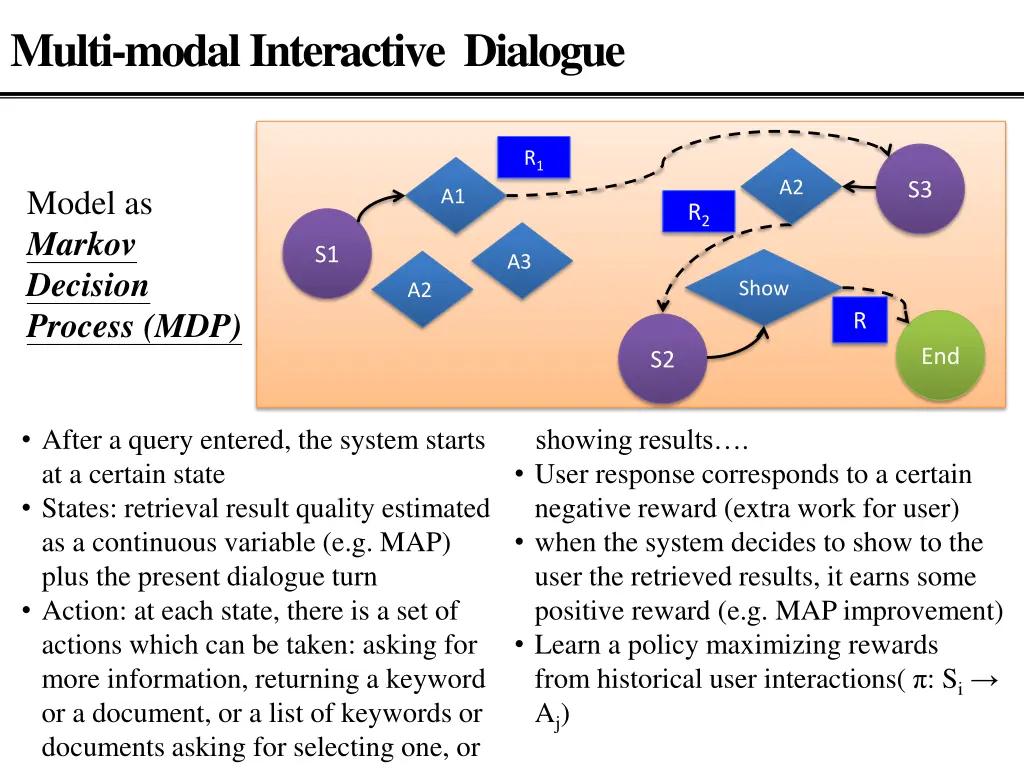
Multi-modal Interactive Dialogue R1 A2 S3 Model as Markov Decision Process (MDP) A1 R2 S1 A3 Show A2 R End S2 After a query entered, the system starts at a certain state States: retrieval result quality estimated as a continuous variable (e.g. MAP) plus the present dialogue turn Action: at each state, there is a set of actions which can be taken: asking for more information, returning a keyword or a document, or a list of keywords or documents asking for selecting one, or showing results . User response corresponds to a certain negative reward (extra work for user) when the system decides to show to the user the retrieved results, it earns some positive reward (e.g. MAP improvement) Learn a policy maximizing rewards from historical user interactions( : Si Aj)
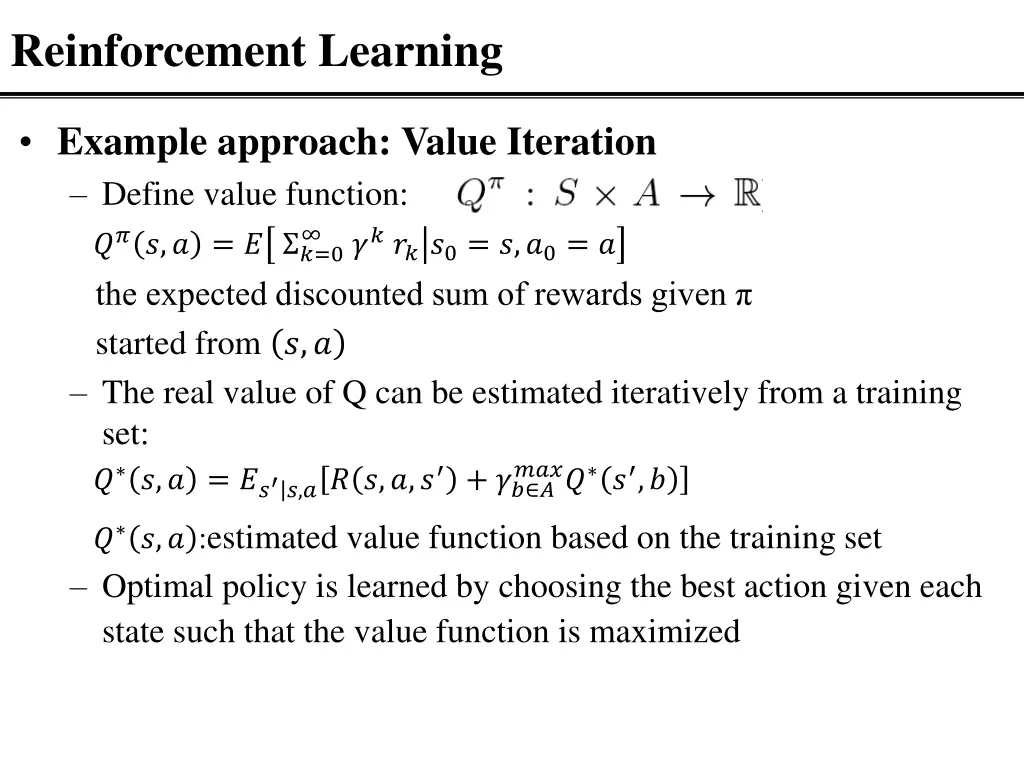
Reinforcement Learning Example approach: Value Iteration Define value function: ???,? = ? ?=0 the expected discounted sum of rewards given started from ?,? The real value of Q can be estimated iteratively from a training set: ? ?,? = ?? ?,?? ?,?,? + ?? ? ? ?,? :estimated value function based on the training set Optimal policy is learned by choosing the best action given each state such that the value function is maximized ???? ?0= ?,?0= ? ???? ? ,?
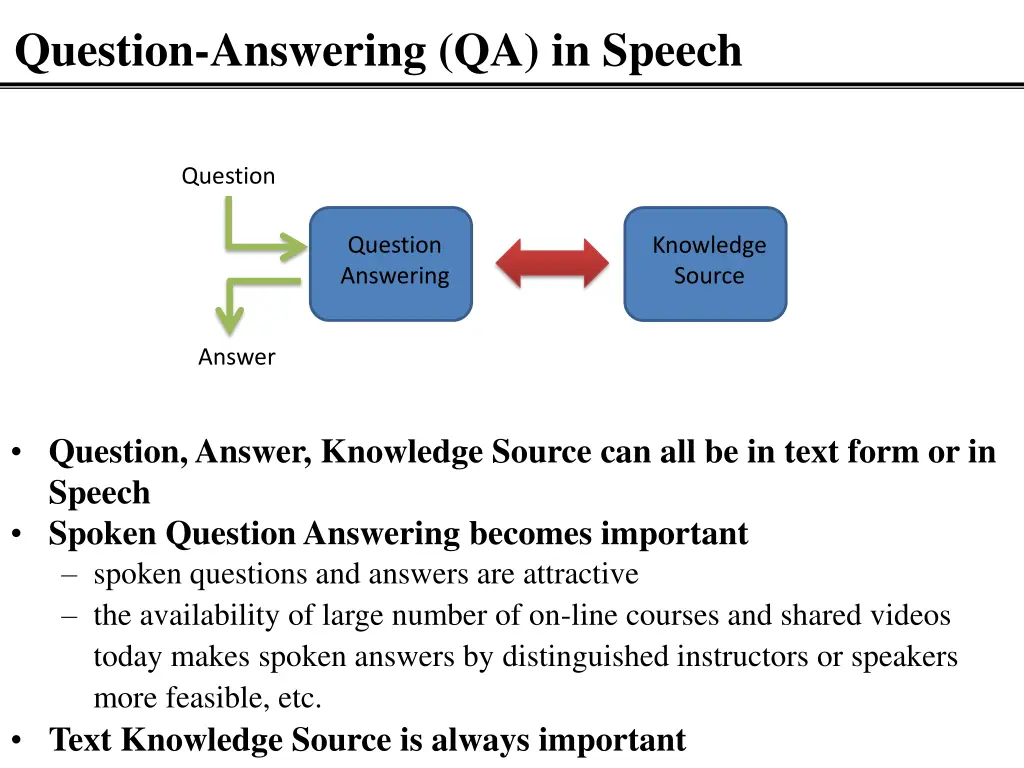
Question-Answering (QA) in Speech Question Question Answering Knowledge Source Answer Question, Answer, Knowledge Source can all be in text form or in Speech Spoken Question Answering becomes important spoken questions and answers are attractive the availability of large number of on-line courses and shared videos today makes spoken answers by distinguished instructors or speakers more feasible, etc. Text Knowledge Source is always important
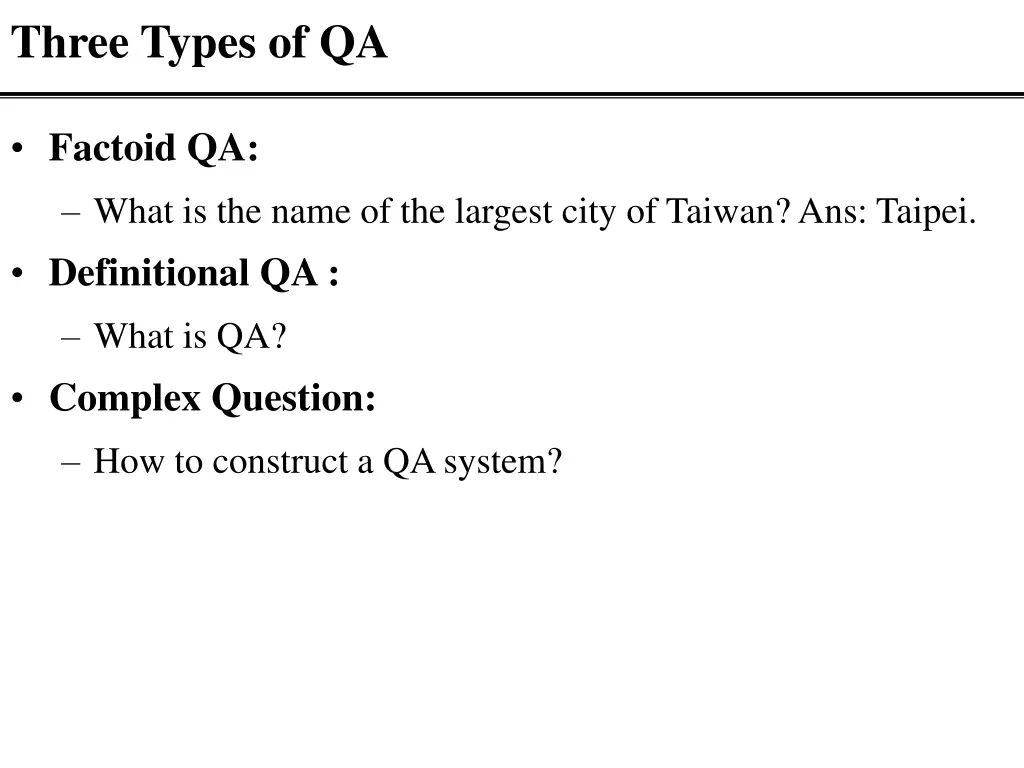
Three Types of QA Factoid QA: What is the name of the largest city of Taiwan? Ans: Taipei. Definitional QA : What is QA? Complex Question: How to construct a QA system?
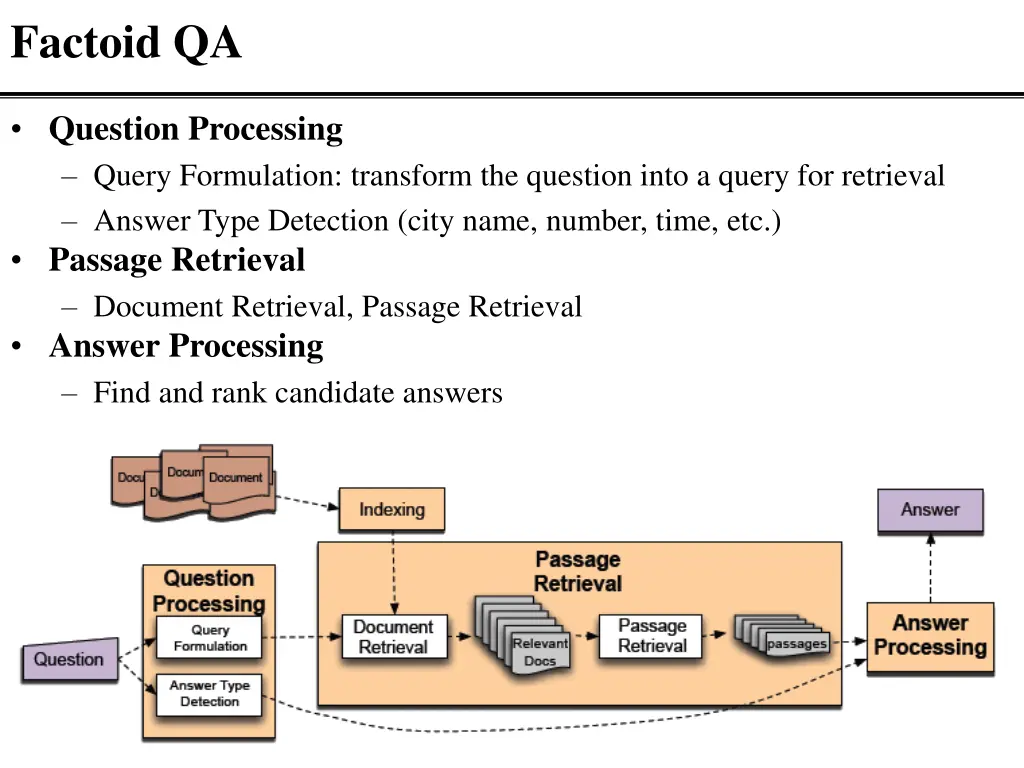
Factoid QA Question Processing Query Formulation: transform the question into a query for retrieval Answer Type Detection (city name, number, time, etc.) Passage Retrieval Document Retrieval, Passage Retrieval Answer Processing Find and rank candidate answers
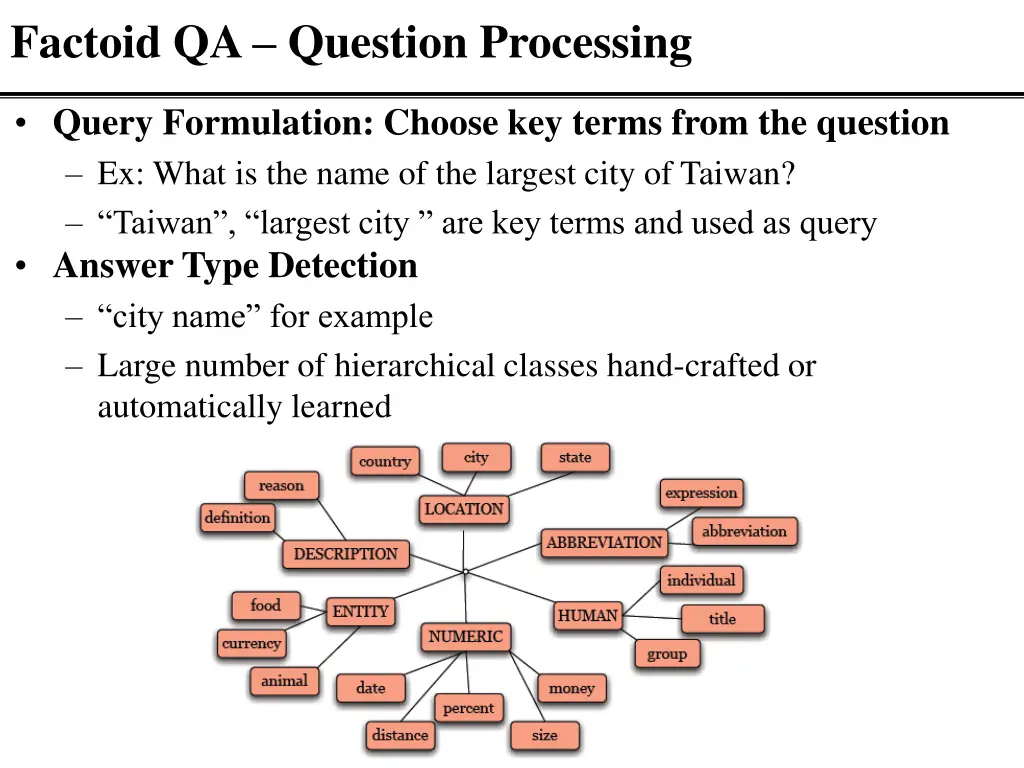
Factoid QA Question Processing Query Formulation: Choose key terms from the question Ex: What is the name of the largest city of Taiwan? Taiwan , largest city are key terms and used as query Answer Type Detection city name for example Large number of hierarchical classes hand-crafted or automatically learned
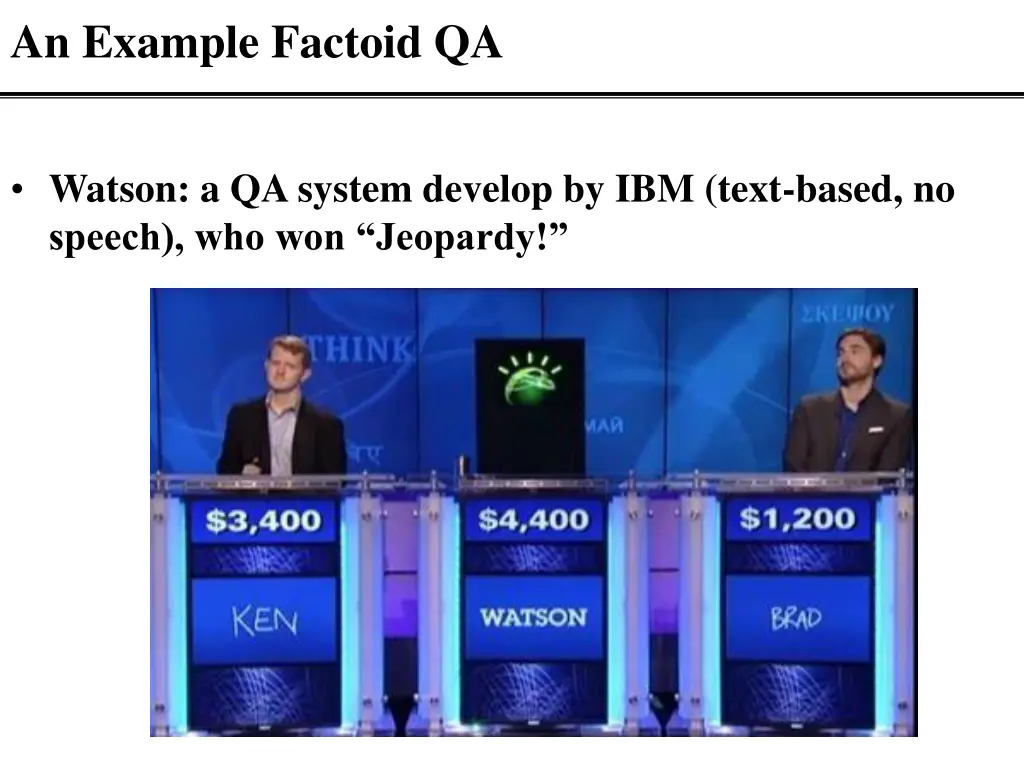
An Example Factoid QA Watson: a QA system develop by IBM (text-based, no speech), who won Jeopardy!
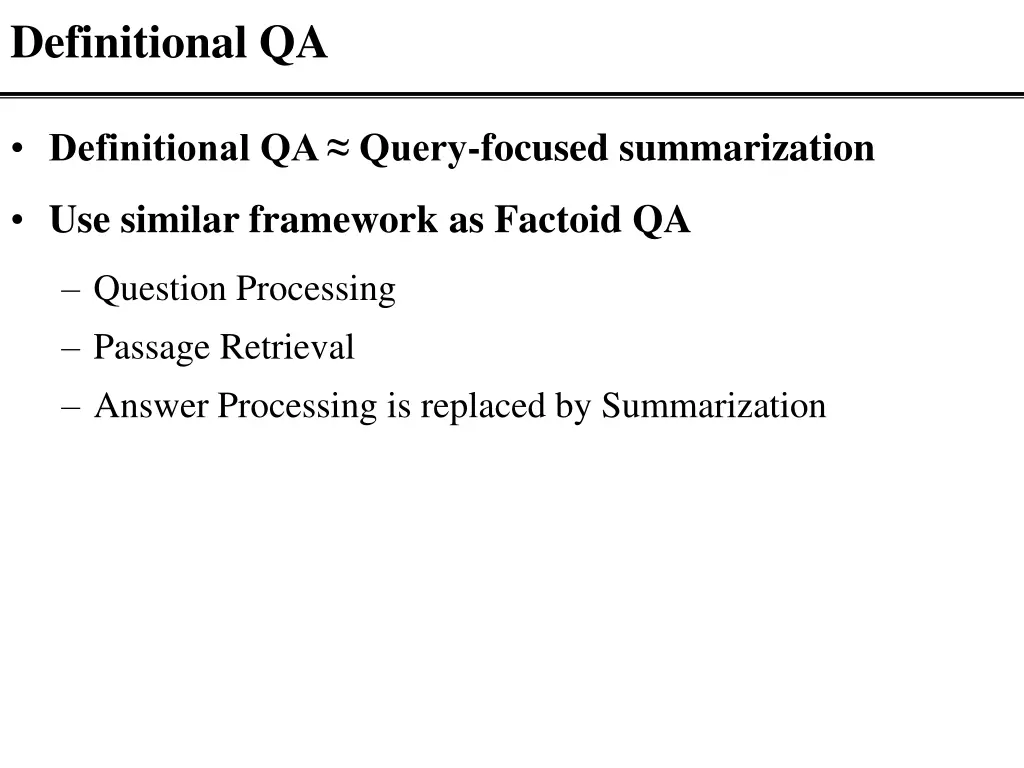
Definitional QA Definitional QA Query-focused summarization Use similar framework as Factoid QA Question Processing Passage Retrieval Answer Processing is replaced by Summarization
References Key terms Automatic Key Term Extraction From Spoken Course Lectures Using Branching Entropy and Prosodic/Semantic Features , IEEE Workshop on Spoken Language Technology, Berkeley, California, U.S.A., Dec 2010, pp. 253-258. Unsupervised Two-Stage Keyword Extraction from Spoken Documents by Topic Coherence and Support Vector Machine , International Conference on Acoustics, Speech and Signal Processing, Kyoto, Japan, Mar 2012, pp. 5041-5044. Title Generation Automatic Title Generation for Spoken Documents with a Delicate Scored Viterbi Algorithm , 2nd IEEE Workshop on Spoken Language Technology, Goa, India, Dec 2008, pp. 165-168. Abstractive Headline Generation for Spoken Content by Attentive Recurrent Neural Networks with ASR Error Modeling IEEE Workshop on Spoken Language Technology (SLT), San Diego, California, USA, Dec 2016, pp. 151-157.
References Summarization Supervised Spoken Document Summarization Jointly Considering Utterance Importance and Redundancy by Structured Support Vector Machine , Interspeech, Portland, U.S.A., Sep 2012. Unsupervised Domain Adaptation for Spoken Document Summarization with Structured Support Vector Machine , International Conference on Acoustics, Speech and Signal Processing, Vancouver, Canada, May 2013. Supervised Spoken Document Summarization Based on Structured Support Vector Machine with Utterance Clusters as Hidden Variables , Interspeech, Lyon, France, Aug 2013, pp. 2728-2732. Semantic Analysis and Organization of Spoken Documents Based on Parameters Derived from Latent Topics , IEEE Transactions on Audio, Speech and Language Processing, Vol. 19, No. 7, Sep 2011, pp. 1875- 1889. "Spoken Lecture Summarization by Random Walk over a Graph Constructed with Automatically Extracted Key Terms," InterSpeech 2011
References Summarization Speech-to-text and Speech-to-speech Summarization of Spontaneous Speech , IEEE Transactions on Speech and Audio Processing, Dec. 2004 The Use of MMR, diversity-based reranking for reordering document and producing summaries SIGIR, 1998 Using Corpus and Knowledge-based Similarity Measure in Maximum Marginal Relevance for Meeting Summarization ICASSP, 2008 Opinosis: A Graph-Based Approach to Abstractive Summarization of Highly Redundant Opinions , International Conference on Computational Linguistics , 2010
References Interactive Retrieval Interactive Spoken Content Retrieval by Extended Query Model and Continuous State Space Markov Decision Process , International Conference on Acoustics, Speech and Signal Processing, Vancouver, Canada, May 2013. Interactive Spoken Content Retrieval by Deep Reinforcement Learning , Interspeech, San Francisco, USA, Sept 2016. Reinforcement Learning: An Introduction, Richard S. Sutton and Andrew G. Barto, The MIT Press, 1999. Partially observable Markov decision processes for spoken dialog systems, Jason D. Williams and Steve Young, Computer Speech and Language, 2007.
Reference Question Answering Rosset, S., Galibert, O. and Lamel, L. (2011) Spoken Question Answering, in Spoken Language Understanding: Systems for Extracting Semantic Information from Speech Pere R. Comas, Jordi Turmo, and Llu s M rquez. 2012. Sibyl, a factoid question-answering system for spoken documents. ACM Trans. Inf. Syst. 30, 3, Article 19 (September 2012), 40 Towards Machine Comprehension of Spoken Content: Initial TOEFL Listening Comprehension Test by Machine , Interspeech, San Francisco, USA, Sept 2016, pp. 2731-2735. Hierarchical Attention Model for Improved Comprehension of Spoken Content , IEEE Workshop on Spoken Language Technology (SLT), San Diego, California, USA, Dec 2016, pp. 234-238.
Reference Sequence-to-sequence Learning Sequence to Sequence Learning with Neural Networks , NIPS, 2014 Listen, Attend and Spell: A Neural Network for Large Vocabulary Conversational Speech Recognition , ICASSP 2016