Discover how data science and automation are revolutionizing malware analysis, with a focus on public datasets, automation tools, and techniques for static and dynamic analysis in cybersecurity.
Please find below an Image/Link to download the presentation.
The content on the website is provided AS IS for your information and personal use only. It may not be sold, licensed, or shared on other websites without obtaining consent from the author. If you encounter any issues during the download, it is possible that the publisher has removed the file from their server.
You are allowed to download the files provided on this website for personal or commercial use, subject to the condition that they are used lawfully. All files are the property of their respective owners.
The content on the website is provided AS IS for your information and personal use only. It may not be sold, licensed, or shared on other websites without obtaining consent from the author.
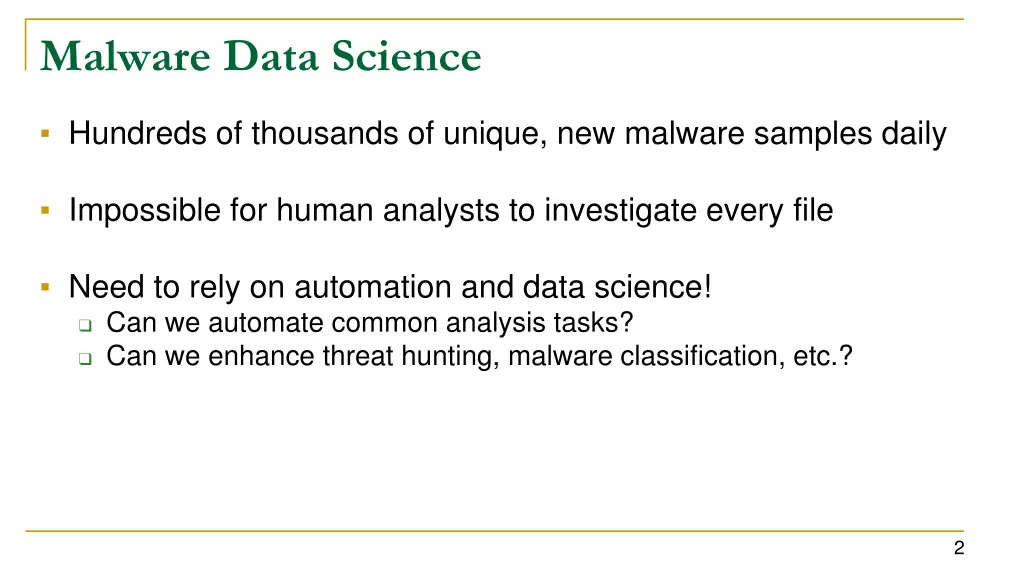
Malware Data Science Hundreds of thousands of unique, new malware samples daily Impossible for human analysts to investigate every file Need to rely on automation and data science! Can we automate common analysis tasks? Can we enhance threat hunting, malware classification, etc.? 2
Public Malware Datasets EMBER2018 Dataset - PE metadata extracted from ~500,000 malicious files and ~500,000 benign files https://github.com/elastic/ember SOREL-20M Dataset - PE Metadata from ~10M benign files and ~10M disarmed malware samples from 11 categories https://github.com/sophos/SOREL-20M MOTIF Dataset - 3,095 malicious PE files from 454 malware family families with ground truth labels https://github.com/boozallen/MOTIF/ 3
Malware Analysis Pipeline Most large malware analysis shops have a pipeline which automatically processes malware Newly-ingested files Re-processing older files Basic static analysis Basic dynamic analysis Malware signatures (YARA, Snort, AV) 5
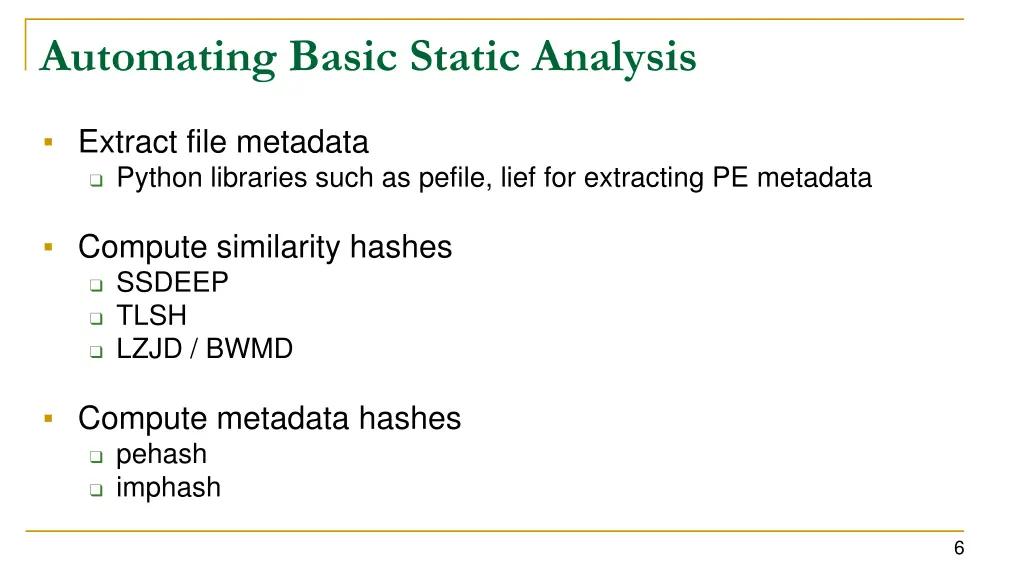
Automating Basic Static Analysis Extract file metadata Python libraries such as pefile, lief for extracting PE metadata Compute similarity hashes SSDEEP TLSH LZJD / BWMD Compute metadata hashes pehash imphash 6
Side Note: Automating Disassembly Can automate many advanced static analysis tasks Too slow to apply to every malware sample though Capstone library for Python is an excellent linear disassembler Most modern disassemblers/decompilers (including IDA Pro, Ghidra, Binary Ninja) support plugins Can use these for automating many advanced static analysis tasks 7
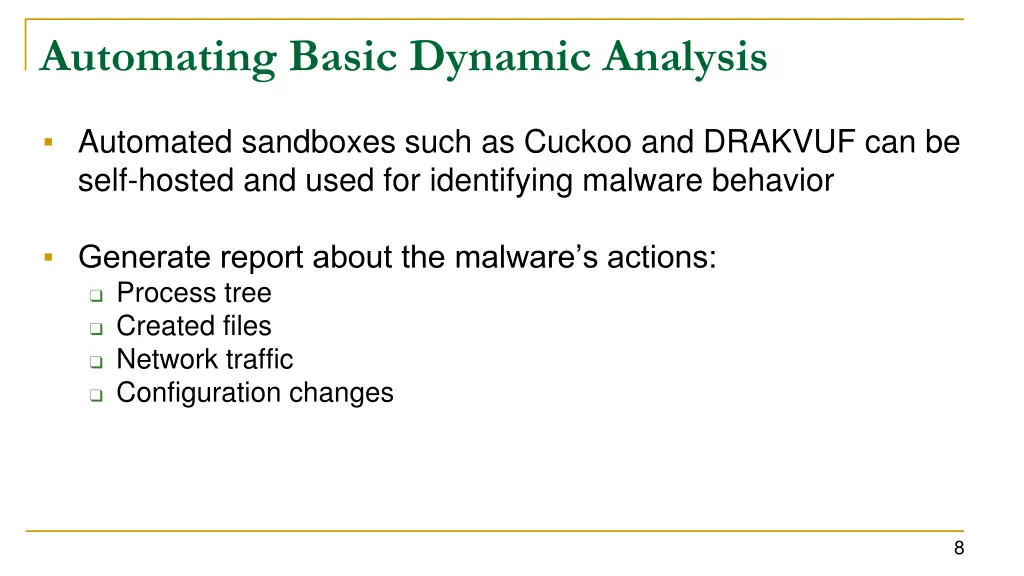
Automating Basic Dynamic Analysis Automated sandboxes such as Cuckoo and DRAKVUF can be self-hosted and used for identifying malware behavior Generate report about the malware s actions: Process tree Created files Network traffic Configuration changes 8
Malware Signatures Many malware analysis shops have a collection of in-house antivirus products May also maintain other large collections of signatures: YARA rules - based on file contents Snort rules - based on network traffic The yara-python library lets YARA be used programmatically 9
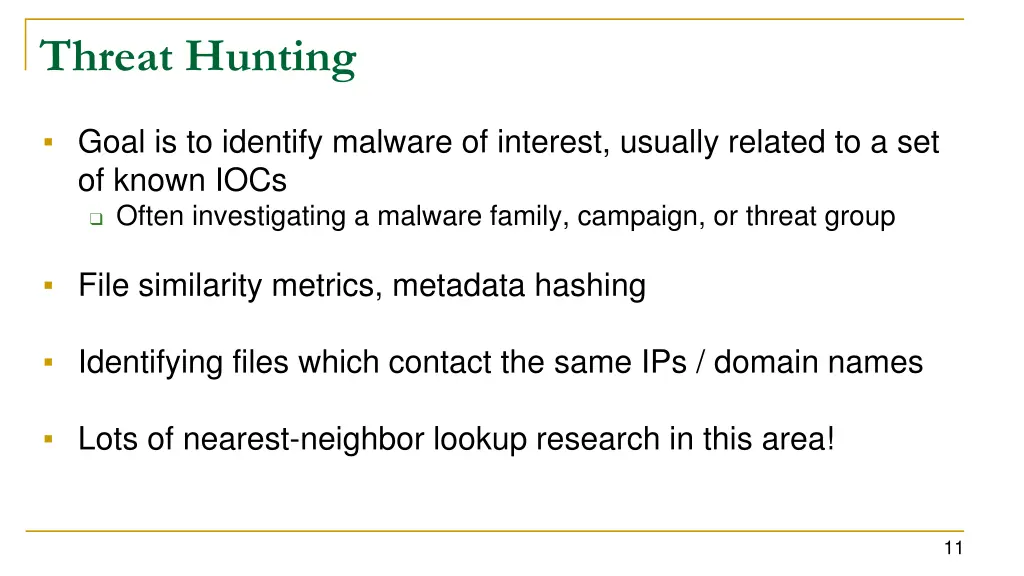
Threat Hunting Goal is to identify malware of interest, usually related to a set of known IOCs Often investigating a malware family, campaign, or threat group File similarity metrics, metadata hashing Identifying files which contact the same IPs / domain names Lots of nearest-neighbor lookup research in this area! 11
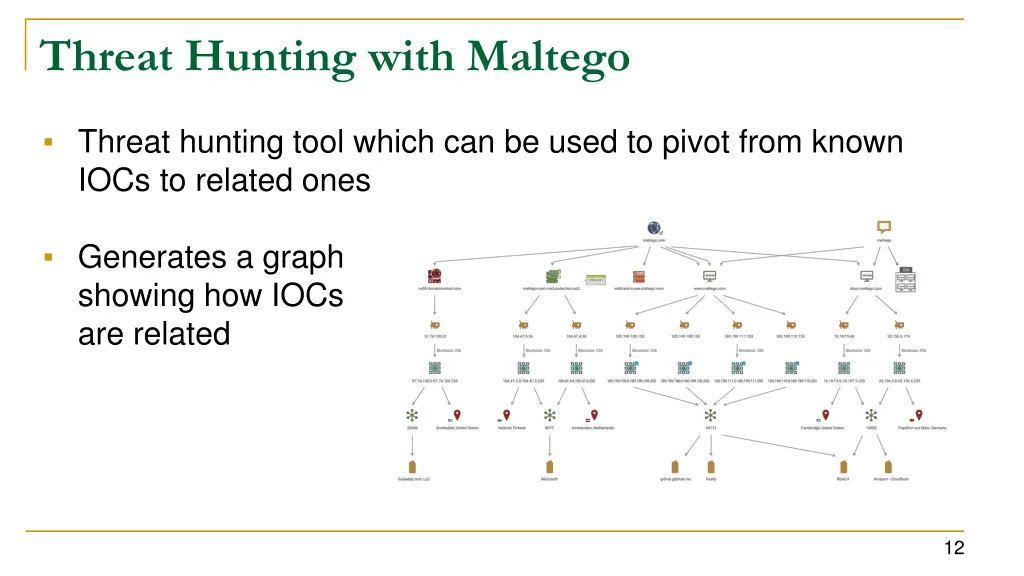
Threat Hunting with Maltego Threat hunting tool which can be used to pivot from known IOCs to related ones Generates a graph showing how IOCs are related 12
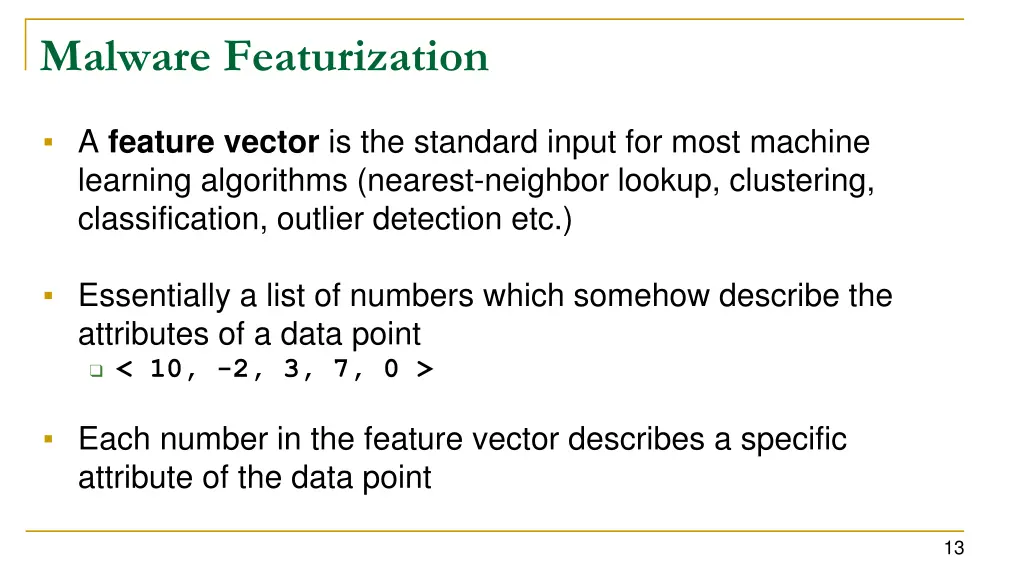
Malware Featurization A feature vector is the standard input for most machine learning algorithms (nearest-neighbor lookup, clustering, classification, outlier detection etc.) Essentially a list of numbers which somehow describe the attributes of a data point < 10, -2, 3, 7, 0 > Each number in the feature vector describes a specific attribute of the data point 13
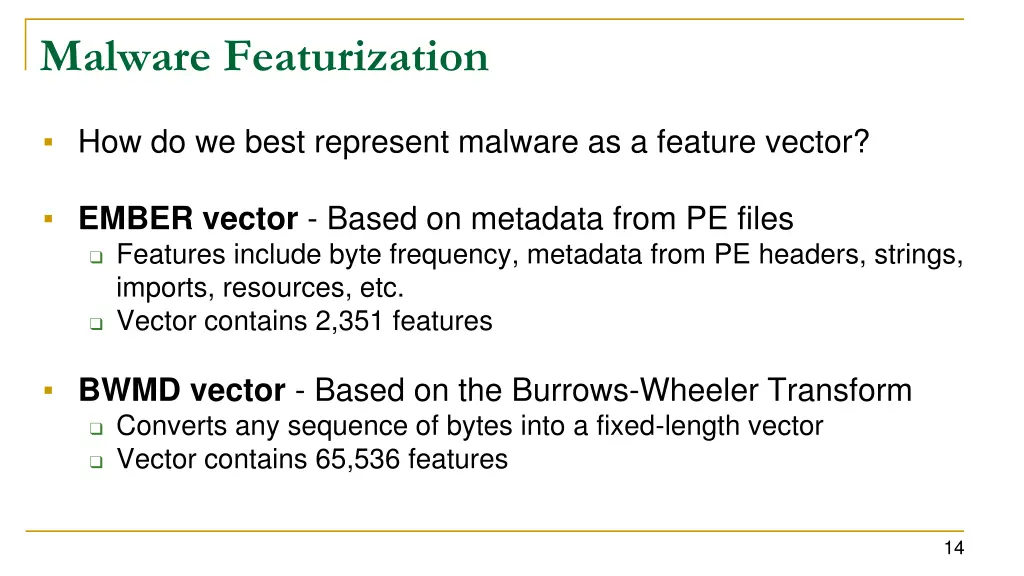
Malware Featurization How do we best represent malware as a feature vector? EMBER vector - Based on metadata from PE files Features include byte frequency, metadata from PE headers, strings, imports, resources, etc. Vector contains 2,351 features BWMD vector - Based on the Burrows-Wheeler Transform Converts any sequence of bytes into a fixed-length vector Vector contains 65,536 features 14
Malware Clustering Clustering: Identify groups of similar malware samples Usually need to convert malware into feature vectors first! Or have a method for computing similarity between two files Many different clustering algorithms, depending on your situation and goals Density-based and hierarchical clustering algorithms work best But may run slowly on large datasets 15
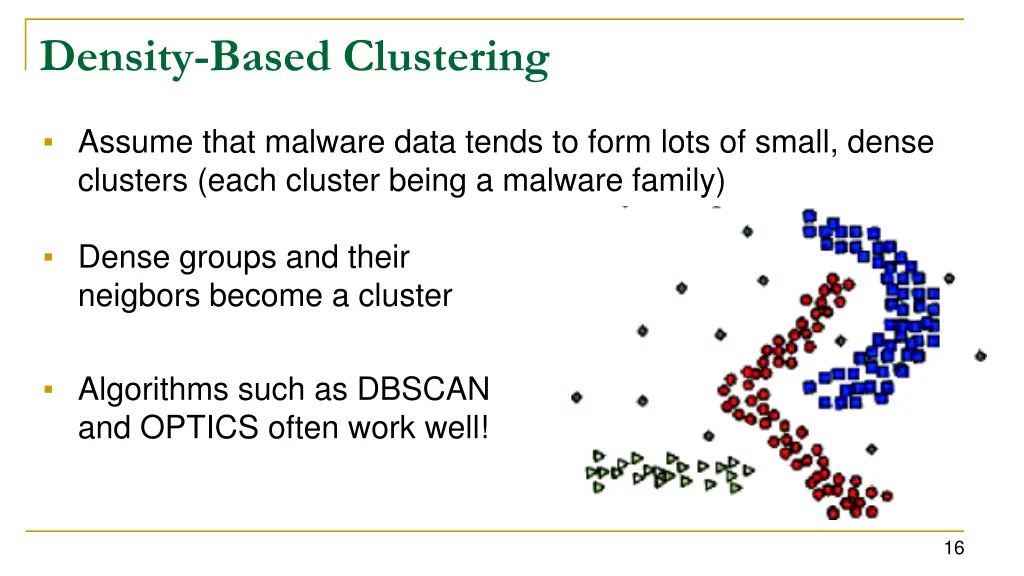
Density-Based Clustering Assume that malware data tends to form lots of small, dense clusters (each cluster being a malware family) Dense groups and their neigbors become a cluster Algorithms such as DBSCAN and OPTICS often work well! 16
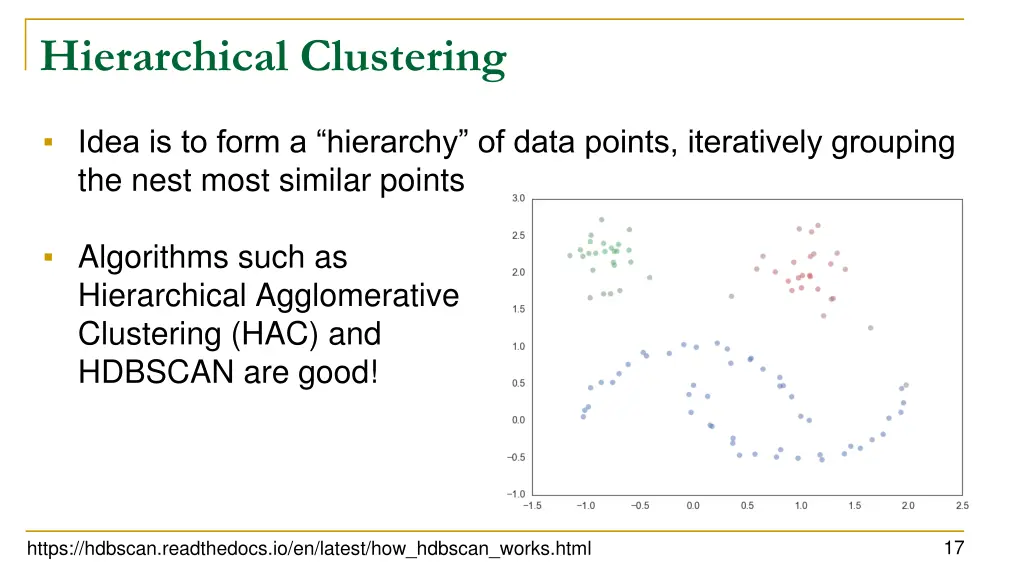
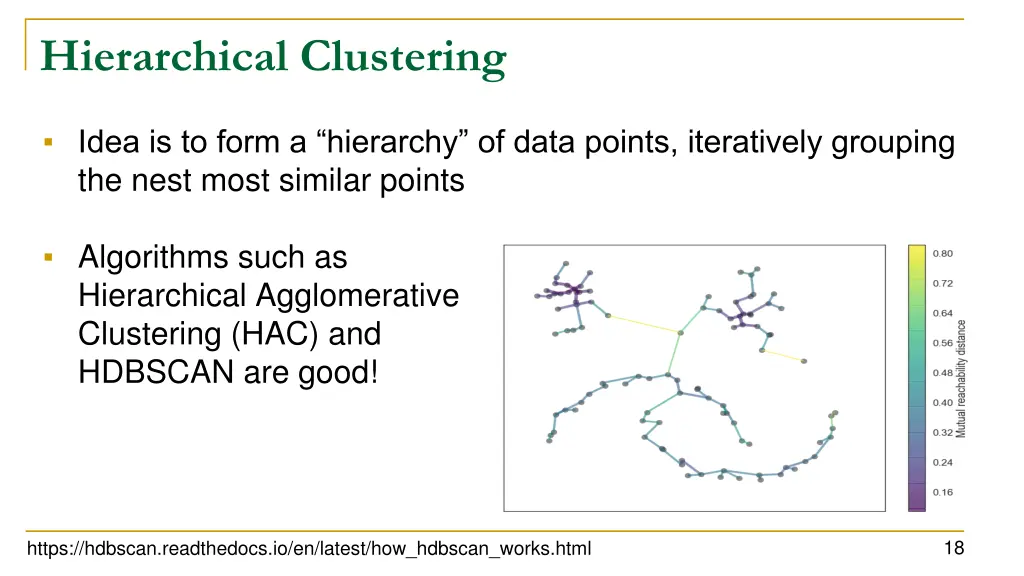
Hierarchical Clustering Idea is to form a hierarchy of data points, iteratively grouping the nest most similar points Algorithms such as Hierarchical Agglomerative Clustering (HAC) and HDBSCAN are good! 17 https://hdbscan.readthedocs.io/en/latest/how_hdbscan_works.html
Hierarchical Clustering Idea is to form a hierarchy of data points, iteratively grouping the nest most similar points Algorithms such as Hierarchical Agglomerative Clustering (HAC) and HDBSCAN are good! 18 https://hdbscan.readthedocs.io/en/latest/how_hdbscan_works.html
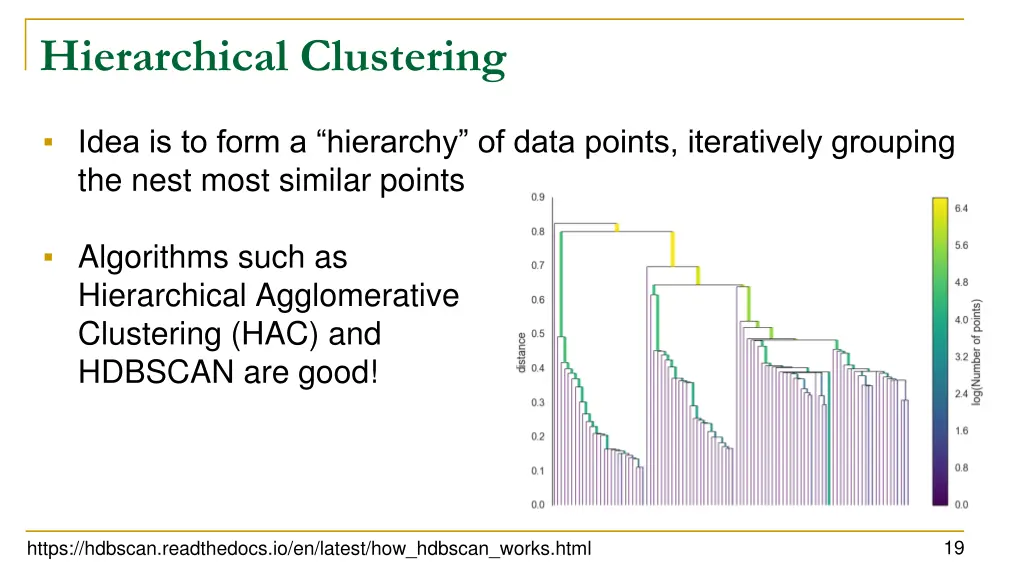
Hierarchical Clustering Idea is to form a hierarchy of data points, iteratively grouping the nest most similar points Algorithms such as Hierarchical Agglomerative Clustering (HAC) and HDBSCAN are good! 19 https://hdbscan.readthedocs.io/en/latest/how_hdbscan_works.html
Hierarchical Clustering Idea is to form a hierarchy of data points, iteratively grouping the nest most similar points Algorithms such as Hierarchical Agglomerative Clustering (HAC) and HDBSCAN are good! 20 https://hdbscan.readthedocs.io/en/latest/how_hdbscan_works.html
Malware Classification Classification: Task of assigning a class to a data point Malware Detection: Classify file as benign/malicious Category Classification: Classify file by behavior category (e.g. ransomware, keylogger, etc.) Family classification: Classify file by malware family 21
Decision Tree Classifiers Decision Tree - simple classification algorithm that maps combinations of features to a class outcome In the figure, the result for red cars newer than 2010 is the buy class 22
Decision Tree-Based Ensemble Classifiers Ensemble: Powerful machine learning technique where a collection of classifiers (often decision trees) vote on a class Algorithms like Random Forests, XGBoost, and LightGBM are extremely accurate for malware detection Usually trained on EMBER feature vectors 23
Deep Learning-Based Malware Classifiers Lots of research using neural networks and deep learning for malware classification MalConv and MalConv2 are leading models Treat malware as a large sequence of bytes Apply 1-D convolution to extract spatial relationships from data Features are learned through convolution! 24