Advancements in HTS Magnets for Muon Collider
HTS conductors have made significant progress, with improved performance and potential for high fields. Challenges remain in cost and maturity of technology. Various magnet concepts and designs are discussed, highlighting the need for innovation and optimization in HTS technology for future applications.

Download Presentation

Please find below an Image/Link to download the presentation.
The content on the website is provided AS IS for your information and personal use only. It may not be sold, licensed, or shared on other websites without obtaining consent from the author.If you encounter any issues during the download, it is possible that the publisher has removed the file from their server.
You are allowed to download the files provided on this website for personal or commercial use, subject to the condition that they are used lawfully. All files are the property of their respective owners.
The content on the website is provided AS IS for your information and personal use only. It may not be sold, licensed, or shared on other websites without obtaining consent from the author.
E N D
Presentation Transcript
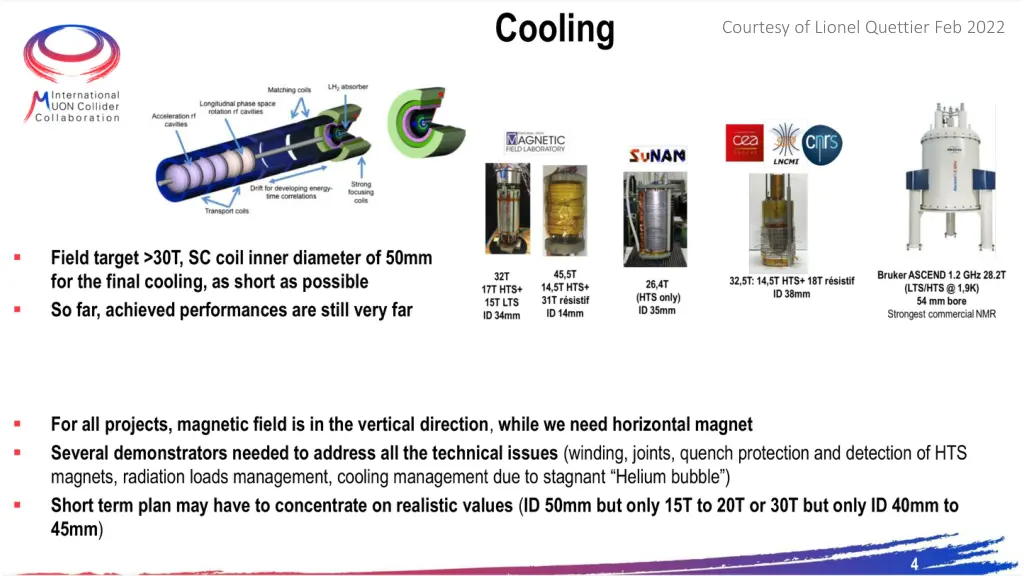
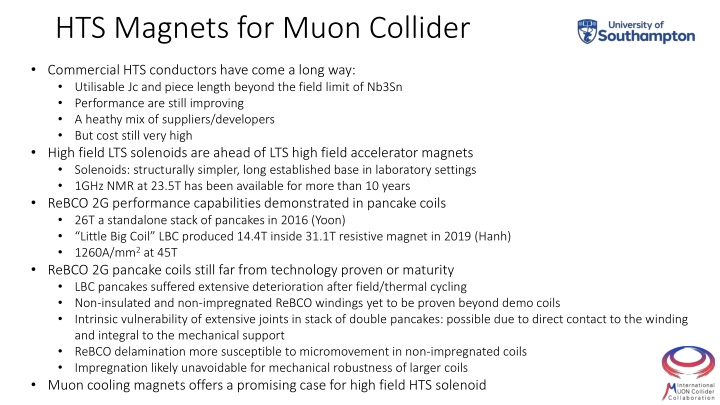
HTS Magnets for Muon Collider Commercial HTS conductors have come a long way: Utilisable Jc and piece length beyond the field limit of Nb3Sn Performance are still improving A heathy mix of suppliers/developers But cost still very high High field LTS solenoids are ahead of LTS high field accelerator magnets Solenoids: structurally simpler, long established base in laboratory settings 1GHz NMR at 23.5T has been available for more than 10 years ReBCO 2G performance capabilities demonstrated in pancake coils 26T a standalone stack of pancakes in 2016 (Yoon) Little Big Coil LBC produced 14.4T inside 31.1T resistive magnet in 2019 (Hanh) 1260A/mm2 at 45T ReBCO 2G pancake coils still far from technology proven or maturity LBC pancakes suffered extensive deterioration after field/thermal cycling Non-insulated and non-impregnated ReBCO windings yet to be proven beyond demo coils Intrinsic vulnerability of extensive joints in stack of double pancakes: possible due to direct contact to the winding and integral to the mechanical support ReBCO delamination more susceptible to micromovement in non-impregnated coils Impregnation likely unavoidable for mechanical robustness of larger coils Muon cooling magnets offers a promising case for high field HTS solenoid
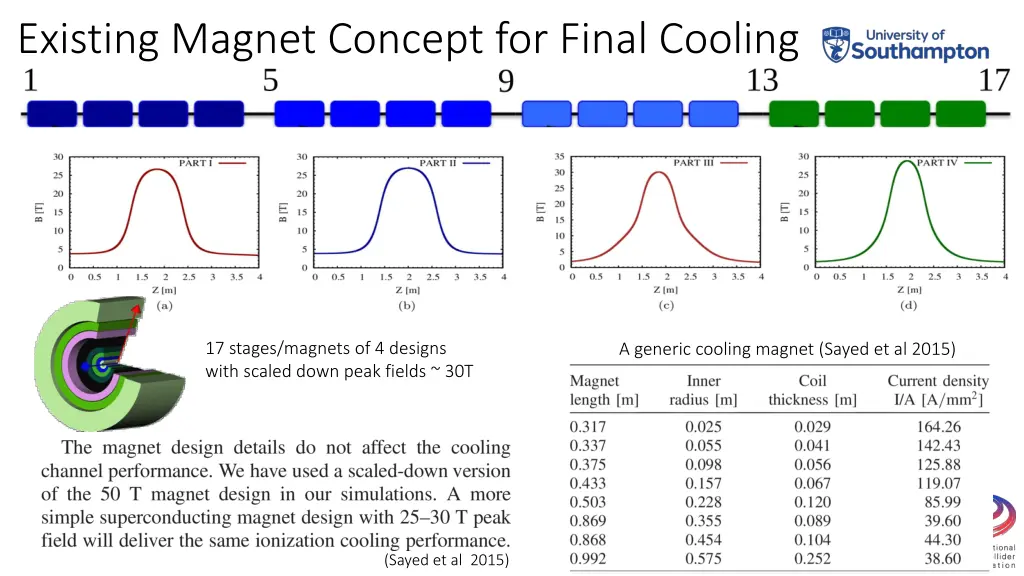
Existing Magnet Concept for Final Cooling 17 stages/magnets of 4 designs with scaled down peak fields ~ 30T A generic cooling magnet (Sayed et al 2015) (Sayed et al 2015)
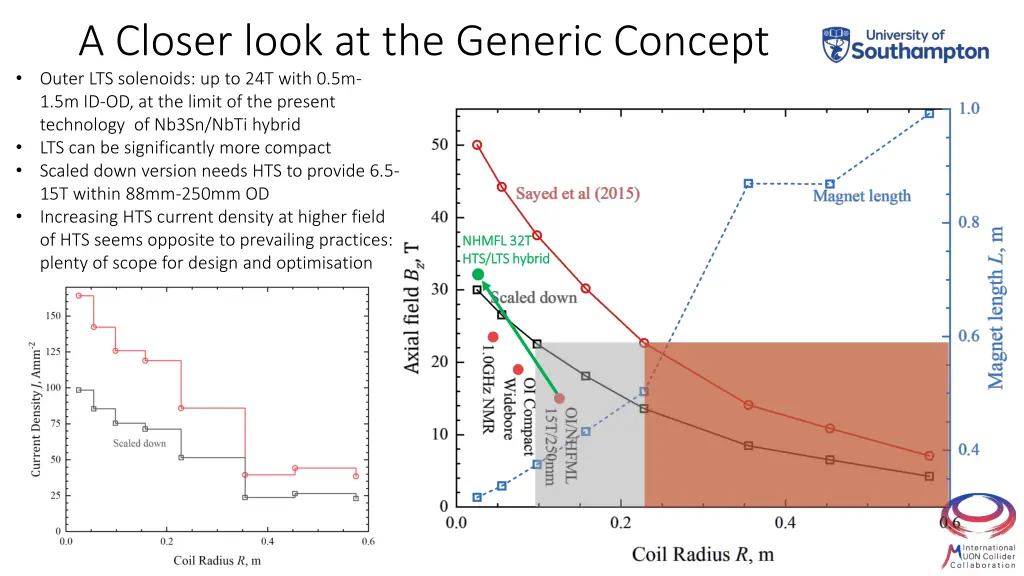
A Closer look at the Generic Concept Outer LTS solenoids: up to 24T with 0.5m- 1.5m ID-OD, at the limit of the present technology of Nb3Sn/NbTi hybrid LTS can be significantly more compact Scaled down version needs HTS to provide 6.5- 15T within 88mm-250mm OD Increasing HTS current density at higher field of HTS seems opposite to prevailing practices: plenty of scope for design and optimisation NHMFL 32T NHMFL 32T HTS/LTS hybrid HTS/LTS hybrid
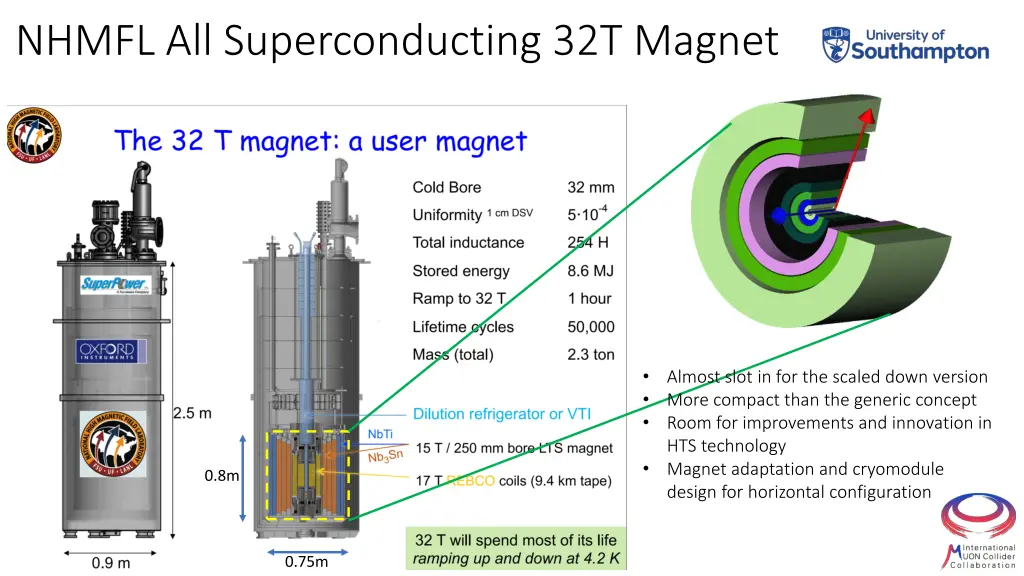
NHMFL All Superconducting 32T Magnet Almost slot in for the scaled down version More compact than the generic concept Room for improvements and innovation in HTS technology Magnet adaptation and cryomodule design for horizontal configuration 0.8m 0.75m
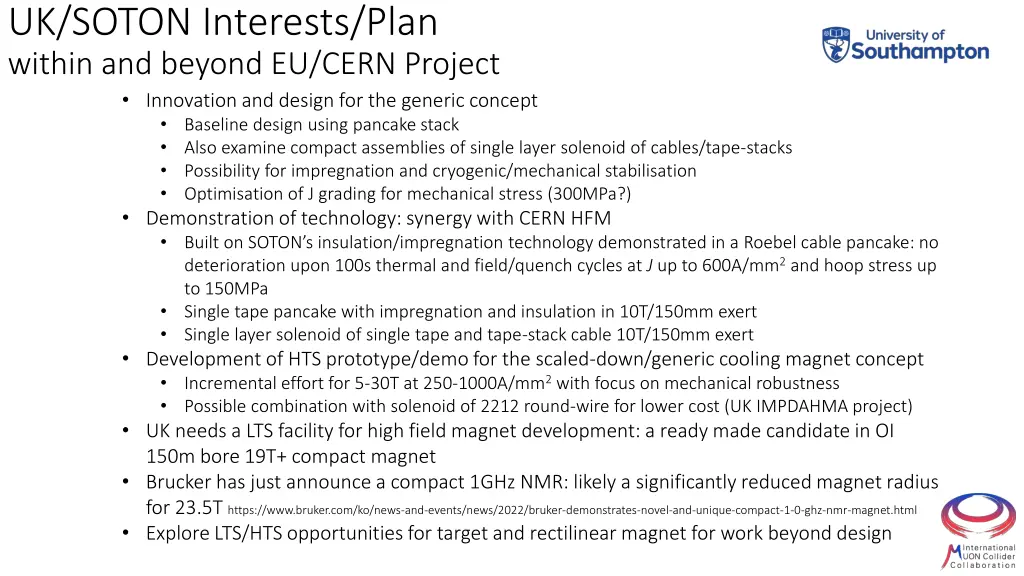
UK/SOTON Interests/Plan within and beyond EU/CERN Project Innovation and design for the generic concept Baseline design using pancake stack Also examine compact assemblies of single layer solenoid of cables/tape-stacks Possibility for impregnation and cryogenic/mechanical stabilisation Optimisation of J grading for mechanical stress (300MPa?) Demonstration of technology: synergy with CERN HFM Built on SOTON s insulation/impregnation technology demonstrated in a Roebel cable pancake: no deterioration upon 100s thermal and field/quench cycles at J up to 600A/mm2 and hoop stress up to 150MPa Single tape pancake with impregnation and insulation in 10T/150mm exert Single layer solenoid of single tape and tape-stack cable 10T/150mm exert Development of HTS prototype/demo for the scaled-down/generic cooling magnet concept Incremental effort for 5-30T at 250-1000A/mm2 with focus on mechanical robustness Possible combination with solenoid of 2212 round-wire for lower cost (UK IMPDAHMA project) UK needs a LTS facility for high field magnet development: a ready made candidate in OI 150m bore 19T+ compact magnet Brucker has just announce a compact 1GHz NMR: likely a significantly reduced magnet radius for 23.5T https://www.bruker.com/ko/news-and-events/news/2022/bruker-demonstrates-novel-and-unique-compact-1-0-ghz-nmr-magnet.html Explore LTS/HTS opportunities for target and rectilinear magnet for work beyond design