Advancing Quality Public Services in Crisis and Insecurity Challenges
Contributing to peace, preventing conflicts, and building resilience are crucial in addressing natural, human-made, and economic crises. The presentation outlines responses, recommendations, and analyses the background of various crisis types such as climate change impacts, refugee flows, and internally displaced persons. Highlighting the need for proactive measures to address the challenges of crisis and insecurity.

Download Presentation

Please find below an Image/Link to download the presentation.
The content on the website is provided AS IS for your information and personal use only. It may not be sold, licensed, or shared on other websites without obtaining consent from the author.If you encounter any issues during the download, it is possible that the publisher has removed the file from their server.
You are allowed to download the files provided on this website for personal or commercial use, subject to the condition that they are used lawfully. All files are the property of their respective owners.
The content on the website is provided AS IS for your information and personal use only. It may not be sold, licensed, or shared on other websites without obtaining consent from the author.
E N D
Presentation Transcript
Advancing Quality Public Services in the Advancing Quality Public Services in the Challenges of Crisis and Insecurity Challenges of Crisis and Insecurity Contributing to the promotion of peace, preventing conflicts, enabling recovery and building resilience, Abuja, Nigeria, 5-6 October 2017 Presentation by: Sani Baba PSI Regional Secretary for Africa and Arab Countries Genevieve Gencianos PSI Migration Programme Coordinator
Presentation Outline Presentation Outline I. II. PSI Response III. Conclusion IV. Recommendation Background and Situation Analysis
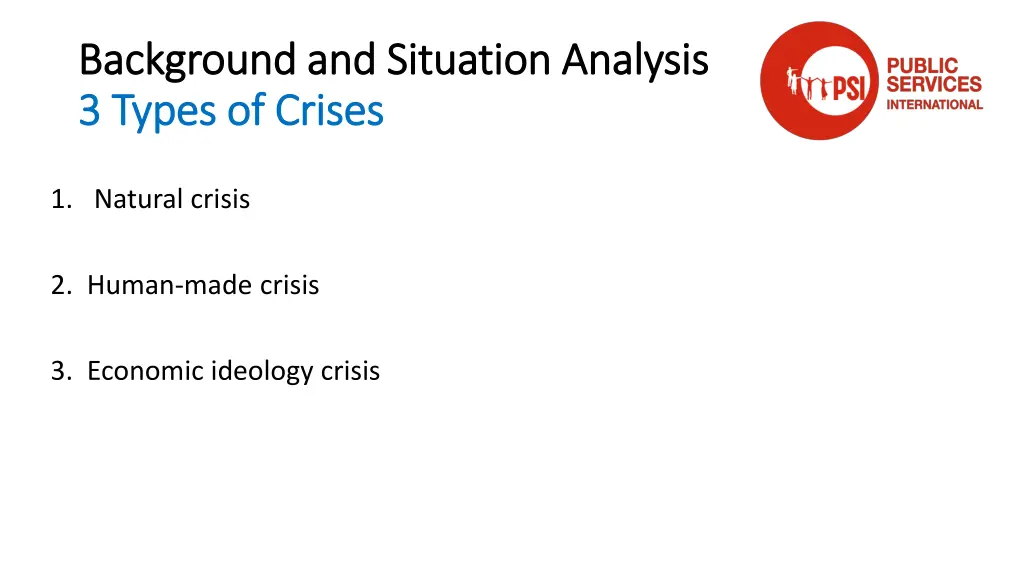
Background and Situation Analysis Background and Situation Analysis 3 Types of Crises 3 Types of Crises 1. Natural crisis 2. Human-made crisis 3. Economic ideology crisis
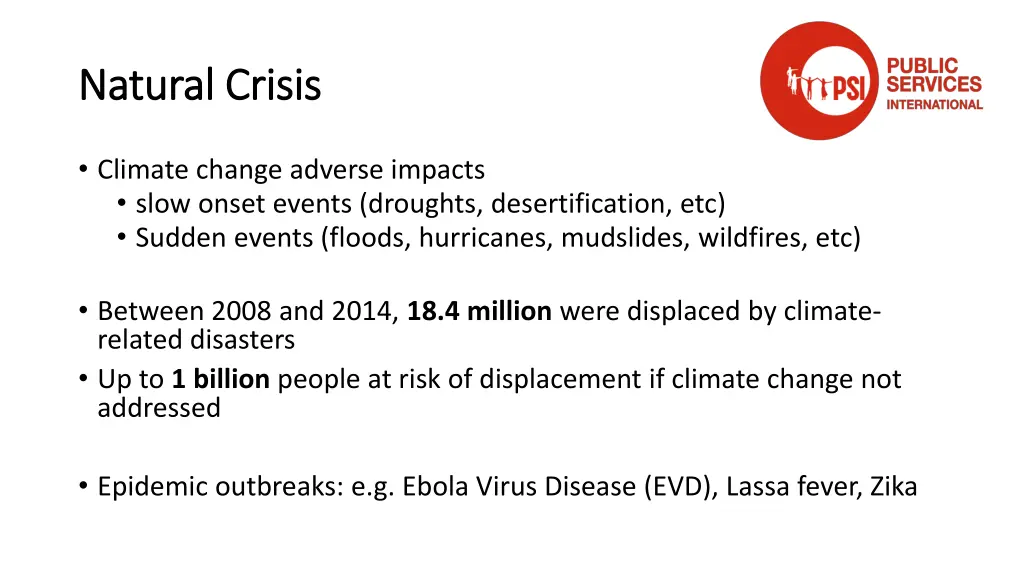
Natural Crisis Natural Crisis Climate change adverse impacts slow onset events (droughts, desertification, etc) Sudden events (floods, hurricanes, mudslides, wildfires, etc) Between 2008 and 2014, 18.4 million were displaced by climate- related disasters Up to 1 billion people at risk of displacement if climate change not addressed Epidemic outbreaks: e.g. Ebola Virus Disease (EVD), Lassa fever, Zika
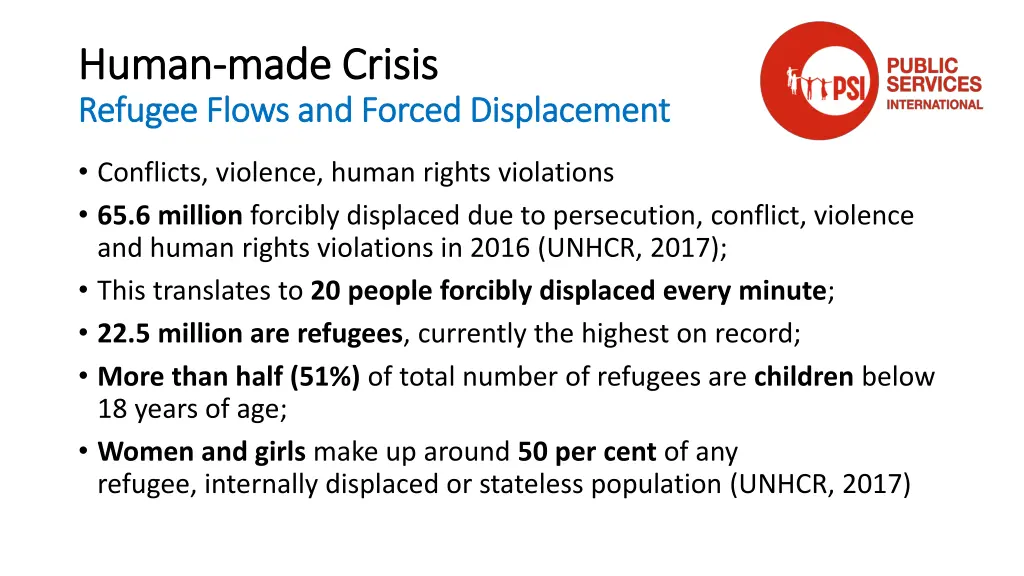
Human Human- -made Crisis made Crisis Refugee Flows and Forced Displacement Refugee Flows and Forced Displacement Conflicts, violence, human rights violations 65.6 million forcibly displaced due to persecution, conflict, violence and human rights violations in 2016 (UNHCR, 2017); This translates to 20 people forcibly displaced every minute; 22.5 million are refugees, currently the highest on record; More than half (51%) of total number of refugees are children below 18 years of age; Women and girls make up around 50 per cent of any refugee, internally displaced or stateless population (UNHCR, 2017)
Human made crisis Human made crisis Internally Displaced Persons (IDPs) Internally Displaced Persons (IDPs) 40.3 million IDPs worldwide as a result of conflict and violence (IDMC, 2017) IDPs are about twice the number of refugees Largest IDP populations are in Africa: Nigeria, DRC, Sudan Nigeria on top of the list in Africa: 2.16 million IDPs (IDMC, 2017) Without fully addressing their human rights, needs and internal protection, today s IDPs will be tomorrow s refugees, trafficked or smuggled migrants. Former UN Special Rapporteur on the Human Rights of IDPs
Economic Ideology Crisis Economic Ideology Crisis Current economic world order in the post-Cold War Era Washington Consensus and the era of Neo-liberalism: Free market capitalism Trade liberalisation Corporate rule and MNCs Rabid Privatisation: PPPs, marketisation, outsourcing, unbundling Bretton Woods Institutions (IMF, WB) and Structural Adjustment Programs (SAPs) and conditionalities Downsizing and dismantling of public services Austerity measures Military dictatorships serving the interests of corporations and the elite Land-grabbing, destruction of the environment, control of natural resources Poverty, repression, discontent, radicalisation and conflicts
Sectoral Analysis Sectoral Analysis Health and Social Services Water Energy Education *Migration and Refugee Services (2017 PSI/EPSU/Study)
Impact Analysis Impact Analysis Service providers: Public sector workers Service: quality and delivery of services Users: community, population Policy: policy interventions without involving workers
Impact on workers Impact on workers Lack of worker involvement in planning and decision-making (fire brigade approach) Lack of decent work (workload, safe-staffing, non-payment of salaries, salary ceilings .) Lack of social protection Migration of workers Casualisation Unemployment Precarious work Women and young workers disproportionately affected
PSI Response: PSI Response: People Over Profits People Over Profits Countering the Neo-liberal ideology Fighting Privatisation, keep Public Services in public hands Water Energy Education (non-teaching) Health oDeveloping campaign materials on privatisation in these sectors oAlliance building Counter-strategies to privatisation: good governance, public-public partnerships, tax justice Fair Trade: No Trade in Public Services
PSI Response: PSI Response: People Over Profits People Over Profits Tax Justice: fighting corporate greed, tax governance and funding of public services Good governance Combatting corruption and whistle-blower protection Trade union rights, right to strike, right to organise and CB in public sector (ILO 151 campaign) PSI Programme on Migration, Refugees and IDPs PSI 2017 Study: Privatisation of Migration and Refugee Services and other forms of State Disengagement Right to Health Campaign including EVD Strategy, firewalls and access of migrants and refugees to quality public services without fear or discrimination
ILO Recommendation No. 205 ILO Recommendation No. 205 Employment and Decent Work for Peace and Resilience Employment and Decent Work for Peace and Resilience Quality public services underpins any sustainable and sound response to disaster, peace-building, adaptation, reconstruction and resilience Specific provisions in ILO Recommendation 205 reiterating this: Preamble, Strategic Approaches 8(c) Social protection can only be secured and delivered through QPS QPS is indispensable, e.g. http://www.world-psi.org/en/delivering-safe- drinking-water-syrian-refugees-and-local-community-lebanonin realising the SDGs However, we caution on insertion of PPPs in ILO Recommendation 205: III (e) Employment Impact Assessment through PPPs, IV (g) Employment and Income Generation Opportunities through PPPs, XIII (44) International Cooperation in public and private sector investment for job creation
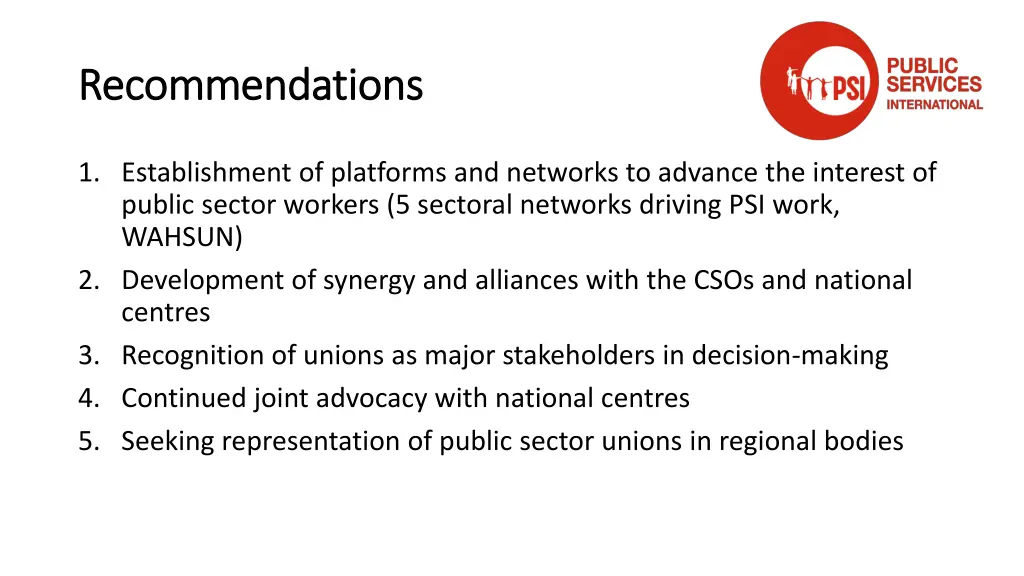
Recommendations Recommendations 1. Establishment of platforms and networks to advance the interest of public sector workers (5 sectoral networks driving PSI work, WAHSUN) 2. Development of synergy and alliances with the CSOs and national centres 3. Recognition of unions as major stakeholders in decision-making 4. Continued joint advocacy with national centres 5. Seeking representation of public sector unions in regional bodies