Advantages and Selection of Mulching for Organic Farming
Learn about the benefits of mulching in organic farming, including soil protection, moisture retention, weed suppression, and nutrient provision. Discover how to choose the right mulch material based on decomposition rate and nitrogen content. Explore different sources of mulching material and receive recommendations for effective mulch usage to enhance crop growth and sustainability.

Download Presentation

Please find below an Image/Link to download the presentation.
The content on the website is provided AS IS for your information and personal use only. It may not be sold, licensed, or shared on other websites without obtaining consent from the author. If you encounter any issues during the download, it is possible that the publisher has removed the file from their server.
You are allowed to download the files provided on this website for personal or commercial use, subject to the condition that they are used lawfully. All files are the property of their respective owners.
The content on the website is provided AS IS for your information and personal use only. It may not be sold, licensed, or shared on other websites without obtaining consent from the author.
E N D
Presentation Transcript
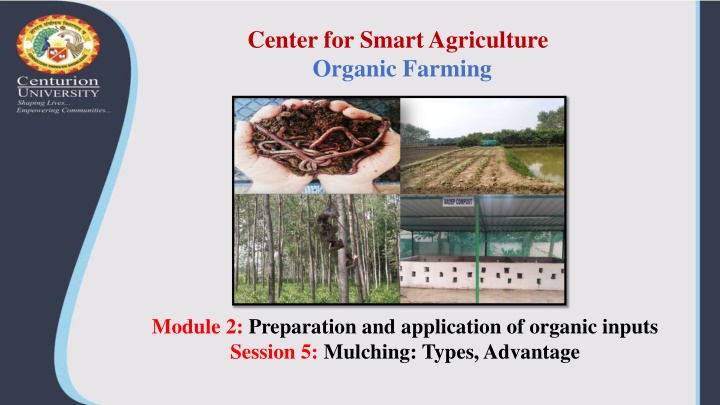
Center for Smart Agriculture Organic Farming Module 2: Preparation and application of organic inputs Session 5: Mulching: Types, Advantage
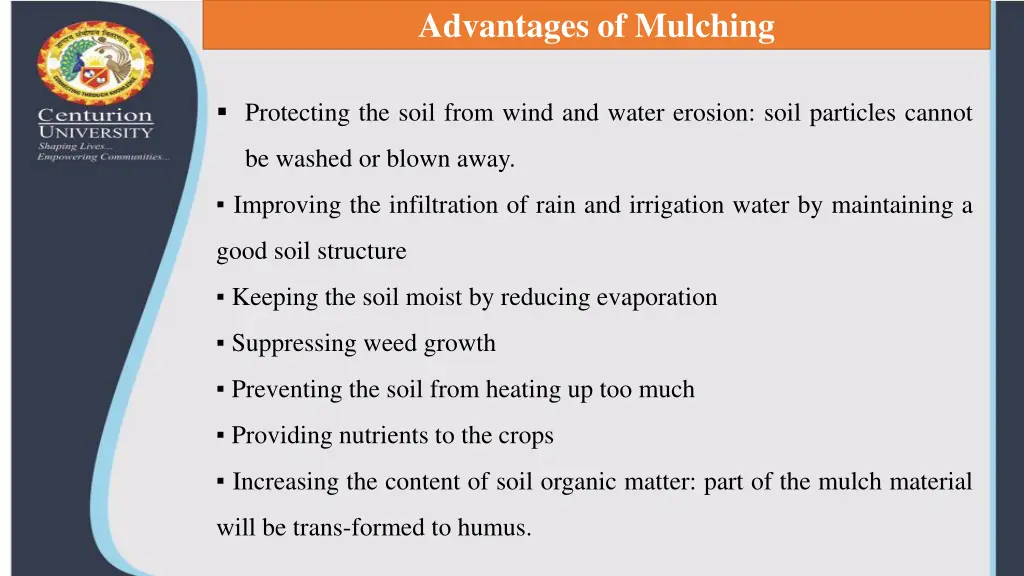
Advantages of Mulching Protecting the soil from wind and water erosion: soil particles cannot be washed or blown away. Improving the infiltration of rain and irrigation water by maintaining a good soil structure Keeping the soil moist by reducing evaporation Suppressing weed growth Preventing the soil from heating up too much Providing nutrients to the crops Increasing the content of soil organic matter: part of the mulch material will be trans-formed to humus.
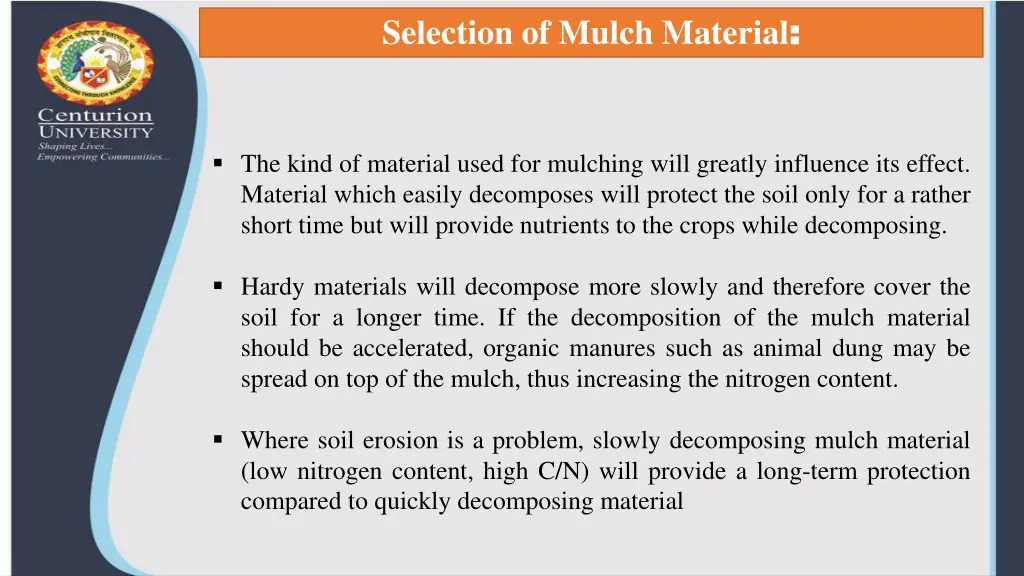
Selection of Mulch Material: : The kind of material used for mulching will greatly influence its effect. Material which easily decomposes will protect the soil only for a rather short time but will provide nutrients to the crops while decomposing. Hardy materials will decompose more slowly and therefore cover the soil for a longer time. If the decomposition of the mulch material should be accelerated, organic manures such as animal dung may be spread on top of the mulch, thus increasing the nitrogen content. Where soil erosion is a problem, slowly decomposing mulch material (low nitrogen content, high C/N) will provide a long-term protection compared to quickly decomposing material
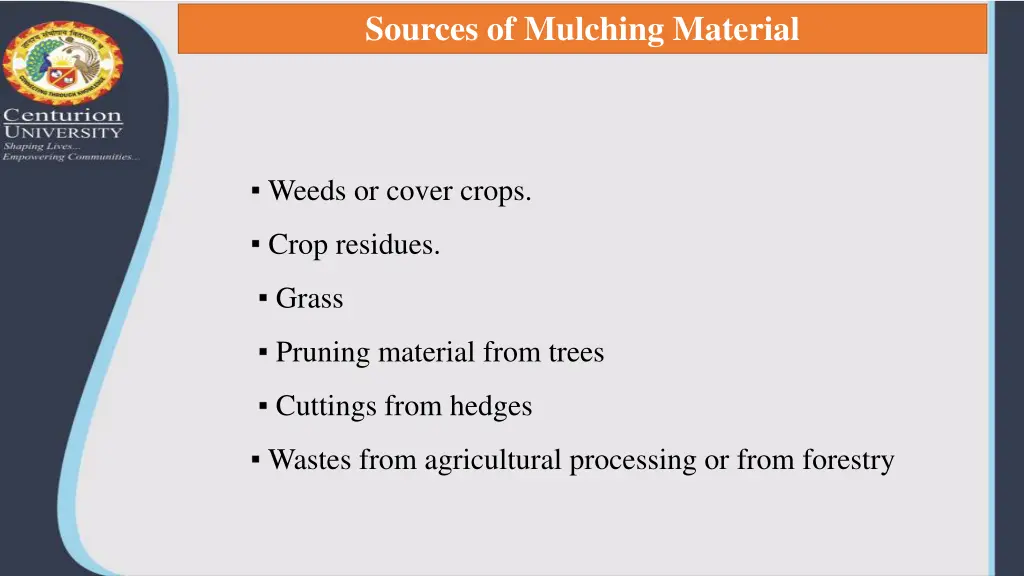
Sources of Mulching Material Weeds or cover crops. Crop residues. Grass Pruning material from trees Cuttings from hedges Wastes from agricultural processing or from forestry
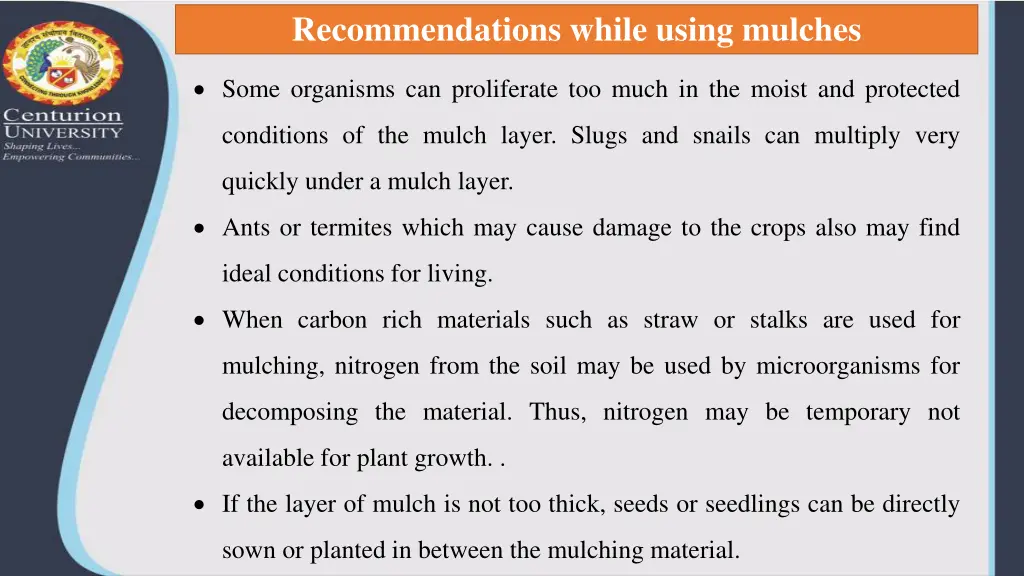
Recommendations while using mulches Some organisms can proliferate too much in the moist and protected conditions of the mulch layer. Slugs and snails can multiply very quickly under a mulch layer. Ants or termites which may cause damage to the crops also may find ideal conditions for living. When carbon rich materials such as straw or stalks are used for mulching, nitrogen from the soil may be used by microorganisms for decomposing the material. Thus, nitrogen may be temporary not available for plant growth. . If the layer of mulch is not too thick, seeds or seedlings can be directly sown or planted in between the mulching material.
Thank you Thank You