Advice on Contract Drafting
A comprehensive guide on drafting a contract involving financial aspects, setting flat rates for various costs, defining budget structures, and preparing the contract with appropriate annexes. Learn about the rules, guidelines, and recommendations for structuring the financial elements of a contract effectively.

Download Presentation

Please find below an Image/Link to download the presentation.
The content on the website is provided AS IS for your information and personal use only. It may not be sold, licensed, or shared on other websites without obtaining consent from the author.If you encounter any issues during the download, it is possible that the publisher has removed the file from their server.
You are allowed to download the files provided on this website for personal or commercial use, subject to the condition that they are used lawfully. All files are the property of their respective owners.
The content on the website is provided AS IS for your information and personal use only. It may not be sold, licensed, or shared on other websites without obtaining consent from the author.
E N D
Presentation Transcript
Advice on drafting of the contract 1
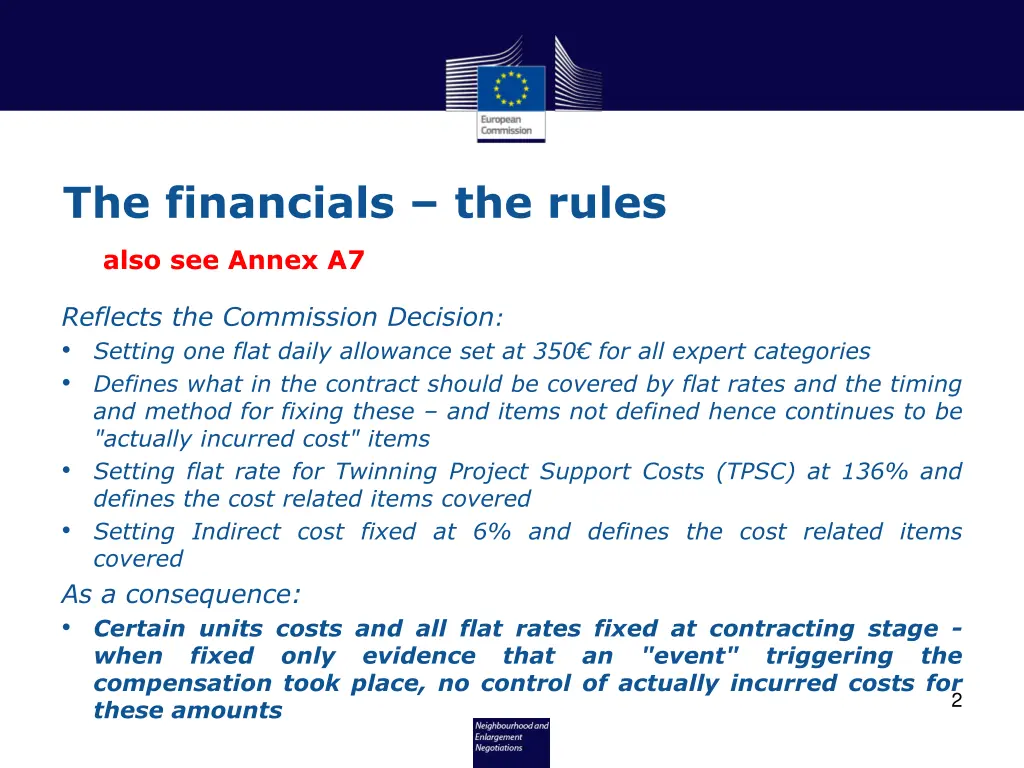
The financials the rules also see Annex A7 Reflects the Commission Decision: Setting one flat daily allowance set at 350 for all expert categories Defines what in the contract should be covered by flat rates and the timing and method for fixing these and items not defined hence continues to be "actually incurred cost" items Setting flat rate for Twinning Project Support Costs (TPSC) at 136% and defines the cost related items covered Setting Indirect cost fixed at 6% and defines the cost related items covered As a consequence: Certain units costs and all flat rates fixed at contracting stage - when fixed only evidence that an "event" triggering the compensation took place, no control of actually incurred costs for these amounts 2
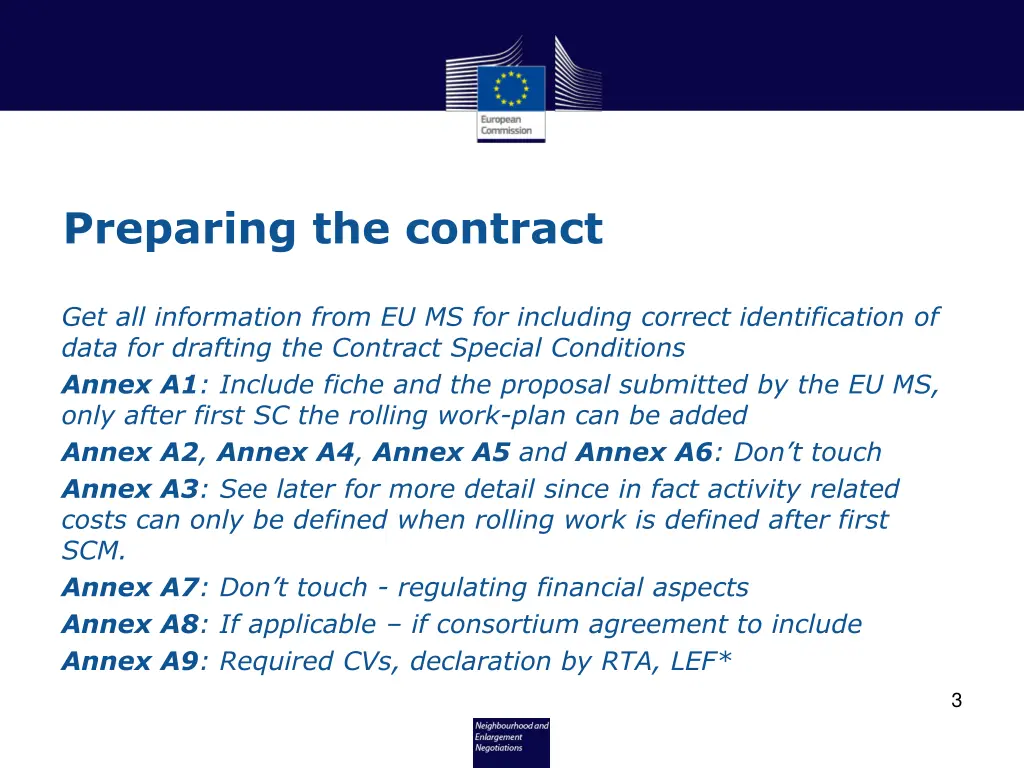
Preparing the contract Get all information from EU MS for including correct identification of data for drafting the Contract Special Conditions Annex A1: Include fiche and the proposal submitted by the EU MS, only after first SC the rolling work-plan can be added Annex A2, Annex A4, Annex A5 and Annex A6: Don t touch Annex A3: See later for more detail since in fact activity related costs can only be defined when rolling work is defined after first SCM. Annex A7: Don t touch - regulating financial aspects Annex A8: If applicable if consortium agreement to include Annex A9: Required CVs, declaration by RTA, LEF* 3
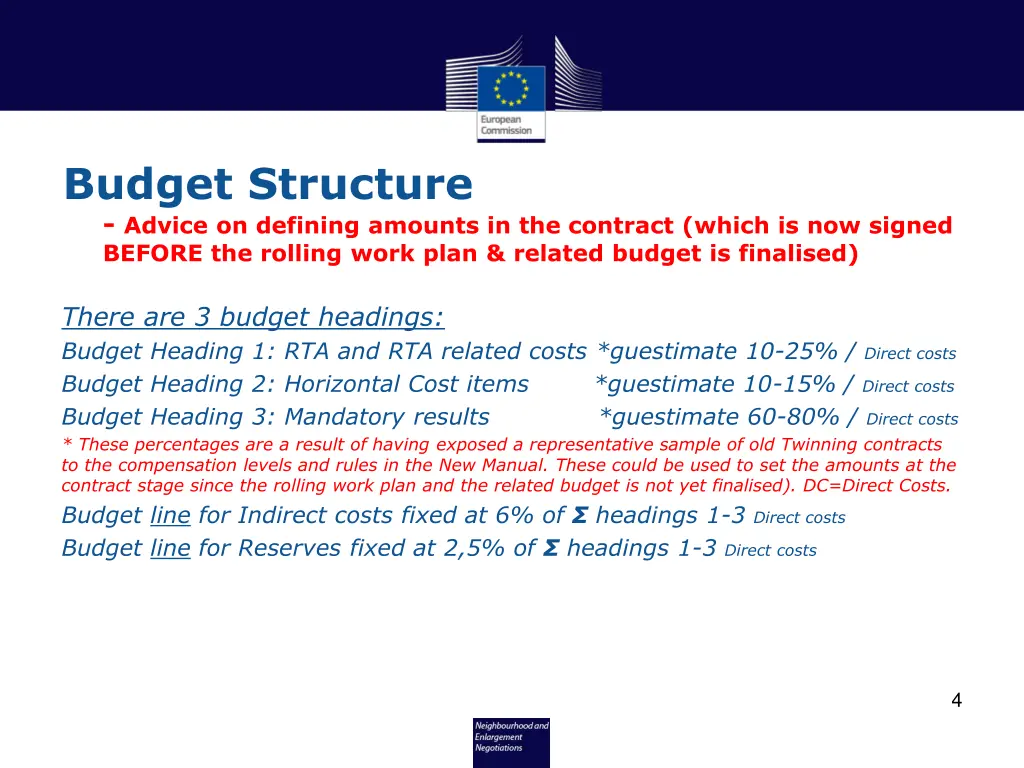
Budget Structure - Advice on defining amounts in the contract (which is now signed BEFORE the rolling work plan & related budget is finalised) There are 3 budget headings: Budget Heading 1: RTA and RTA related costs *guestimate 10-25% / Direct costs Budget Heading 2: Horizontal Cost items *guestimate 10-15% / Direct costs Budget Heading 3: Mandatory results * These percentages are a result of having exposed a representative sample of old Twinning contracts to the compensation levels and rules in the New Manual. These could be used to set the amounts at the contract stage since the rolling work plan and the related budget is not yet finalised). DC=Direct Costs. Budget line for Indirect costs fixed at 6% of headings 1-3 Direct costs Budget line for Reserves fixed at 2,5% of headings 1-3 Direct costs *guestimate 60-80% / Direct costs 4
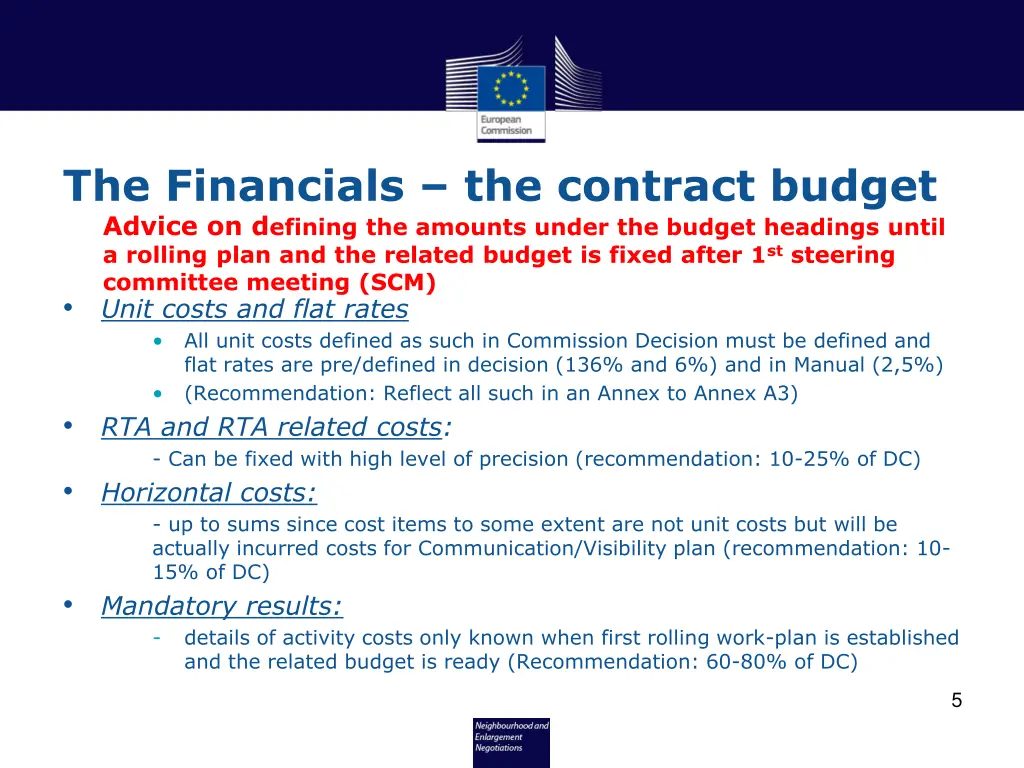
The Financials the contract budget Advice on defining the amounts under the budget headings until a rolling plan and the related budget is fixed after 1st steering committee meeting (SCM) Unit costs and flat rates All unit costs defined as such in Commission Decision must be defined and flat rates are pre/defined in decision (136% and 6%) and in Manual (2,5%) (Recommendation: Reflect all such in an Annex to Annex A3) RTA and RTA related costs: - Can be fixed with high level of precision (recommendation: 10-25% of DC) Horizontal costs: - up to sums since cost items to some extent are not unit costs but will be actually incurred costs for Communication/Visibility plan (recommendation: 10- 15% of DC) Mandatory results: - details of activity costs only known when first rolling work-plan is established and the related budget is ready (Recommendation: 60-80% of DC) 5
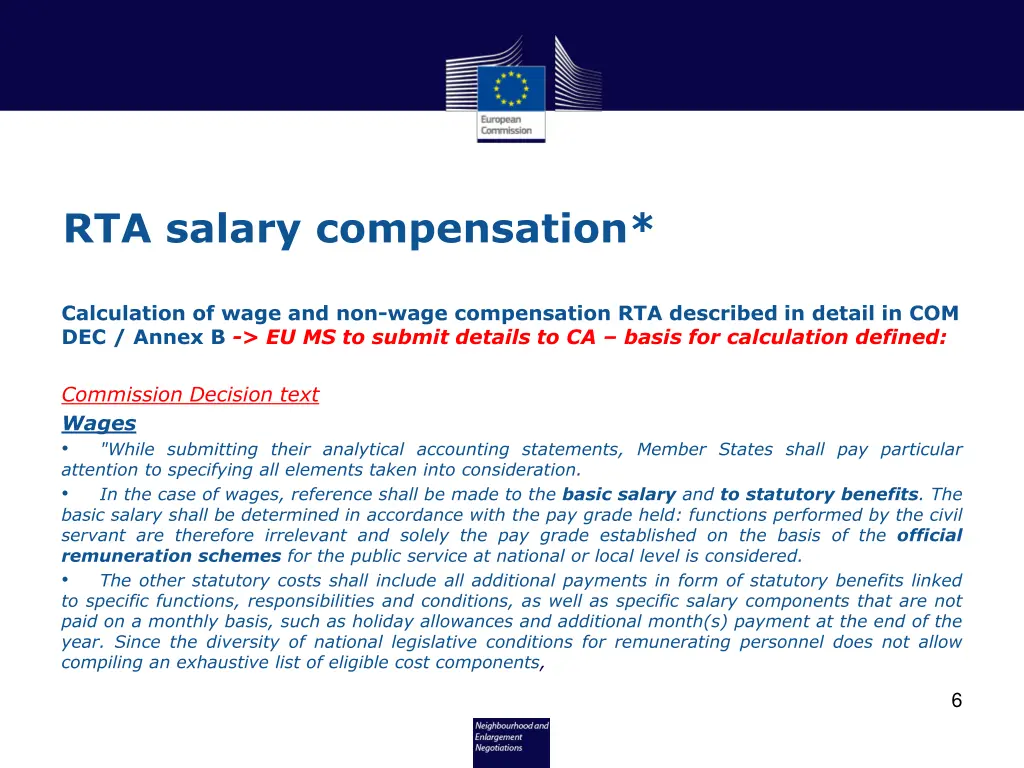
RTA salary compensation* Calculation of wage and non-wage compensation RTA described in detail in COM DEC / Annex B -> EU MS to submit details to CA basis for calculation defined: Commission Decision text Wages "While submitting their analytical accounting statements, Member States shall pay particular attention to specifying all elements taken into consideration. In the case of wages, reference shall be made to the basic salary and to statutory benefits. The basic salary shall be determined in accordance with the pay grade held: functions performed by the civil servant are therefore irrelevant and solely the pay grade established on the basis of the official remuneration schemes for the public service at national or local level is considered. The other statutory costs shall include all additional payments in form of statutory benefits linked to specific functions, responsibilities and conditions, as well as specific salary components that are not paid on a monthly basis, such as holiday allowances and additional month(s) payment at the end of the year. Since the diversity of national legislative conditions for remunerating personnel does not allow compiling an exhaustive list of eligible cost components, 6
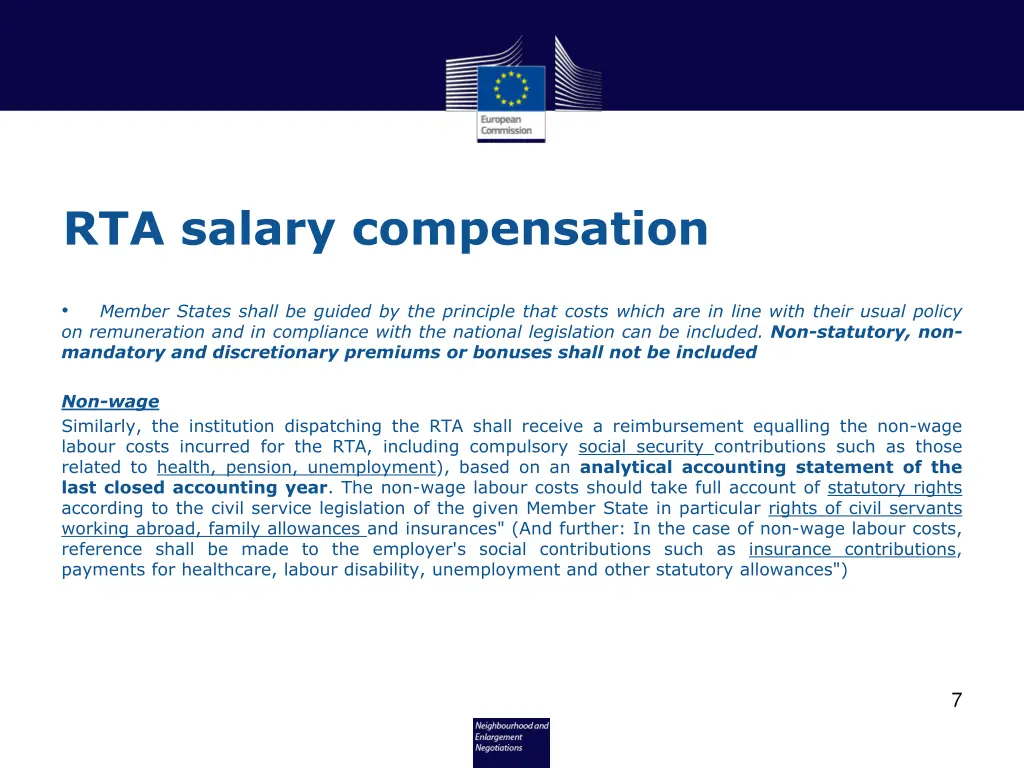
RTA salary compensation on remuneration and in compliance with the national legislation can be included. Non-statutory, non- mandatory and discretionary premiums or bonuses shall not be included Member States shall be guided by the principle that costs which are in line with their usual policy Non-wage Similarly, the institution dispatching the RTA shall receive a reimbursement equalling the non-wage labour costs incurred for the RTA, including compulsory social security contributions such as those related to health, pension, unemployment), based on an analytical accounting statement of the last closed accounting year. The non-wage labour costs should take full account of statutory rights according to the civil service legislation of the given Member State in particular rights of civil servants working abroad, family allowances and insurances" (And further: In the case of non-wage labour costs, reference shall be made to the employer's social contributions such as insurance contributions, payments for healthcare, labour disability, unemployment and other statutory allowances") 7
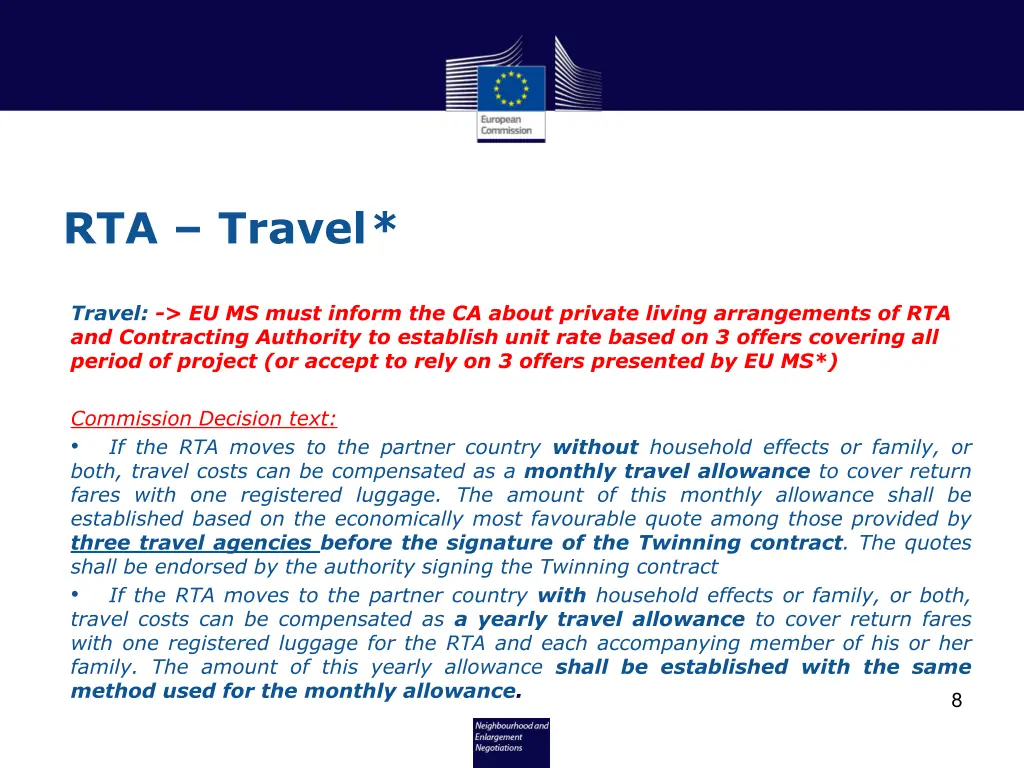
RTA Travel * Travel: -> EU MS must inform the CA about private living arrangements of RTA and Contracting Authority to establish unit rate based on 3 offers covering all period of project (or accept to rely on 3 offers presented by EU MS*) Commission Decision text: If the RTA moves to the partner country without household effects or family, or both, travel costs can be compensated as a monthly travel allowance to cover return fares with one registered luggage. The amount of this monthly allowance shall be established based on the economically most favourable quote among those provided by three travel agencies before the signature of the Twinning contract. The quotes shall be endorsed by the authority signing the Twinning contract If the RTA moves to the partner country with household effects or family, or both, travel costs can be compensated as a yearly travel allowance to cover return fares with one registered luggage for the RTA and each accompanying member of his or her family. The amount of this yearly allowance shall be established with the same method used for the monthly allowance. 8
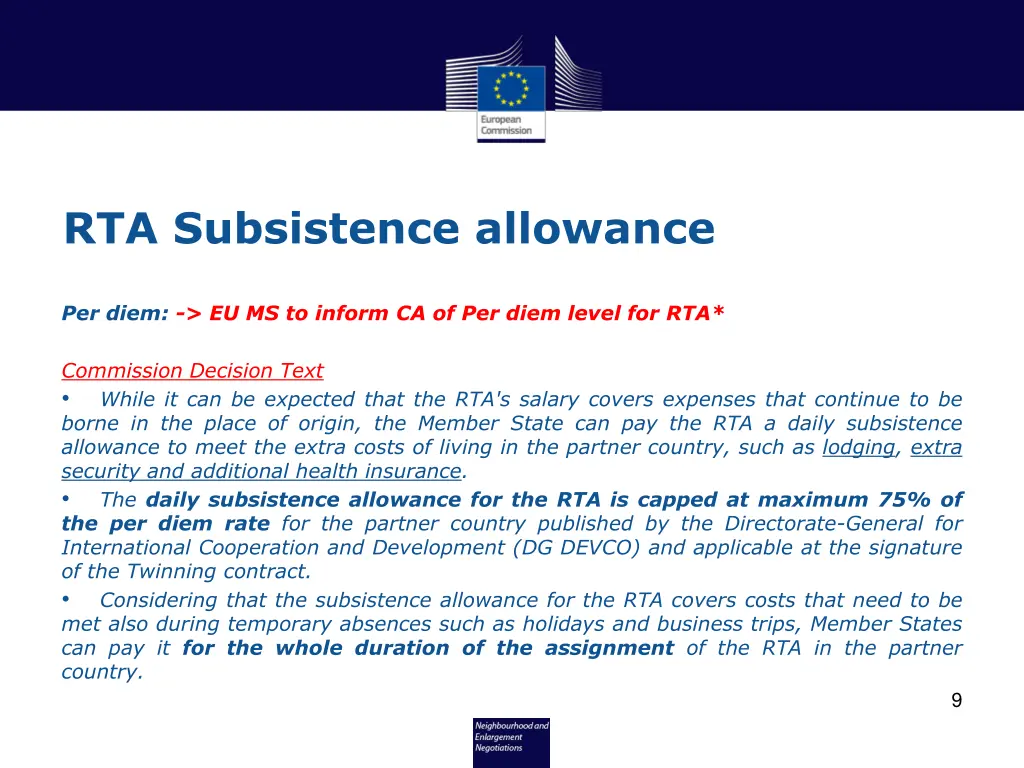
RTA Subsistence allowance Per diem: -> EU MS to inform CA of Per diem level for RTA* Commission Decision Text While it can be expected that the RTA's salary covers expenses that continue to be borne in the place of origin, the Member State can pay the RTA a daily subsistence allowance to meet the extra costs of living in the partner country, such as lodging, extra security and additional health insurance. The daily subsistence allowance for the RTA is capped at maximum 75% of the per diem rate for the partner country published by the Directorate-General for International Cooperation and Development (DG DEVCO) and applicable at the signature of the Twinning contract. Considering that the subsistence allowance for the RTA covers costs that need to be met also during temporary absences such as holidays and business trips, Member States can pay it for the whole duration of the assignment of the RTA in the partner country. 9
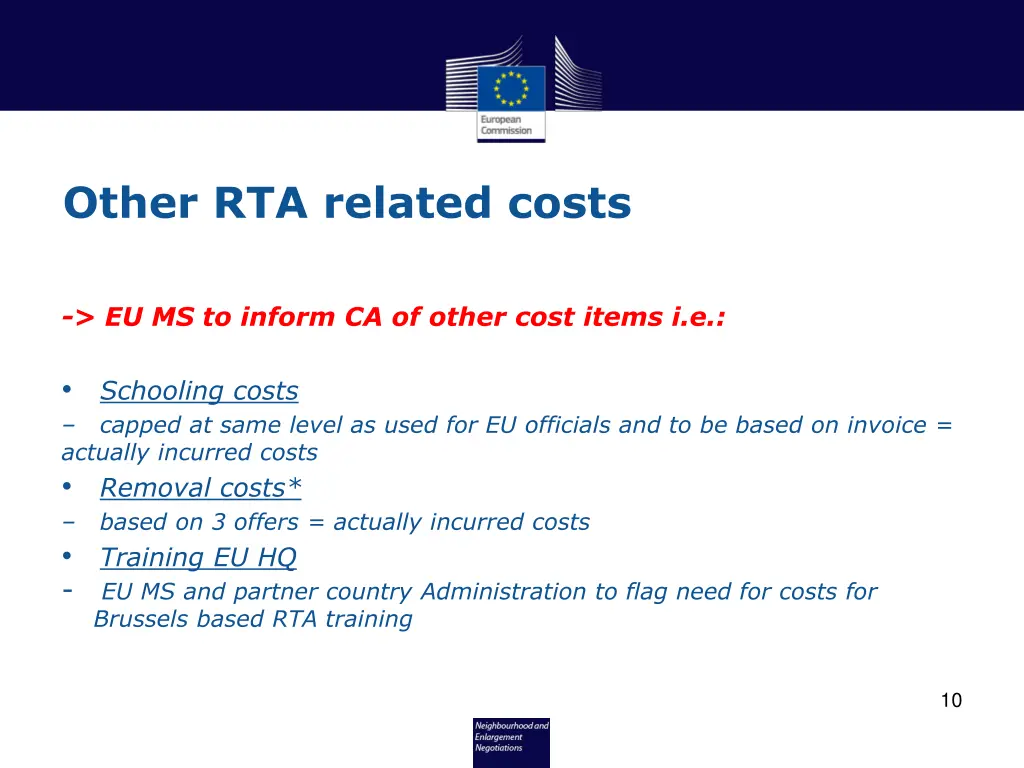
Other RTA related costs -> EU MS to inform CA of other cost items i.e.: capped at same level as used for EU officials and to be based on invoice = actually incurred costs Removal costs* based on 3 offers = actually incurred costs Training EU HQ - EU MS and partner country Administration to flag need for costs for Brussels based RTA training Schooling costs 10
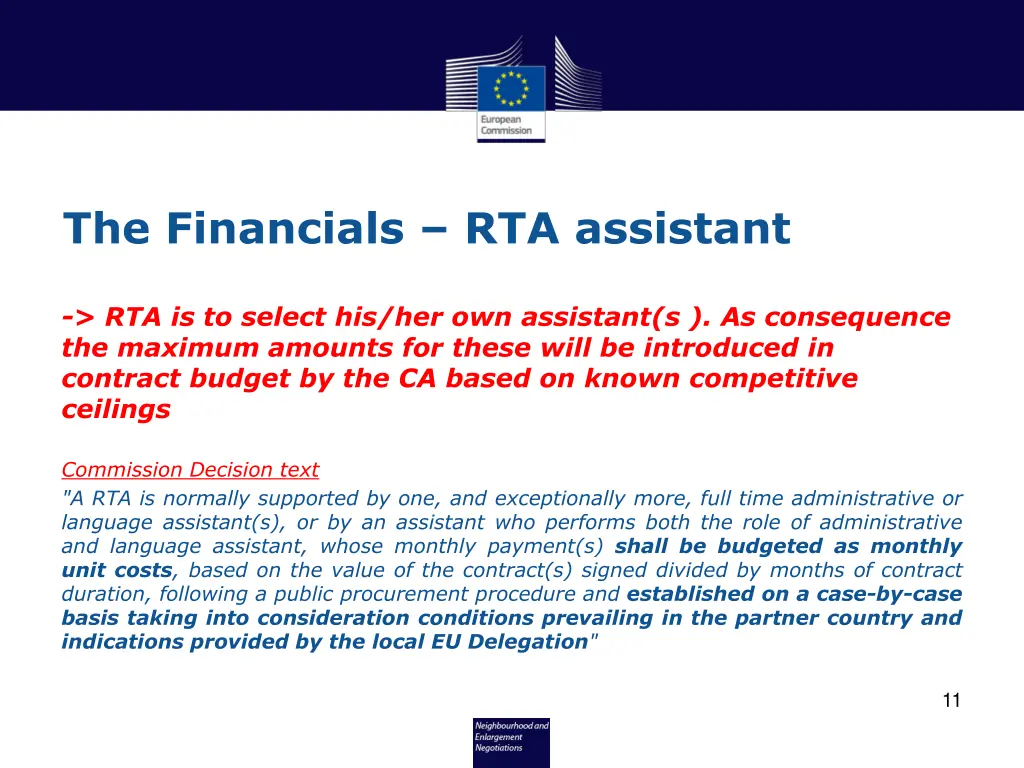
The Financials RTA assistant -> RTA is to select his/her own assistant(s ). As consequence the maximum amounts for these will be introduced in contract budget by the CA based on known competitive ceilings Commission Decision text "A RTA is normally supported by one, and exceptionally more, full time administrative or language assistant(s), or by an assistant who performs both the role of administrative and language assistant, whose monthly payment(s) shall be budgeted as monthly unit costs, based on the value of the contract(s) signed divided by months of contract duration, following a public procurement procedure and established on a case-by-case basis taking into consideration conditions prevailing in the partner country and indications provided by the local EU Delegation" 11
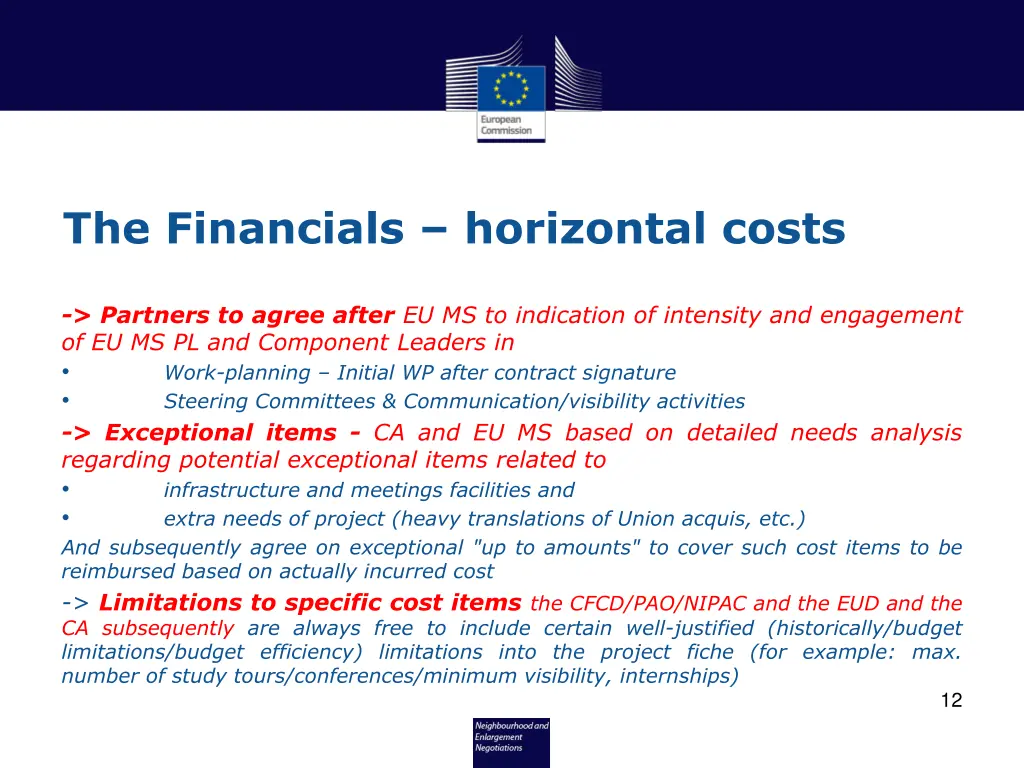
The Financials horizontal costs -> Partners to agree after EU MS to indication of intensity and engagement of EU MS PL and Component Leaders in Work-planning Initial WP after contract signature Steering Committees & Communication/visibility activities -> Exceptional items - CA and EU MS based on detailed needs analysis regarding potential exceptional items related to infrastructure and meetings facilities and extra needs of project (heavy translations of Union acquis, etc.) And subsequently agree on exceptional "up to amounts" to cover such cost items to be reimbursed based on actually incurred cost -> Limitations to specific cost itemsthe CFCD/PAO/NIPAC and the EUD and the CA subsequently are always free to include certain well-justified (historically/budget limitations/budget efficiency) limitations into the project fiche (for example: max. number of study tours/conferences/minimum visibility, internships) 12
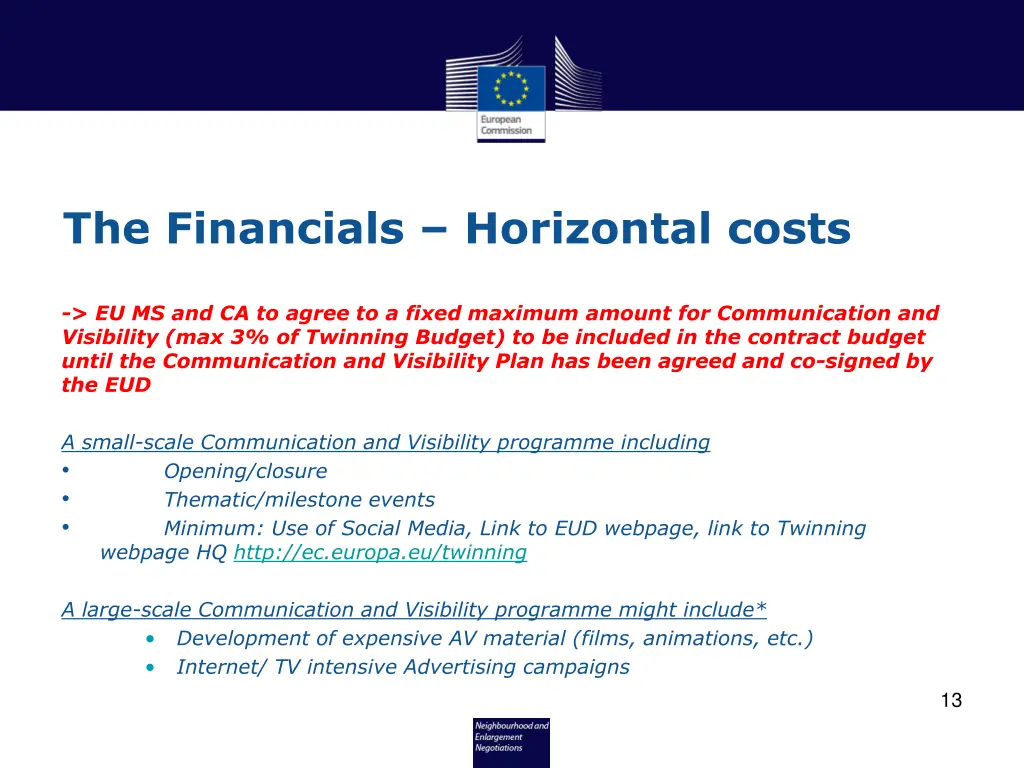
The Financials Horizontal costs -> EU MS and CA to agree to a fixed maximum amount for Communication and Visibility (max 3% of Twinning Budget) to be included in the contract budget until the Communication and Visibility Plan has been agreed and co-signed by the EUD A small-scale Communication and Visibility programme including Opening/closure Thematic/milestone events Minimum: Use of Social Media, Link to EUD webpage, link to Twinning webpage HQ http://ec.europa.eu/twinning A large-scale Communication and Visibility programme might include* Development of expensive AV material (films, animations, etc.) Internet/ TV intensive Advertising campaigns 13
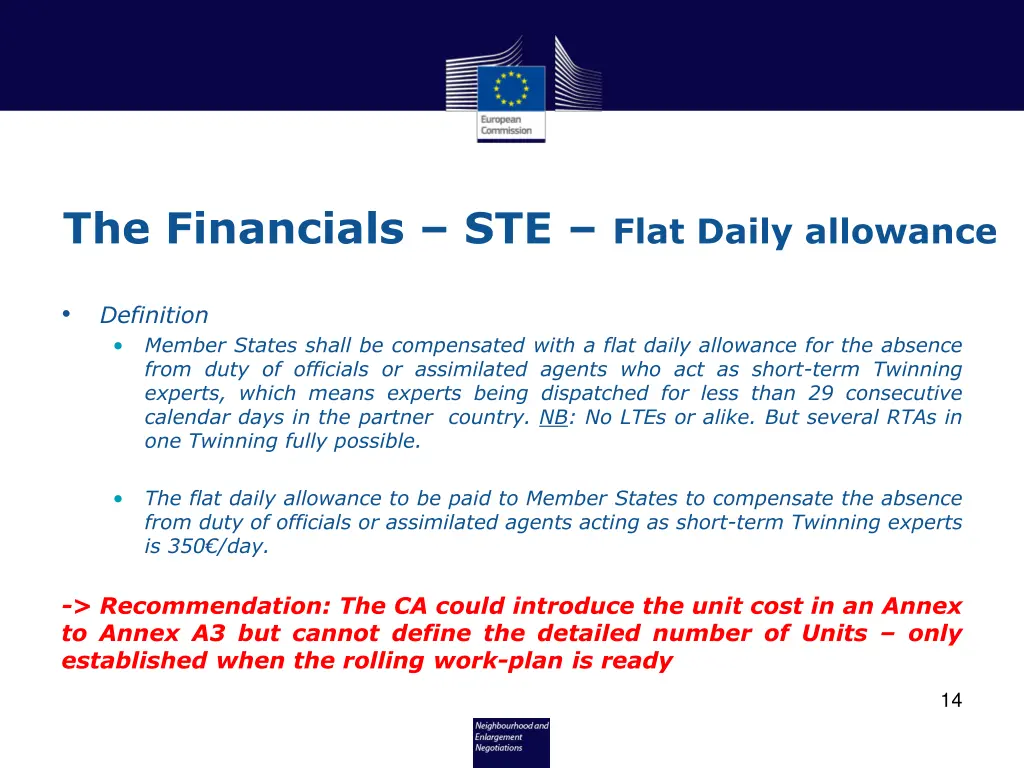
The Financials STE Flat Daily allowance Definition Member States shall be compensated with a flat daily allowance for the absence from duty of officials or assimilated agents who act as short-term Twinning experts, which means experts being dispatched for less than 29 consecutive calendar days in the partner country. NB: No LTEs or alike. But several RTAs in one Twinning fully possible. The flat daily allowance to be paid to Member States to compensate the absence from duty of officials or assimilated agents acting as short-term Twinning experts is 350 /day. -> Recommendation: The CA could introduce the unit cost in an Annex to Annex A3 but cannot define the detailed number of Units only established when the rolling work-plan is ready 14
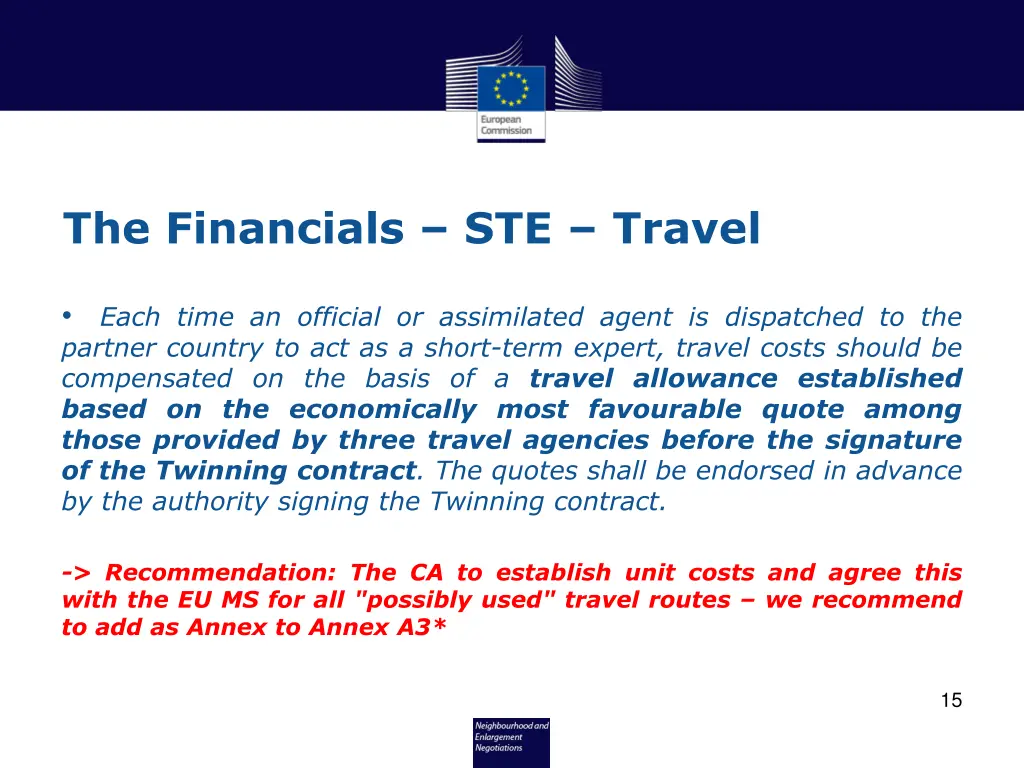
The Financials STE Travel partner country to act as a short-term expert, travel costs should be compensated on the basis of a travel allowance established based on the economically most favourable quote among those provided by three travel agencies before the signature of the Twinning contract. The quotes shall be endorsed in advance by the authority signing the Twinning contract. Each time an official or assimilated agent is dispatched to the -> Recommendation: The CA to establish unit costs and agree this with the EU MS for all "possibly used" travel routes we recommend to add as Annex to Annex A3* 15
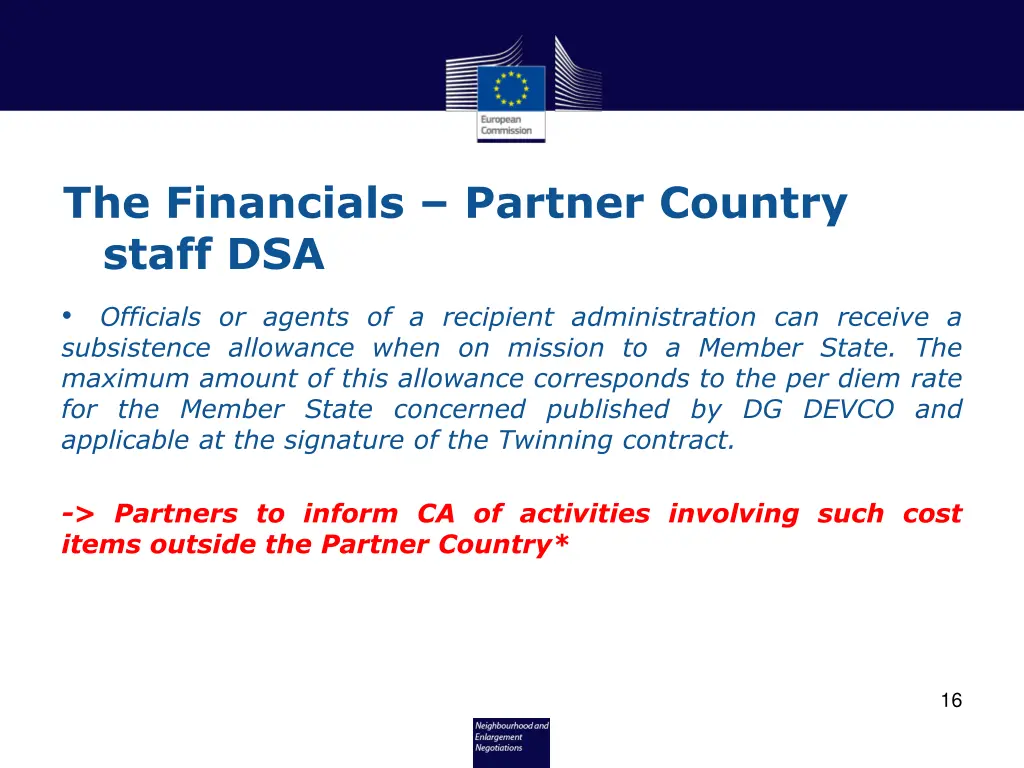
The Financials Partner Country staff DSA subsistence allowance when on mission to a Member State. The maximum amount of this allowance corresponds to the per diem rate for the Member State concerned published by DG DEVCO and applicable at the signature of the Twinning contract. Officials or agents of a recipient administration can receive a -> Partners to inform CA of activities involving such cost items outside the Partner Country* 16
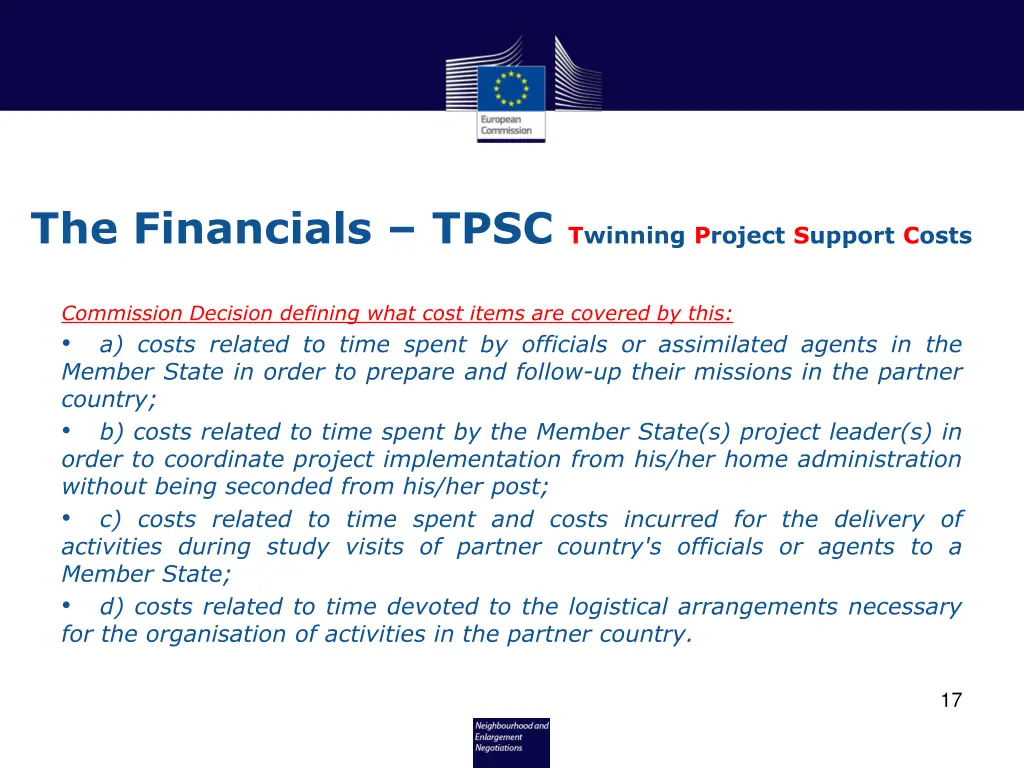
The Financials TPSC Twinning Project Support Costs Commission Decision defining what cost items are covered by this: a) costs related to time spent by officials or assimilated agents in the Member State in order to prepare and follow-up their missions in the partner country; b) costs related to time spent by the Member State(s) project leader(s) in order to coordinate project implementation from his/her home administration without being seconded from his/her post; c) costs related to time spent and costs incurred for the delivery of activities during study visits of partner country's officials or agents to a Member State; d) costs related to time devoted to the logistical arrangements necessary for the organisation of activities in the partner country. 17
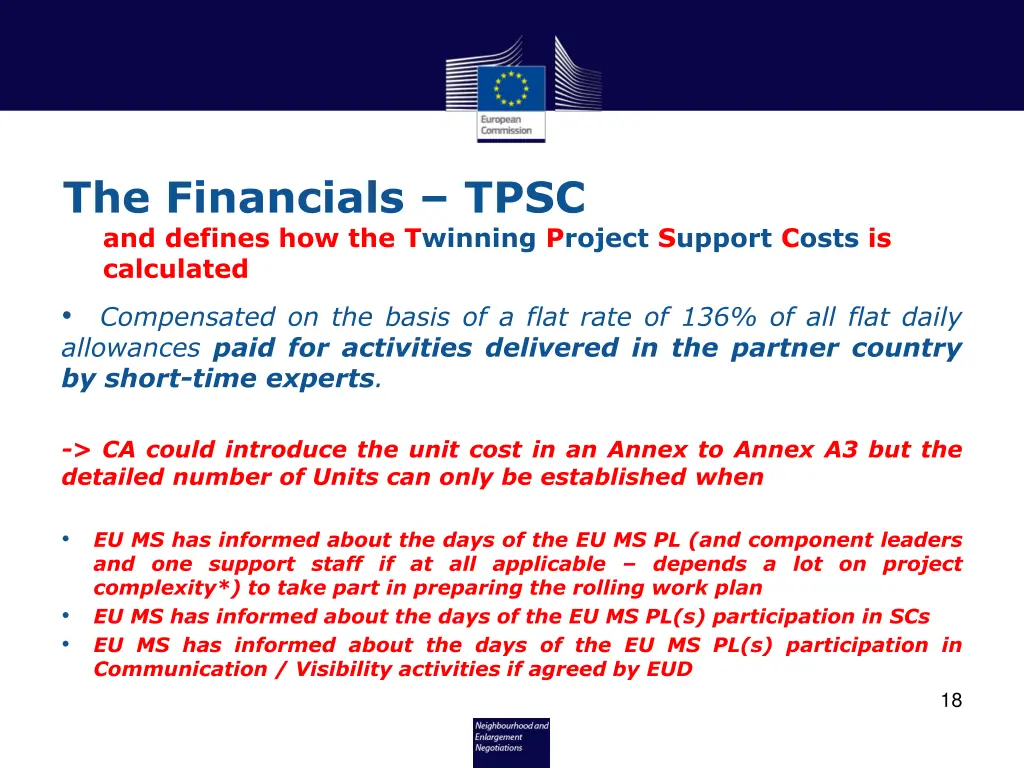
The Financials TPSC and defines how the Twinning Project Support Costs is calculated Compensated on the basis of a flat rate of 136% of all flat daily allowances paid for activities delivered in the partner country by short-time experts. -> CA could introduce the unit cost in an Annex to Annex A3 but the detailed number of Units can only be established when EU MS has informed about the days of the EU MS PL (and component leaders and one support staff if at all applicable depends a lot on project complexity*) to take part in preparing the rolling work plan EU MS has informed about the days of the EU MS PL(s) participation in SCs EU MS has informed about the days of the EU MS PL(s) participation in Communication / Visibility activities if agreed by EUD 18
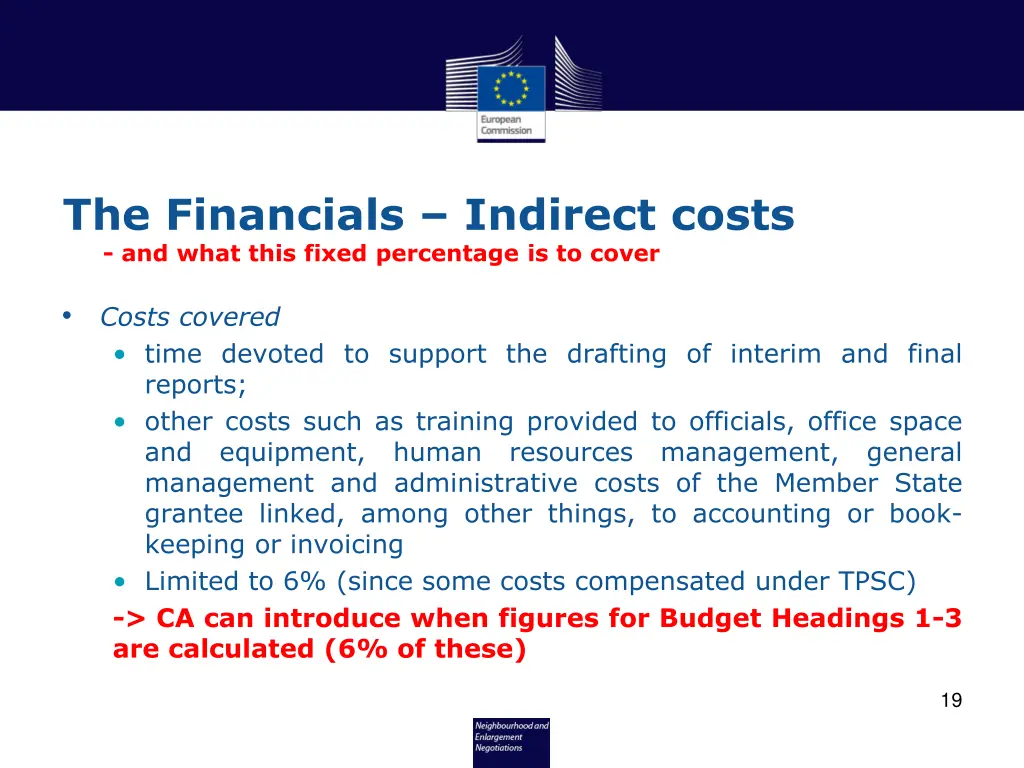
The Financials Indirect costs - and what this fixed percentage is to cover Costs covered time devoted to support the drafting of interim and final reports; other costs such as training provided to officials, office space and equipment, human resources management, general management and administrative costs of the Member State grantee linked, among other things, to accounting or book- keeping or invoicing Limited to 6% (since some costs compensated under TPSC) -> CA can introduce when figures for Budget Headings 1-3 are calculated (6% of these) 19
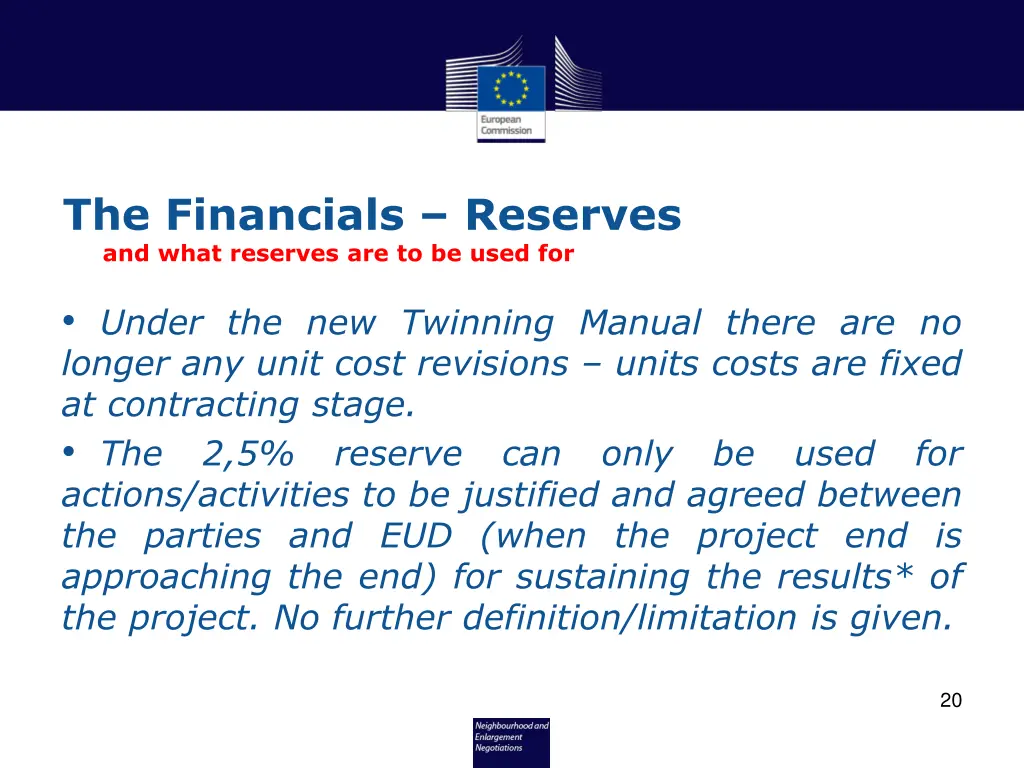
The Financials Reserves and what reserves are to be used for Under the new Twinning Manual there are no longer any unit cost revisions units costs are fixed at contracting stage. The 2,5% reserve can only be used for actions/activities to be justified and agreed between the parties and EUD (when the project end is approaching the end) for sustaining the results* of the project. No further definition/limitation is given. 20
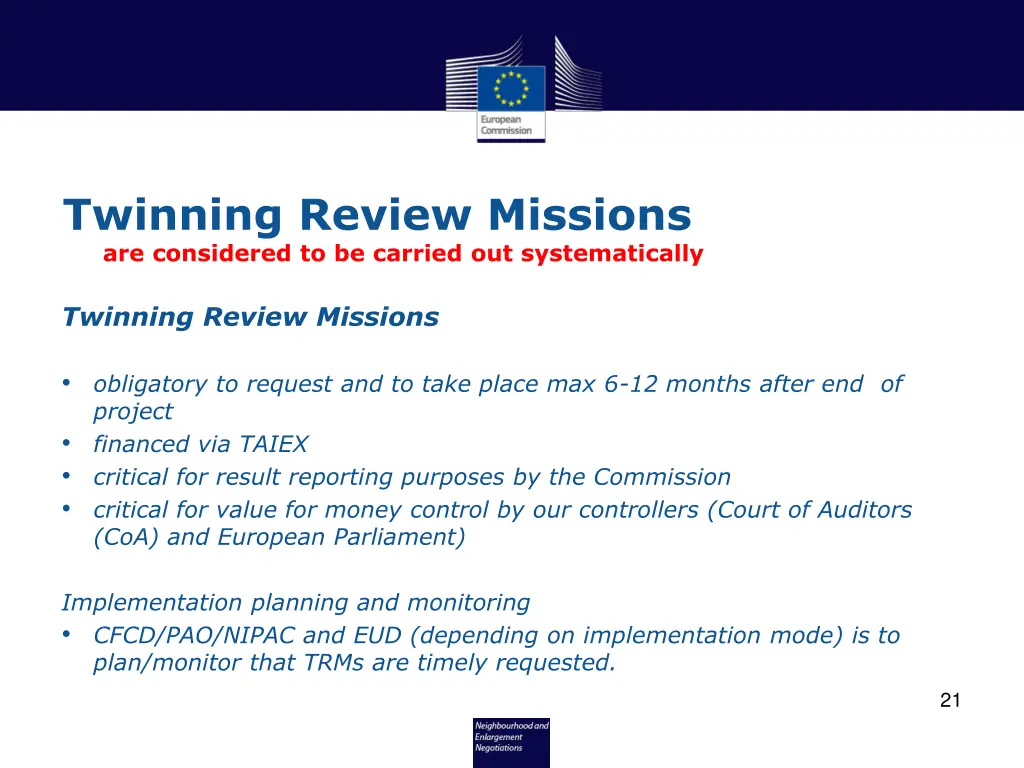
Twinning Review Missions are considered to be carried out systematically Twinning Review Missions obligatory to request and to take place max 6-12 months after end of project financed via TAIEX critical for result reporting purposes by the Commission critical for value for money control by our controllers (Court of Auditors (CoA) and European Parliament) Implementation planning and monitoring CFCD/PAO/NIPAC and EUD (depending on implementation mode) is to plan/monitor that TRMs are timely requested. 21
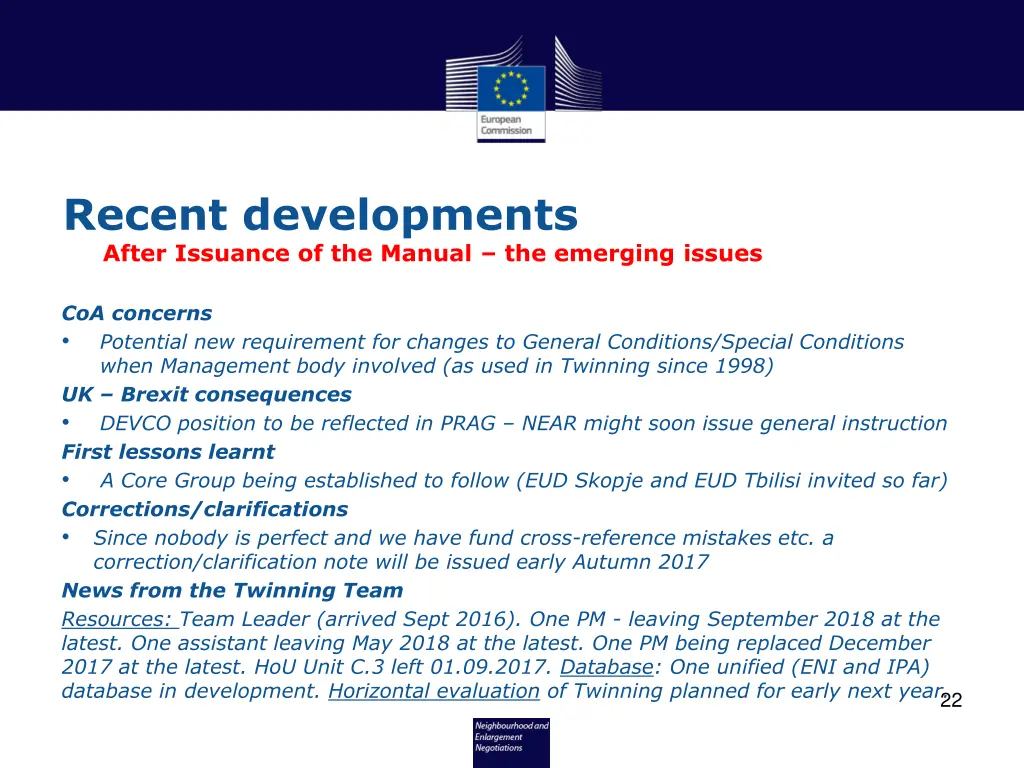
Recent developments After Issuance of the Manual the emerging issues CoA concerns Potential new requirement for changes to General Conditions/Special Conditions when Management body involved (as used in Twinning since 1998) UK Brexit consequences DEVCO position to be reflected in PRAG NEAR might soon issue general instruction First lessons learnt A Core Group being established to follow (EUD Skopje and EUD Tbilisi invited so far) Corrections/clarifications Since nobody is perfect and we have fund cross-reference mistakes etc. a correction/clarification note will be issued early Autumn 2017 News from the Twinning Team Resources: Team Leader (arrived Sept 2016). One PM - leaving September 2018 at the latest. One assistant leaving May 2018 at the latest. One PM being replaced December 2017 at the latest. HoU Unit C.3 left 01.09.2017. Database: One unified (ENI and IPA) database in development. Horizontal evaluation of Twinning planned for early next year.22
THANK YOU INSTITUTION BUILDING ACTIONS LEADING TO SUSTAINABLE CHANGES TAKES TIME AND REQUIRE A CHANGE OF MINDSET OF GOVERNMENTS AND INDIVIDUALS. A BIG THANK YOU FOR YOUR ENGAGEMENT IN MAKING TWINNING A SUCCESS. 23