Airline Safety Management
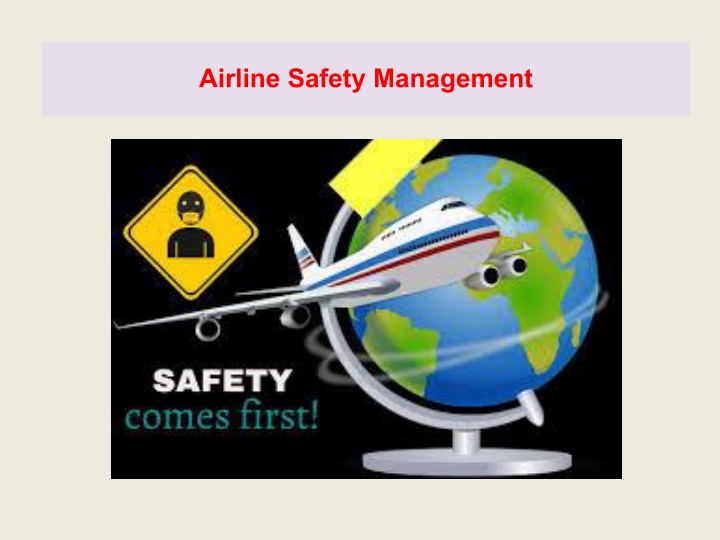
Airline safety management is crucial for ensuring the safety of passengers and flight crews. It involves consistent adherence to standards set by civil aviation authorities to protect lives and promote secure air travel. Effective safety management systems, along with regulatory procedures and audits, play a vital role in maintaining high safety standards in aviation. Understanding the objectives of the International Civil Aviation Organization (ICAO) and the essential standards helps to foster a secure and economically sustainable aviation environment.

Download Presentation

Please find below an Image/Link to download the presentation.
The content on the website is provided AS IS for your information and personal use only. It may not be sold, licensed, or shared on other websites without obtaining consent from the author.If you encounter any issues during the download, it is possible that the publisher has removed the file from their server.
You are allowed to download the files provided on this website for personal or commercial use, subject to the condition that they are used lawfully. All files are the property of their respective owners.
The content on the website is provided AS IS for your information and personal use only. It may not be sold, licensed, or shared on other websites without obtaining consent from the author.
E N D
Presentation Transcript
Outlines Safety Management System basics List of Civil Aviation Authorities Acronyms and definition The concepts of safety The evaluation of safety
Why airline safety is important?
Why Aviation Safety is so important ? To keep passengers and flight crew safe while flying, Safety always comes first. Aviation safety is important because there are lives involve in every operation of aircraft. Safety must be number one priority for any airlines in all aspect of air transportation. Due to poor safety management in aviation not only damages associated with a single airplane crash but loss of many valuable human life.
Standards in Civil Aviation is very necessary in order to make safe air transportation. Standardization brings quality and healthy environments to achieve the highest level of safety. Standards can be achieved by following proper regulatory procedures.
The civil aviation authorities of state always audits of concern organizations to keep these standards up. ICAO is the overall leader of all state government aviation authorities.
The objectives of the ICAO is to keep the aviation standard up and maintain aviation safety. It sets the international civil aviation Standards and Recommended Practices (SARPs) and policies to support efficient, safe, secure, and economically sustainable civil aviation sector worldwide.
List of Civil Aviation Authorities International Civil Aviation Organization (ICAO) Federal Aviation Administration (FAA) European Aviation Safety Agency (EASA) Civil Aviation Safety Authority (CASA), Australia Transport Canada (TC)
List of Civil Aviation Authorities (cont.) Civil Aviation Administration of China (CAAC) Civil Aviation Authority of Singapore (CAAS) Civil Aviation Authority of Thailand (CAAT) .
Acronyms Acronyms 1 1 AOC AOG ATC ATM CAA CEO Air operator certificate Aircraft on ground Air traffic control Air traffic management Civil aviation Chief executive officer
Acronyms 2 Acronyms 2 ERP H HF IATA Emergency response plan Hazard Human factors International Air Transport Association International Civil Aviation Organization Minimum equipment list Not applicable ICAO MEL N/A
Acronyms Acronyms 3 3 QA QC SA SARPs Quality assurance Quality control Safety assurance Standards and Recommended Practices (ICAO) Safety management system(s) Standard operating procedures SMS SOPs
Acronyms Acronyms 4 4 SRM TBD TOR UE USOAP Safety risk management To be determined Terms of reference Unsafe event Universal Safety Oversight Audit Program (ICAO) Work in progress WIP
DEFINITIONS 1 Errors: An action or inaction by an operational person that leads to deviations from organizational or the operational person s intentions or expectations Risk mitigation: The process of incorporating defenses or preventive controls to lower the severity and/or likelihood of a hazard s projected consequence
DEFINITIONS DEFINITIONS 2 2 Safety risk: The predicted probability and severity of the consequences or outcomes of a hazard. Risk mitigation. Safety management system: A systematic approach to managing safety, including the necessary organizational structures, accountabilities, policies and procedures.
What is Safety? What is Safety?
Safety is? Safety is? Zero accidents or serious incidents Error avoidance Freedom from hazard ( those factors which cause or are likely to cause harm )
Safety is? Safety is? The absence of undesired outcomes, effects on People Asset/ Equipment Reputation Freedom from the unacceptable risk of harm to individuals and business
Concept of safety (ICAO) Safety is the state in which the risk of harm to persons or property damage is reduced to, and maintained at or below, an acceptable level through a continuing process of hazard identification and risk management. Safety = How well risk is managed.
THE EVOLUTION OF SAFETY THE EVOLUTION OF SAFETY The history of the progress in aviation safety can be divided into three eras. 1) The technical era from the early 1900s until the late 1960s. Aviation emerged as a form of mass transportation in which safety deficiencies were related to technical factors and technological failures. The focus of safety endeavors was placed on the investigation and improvement of technical factors.
THE EVOLUTION OF SAFETY THE EVOLUTION OF SAFETY 2)The human factors era from the early 1970s until the mid-1990s. In the early 1970s, the aviation accidents was reduced due to technological advances and enhancements to safety regulations. Aviation became a safer mode of transportation, and the focus of safety endeavors was include human factors issues including the man/machine interface. This led to a search for safety information from the earlier accident investigation.
THE EVOLUTION OF SAFETY THE EVOLUTION OF SAFETY 3)The organizational era from the mid-1990s to the present day. Safety began to be viewed from a systemic perspective, which was to encompass organizational factors in addition to human and technical factors. As a result, the organizational accident was introduced, considering the impact of organizational culture and policies on the effectiveness of safety risk controls.