Alex Tabarrok: A Look into the Respected Economist's Insightful Work

Embark on a journey through the notable contributions of economist Alex Tabarrok. Delve into his research and teachings that have left a lasting impact on the field of economics. Explore Tabarrok's unique perspective on various economic issues and gain a deeper understanding of his innovative ideas. Discover why he is considered a thought leader in the realm of economics and how his work continues to shape discussions in the academic and policy spheres.

Uploaded on Feb 20, 2025 | 4 Views
Download Presentation

Please find below an Image/Link to download the presentation.
The content on the website is provided AS IS for your information and personal use only. It may not be sold, licensed, or shared on other websites without obtaining consent from the author.If you encounter any issues during the download, it is possible that the publisher has removed the file from their server.
You are allowed to download the files provided on this website for personal or commercial use, subject to the condition that they are used lawfully. All files are the property of their respective owners.
The content on the website is provided AS IS for your information and personal use only. It may not be sold, licensed, or shared on other websites without obtaining consent from the author.
E N D
Presentation Transcript
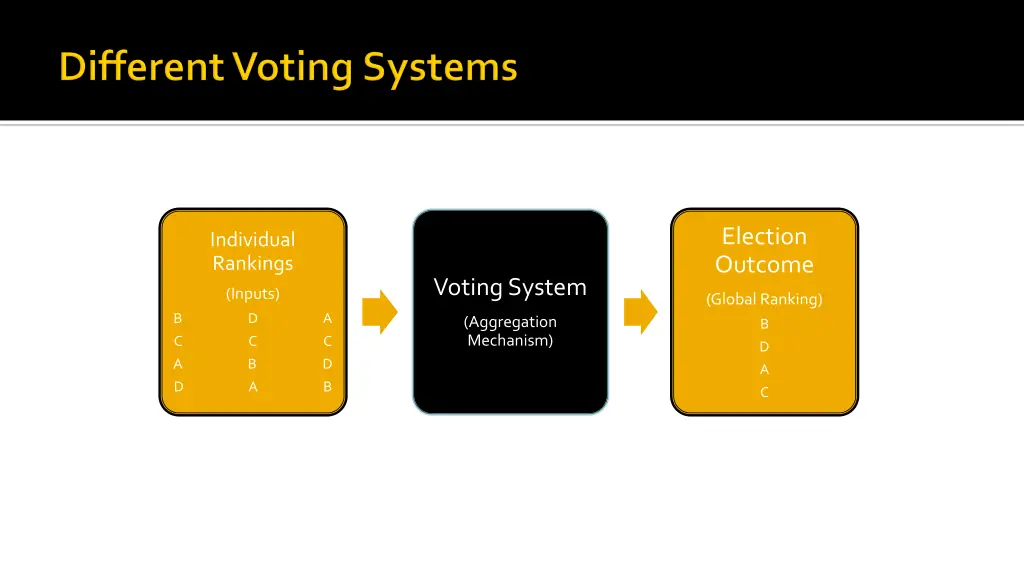
Election Outcome Individual Rankings Voting System (Inputs) (Global Ranking) B D A (Aggregation Mechanism) B C C C D A B D A D A B C
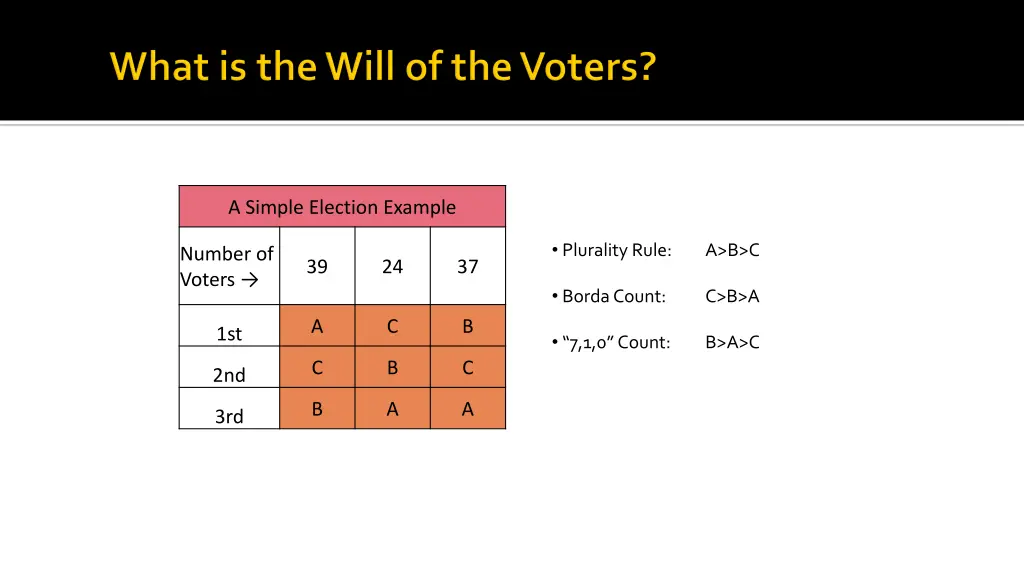
A Simple Election Example Plurality Rule: A>B>C Number of Voters 39 24 37 Borda Count: C>B>A A C B 1st 7,1,0 Count: B>A>C C B C 2nd B A A 3rd
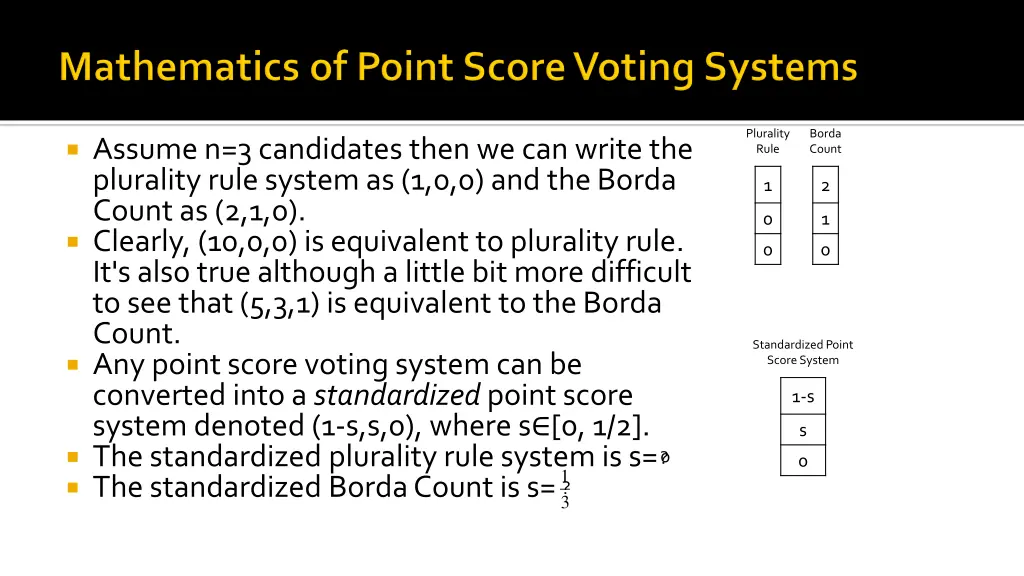
Plurality Rule Borda Count Assume n=3 candidates then we can write the plurality rule system as (1,0,0) and the Borda Count as (2,1,0). Clearly, (10,0,0) is equivalent to plurality rule. It's also true although a little bit more difficult to see that (5,3,1) is equivalent to the Borda Count. Any point score voting system can be converted into a standardized point score system denoted (1-s,s,0), where s [0, 1/2]. The standardized plurality rule system is s= The standardized Borda Count is s= 1 2 0 1 0 0 Standardized Point Score System 1-s s 0 ? 0 1 3 ?
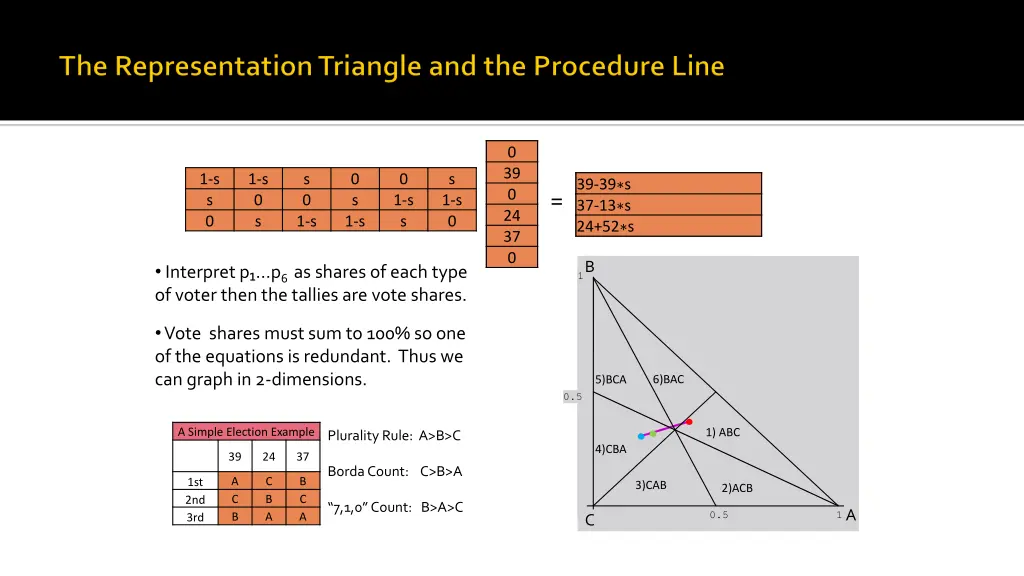
A voter may rank three candidates in any one of six possible ways. The vote matrix can be read in two ways. Reading down a particular column we see the number of points given to each candidate from a voter with the ranking indicated by that column. Reading across the rows we see where a candidate's votes come from. We will write the number of voters with ranking (1) ABC as p the number of voters with ranking (2) ACB as p and so forth up until p . We can place all this information in matrix form by multiplying the vote matrix with the voter type matrix. ABC 1-s s 0 ACB 1-s 0 s CAB s 0 1-s CBA 0 s 1-s BCA 0 1-s s BAC s 1-s 0 A B C p (ABC) p (ACB) p (CAB) p (CBA) p (BCA) p (BAC) A s tally B s tally C s tally 1-s s 0 1-s 0 s s 0 0 s 0 s = 1-s S 1-s 0 1-s 1-s
p =0 (ABC) p =39 (ACB) p =0 (CAB) p =24 (CBA) p =37 (BCA) p =0 (BAC) A Simple Election Example 39 24 37 A C B C B A B C A 1st 2nd 3rd 0 39 0 24 37 0 39 37 24 1 0 0 1 0 0 0 0 1 0 0 1 0 1 0 0 1 0 Plurality Rule = 0 39 0 24 37 0 26 2/3 1/3 0 2/3 0 1/3 1/3 0 2/3 0 0 1/3 2/3 0 Borda Count = 32.66 41.33 1/3 2/3 2/3 1/3
0 39 0 24 37 p p p p p p 0 1-s s 0 1-s 0 s s 0 0 s 0 s 39-39 s 37-13 s p +p +(-p -p +p +p ) s p +p +(p -p +p -p ) s p +p +(p -p -p +p ) s 24+52 s = 1-s s 1-s 0 1-s 1-s 1B Interpret p p6 as shares of each type of voter then the tallies are vote shares. Vote shares must sum to 100% so one of the equations is redundant. Thus we can graph in 2-dimensions. 6)BAC 5)BCA 0.5 A Simple Election Example 1) ABC Plurality Rule: A>B>C 4)CBA 39 24 37 Borda Count: C>B>A A C B C B A B C A 1st 2nd 3rd 3)CAB 2)ACB 7,1,0 Count: B>A>C 1A 0.5 C
Maximum Outcomes from One Ranking Intuition for these results comes from the geometry of the procedure line extended to higher dimensions. Max. Outcomes from 1 Ranking _____________ Total Outcomes 0.5 0.66 0.75 0.8 0.833 0.857 0.875 0.888 0.9 1-(1/n) Max. Outcomes from 1 Ranking 1 4 18 96 600 4320 35,280 322,560 3,265,920 n!-(n-1)! Candidates Outcomes 2 3 4 5 6 7 8 9 10 n 2 6 24 120 720 5040 40,320 362,880 3,628,800 n! 1B 6)BAC 5)BCA 0.5 1) ABC 4)CBA 3)CAB 2)ACB 1A 0.5 C Source: Saari (1992)
For even small electorates (say 50 or more) and 3 candidates a single profile generates: 7 different rankings (including ties) about 6.7 percent of the time 5 different rankings 18.6 percent of the time, 3 different rankings 41.3 percent of the time a single ranking 33.3 percent of the time. A single profile, therefore, generates more than one ranking 66 percent of the time. As the number of candidates increases the probability that all positional voting systems agree on the winner (K=1) quickly goes to zero.
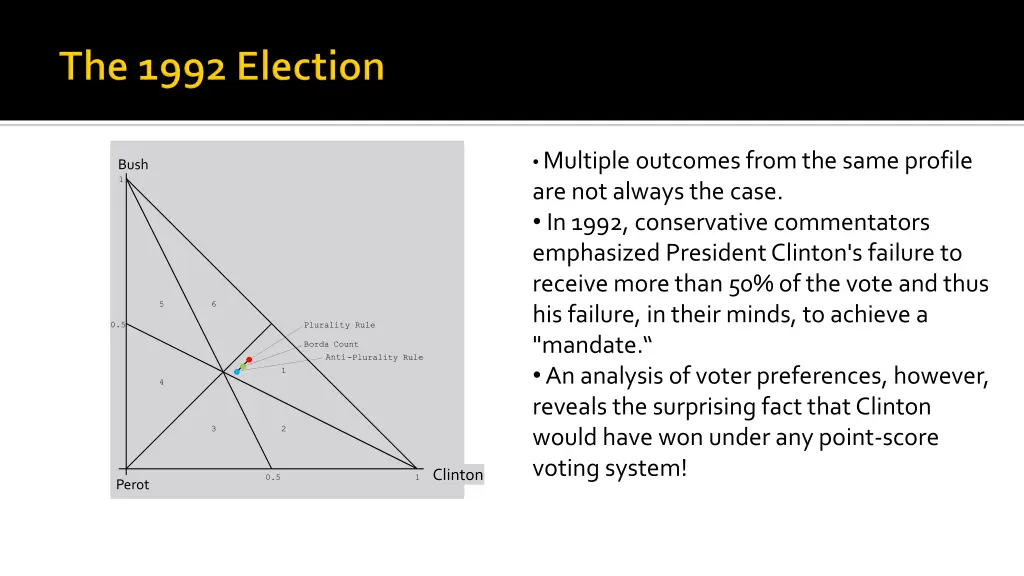
Multiple outcomes from the same profile are not always the case. In 1992, conservative commentators emphasized President Clinton's failure to receive more than 50% of the vote and thus his failure, in their minds, to achieve a "mandate. An analysis of voter preferences, however, reveals the surprising fact that Clinton would have won under any point-score voting system! Bush 1 5 6 0.5 Plurality y Rule Borda Count Anti-Plurality Rule 1 4 3 2 1 Clinton 0.5 Perot
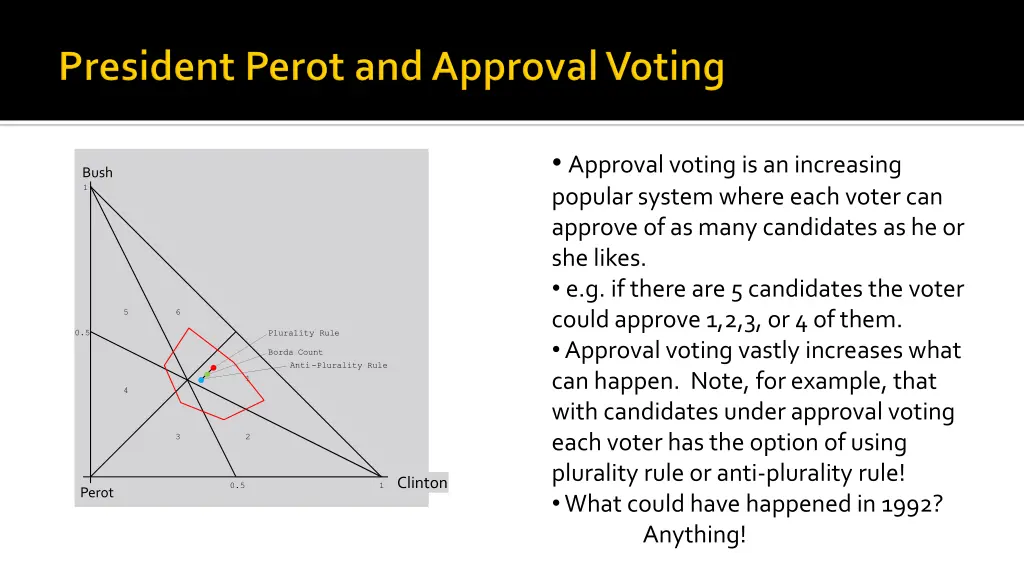
Approval voting is an increasing popular system where each voter can approve of as many candidates as he or she likes. e.g. if there are 5 candidates the voter could approve 1,2,3, or 4 of them. Approval voting vastly increases what can happen. Note, for example, that with candidates under approval voting each voter has the option of using plurality rule or anti-plurality rule! What could have happened in 1992? Anything! Bush 1 5 6 0.5 Plurality y Rule Borda Count Anti-Plurality Rule 1 4 3 2 1 Clinton 0.5 Perot
Group choice is not at all like individual choice. Groups will always choose in ways that would appear irrational if chosen by an individual. The voting system determines the outcome of an election at least as much as do preferences. Voting does not represent the will of the voters. The idea of a group will is incoherent.
Nobel prize winner Amartya Sen has argued that: No famine has ever taken place in the history of the world in a functioning democracy. Democracies have to win elections and face public criticism, and have strong incentive to undertake measures to avert famines and other catastrophes.
Democratic Peace democracies rarely go to war against one another. Capitalist Peace trading countries, countries with private property and capitalist economies rarely go to war against one another. Democratic and capitalist peace are strongly supported in the data and a consensus has developed in the International Relations literature but less consensus on why.
The Growth of Democracy and Economic Freedom 1900-2009 60 70 50 60 Number of Democracies Democracies Free Economies 50 40 40 30 30 Free Economies 20 20 10 10 0 1900 1910 1920 1930 1940 1950 1960 Year 1970 1980 1990 2000 2010 Source: Polity IV, Democracy measured as democ>=8. Economic Freedom of the World 2010, measured as chained summary index>7
Democracies dont kill their own citizens or let them starve. Democracy is compatible with economic freedom -> democratic/capitalist peace. Democracies avoid some very bad possibilities. The threat of throwing politicians out of office is a constraint on what can happen in a democracy. Dictatorships and oligarchies need only not abuse a minority in a democracy the standard is higher. Democracy, however, is not good at representing the will of the voters and in general we should not expect democracy to be a good way of making decisions. Democracy should be seen as a way of limiting or constraining government.