Alfalfa Breeding: Selection and Development for Superior Cultivars
The process of breeding alfalfa cultivars involves phenotypic and genotypic selection, recurrent phenotypic selection, and the development of synthetic cultivars. Selection of superior individuals based on desirable traits leads to the creation of new cultivars with improved characteristics. Synthetic cultivars are developed by intermating superior clones to create a genetically diverse population. This method enhances the genetic variability and resilience of alfalfa cultivars.

Download Presentation

Please find below an Image/Link to download the presentation.
The content on the website is provided AS IS for your information and personal use only. It may not be sold, licensed, or shared on other websites without obtaining consent from the author.If you encounter any issues during the download, it is possible that the publisher has removed the file from their server.
You are allowed to download the files provided on this website for personal or commercial use, subject to the condition that they are used lawfully. All files are the property of their respective owners.
The content on the website is provided AS IS for your information and personal use only. It may not be sold, licensed, or shared on other websites without obtaining consent from the author.
E N D
Presentation Transcript
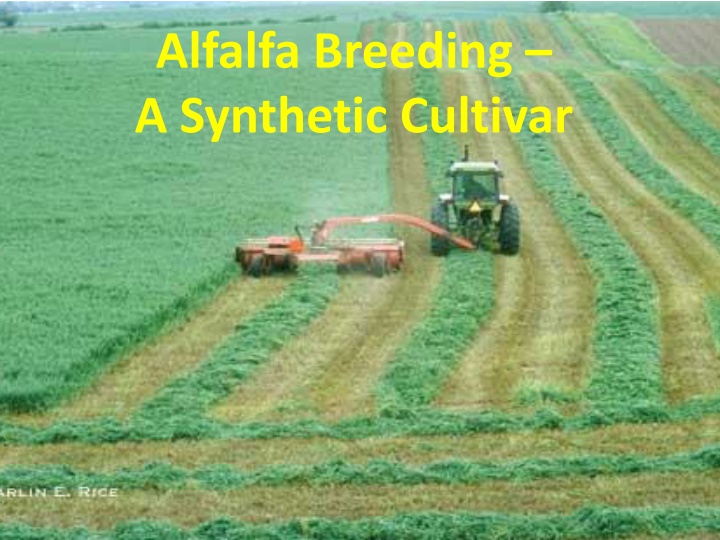
Alfalfa Breeding A Synthetic Cultivar
Selection of Parents Phenotypic Selection: 1. Identify individual clones with desirable phenotype 2. Clonal evaluation with replicated testing of individuals reproduced by vegetative propagation 3. More efficient in traits with high heritability Genotypic Selection: 1. Select superior individuals based on progeny performance and general combining ability using a polycross with other selected clones for pollination 2. Superior to phenotypic selection for traits with low heritability
Recurrent Phenotypic Selection Often used to select for insect and disease resistance in alfalfa Most efficient in highly heritable traits 10,000 Individuals Evaluate Individuals Recombine Select Desirable Individuals Recombine 1,000 Selected Clones 10% Selection Phenotypic Selection
Development of a Synthetic Cultivar 100 superior clones identified = SYN 0 Generation All clones are intermated in isolation cages using insect pollination An equal amount of seed is harvested from each mating and bulked to form the SYN 1 Seed