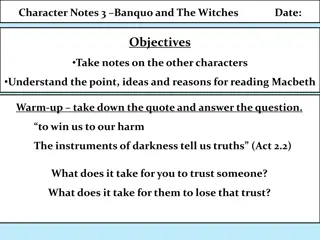
ALL THE MACBETH STUFF

The instability of governance during Shakespeare's time, the importance of the order of succession, and the portrayal of succession struggles through Banquo in Macbeth. Explore the challenges faced by rulers in maintaining power and legitimacy amidst familial disputes and political turmoil.

Download Presentation

Please find below an Image/Link to download the presentation.
The content on the website is provided AS IS for your information and personal use only. It may not be sold, licensed, or shared on other websites without obtaining consent from the author.If you encounter any issues during the download, it is possible that the publisher has removed the file from their server.
You are allowed to download the files provided on this website for personal or commercial use, subject to the condition that they are used lawfully. All files are the property of their respective owners.
The content on the website is provided AS IS for your information and personal use only. It may not be sold, licensed, or shared on other websites without obtaining consent from the author.
E N D
Presentation Transcript
ALL THE MACBETH STUFF (YAY! SO EXCITING!)
Unstable Government Many of Shakespeare s plays are about Kings and Queens who struggle to hold onto their power or have it taken from them, because, during Shakespeare s time, when a ruler died or was overthrown, the whole country would go through a period of chaos until the new government settled in. HOW DID SUCCESSION WORK? The ruler of England had absolute power only because they were chosen by God, so if a ruler couldn t prove that they were the rightful King/Queen, they were vulnerable to rebellions from the people and other wealthy noblemen. English Government During this time in history, the throne was passed down from parent to child (firstborn son). If a ruler didn t have a son, OR if they didn t have children at all, the closest male blood relative would inherit the throne. Potential problems: If a ruler had more than one son, sometimes the brothers fought with or killed each other over the Crown. If there were no sons, male relatives would often fight with/kill each other over the Crown.
Why is the order of succession important? During Shakespeare s time, the Queen of England was Elizabeth I. She did not have any children, so her nephew, James I, became king of England. Queen Elizabeth & James I James I was from Scotland, and there were a lot of people who doubted his claim to the throne, because Queen Elizabeth s family tree was pretty complicated. Because of this, James was very sensitive about the subject of his legitimacy
Banquo in real life Banquo was a Scottish king, who lived and died long before James I was born. James claimed to be Banquo s descendant. Banquo in the play James I & Macbeth Shakespeare s play Macbeth is about a Scottish man (Macbeth) who murders his king in order to take the Crown for himself. This would have been extremely shocking to Shakespeare s audience it would be seen as evil, as an act of defiance against God. It would immediately make Macbeth the villain. In the play, there is a character named Banquo, who ends up becoming king after Macbeth is defeated. Banquo doesn t take the power for himself. Instead, the audience learns that it is Banquo s destiny to become king. Shakespeare does this on purpose, to make James I and his family look good since they claim to be descendants of the historical Banquo. Also, Shakespeare uses Macbeth as a foil to James I. By portraying Macbeth as an evil villain, Shakespeare makes James I look better in contrast.