This research article discusses the effectiveness of seeding strategies for viral marketing in the era of social media, highlighting the shift from traditional marketing methods to leveraging the power of personal communications in social networks. The study emphasizes the importance of content, willingness to share, social network structure, and strategic seeding in maximizing the impact of viral marketing campaigns.
Please find below an Image/Link to download the presentation.
The content on the website is provided AS IS for your information and personal use only. It may not be sold, licensed, or shared on other websites without obtaining consent from the author. If you encounter any issues during the download, it is possible that the publisher has removed the file from their server.
You are allowed to download the files provided on this website for personal or commercial use, subject to the condition that they are used lawfully. All files are the property of their respective owners.
The content on the website is provided AS IS for your information and personal use only. It may not be sold, licensed, or shared on other websites without obtaining consent from the author.
E N D
Presentation Transcript
Social Contagion An Empirical Comparison of Seeding Strategies for Viral Marketing Hinz, Oliver / Skiera, Bernd / Barrot, Christian / Becker, Jan U. (2011), "An Empirical Comparison of Seeding Strategies for Viral Marketing", Journal of Marketing, 75 (November), 55-71 Oliver Hinz TU Darmstadt University of Frankfurt Bernd Skiera Christian Barrot & Jan U. Becker K hne Logistics University, Hamburg
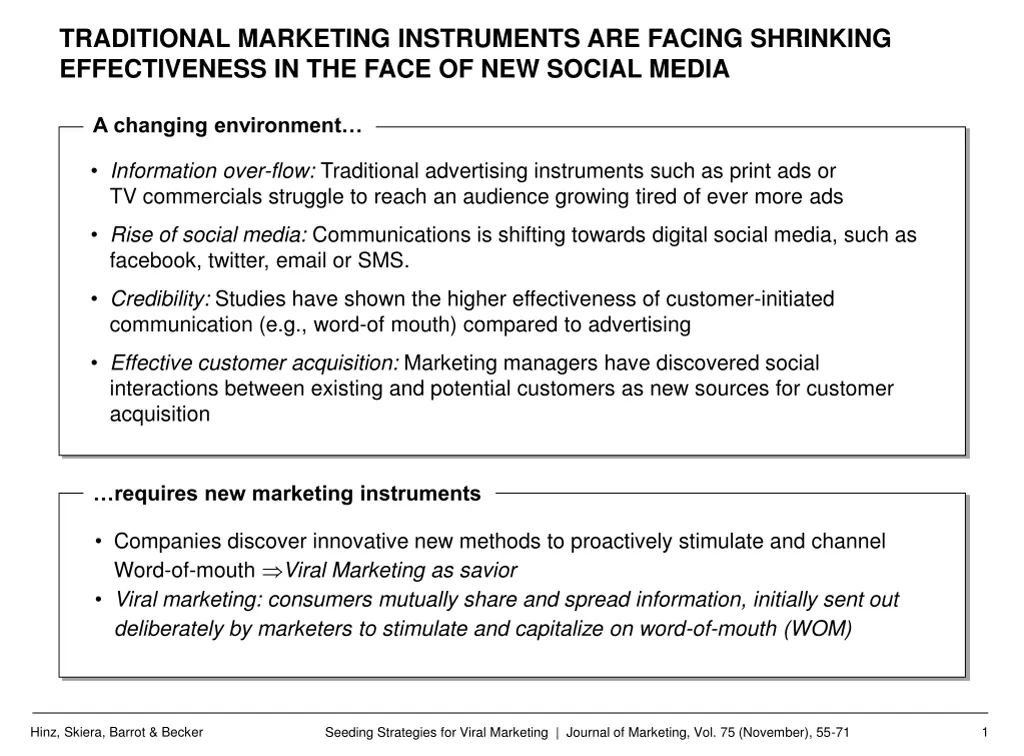
TRADITIONAL MARKETING INSTRUMENTS ARE FACING SHRINKING EFFECTIVENESS IN THE FACE OF NEW SOCIAL MEDIA A changing environment Information over-flow: Traditional advertising instruments such as print ads or TV commercials struggle to reach an audience growing tired of ever more ads Rise of social media: Communications is shifting towards digital social media, such as facebook, twitter, email or SMS. Credibility: Studies have shown the higher effectiveness of customer-initiated communication (e.g., word-of mouth) compared to advertising Effective customer acquisition: Marketing managers have discovered social interactions between existing and potential customers as new sources for customer acquisition requires new marketing instruments Companies discover innovative new methods to proactively stimulate and channel Word-of-mouth Viral Marketing as savior Viral marketing: consumers mutually share and spread information, initially sent out deliberately by marketers to stimulate and capitalize on word-of-mouth (WOM) Hinz, Skiera, Barrot & Becker 1 Seeding Strategies for Viral Marketing | Journal of Marketing, Vol. 75 (November), 55-71
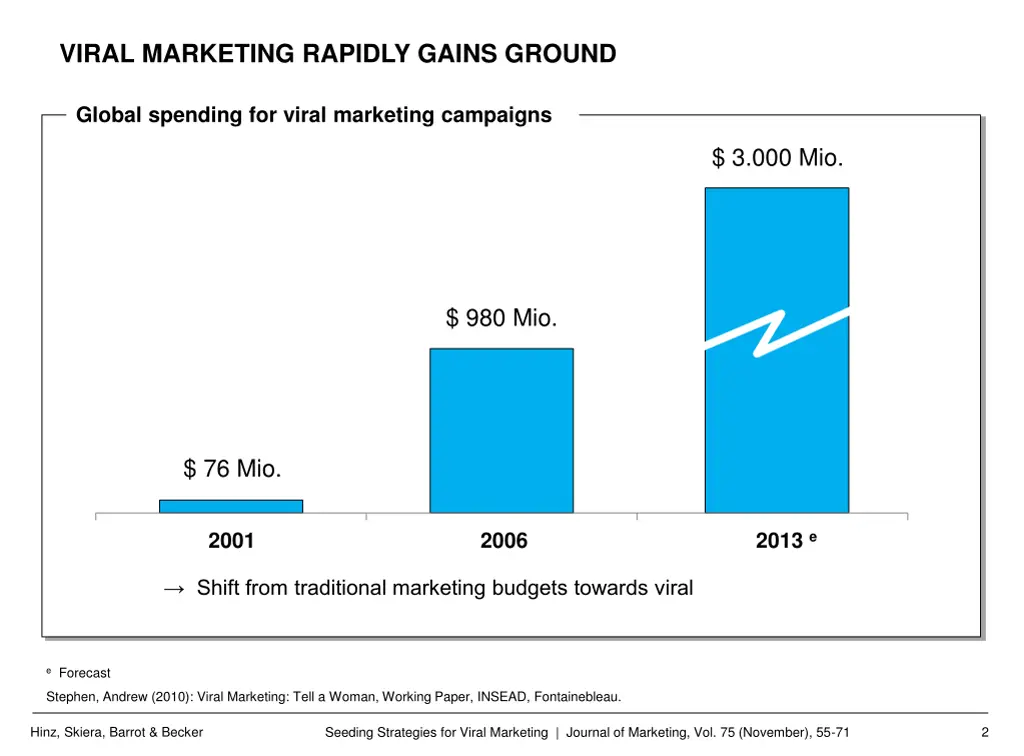
VIRAL MARKETING RAPIDLY GAINS GROUND Global spending for viral marketing campaigns $ 3.000 Mio. $ 980 Mio. $ 76 Mio. 2001 2006 2013 e Shift from traditional marketing budgets towards viral e Forecast Stephen, Andrew (2010): Viral Marketing: Tell a Woman, Working Paper, INSEAD, Fontainebleau. Hinz, Skiera, Barrot & Becker 2 Seeding Strategies for Viral Marketing | Journal of Marketing, Vol. 75 (November), 55-71
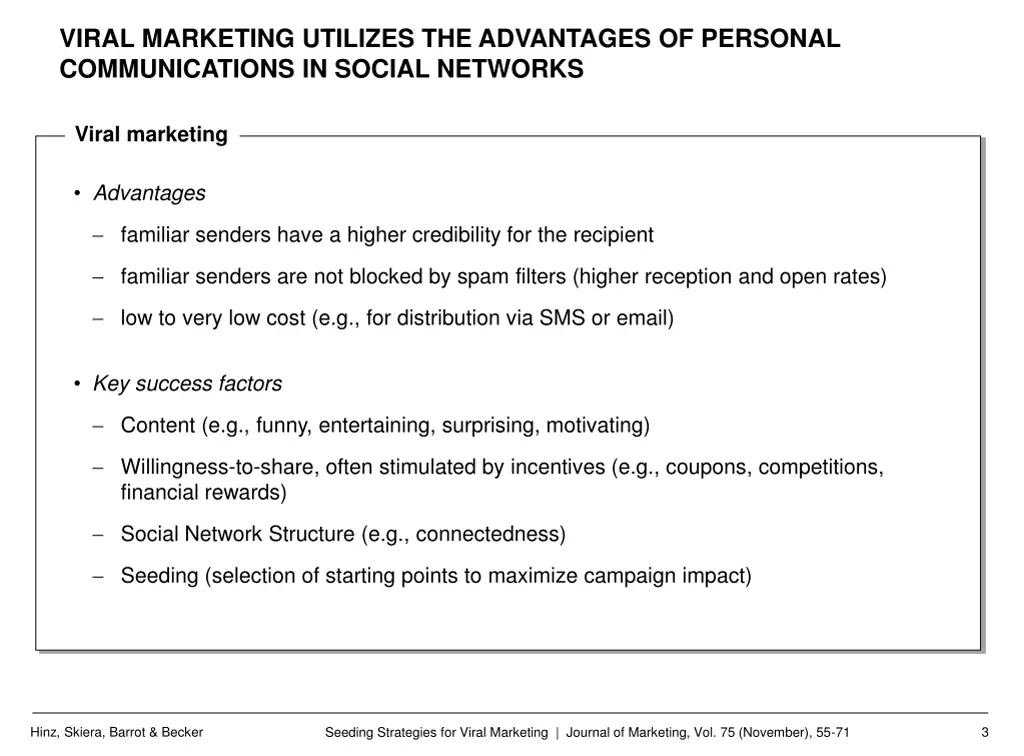
VIRAL MARKETING UTILIZES THE ADVANTAGES OF PERSONAL COMMUNICATIONS IN SOCIAL NETWORKS Viral marketing Advantages familiar senders have a higher credibility for the recipient familiar senders are not blocked by spam filters (higher reception and open rates) low to very low cost (e.g., for distribution via SMS or email) Key success factors Content (e.g., funny, entertaining, surprising, motivating) Willingness-to-share, often stimulated by incentives (e.g., coupons, competitions, financial rewards) Social Network Structure (e.g., connectedness) Seeding (selection of starting points to maximize campaign impact) Hinz, Skiera, Barrot & Becker 3 Seeding Strategies for Viral Marketing | Journal of Marketing, Vol. 75 (November), 55-71
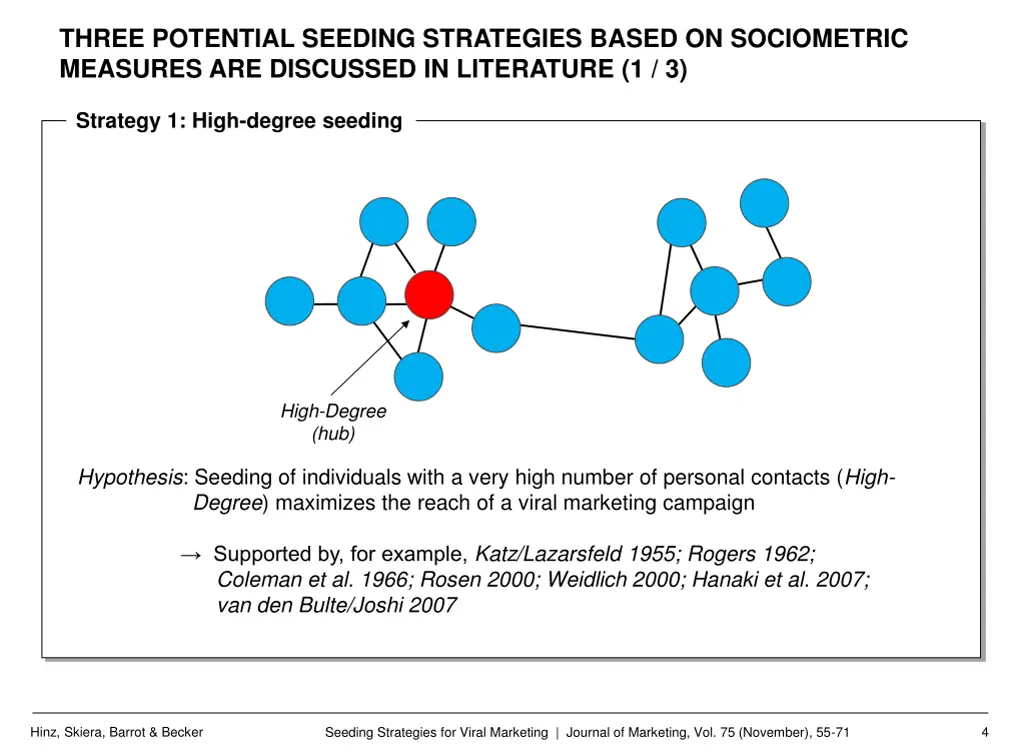
THREE POTENTIAL SEEDING STRATEGIES BASED ON SOCIOMETRIC MEASURES ARE DISCUSSED IN LITERATURE (1 / 3) Strategy 1: High-degree seeding High-Degree (hub) Hypothesis: Seeding of individuals with a very high number of personal contacts (High- Degree) maximizes the reach of a viral marketing campaign Supported by, for example, Katz/Lazarsfeld 1955; Rogers 1962; Coleman et al. 1966; Rosen 2000; Weidlich 2000; Hanaki et al. 2007; van den Bulte/Joshi 2007 Hinz, Skiera, Barrot & Becker 4 Seeding Strategies for Viral Marketing | Journal of Marketing, Vol. 75 (November), 55-71
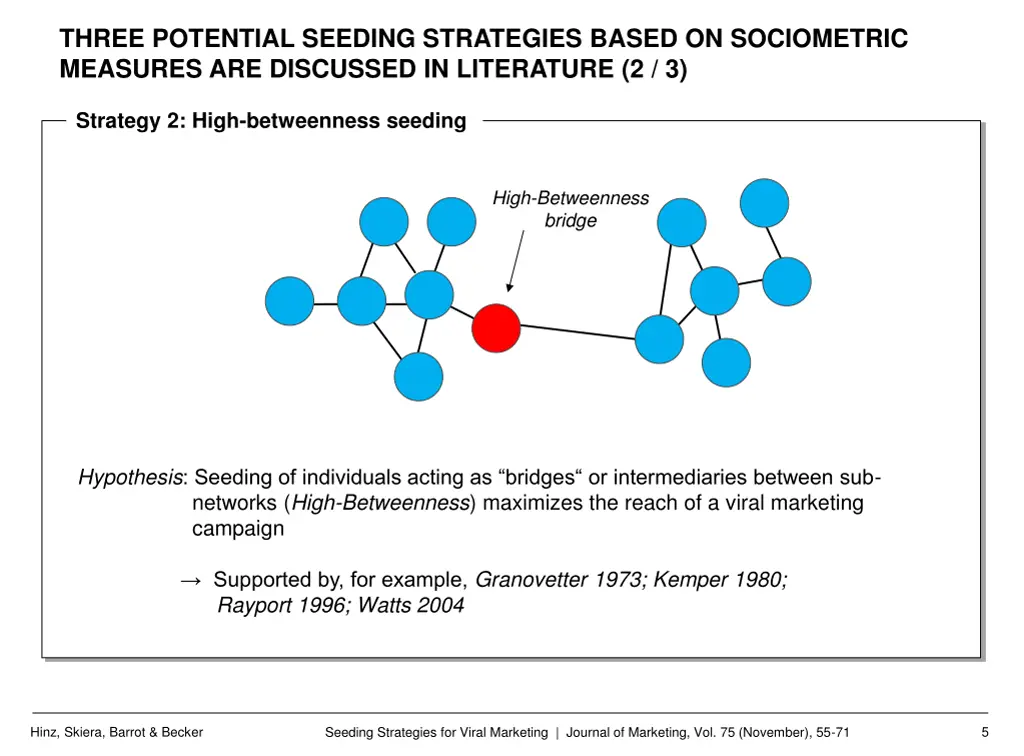
THREE POTENTIAL SEEDING STRATEGIES BASED ON SOCIOMETRIC MEASURES ARE DISCUSSED IN LITERATURE (2 / 3) Strategy 2: High-betweenness seeding High-Betweenness bridge Hypothesis: Seeding of individuals acting as bridges or intermediaries between sub- networks (High-Betweenness) maximizes the reach of a viral marketing campaign Supported by, for example, Granovetter 1973; Kemper 1980; Rayport 1996; Watts 2004 Hinz, Skiera, Barrot & Becker 5 Seeding Strategies for Viral Marketing | Journal of Marketing, Vol. 75 (November), 55-71
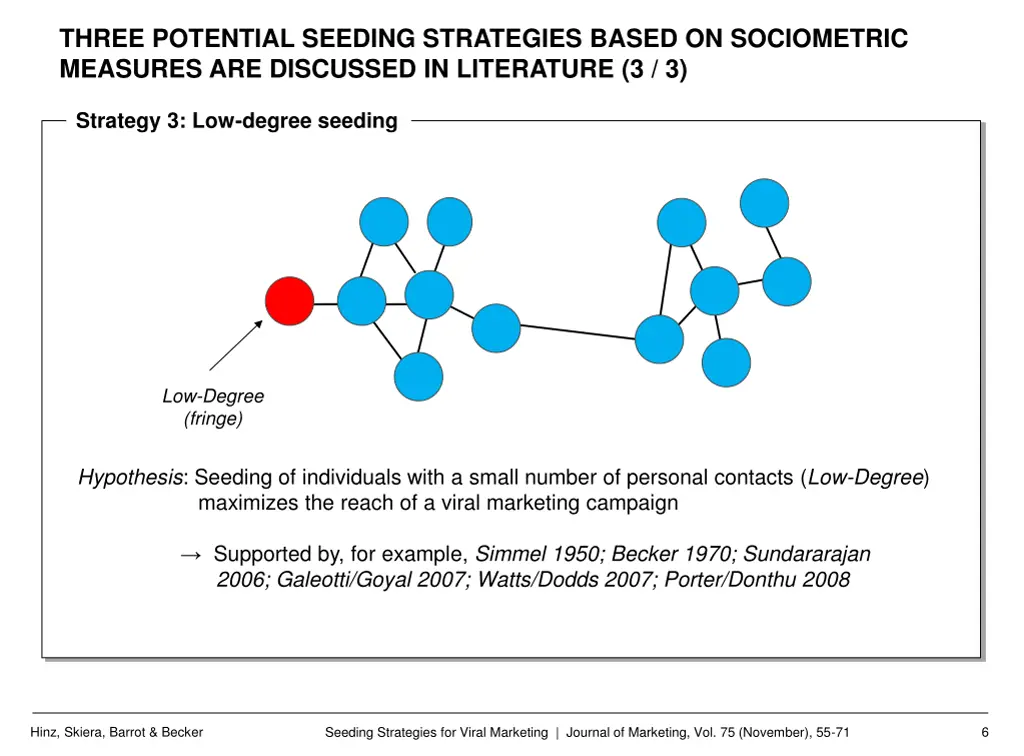
THREE POTENTIAL SEEDING STRATEGIES BASED ON SOCIOMETRIC MEASURES ARE DISCUSSED IN LITERATURE (3 / 3) Strategy 3: Low-degree seeding Low-Degree (fringe) Hypothesis: Seeding of individuals with a small number of personal contacts (Low-Degree) maximizes the reach of a viral marketing campaign Supported by, for example, Simmel 1950; Becker 1970; Sundararajan 2006; Galeotti/Goyal 2007; Watts/Dodds 2007; Porter/Donthu 2008 Hinz, Skiera, Barrot & Becker 6 Seeding Strategies for Viral Marketing | Journal of Marketing, Vol. 75 (November), 55-71
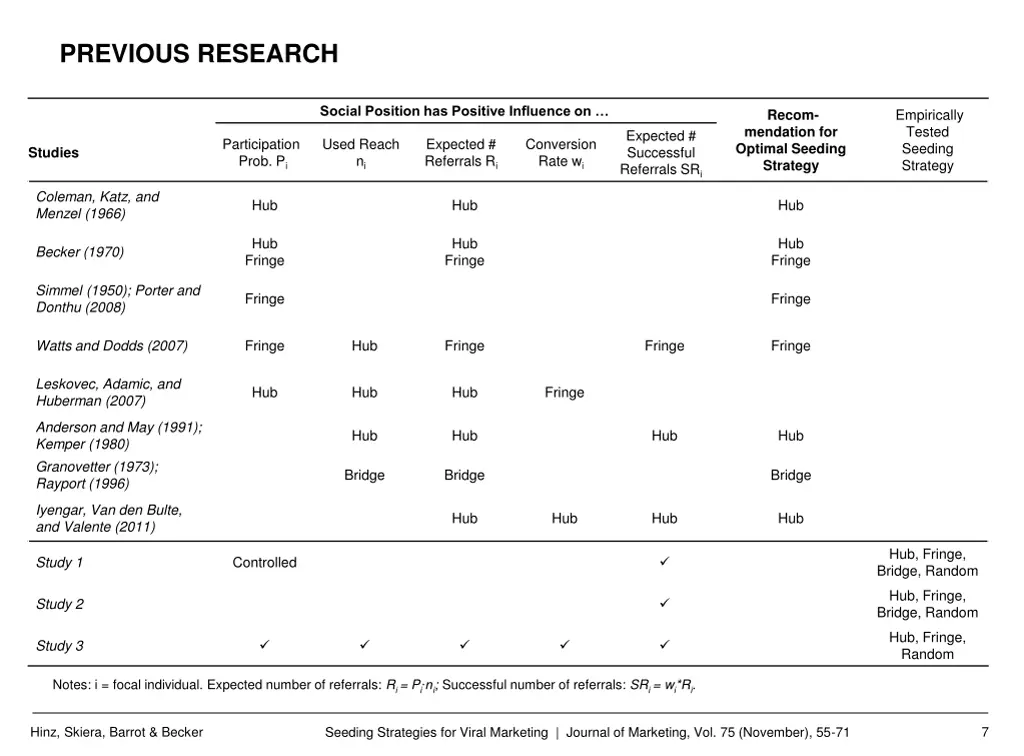
PREVIOUS RESEARCH Social Position has Positive Influence on Empirically Tested Seeding Strategy Recom- mendation for Optimal Seeding Strategy Expected # Successful Referrals SRi Participation Prob. Pi Used Reach ni Expected # Referrals Ri Conversion Rate wi Studies Coleman, Katz, and Menzel (1966) Hub Hub Hub Hub Fringe Hub Fringe Hub Fringe Becker (1970) Simmel (1950); Porter and Donthu (2008) Fringe Fringe Watts and Dodds (2007) Fringe Hub Fringe Fringe Fringe Leskovec, Adamic, and Huberman (2007) Hub Hub Hub Fringe Anderson and May (1991); Kemper (1980) Granovetter (1973); Rayport (1996) Hub Hub Hub Hub Bridge Bridge Bridge Iyengar, Van den Bulte, and Valente (2011) Hub Hub Hub Hub Hub, Fringe, Bridge, Random Study 1 Controlled Hub, Fringe, Bridge, Random Study 2 Hub, Fringe, Random Study 3 Notes: i = focal individual. Expected number of referrals: Ri= Pi ni; Successful number of referrals: SRi= wi*Ri. Hinz, Skiera, Barrot & Becker 7 Seeding Strategies for Viral Marketing | Journal of Marketing, Vol. 75 (November), 55-71
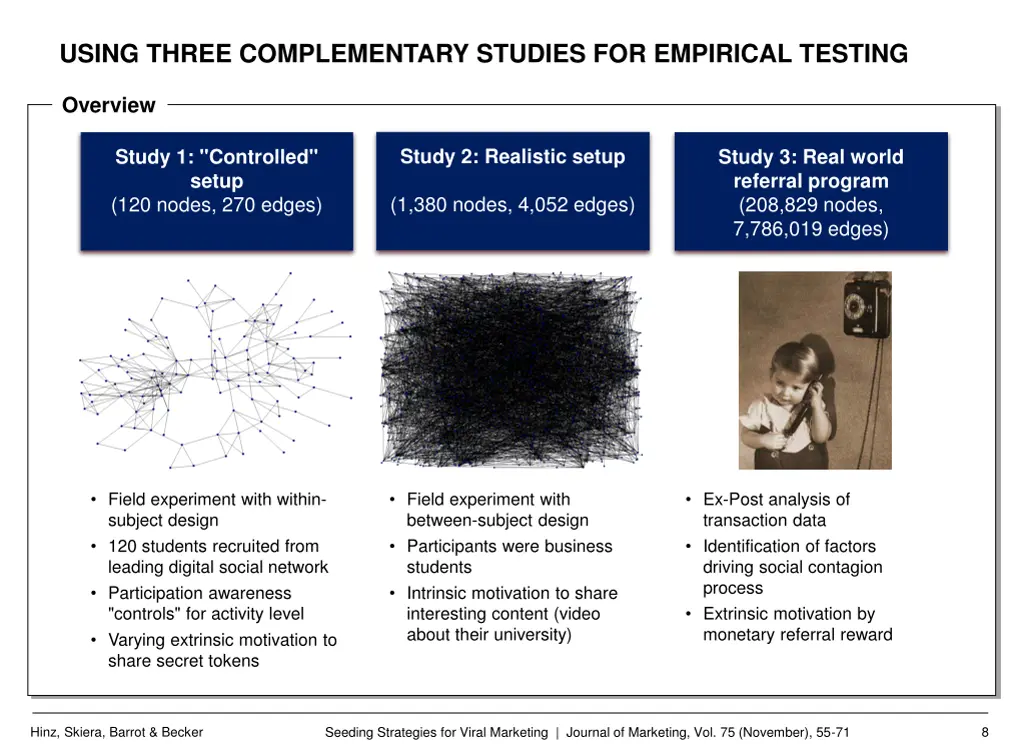
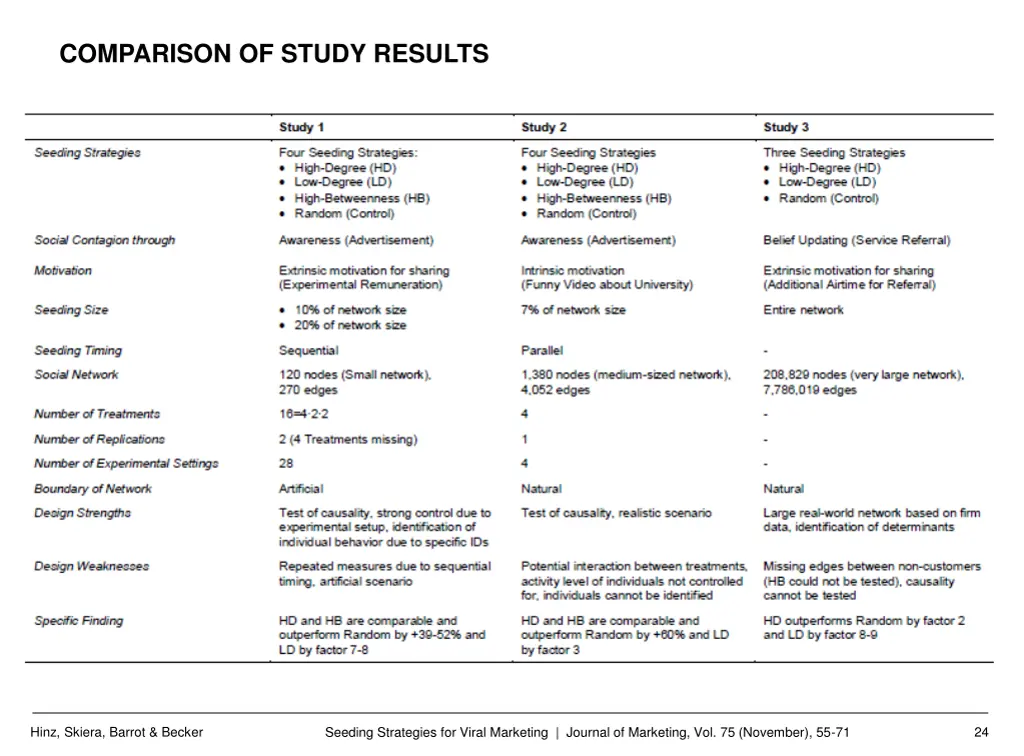
USING THREE COMPLEMENTARY STUDIES FOR EMPIRICAL TESTING Overview Study 2: Realistic setup Study 1: "Controlled" setup (120 nodes, 270 edges) Study 3: Real world referral program (208,829 nodes, 7,786,019 edges) (1,380 nodes, 4,052 edges) Field experiment with within- subject design 120 students recruited from leading digital social network Participation awareness "controls" for activity level Varying extrinsic motivation to share secret tokens Field experiment with between-subject design Participants were business students Intrinsic motivation to share interesting content (video about their university) Ex-Post analysis of transaction data Identification of factors driving social contagion process Extrinsic motivation by monetary referral reward Hinz, Skiera, Barrot & Becker 8 Seeding Strategies for Viral Marketing | Journal of Marketing, Vol. 75 (November), 55-71
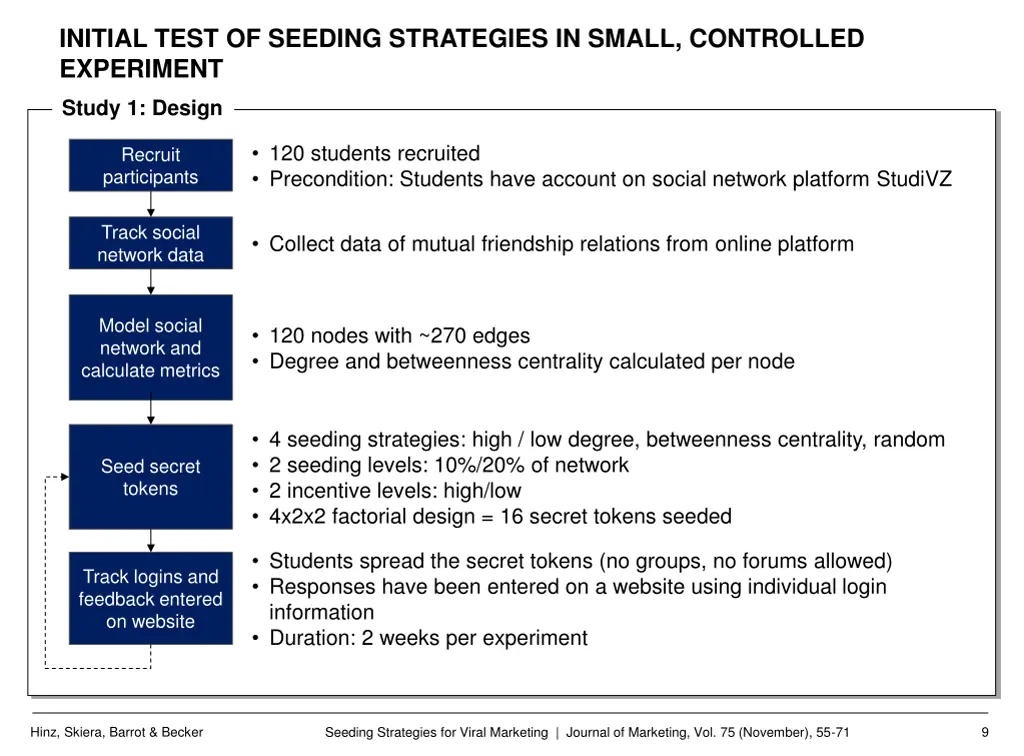
INITIAL TEST OF SEEDING STRATEGIES IN SMALL, CONTROLLED EXPERIMENT Study 1: Design 120 students recruited Precondition: Students have account on social network platform StudiVZ Recruit participants Track social network data Collect data of mutual friendship relations from online platform Model social network and calculate metrics 120 nodes with ~270 edges Degree and betweenness centrality calculated per node 4 seeding strategies: high / low degree, betweenness centrality, random 2 seeding levels: 10%/20% of network 2 incentive levels: high/low 4x2x2 factorial design = 16 secret tokens seeded Seed secret tokens Students spread the secret tokens (no groups, no forums allowed) Responses have been entered on a website using individual login information Duration: 2 weeks per experiment Track logins and feedback entered on website Hinz, Skiera, Barrot & Becker 9 Seeding Strategies for Viral Marketing | Journal of Marketing, Vol. 75 (November), 55-71
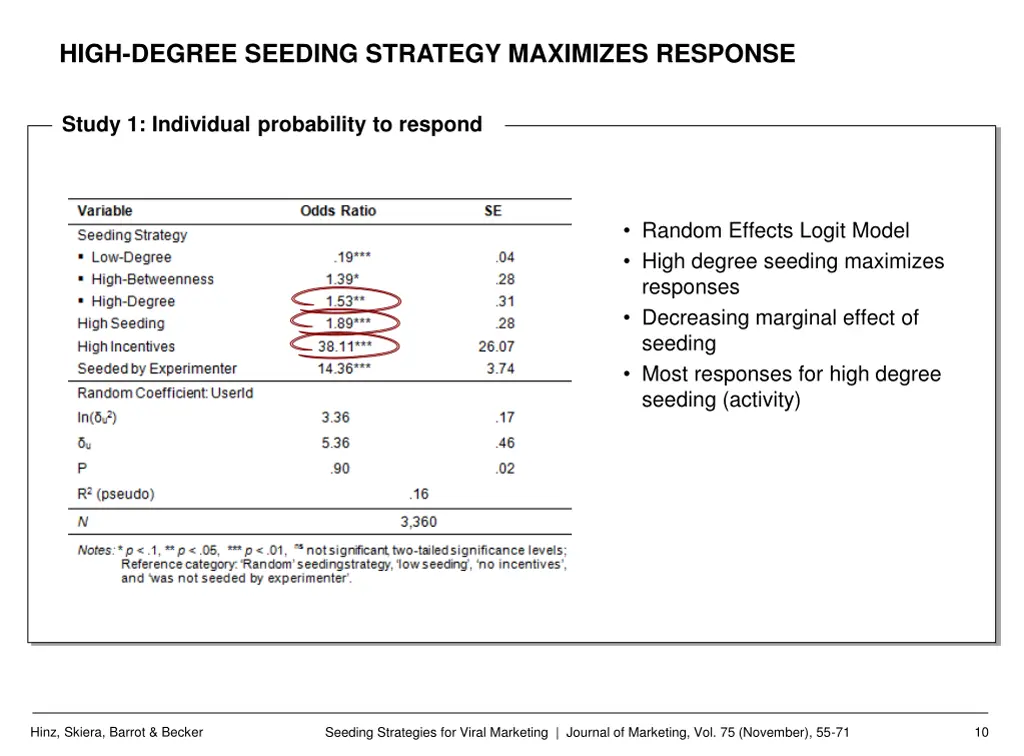
HIGH-DEGREE SEEDING STRATEGY MAXIMIZES RESPONSE Study 1: Individual probability to respond Random Effects Logit Model High degree seeding maximizes responses Decreasing marginal effect of seeding Most responses for high degree seeding (activity) Hinz, Skiera, Barrot & Becker 10 Seeding Strategies for Viral Marketing | Journal of Marketing, Vol. 75 (November), 55-71
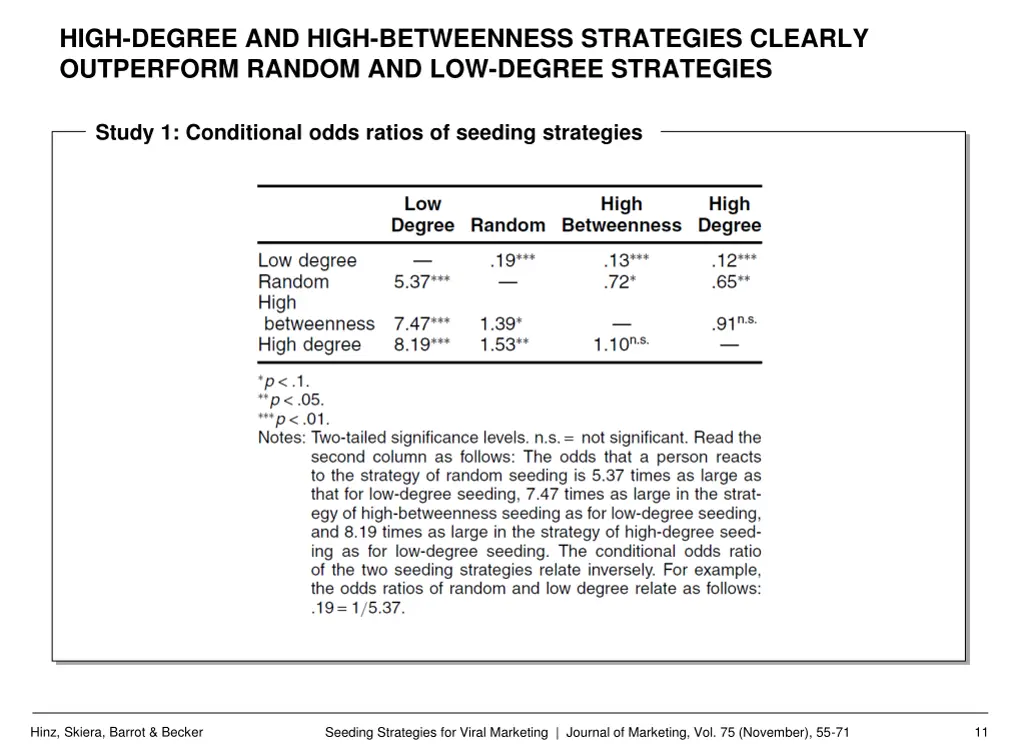
HIGH-DEGREE AND HIGH-BETWEENNESS STRATEGIES CLEARLY OUTPERFORM RANDOM AND LOW-DEGREE STRATEGIES Study 1: Conditional odds ratios of seeding strategies Hinz, Skiera, Barrot & Becker 11 Seeding Strategies for Viral Marketing | Journal of Marketing, Vol. 75 (November), 55-71
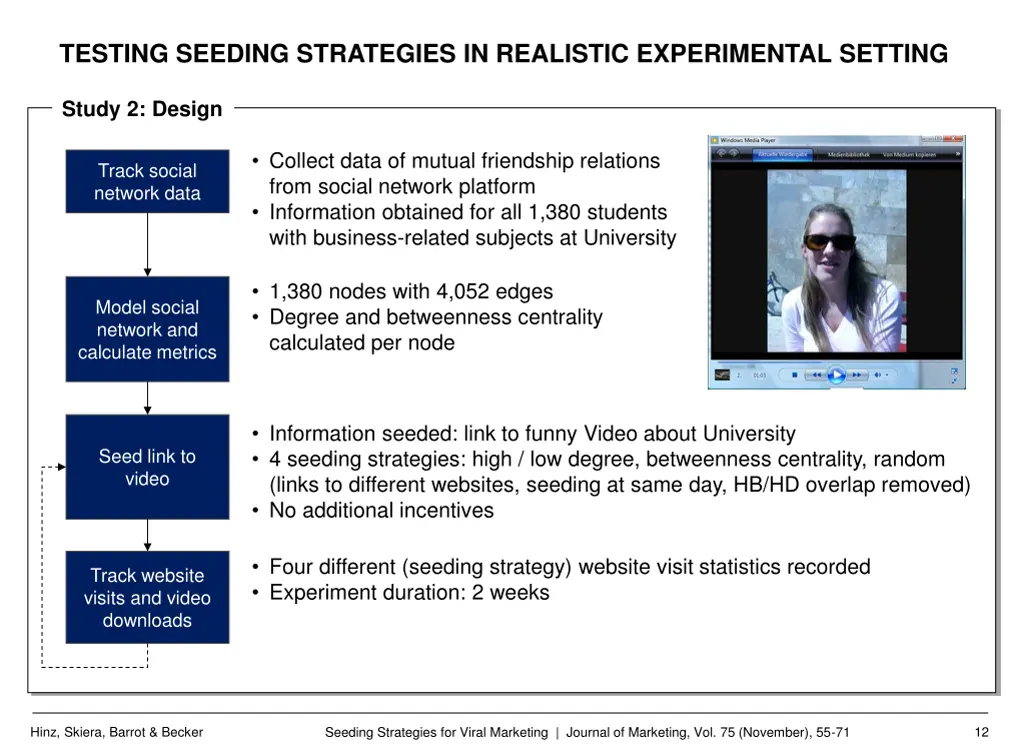
TESTING SEEDING STRATEGIES IN REALISTIC EXPERIMENTAL SETTING Study 2: Design Collect data of mutual friendship relations from social network platform Information obtained for all 1,380 students with business-related subjects at University Track social network data 1,380 nodes with 4,052 edges Degree and betweenness centrality calculated per node Model social network and calculate metrics Information seeded: link to funny Video about University 4 seeding strategies: high / low degree, betweenness centrality, random (links to different websites, seeding at same day, HB/HD overlap removed) No additional incentives Seed link to video Four different (seeding strategy) website visit statistics recorded Experiment duration: 2 weeks Track website visits and video downloads Hinz, Skiera, Barrot & Becker 12 Seeding Strategies for Viral Marketing | Journal of Marketing, Vol. 75 (November), 55-71
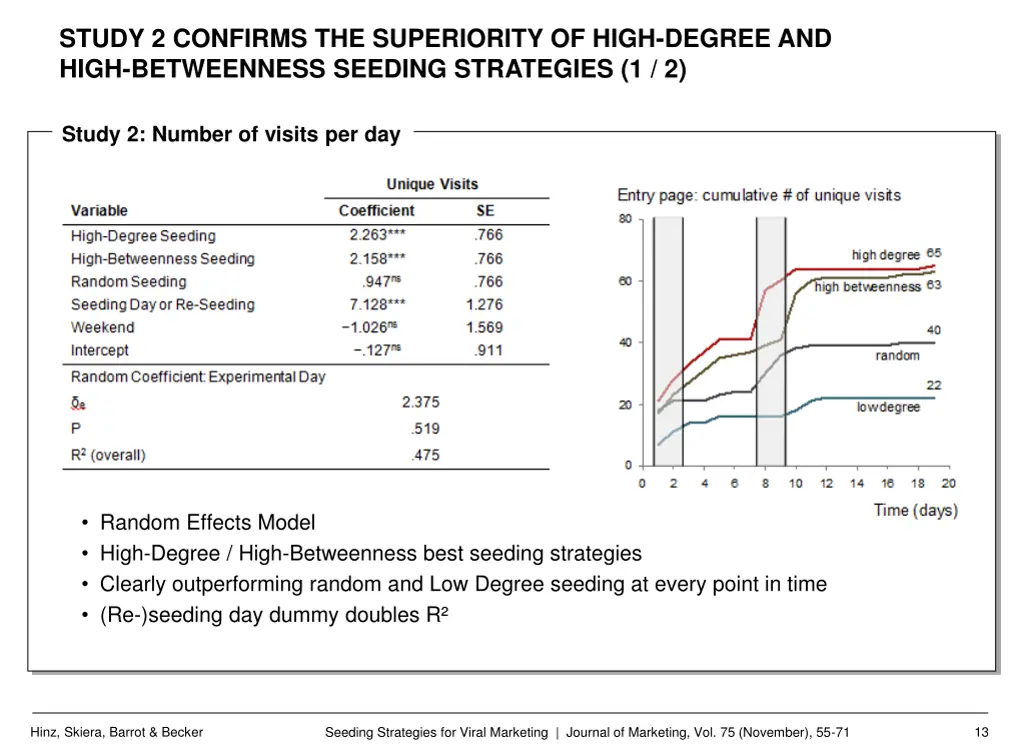
STUDY 2 CONFIRMS THE SUPERIORITY OF HIGH-DEGREE AND HIGH-BETWEENNESS SEEDING STRATEGIES (1 / 2) Study 2: Number of visits per day Random Effects Model High-Degree / High-Betweenness best seeding strategies Clearly outperforming random and Low Degree seeding at every point in time (Re-)seeding day dummy doubles R Hinz, Skiera, Barrot & Becker 13 Seeding Strategies for Viral Marketing | Journal of Marketing, Vol. 75 (November), 55-71
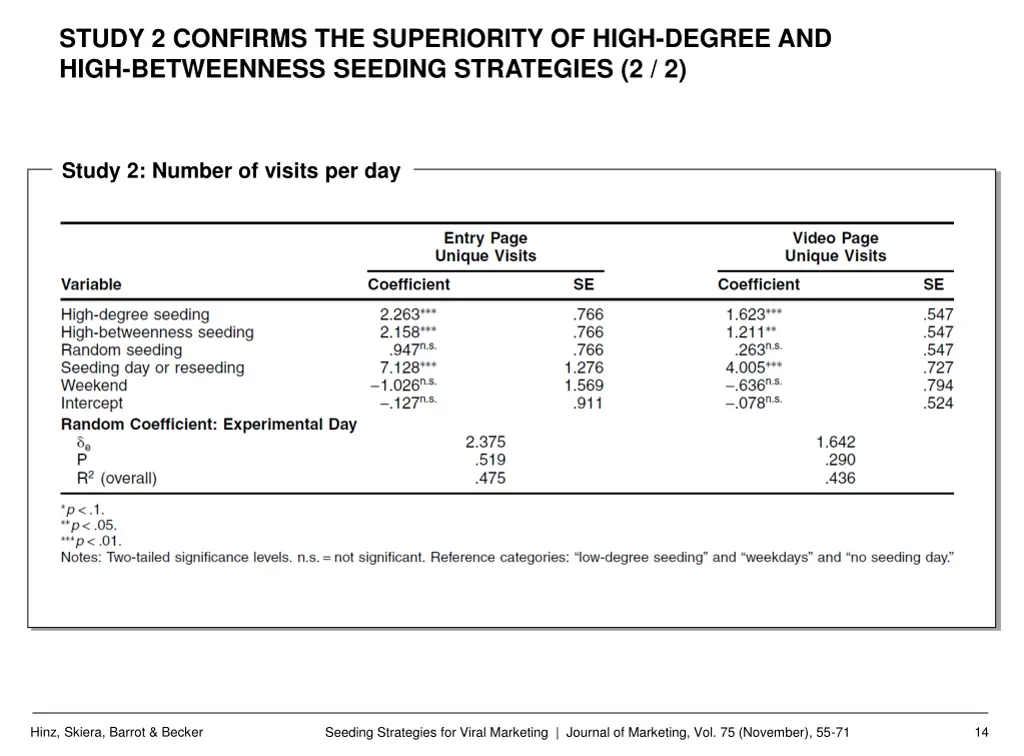
STUDY 2 CONFIRMS THE SUPERIORITY OF HIGH-DEGREE AND HIGH-BETWEENNESS SEEDING STRATEGIES (2 / 2) Study 2: Number of visits per day Hinz, Skiera, Barrot & Becker 14 Seeding Strategies for Viral Marketing | Journal of Marketing, Vol. 75 (November), 55-71
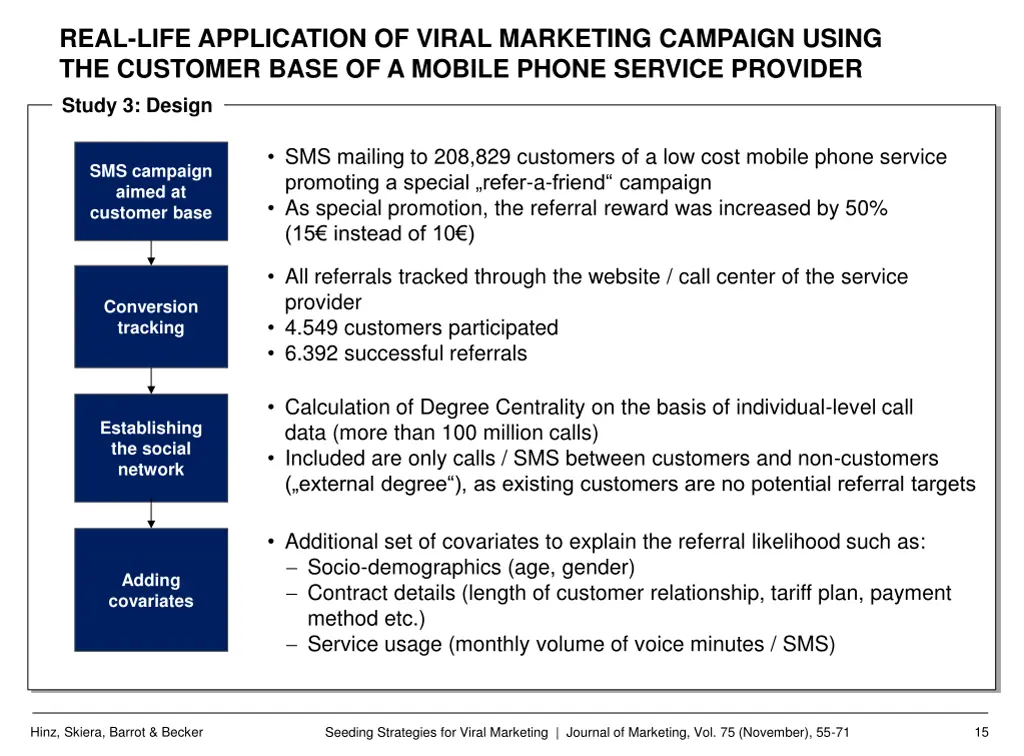
REAL-LIFE APPLICATION OF VIRAL MARKETING CAMPAIGN USING THE CUSTOMER BASE OF A MOBILE PHONE SERVICE PROVIDER Study 3: Design SMS mailing to 208,829 customers of a low cost mobile phone service promoting a special refer-a-friend campaign As special promotion, the referral reward was increased by 50% (15 instead of 10 ) SMS campaign aimed at customer base All referrals tracked through the website / call center of the service provider 4.549 customers participated 6.392 successful referrals Conversion tracking Calculation of Degree Centrality on the basis of individual-level call data (more than 100 million calls) Included are only calls / SMS between customers and non-customers ( external degree ), as existing customers are no potential referral targets Establishing the social network Additional set of covariates to explain the referral likelihood such as: Socio-demographics (age, gender) Contract details (length of customer relationship, tariff plan, payment method etc.) Service usage (monthly volume of voice minutes / SMS) Adding covariates Hinz, Skiera, Barrot & Becker 15 Seeding Strategies for Viral Marketing | Journal of Marketing, Vol. 75 (November), 55-71
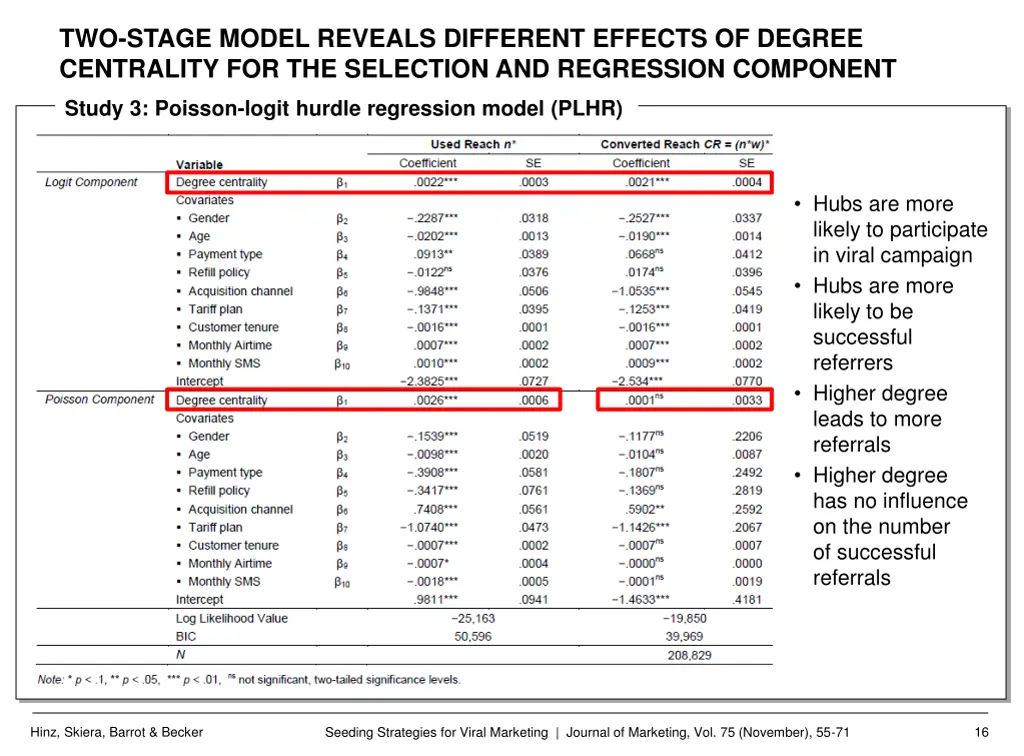
TWO-STAGE MODEL REVEALS DIFFERENT EFFECTS OF DEGREE CENTRALITY FOR THE SELECTION AND REGRESSION COMPONENT Study 3: Poisson-logit hurdle regression model (PLHR) Hubs are more likely to participate in viral campaign Hubs are more likely to be successful referrers Higher degree leads to more referrals Higher degree has no influence on the number of successful referrals Hinz, Skiera, Barrot & Becker 16 Seeding Strategies for Viral Marketing | Journal of Marketing, Vol. 75 (November), 55-71
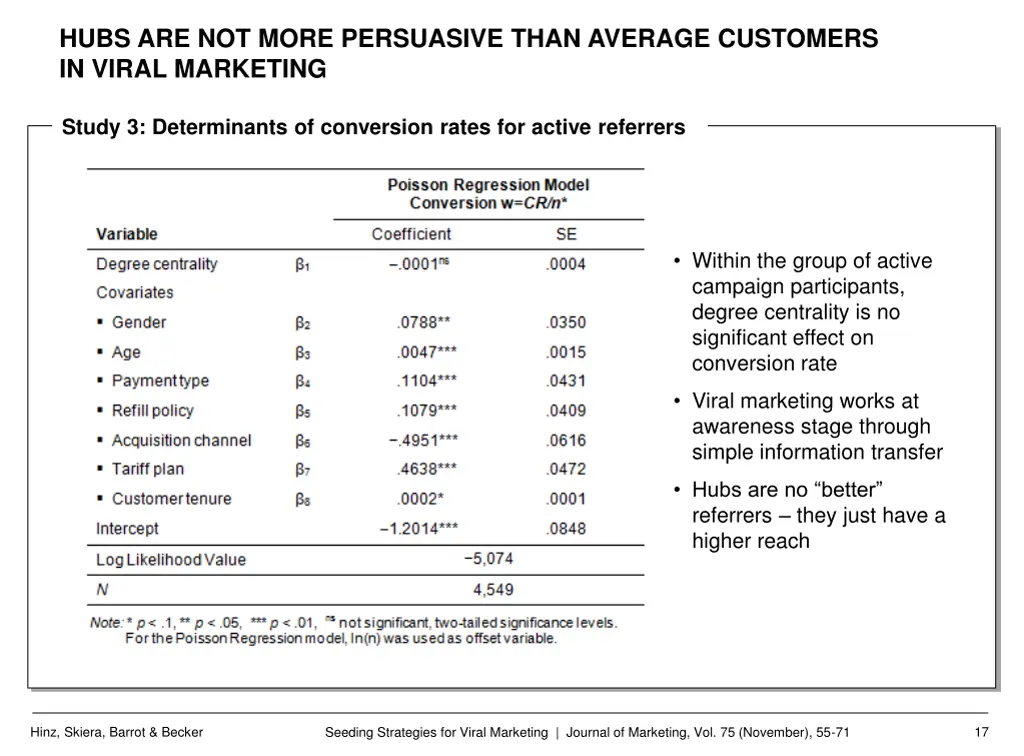
HUBS ARE NOT MORE PERSUASIVE THAN AVERAGE CUSTOMERS IN VIRAL MARKETING Study 3: Determinants of conversion rates for active referrers Within the group of active campaign participants, degree centrality is no significant effect on conversion rate Viral marketing works at awareness stage through simple information transfer Hubs are no better referrers they just have a higher reach Hinz, Skiera, Barrot & Becker 17 Seeding Strategies for Viral Marketing | Journal of Marketing, Vol. 75 (November), 55-71
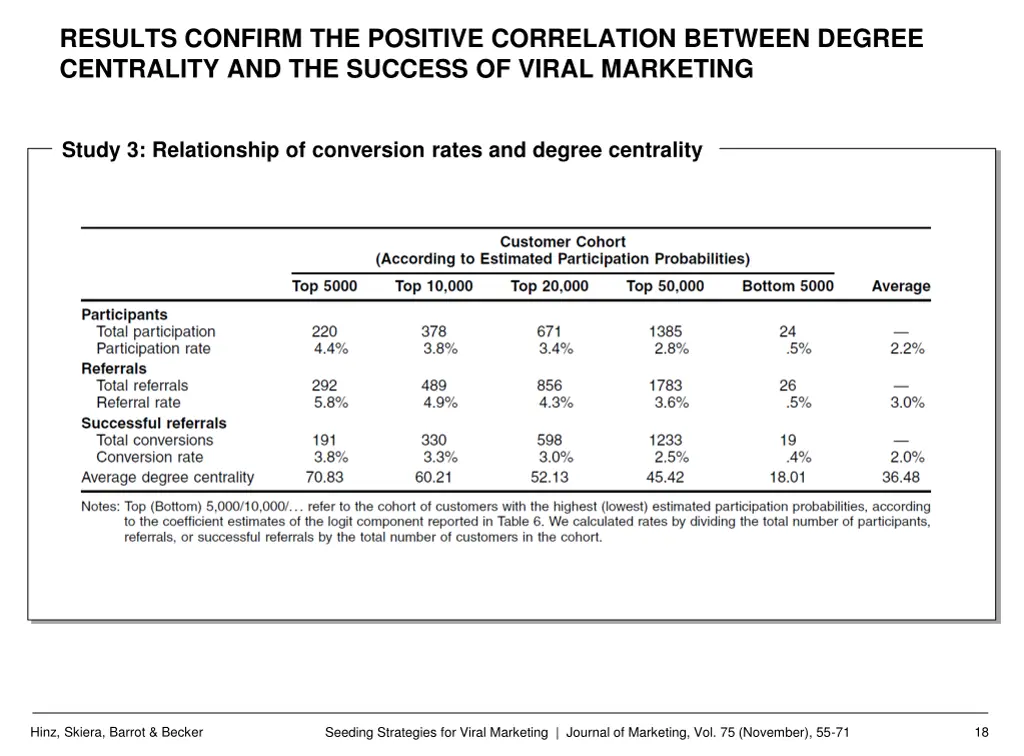
RESULTS CONFIRM THE POSITIVE CORRELATION BETWEEN DEGREE CENTRALITY AND THE SUCCESS OF VIRAL MARKETING Study 3: Relationship of conversion rates and degree centrality Hinz, Skiera, Barrot & Becker 18 Seeding Strategies for Viral Marketing | Journal of Marketing, Vol. 75 (November), 55-71
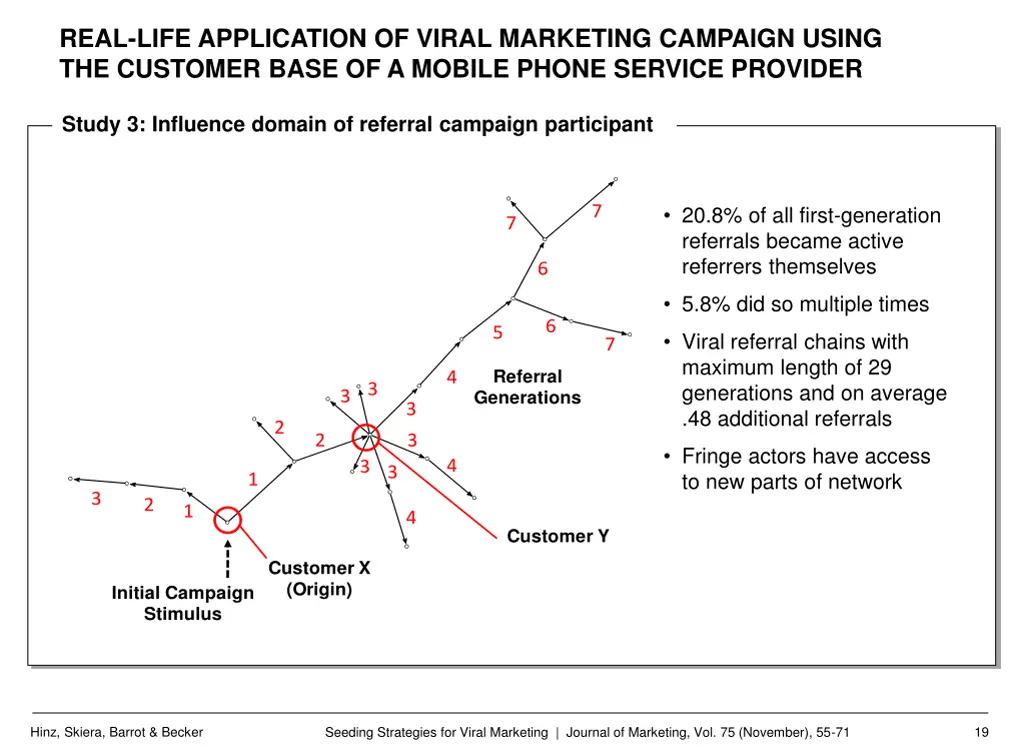
REAL-LIFE APPLICATION OF VIRAL MARKETING CAMPAIGN USING THE CUSTOMER BASE OF A MOBILE PHONE SERVICE PROVIDER Study 3: Influence domain of referral campaign participant 7 20.8% of all first-generation referrals became active referrers themselves 7 6 5.8% did so multiple times 6 5 Viral referral chains with maximum length of 29 generations and on average .48 additional referrals 7 Referral Generations 4 3 3 3 2 2 3 Fringe actors have access to new parts of network 4 3 3 1 3 2 1 4 Customer Y Customer X (Origin) Initial Campaign Stimulus Hinz, Skiera, Barrot & Becker 19 Seeding Strategies for Viral Marketing | Journal of Marketing, Vol. 75 (November), 55-71
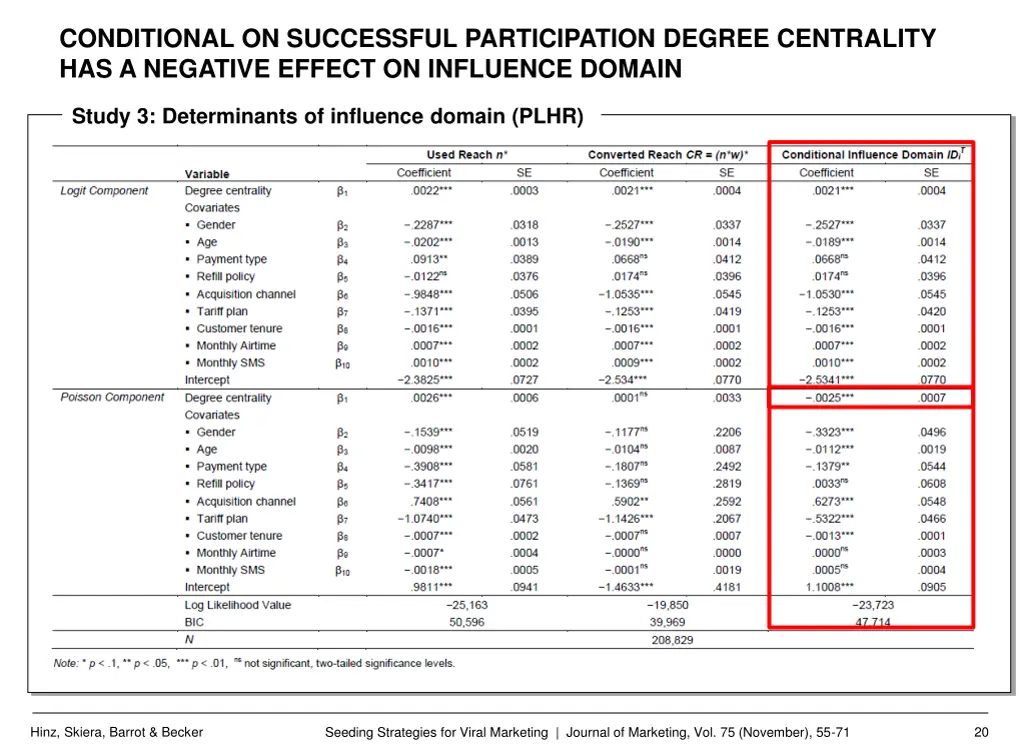
CONDITIONAL ON SUCCESSFUL PARTICIPATION DEGREE CENTRALITY HAS A NEGATIVE EFFECT ON INFLUENCE DOMAIN Study 3: Determinants of influence domain (PLHR) Hinz, Skiera, Barrot & Becker 20 Seeding Strategies for Viral Marketing | Journal of Marketing, Vol. 75 (November), 55-71
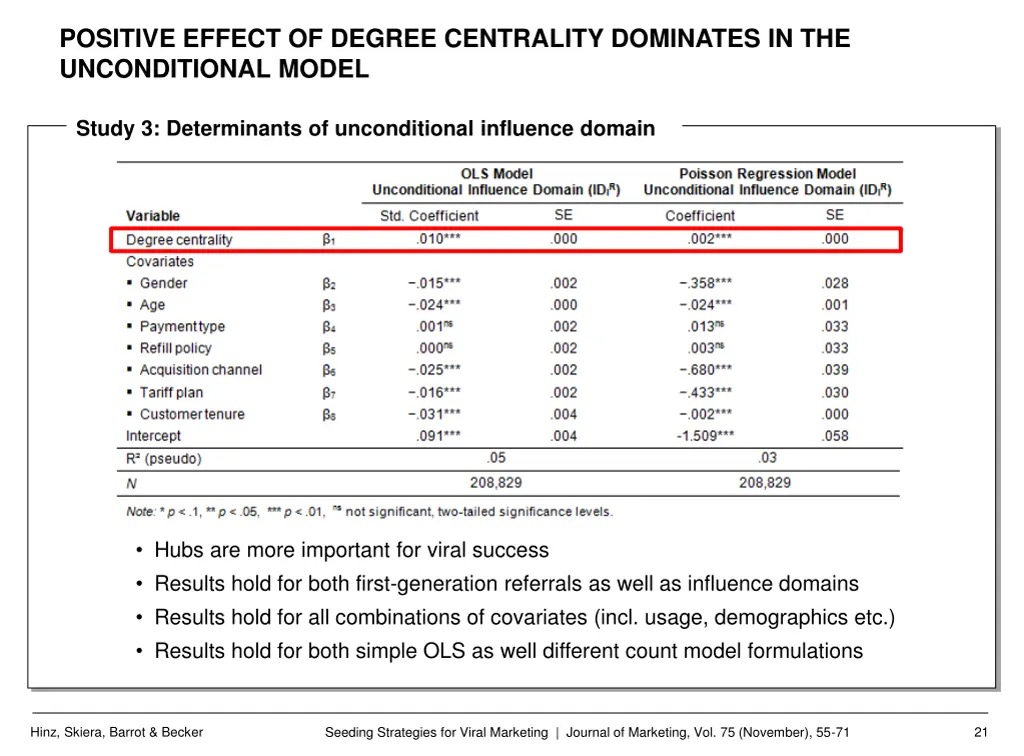
POSITIVE EFFECT OF DEGREE CENTRALITY DOMINATES IN THE UNCONDITIONAL MODEL Study 3: Determinants of unconditional influence domain Hubs are more important for viral success Results hold for both first-generation referrals as well as influence domains Results hold for all combinations of covariates (incl. usage, demographics etc.) Results hold for both simple OLS as well different count model formulations Hinz, Skiera, Barrot & Becker 21 Seeding Strategies for Viral Marketing | Journal of Marketing, Vol. 75 (November), 55-71
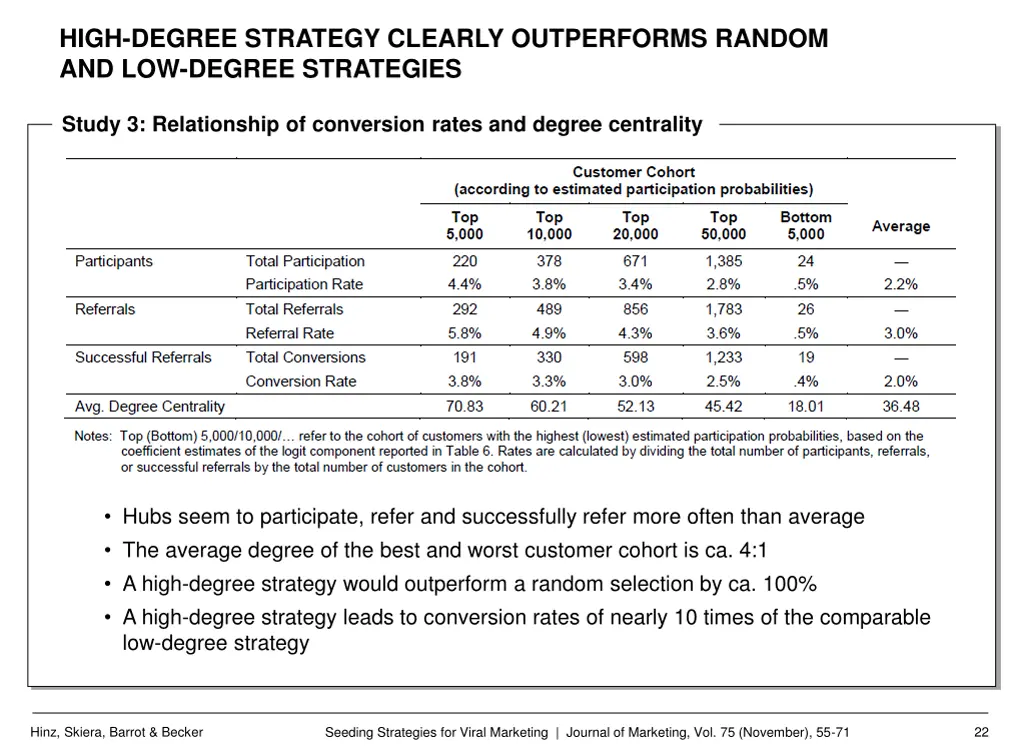
HIGH-DEGREE STRATEGY CLEARLY OUTPERFORMS RANDOM AND LOW-DEGREE STRATEGIES Study 3: Relationship of conversion rates and degree centrality Hubs seem to participate, refer and successfully refer more often than average The average degree of the best and worst customer cohort is ca. 4:1 A high-degree strategy would outperform a random selection by ca. 100% A high-degree strategy leads to conversion rates of nearly 10 times of the comparable low-degree strategy Hinz, Skiera, Barrot & Becker 22 Seeding Strategies for Viral Marketing | Journal of Marketing, Vol. 75 (November), 55-71
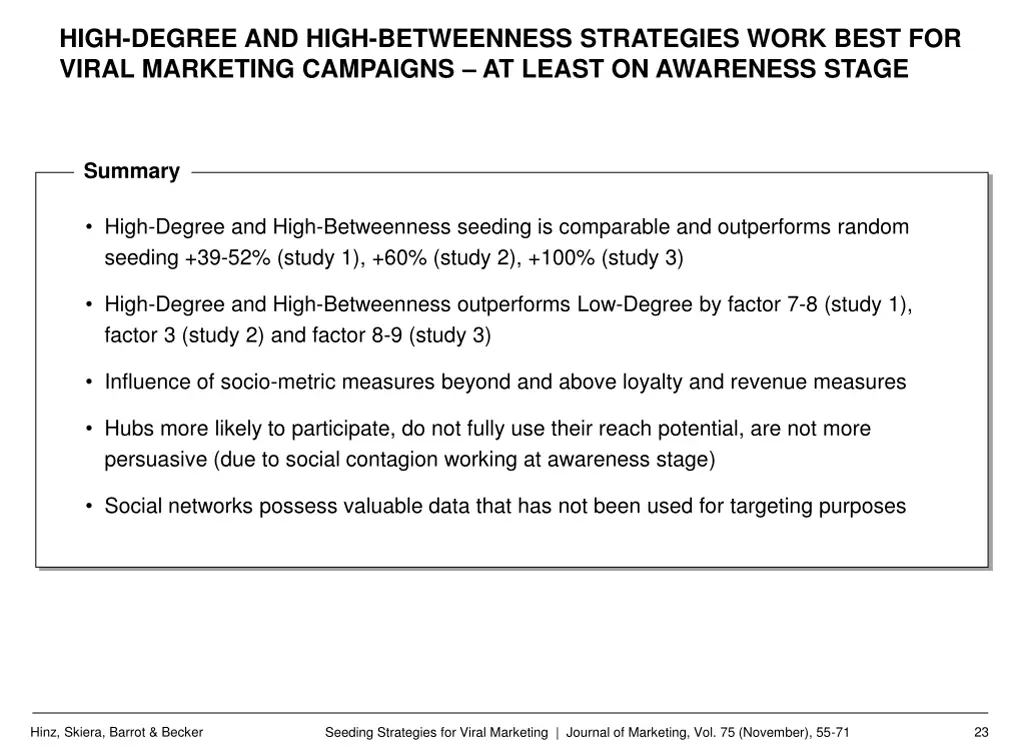
HIGH-DEGREE AND HIGH-BETWEENNESS STRATEGIES WORK BEST FOR VIRAL MARKETING CAMPAIGNS AT LEAST ON AWARENESS STAGE Summary High-Degree and High-Betweenness seeding is comparable and outperforms random seeding +39-52% (study 1), +60% (study 2), +100% (study 3) High-Degree and High-Betweenness outperforms Low-Degree by factor 7-8 (study 1), factor 3 (study 2) and factor 8-9 (study 3) Influence of socio-metric measures beyond and above loyalty and revenue measures Hubs more likely to participate, do not fully use their reach potential, are not more persuasive (due to social contagion working at awareness stage) Social networks possess valuable data that has not been used for targeting purposes Hinz, Skiera, Barrot & Becker 23 Seeding Strategies for Viral Marketing | Journal of Marketing, Vol. 75 (November), 55-71
COMPARISON OF STUDY RESULTS Hinz, Skiera, Barrot & Becker 24 Seeding Strategies for Viral Marketing | Journal of Marketing, Vol. 75 (November), 55-71