Dive into the intricacies of identifying and reading Qal and Piel imperatives in Hebrew texts, with a focus on verb forms, discourse boundaries, and the use of Furtivepatach. Explore the nuances of stative verbs and mainline verb forms for Historical Narrative to enhance your understanding of Biblical Hebrew language structures.
Please find below an Image/Link to download the presentation.
The content on the website is provided AS IS for your information and personal use only. It may not be sold, licensed, or shared on other websites without obtaining consent from the author. If you encounter any issues during the download, it is possible that the publisher has removed the file from their server.
You are allowed to download the files provided on this website for personal or commercial use, subject to the condition that they are used lawfully. All files are the property of their respective owners.
The content on the website is provided AS IS for your information and personal use only. It may not be sold, licensed, or shared on other websites without obtaining consent from the author.
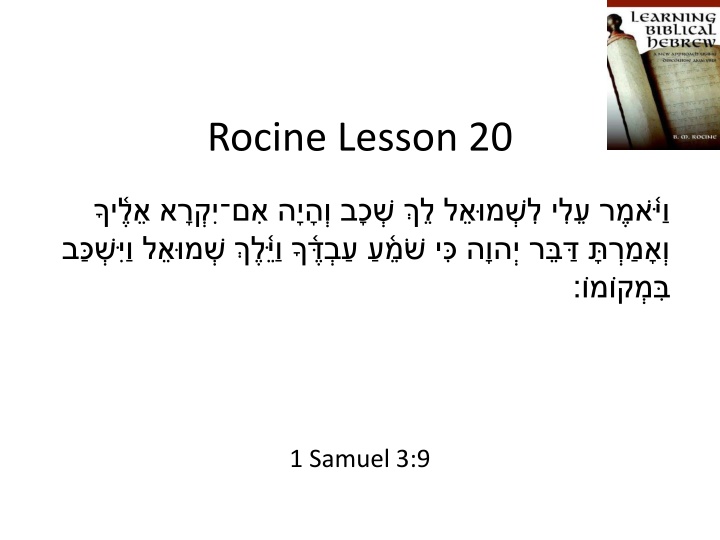
Goals Identify and read Qal and Piel imperatives in all genders and numbers. Use verb forms to locate the boundaries between discourses. Also Furtivepatach When to use and vs. then
What we already know Side Note: This is an a vowel rather than an o vowel because the verb is stative (as opposed to dynamic). Stative verbs typically have an a theme vowel in the prefix conjugations (yiqtol, wayyiqtol, etc.). Cf. or (Rocine 17.4c).
What we already know Wayyiqtol is the mainline verb form for Historical Narrative, so we can reformat the text to reflect that.
What we already know There are two Qal imperatives Both are masculine, singular (cf. Rocine 19.2) is stative, which is why it has the a vowel. Sometimes with a qamets as above (1 Sam 3:5,6,9) Sometimes it is spelled with a patach (2 Sam 13:5, Ezek 4:4)
What we already know There is one participle What is it s gender, number? (remember participles have no person)
What we already know furtive patach RULE: When a word ends with khet or ayin and has a patakh as its vowel, the patakh will be written slightly to the right of normal in your Bible and is called furtivepatakh. The furtive patakh is to be pronounced before its accompanying consonant, rather than after, as normal. The furtive patakh also usually shifts the emphasis in a word from its last syllable to the second to the last.
What we already know Finally there is one verb remaining. It is a Piel imperative How does it look different than the Qal imperative? (We ll compare Qal and Piel imperatives before returning to our lesson verse.)
Qal Imperatives (Review) Qatal 3ms Yiqtol 2ms Imperative ms III-Guttural I-Nun I-Yod (like I-Nun) (like I-Yod) Strong
Qal Imperatives (Review) Qatal 3ms Yiqtol 2ms Imperative ms III-Guttural I-Nun I-Yod (like I-Nun) (like I-Yod) Strong 1. A shewa at the beginning is supposed to be the sign of the Qal ms imperative (cf. see rule in Rocine 19.2a) but in reality in many weak verbs the shewa is missing. Most imperatives are weak verbs. The second vowel (sometimes called the theme vowel) is NOT an indicator of the imperative (note the variety above). 2. 3. So how do we identify imperatives?
Qal Imperatives (Review) Qatal 3ms Yiqtol 2ms Imperative ms III-Guttural I-Nun I-Yod (like I-Nun) (like I-Yod) Strong The best way to identify imperatives is to 1. Learn the strong verb imperative paradigm (next slide) (It s only 4 words.) 2. Be familiar with the yiqtol form from which the imperative derives. 3. Recognize that the imperative will typically be shorter, in sound and number of letters. This is a visual and auditory clue. Imperatives are quite naked, so to speak.
Qal & Piel Imperative Paradigm Qal Piel ms fs mpl fpl Note the hireqs here. This is due to a rule of shewa that comes into effect when you have 2 initial shewas in a word. See animatedhebrew lecture 20 for details.
Qal & Piel Imperative Paradigm Qal Piel ms fs mpl fpl Memorize the Qal Paradigm Note that Shewa marks the Qal imperative Patach marks the Piel imperative
Determining Genres Returning to our lesson verse, Try to identify the genres. How many different genres are in this verse? Where do the genres switch? (See the next slide for a reminder of genres and verb forms.)
Determining Genres Genre Task Mainline Verb Form Function Historical Narrative Tell a story about the past. Wayyiqtol (Rocine 1.2c) Historical Narrative Mainline Predictive Narrative Tell a story set in the future. Weqatal (Rocine 13.2e) Predictive Narrative Mainline Instructional Discourse Tell how to do something. Weqatal (Rocine 16.2a,3a) Instructional Discourse Mainline Imperative Weqatal (Rocine 19.2c) (Rocine 19.5a) Hortatory Discourse Mainline Hortatory Mitigated Mainline Hortatory Discourse Influence the behavior of someone.
Determining Genres ? ? Wayyiqtol mainline verb of Imperative mainline verb of ? Weqatal mainline verb of mainline verb of continuing verb of ? Imperative mainline verb of ? Wayyiqtol mainline verb of
Determining Genres Historical Narrative Wayyiqtol mainline verb of Historical Narrative Hortatory Discourse Imperative mainline verb of Hortatory Discourse Instructional Discourse Weqatal mainline verb of Predictive Narrative mainline verb of Instructional Narrative continuing verb of Mitigated Hortatory Discourse Hortatory Discourse Imperative mainline verb of Hortatory Discourse Historical Narrative Wayyiqtol mainline verb of Historical Narrative
Determining Genres Historical Narrative Wayyiqtol mainline verb of Historical Narrative Hortatory Discourse Imperative mainline verb of Hortatory Discourse Instructional Discourse Weqatal mainline verb of Predictive Narrative mainline verb of Instructional Narrative continuing verb of Mitigated Hortatory Discourse Hortatory Discourse Imperative mainline verb of Hortatory Discourse Historical Narrative Wayyiqtol mainline verb of Historical Narrative Note: This weqatal is 3rd person so it cannot be continuing the imperatival sense of and . Imperatives are 2nd person.
Determining Genres Historical Narrative Subject: Eli Hortatory Discourse Instructional Discourse Hortatory Discourse Historical Narrative Switch of Subject Subject: Samuel Subject: Samuel A switch of subject is a good place to translate the waw of the wayyiqtol as then rather than the usual and or leaving it untranslated.