Understanding the complex cost structures involved in running a computing center, this analysis delves into factors beyond hardware expenses, including energy consumption, cooling, and space usage. Explore the cost breakdown, machine categories, and MIT Tier-2 center evaluation to optimize efficiency and sustainability in computing operations.
Please find below an Image/Link to download the presentation.
The content on the website is provided AS IS for your information and personal use only. It may not be sold, licensed, or shared on other websites without obtaining consent from the author. If you encounter any issues during the download, it is possible that the publisher has removed the file from their server.
You are allowed to download the files provided on this website for personal or commercial use, subject to the condition that they are used lawfully. All files are the property of their respective owners.
The content on the website is provided AS IS for your information and personal use only. It may not be sold, licensed, or shared on other websites without obtaining consent from the author.
E N D
Presentation Transcript
Holistic Cost Analysis of Running a Computing Center Zhangqier Wang Throughput Computing 2025 June. 4th2025 1
Outline Introduction Holistic cost analysis on CMS T2 Estimate the cost of each type of hardware Policy for procurement plan Cost analysis for a general computing center A general way to form the policy 2
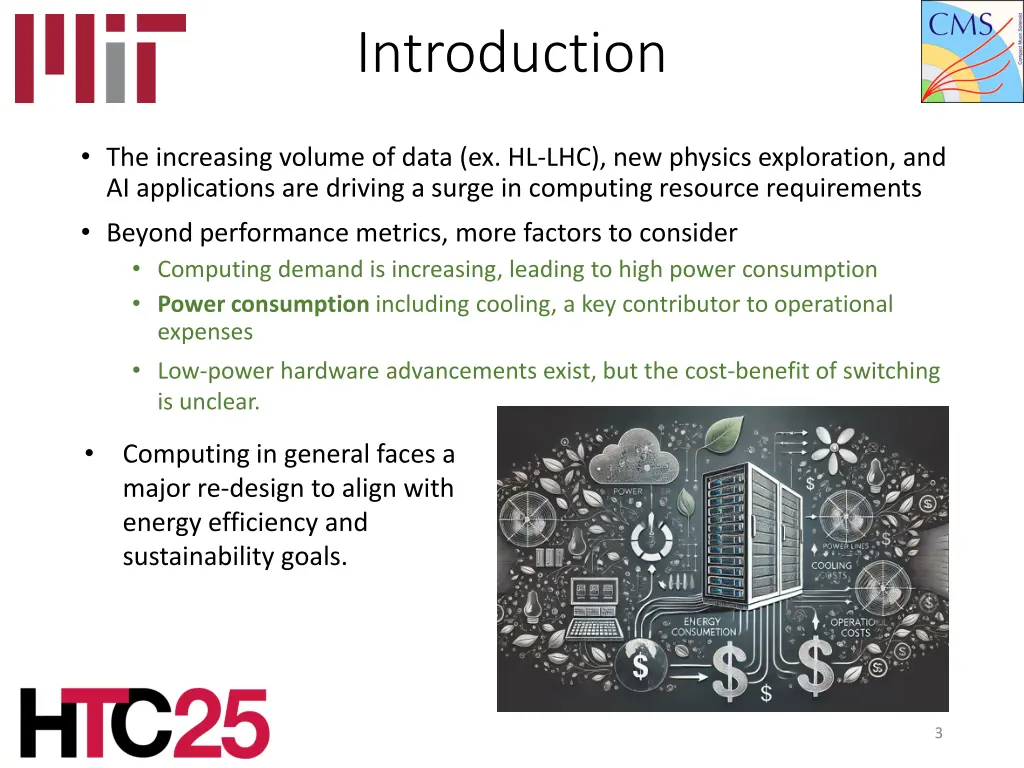
Introduction The increasing volume of data (ex. HL-LHC), new physics exploration, and AI applications are driving a surge in computing resource requirements Beyond performance metrics, more factors to consider Computing demand is increasing, leading to high power consumption Power consumption including cooling, a key contributor to operational expenses Low-power hardware advancements exist, but the cost-benefit of switching is unclear. Computing in general faces a major re-design to align with energy efficiency and sustainability goals. 3
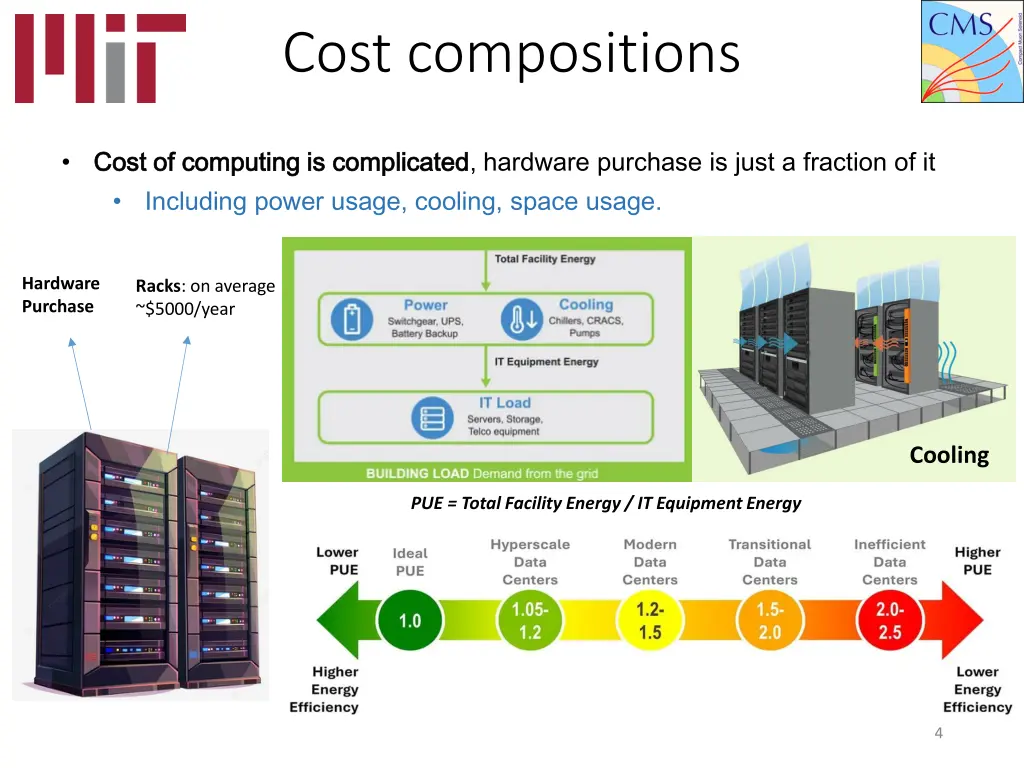
Cost compositions Cost of computing is complicated Cost of computing is complicated, hardware purchase is just a fraction of it Including power usage, cooling, space usage. Hardware Purchase Racks: on average ~$5000/year Cooling PUE = Total Facility Energy / IT Equipment Energy 4
MIT Tier 2 Center The MIT Tier-2 Center is a high-performance computing facility dedicated to processing, storing, and analyzing data for the CMS, LHCb, and other experiments Comprises approximately 700 machines, providing 25k CPU cores and 16.5 PB of storage. Compute/Storage mix model Worker nodes are also used as storage devices Re-design to have dedicated compute and storage servers Cost evaluation determine hardware retirement policy Prepare MIT T2 for HL-LHC (data x10) Improve energy efficiency Spend less to provide same amount of computation MIT T2 site 5
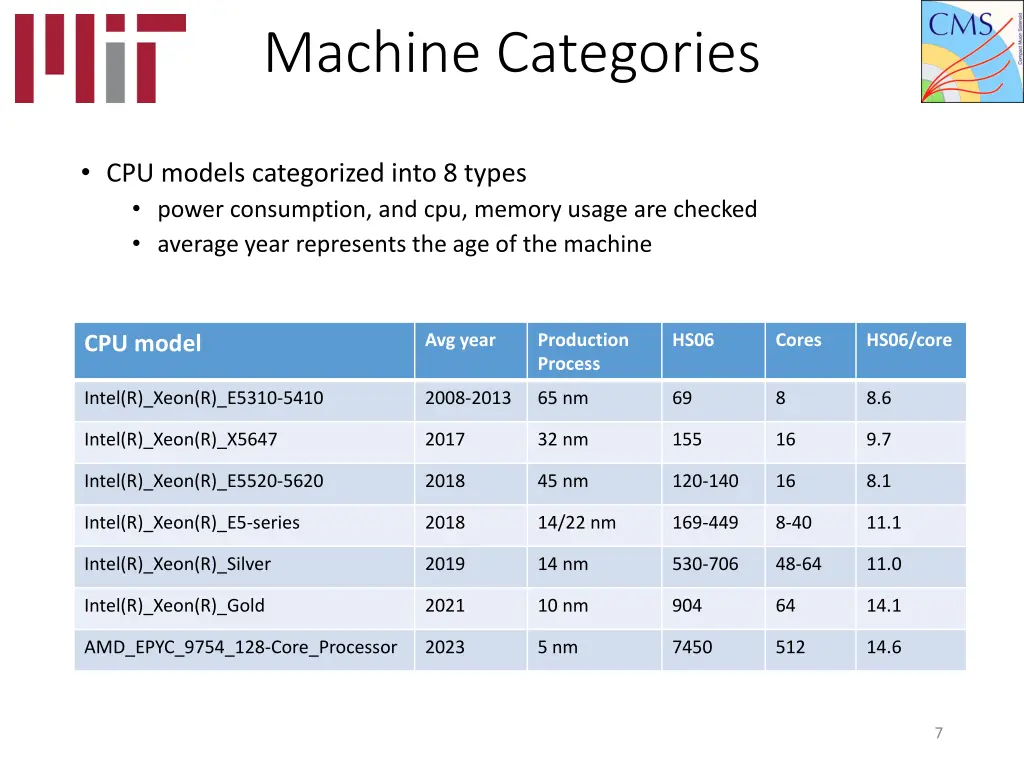
Machine Categories CPU models categorized into 8 types power consumption, and cpu, memory usage are checked average year represents the age of the machine Avg year Production Process HS06 Cores HS06/core CPU model Intel(R)_Xeon(R)_E5310-5410 2008-2013 65 nm 69 8 8.6 Intel(R)_Xeon(R)_X5647 2017 32 nm 155 16 9.7 Intel(R)_Xeon(R)_E5520-5620 2018 45 nm 120-140 16 8.1 Intel(R)_Xeon(R)_E5-series 2018 14/22 nm 169-449 8-40 11.1 Intel(R)_Xeon(R)_Silver 2019 14 nm 530-706 48-64 11.0 Intel(R)_Xeon(R)_Gold 2021 10 nm 904 64 14.1 AMD_EPYC_9754_128-Core_Processor 2023 5 nm 7450 512 14.6 7
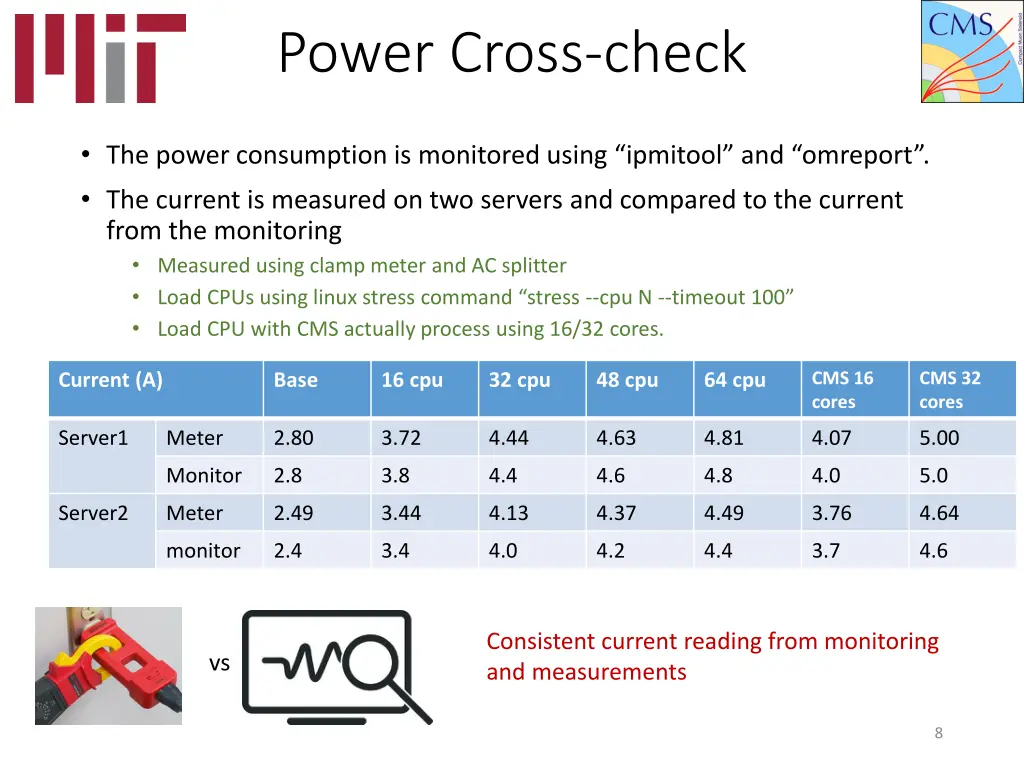
Power Cross-check The power consumption is monitored using ipmitool and omreport . The current is measured on two servers and compared to the current from the monitoring Measured using clamp meter and AC splitter Load CPUs using linux stress command stress --cpu N --timeout 100 Load CPU with CMS actually process using 16/32 cores. CMS 16 cores CMS 32 cores Current (A) Base 16 cpu 32 cpu 48 cpu 64 cpu Server1 Meter 2.80 3.72 4.44 4.63 4.81 4.07 5.00 Monitor 2.8 3.8 4.4 4.6 4.8 4.0 5.0 Server2 Meter 2.49 3.44 4.13 4.37 4.49 3.76 4.64 monitor 2.4 3.4 4.0 4.2 4.4 3.7 4.6 Consistent current reading from monitoring and measurements vs 8
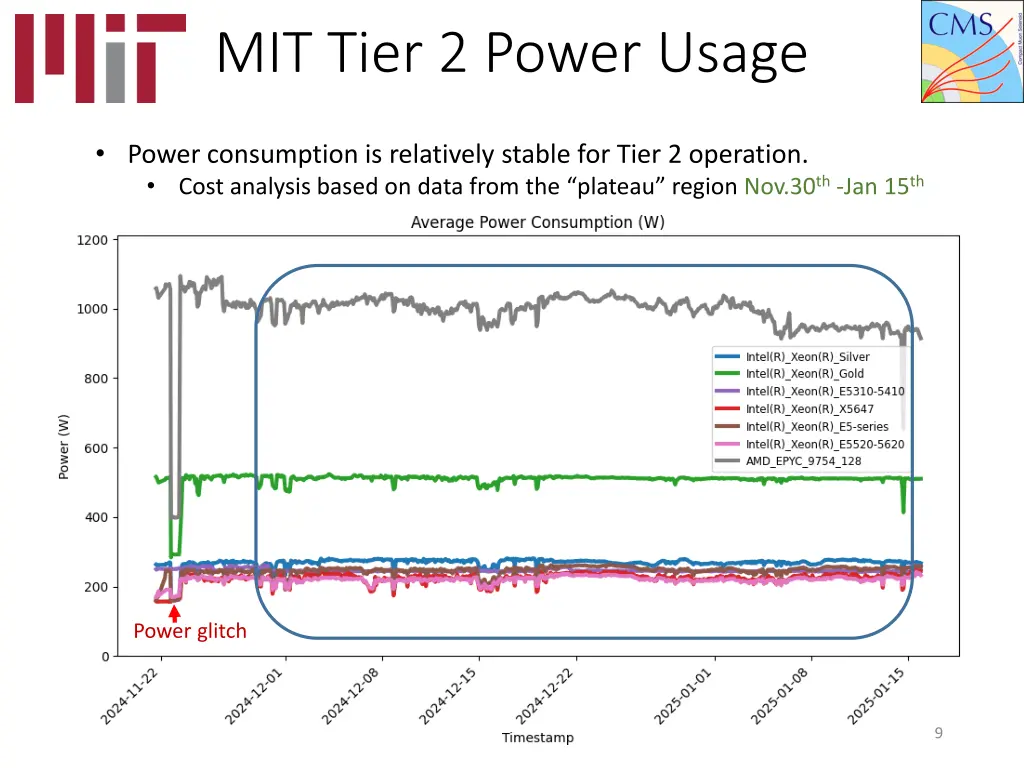
MIT Tier 2 Power Usage Power consumption is relatively stable for Tier 2 operation. Cost analysis based on data from the plateau region Nov.30th-Jan 15th Power glitch 9
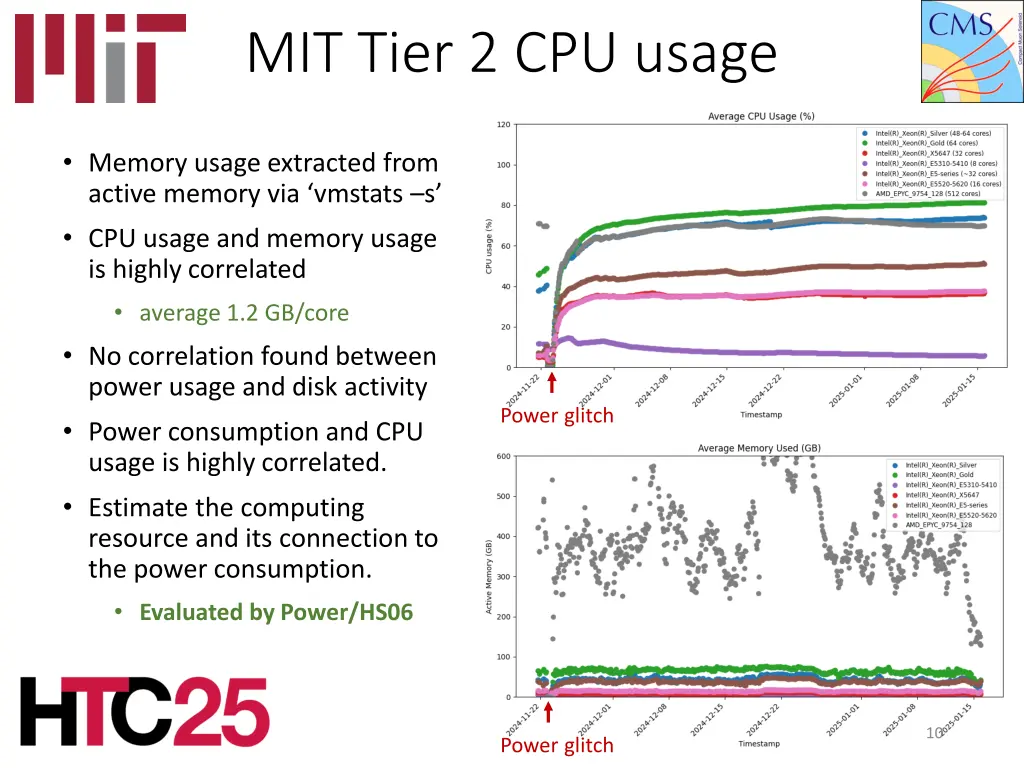
MIT Tier 2 CPU usage Memory usage extracted from active memory via vmstats s CPU usage and memory usage is highly correlated average 1.2 GB/core No correlation found between power usage and disk activity Power consumption and CPU usage is highly correlated. Estimate the computing resource and its connection to the power consumption. Evaluated by Power/HS06 Power glitch 10 Power glitch
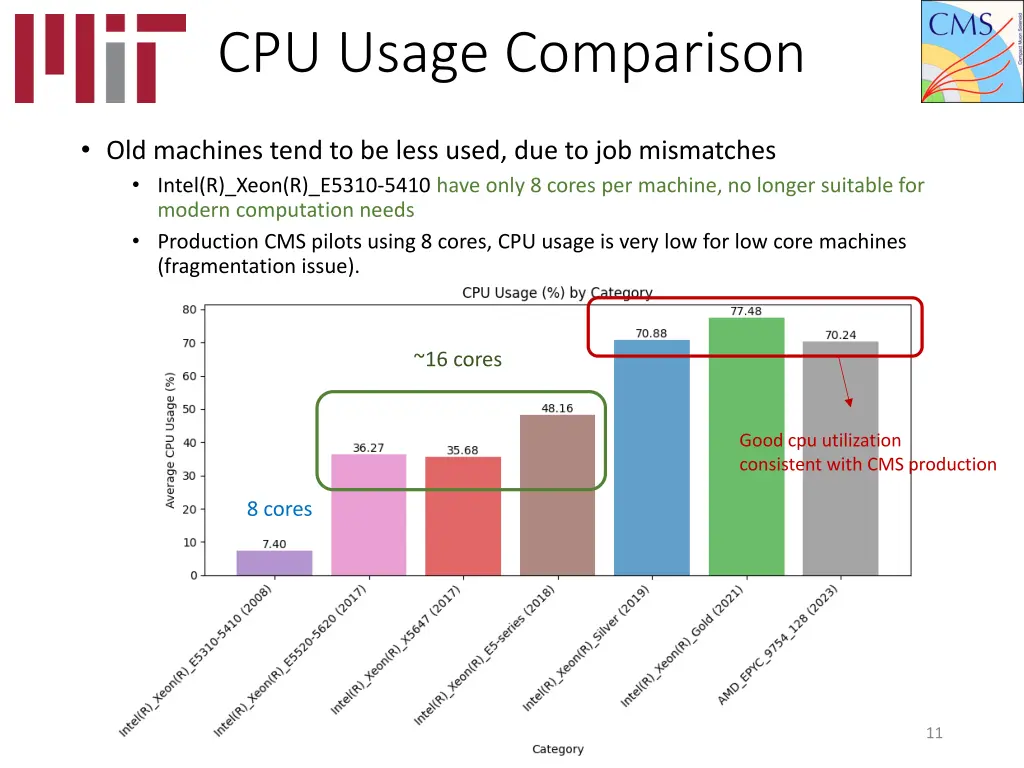
CPU Usage Comparison Old machines tend to be less used, due to job mismatches Intel(R)_Xeon(R)_E5310-5410 have only 8 cores per machine, no longer suitable for modern computation needs Production CMS pilots using 8 cores, CPU usage is very low for low core machines (fragmentation issue). ~16 cores Good cpu utilization consistent with CMS production 8 cores 11
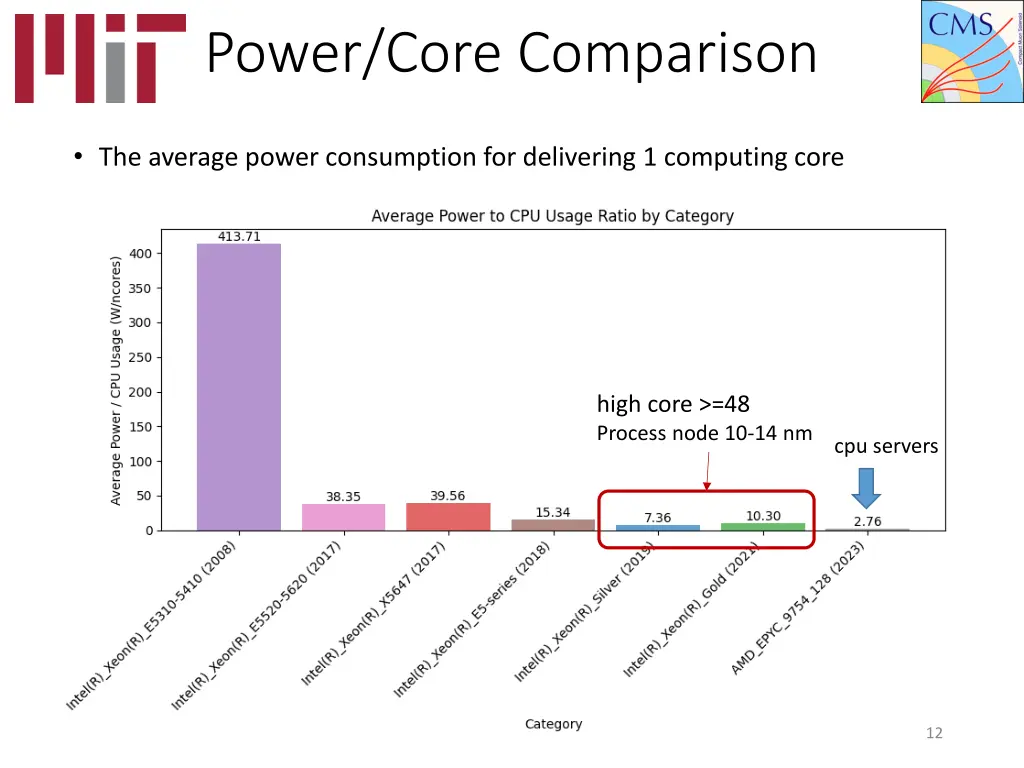
Power/Core Comparison The average power consumption for delivering 1 computing core high core >=48 Process node 10-14 nm cpu servers 12
Power/HS06 Comparison The average power consumption for delivering 100 HS06 of compute >250 time less efficient compared to AMD cpu A factor of 10 times due to low CPU efficiency A factor of 25 times due to hardware power consumption high core >=48 Process node 10-14 nm cpu servers 13
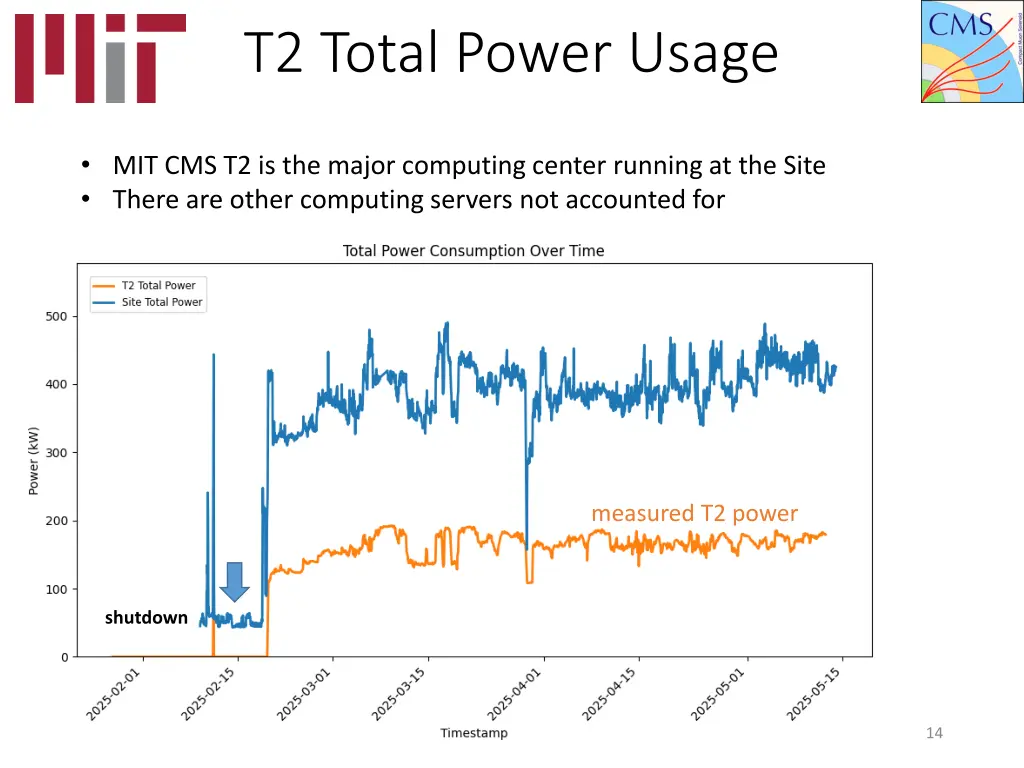
T2 Total Power Usage MIT CMS T2 is the major computing center running at the Site There are other computing servers not accounted for measured T2 power shutdown 14
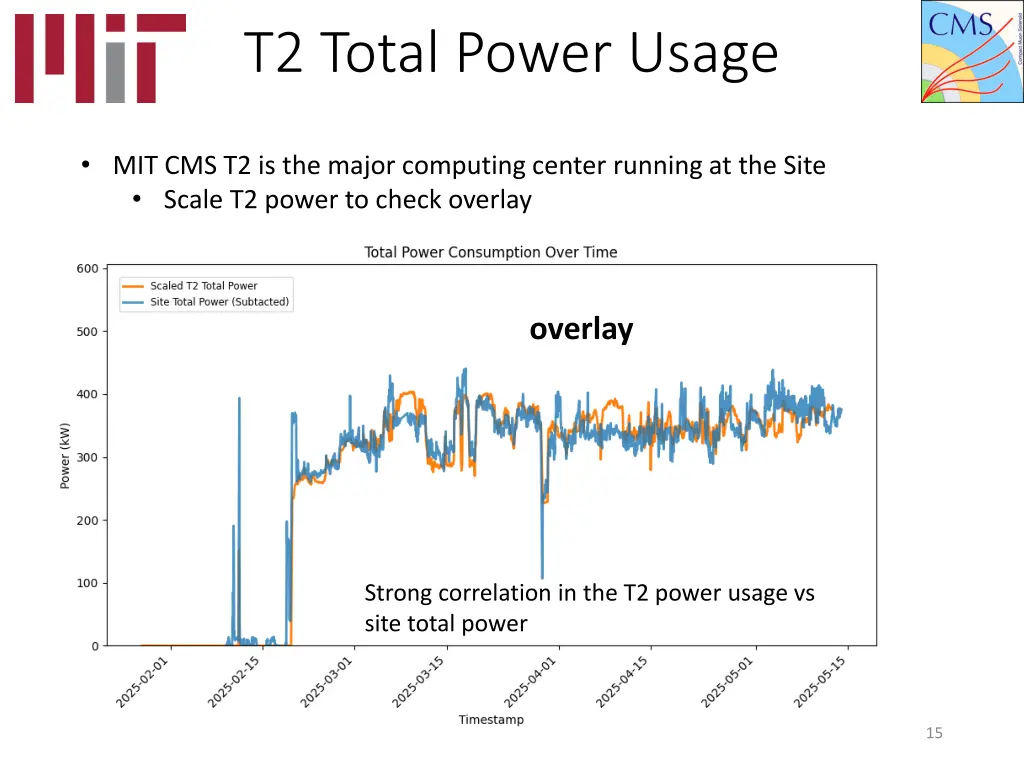
T2 Total Power Usage MIT CMS T2 is the major computing center running at the Site Scale T2 power to check overlay overlay Strong correlation in the T2 power usage vs site total power 15
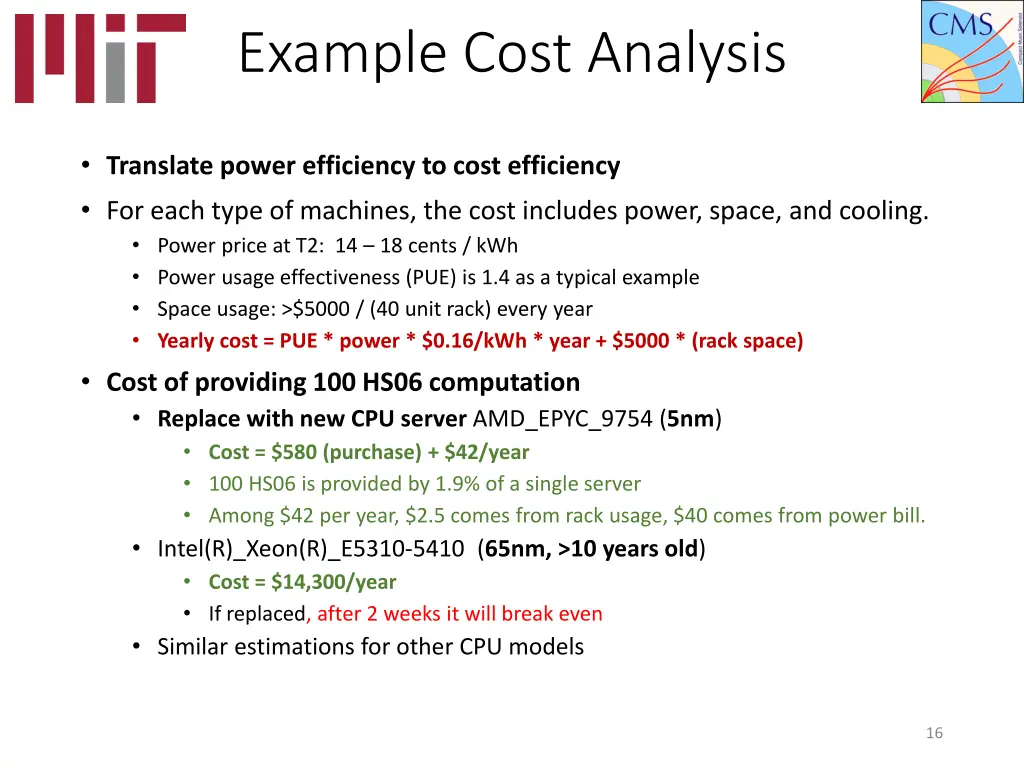
Example Cost Analysis Translate power efficiency to cost efficiency For each type of machines, the cost includes power, space, and cooling. Power price at T2: 14 18 cents / kWh Power usage effectiveness (PUE) is 1.4 as a typical example Space usage: >$5000 / (40 unit rack) every year Yearly cost = PUE * power * $0.16/kWh * year + $5000 * (rack space) Cost of providing 100 HS06 computation Replace with new CPU server AMD_EPYC_9754 (5nm) Cost = $580 (purchase) + $42/year 100 HS06 is provided by 1.9% of a single server Among $42 per year, $2.5 comes from rack usage, $40 comes from power bill. Intel(R)_Xeon(R)_E5310-5410 (65nm, >10 years old) Cost = $14,300/year If replaced, after 2 weeks it will break even Similar estimations for other CPU models 16
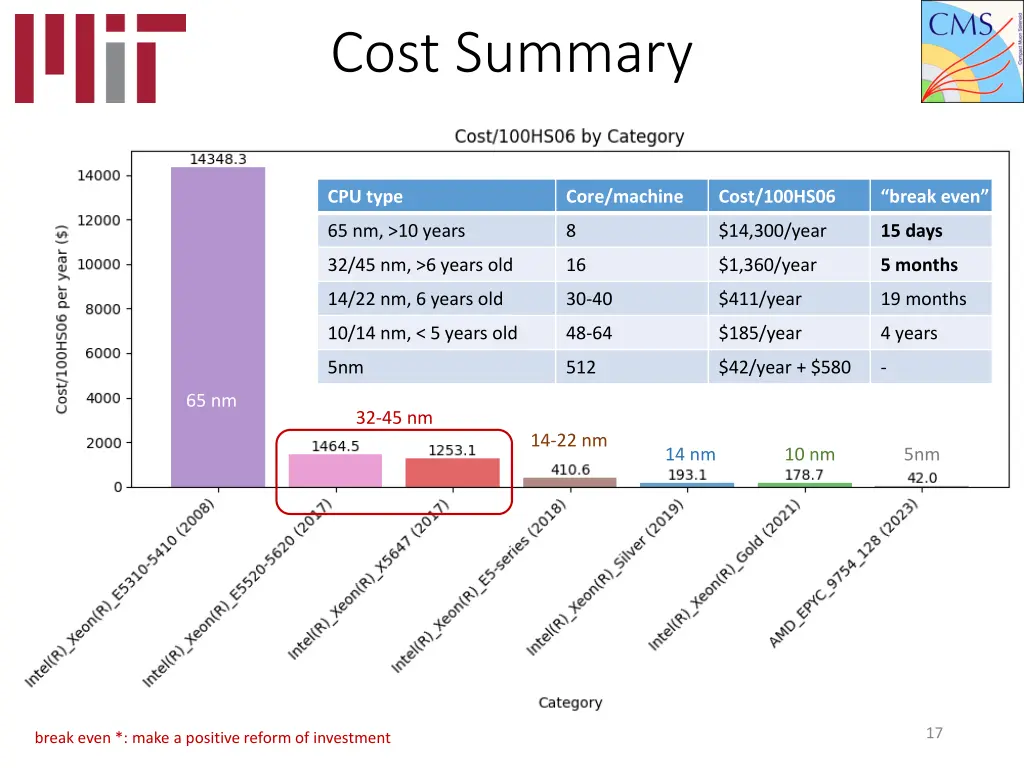
Cost Summary CPU type Core/machine Cost/100HS06 break even 65 nm, >10 years 8 $14,300/year 15 days 32/45 nm, >6 years old 16 $1,360/year 5 months 14/22 nm, 6 years old 30-40 $411/year 19 months 10/14 nm, < 5 years old 48-64 $185/year 4 years 5nm 512 $42/year + $580 - 65 nm 32-45 nm 14-22 nm 14 nm 10 nm 5nm 17 break even *: make a positive reform of investment
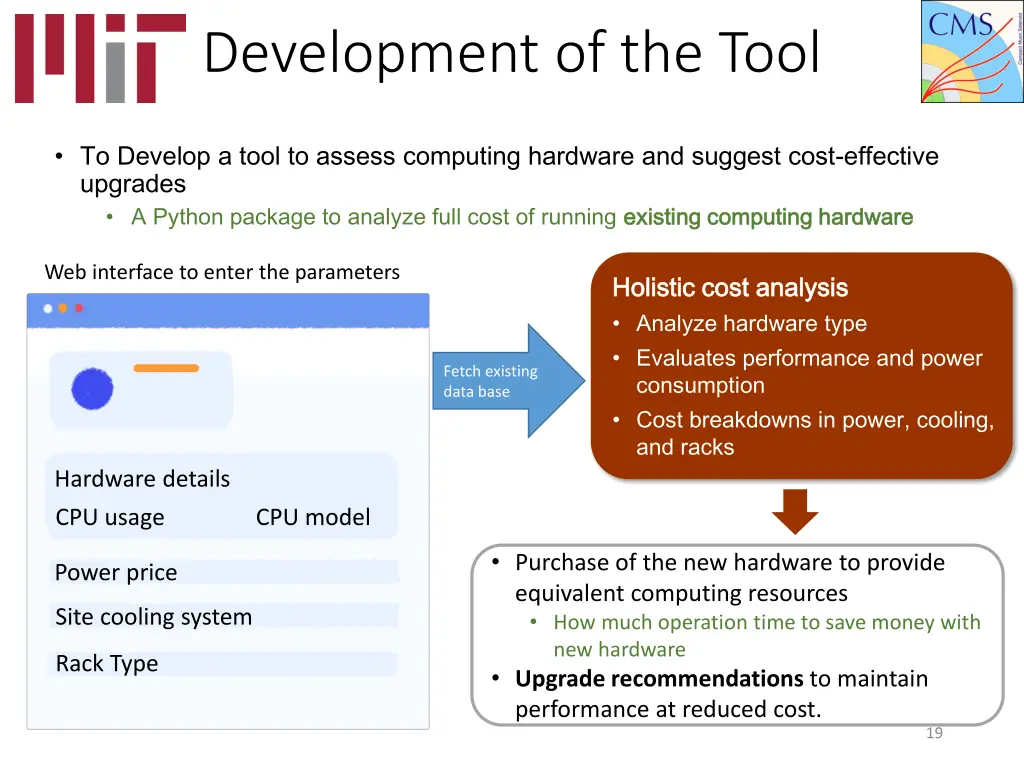
Development of the Tool To Develop a tool to assess computing hardware and suggest cost-effective upgrades A Python package to analyze full cost of running existing computing hardware existing computing hardware Web interface to enter the parameters Holistic cost analysis Holistic cost analysis Analyze hardware type Evaluates performance and power consumption Cost breakdowns in power, cooling, and racks Fetch existing data base Hardware details CPU usage CPU model Purchase of the new hardware to provide equivalent computing resources How much operation time to save money with new hardware Upgrade recommendations to maintain performance at reduced cost. Power price Site cooling system Rack Type 19
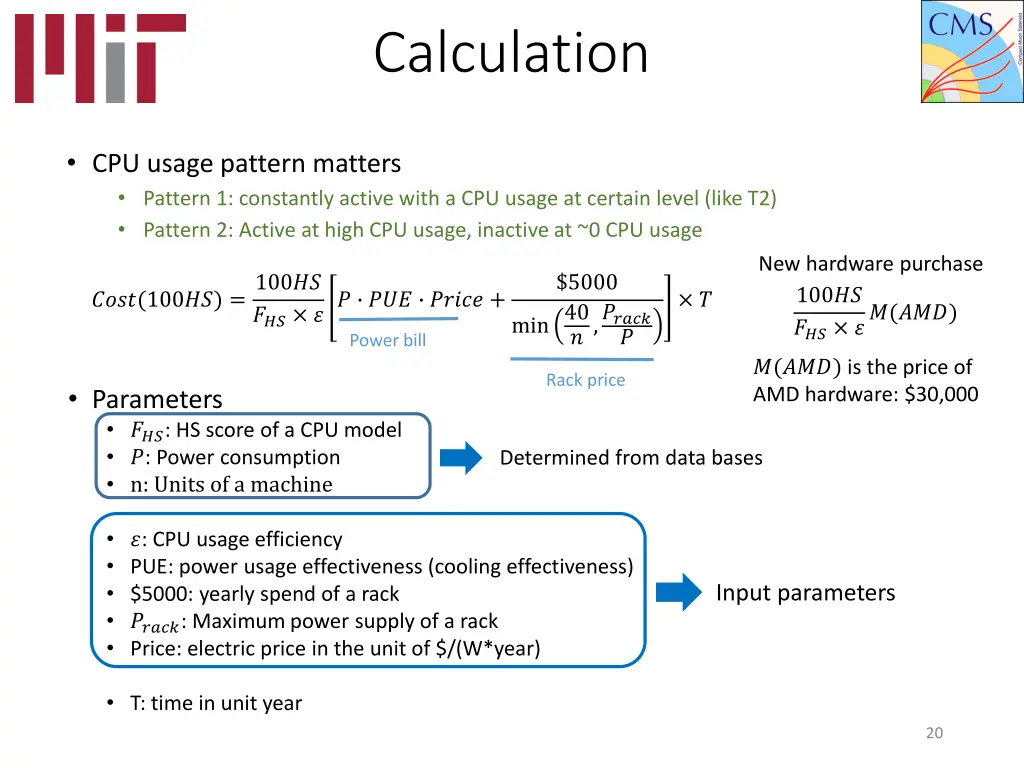
Calculation CPU usage pattern matters Pattern 1: constantly active with a CPU usage at certain level (like T2) Pattern 2: Active at high CPU usage, inactive at ~0 CPU usage New hardware purchase ????(100??) =100?? $5000 ?,????? 100?? ??? ??(???) ??? ?? ??? ????? + Power bill ? min40 ? ?(???) is the price of AMD hardware: $30,000 Rack price Parameters ???: HS score of a CPU model ?: Power consumption n: Units of a machine Determined from data bases ?: CPU usage efficiency PUE: power usage effectiveness (cooling effectiveness) $5000: yearly spend of a rack ?????: Maximum power supply of a rack Price: electric price in the unit of $/(W*year) Input parameters T: time in unit year 20
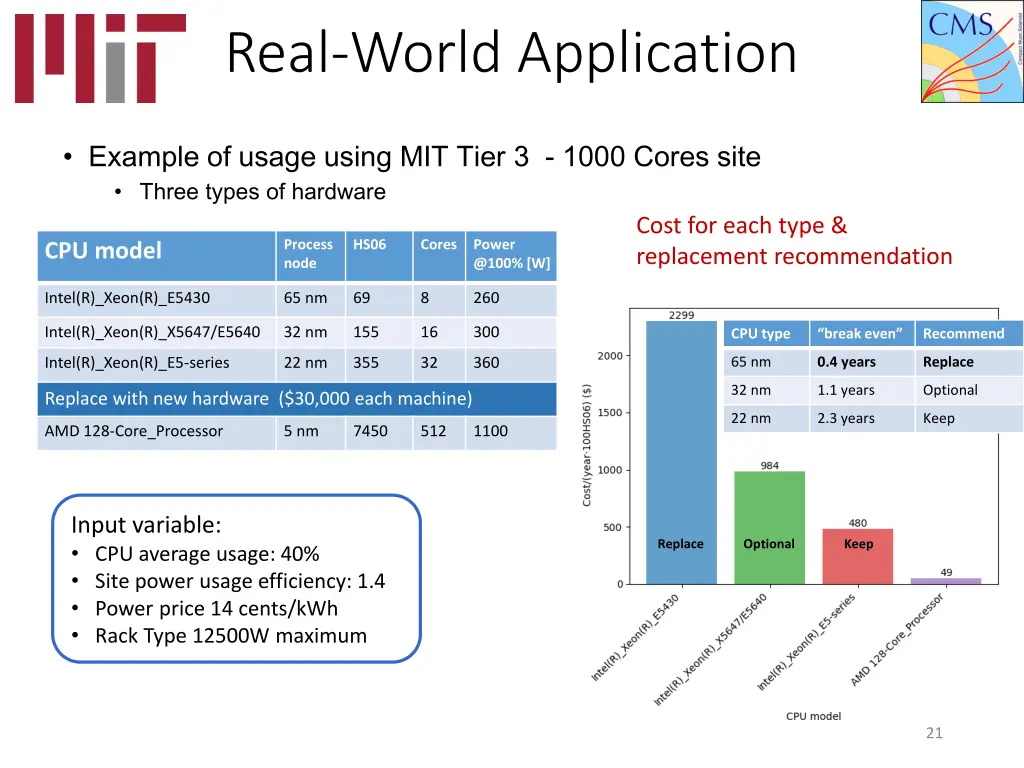
Real-World Application Example of usage using MIT Tier 3 - 1000 Cores site Three types of hardware Cost for each type & replacement recommendation Process node HS06 Cores Power @100% [W] CPU model Intel(R)_Xeon(R)_E5430 65 nm 69 8 260 Intel(R)_Xeon(R)_X5647/E5640 32 nm 155 16 300 CPU type break even Recommend 65 nm 0.4 years Replace Intel(R)_Xeon(R)_E5-series 22 nm 355 32 360 32 nm 1.1 years Optional Replace with new hardware ($30,000 each machine) 22 nm 2.3 years Keep AMD 128-Core_Processor 5 nm 7450 512 1100 Input variable: CPU average usage: 40% Site power usage efficiency: 1.4 Power price 14 cents/kWh Rack Type 12500W maximum Replace Optional Keep 21
Summary Holistic Cost Analysis is presented for running a computing center Cost from the power consumption can be enormous, strongly depends on the hardware and age Smaller computing setups can draw substantial amount of power Old hardware should be replaced to reduce long-term operational costs A rough guideline Hardware older than 10 years should be replaced immediately Hardware older than 7 years should be replaced A node with >30 nm process Cost savings typically realized within 1 2 years. Provide a general tool/way to conduct the cost analysis The End 22
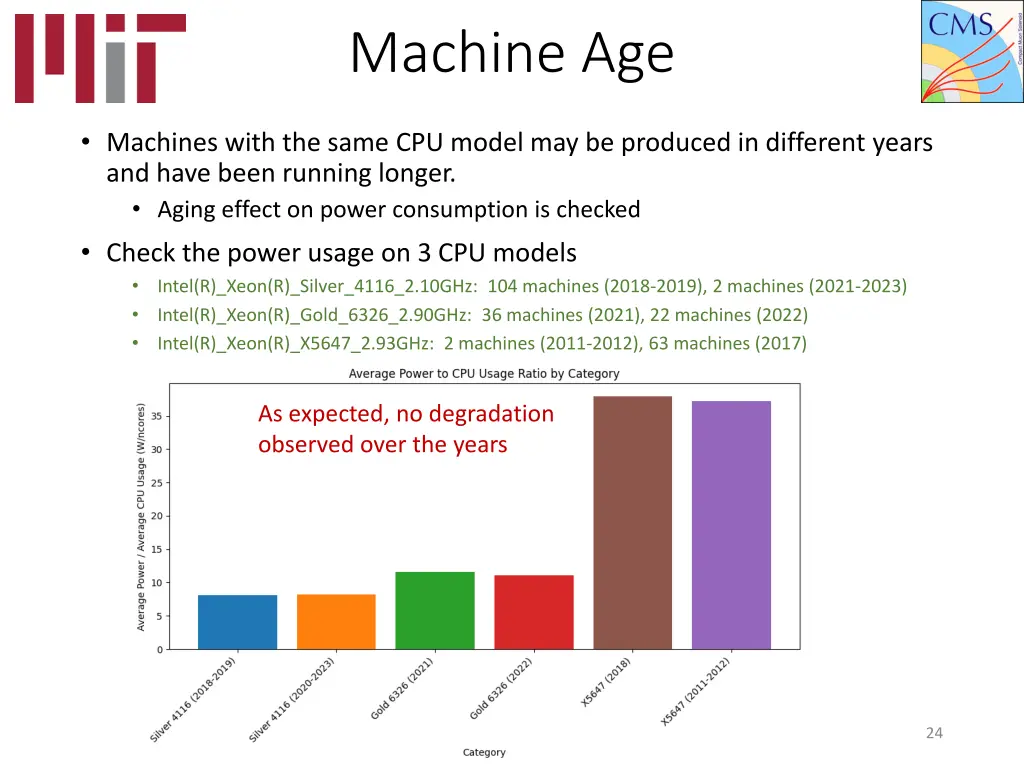
Machine Age Machines with the same CPU model may be produced in different years and have been running longer. Aging effect on power consumption is checked Check the power usage on 3 CPU models Intel(R)_Xeon(R)_Silver_4116_2.10GHz: 104 machines (2018-2019), 2 machines (2021-2023) Intel(R)_Xeon(R)_Gold_6326_2.90GHz: 36 machines (2021), 22 machines (2022) Intel(R)_Xeon(R)_X5647_2.93GHz: 2 machines (2011-2012), 63 machines (2017) As expected, no degradation observed over the years 24