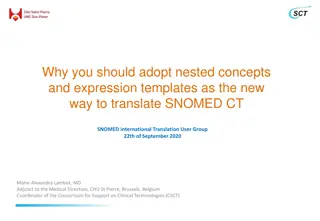
Explore how Natural Language Processing (NLP) is used to annotate German clinical narratives with SNOMED CT, addressing gaps in structured data, clinical text mining challenges, and the importance of terminology linkage. Learn about term matching with localized SNOMED CT versions and recommendations for large-scale eHealth deployments.
Please find below an Image/Link to download the presentation.
The content on the website is provided AS IS for your information and personal use only. It may not be sold, licensed, or shared on other websites without obtaining consent from the author. If you encounter any issues during the download, it is possible that the publisher has removed the file from their server.
You are allowed to download the files provided on this website for personal or commercial use, subject to the condition that they are used lawfully. All files are the property of their respective owners.
The content on the website is provided AS IS for your information and personal use only. It may not be sold, licensed, or shared on other websites without obtaining consent from the author.
E N D
Presentation Transcript
Using NLP for Annotating German Clinical Narratives with SNOMED CT Using Natural Language Processing (NLP) for Annotating German Clinical Narratives with SNOMED CT Stefan Schulz, Markus Kreuzthaler, David Hashemian Nik, Larissa Hammer, Michaela Schneider Institute for Medical Informatics, Statistics and Documentation Medical University of Graz, Austria 1 1
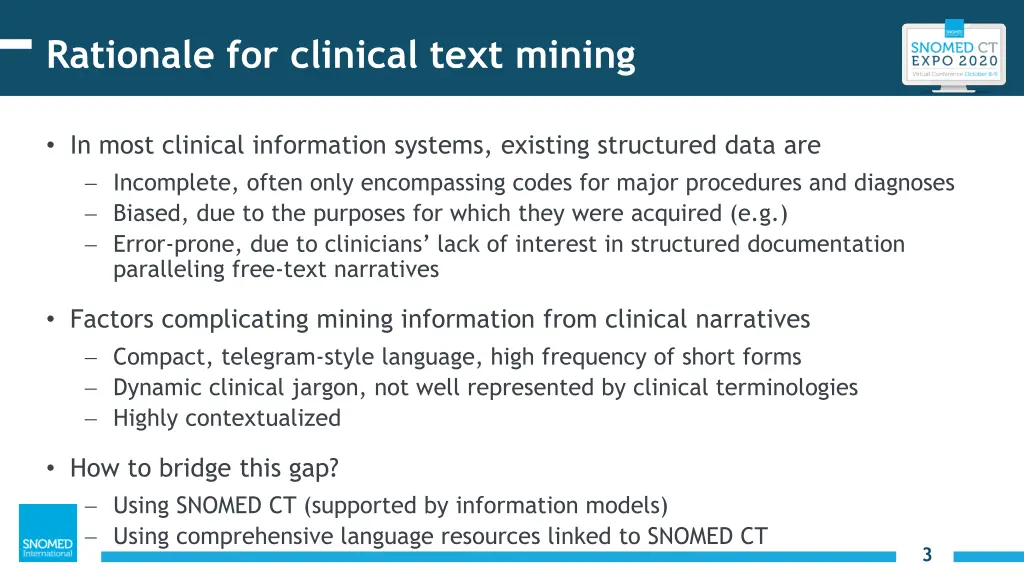
Rationale for clinical text mining In most clinical information systems, existing structured data are Incomplete, often only encompassing codes for major procedures and diagnoses Biased, due to the purposes for which they were acquired (e.g.) Error-prone, due to clinicians lack of interest in structured documentation paralleling free-text narratives Factors complicating mining information from clinical narratives Compact, telegram-style language, high frequency of short forms Dynamic clinical jargon, not well represented by clinical terminologies Highly contextualized How to bridge this gap? Using SNOMED CT (supported by information models) Using comprehensive language resources linked to SNOMED CT 3
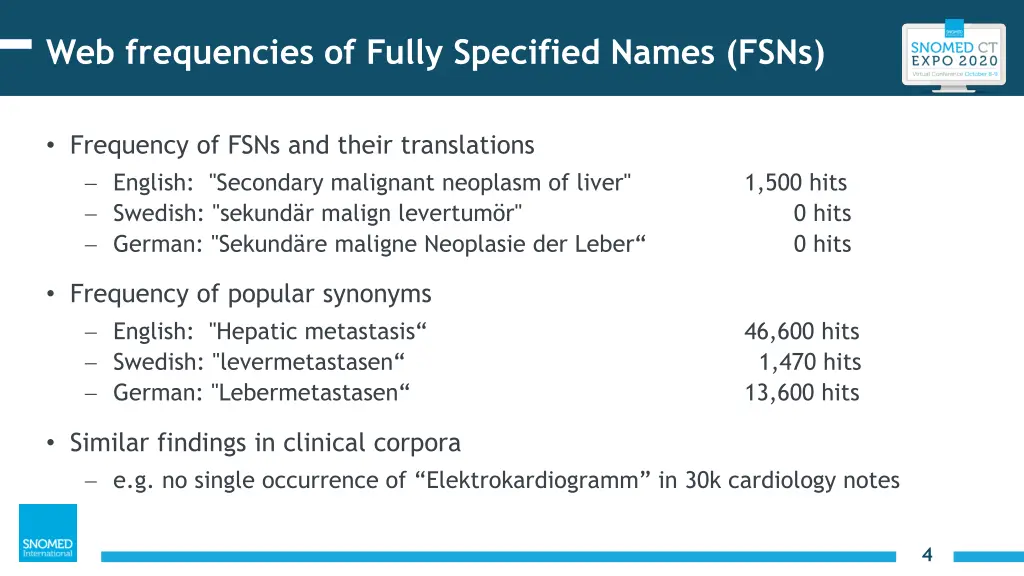
Web frequencies of Fully Specified Names (FSNs) Frequency of FSNs and their translations English: "Secondary malignant neoplasm of liver" Swedish: "sekund r malign levertum r" German: "Sekund re maligne Neoplasie der Leber 1,500 hits 0 hits 0 hits Frequency of popular synonyms English: "Hepatic metastasis Swedish: "levermetastasen German: "Lebermetastasen 46,600 hits 1,470 hits 13,600 hits Similar findings in clinical corpora e.g. no single occurrence of Elektrokardiogramm in 30k cardiology notes 4
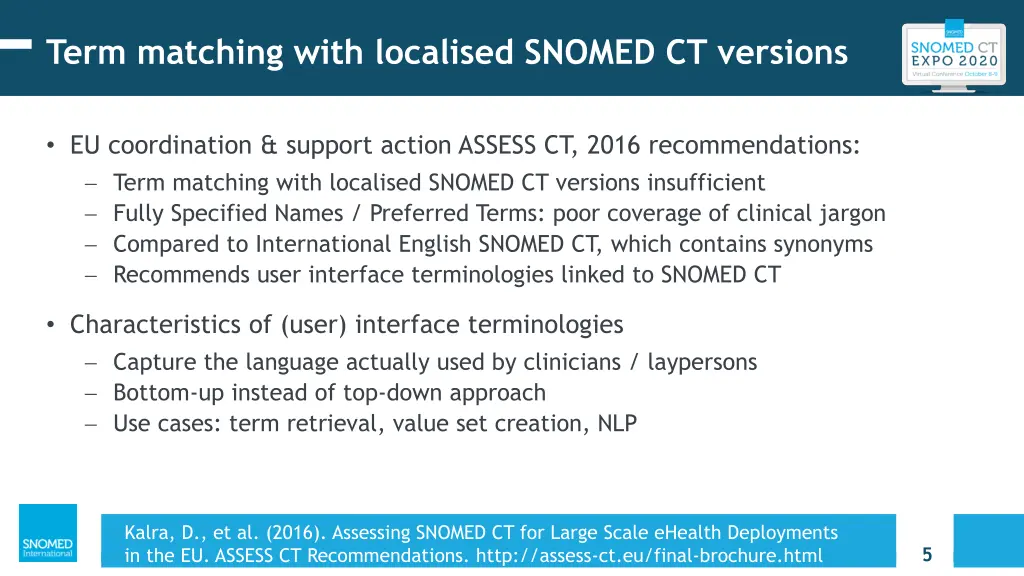
Term matching with localised SNOMED CT versions EU coordination & support action ASSESS CT, 2016 recommendations: Term matching with localised SNOMED CT versions insufficient Fully Specified Names / Preferred Terms: poor coverage of clinical jargon Compared to International English SNOMED CT, which contains synonyms Recommends user interface terminologies linked to SNOMED CT Characteristics of (user) interface terminologies Capture the language actually used by clinicians / laypersons Bottom-up instead of top-down approach Use cases: term retrieval, value set creation, NLP Kalra, D., et al. (2016). Assessing SNOMED CT for Large Scale eHealth Deployments in the EU. ASSESS CT Recommendations. http://assess-ct.eu/final-brochure.html 5
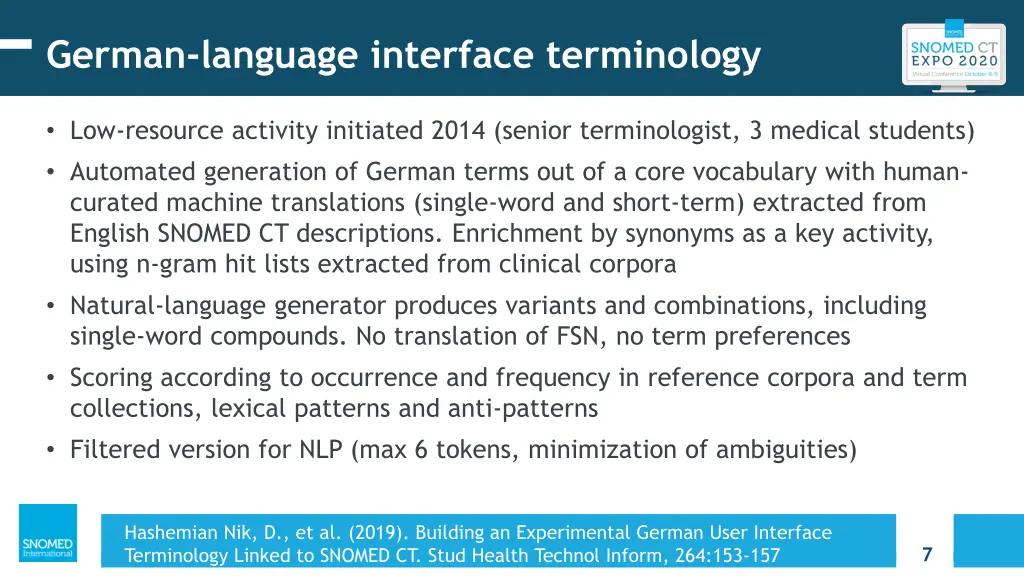
German-language interface terminology Low-resource activity initiated 2014 (senior terminologist, 3 medical students) Automated generation of German terms out of a core vocabulary with human- curated machine translations (single-word and short-term) extracted from English SNOMED CT descriptions. Enrichment by synonyms as a key activity, using n-gram hit lists extracted from clinical corpora Natural-language generator produces variants and combinations, including single-word compounds. No translation of FSN, no term preferences Scoring according to occurrence and frequency in reference corpora and term collections, lexical patterns and anti-patterns Filtered version for NLP (max 6 tokens, minimization of ambiguities) Hashemian Nik, D., et al. (2019). Building an Experimental German User Interface Terminology Linked to SNOMED CT. Stud Health Technol Inform, 264:153-157 7
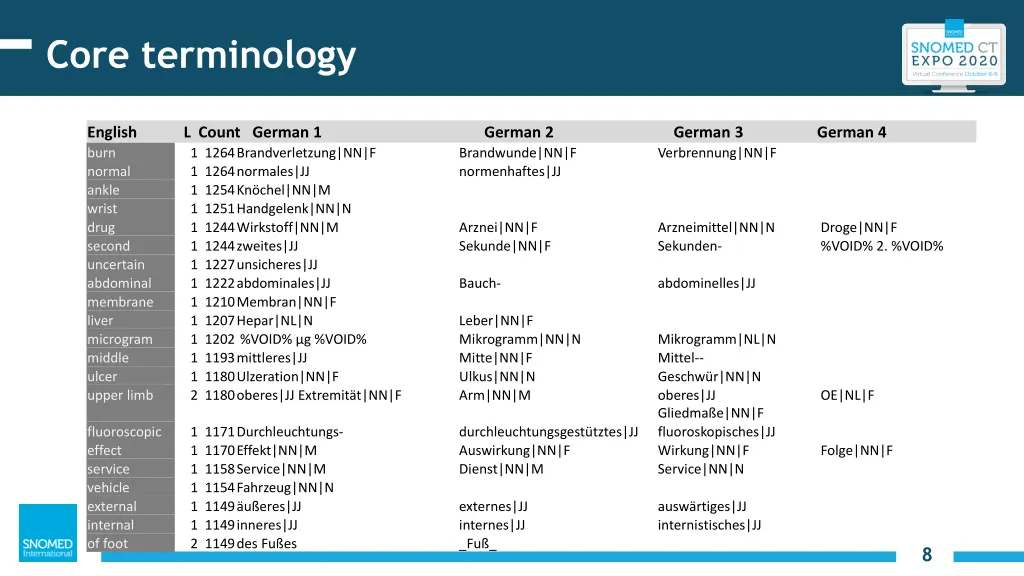
Core terminology English L Count German 1 German 2 German 3 German 4 burn normal ankle wrist drug second uncertain abdominal membrane liver microgram middle ulcer upper limb 1 1264Brandverletzung|NN|F 1 1264normales|JJ 1 1254Kn chel|NN|M 1 1251Handgelenk|NN|N 1 1244Wirkstoff|NN|M 1 1244zweites|JJ 1 1227unsicheres|JJ 1 1222abdominales|JJ 1 1210Membran|NN|F 1 1207Hepar|NL|N 1 1202 %VOID% g %VOID% 1 1193mittleres|JJ 1 1180Ulzeration|NN|F 2 1180oberes|JJ Extremit t|NN|F Brandwunde|NN|F normenhaftes|JJ Verbrennung|NN|F Arznei|NN|F Sekunde|NN|F Arzneimittel|NN|N Sekunden- Droge|NN|F %VOID% 2. %VOID% Bauch- abdominelles|JJ Leber|NN|F Mikrogramm|NN|N Mitte|NN|F Ulkus|NN|N Arm|NN|M Mikrogramm|NL|N Mittel-- Geschw r|NN|N oberes|JJ Gliedma e|NN|F fluoroskopisches|JJ Wirkung|NN|F Service|NN|N OE|NL|F fluoroscopic effect service vehicle external internal of foot 1 1171Durchleuchtungs- 1 1170Effekt|NN|M 1 1158Service|NN|M 1 1154Fahrzeug|NN|N 1 1149 u eres|JJ 1 1149inneres|JJ 2 1149des Fu es durchleuchtungsgest tztes|JJ Auswirkung|NN|F Dienst|NN|M Folge|NN|F externes|JJ internes|JJ _Fu _ ausw rtiges|JJ internistisches|JJ 8
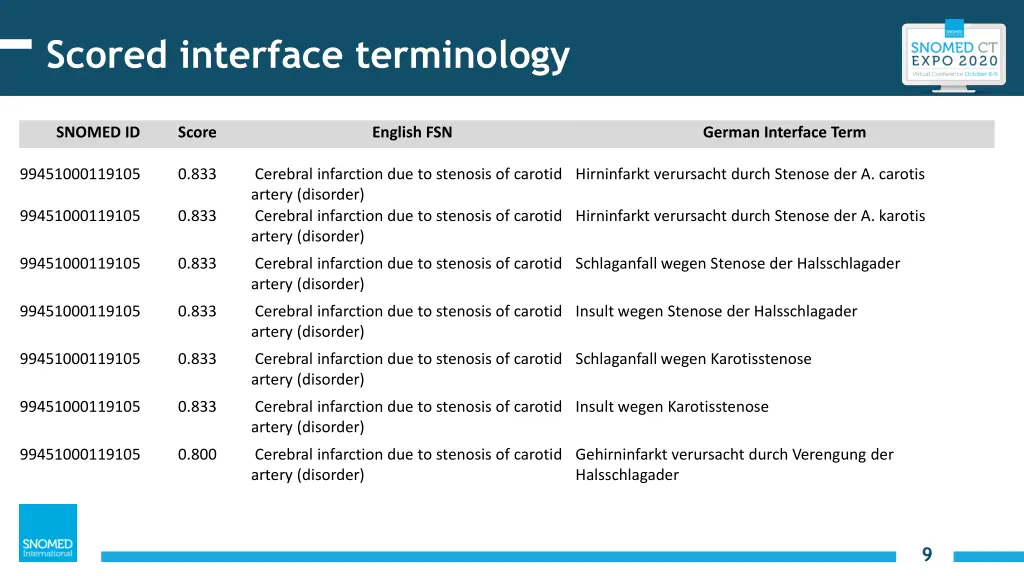
Scored interface terminology SNOMED ID Score English FSN German Interface Term 99451000119105 0.833 Cerebral infarction due to stenosis of carotid artery (disorder) Cerebral infarction due to stenosis of carotid artery (disorder) Hirninfarkt verursacht durch Stenose der A. carotis 99451000119105 0.833 Hirninfarkt verursacht durch Stenose der A. karotis 99451000119105 0.833 Cerebral infarction due to stenosis of carotid artery (disorder) Schlaganfall wegen Stenose der Halsschlagader 99451000119105 0.833 Cerebral infarction due to stenosis of carotid artery (disorder) Insult wegen Stenose der Halsschlagader 99451000119105 0.833 Cerebral infarction due to stenosis of carotid artery (disorder) Schlaganfall wegen Karotisstenose 99451000119105 0.833 Cerebral infarction due to stenosis of carotid artery (disorder) Insult wegen Karotisstenose 99451000119105 0.800 Cerebral infarction due to stenosis of carotid artery (disorder) Gehirninfarkt verursacht durch Verengung der Halsschlagader 9
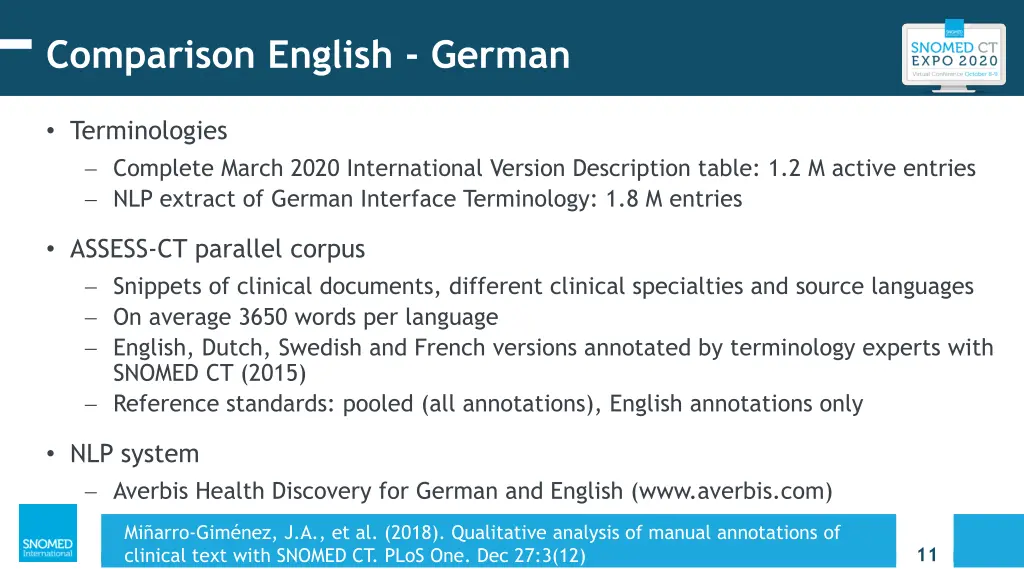
Comparison English - German Terminologies Complete March 2020 International Version Description table: 1.2 M active entries NLP extract of German Interface Terminology: 1.8 M entries ASSESS-CT parallel corpus Snippets of clinical documents, different clinical specialties and source languages On average 3650 words per language English, Dutch, Swedish and French versions annotated by terminology experts with SNOMED CT (2015) Reference standards: pooled (all annotations), English annotations only NLP system Averbis Health Discovery for German and English (www.averbis.com) Mi arro-Gim nez, J.A., et al. (2018). Qualitative analysis of manual annotations of clinical text with SNOMED CT. PLoS One. Dec 27:3(12) 11
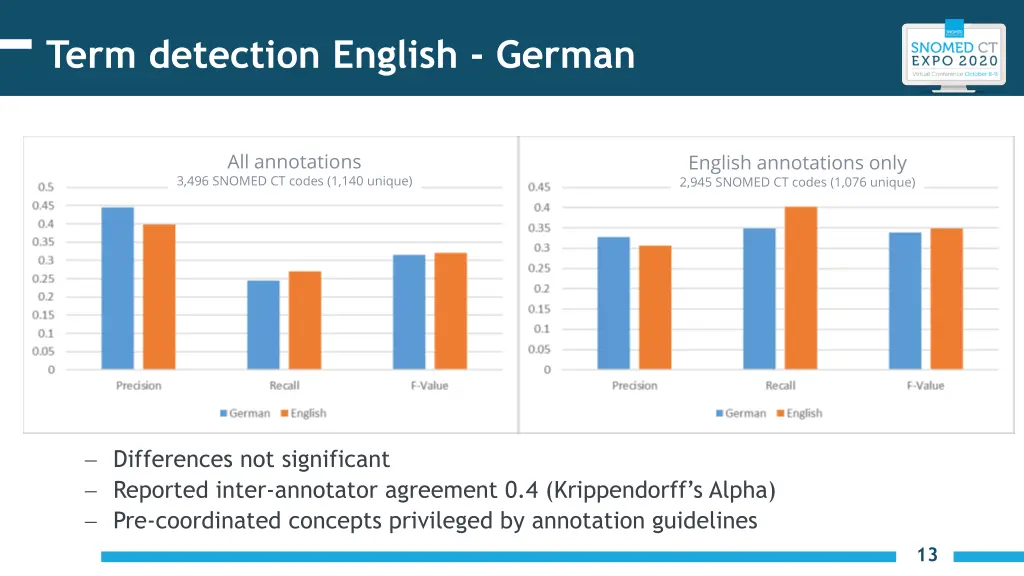
Term detection English - German All annotations 3,496 SNOMED CT codes (1,140 unique) English annotations only 2,945 SNOMED CT codes (1,076 unique) Differences not significant Reported inter-annotator agreement 0.4 (Krippendorff s Alpha) Pre-coordinated concepts privileged by annotation guidelines 13
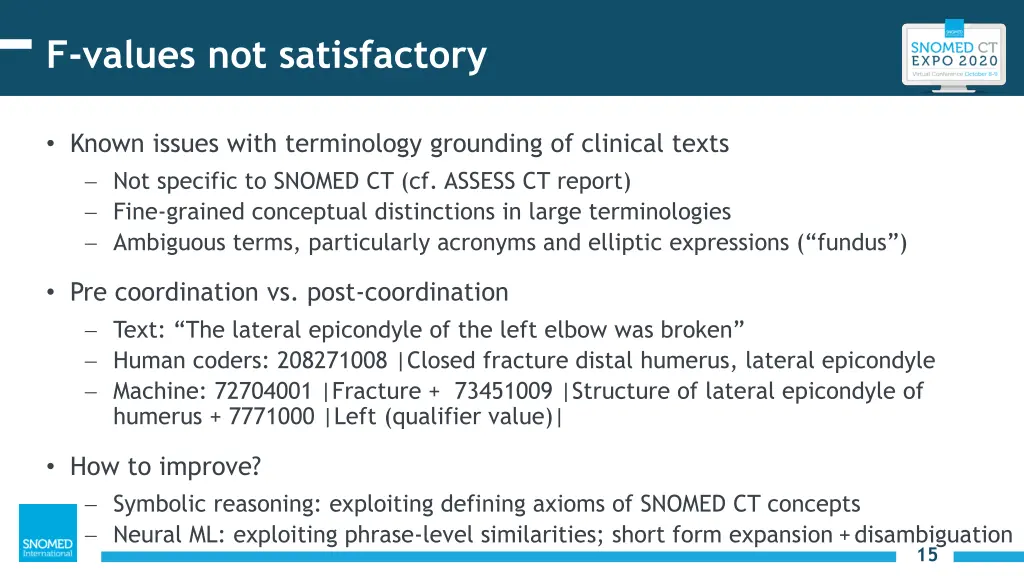
F-values not satisfactory Known issues with terminology grounding of clinical texts Not specific to SNOMED CT (cf. ASSESS CT report) Fine-grained conceptual distinctions in large terminologies Ambiguous terms, particularly acronyms and elliptic expressions ( fundus ) Pre coordination vs. post-coordination Text: The lateral epicondyle of the left elbow was broken Human coders: 208271008 |Closed fracture distal humerus, lateral epicondyle Machine: 72704001 |Fracture + 73451009 |Structure of lateral epicondyle of humerus + 7771000 |Left (qualifier value)| How to improve? Symbolic reasoning: exploiting defining axioms of SNOMED CT concepts Neural ML: exploiting phrase-level similarities; short form expansion+disambiguation 15
Encouraging for interface terminology approach German interface terminology behaves as well on German texts as English SNOMED CT descriptions on English text Remarkable due to absence of German SNOMED CT translation and low-resource terminology-building approach Puts the benefits of the traditional terminology translation process into perspective Example Swedish SNOMED CT translation: > 8 M , but much lower term matching rate compared to English on same corpus (cf. ASSESS-CT) Conclusion At least for NLP: Interface terminology construction more cost-effective Independent of language: still a long way to go to really satisfactory text mining results of real-world clinical texts Mi arro-Gim nez, J.A., et al. (2019) Quantitative analysis of manual annotation of clinical text samples. Int J Med Inform.:123:37-48 16
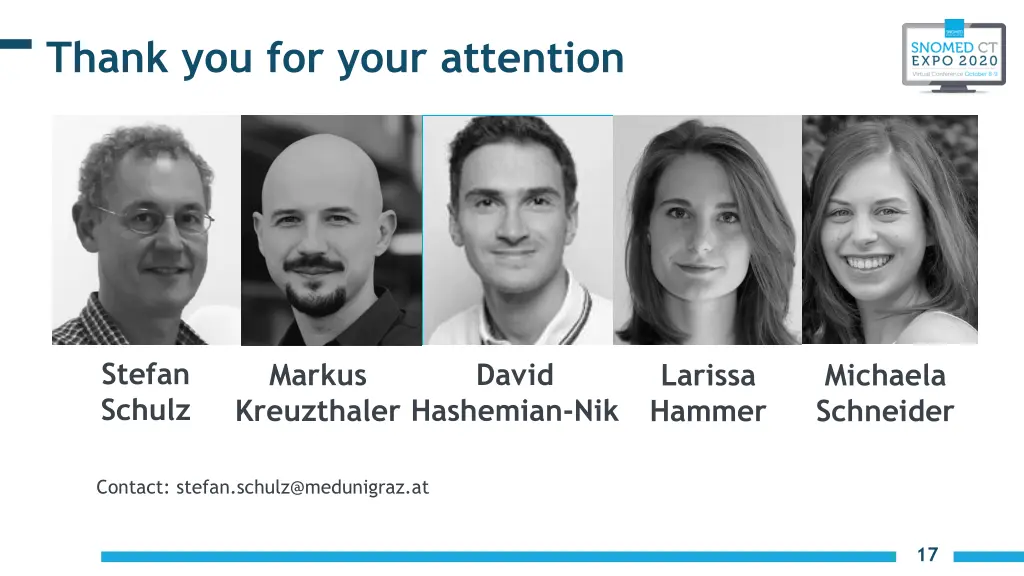
Thank you for your attention Stefan Schulz David Markus Kreuzthaler Larissa Hammer Michaela Schneider Hashemian-Nik Contact: stefan.schulz@medunigraz.at 17