Approach and Research Plan for Career Development Grant Writing Course
Explore the approach and distinctive features of a research plan for a mentored K award in the field of grant writing. Delve into the general strategy, aims, methodologies, and potential pitfalls to anticipate in your career development journey.

Download Presentation

Please find below an Image/Link to download the presentation.
The content on the website is provided AS IS for your information and personal use only. It may not be sold, licensed, or shared on other websites without obtaining consent from the author. If you encounter any issues during the download, it is possible that the publisher has removed the file from their server.
You are allowed to download the files provided on this website for personal or commercial use, subject to the condition that they are used lawfully. All files are the property of their respective owners.
The content on the website is provided AS IS for your information and personal use only. It may not be sold, licensed, or shared on other websites without obtaining consent from the author.
E N D
Presentation Transcript
BU Career Development Grant Writing Course- Session 3, Approach
Initial Thoughts Initial Thoughts Of all the review criteria, approach most closely correlates with overall impact score Experiments/studies designed to test each aim Include enough detail to convince Reviewers that you understand and can handle a method Mentorship is important here Think less is best propose a clearly defined problem, with each Aim addressing part of that problem. This is clear and not overly ambitious
Distinctive Features of a Research Plan for a Distinctive Features of a Research Plan for a Mentored K award Mentored K award 3 key things to remember when designing a research plan for a K award. 1.The research plan is a training vehicle. The research plan should be well integrated with your career development training plan. 2. The research plan is a means to achieve independence. The research plan should be viewed as a precursor for a subsequent R. 3. Mentored K awards provide limited funding. The scope of the research plan needs to be appropriate and feasible, given the modest resources available in a mentored K award. A modular approach is possible, which might include several small projects, such as secondary analyses of existing data, leveraging ongoing cohort studies or clinical trials, or conducting a small pilot study.
Approach: General Approach: General Describe the overall strategy, methodology, and analyses to be used to accomplish each specific aim. Include how the data will be collected, analyzed, and interpreted as well as any resource sharing plans as appropriate. Describe any strategy to establish feasibility, and strategy to manage any high risk aspects of the work. A discussion of possible problems and how they will be managed, alternative approaches that might be tried if the initial approaches do not work, and benchmarks for success
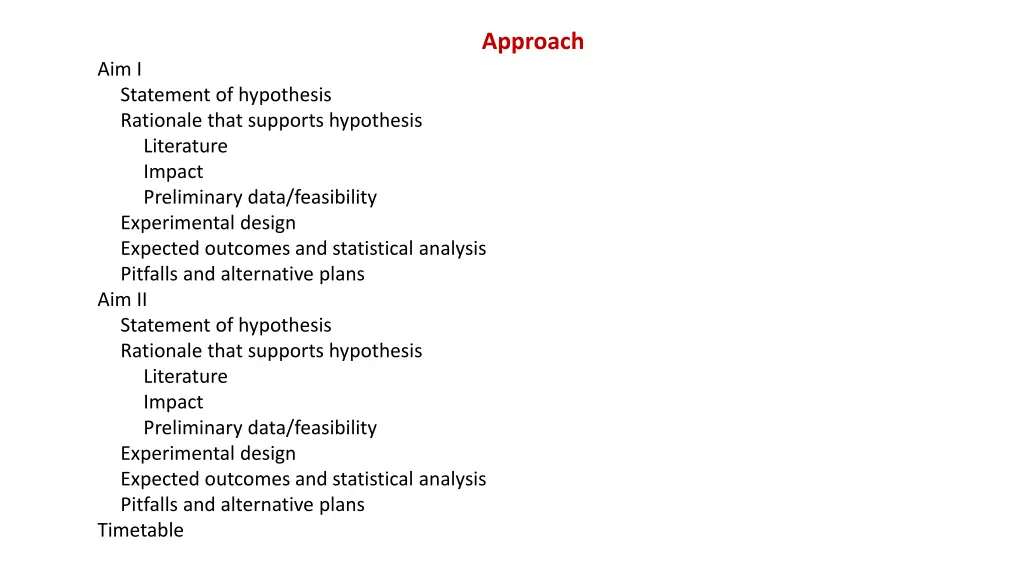
Approach Aim I Statement of hypothesis Rationale that supports hypothesis Literature Impact Preliminary data/feasibility Experimental design Expected outcomes and statistical analysis Pitfalls and alternative plans Aim II Statement of hypothesis Rationale that supports hypothesis Literature Impact Preliminary data/feasibility Experimental design Expected outcomes and statistical analysis Pitfalls and alternative plans Timetable
11. Research Strategy 11. Research Strategy Significance Innovation Approach Preliminary studies Research Design & Methods Data Analysis Challenges & Solutions Timeline Often organized by aim
Preliminary Studies Preliminary Studies Make it clear what you do well and what unique skills you and your team bring to the research Show how your previous experience prepared you for the project Feasibility Informs power/sample size calculations Interpret your preliminary results critically Make clear which data are yours & which are not
Research Design & Methods Research Design & Methods Data sources Study population Data collection Recruitment, sampling strategy Inclusion/exclusion criteria Enrollment & attrition if secondary analysis Procedures: Interviewer-administered questionnaire Focus groups Semi-structured interviews Medical records Neighborhood canvassing Randomization
Analysis Plan Analysis Plan Measures Statistical analysis Power calculations
Measures Measures Must mirror what is in the aims Conceptual framework New, established, modified/adapted? Tailor details: Procedures Sensitivity/specificity Citations [Cronbach s ] Validation Detail: Dependent & independent > mediators > confounders RCT: clearly distinguish control from treatment
Statistical Analysis Statistical Analysis Hypothesis testing Outline your analytical approach Exploratory data analysis Modeling approach Assumptions Missing data For qualitative studies, describe content analysis
Power and Sample Size Power and Sample Size Depends on what you are starting with: Secondary data analysis: sample size is fixed Budget for data collection is limited Ability to detect the difference* you are trying to see * meaningful difference: effect size For the sake of space, power your weakest aim Make this explicit
Challenges & Solutions Challenges & Solutions Anticipate reviewers concerns and outline how you will change gears if necessary if/then Also in this section can highlight strengths of study
Activity Activity Read Approach sections of successful grants We will discuss
Assignment Assignment Revise S & I sections Write Approach sections Send to group a minimum of 3-5 days before class