Explore Aristotle’s Nicomachean Ethics, delving into the concept of eudaimonia, virtues of disposition, and the doctrine of the mean. Understand the three different types of flourishing lives according to Aristotle and the function argument explaining why humans have a unique function. Discover the essence of human existence through Aristotle’s philosophical insights.
Please find below an Image/Link to download the presentation.
The content on the website is provided AS IS for your information and personal use only. It may not be sold, licensed, or shared on other websites without obtaining consent from the author. If you encounter any issues during the download, it is possible that the publisher has removed the file from their server.
You are allowed to download the files provided on this website for personal or commercial use, subject to the condition that they are used lawfully. All files are the property of their respective owners.
The content on the website is provided AS IS for your information and personal use only. It may not be sold, licensed, or shared on other websites without obtaining consent from the author.
E N D
Presentation Transcript
Nicomachean Ethics Defining eudaimonia The psyche Doctrine of the mean Virtues of disposition
Preliminary notes Defining ethics : Ta ethika: characteristics, dispositions Descriptive work (includes some prescriptions) Defining good : Criticises the Platonic Good (absolute good) Aristotle: good is relative (e.g. a human good) Study of ethics: Practical science (like politics) Ethics is a sub-division of politics Imprecise (human circumstances are too complex) Doesn t assume that the flourishing life is the virtuous life
Opening assumptions All actions aim towards the good 1. Activity aims towards a telos (an end) 2. There s one telos for each kind of activity 3. Eudaimonia is the goal (telos) of all actions 4. This is how things are because nature arranges things for the best
3 different kinds of flourishing lives (eudaimonia) 1. Life of pleasure 2. Life of honour and worldly success 3. Some kind of rational life
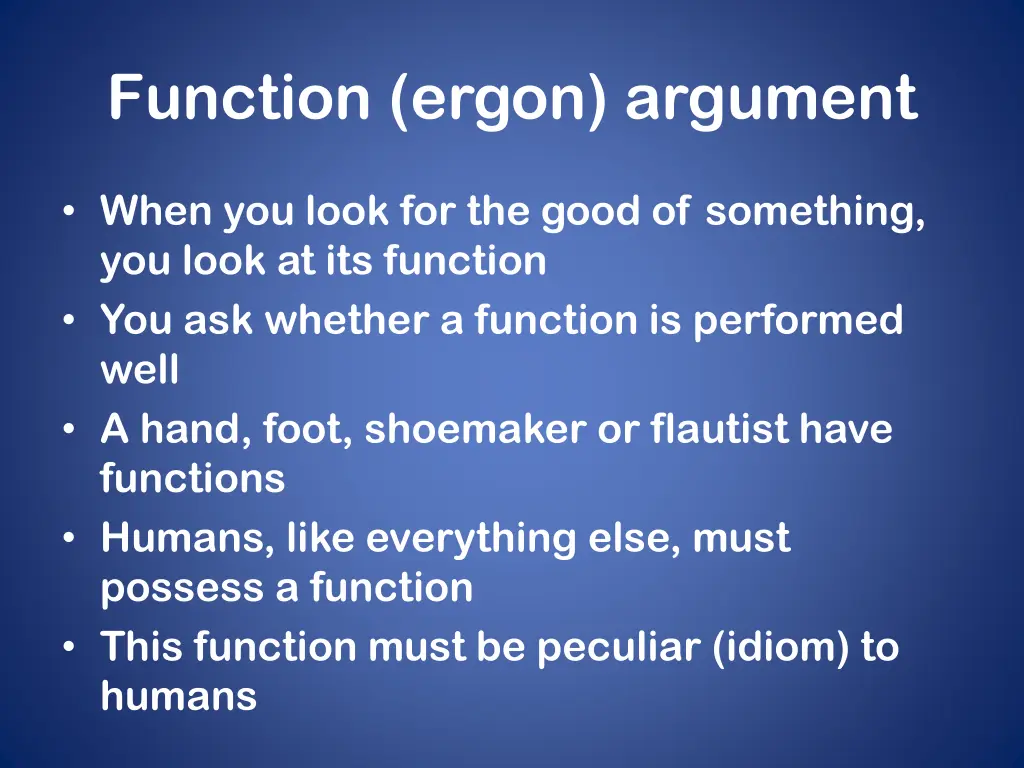
Function (ergon) argument When you look for the good of something, you look at its function You ask whether a function is performed well A hand, foot, shoemaker or flautist have functions Humans, like everything else, must possess a function This function must be peculiar (idiom) to humans
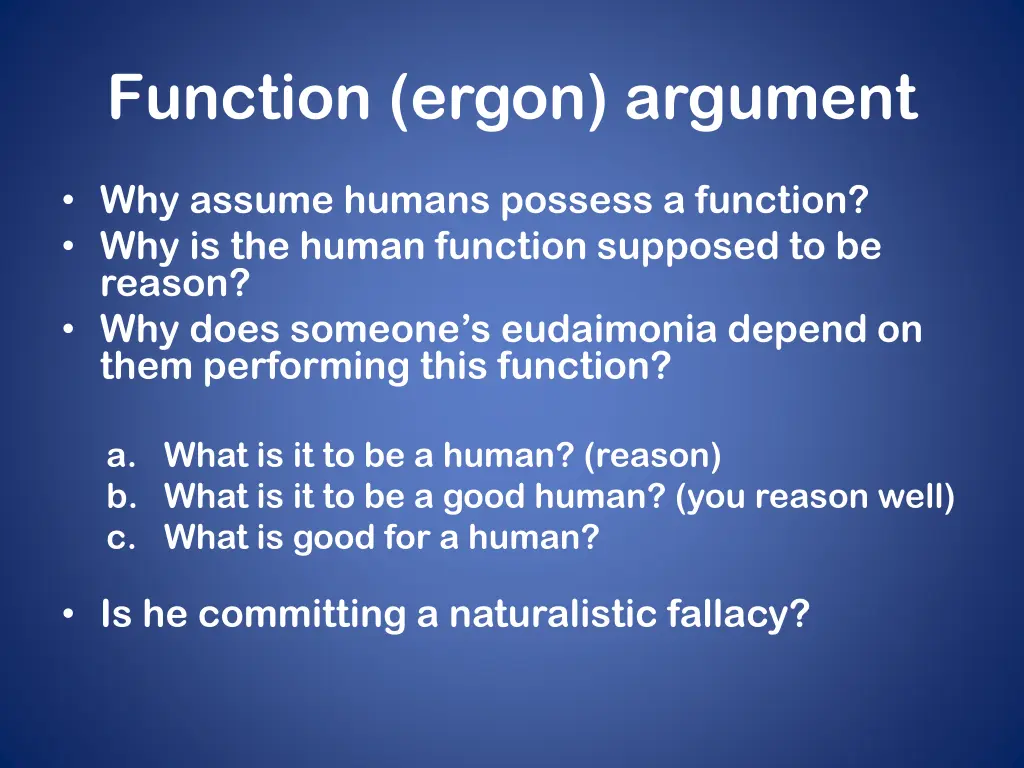
Function (ergon) argument Why assume humans possess a function? Why is the human function supposed to be reason? Why does someone s eudaimonia depend on them performing this function? a. What is it to be a human? (reason) b. What is it to be a good human? (you reason well) c. What is good for a human? Is he committing a naturalistic fallacy?
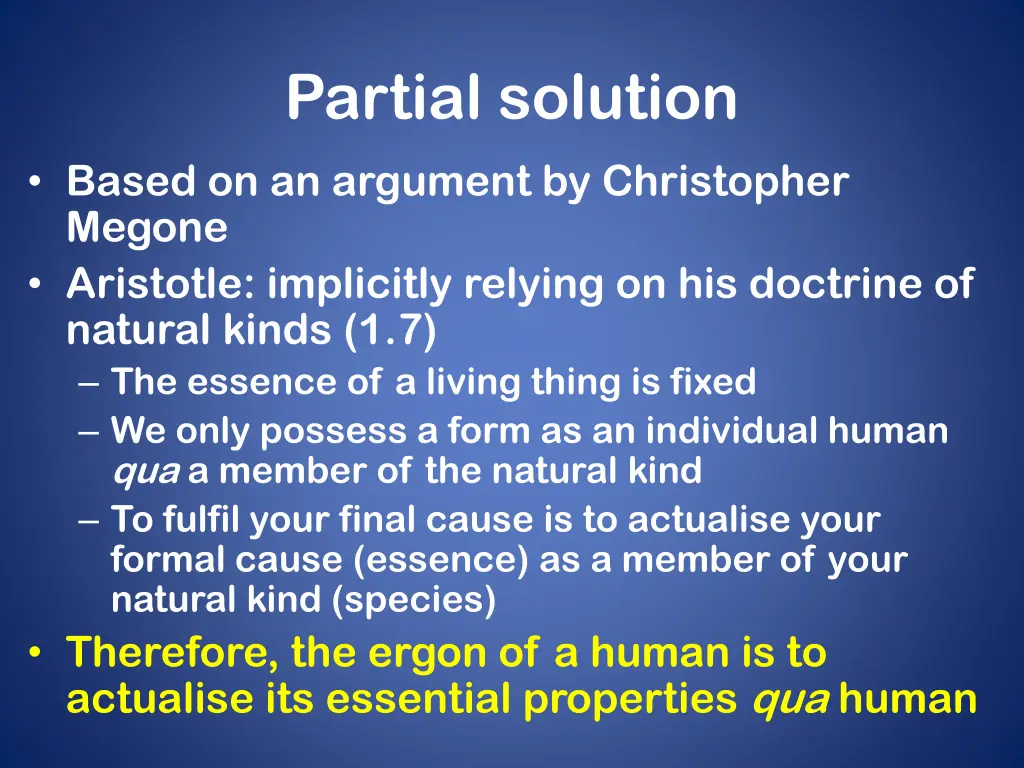
Partial solution Based on an argument by Christopher Megone Aristotle: implicitly relying on his doctrine of natural kinds (1.7) The essence of a living thing is fixed We only possess a form as an individual human qua a member of the natural kind To fulfil your final cause is to actualise your formal cause (essence) as a member of your natural kind (species) Therefore, the ergon of a human is to actualise its essential properties qua human
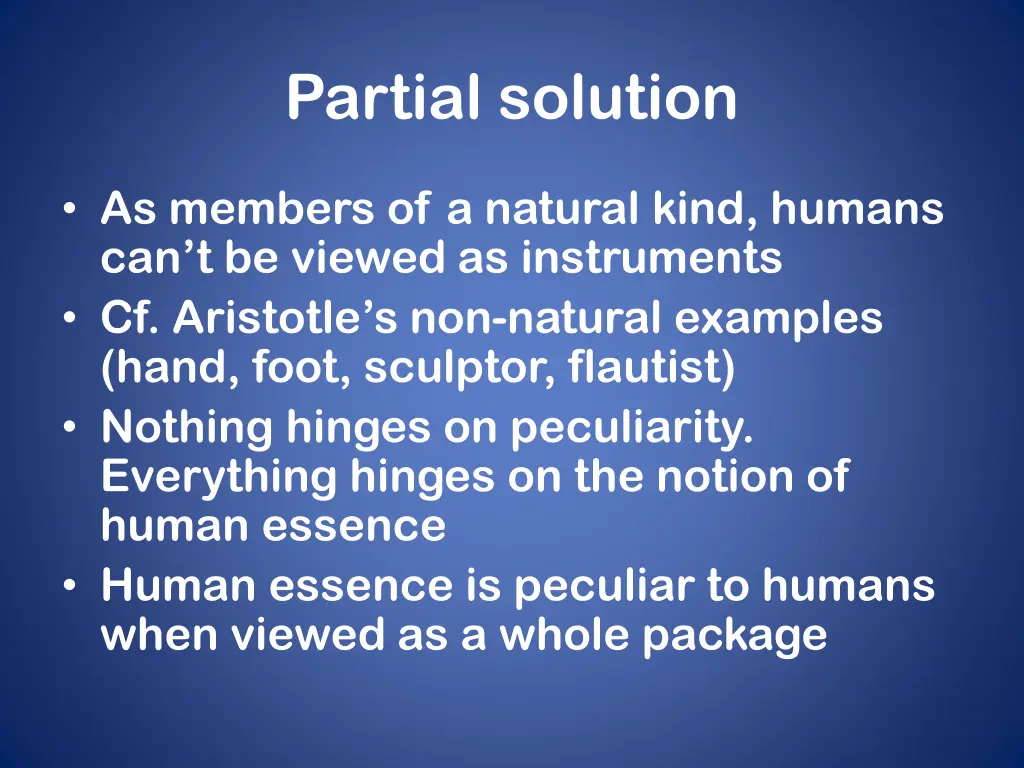
Partial solution As members of a natural kind, humans can t be viewed as instruments Cf. Aristotle s non-natural examples (hand, foot, sculptor, flautist) Nothing hinges on peculiarity. Everything hinges on the notion of human essence Human essence is peculiar to humans when viewed as a whole package
Definition of eudaimonia if this is the case [and we state the function of man to be a certain kind of life, and this to be an activity or actions of the soul implying a rational principle, and the function of a good man to be the good and noble performance of these, and if any action is well performed when it is performed in accordance with the appropriate virtue: if this is the case], human good turns out to be activity of the soul exhibiting virtue, and if there are more than one virtue, in accordance with the best and most complete. (1.8,1098a12-18]
Definition of eudaimonia Eudaimonia is an activity (energeia) or actualisation (as opposed to dunamis, a potentiality) of the soul or psyche in accordance with virtue (ar te).
In accordance with virtue Moral virtues are connected to a constituent part of our eudaimonia Note: eudaimonia means excellence (i.e. not moral virtue). E.g. a knife can have excellence (a knife that is sharp and cuts well). At this point, excellence simply means excellent psychic activity.
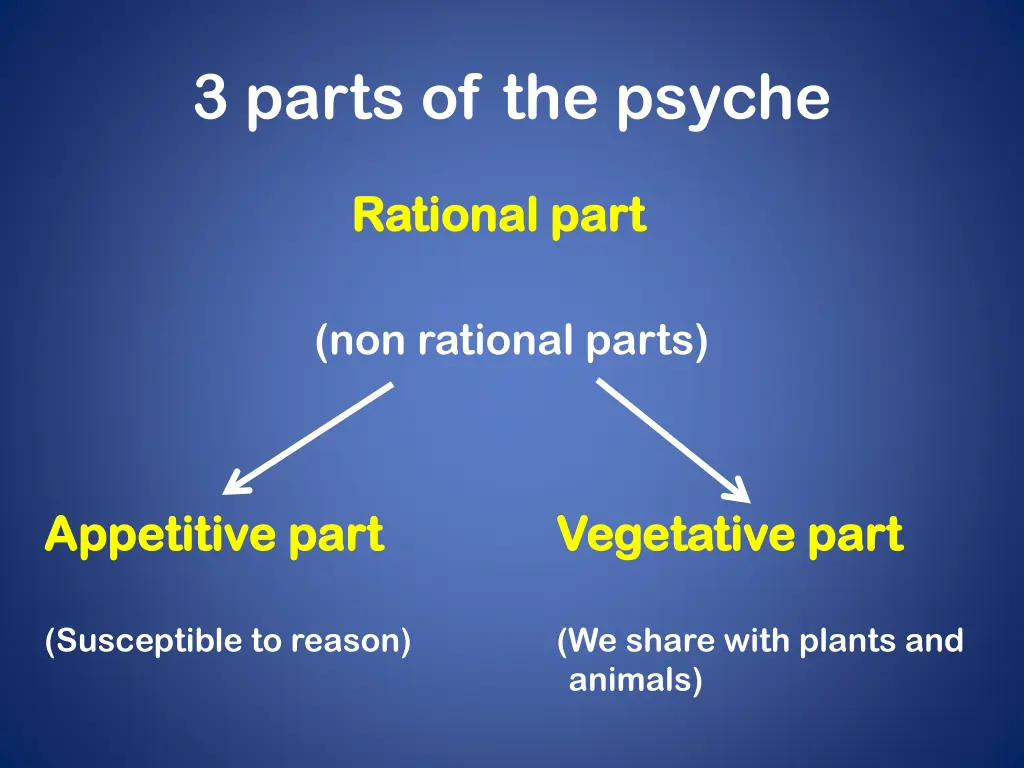
3 parts of the psyche Rational part Rational part (non rational parts) Appetitive part Appetitive part Vegetative part Vegetative part (Susceptible to reason) (We share with plants and animals)
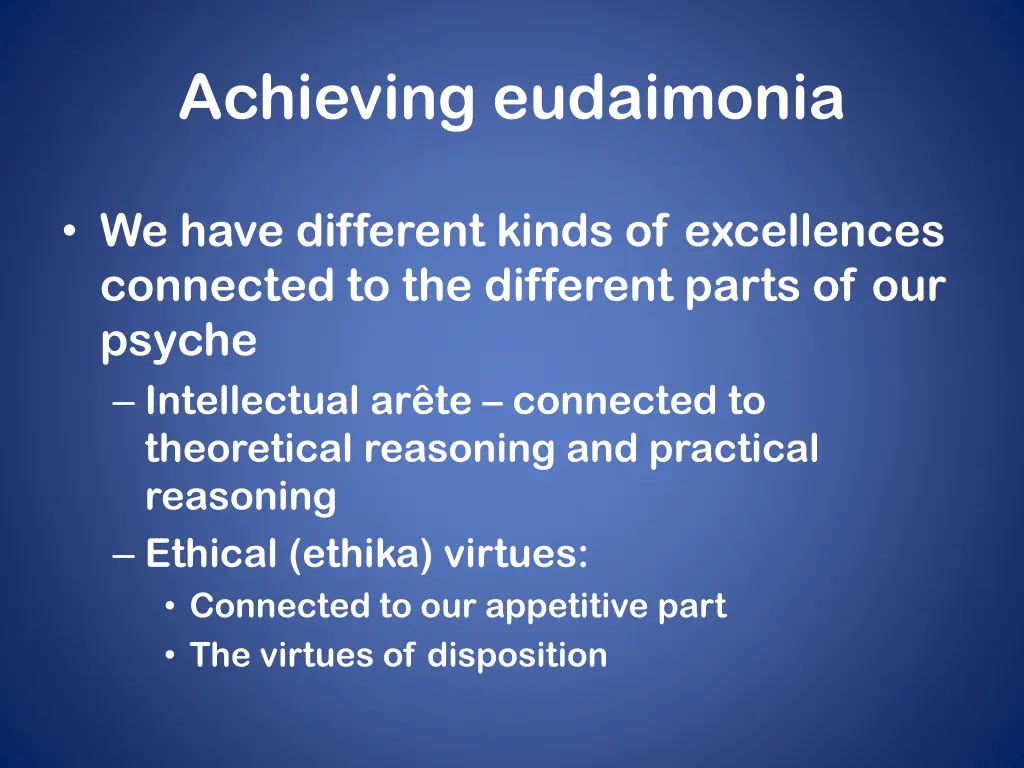
Achieving eudaimonia We have different kinds of excellences connected to the different parts of our psyche Intellectual ar te connected to theoretical reasoning and practical reasoning Ethical (ethika) virtues: Connected to our appetitive part The virtues of disposition
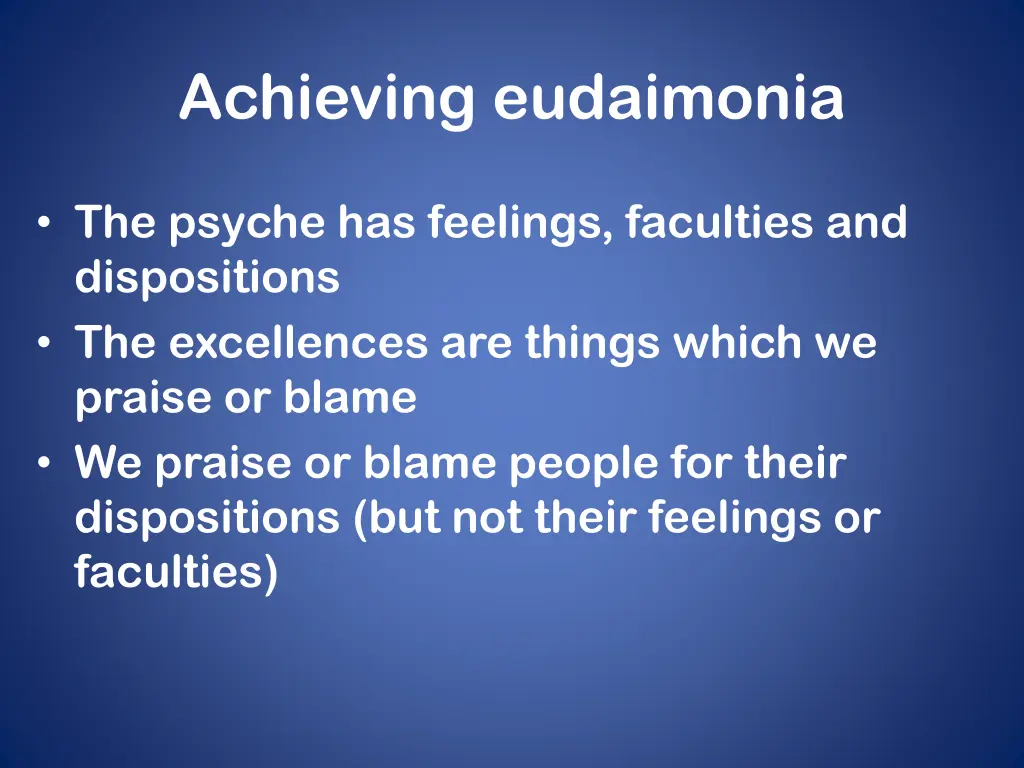
Achieving eudaimonia The psyche has feelings, faculties and dispositions The excellences are things which we praise or blame We praise or blame people for their dispositions (but not their feelings or faculties)
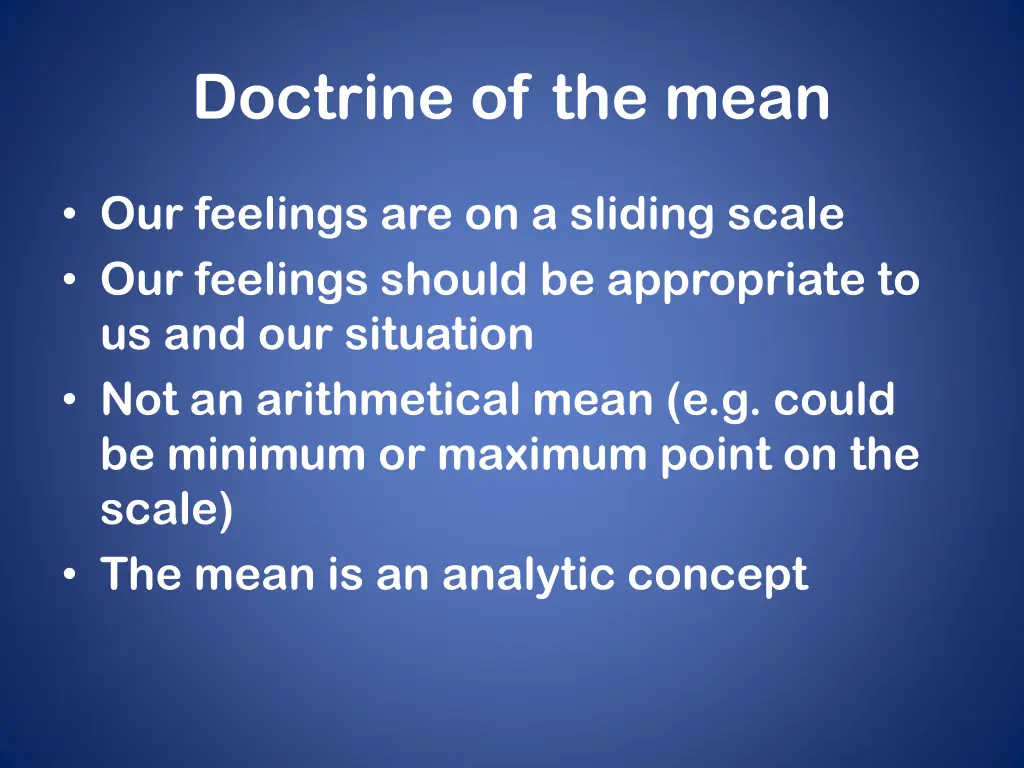
Doctrine of the mean Our feelings are on a sliding scale Our feelings should be appropriate to us and our situation Not an arithmetical mean (e.g. could be minimum or maximum point on the scale) The mean is an analytic concept
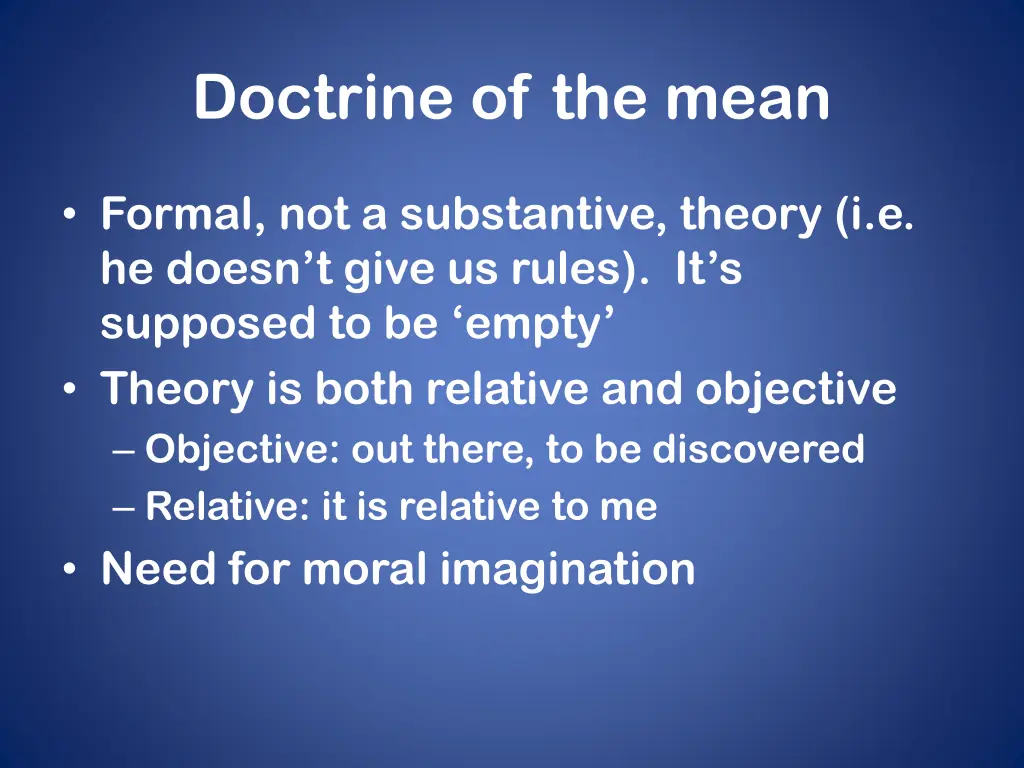
Doctrine of the mean Formal, not a substantive, theory (i.e. he doesn t give us rules). It s supposed to be empty Theory is both relative and objective Objective: out there, to be discovered Relative: it is relative to me Need for moral imagination
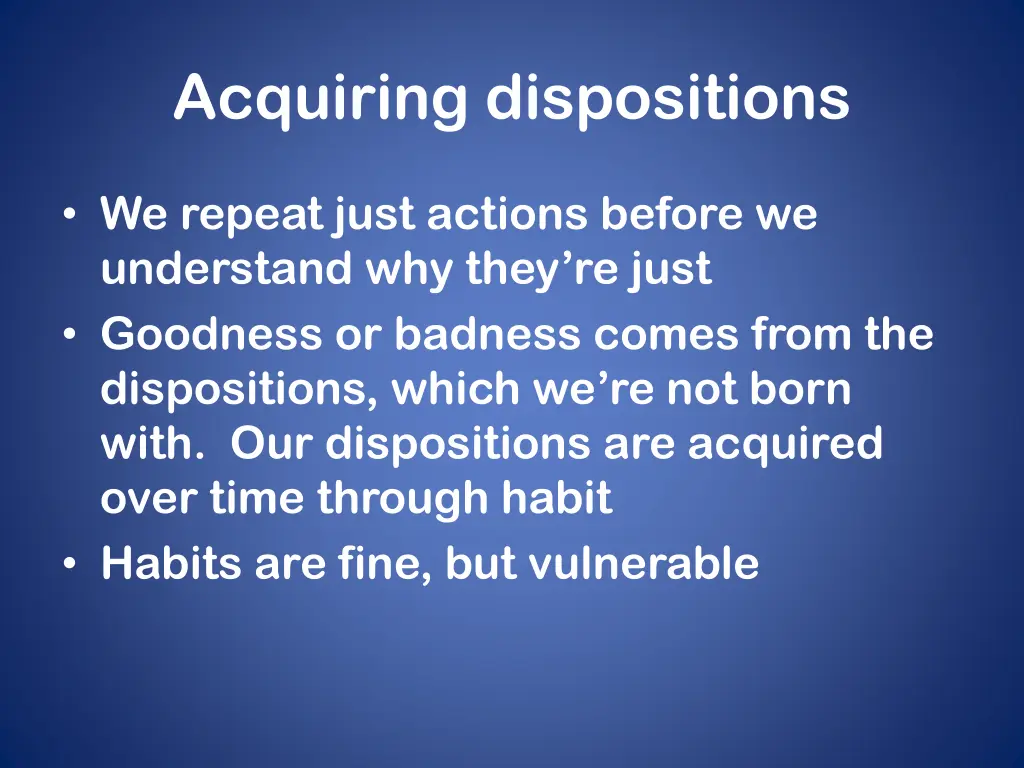
Acquiring dispositions We repeat just actions before we understand why they re just Goodness or badness comes from the dispositions, which we re not born with. Our dispositions are acquired over time through habit Habits are fine, but vulnerable
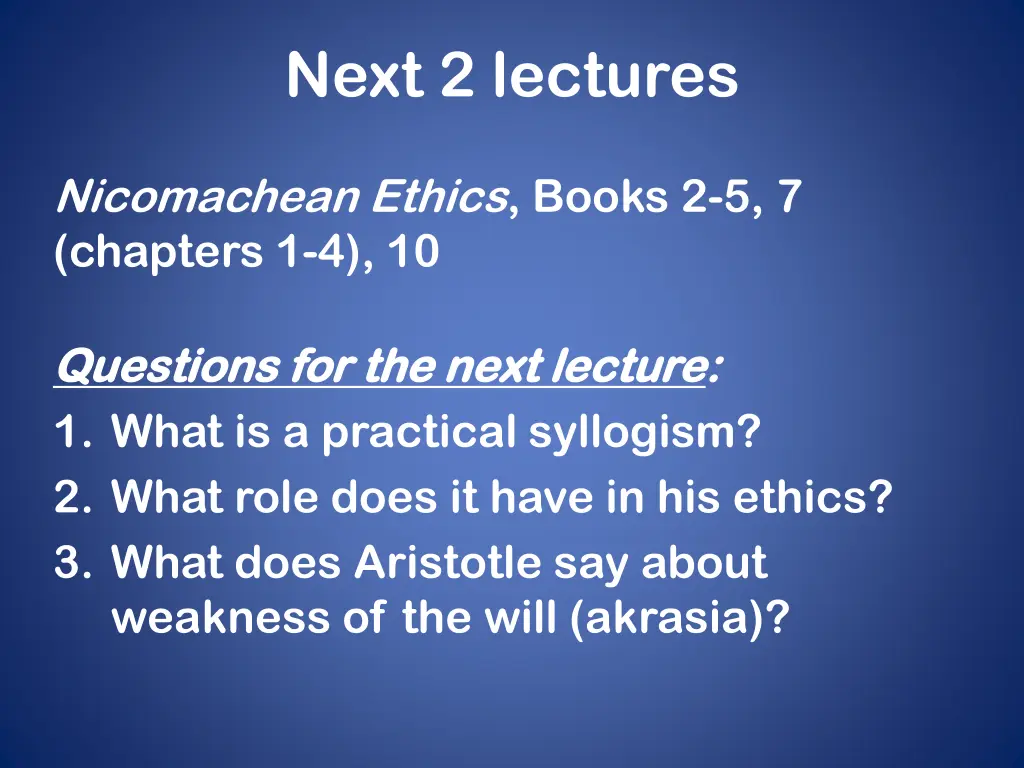
Next 2 lectures Nicomachean Ethics, Books 2-5, 7 (chapters 1-4), 10 Questions for the next lecture Questions for the next lecture: : 1. What is a practical syllogism? 2. What role does it have in his ethics? 3. What does Aristotle say about weakness of the will (akrasia)?