Discover how to automate heap memory management in C++ using smart pointers to improve efficiency and reduce memory leaks. Learn about aggregation with raw pointers, simple aggregation with smart pointers, shared aggregation, and advanced concepts like unique_ptr and shared_ptr.
Please find below an Image/Link to download the presentation.
The content on the website is provided AS IS for your information and personal use only. It may not be sold, licensed, or shared on other websites without obtaining consent from the author. If you encounter any issues during the download, it is possible that the publisher has removed the file from their server.
You are allowed to download the files provided on this website for personal or commercial use, subject to the condition that they are used lawfully. All files are the property of their respective owners.
The content on the website is provided AS IS for your information and personal use only. It may not be sold, licensed, or shared on other websites without obtaining consent from the author.
E N D
Presentation Transcript
AGGREGATION WITH SMART POINTERS Automating heap memory management Delroy A. Brinkerhoff
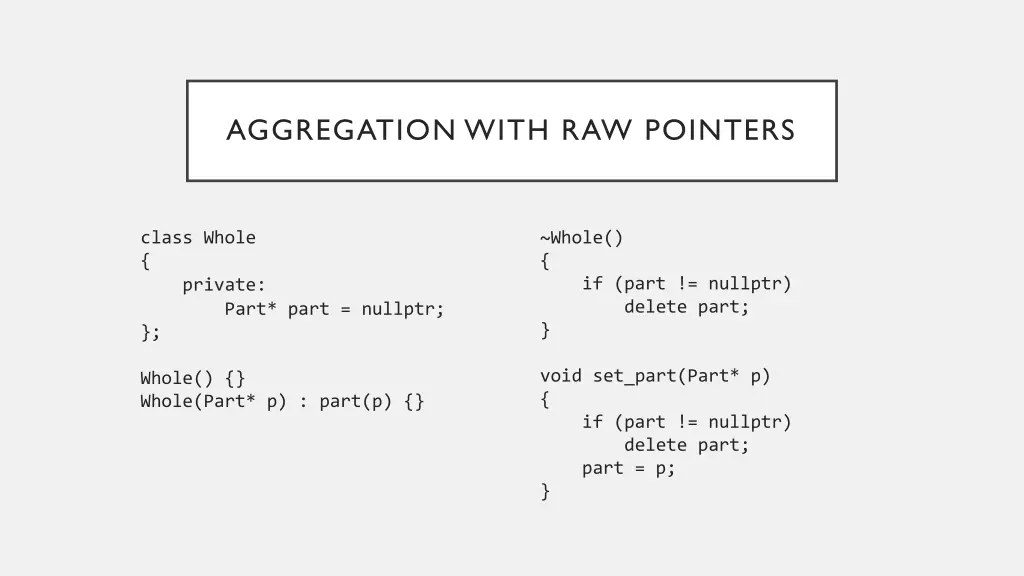
AGGREGATION WITH RAW POINTERS class Whole { private: Part* part = nullptr; }; ~Whole() { if (part != nullptr) delete part; } void set_part(Part* p) { if (part != nullptr) delete part; part = p; } Whole() {} Whole(Part* p) : part(p) {}
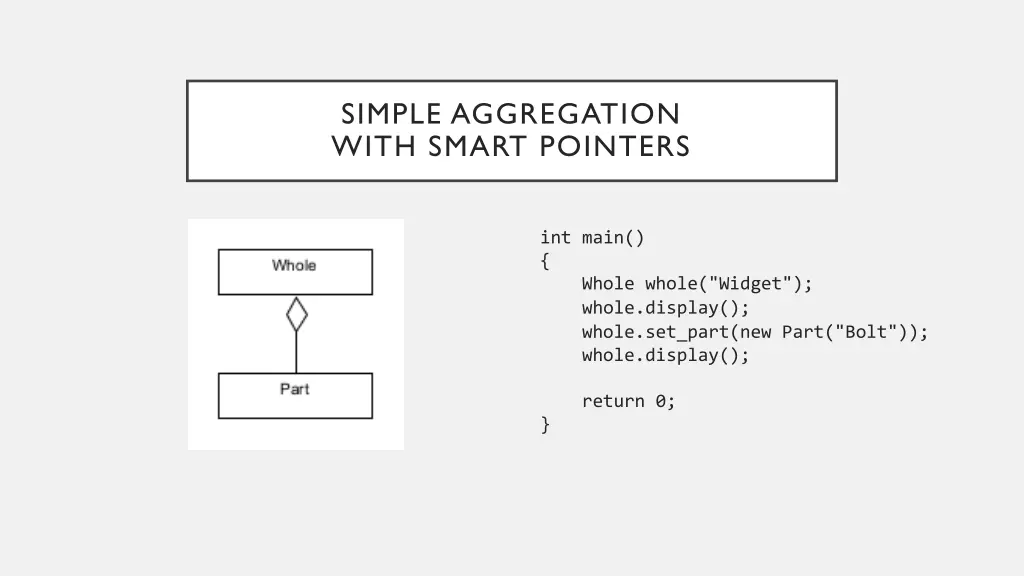
SIMPLE AGGREGATION WITH SMART POINTERS int main() { Whole whole("Widget"); whole.display(); whole.set_part(new Part("Bolt")); whole.display(); return 0; }
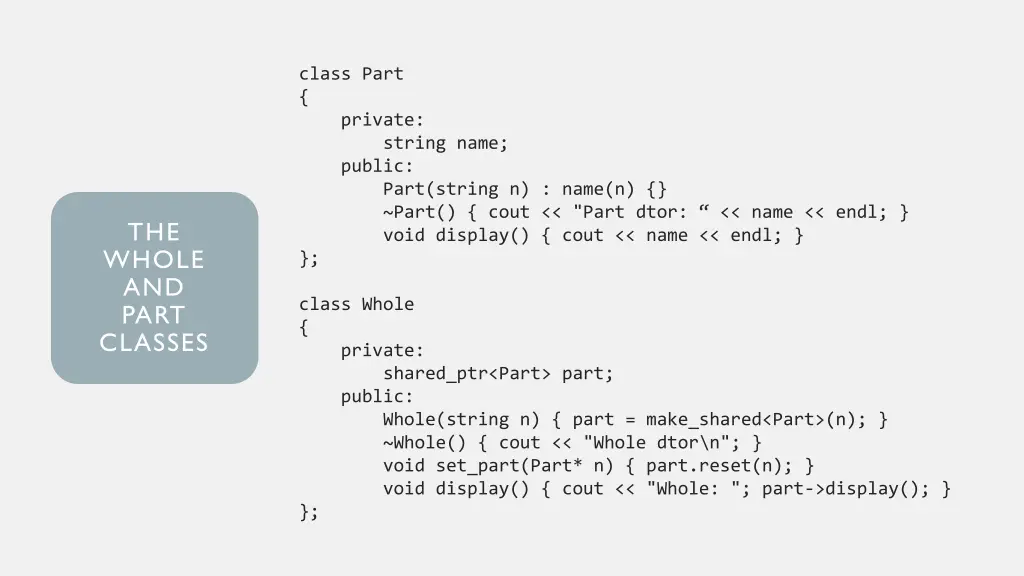
class Part { private: string name; public: Part(string n) : name(n) {} ~Part() { cout << "Part dtor: << name << endl; } void display() { cout << name << endl; } }; THE WHOLE AND PART CLASSES class Whole { private: shared_ptr<Part> part; public: Whole(string n) { part = make_shared<Part>(n); } ~Whole() { cout << "Whole dtor\n"; } void set_part(Part* n) { part.reset(n); } void display() { cout << "Whole: "; part->display(); } };
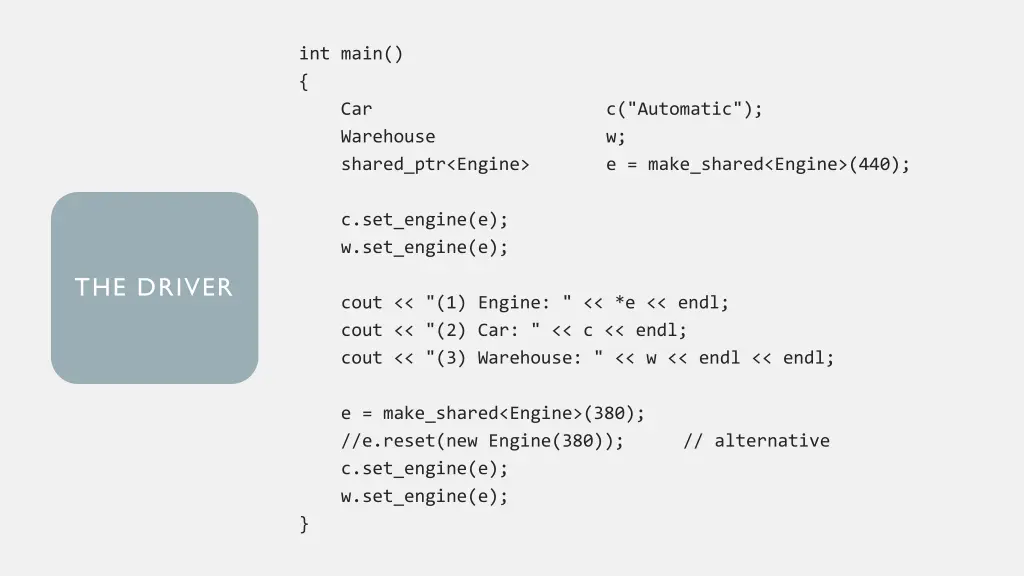
int main() { Car Warehouse shared_ptr<Engine> c("Automatic"); w; e = make_shared<Engine>(440); c.set_engine(e); w.set_engine(e); THE DRIVER cout << "(1) Engine: " << *e << endl; cout << "(2) Car: " << c << endl; cout << "(3) Warehouse: " << w << endl << endl; e = make_shared<Engine>(380); //e.reset(new Engine(380)); c.set_engine(e); w.set_engine(e); } // alternative
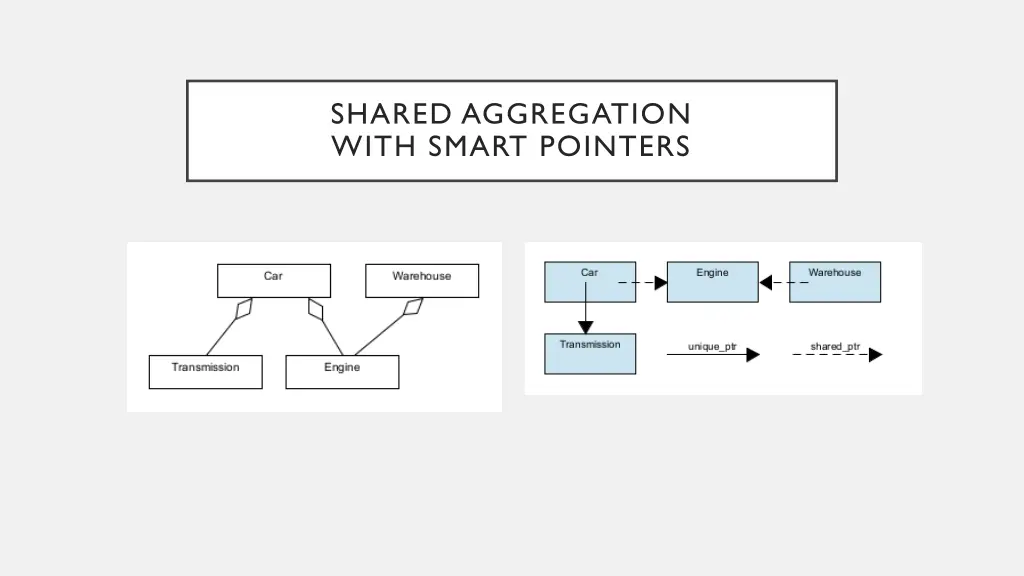
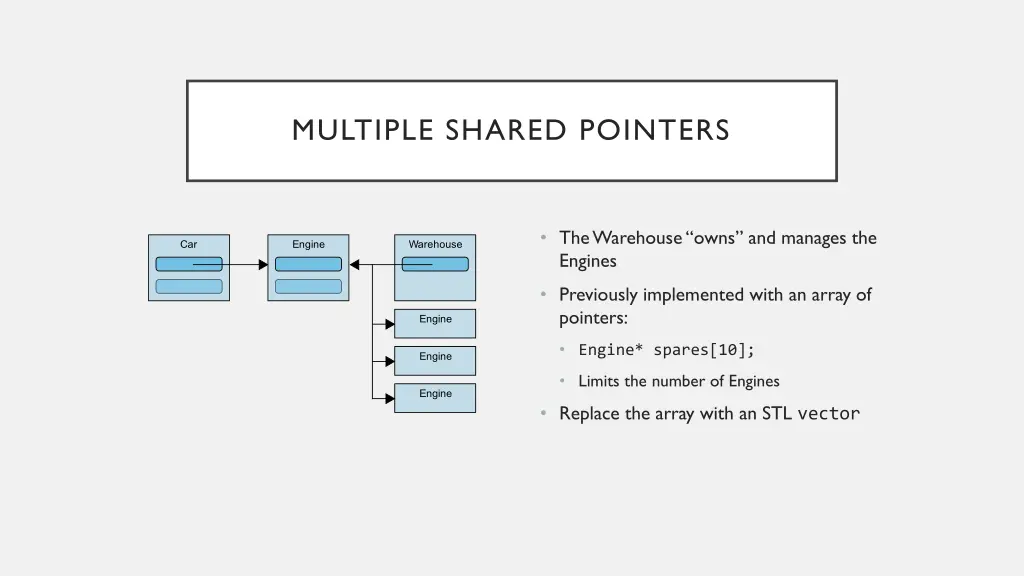
MULTIPLE SHARED POINTERS The Warehouse owns and manages the Engines Previously implemented with an array of pointers: Engine* spares[10]; Limits the number of Engines Replace the array with an STL vector
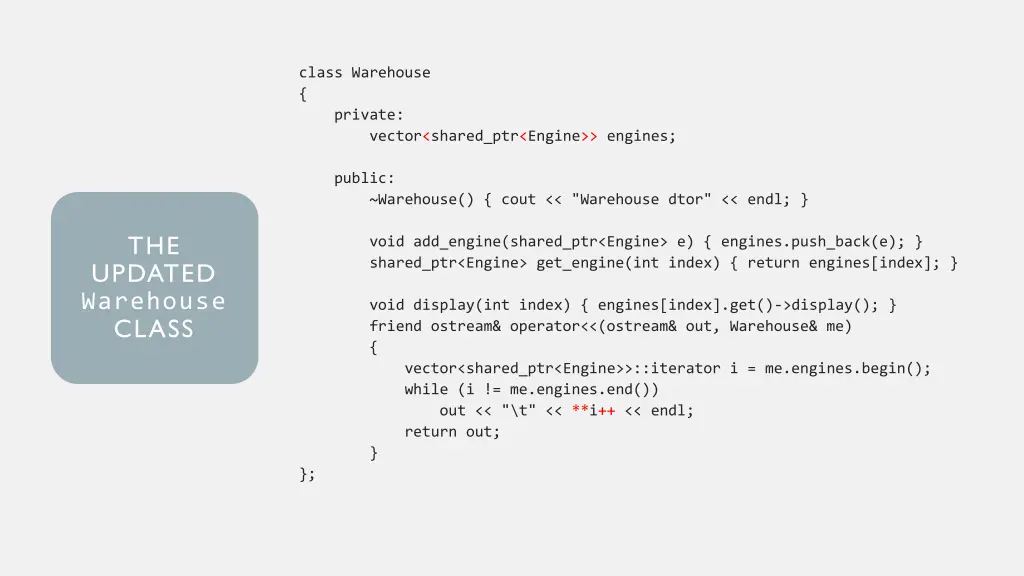
class Warehouse { private: vector<shared_ptr<Engine>> engines; public: ~Warehouse() { cout << "Warehouse dtor" << endl; } THE void add_engine(shared_ptr<Engine> e) { engines.push_back(e); } shared_ptr<Engine> get_engine(int index) { return engines[index]; } UPDATED Warehouse CLASS void display(int index) { engines[index].get()->display(); } friend ostream& operator<<(ostream& out, Warehouse& me) { vector<shared_ptr<Engine>>::iterator i = me.engines.begin(); while (i != me.engines.end()) out << "\t" << **i++ << endl; return out; } };
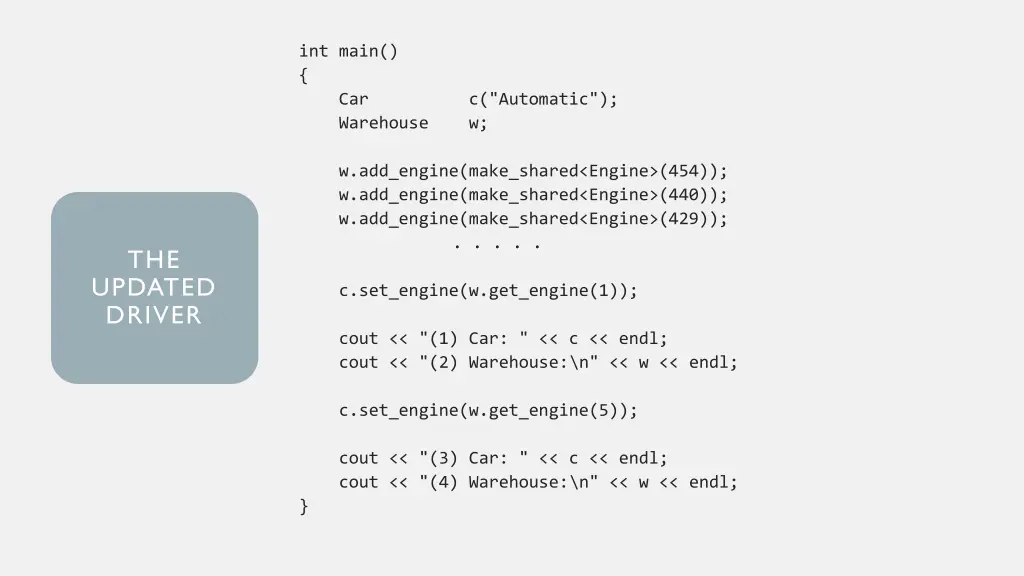
int main() { Car c("Automatic"); Warehouse w; w.add_engine(make_shared<Engine>(454)); w.add_engine(make_shared<Engine>(440)); w.add_engine(make_shared<Engine>(429)); . . . . . THE UPDATED DRIVER c.set_engine(w.get_engine(1)); cout << "(1) Car: " << c << endl; cout << "(2) Warehouse:\n" << w << endl; c.set_engine(w.get_engine(5)); cout << "(3) Car: " << c << endl; cout << "(4) Warehouse:\n" << w << endl; }
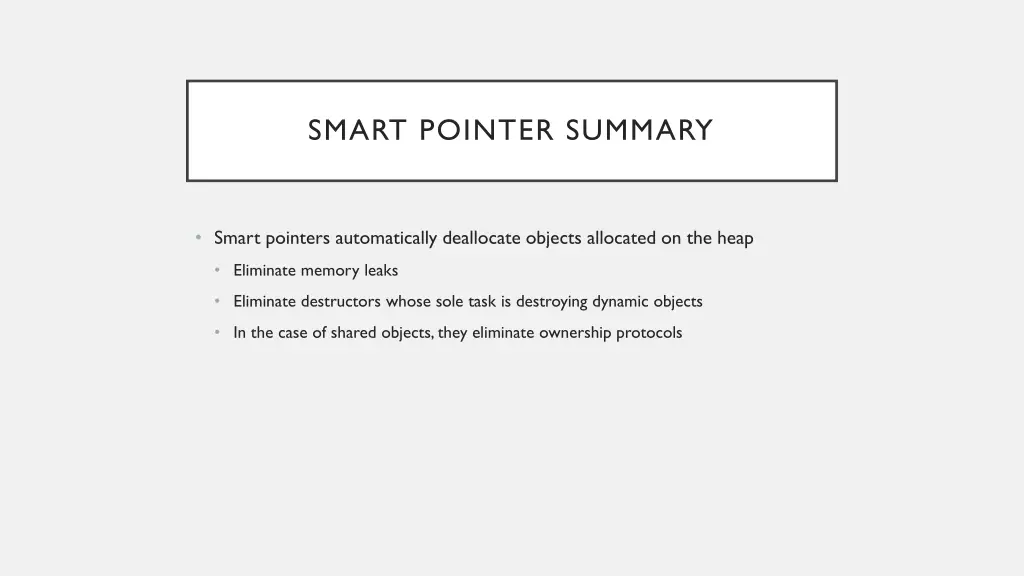
SMART POINTER SUMMARY Smart pointers automatically deallocate objects allocated on the heap Eliminate memory leaks Eliminate destructors whose sole task is destroying dynamic objects In the case of shared objects, they eliminate ownership protocols