Explore the concept of Axiomatic Semantics, also known as Floyd-Hoare Logic, a logical system built on formal logic for proving properties of state in programming. Learn about deriving logical statements, building proofs for programs, and ensuring partial correctness. Dive into rules for simple imperative language constructs.
Please find below an Image/Link to download the presentation.
The content on the website is provided AS IS for your information and personal use only. It may not be sold, licensed, or shared on other websites without obtaining consent from the author. If you encounter any issues during the download, it is possible that the publisher has removed the file from their server.
You are allowed to download the files provided on this website for personal or commercial use, subject to the condition that they are used lawfully. All files are the property of their respective owners.
The content on the website is provided AS IS for your information and personal use only. It may not be sold, licensed, or shared on other websites without obtaining consent from the author.
E N D
Presentation Transcript
Programming Languages and Compilers (CS 421) Elsa L Gunter 2112 SC, UIUC http://courses.engr.illinois.edu/cs421 Based in part on slides by Mattox Beckman, as updated by Vikram Adve and Gul Agha 4/12/2025 1
Axiomatic Semantics Also called Floyd-Hoare Logic Based on formal logic (first order predicate calculus) Axiomatic Semantics is a logical system built from axioms and inference rules Mainly suited to simple imperative programming languages 4/12/2025 2
Axiomatic Semantics Used to formally prove a property (post- condition) of the state (the values of the program variables) after the execution of program, assuming another property (pre-condition) of the state holds before execution 4/12/2025 3
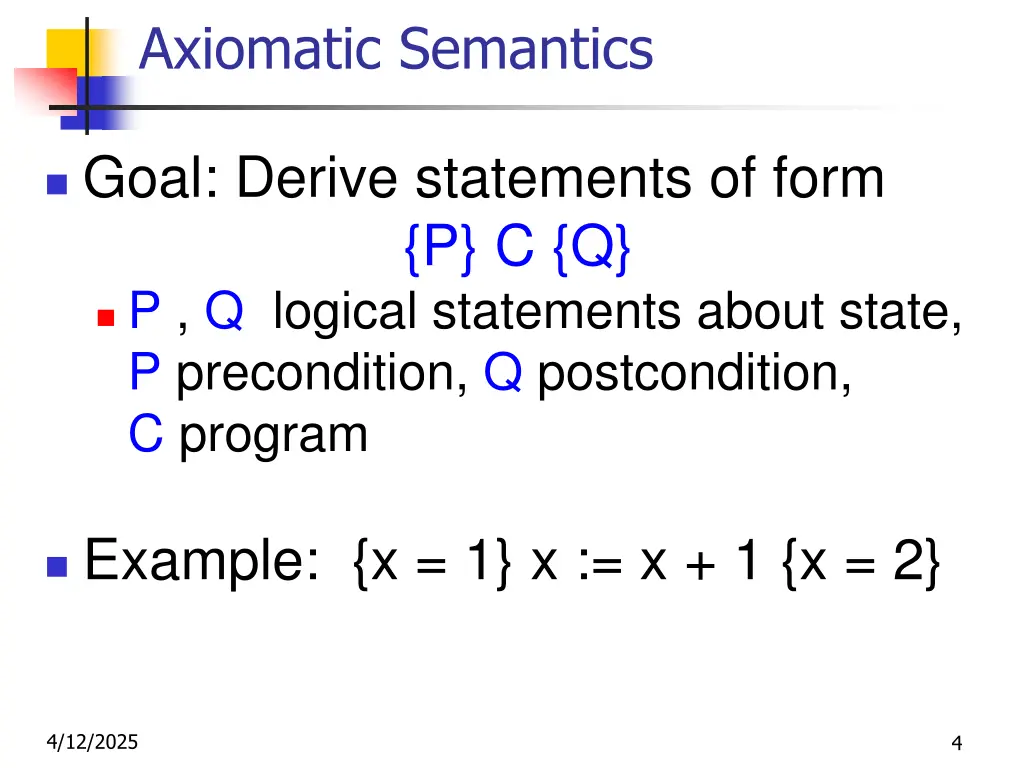
Axiomatic Semantics Goal: Derive statements of form {P} C {Q} P , Q logical statements about state, P precondition, Q postcondition, C program Example: {x = 1} x := x + 1 {x = 2} 4/12/2025 4
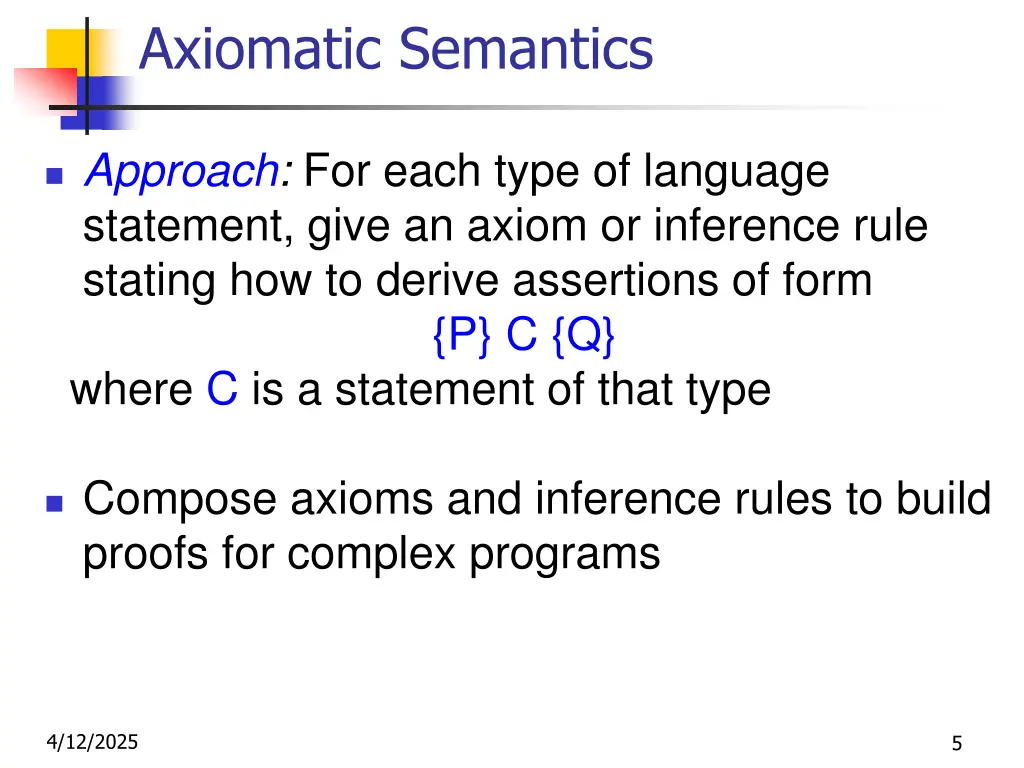
Axiomatic Semantics Approach: For each type of language statement, give an axiom or inference rule stating how to derive assertions of form {P} C {Q} where C is a statement of that type Compose axioms and inference rules to build proofs for complex programs 4/12/2025 5
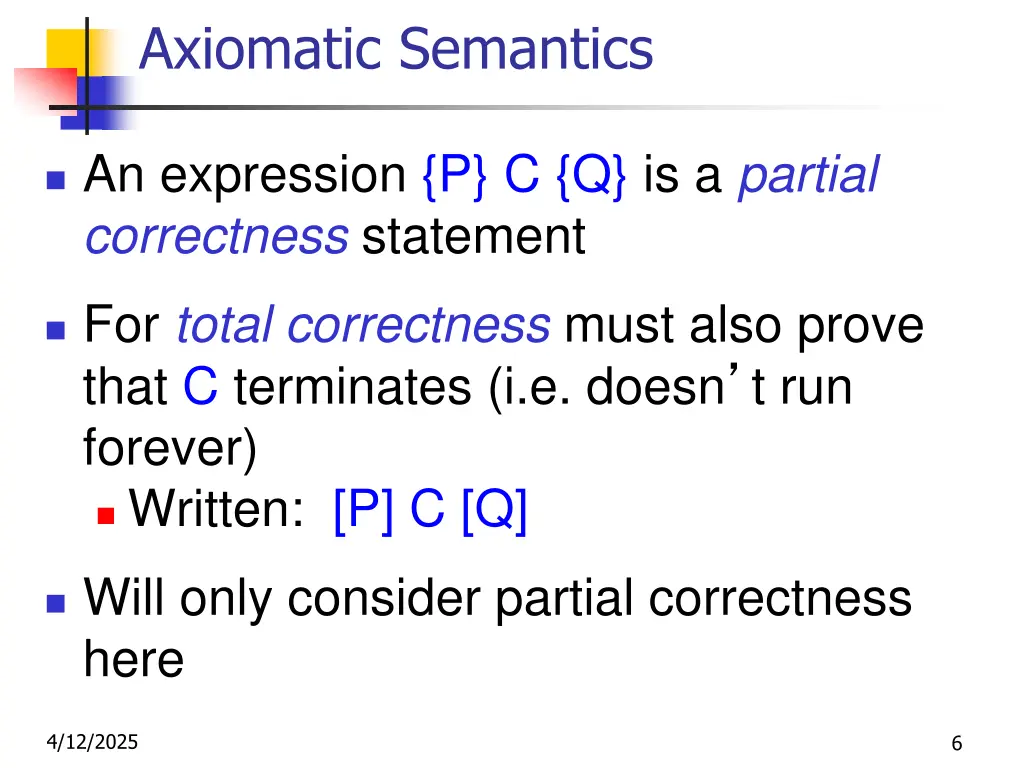
Axiomatic Semantics An expression {P} C {Q} is a partial correctness statement For total correctness must also prove that C terminates (i.e. doesn t run forever) Written: [P] C [Q] Will only consider partial correctness here 4/12/2025 6
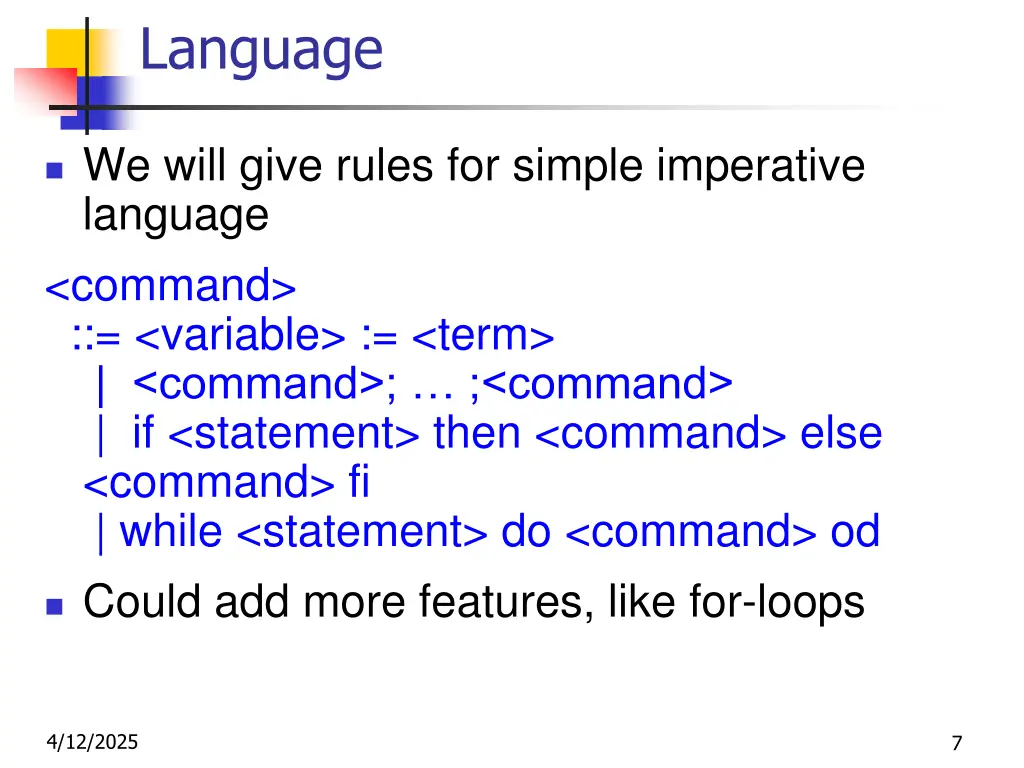
Language We will give rules for simple imperative language <command> ::= <variable> := <term> | <command>; ;<command> | if <statement> then <command> else <command> fi | while <statement> do <command> od Could add more features, like for-loops 4/12/2025 7
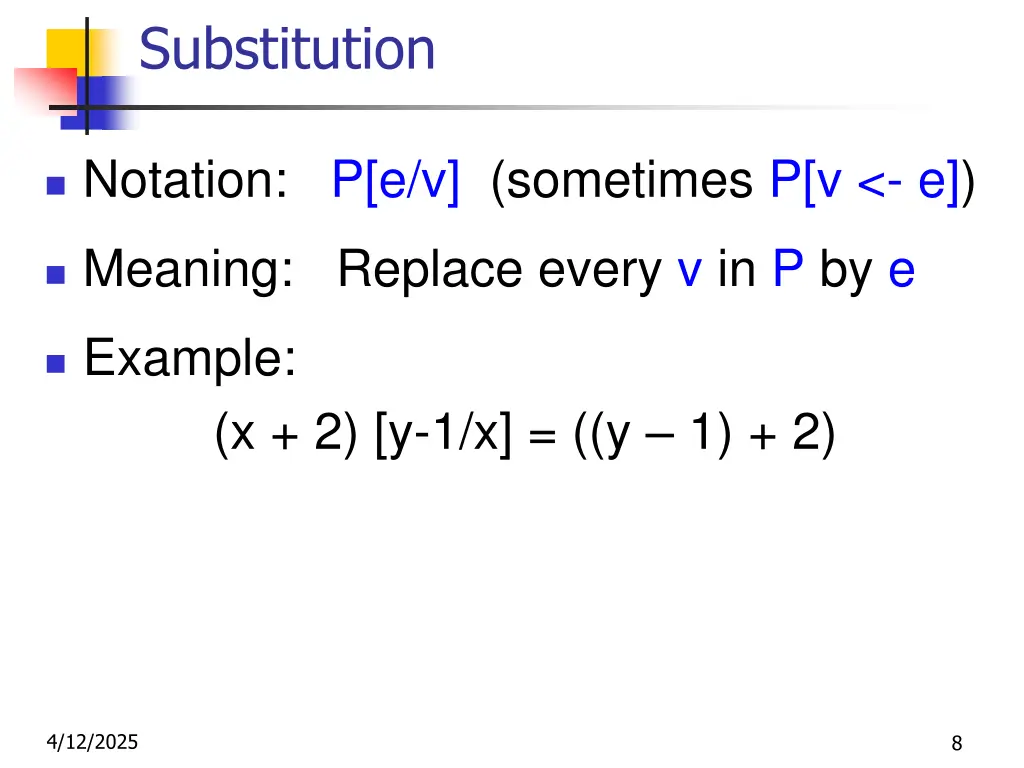
Substitution Notation: P[e/v] (sometimes P[v <- e]) Meaning: Replace every v in P by e Example: (x + 2) [y-1/x] = ((y 1) + 2) 4/12/2025 8
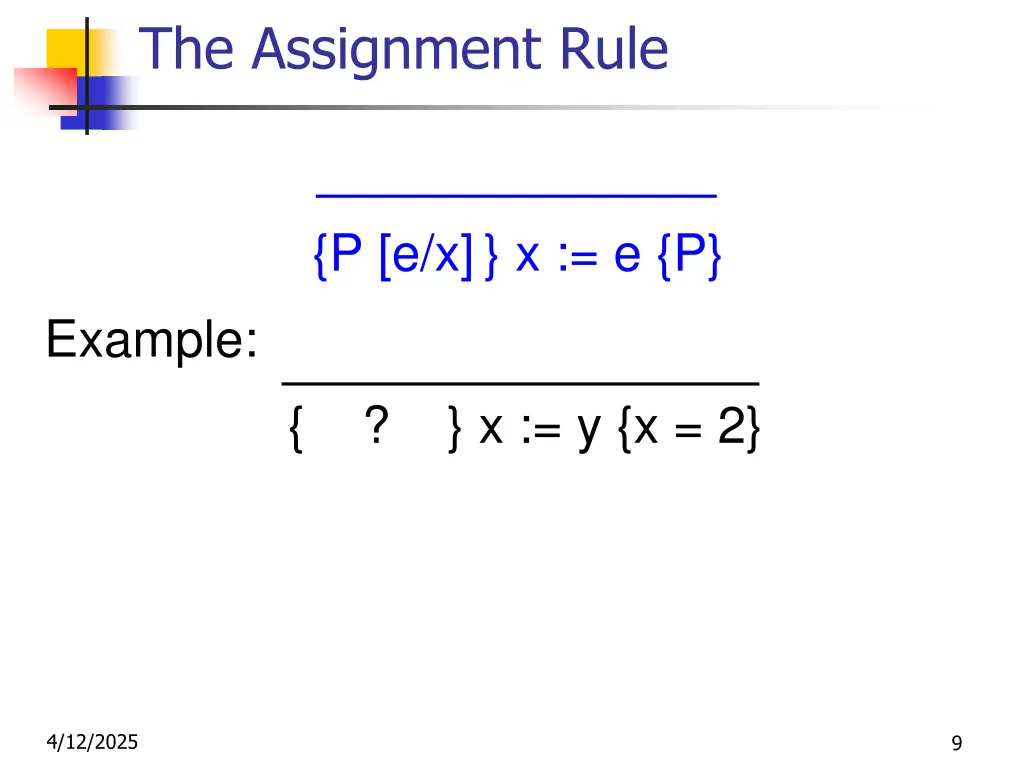
The Assignment Rule {P [e/x]} x := e {P} Example: { ? } x := y {x = 2} 4/12/2025 9
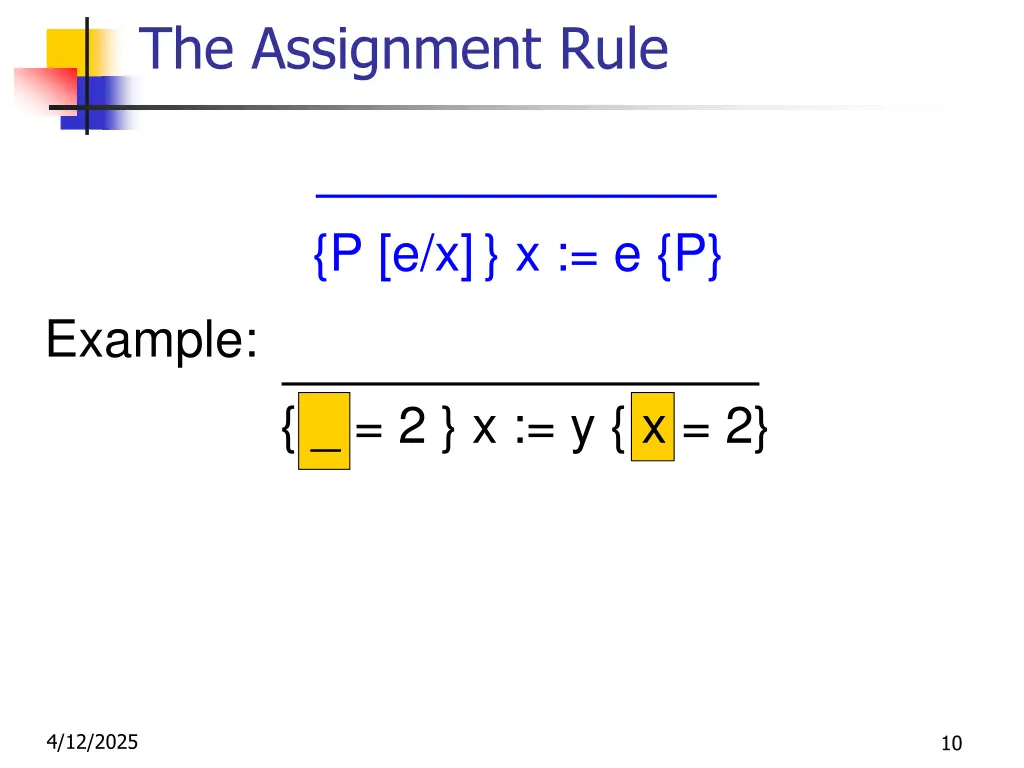
The Assignment Rule {P [e/x]} x := e {P} Example: { _ = 2 } x := y { x = 2} 4/12/2025 10
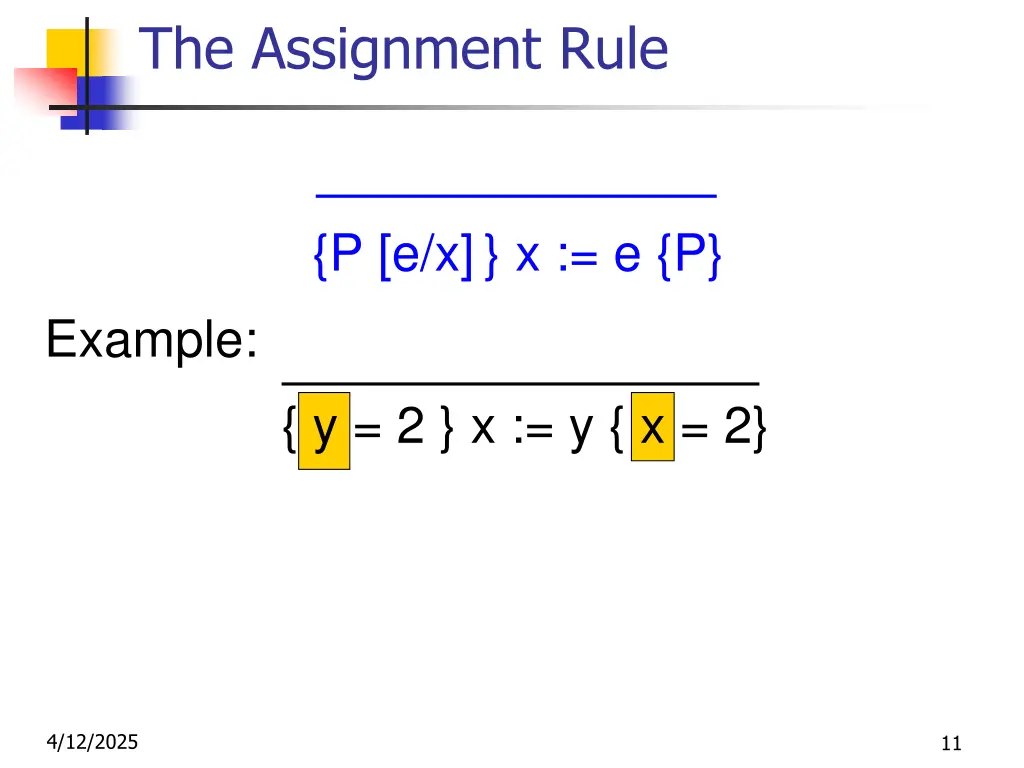
The Assignment Rule {P [e/x]} x := e {P} Example: { y = 2 } x := y { x = 2} 4/12/2025 11
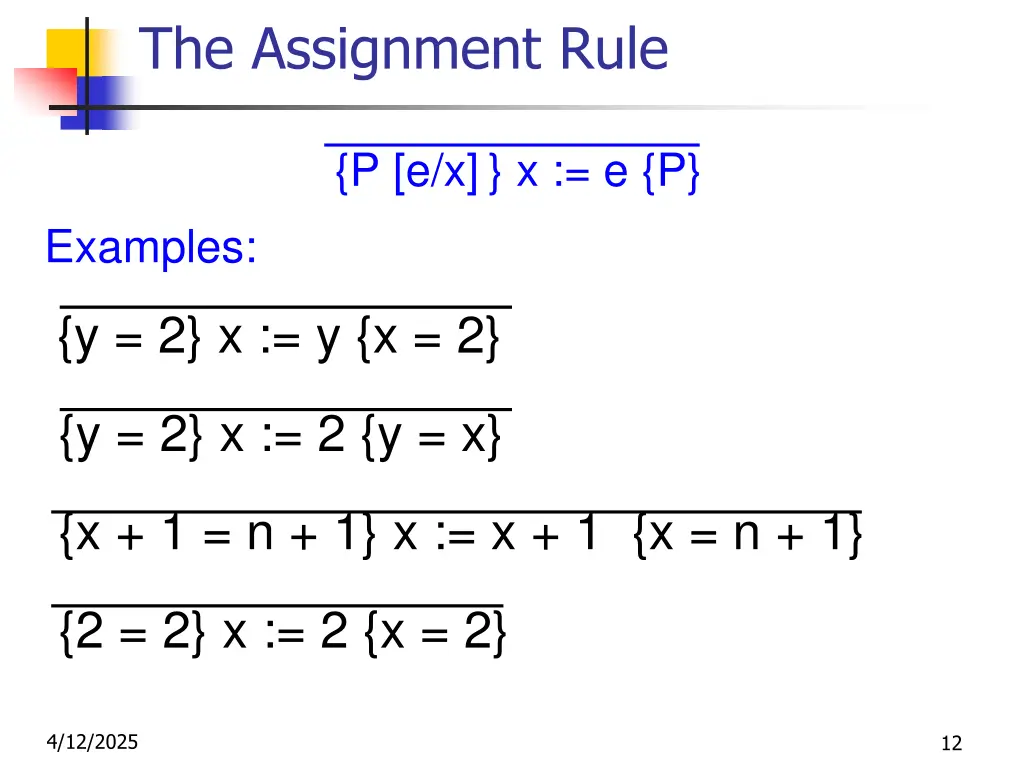
The Assignment Rule {P [e/x]} x := e {P} Examples: {y = 2} x := y {x = 2} {y = 2} x := 2 {y = x} {x + 1 = n + 1} x := x + 1 {x = n + 1} {2 = 2} x := 2 {x = 2} 4/12/2025 12
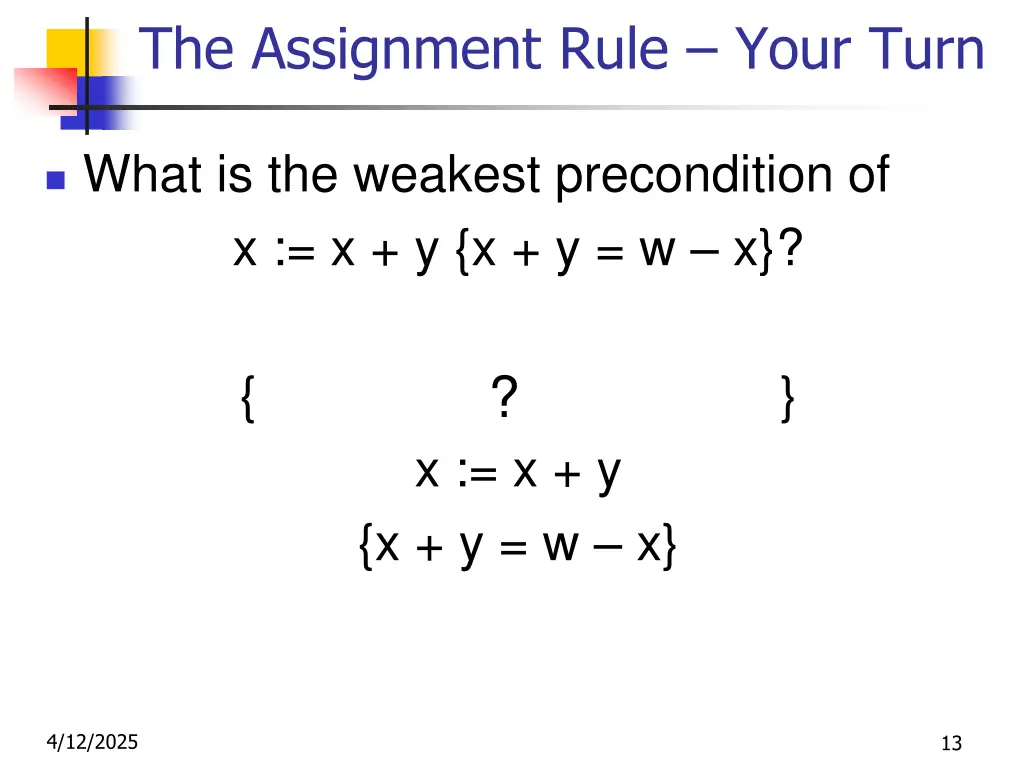
The Assignment Rule Your Turn What is the weakest precondition of x := x + y {x + y = w x}? ? {(x + y) + y = w (x + y)} x := x + y {x + y = w x} 4/12/2025 13
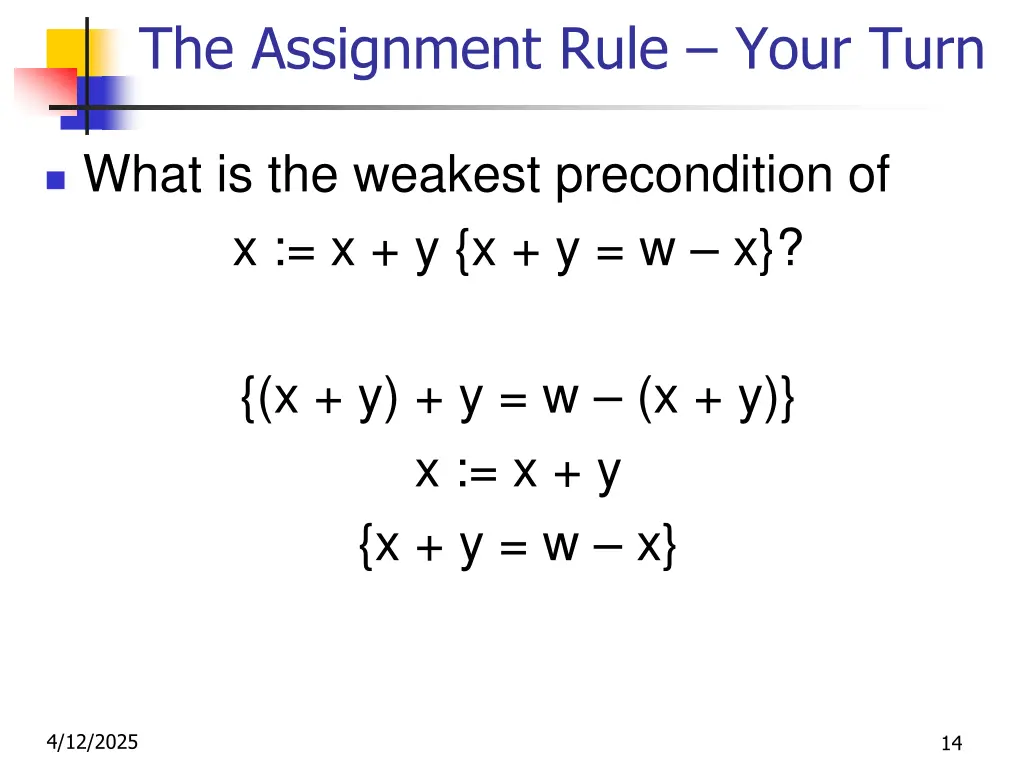
The Assignment Rule Your Turn What is the weakest precondition of x := x + y {x + y = w x}? {(x + y) + y = w (x + y)} x := x + y {x + y = w x} 4/12/2025 14
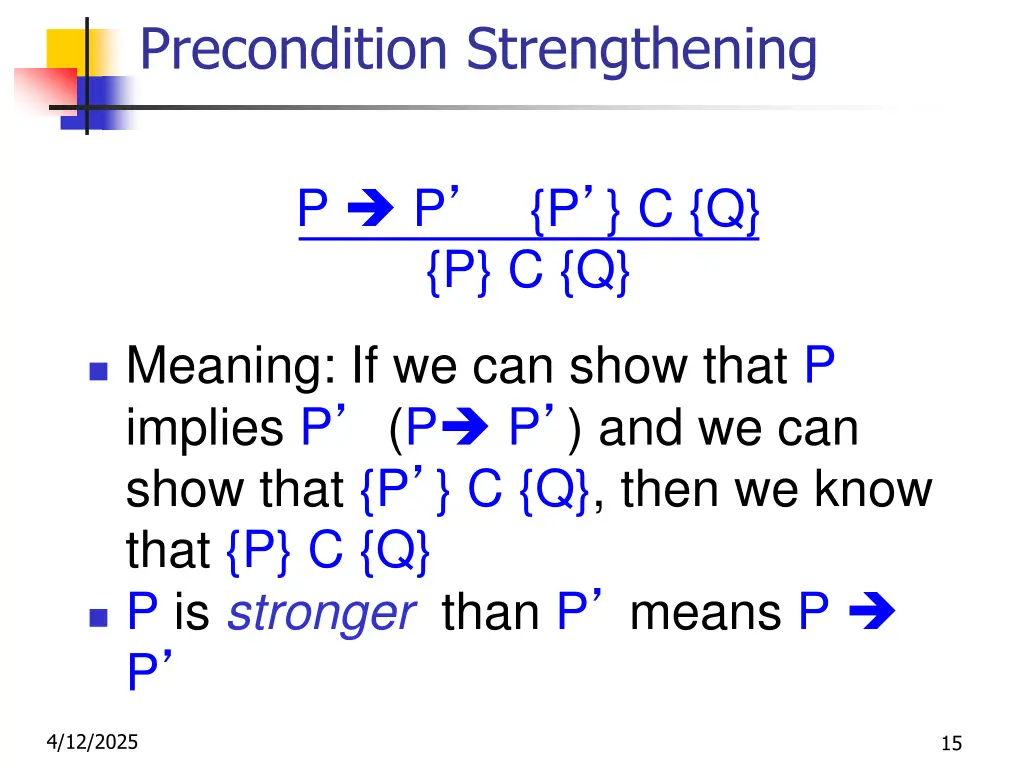
Precondition Strengthening P P {P } C {Q} {P} C {Q} Meaning: If we can show that P implies P (P P ) and we can show that {P } C {Q}, then we know that {P} C {Q} P is stronger than P means P P 4/12/2025 15
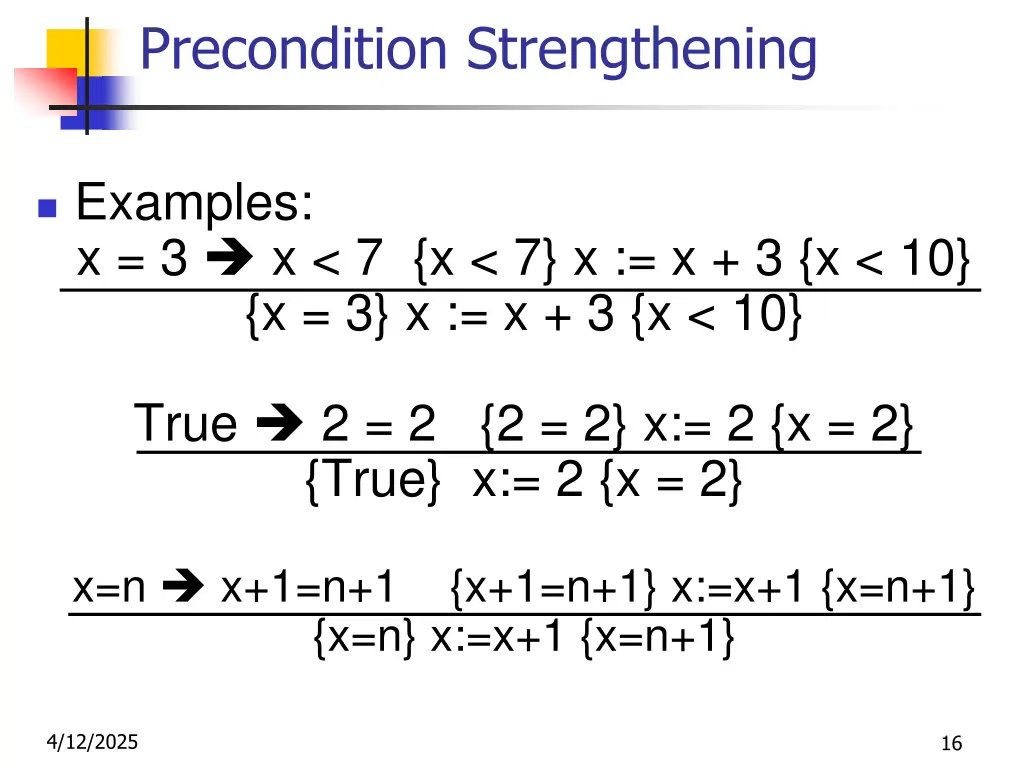
Precondition Strengthening Examples: x = 3 x < 7 {x < 7} x := x + 3 {x < 10} {x = 3} x := x + 3 {x < 10} True 2 = 2 {2 = 2} x:= 2 {x = 2} {True} x:= 2 {x = 2} x=n x+1=n+1 {x+1=n+1} x:=x+1 {x=n+1} {x=n} x:=x+1 {x=n+1} 4/12/2025 16
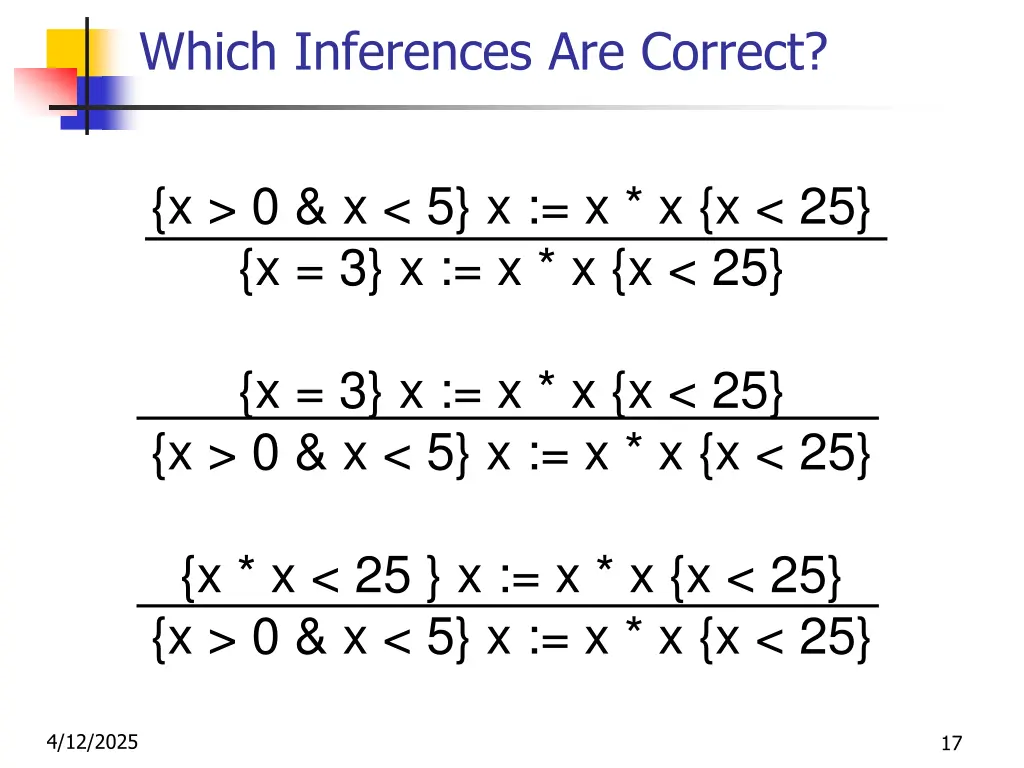
Which Inferences Are Correct? {x > 0 & x < 5} x := x * x {x < 25} {x = 3} x := x * x {x < 25} {x = 3} x := x * x {x < 25} {x > 0 & x < 5} x := x * x {x < 25} {x * x < 25 } x := x * x {x < 25} {x > 0 & x < 5} x := x * x {x < 25} 4/12/2025 17
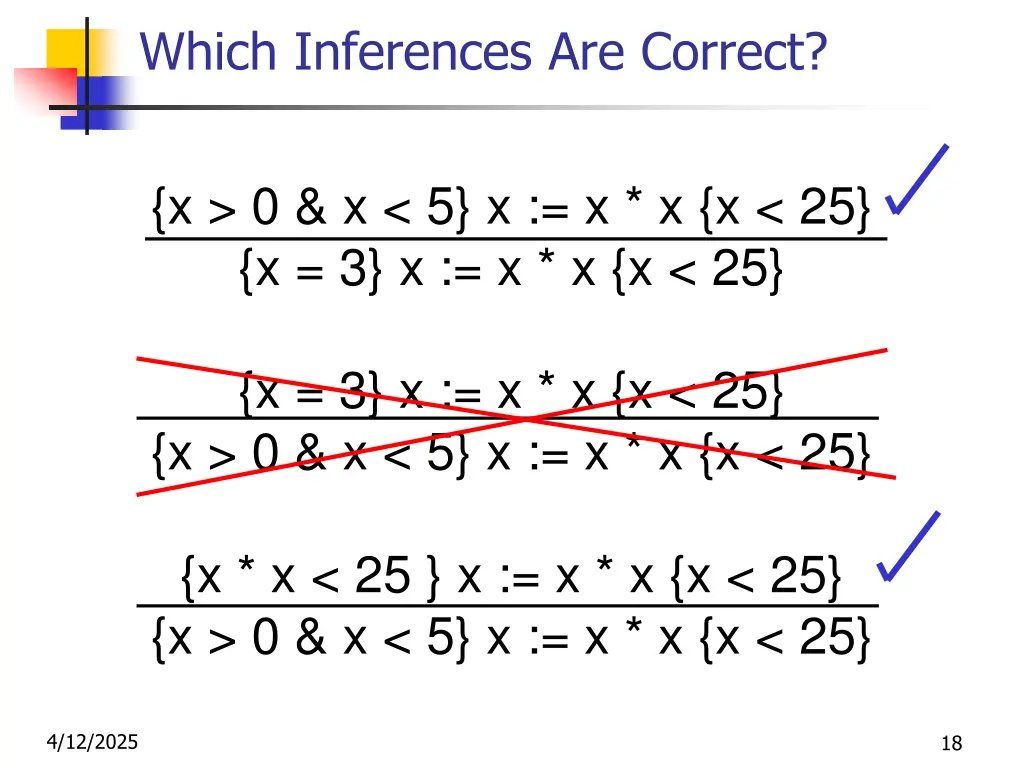
Which Inferences Are Correct? {x > 0 & x < 5} x := x * x {x < 25} {x = 3} x := x * x {x < 25} {x = 3} x := x * x {x < 25} {x > 0 & x < 5} x := x * x {x < 25} {x * x < 25 } x := x * x {x < 25} {x > 0 & x < 5} x := x * x {x < 25} 4/12/2025 18
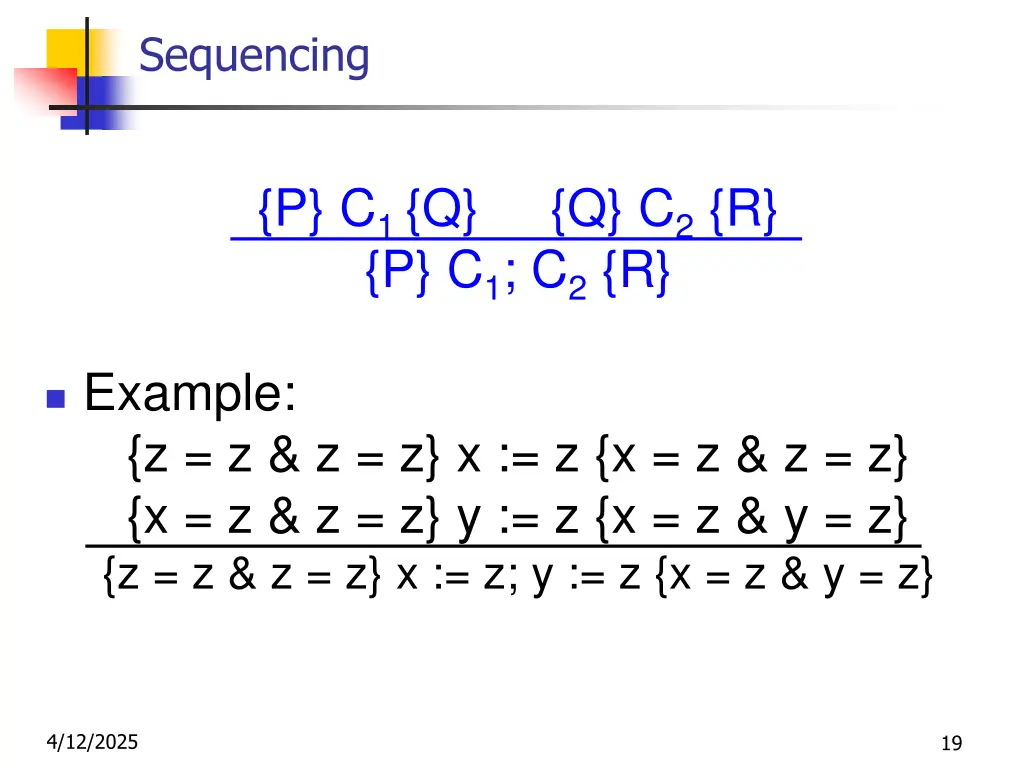
Sequencing {P} C1 {Q} {Q} C2 {R} {P} C1; C2 {R} Example: {z = z & z = z} x := z {x = z & z = z} {x = z & z = z} y := z {x = z & y = z} {z = z & z = z} x := z; y := z {x = z & y = z} 4/12/2025 19
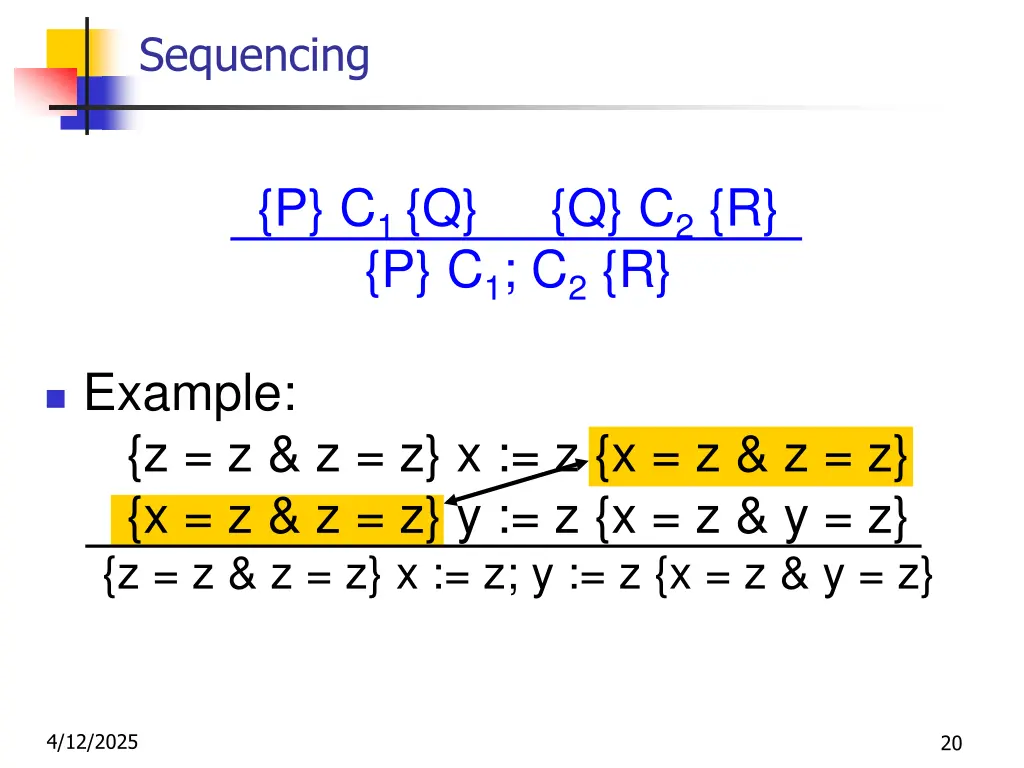
Sequencing {P} C1 {Q} {Q} C2 {R} {P} C1; C2 {R} Example: {z = z & z = z} x := z {x = z & z = z} {x = z & z = z} y := z {x = z & y = z} {z = z & z = z} x := z; y := z {x = z & y = z} 4/12/2025 20
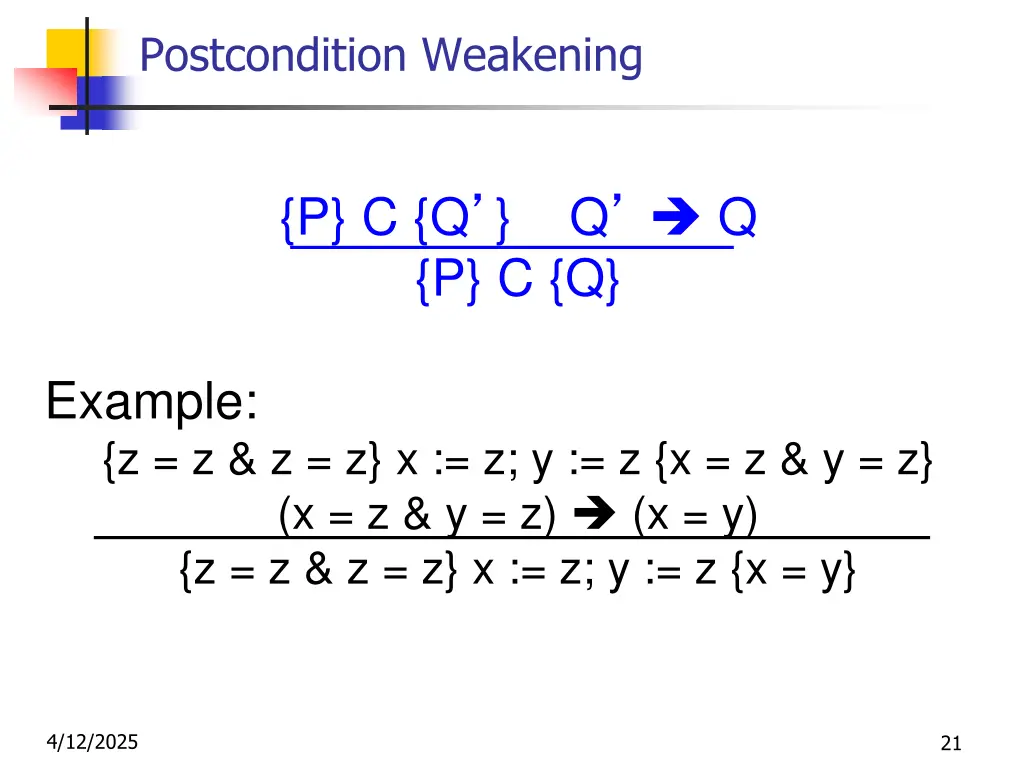
Postcondition Weakening {P} C {Q } Q Q {P} C {Q} Example: {z = z & z = z} x := z; y := z {x = z & y = z} (x = z & y = z) (x = y) {z = z & z = z} x := z; y := z {x = y} 4/12/2025 21
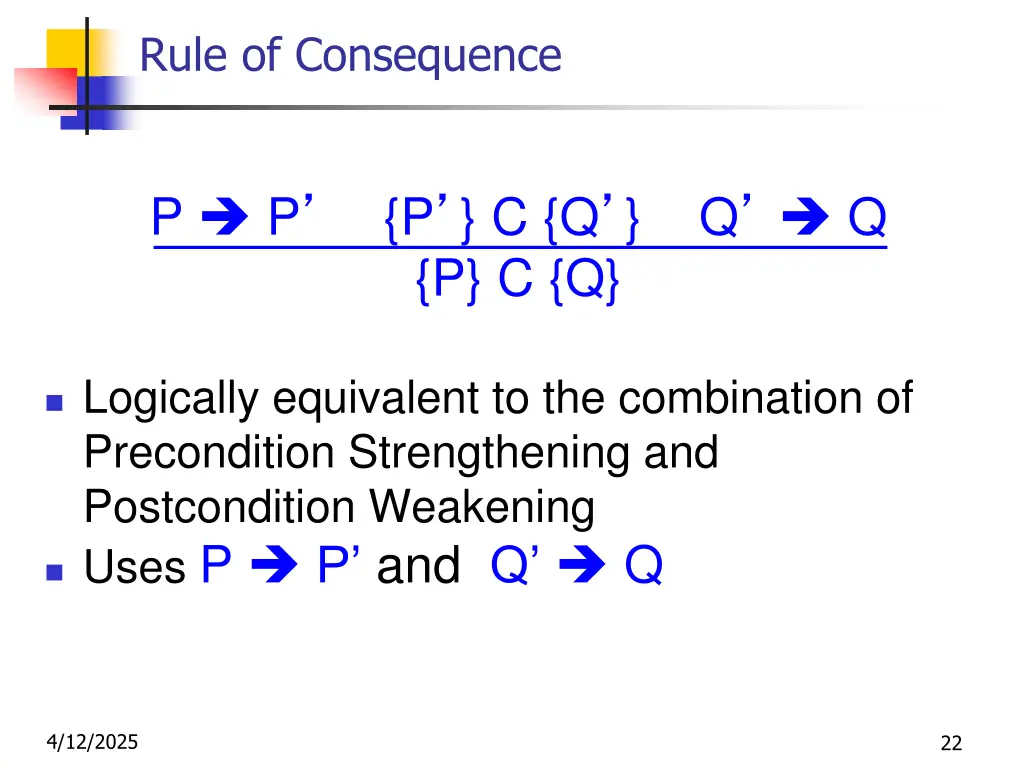
Rule of Consequence P P {P } C {Q } Q Q {P} C {Q} Logically equivalent to the combination of Precondition Strengthening and Postcondition Weakening Uses P P and Q Q 4/12/2025 22
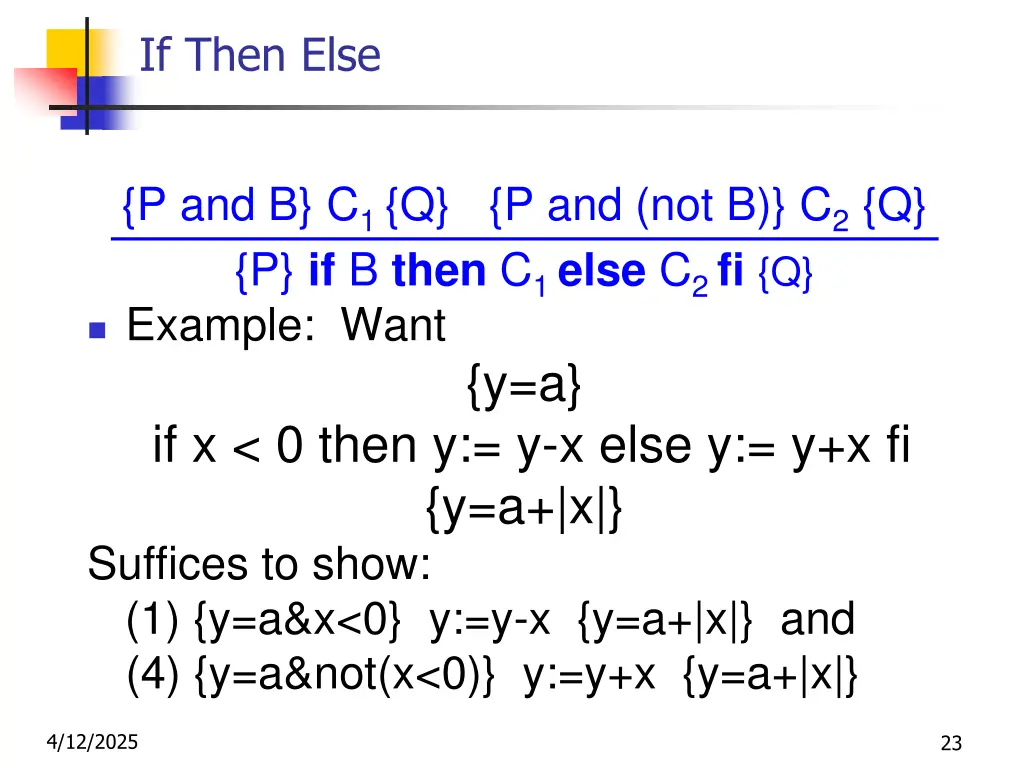
If Then Else {P and B} C1 {Q} {P and (not B)} C2 {Q} {P} if B then C1 else C2 fi {Q} Example: Want {y=a} if x < 0 then y:= y-x else y:= y+x fi {y=a+|x|} Suffices to show: (1) {y=a&x<0} y:=y-x {y=a+|x|} and (4) {y=a¬(x<0)} y:=y+x {y=a+|x|} 4/12/2025 23
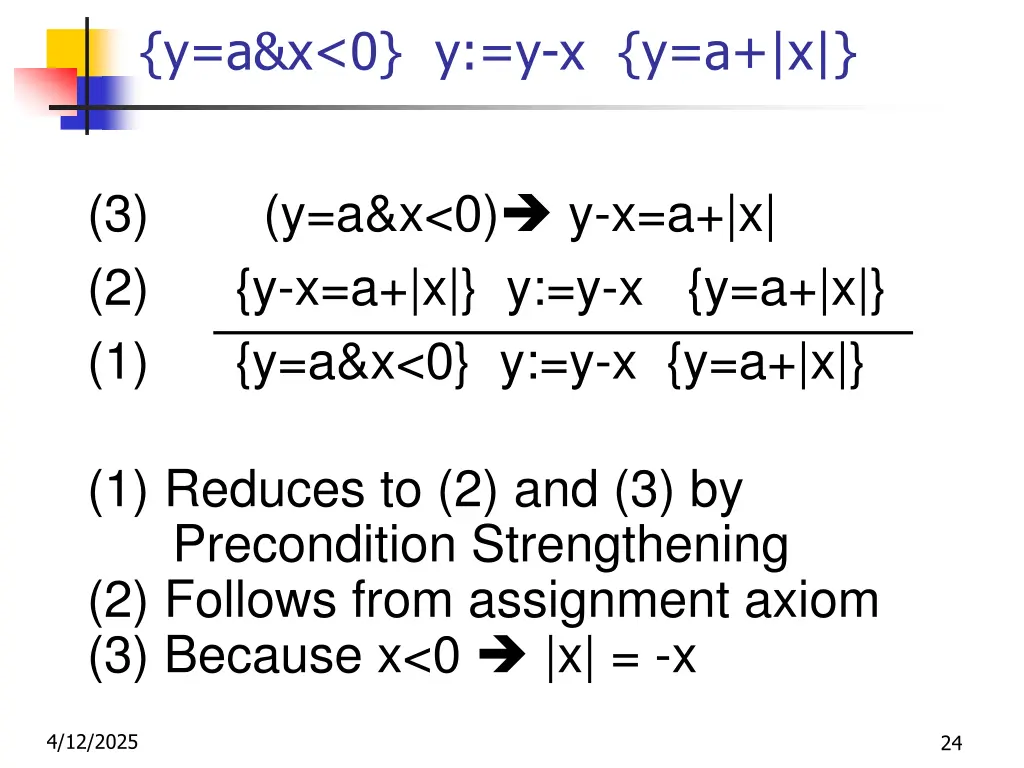
{y=a&x<0} y:=y-x {y=a+|x|} (3) (y=a&x<0) y-x=a+|x| (2) {y-x=a+|x|} y:=y-x {y=a+|x|} (1) {y=a&x<0} y:=y-x {y=a+|x|} (1) Reduces to (2) and (3) by Precondition Strengthening (2) Follows from assignment axiom (3) Because x<0 |x| = -x 4/12/2025 24
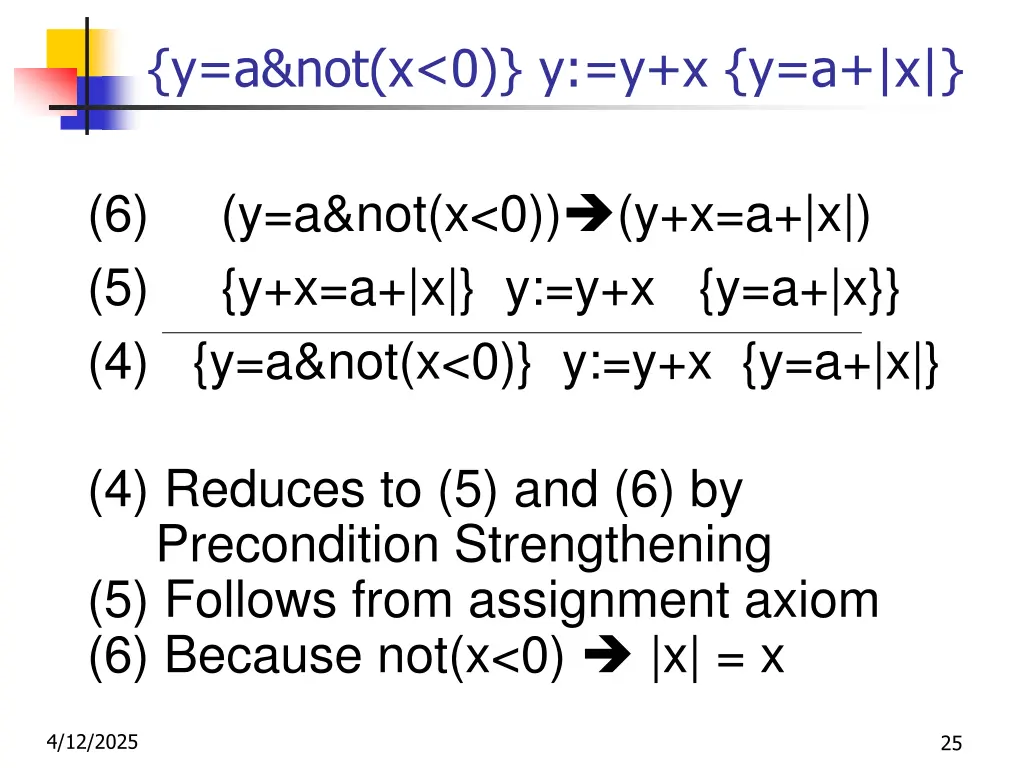
{y=a¬(x<0)} y:=y+x {y=a+|x|} (6) (y=a¬(x<0)) (y+x=a+|x|) (5) {y+x=a+|x|} y:=y+x {y=a+|x}} (4) {y=a¬(x<0)} y:=y+x {y=a+|x|} (4) Reduces to (5) and (6) by Precondition Strengthening (5) Follows from assignment axiom (6) Because not(x<0) |x| = x 4/12/2025 25
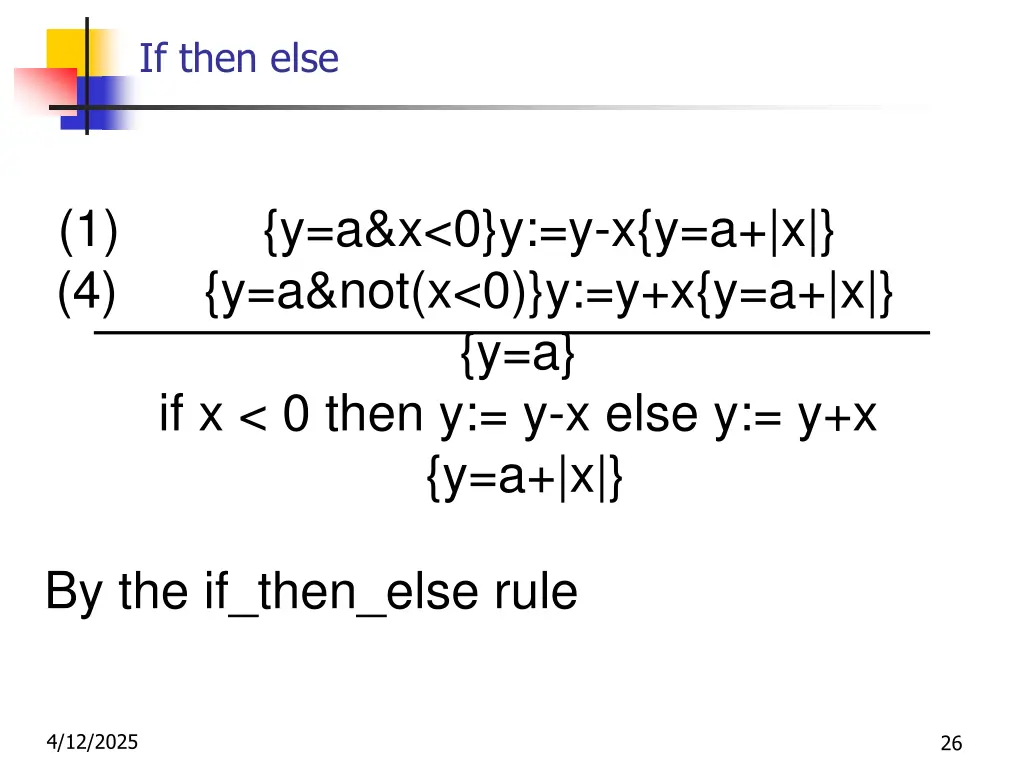
If then else (1) {y=a&x<0}y:=y-x{y=a+|x|} . (4) {y=a¬(x<0)}y:=y+x{y=a+|x|} . {y=a} if x < 0 then y:= y-x else y:= y+x {y=a+|x|} By the if_then_else rule 4/12/2025 26
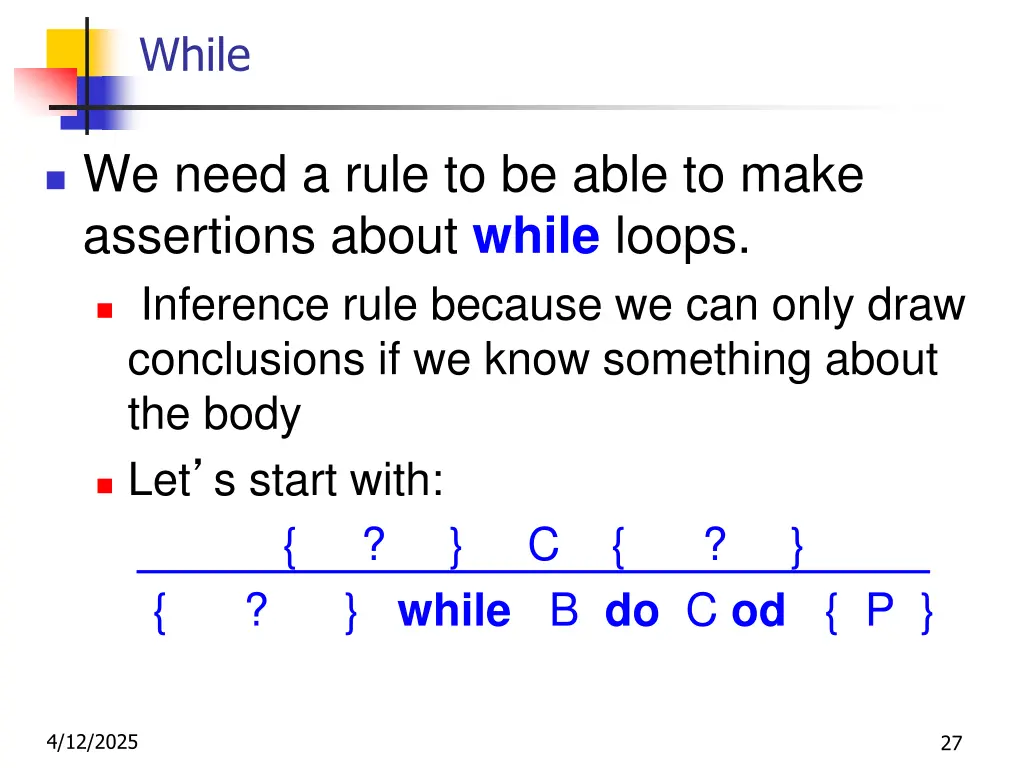
While We need a rule to be able to make assertions about while loops. Inference rule because we can only draw conclusions if we know something about the body Let s start with: { ? } C { ? } { ? } while B do C od { P } 4/12/2025 27
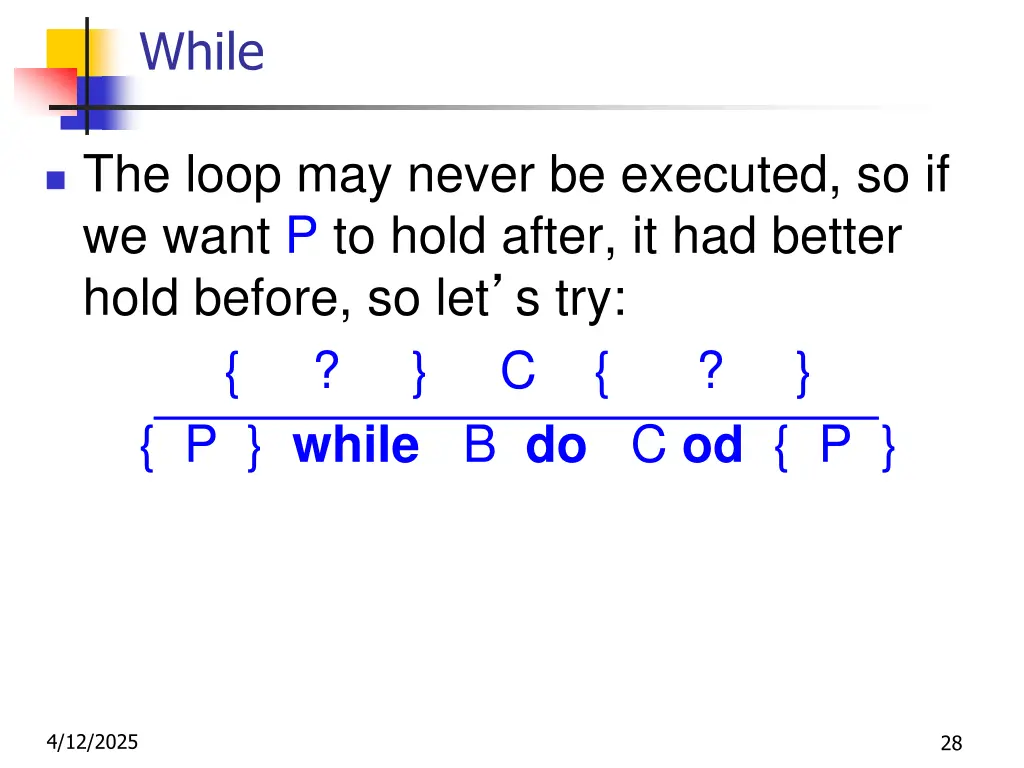
While The loop may never be executed, so if we want P to hold after, it had better hold before, so let s try: { ? } C { ? } { P } while B do C od { P } 4/12/2025 28
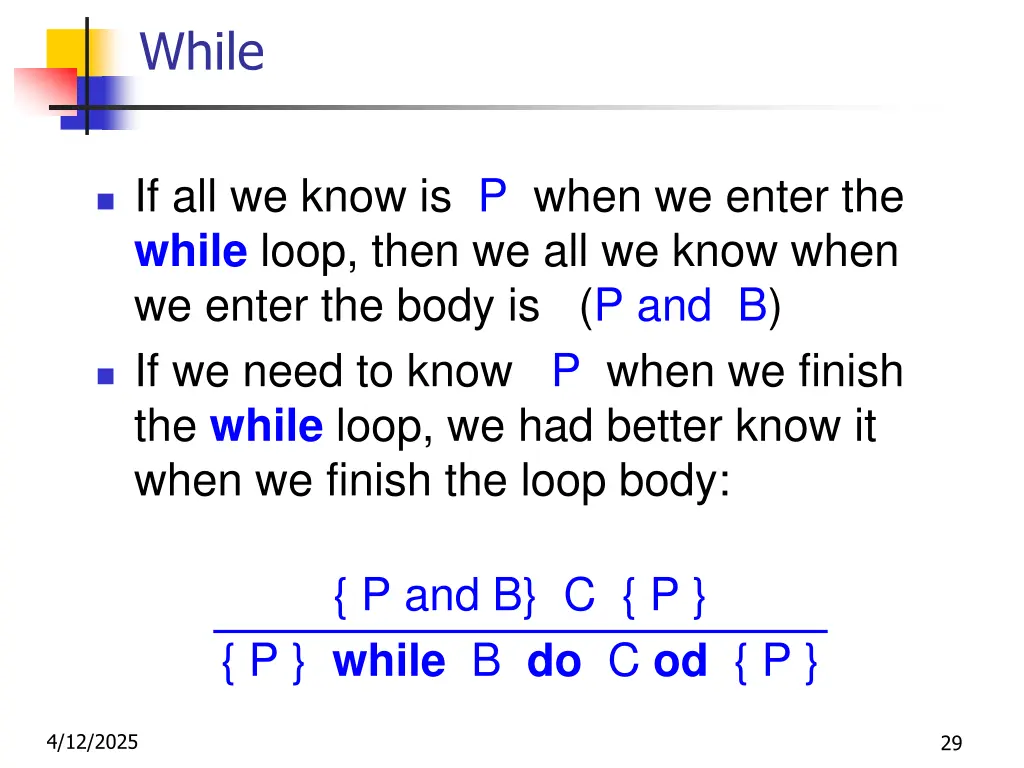
While If all we know is P when we enter the while loop, then we all we know when we enter the body is (P and B) If we need to know P when we finish the while loop, we had better know it when we finish the loop body: { P and B} C { P } { P } while B do C od { P } 4/12/2025 29
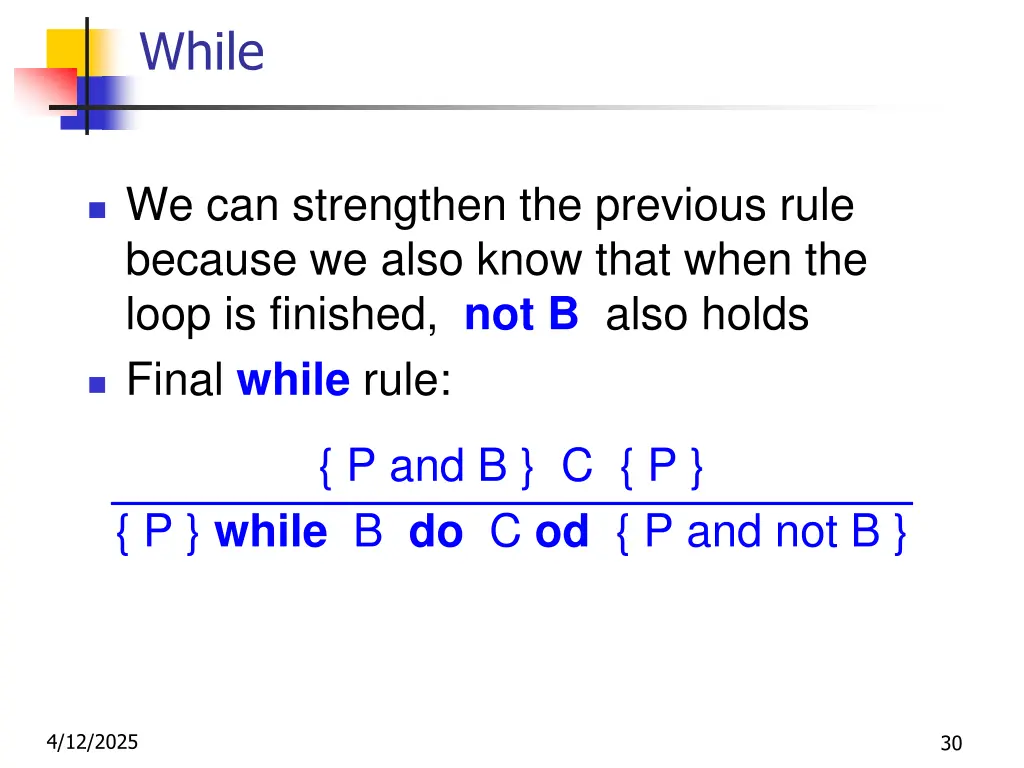
While We can strengthen the previous rule because we also know that when the loop is finished, not B also holds Final while rule: { P and B } C { P } { P } while B do C od { P and not B } 4/12/2025 30
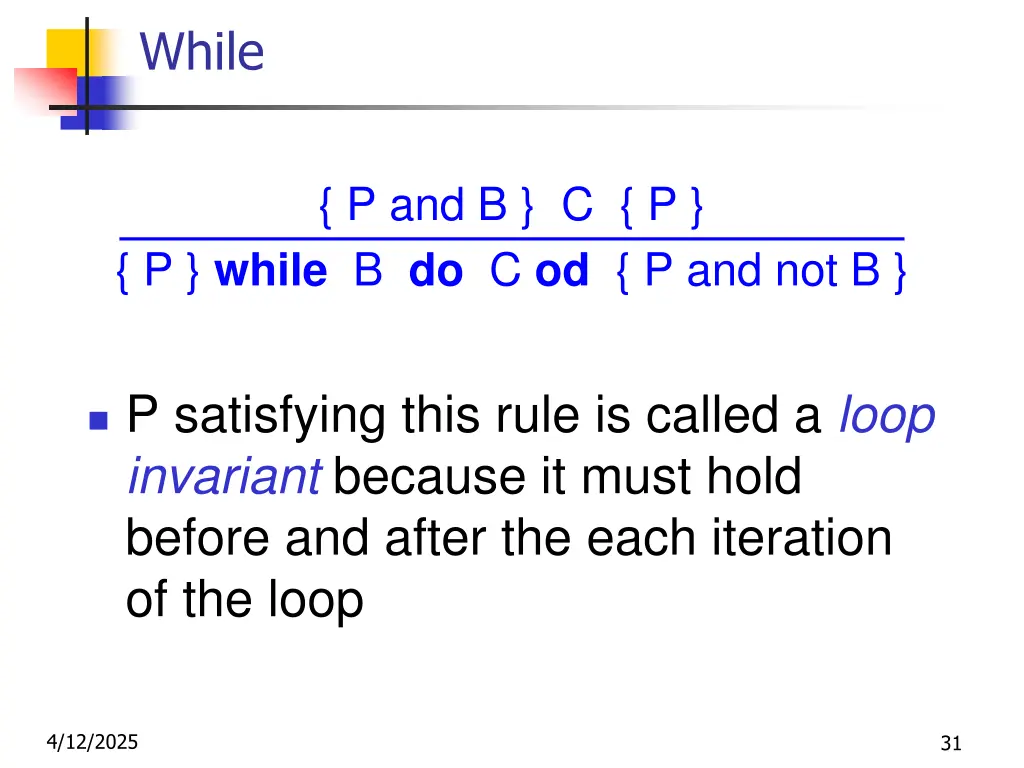
While { P and B } C { P } { P } while B do C od { P and not B } P satisfying this rule is called a loop invariant because it must hold before and after the each iteration of the loop 4/12/2025 31
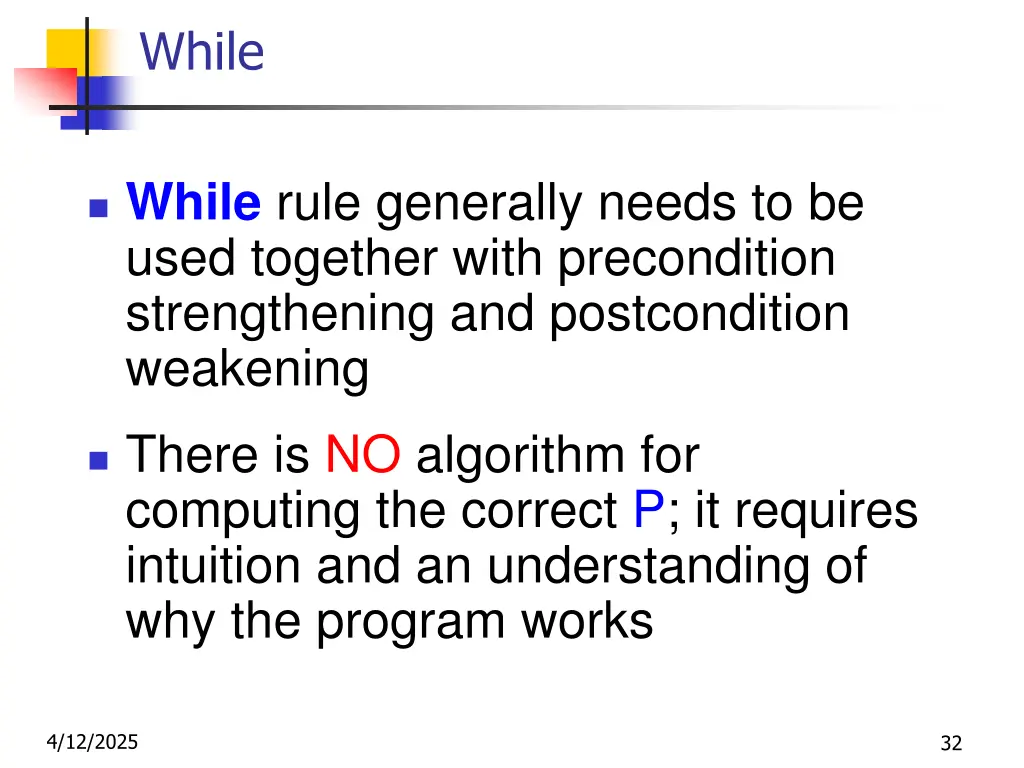
While While rule generally needs to be used together with precondition strengthening and postcondition weakening There is NO algorithm for computing the correct P; it requires intuition and an understanding of why the program works 4/12/2025 32
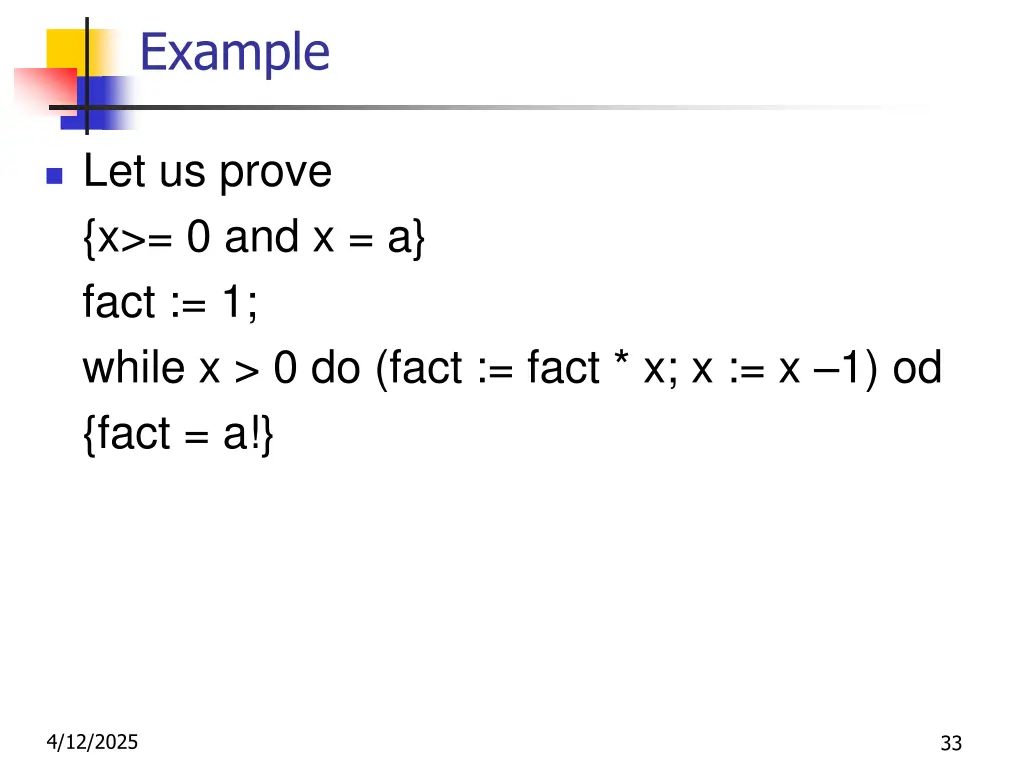
Example Let us prove {x>= 0 and x = a} fact := 1; while x > 0 do (fact := fact * x; x := x 1) od {fact = a!} 4/12/2025 33
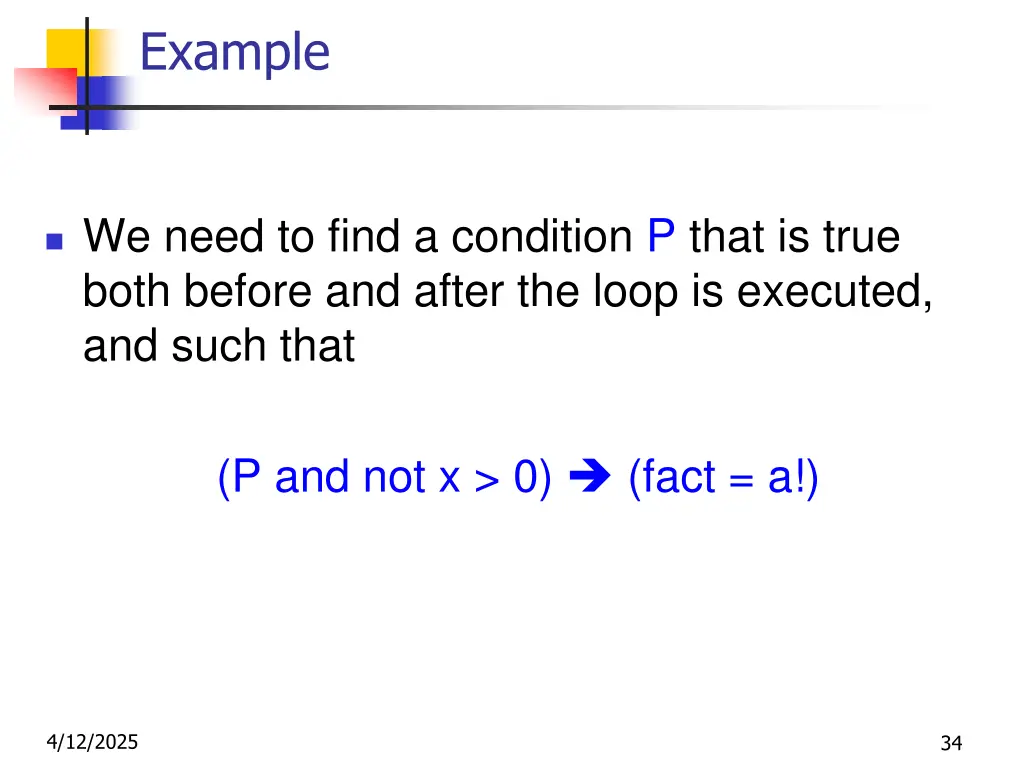
Example We need to find a condition P that is true both before and after the loop is executed, and such that (P and not x > 0) (fact = a!) 4/12/2025 34
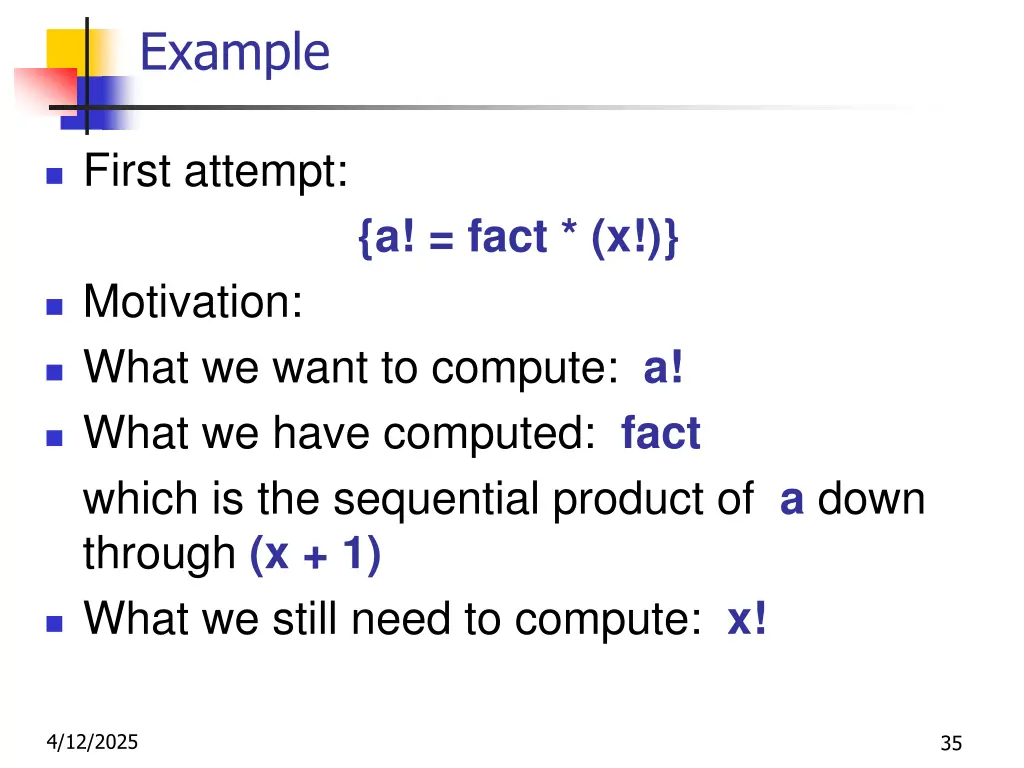
Example First attempt: {a! = fact * (x!)} Motivation: What we want to compute: a! What we have computed: fact which is the sequential product of a down through (x + 1) What we still need to compute: x! 4/12/2025 35
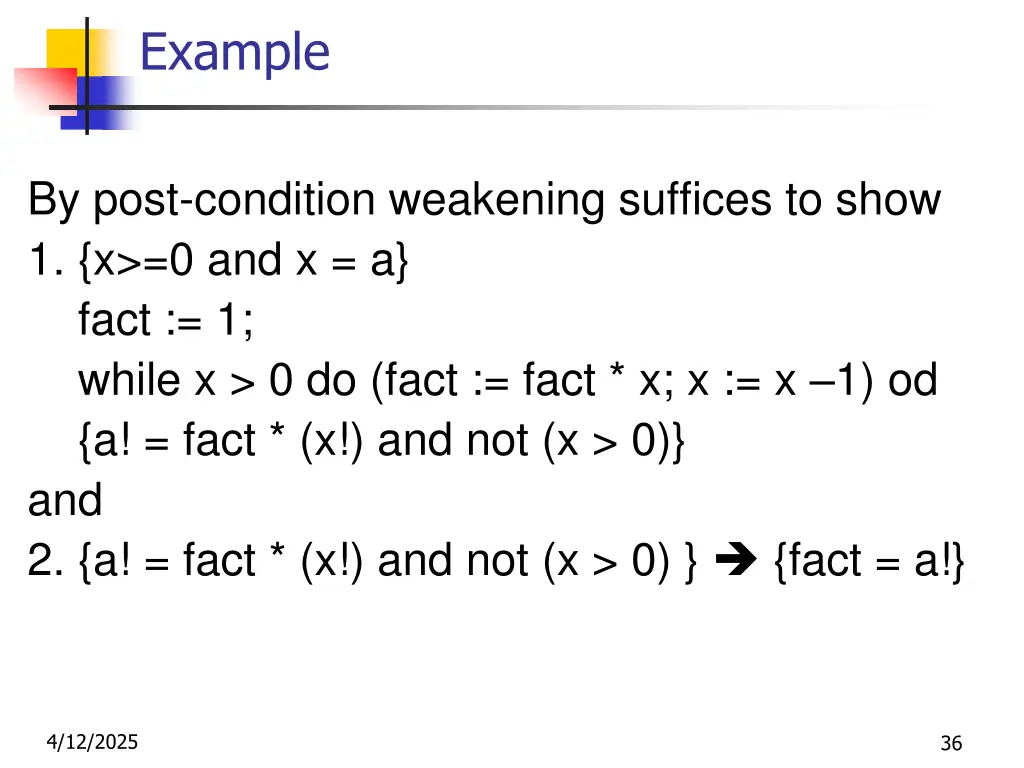
Example By post-condition weakening suffices to show 1. {x>=0 and x = a} fact := 1; while x > 0 do (fact := fact * x; x := x 1) od {a! = fact * (x!) and not (x > 0)} and 2. {a! = fact * (x!) and not (x > 0) } {fact = a!} 4/12/2025 36
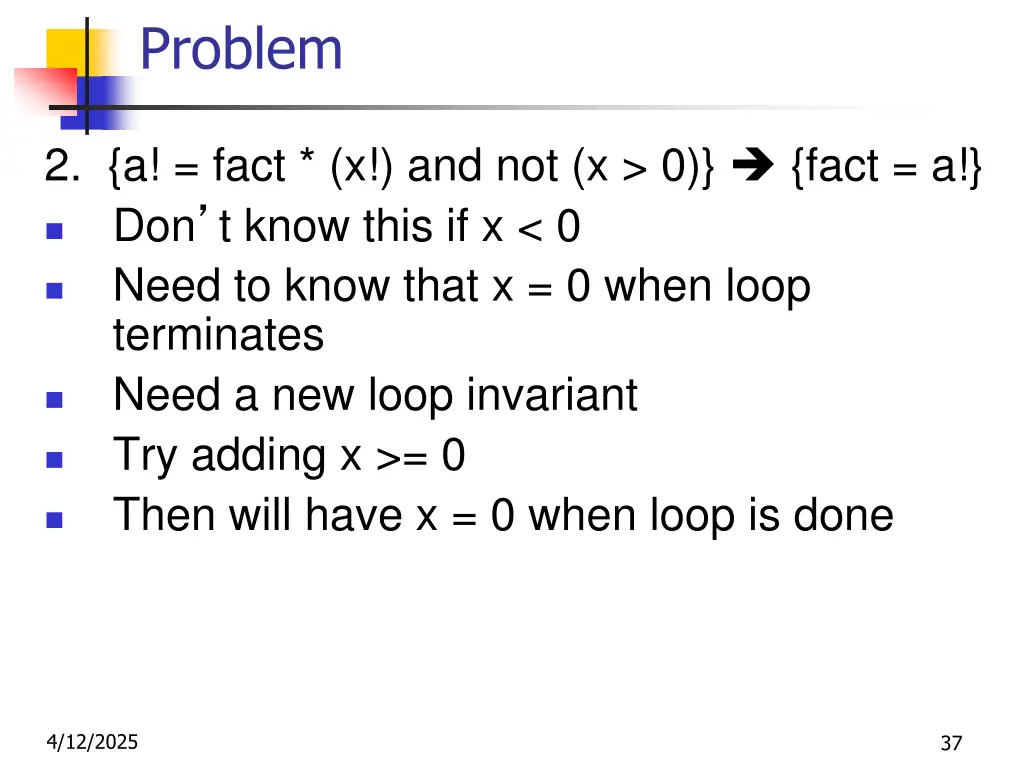
Problem 2. {a! = fact * (x!) and not (x > 0)} {fact = a!} Don t know this if x < 0 Need to know that x = 0 when loop terminates Need a new loop invariant Try adding x >= 0 Then will have x = 0 when loop is done 4/12/2025 37
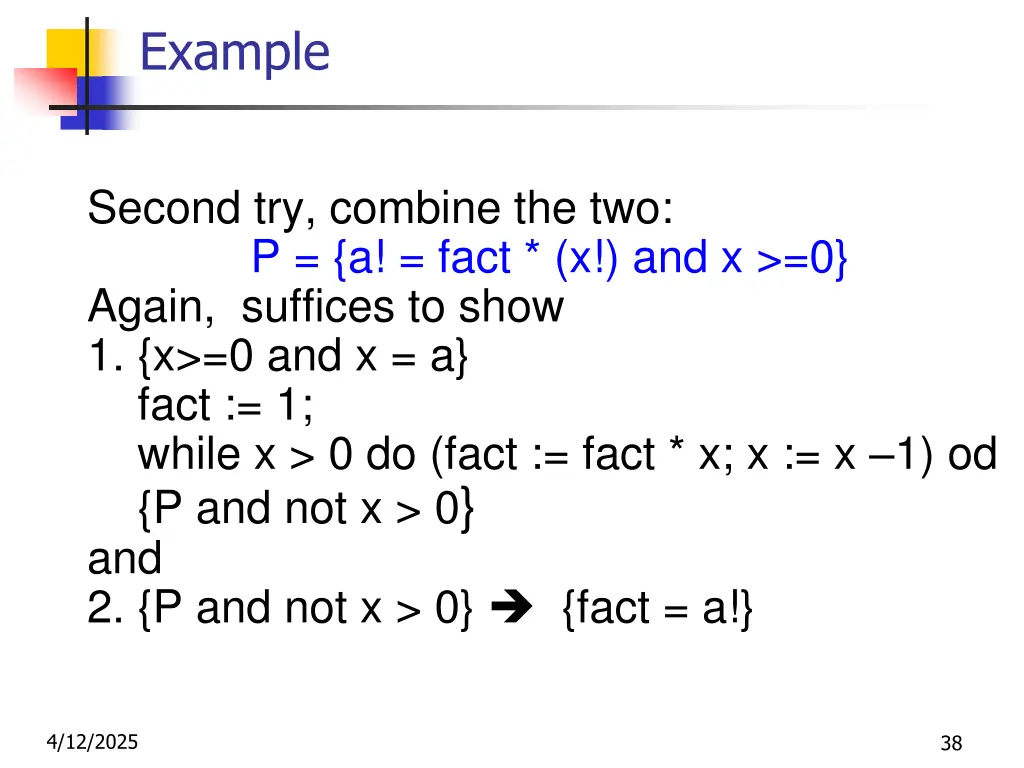
Example Second try, combine the two: P = {a! = fact * (x!) and x >=0} Again, suffices to show 1. {x>=0 and x = a} fact := 1; while x > 0 do (fact := fact * x; x := x 1) od {P and not x > 0} and 2. {P and not x > 0} {fact = a!} 4/12/2025 38
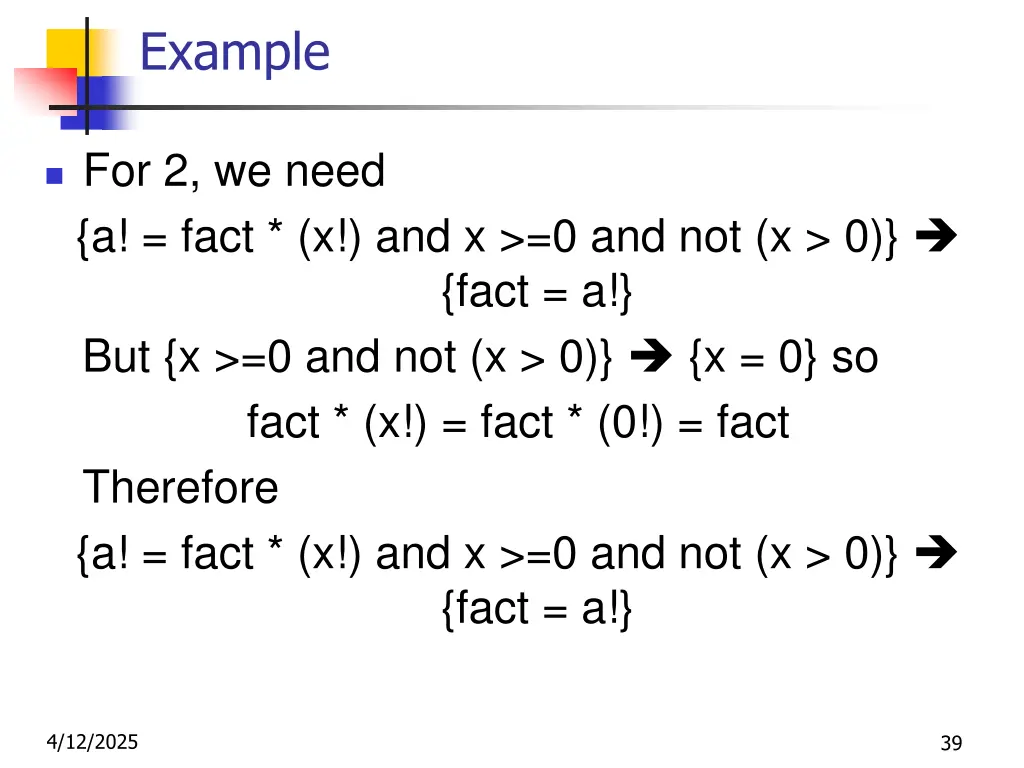
Example For 2, we need {a! = fact * (x!) and x >=0 and not (x > 0)} {fact = a!} But {x >=0 and not (x > 0)} {x = 0} so fact * (x!) = fact * (0!) = fact Therefore {a! = fact * (x!) and x >=0 and not (x > 0)} {fact = a!} 4/12/2025 39
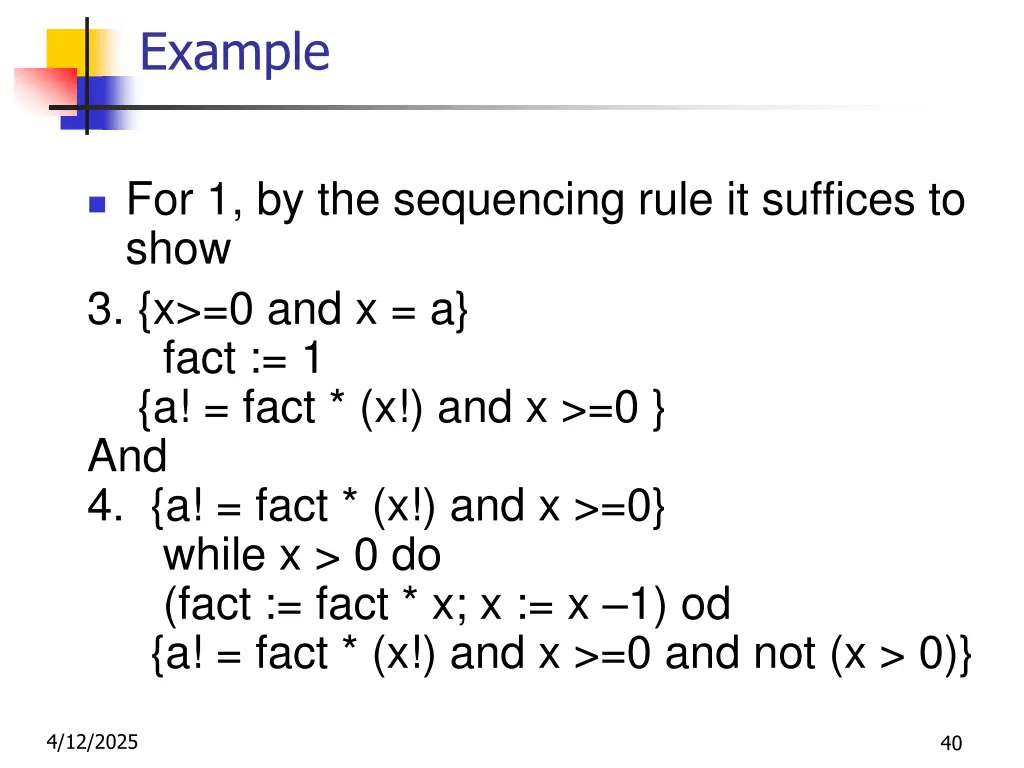
Example For 1, by the sequencing rule it suffices to show 3. {x>=0 and x = a} fact := 1 {a! = fact * (x!) and x >=0 } And 4. {a! = fact * (x!) and x >=0} while x > 0 do (fact := fact * x; x := x 1) od {a! = fact * (x!) and x >=0 and not (x > 0)} 4/12/2025 40
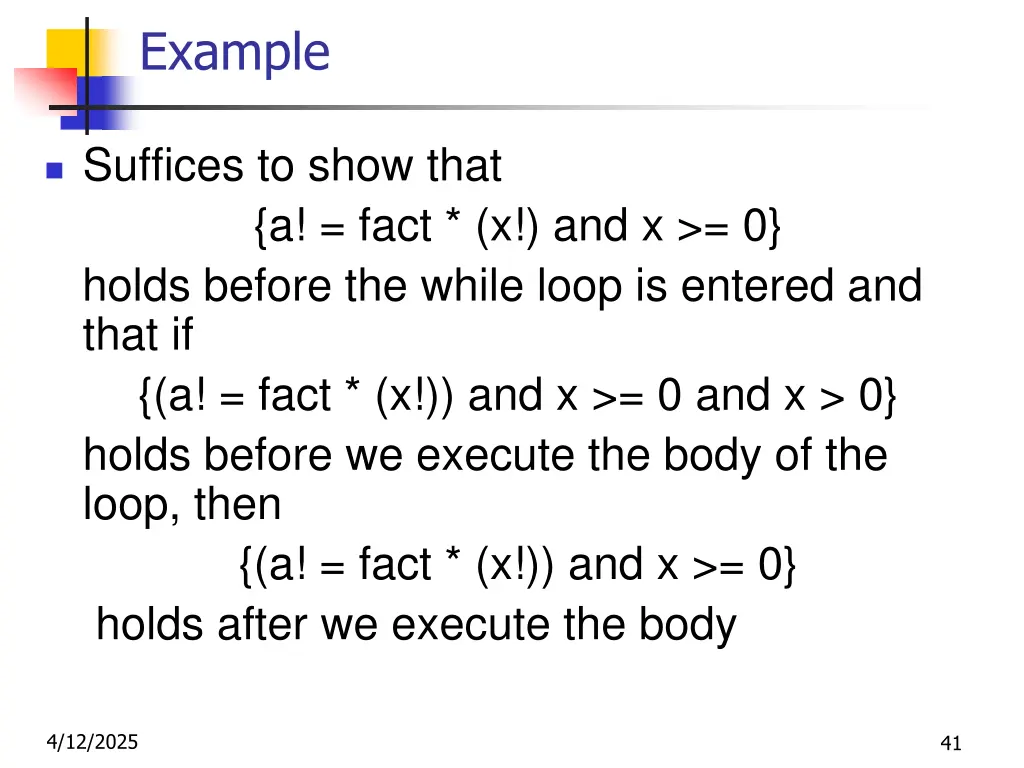
Example Suffices to show that {a! = fact * (x!) and x >= 0} holds before the while loop is entered and that if {(a! = fact * (x!)) and x >= 0 and x > 0} holds before we execute the body of the loop, then {(a! = fact * (x!)) and x >= 0} holds after we execute the body 4/12/2025 41
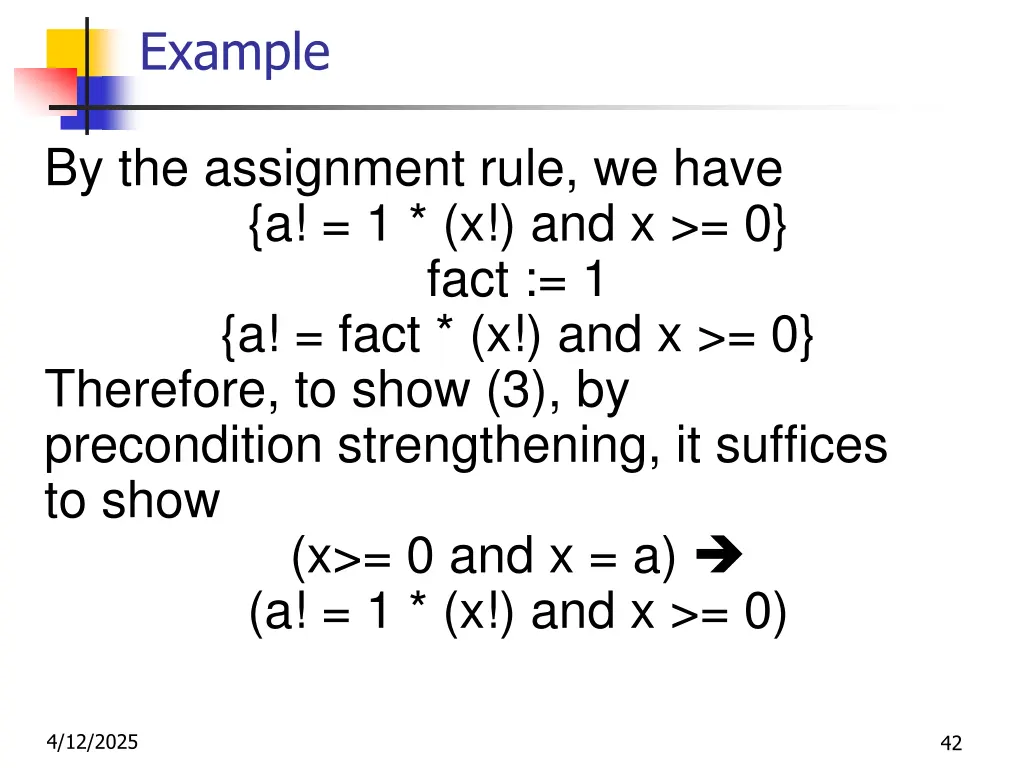
Example By the assignment rule, we have {a! = 1 * (x!) and x >= 0} fact := 1 {a! = fact * (x!) and x >= 0} Therefore, to show (3), by precondition strengthening, it suffices to show (x>= 0 and x = a) (a! = 1 * (x!) and x >= 0) 4/12/2025 42
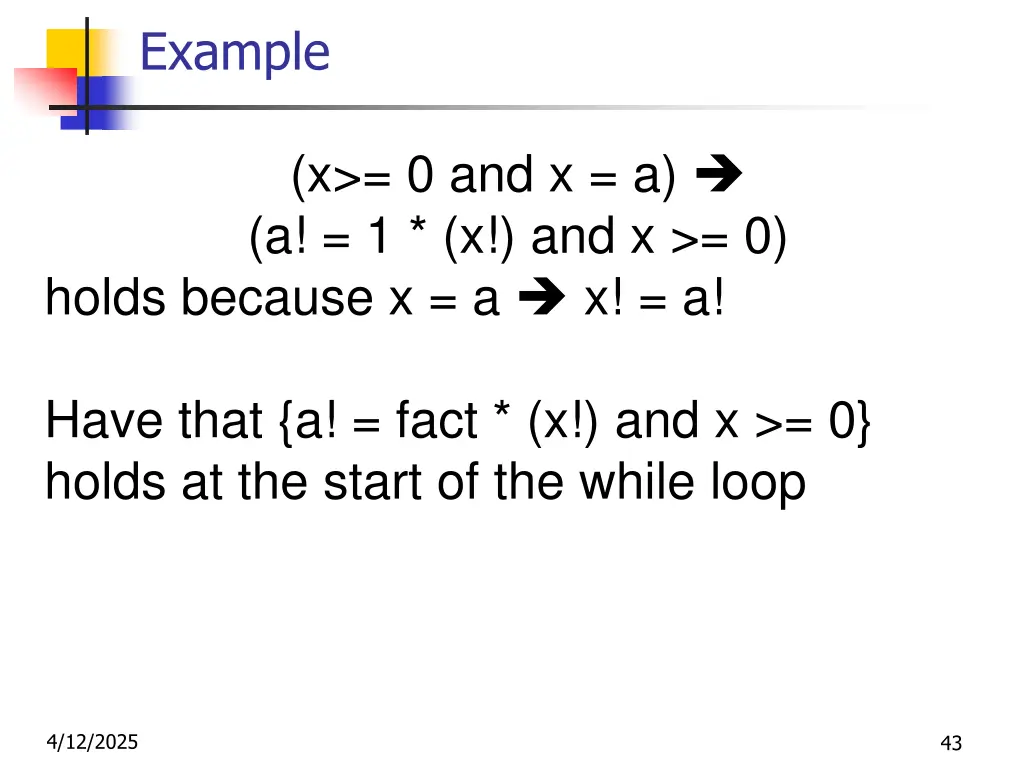
Example (x>= 0 and x = a) (a! = 1 * (x!) and x >= 0) holds because x = a x! = a! Have that {a! = fact * (x!) and x >= 0} holds at the start of the while loop 4/12/2025 43
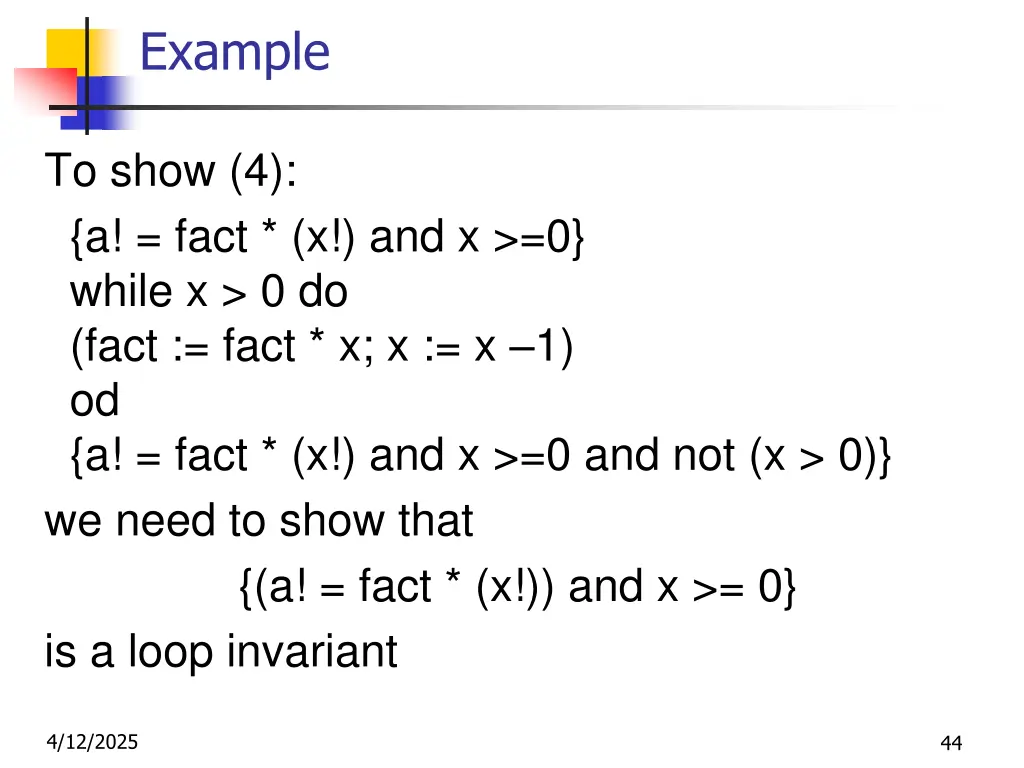
Example To show (4): {a! = fact * (x!) and x >=0} while x > 0 do (fact := fact * x; x := x 1) od {a! = fact * (x!) and x >=0 and not (x > 0)} we need to show that {(a! = fact * (x!)) and x >= 0} is a loop invariant 4/12/2025 44
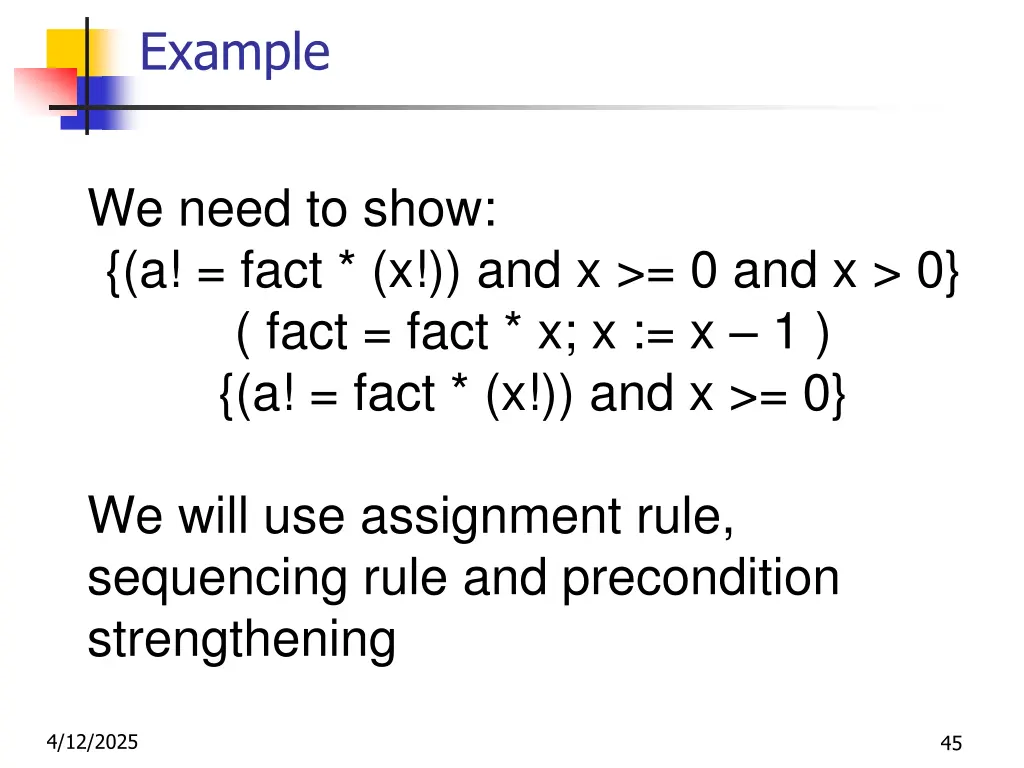
Example We need to show: {(a! = fact * (x!)) and x >= 0 and x > 0} ( fact = fact * x; x := x 1 ) {(a! = fact * (x!)) and x >= 0} We will use assignment rule, sequencing rule and precondition strengthening 4/12/2025 45
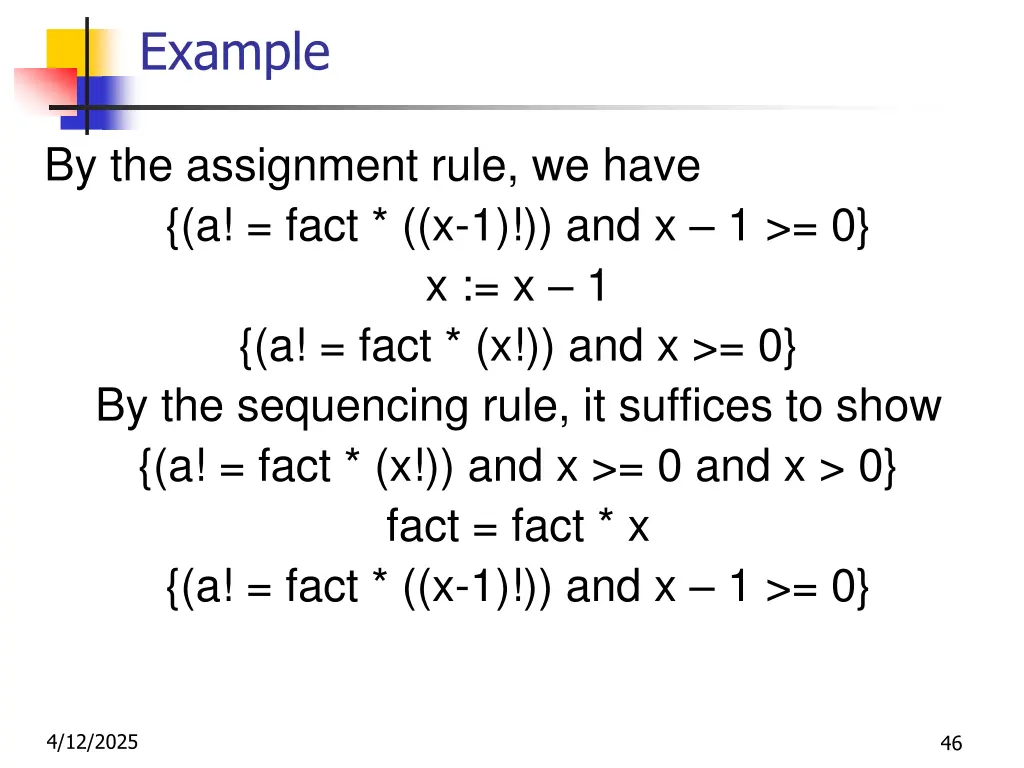
Example By the assignment rule, we have {(a! = fact * ((x-1)!)) and x 1 >= 0} x := x 1 {(a! = fact * (x!)) and x >= 0} By the sequencing rule, it suffices to show {(a! = fact * (x!)) and x >= 0 and x > 0} fact = fact * x {(a! = fact * ((x-1)!)) and x 1 >= 0} 4/12/2025 46
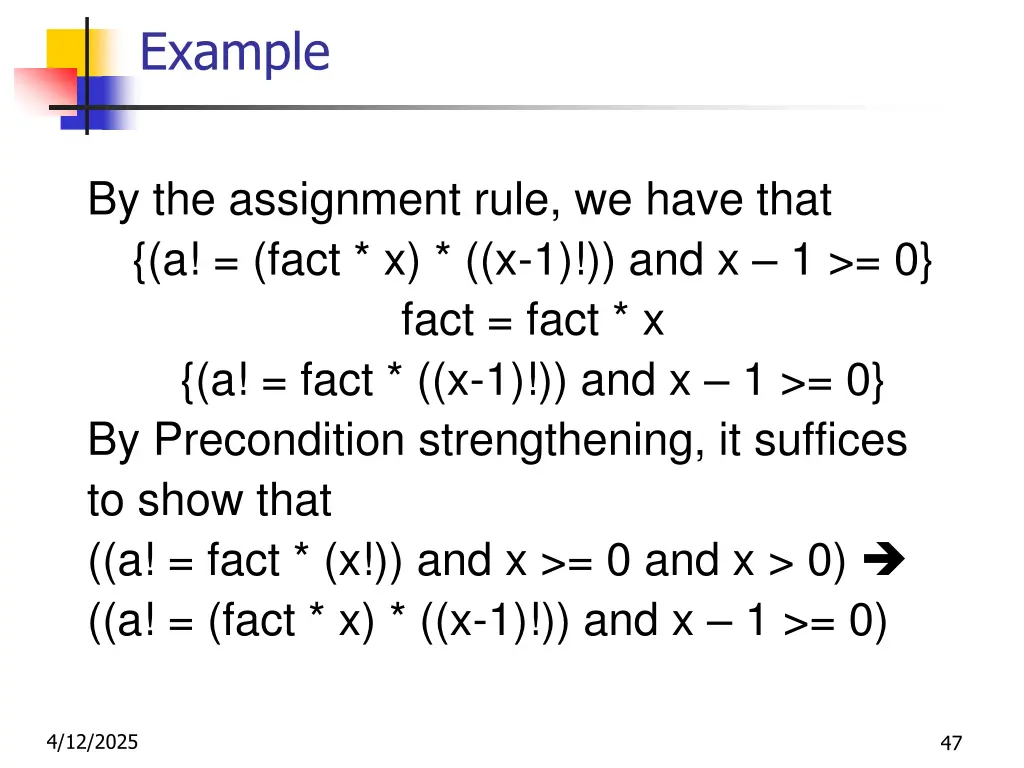
Example By the assignment rule, we have that {(a! = (fact * x) * ((x-1)!)) and x 1 >= 0} fact = fact * x {(a! = fact * ((x-1)!)) and x 1 >= 0} By Precondition strengthening, it suffices to show that ((a! = fact * (x!)) and x >= 0 and x > 0) ((a! = (fact * x) * ((x-1)!)) and x 1 >= 0) 4/12/2025 47
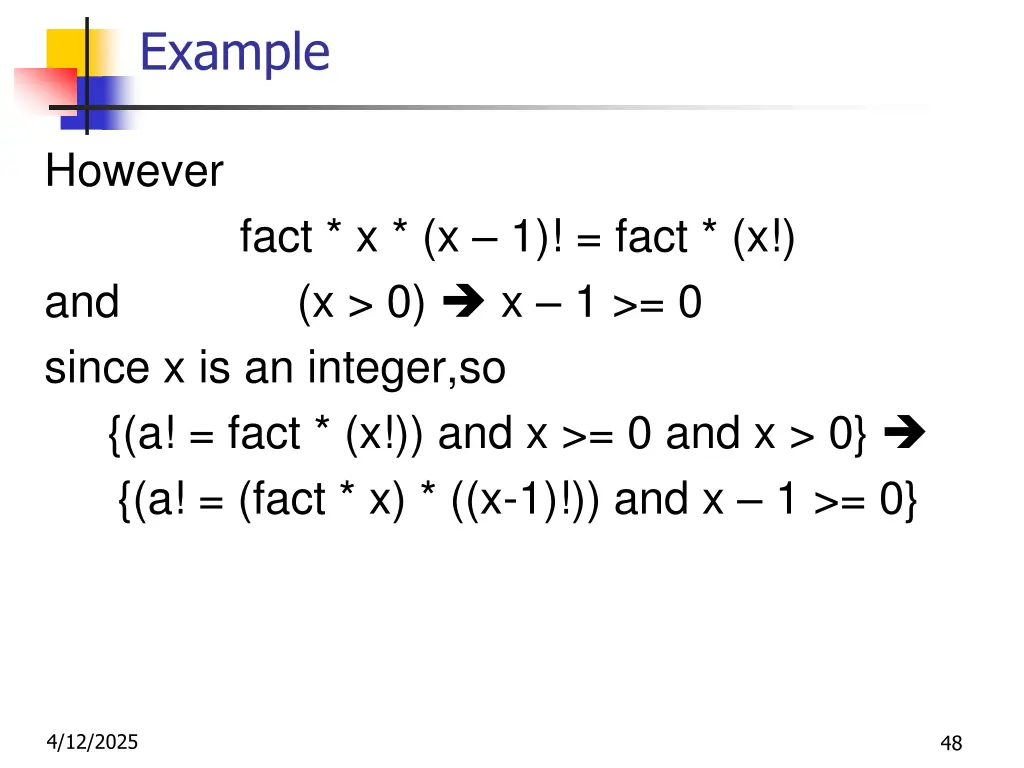
Example However fact * x * (x 1)! = fact * (x!) and (x > 0) x 1 >= 0 since x is an integer,so {(a! = fact * (x!)) and x >= 0 and x > 0} {(a! = (fact * x) * ((x-1)!)) and x 1 >= 0} 4/12/2025 48
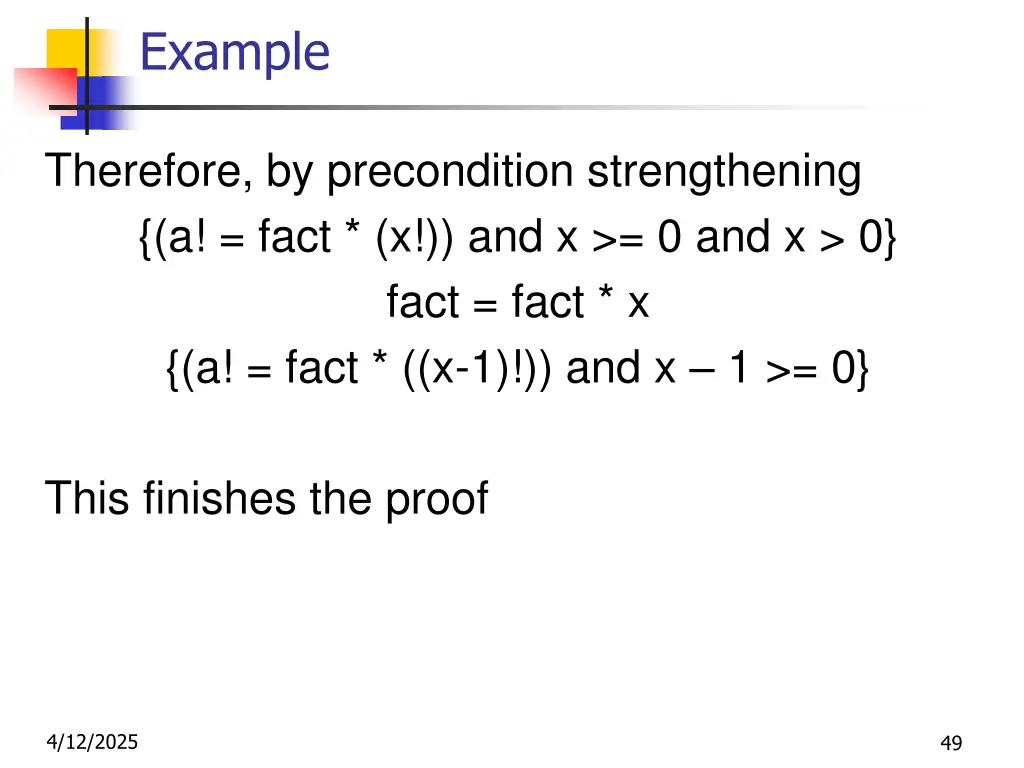
Example Therefore, by precondition strengthening {(a! = fact * (x!)) and x >= 0 and x > 0} fact = fact * x {(a! = fact * ((x-1)!)) and x 1 >= 0} This finishes the proof 4/12/2025 49