Bank Reconciliation Statement in Financial Management
Banks play a crucial role for organizations through their accounts. Learn about the importance of bank reconciliation, how it ensures accuracy between cash book and passbook balances, and reasons for discrepancies. Understand the process and significance of reconciling bank balances in financial management.

Download Presentation

Please find below an Image/Link to download the presentation.
The content on the website is provided AS IS for your information and personal use only. It may not be sold, licensed, or shared on other websites without obtaining consent from the author.If you encounter any issues during the download, it is possible that the publisher has removed the file from their server.
You are allowed to download the files provided on this website for personal or commercial use, subject to the condition that they are used lawfully. All files are the property of their respective owners.
The content on the website is provided AS IS for your information and personal use only. It may not be sold, licensed, or shared on other websites without obtaining consent from the author.
E N D
Presentation Transcript
Bank Reconciliation Statement Financial Management and Cost Accounting (DBM-422) A K JHA
Bank Reconciliation Organizations have their accounts in banks. A banking account is thus an essential part of any organization Be it a business enterprise or Not-For-Profit organization It is not possible to run and carry out the business activities without having a banking account. An enterprise usually has a Current Account in the bank Not-For-Profit organizations normally maintain Saving Accounts.
Bank Reconciliation Statement Meaning Bank records banking transactions in a Two-Column Cash Book. Money deposited into a bank is recorded on the debit side and Withdrawals are recorded on the credit side in the Two- Column cash book. Bank also maintain a customer s account in its books of account. Deposits made by customer are recorded on the credit side of the customer s account and Withdrawals on the debit side. A copy of it is also given to the customer for his information, which is known as a passbook or a statement of account.
As the same transaction relating to deposits and withdrawals made during a period are recorded in both Cash Book and the Passbook, the balance shown by the two records at the end of a period should agree. Sometimes the two balances differ. If the two balances differ, it implies that some error or omission has occurred. It, therefore, becomes essential to know the reason for the difference. A statement showing the reason of difference is prepared. This statement is Reconciliation Statement. known as a Bank
A Bank Reconciliation Statement is prepared on a particular date to reconcile the bank balance in the cash book with the balance as per the Bank Passbook or Bank Statement by showing reasons for difference between the two.
Reasons for difference between Cashbook and Passbook balance Balance as per book of accounts and Passbook may differ under some situations. These situations can be classified into three categories: 1. Difference due to timing 1. There is always a time gap between recording a transaction in the books of account s and their being recorded by the bank. For example a cheque issued is recorded in the books of accounts immediately buut the bank will record it when it is presented for the payment
2. Transaction recorded by the bank Sometimes transactions recorded by the banks are not known to the account holders. For example, interest charged or allowed, bank charges, transfer of balance from one account to anther. The account holder comes to know about these after receiving the bank statement
3. Errors Errors may be committed by the bank or the accountant, and these errors lead to difference in the balance of cashbook and bank statement. For example. Wrong balance may be carry forward by the accountant, a transaction may not have been recorded in the Cashbook, or a transaction may have been wrongly recorded in another account. The bank balance a per the cash book will not agree with the balance as per the bank statement under the above situations.
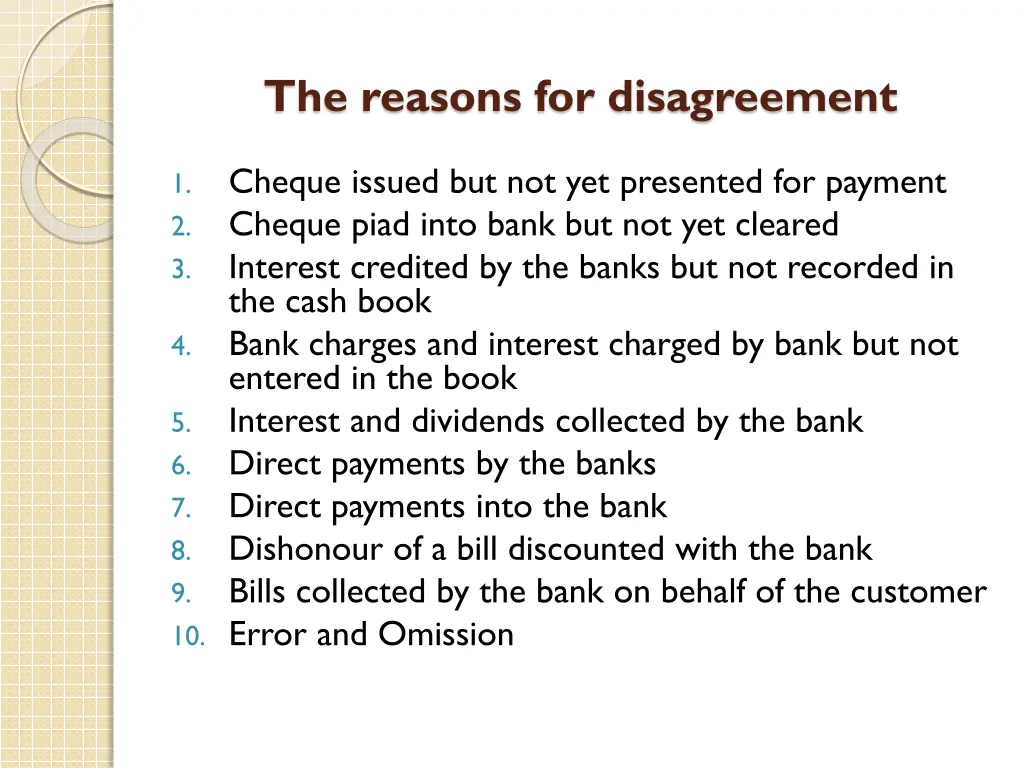
The reasons for disagreement Cheque issued but not yet presented for payment Cheque piad into bank but not yet cleared Interest credited by the banks but not recorded in the cash book Bank charges and interest charged by bank but not entered in the book Interest and dividends collected by the bank Direct payments by the banks Direct payments into the bank Dishonour of a bill discounted with the bank Bills collected by the bank on behalf of the customer 10. Error and Omission 1. 2. 3. 4. 5. 6. 7. 8. 9.
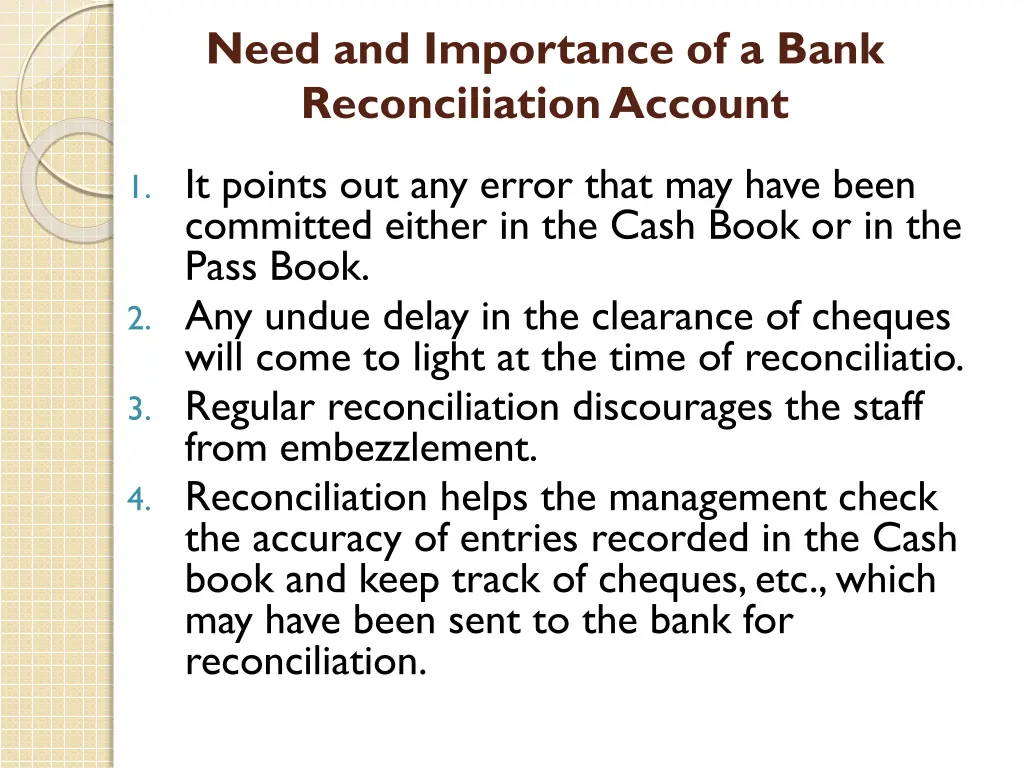
Need and Importance of a Bank Reconciliation Account 1. It points out any error that may have been committed either in the Cash Book or in the Pass Book. 2. Any undue delay in the clearance of cheques will come to light at the time of reconciliatio. 3. Regular reconciliation discourages the staff from embezzlement. 4. Reconciliation helps the management check the accuracy of entries recorded in the Cash book and keep track of cheques, etc., which may have been sent to the bank for reconciliation.
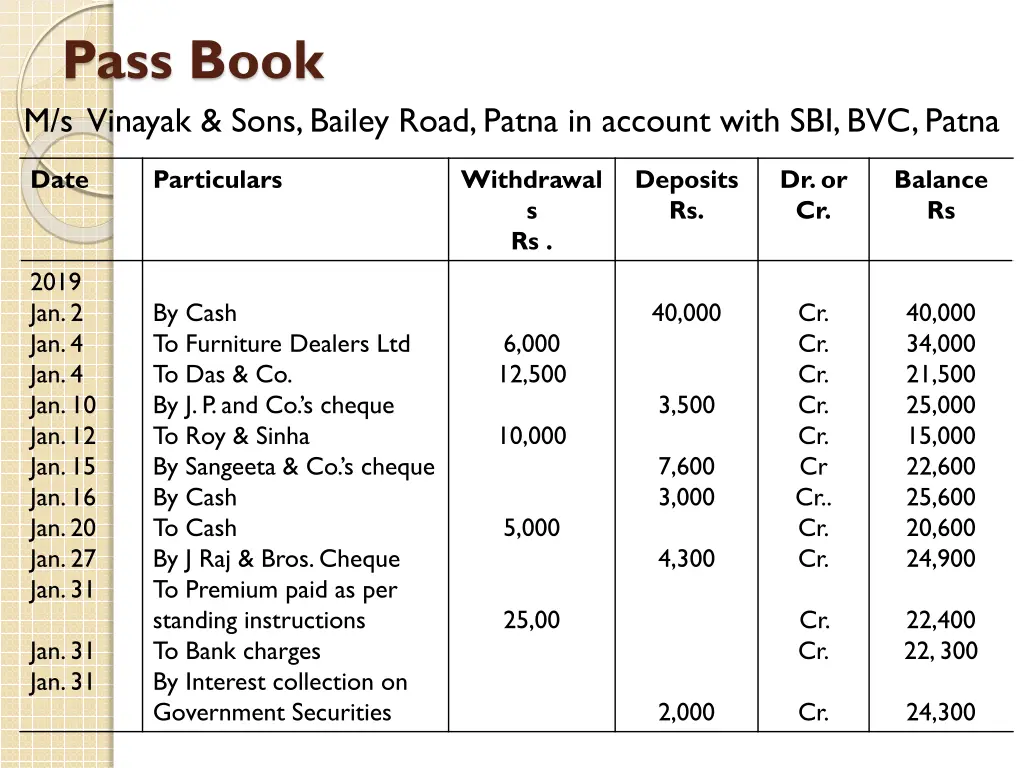
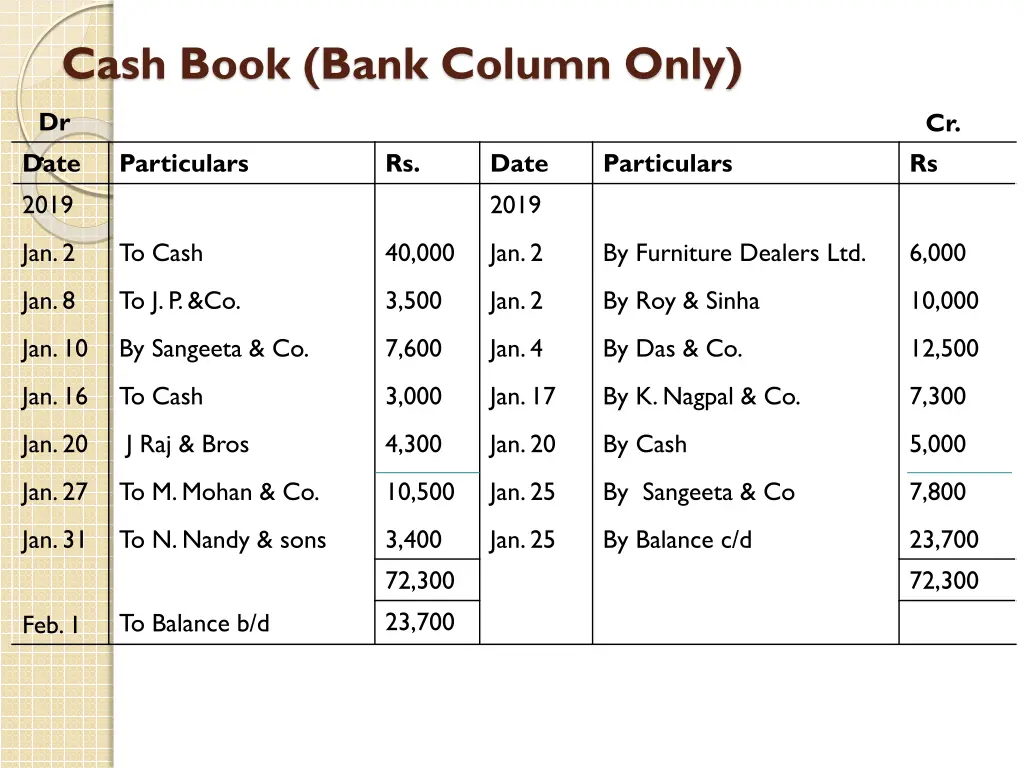
Ascertaining the Reasons or Causes of the Difference in the Balance The causes of the difference are ascertained when items in the Pass Book and in the Cash Book are compared. An extract from a Pass Book and the Bank Account columns in the Cash Book is given in the next slide, which may be carefully perused.
Pass Book M/s Vinayak & Sons, Bailey Road, Patna in account with SBI, BVC, Patna Date Particulars Withdrawal s Rs . Deposits Rs. Dr.or Cr. Balance Rs 2019 Jan. 2 Jan. 4 Jan. 4 Jan. 10 Jan. 12 Jan. 15 Jan. 16 Jan. 20 Jan. 27 Jan. 31 By Cash To Furniture Dealers Ltd To Das & Co. By J. P. and Co. s cheque To Roy & Sinha By Sangeeta & Co. s cheque By Cash To Cash By J Raj & Bros. Cheque To Premium paid as per standing instructions To Bank charges By Interest collection on Government Securities 40,000 Cr. Cr. Cr. Cr. Cr. Cr Cr.. Cr. Cr. 40,000 34,000 21,500 25,000 15,000 22,600 25,600 20,600 24,900 6,000 12,500 3,500 10,000 7,600 3,000 5,000 4,300 25,00 Cr. Cr. 22,400 22, 300 Jan. 31 Jan. 31 2,000 Cr. 24,300
Cash Book (Bank Column Only) Dr . Cr. Date 2019 Particulars Rs. Date 2019 Particulars Rs Jan. 2 To Cash 40,000 Jan. 2 By Furniture Dealers Ltd. 6,000 Jan. 8 To J. P. &Co. 3,500 Jan. 2 By Roy & Sinha 10,000 Jan. 10 By Sangeeta & Co. 7,600 Jan. 4 By Das & Co. 12,500 Jan. 16 To Cash 3,000 Jan. 17 By K. Nagpal & Co. 7,300 Jan. 20 J Raj & Bros 4,300 Jan. 20 By Cash 5,000 Jan. 27 To M. Mohan & Co. 10,500 Jan. 25 By Sangeeta & Co 7,800 Jan. 31 To N. Nandy & sons 3,400 72,300 23,700 Jan. 25 By Balance c/d 23,700 72,300 To Balance b/d Feb. 1