Basic Probability Theory Terminology and Distributions
This content covers fundamental concepts in probability theory such as sample spaces, events, random variables, and probability distributions. It explains terminology like sample space, events, and random variables, along with how probabilities are assigned to different values of a random variable to create a probability distribution. It aims to provide a clear understanding of these key concepts in the field of probability theory.

Download Presentation

Please find below an Image/Link to download the presentation.
The content on the website is provided AS IS for your information and personal use only. It may not be sold, licensed, or shared on other websites without obtaining consent from the author.If you encounter any issues during the download, it is possible that the publisher has removed the file from their server.
You are allowed to download the files provided on this website for personal or commercial use, subject to the condition that they are used lawfully. All files are the property of their respective owners.
The content on the website is provided AS IS for your information and personal use only. It may not be sold, licensed, or shared on other websites without obtaining consent from the author.
E N D
Presentation Transcript
PROBABILITY David Kauchak CS158 Fall 2013
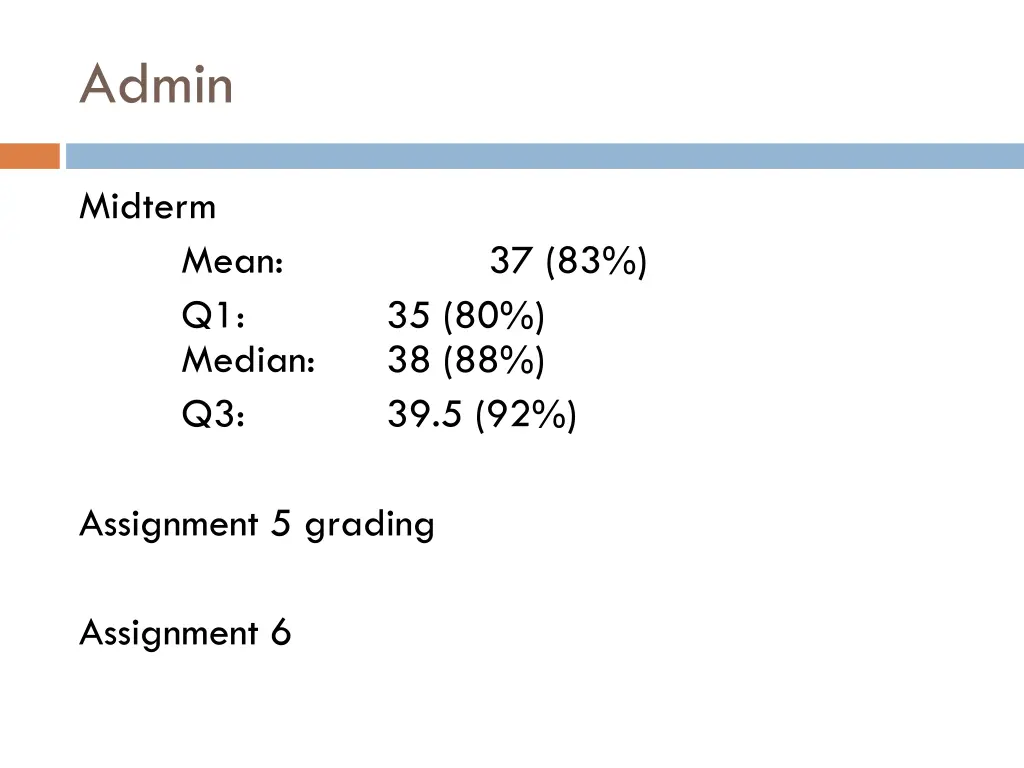
Admin Midterm Mean: Q1: Median: Q3: 37 (83%) 35 (80%) 38 (88%) 39.5 (92%) Assignment 5 grading Assignment 6
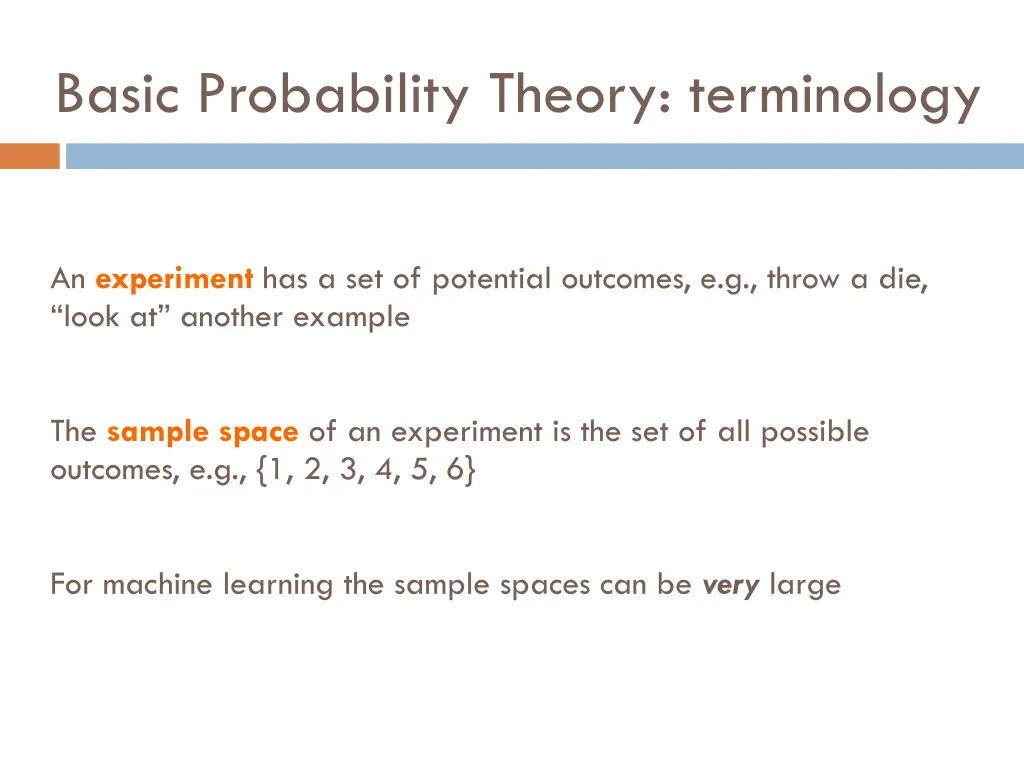
Basic Probability Theory: terminology An experiment has a set of potential outcomes, e.g., throw a die, look at another example The sample space of an experiment is the set of all possible outcomes, e.g., {1, 2, 3, 4, 5, 6} For machine learning the sample spaces can be very large
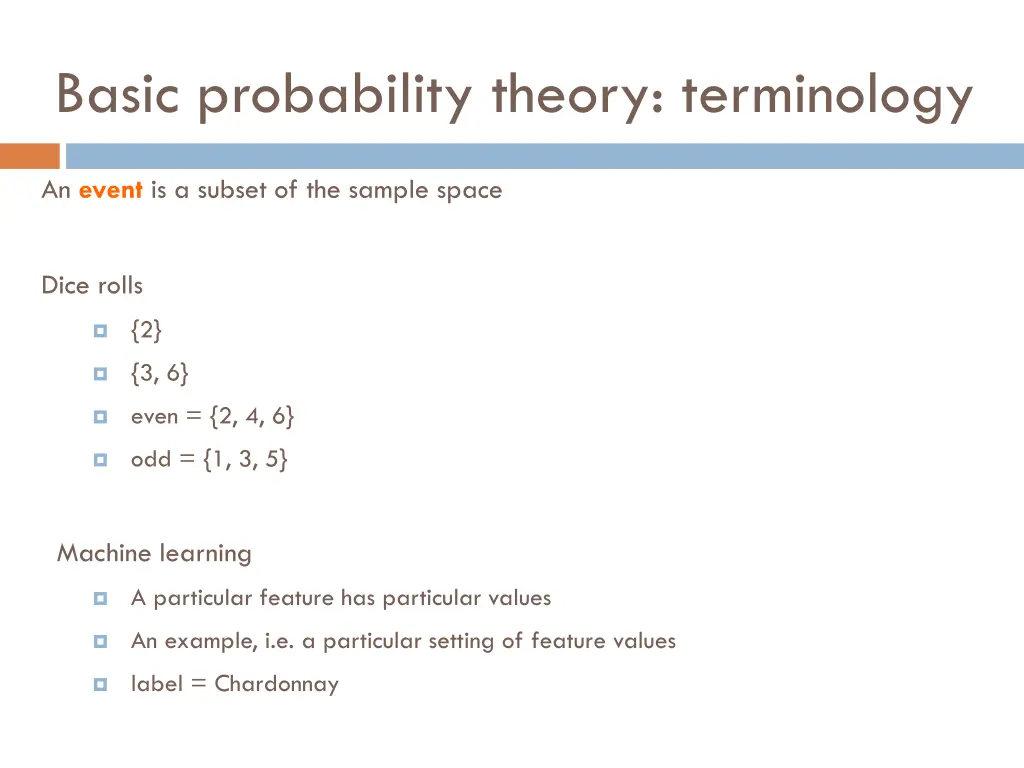
Basic probability theory: terminology An event is a subset of the sample space Dice rolls {2} {3, 6} even = {2, 4, 6} odd = {1, 3, 5} Machine learning A particular feature has particular values An example, i.e. a particular setting of feature values label = Chardonnay
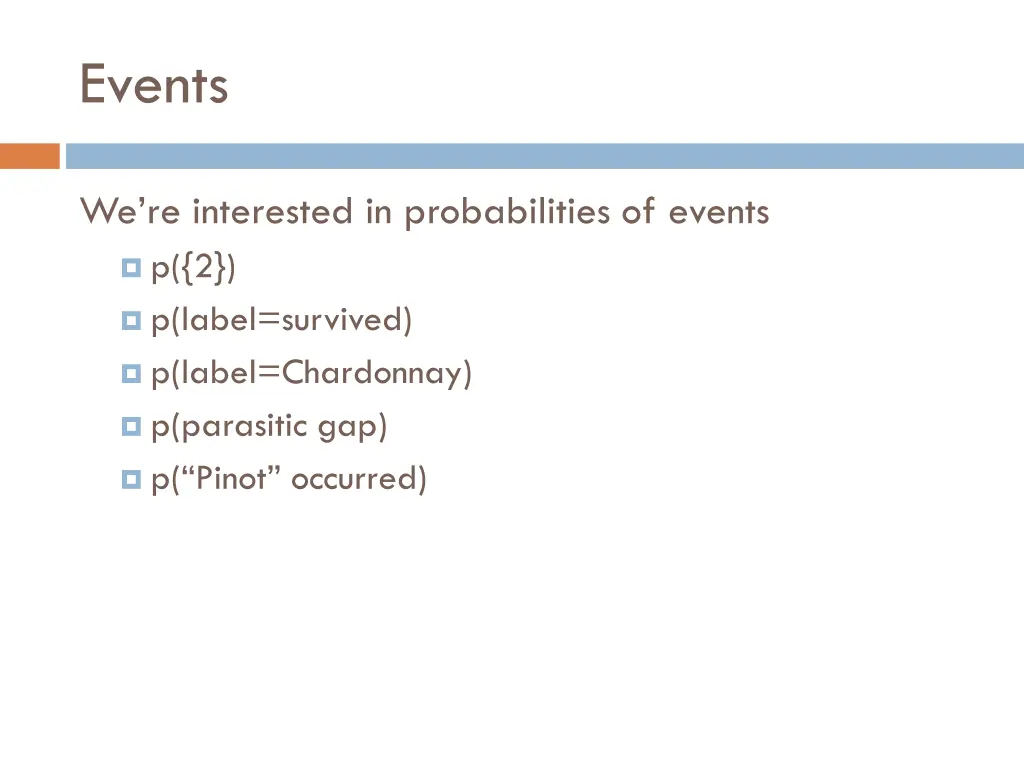
Events We re interested in probabilities of events p({2}) p(label=survived) p(label=Chardonnay) p(parasitic gap) p( Pinot occurred)
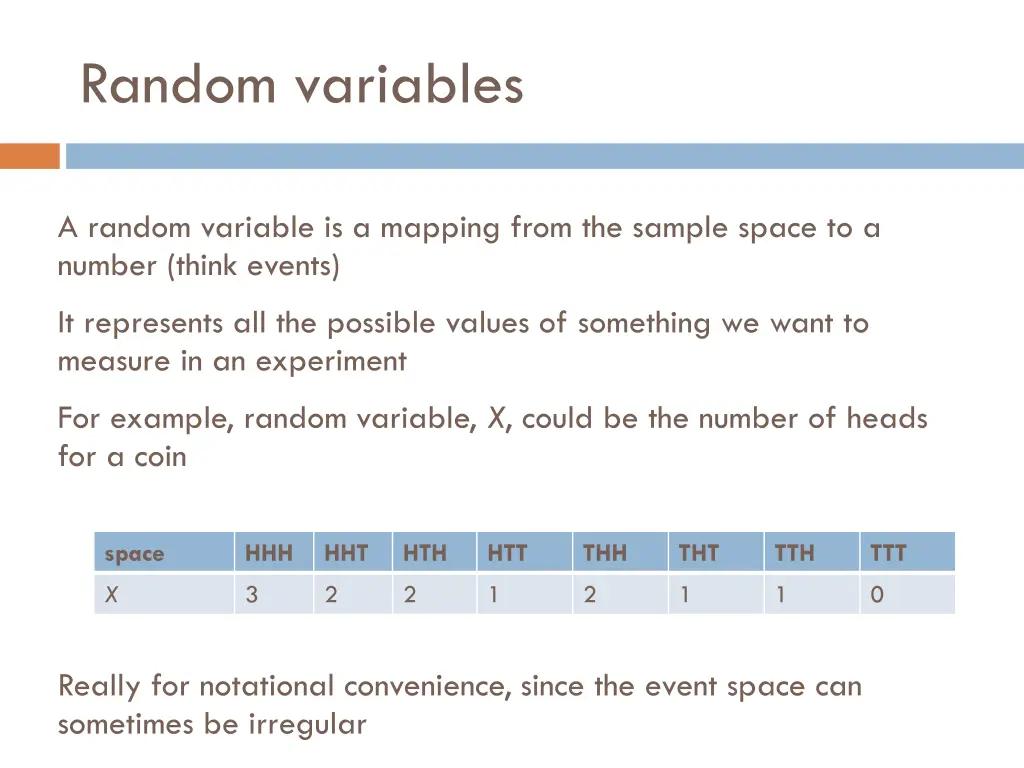
Random variables A random variable is a mapping from the sample space to a number (think events) It represents all the possible values of something we want to measure in an experiment For example, random variable, X, could be the number of heads for a coin space HHH HHT HTH HTT THH THT TTH TTT X 3 2 2 1 2 1 1 0 Really for notational convenience, since the event space can sometimes be irregular
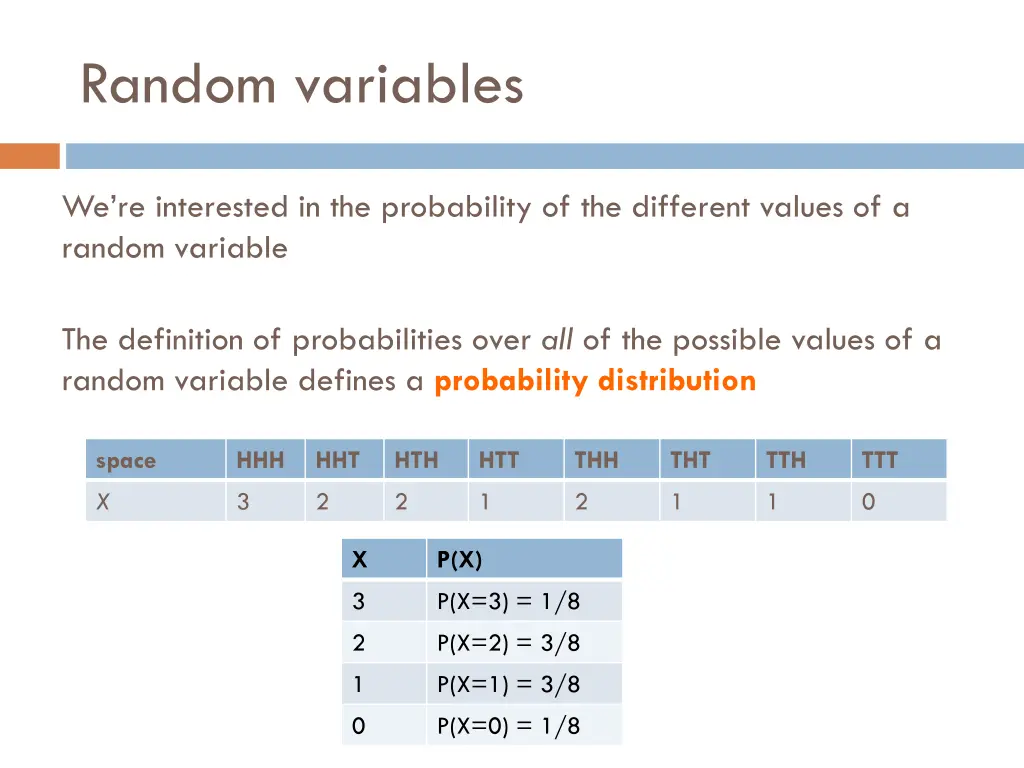
Random variables We re interested in the probability of the different values of a random variable The definition of probabilities over all of the possible values of a random variable defines a probability distribution space HHH HHT HTH HTT THH THT TTH TTT X 3 2 2 1 2 1 1 0 X P(X) 3 P(X=3) = 1/8 2 P(X=2) = 3/8 1 P(X=1) = 3/8 0 P(X=0) = 1/8
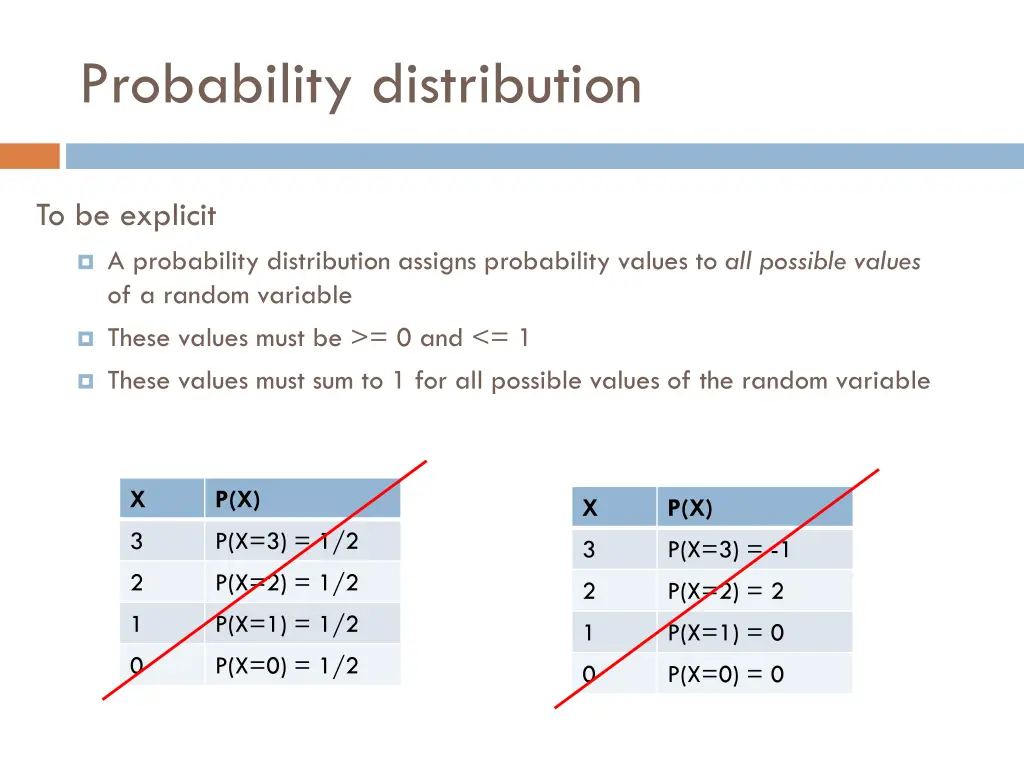
Probability distribution To be explicit A probability distribution assigns probability values to all possible values of a random variable These values must be >= 0 and <= 1 These values must sum to 1 for all possible values of the random variable X P(X) X P(X) 3 P(X=3) = 1/2 3 P(X=3) = -1 2 P(X=2) = 1/2 2 P(X=2) = 2 1 P(X=1) = 1/2 1 P(X=1) = 0 0 P(X=0) = 1/2 0 P(X=0) = 0
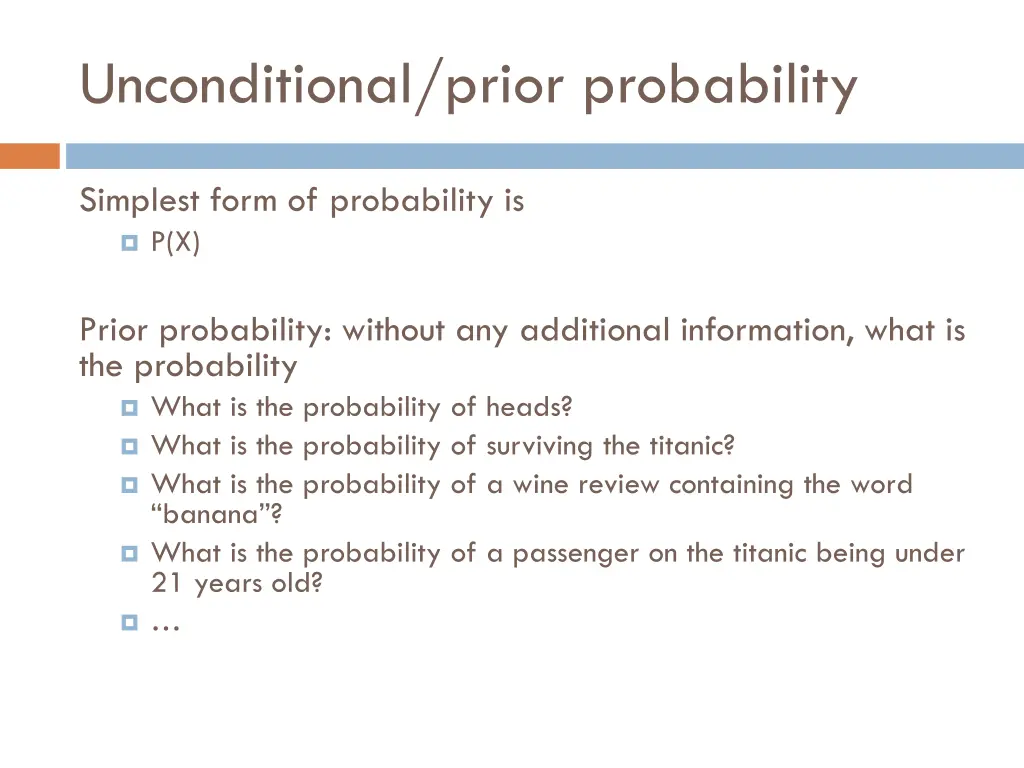
Unconditional/prior probability Simplest form of probability is P(X) Prior probability: without any additional information, what is the probability What is the probability of heads? What is the probability of surviving the titanic? What is the probability of a wine review containing the word banana ? What is the probability of a passenger on the titanic being under 21 years old?
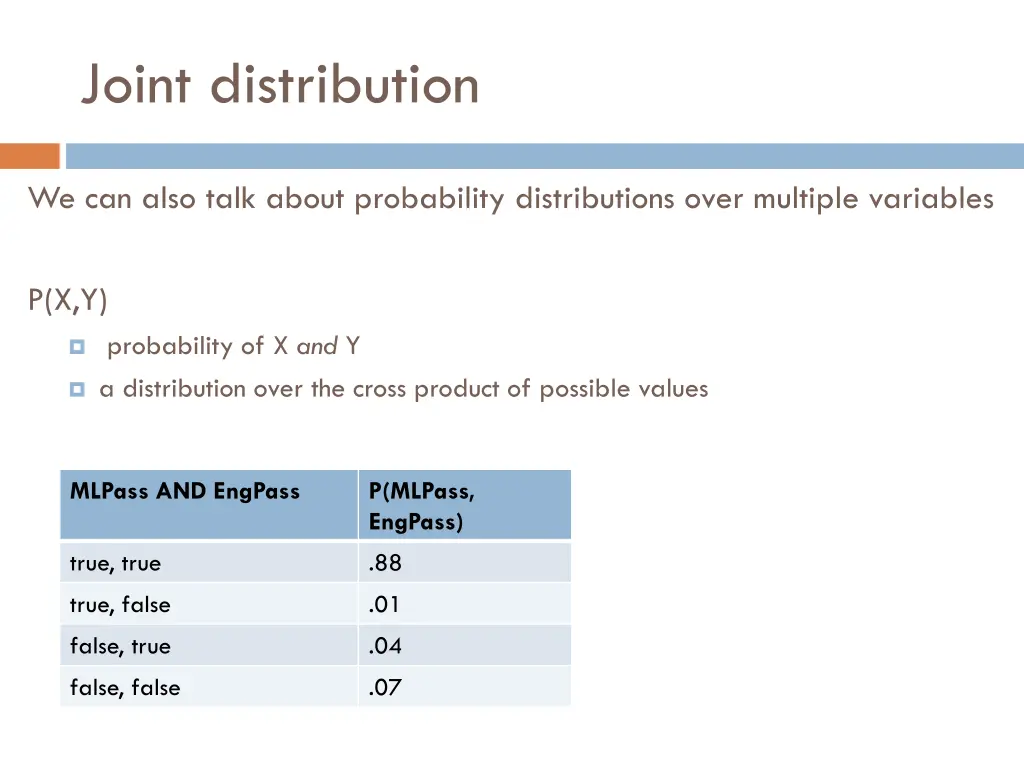
Joint distribution We can also talk about probability distributions over multiple variables P(X,Y) probability of X and Y a distribution over the cross product of possible values MLPass AND EngPass P(MLPass, EngPass) true, true .88 true, false .01 false, true .04 false, false .07
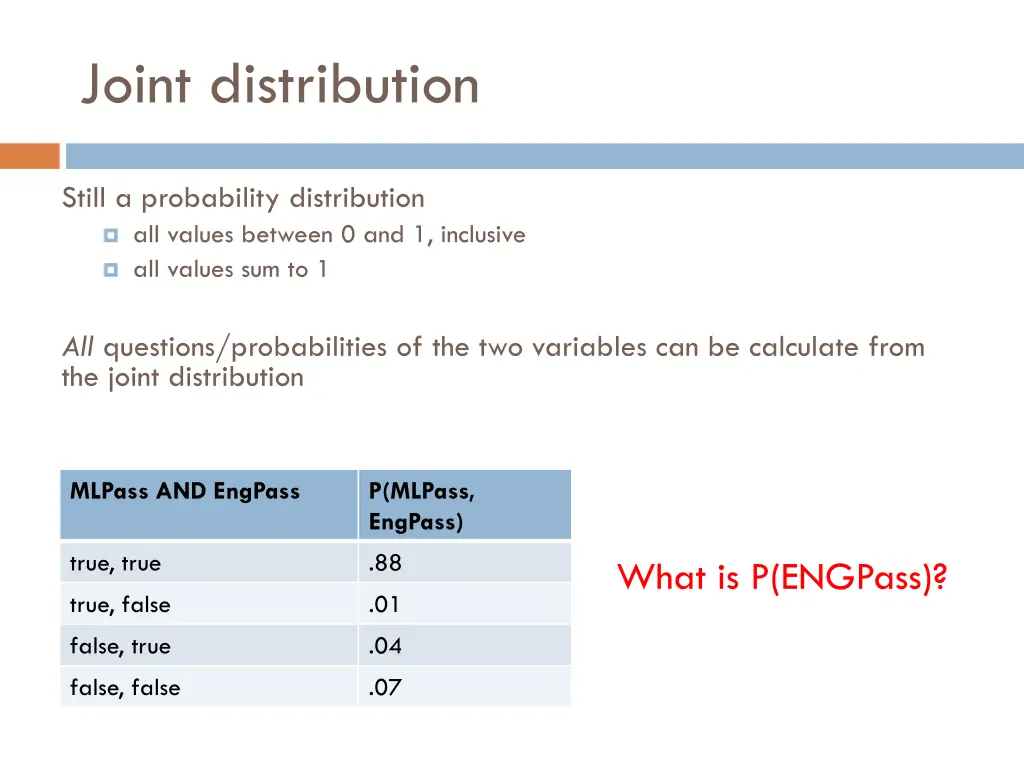
Joint distribution Still a probability distribution all values between 0 and 1, inclusive all values sum to 1 All questions/probabilities of the two variables can be calculate from the joint distribution MLPass AND EngPass P(MLPass, EngPass) true, true .88 What is P(ENGPass)? true, false .01 false, true .04 false, false .07
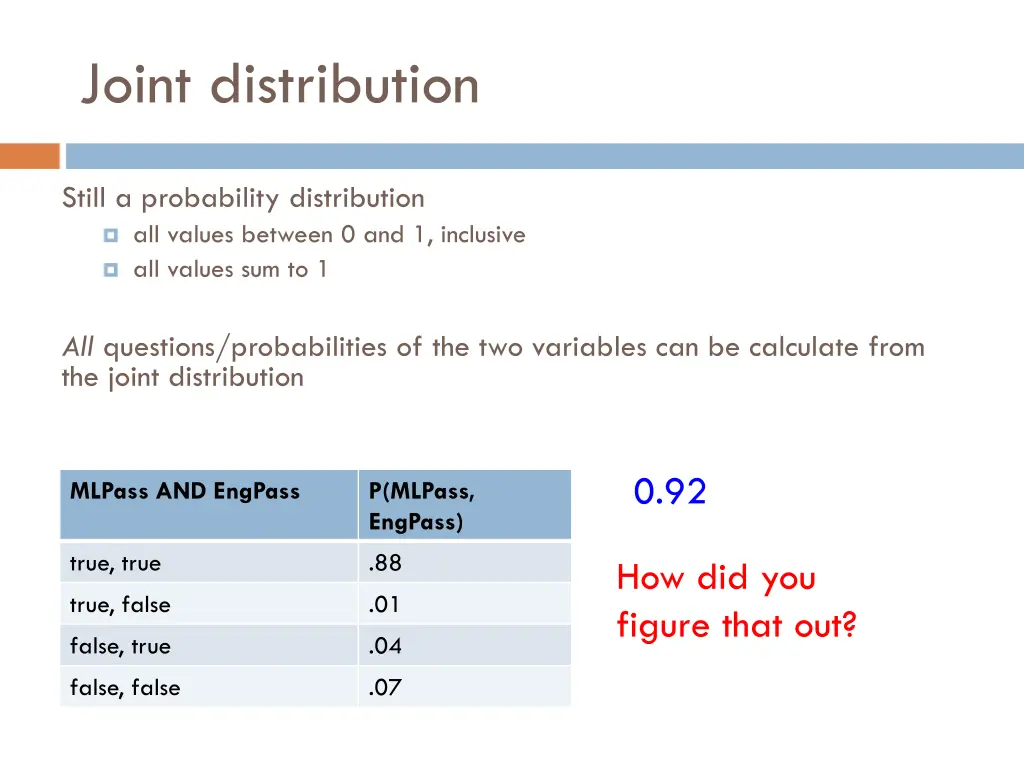
Joint distribution Still a probability distribution all values between 0 and 1, inclusive all values sum to 1 All questions/probabilities of the two variables can be calculate from the joint distribution 0.92 MLPass AND EngPass P(MLPass, EngPass) true, true .88 How did you figure that out? true, false .01 false, true .04 false, false .07
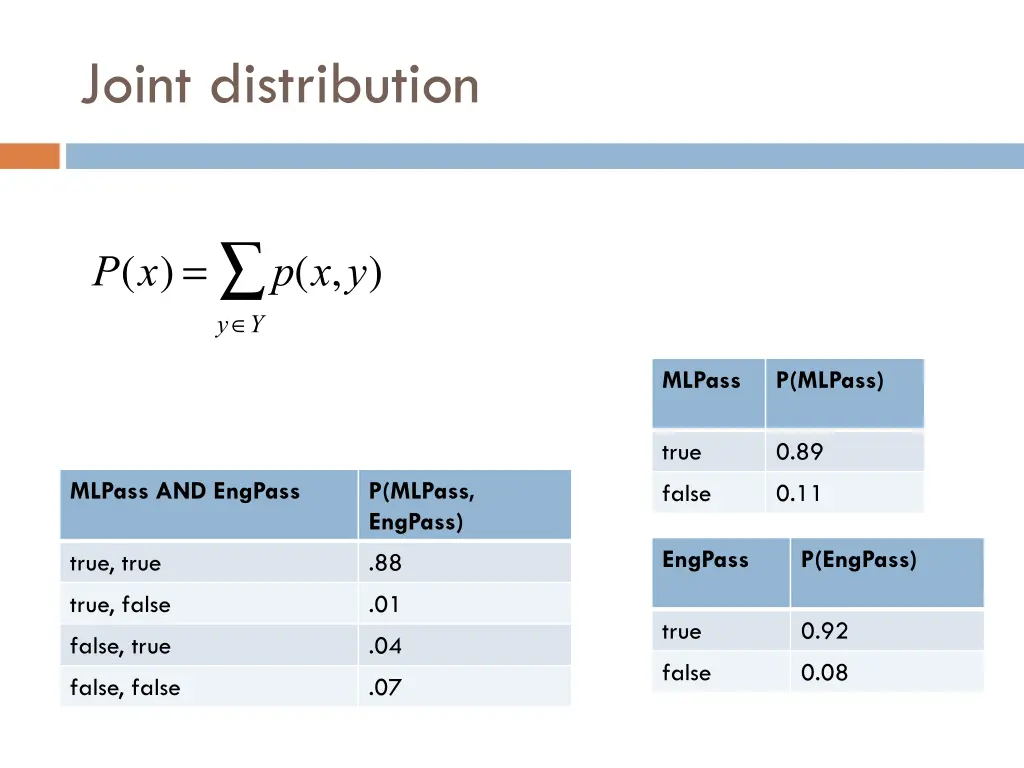
Joint distribution P(x)= p(x,y) y Y MLPass P(MLPass) true 0.89 MLPass AND EngPass P(MLPass, EngPass) false 0.11 EngPass P(EngPass) true, true .88 true, false .01 true 0.92 false, true .04 false 0.08 false, false .07
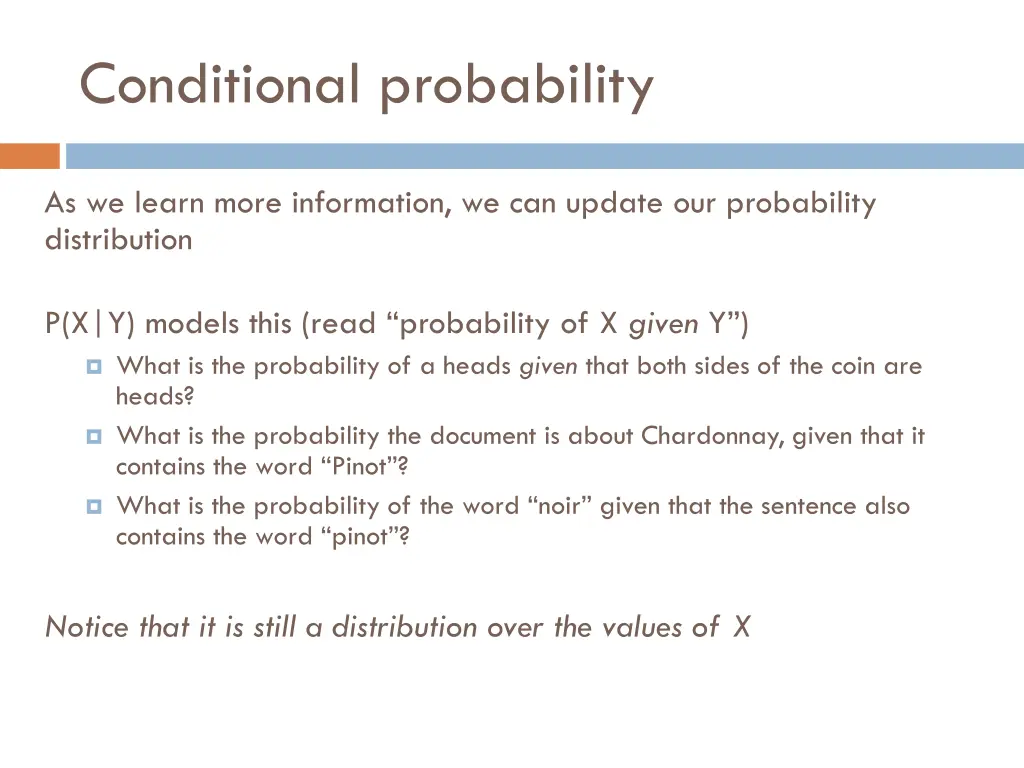
Conditional probability As we learn more information, we can update our probability distribution P(X|Y) models this (read probability of X givenY ) What is the probability of a heads given that both sides of the coin are heads? What is the probability the document is about Chardonnay, given that it contains the word Pinot ? What is the probability of the word noir given that the sentence also contains the word pinot ? Notice that it is still a distribution over the values of X
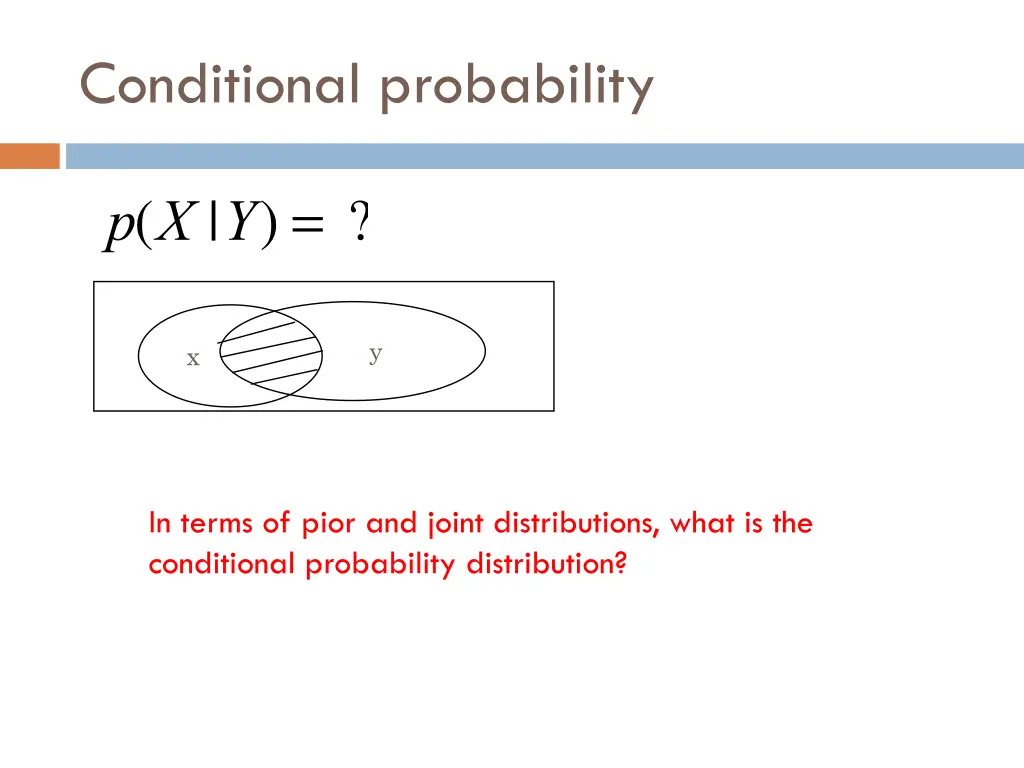
Conditional probability p(X |Y) = ? y x In terms of pior and joint distributions, what is the conditional probability distribution?
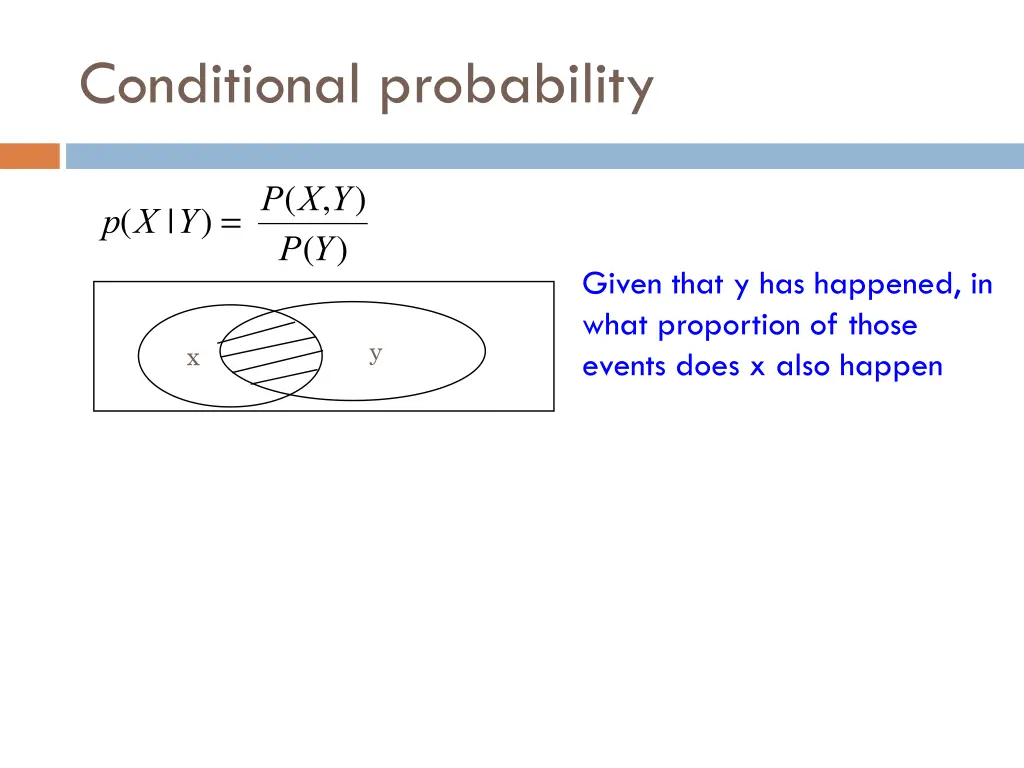
Conditional probability p(X |Y) =P(X,Y) P(Y) Given that y has happened, in what proportion of those events does x also happen y x
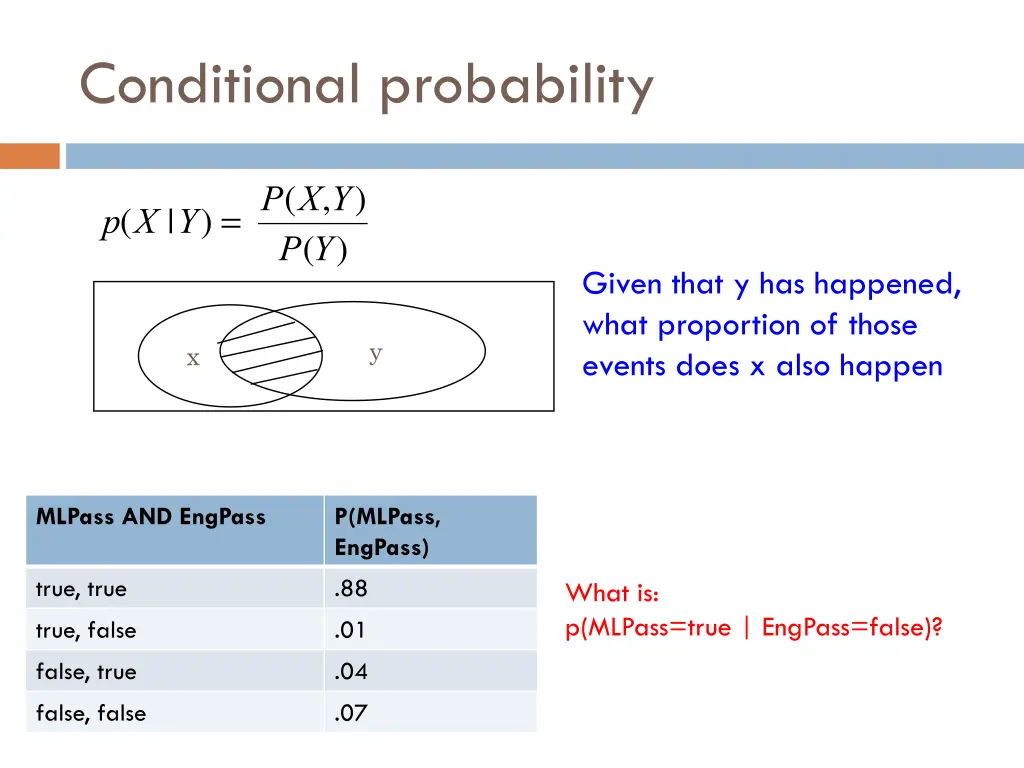
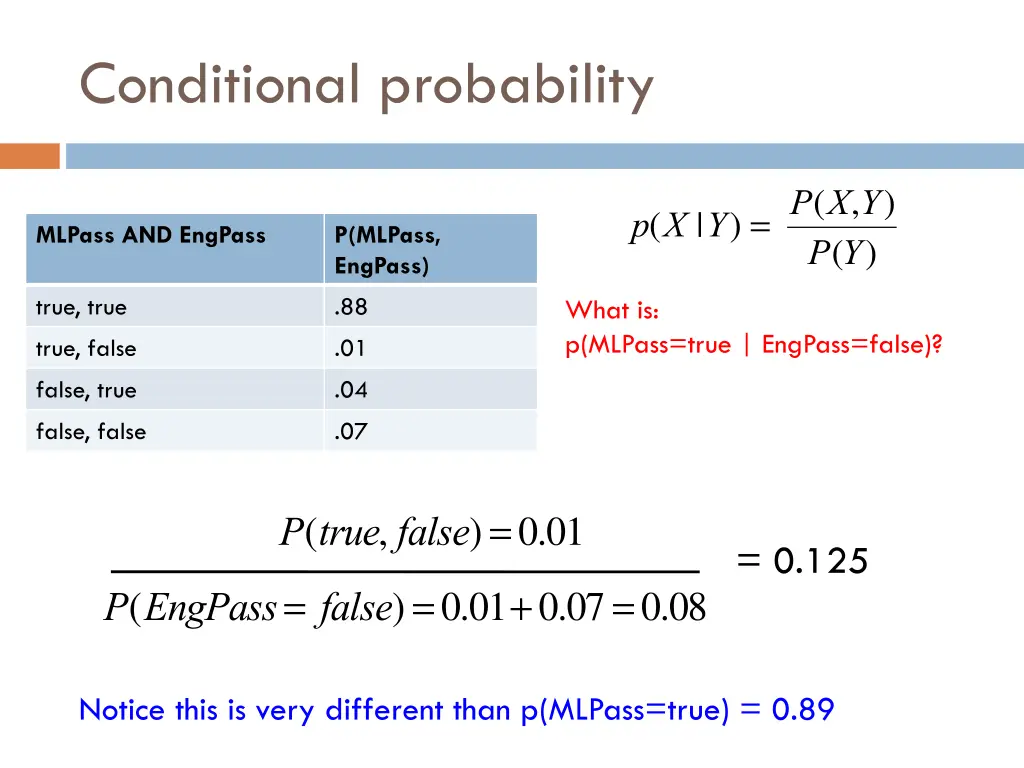
Conditional probability p(X |Y) =P(X,Y) P(Y) Given that y has happened, what proportion of those events does x also happen y x MLPass AND EngPass P(MLPass, EngPass) true, true .88 What is: p(MLPass=true | EngPass=false)? true, false .01 false, true .04 false, false .07
Conditional probability p(X |Y) =P(X,Y) MLPass AND EngPass P(MLPass, EngPass) P(Y) true, true .88 What is: p(MLPass=true | EngPass=false)? true, false .01 false, true .04 false, false .07 P(true, false)=0.01 = 0.125 P(EngPass= false)=0.01+0.07=0.08 Notice this is very different than p(MLPass=true) = 0.89
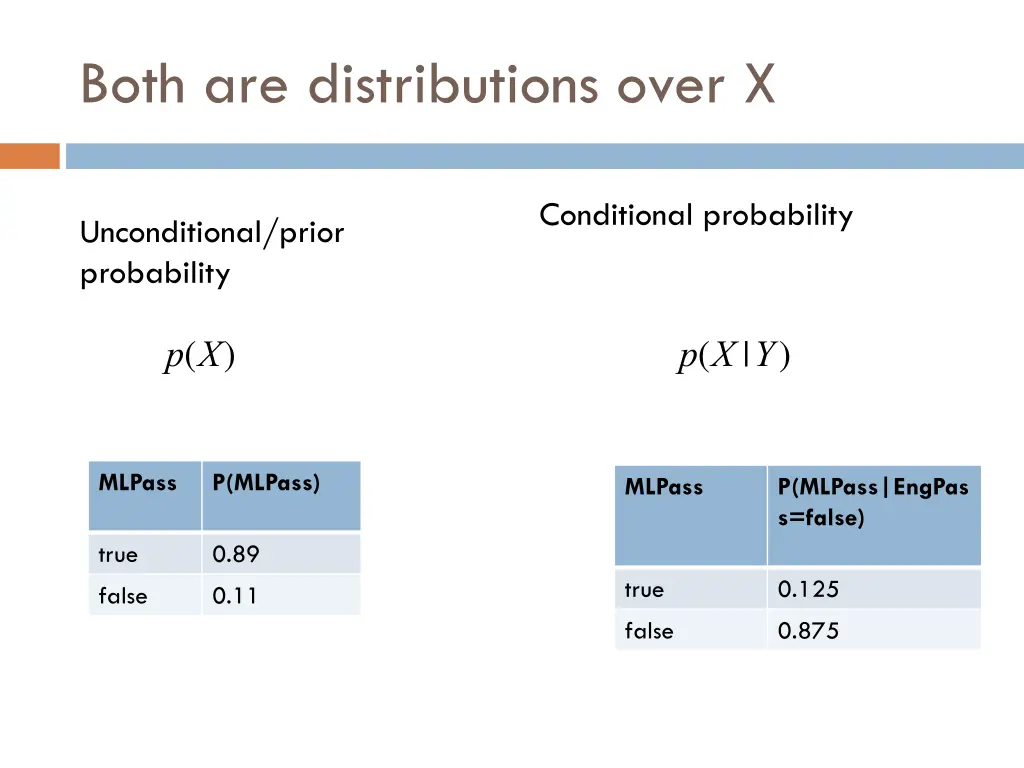
Both are distributions over X Conditional probability Unconditional/prior probability p(X) p(X |Y) MLPass P(MLPass) MLPass P(MLPass|EngPas s=false) true 0.89 true 0.125 false 0.11 false 0.875
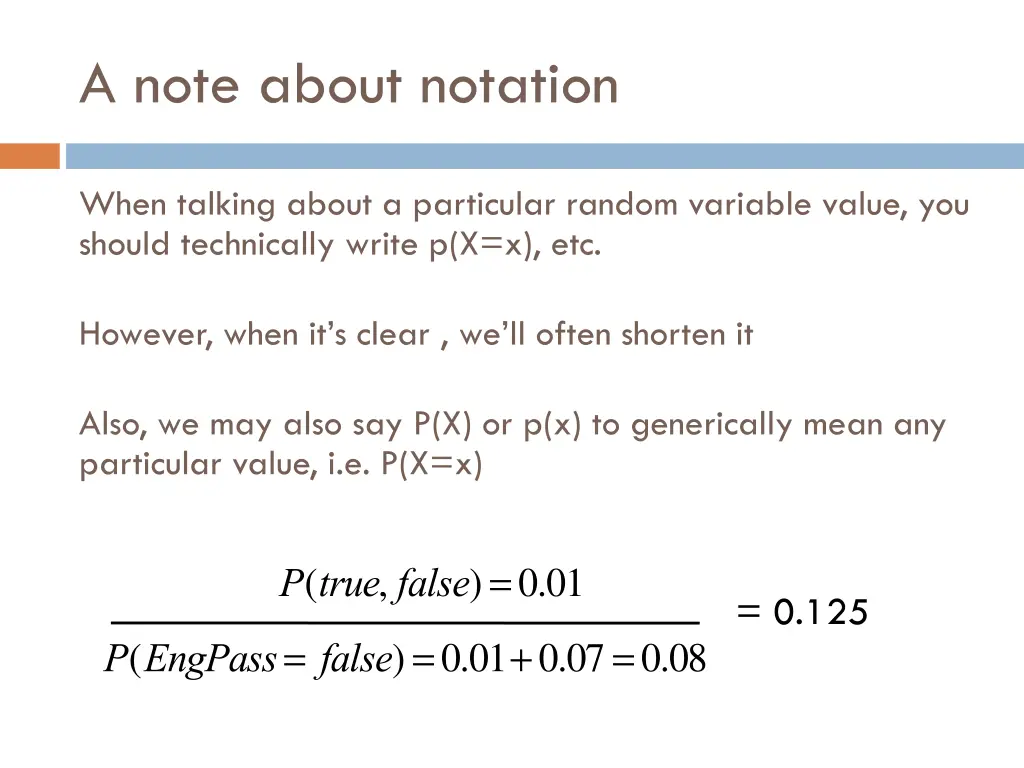
A note about notation When talking about a particular random variable value, you should technically write p(X=x), etc. However, when it s clear , we ll often shorten it Also, we may also say P(X) or p(x) to generically mean any particular value, i.e. P(X=x) P(true, false)=0.01 = 0.125 P(EngPass= false)=0.01+0.07=0.08
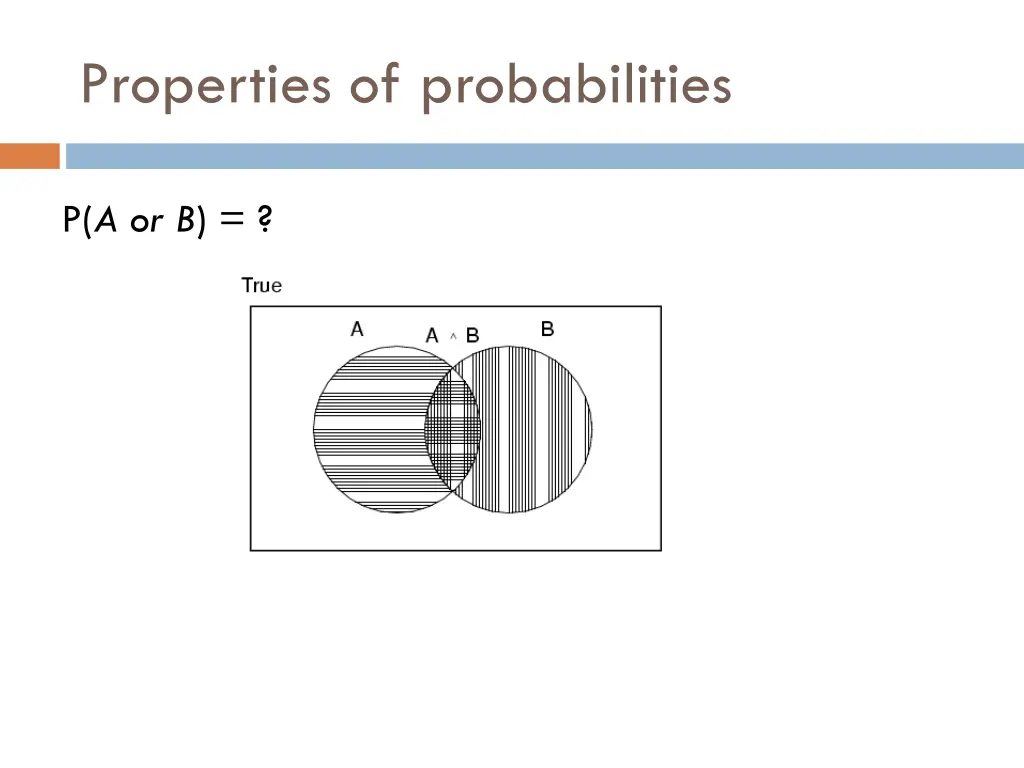
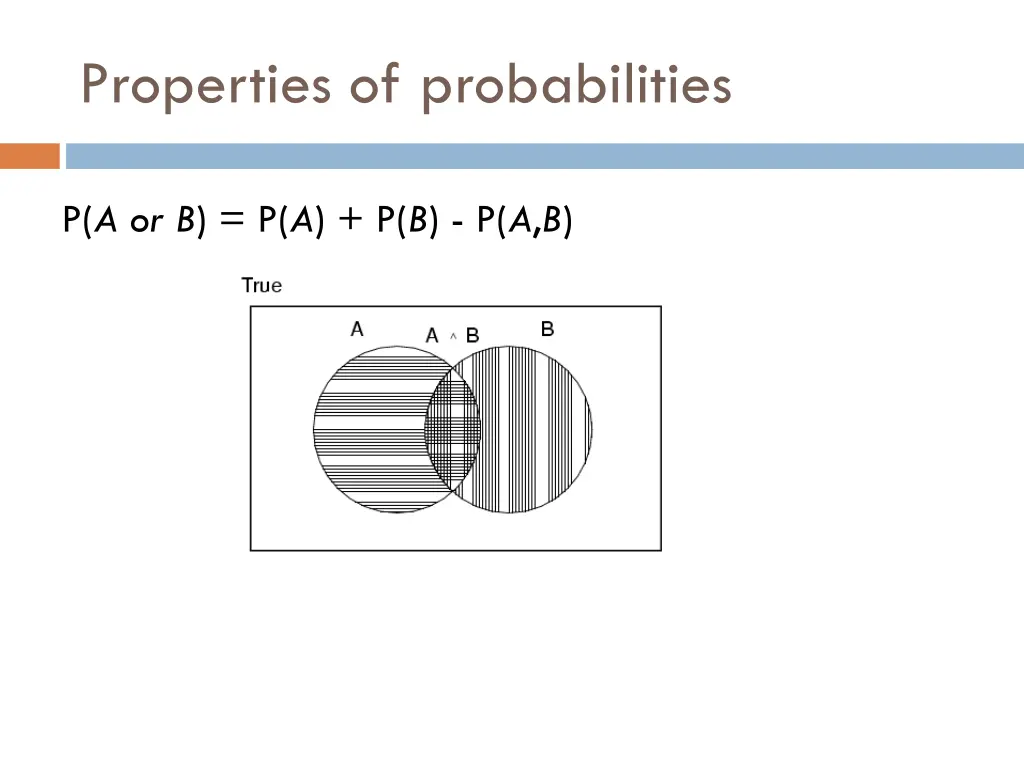
Properties of probabilities P(AorB) = ?
Properties of probabilities P(AorB) = P(A) + P(B) - P(A,B)
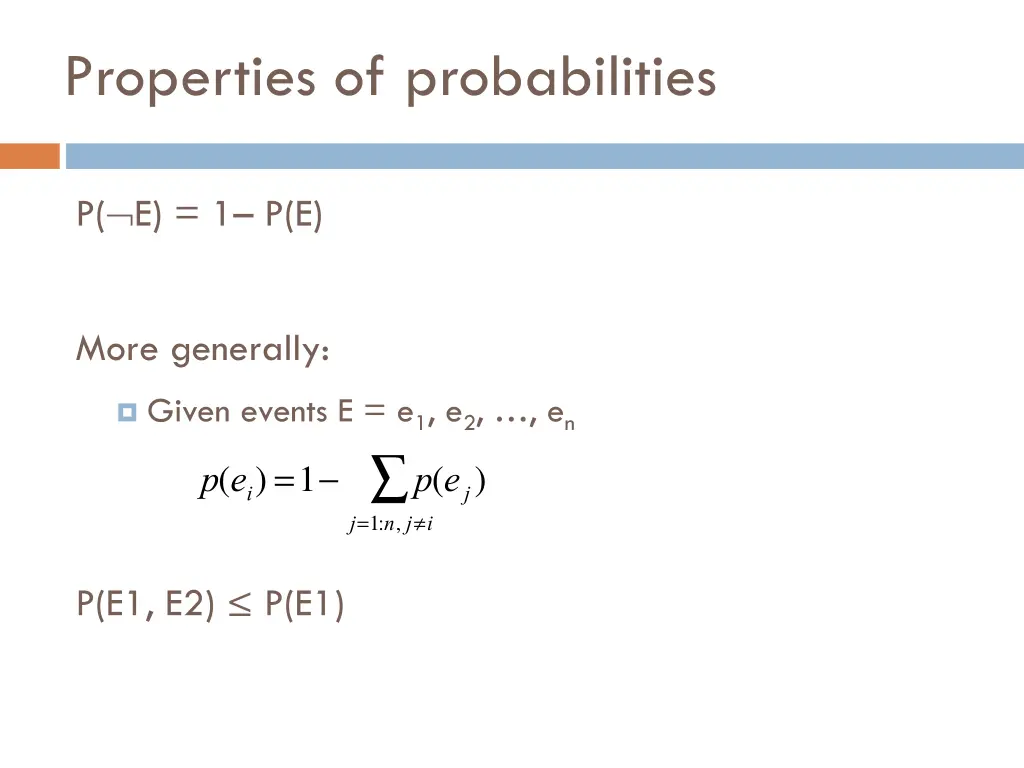
Properties of probabilities P( E) = 1 P(E) More generally: Given events E = e1, e2, , en p(ei)=1- p(ej) j=1:n, j i P(E1, E2) P(E1)
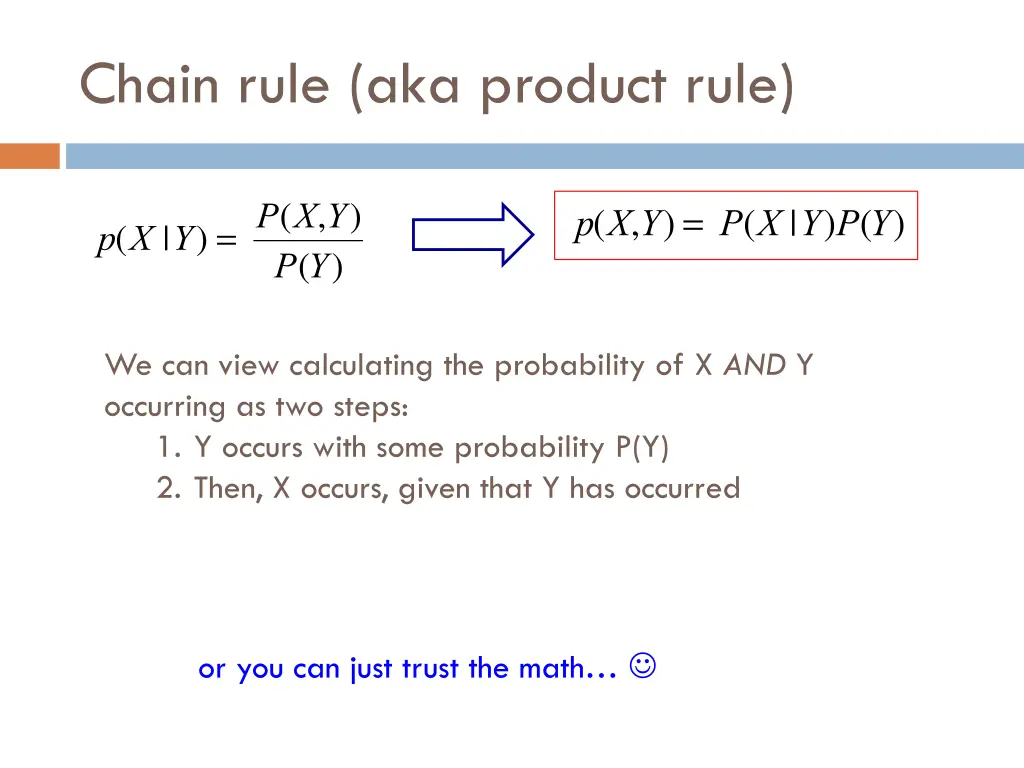
Chain rule (aka product rule) p(X |Y) =P(X,Y) p(X,Y) =P(X |Y)P(Y) P(Y) We can view calculating the probability of X AND Y occurring as two steps: 1. Y occurs with some probability P(Y) 2. Then, X occurs, given that Y has occurred or you can just trust the math
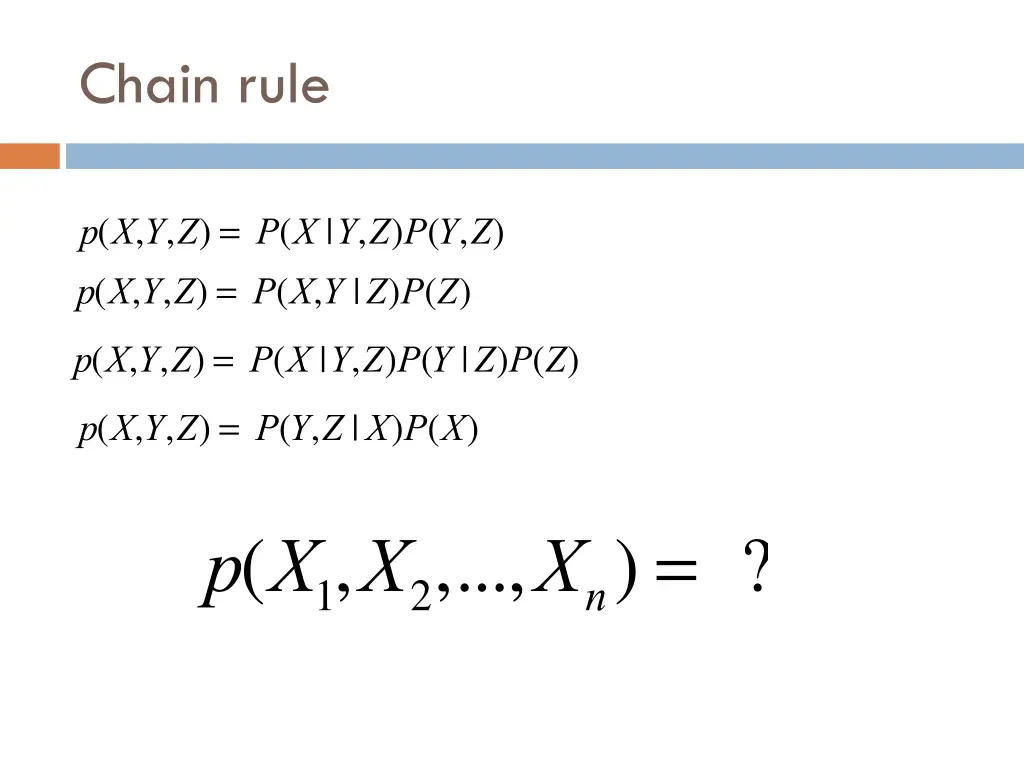
Chain rule p(X,Y,Z) =P(X |Y,Z)P(Y,Z) p(X,Y,Z) =P(X,Y |Z)P(Z) p(X,Y,Z) =P(X |Y,Z)P(Y |Z)P(Z) p(X,Y,Z) =P(Y,Z |X)P(X) p(X1,X2,...,Xn) = ?
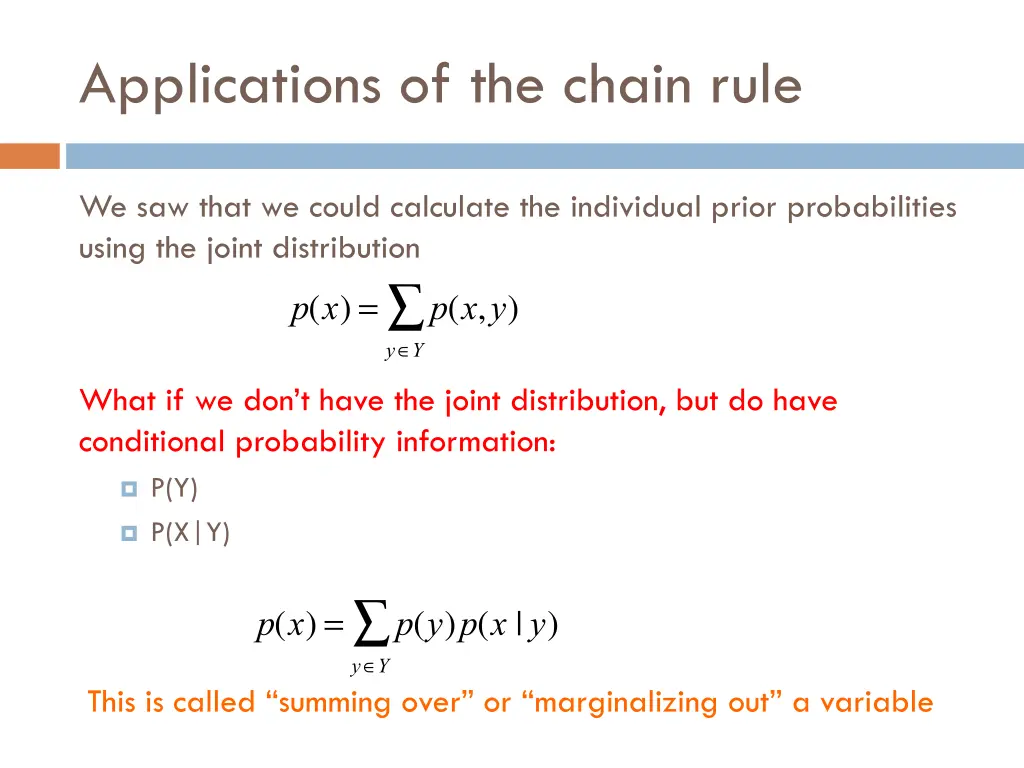
Applications of the chain rule We saw that we could calculate the individual prior probabilities using the joint distribution p(x) = p(x,y) y Y What if we don t have the joint distribution, but do have conditional probability information: P(Y) P(X|Y) p(x)= p(y)p(x | y) y Y This is called summing over or marginalizing out a variable
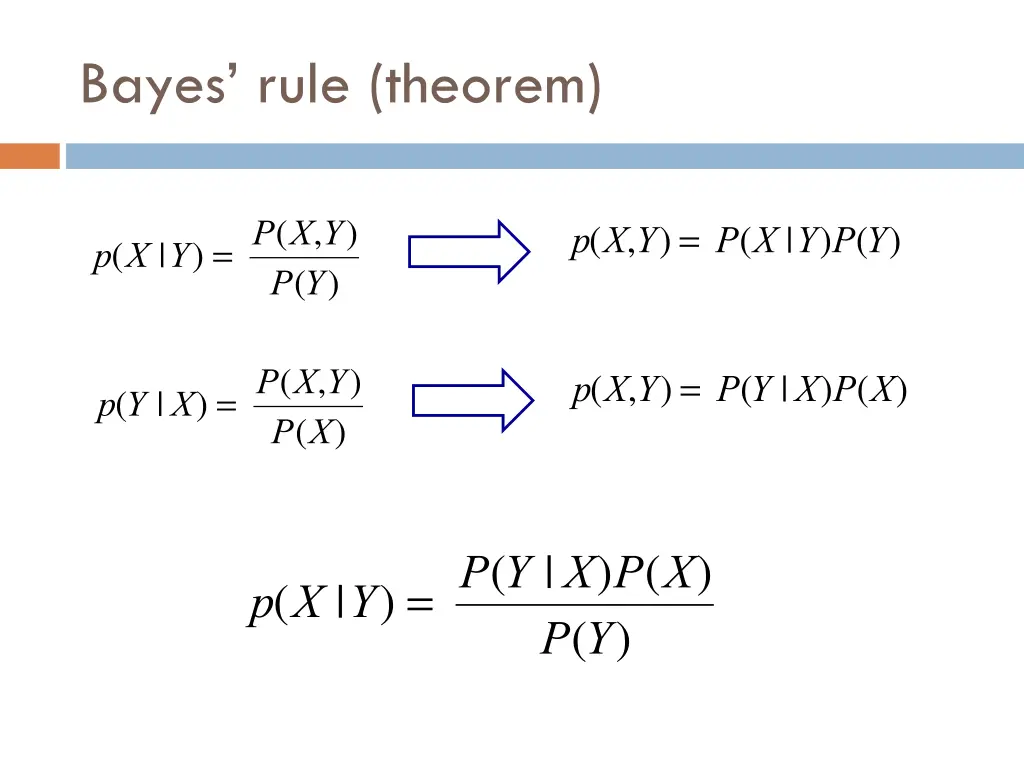
Bayes rule (theorem) p(X |Y) =P(X,Y) p(X,Y) =P(X |Y)P(Y) P(Y) p(Y | X) =P(X,Y) p(X,Y) =P(Y |X)P(X) P(X) p(X |Y) =P(Y | X)P(X) P(Y)
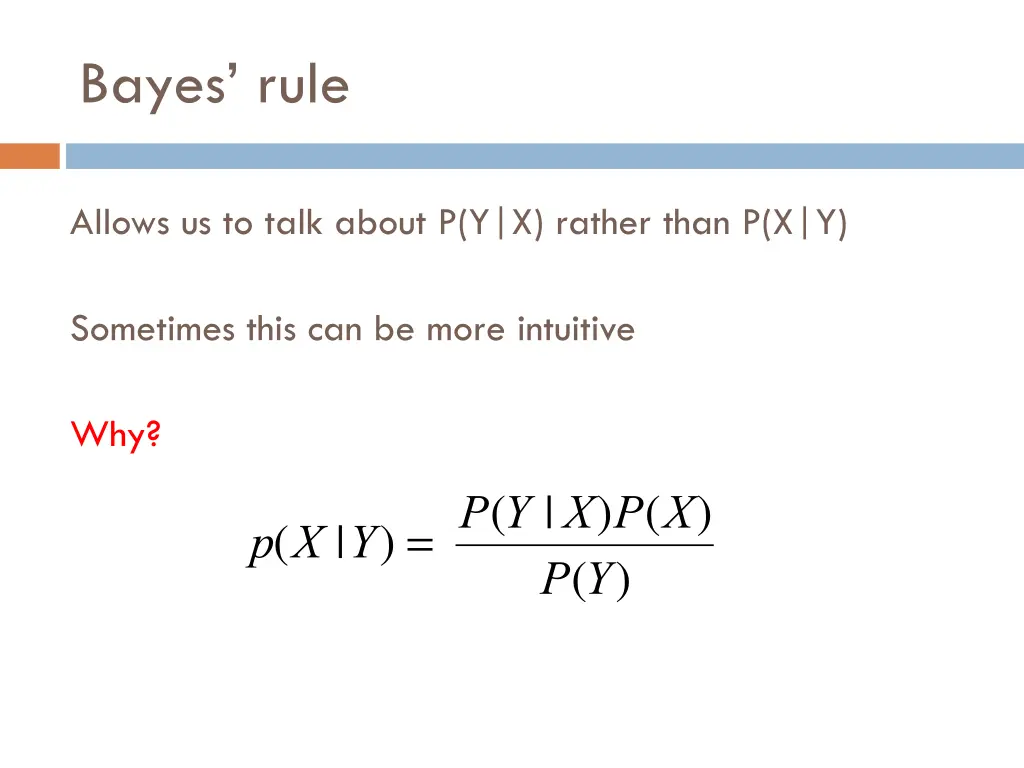
Bayes rule Allows us to talk about P(Y|X) rather than P(X|Y) Sometimes this can be more intuitive Why? p(X |Y) =P(Y | X)P(X) P(Y)
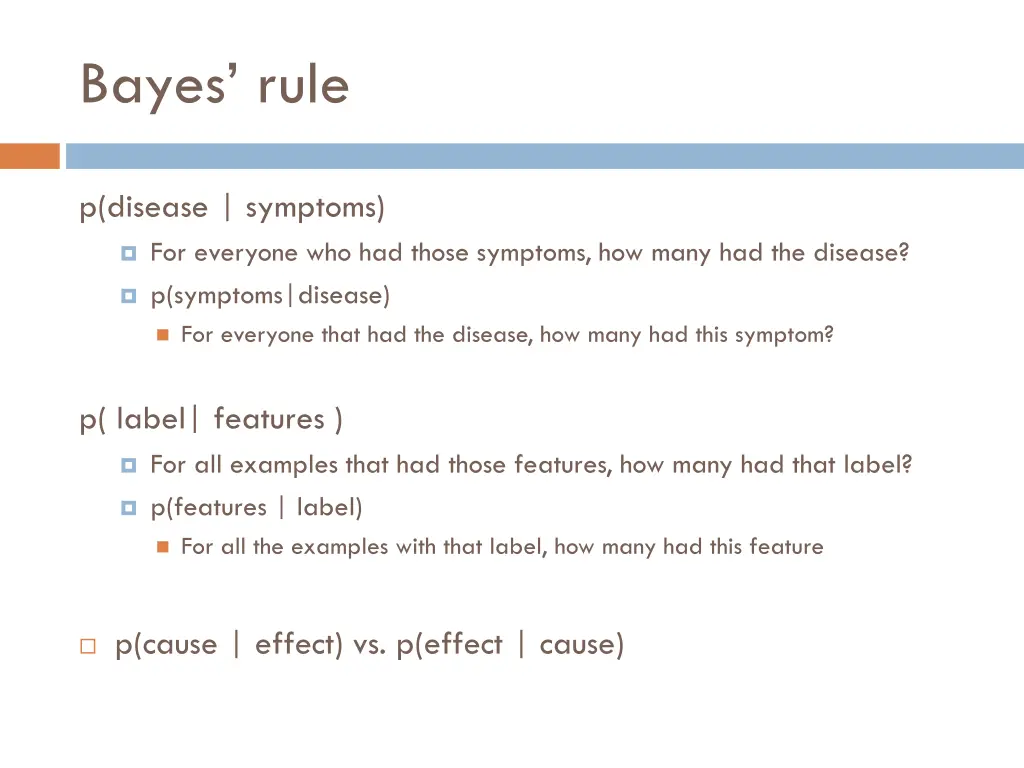
Bayes rule p(disease | symptoms) For everyone who had those symptoms, how many had the disease? p(symptoms|disease) For everyone that had the disease, how many had this symptom? p( label| features ) For all examples that had those features, how many had that label? p(features | label) For all the examples with that label, how many had this feature p(cause | effect) vs. p(effect | cause)
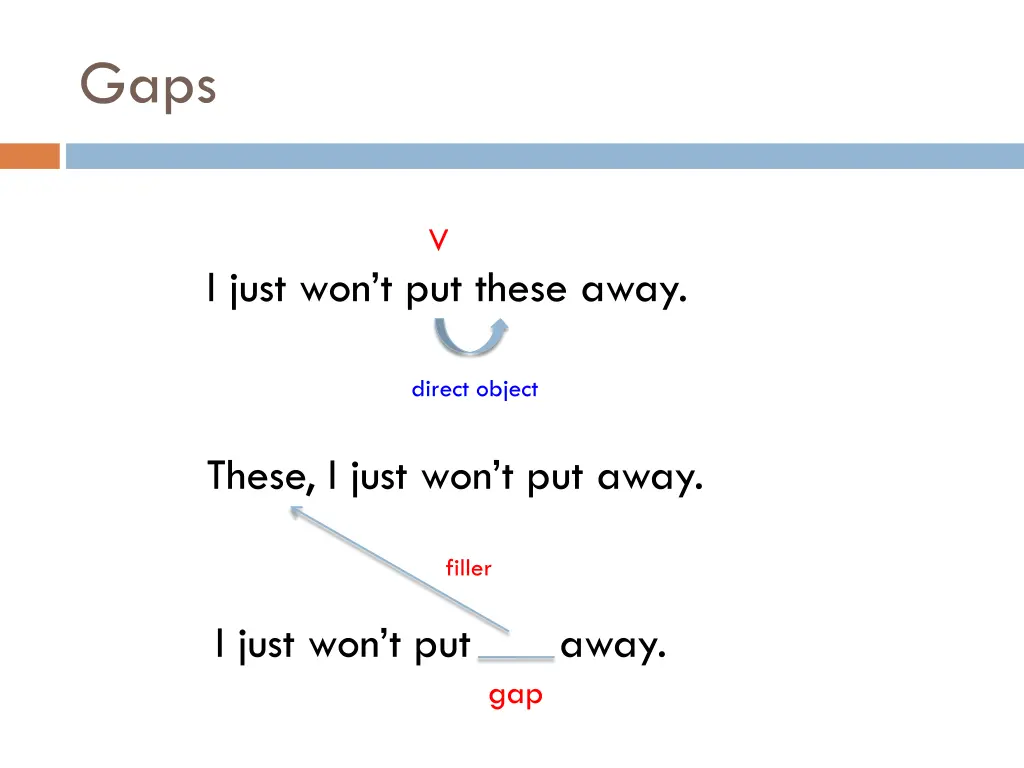
Gaps V I just won t put these away. direct object These, I just won t put away. filler I just won t put away. gap
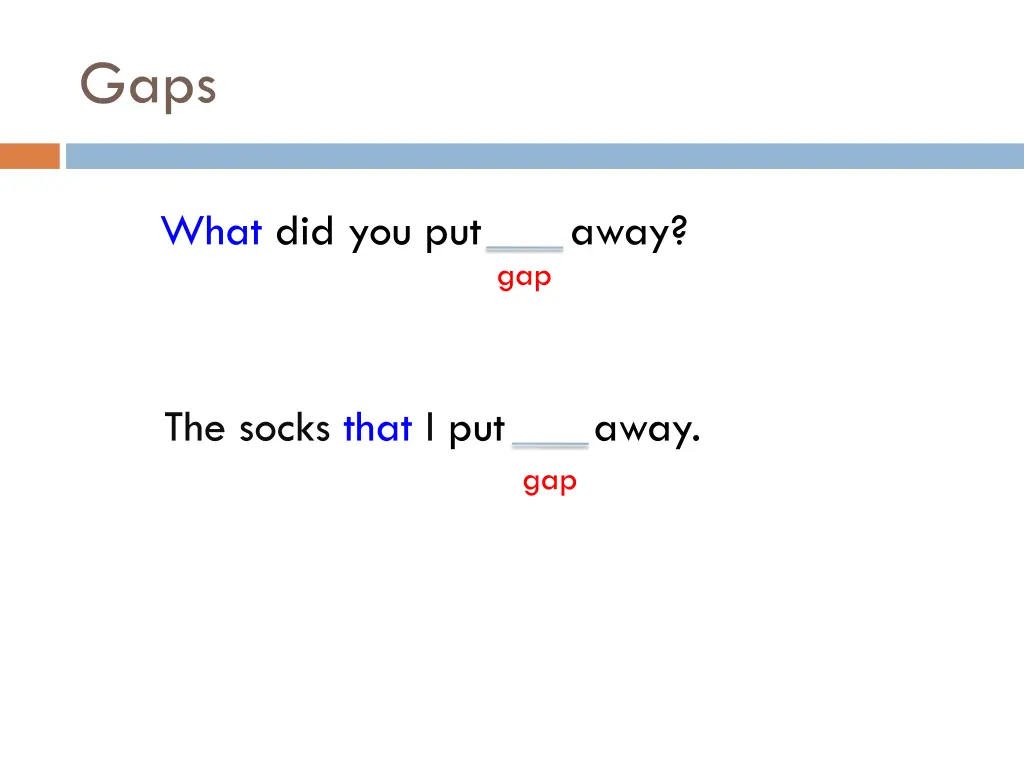
Gaps What did you put away? gap The socks that I put away. gap
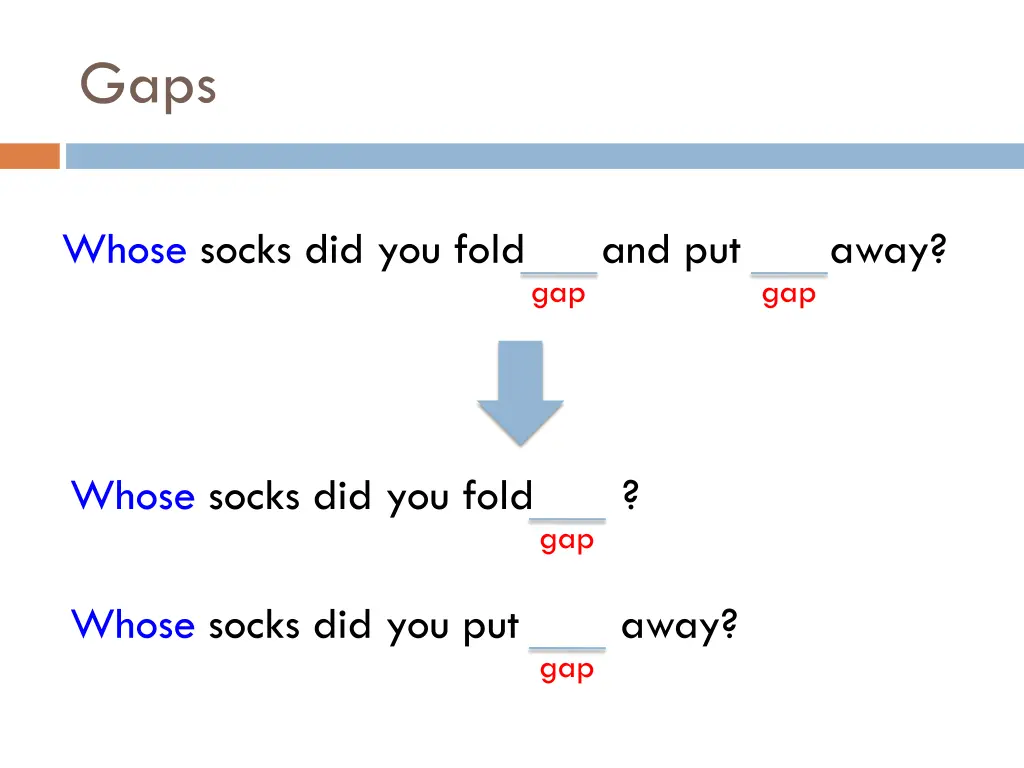
Gaps Whose socks did you fold and put away? gap gap Whose socks did you fold ? gap Whose socks did you put away? gap
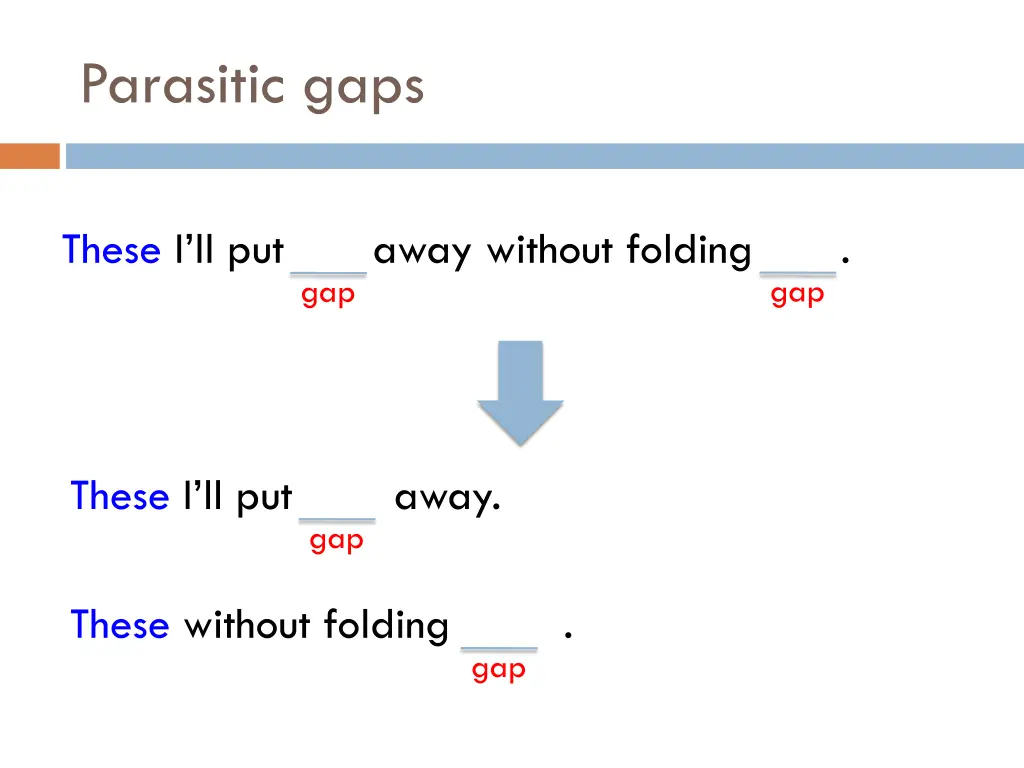
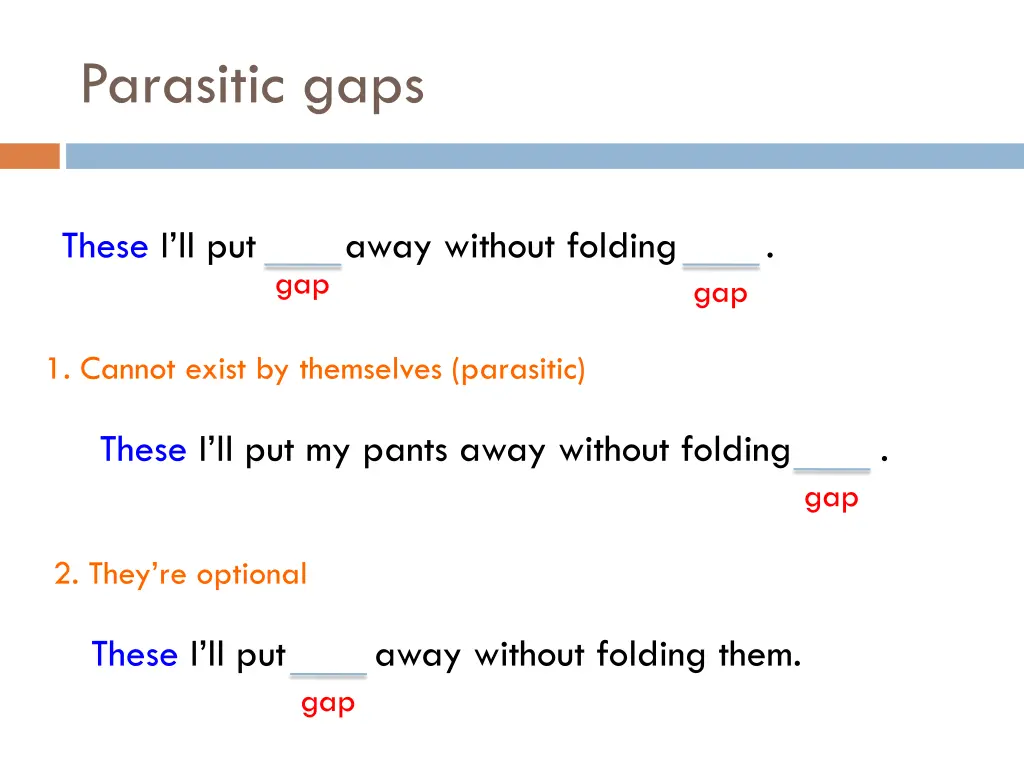
Parasitic gaps These I ll put away without folding . gap gap These I ll put away. gap These without folding . gap
Parasitic gaps These I ll put away without folding . gap gap 1. Cannot exist by themselves (parasitic) These I ll put my pants away without folding . gap 2. They re optional These I ll put away without folding them. gap
Parasitic gaps http://literalminded.wordpress.com/2009/02/10/do ugs-parasitic-gap/
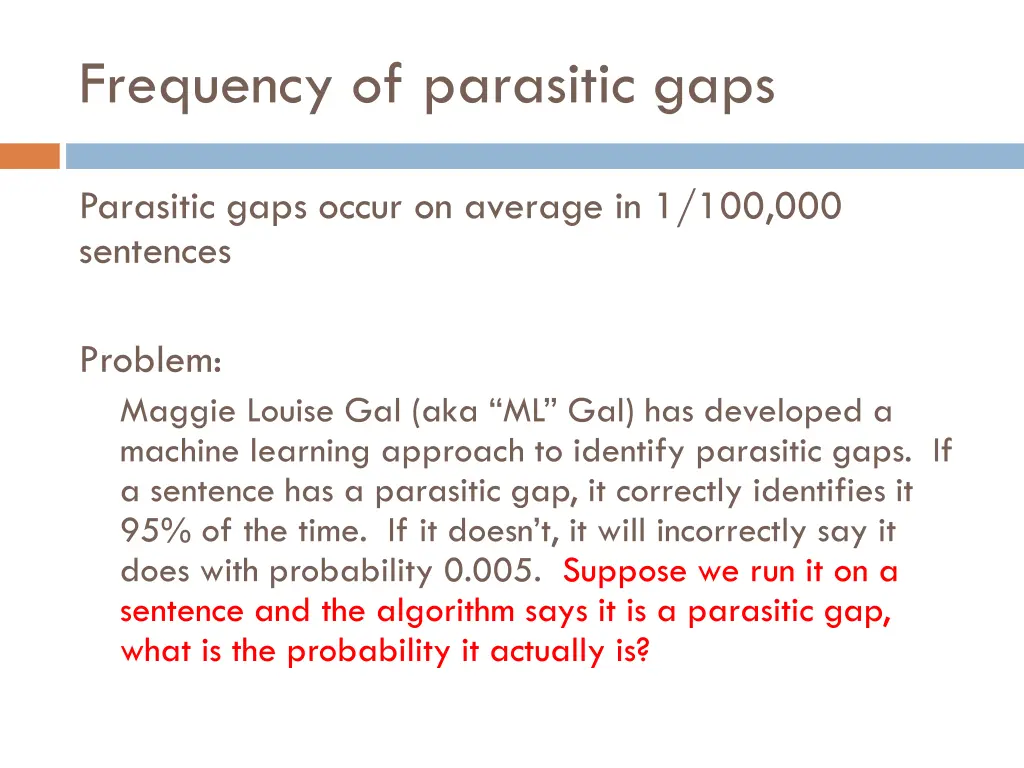
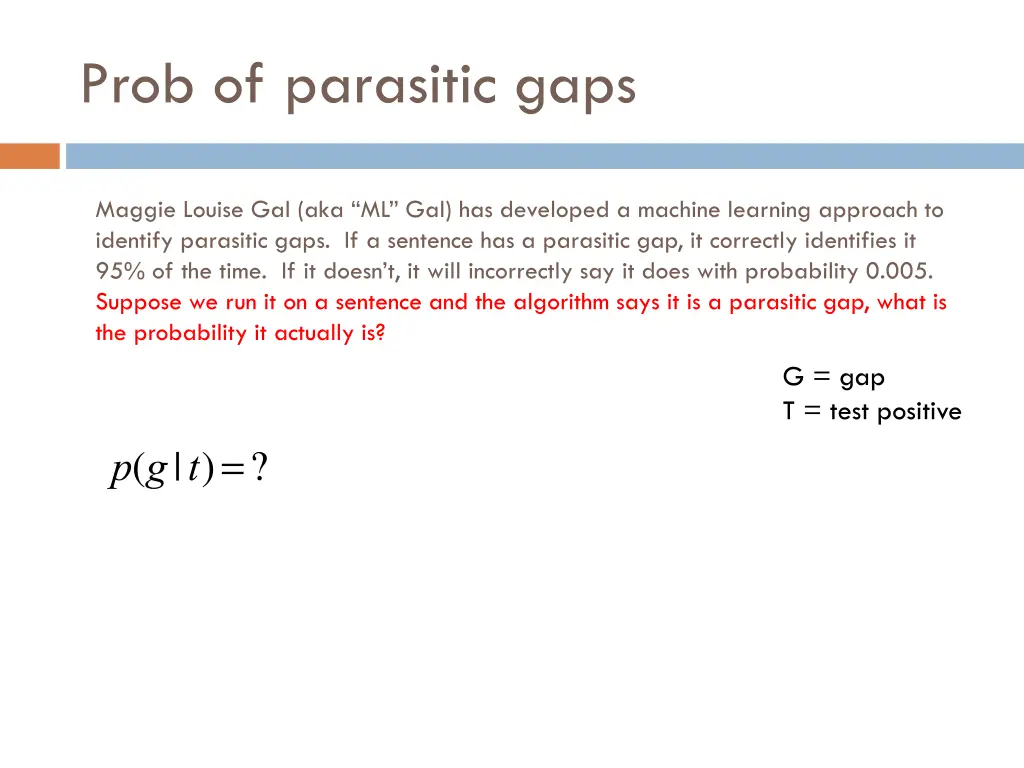
Frequency of parasitic gaps Parasitic gaps occur on average in 1/100,000 sentences Problem: Maggie Louise Gal (aka ML Gal) has developed a machine learning approach to identify parasitic gaps. If a sentence has a parasitic gap, it correctly identifies it 95% of the time. If it doesn t, it will incorrectly say it does with probability 0.005. Suppose we run it on a sentence and the algorithm says it is a parasitic gap, what is the probability it actually is?
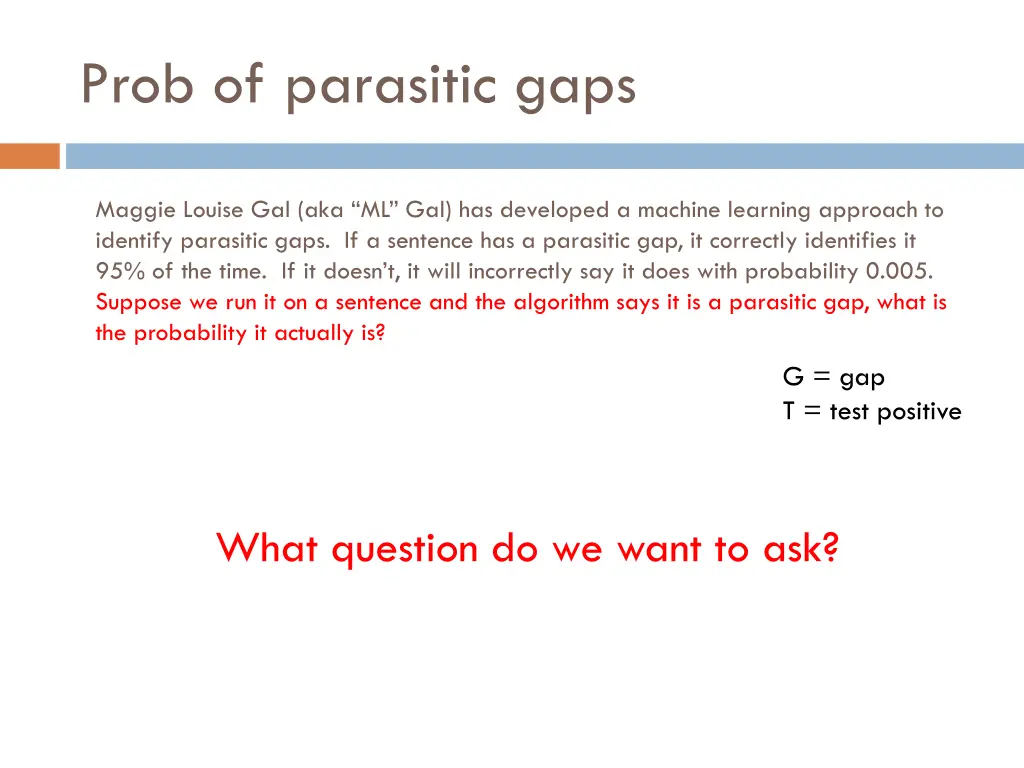
Prob of parasitic gaps Maggie Louise Gal (aka ML Gal) has developed a machine learning approach to identify parasitic gaps. If a sentence has a parasitic gap, it correctly identifies it 95% of the time. If it doesn t, it will incorrectly say it does with probability 0.005. Suppose we run it on a sentence and the algorithm says it is a parasitic gap, what is the probability it actually is? G = gap T = test positive What question do we want to ask?
Prob of parasitic gaps Maggie Louise Gal (aka ML Gal) has developed a machine learning approach to identify parasitic gaps. If a sentence has a parasitic gap, it correctly identifies it 95% of the time. If it doesn t, it will incorrectly say it does with probability 0.005. Suppose we run it on a sentence and the algorithm says it is a parasitic gap, what is the probability it actually is? G = gap T = test positive p(g|t)=?
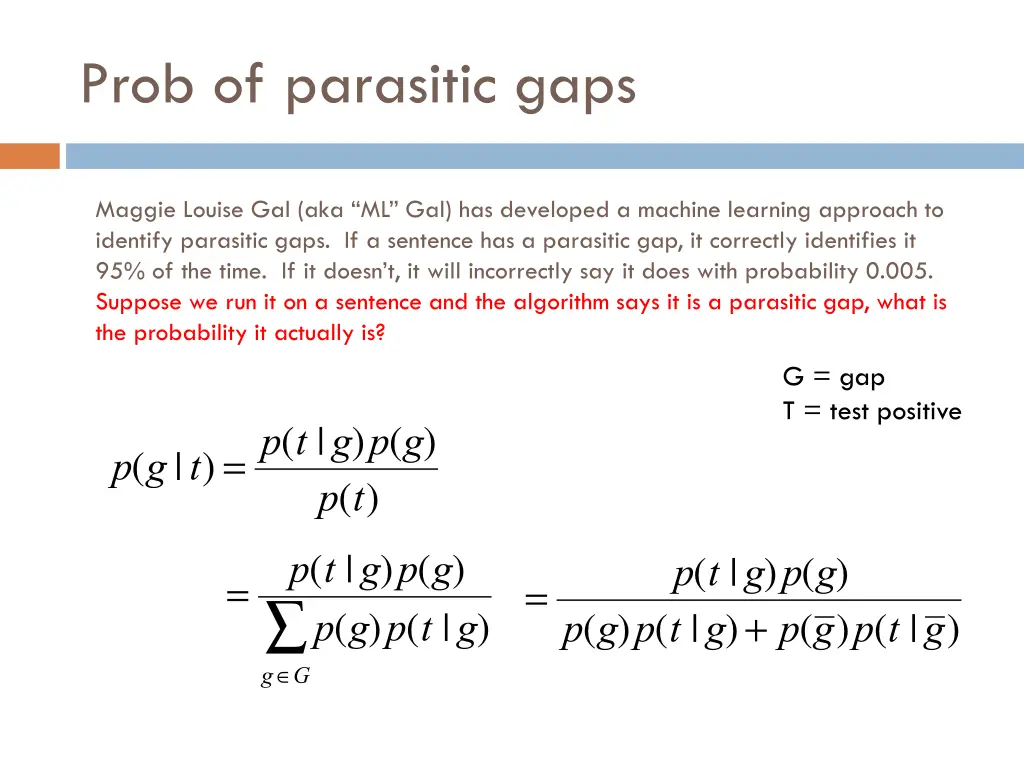
Prob of parasitic gaps Maggie Louise Gal (aka ML Gal) has developed a machine learning approach to identify parasitic gaps. If a sentence has a parasitic gap, it correctly identifies it 95% of the time. If it doesn t, it will incorrectly say it does with probability 0.005. Suppose we run it on a sentence and the algorithm says it is a parasitic gap, what is the probability it actually is? G = gap T = test positive p(g|t) =p(t |g)p(g) p(t) p(t |g)p(g) p(g)p(t |g) g G p(t |g)p(g) = = p(g)p(t |g)+ p(g )p(t |g )
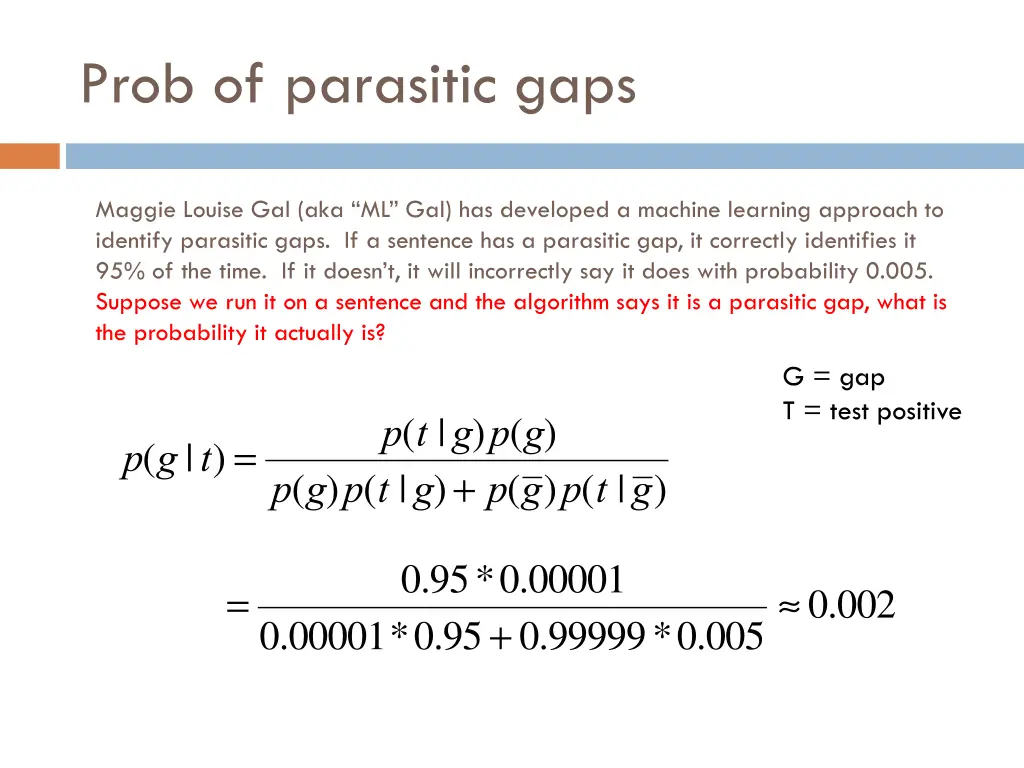
Prob of parasitic gaps Maggie Louise Gal (aka ML Gal) has developed a machine learning approach to identify parasitic gaps. If a sentence has a parasitic gap, it correctly identifies it 95% of the time. If it doesn t, it will incorrectly say it does with probability 0.005. Suppose we run it on a sentence and the algorithm says it is a parasitic gap, what is the probability it actually is? G = gap T = test positive p(t |g)p(g) p(g|t)= p(g)p(t |g)+ p(g )p(t |g ) 0.95*0.00001 = 0.00001*0.95+0.99999*0.005 0.002
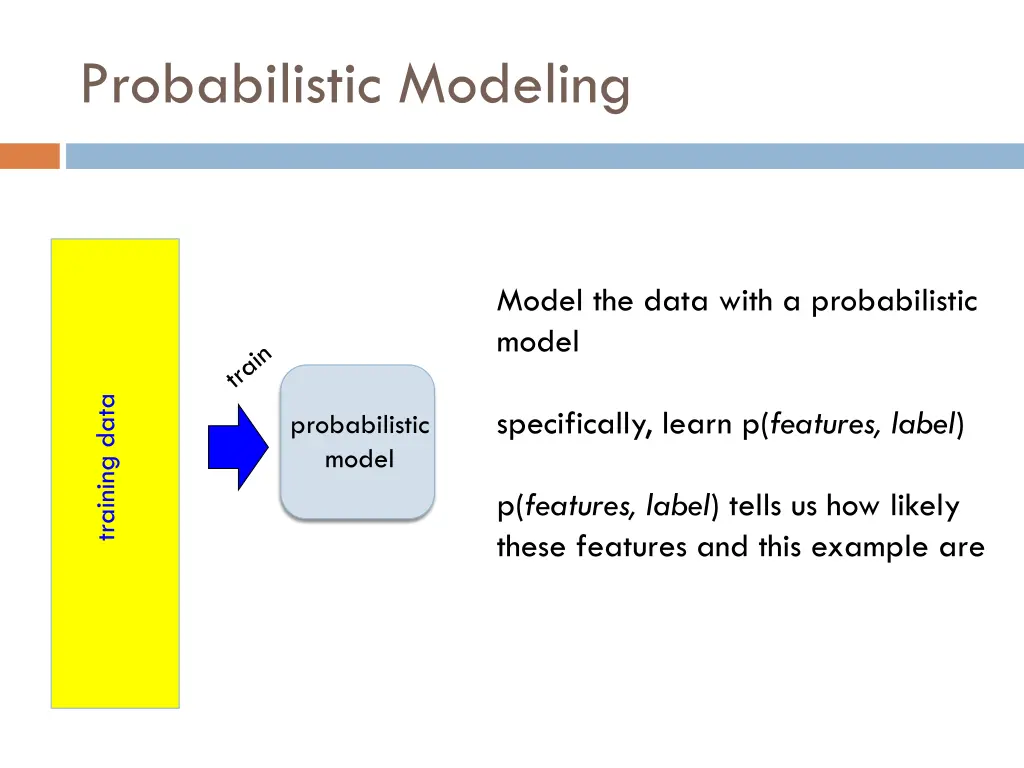
Probabilistic Modeling Model the data with a probabilistic model training data specifically, learn p(features, label) probabilistic model p(features, label) tells us how likely these features and this example are
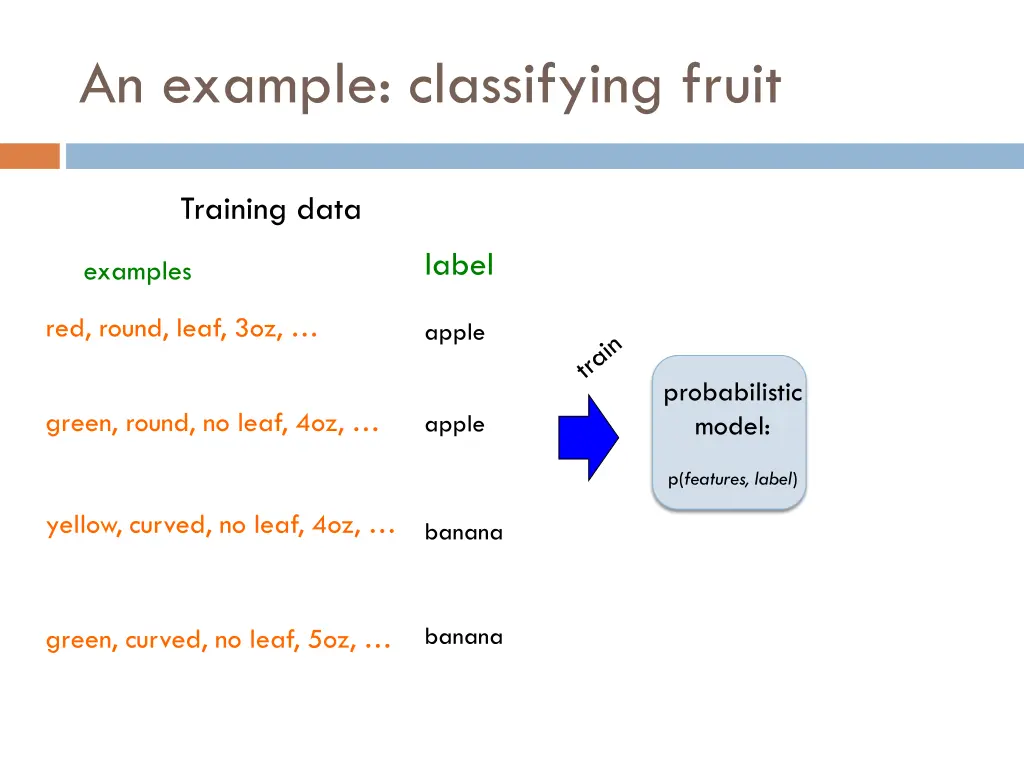
An example: classifying fruit Training data label examples red, round, leaf, 3oz, apple probabilistic model: green, round, no leaf, 4oz, apple p(features, label) yellow, curved, no leaf, 4oz, banana banana green, curved, no leaf, 5oz,
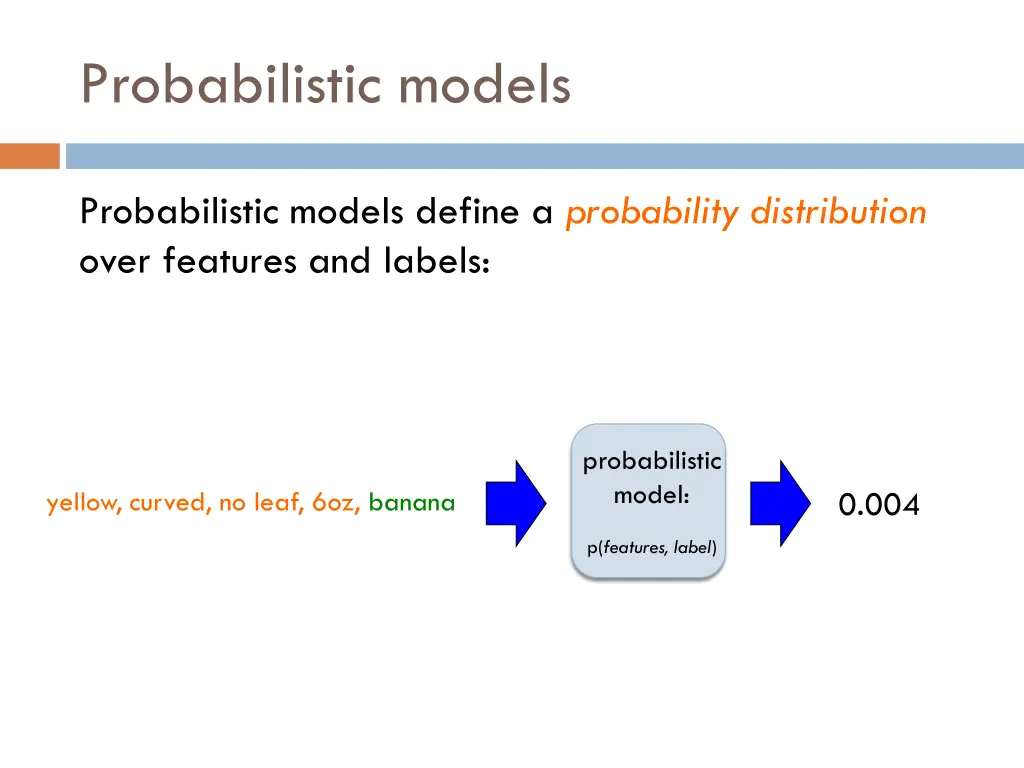
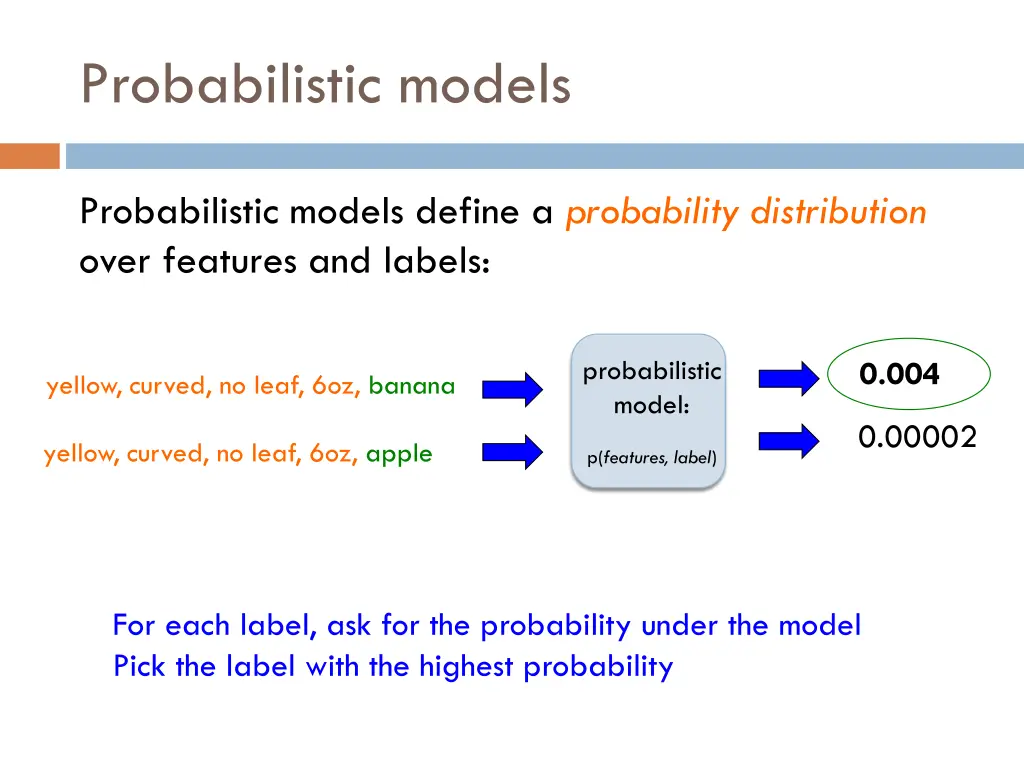
Probabilistic models Probabilistic models define a probability distribution over features and labels: probabilistic model: 0.004 yellow, curved, no leaf, 6oz, banana p(features, label)
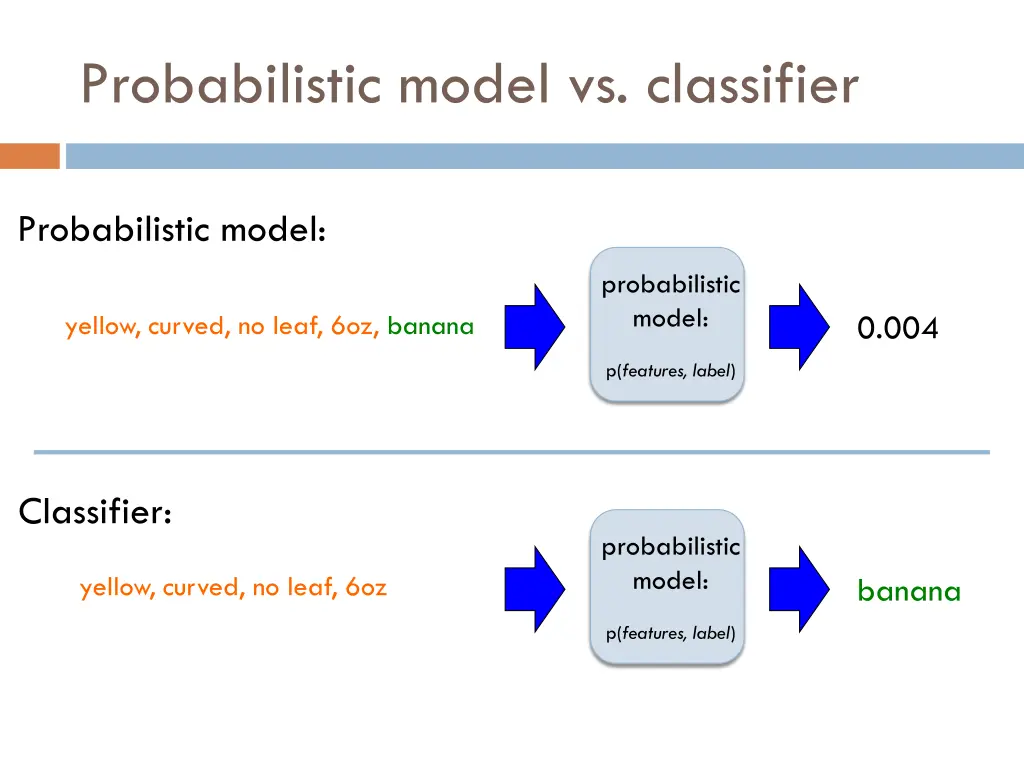
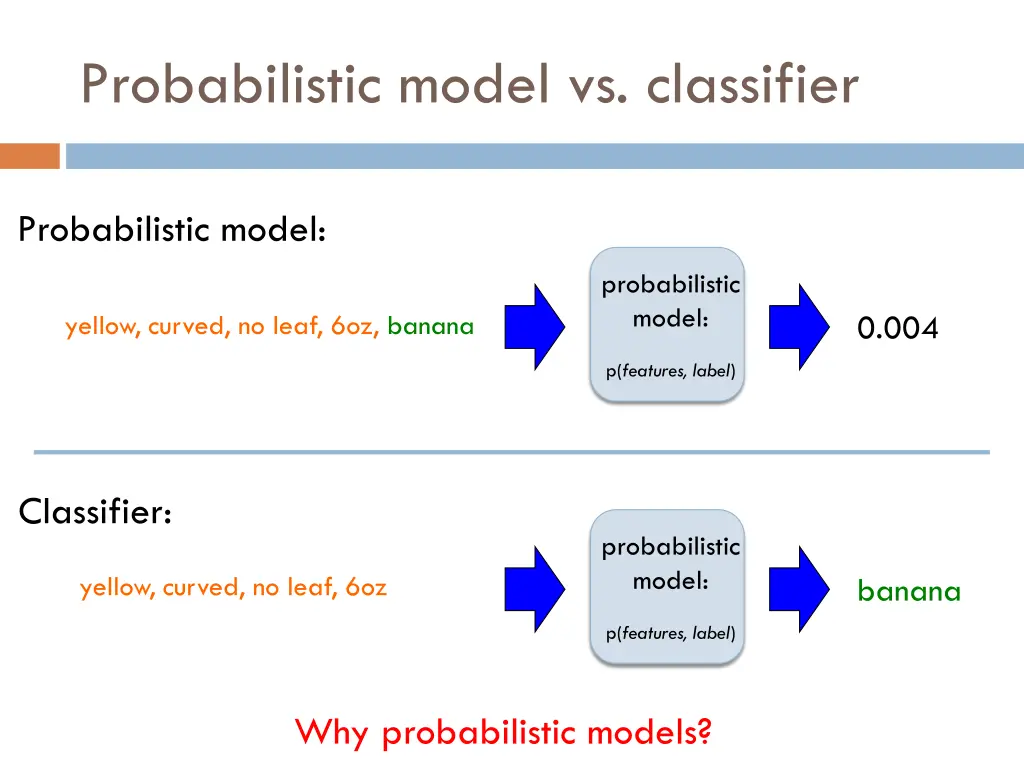
Probabilistic model vs. classifier Probabilistic model: probabilistic model: 0.004 yellow, curved, no leaf, 6oz, banana p(features, label) Classifier: probabilistic model: yellow, curved, no leaf, 6oz banana p(features, label)
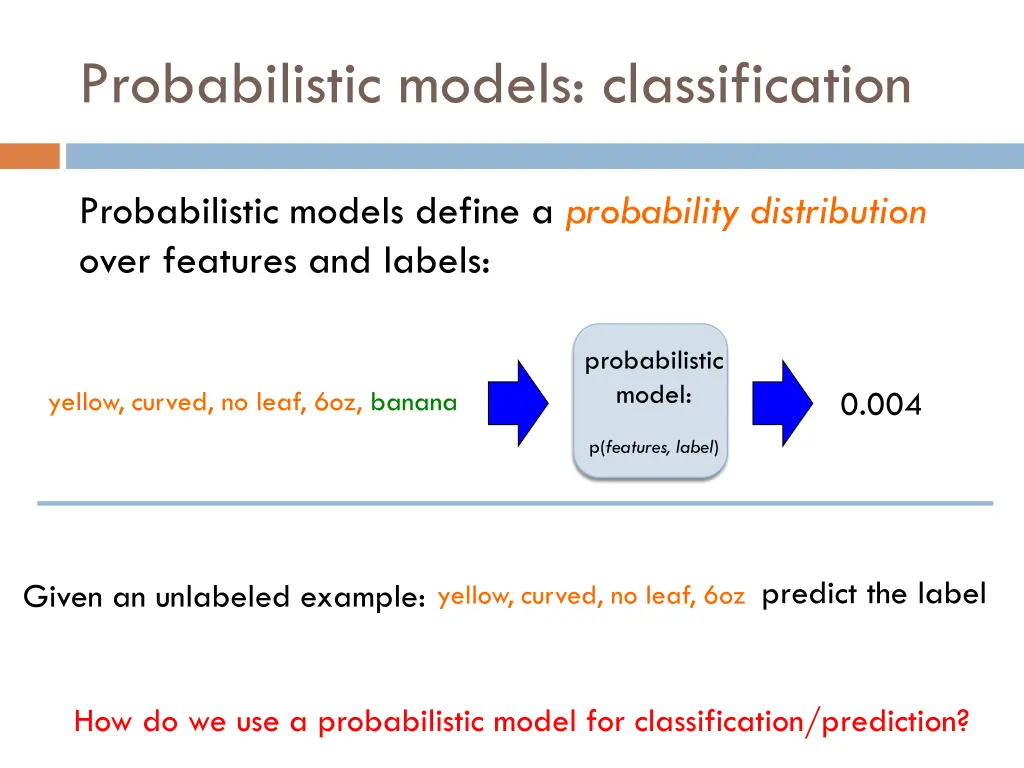
Probabilistic models: classification Probabilistic models define a probability distribution over features and labels: probabilistic model: 0.004 yellow, curved, no leaf, 6oz, banana p(features, label) Given an unlabeled example: yellow, curved, no leaf, 6oz predict the label How do we use a probabilistic model for classification/prediction?
Probabilistic models Probabilistic models define a probability distribution over features and labels: probabilistic model: 0.004 yellow, curved, no leaf, 6oz, banana 0.00002 yellow, curved, no leaf, 6oz, apple p(features, label) For each label, ask for the probability under the model Pick the label with the highest probability
Probabilistic model vs. classifier Probabilistic model: probabilistic model: 0.004 yellow, curved, no leaf, 6oz, banana p(features, label) Classifier: probabilistic model: yellow, curved, no leaf, 6oz banana p(features, label) Why probabilistic models?
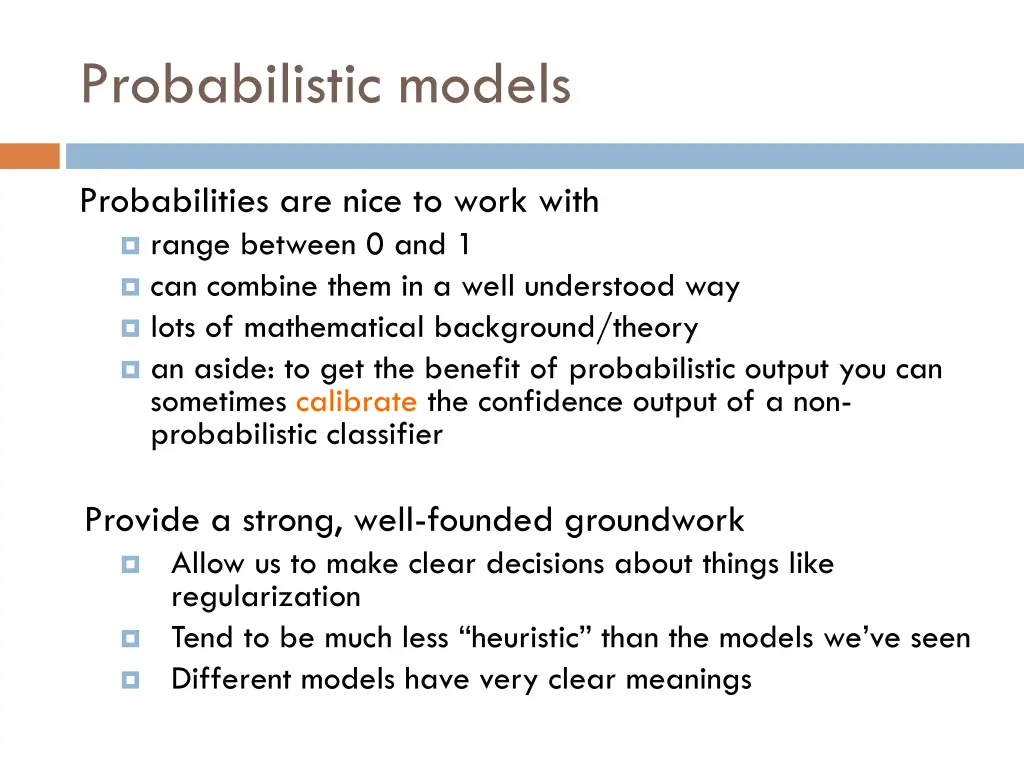
Probabilistic models Probabilities are nice to work with range between 0 and 1 can combine them in a well understood way lots of mathematical background/theory an aside: to get the benefit of probabilistic output you can sometimes calibrate the confidence output of a non- probabilistic classifier Provide a strong, well-founded groundwork Allow us to make clear decisions about things like regularization Tend to be much less heuristic than the models we ve seen Different models have very clear meanings
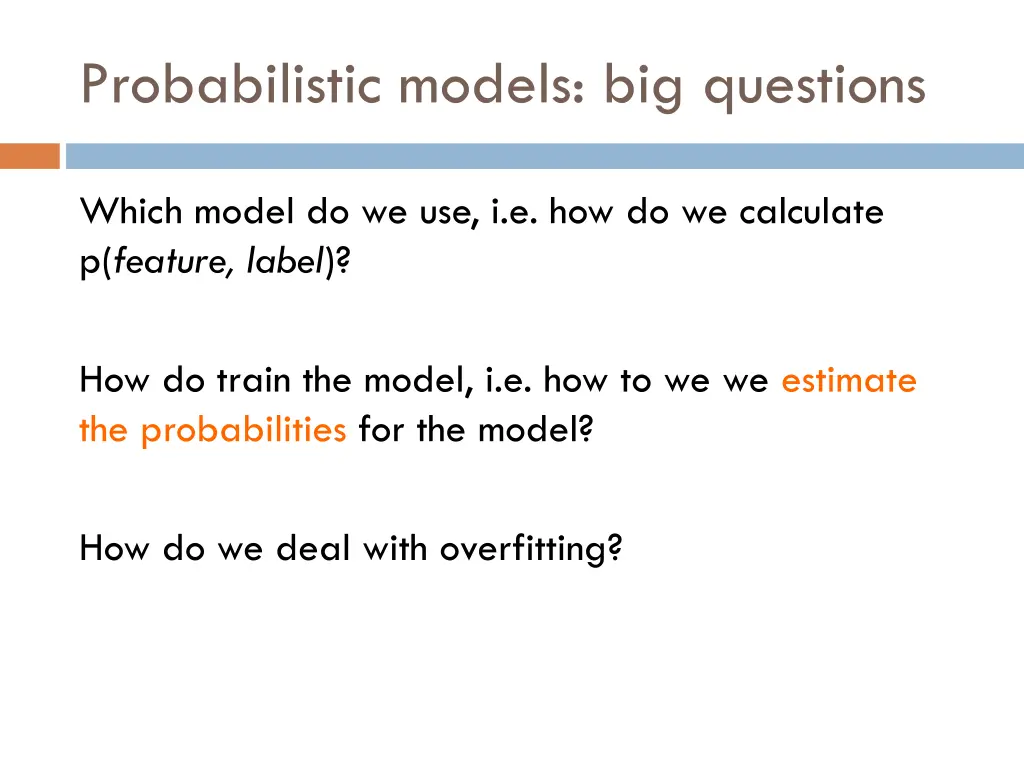
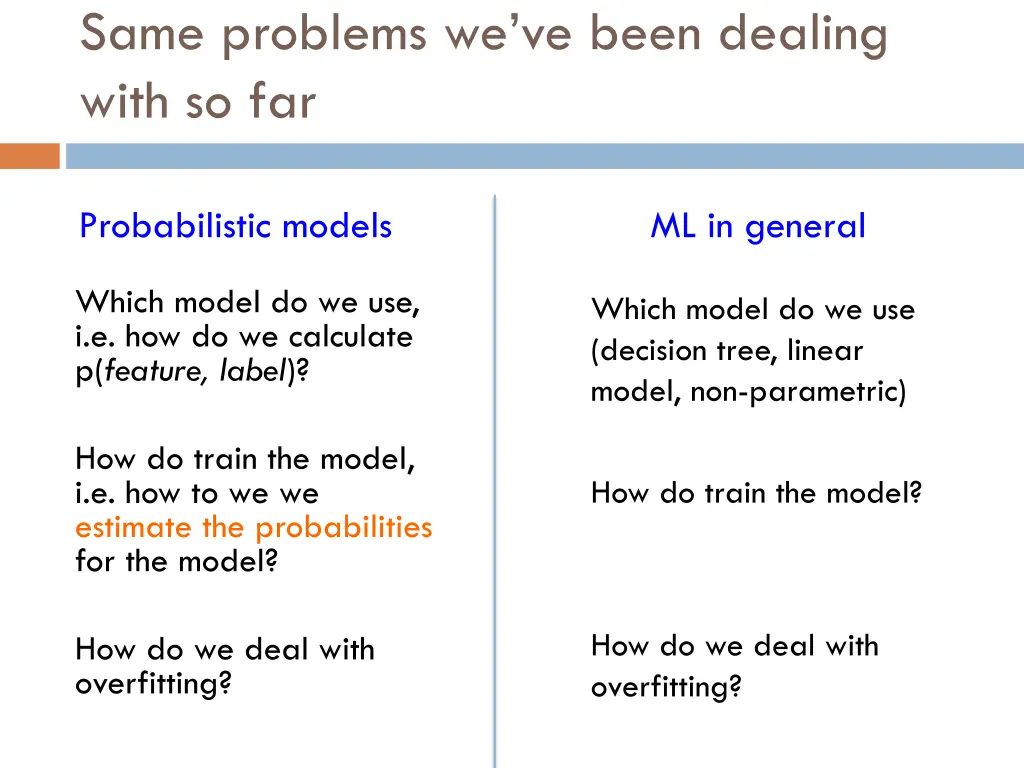
Probabilistic models: big questions Which model do we use, i.e. how do we calculate p(feature, label)? How do train the model, i.e. how to we we estimate the probabilities for the model? How do we deal with overfitting?
Same problems weve been dealing with so far Probabilistic models ML in general Which model do we use, i.e. how do we calculate p(feature, label)? Which model do we use (decision tree, linear model, non-parametric) How do train the model, i.e. how to we we estimate the probabilities for the model? How do train the model? How do we deal with overfitting? How do we deal with overfitting?