Best Refuted Causal Claims from Observational Studies
In large organizations, correlations often lead to mistaken causal claims, especially when observing user behavior related to product features. This presentation discusses the prevalent misconception that certain observational studies indicate causation. Examples from Microsoft Office 365 highlight how claims, such as features reducing churn or heavy users having higher retention, can be misleading. It emphasizes the need for rigorous experimentation and skepticism when interpreting data to ensure that decisions are based on valid causal inferences.

Download Presentation

Please find below an Image/Link to download the presentation.
The content on the website is provided AS IS for your information and personal use only. It may not be sold, licensed, or shared on other websites without obtaining consent from the author.If you encounter any issues during the download, it is possible that the publisher has removed the file from their server.
You are allowed to download the files provided on this website for personal or commercial use, subject to the condition that they are used lawfully. All files are the property of their respective owners.
The content on the website is provided AS IS for your information and personal use only. It may not be sold, licensed, or shared on other websites without obtaining consent from the author.
E N D
Presentation Transcript
Oct 26-27, 2018 Best Refuted Causal Claims from Best Refuted Causal Claims from Observational Studies Observational Studies Slides at https://bit.ly/CODE2018Kohavi Ron Kohavi, Technical Fellow and Vice President, Analysis & Experimentation, Microsoft In narrative form with references at https://bit.ly/ExPAdvanced -> #6 Thanks to Tommy Guy and Jonathan Litz for feedback
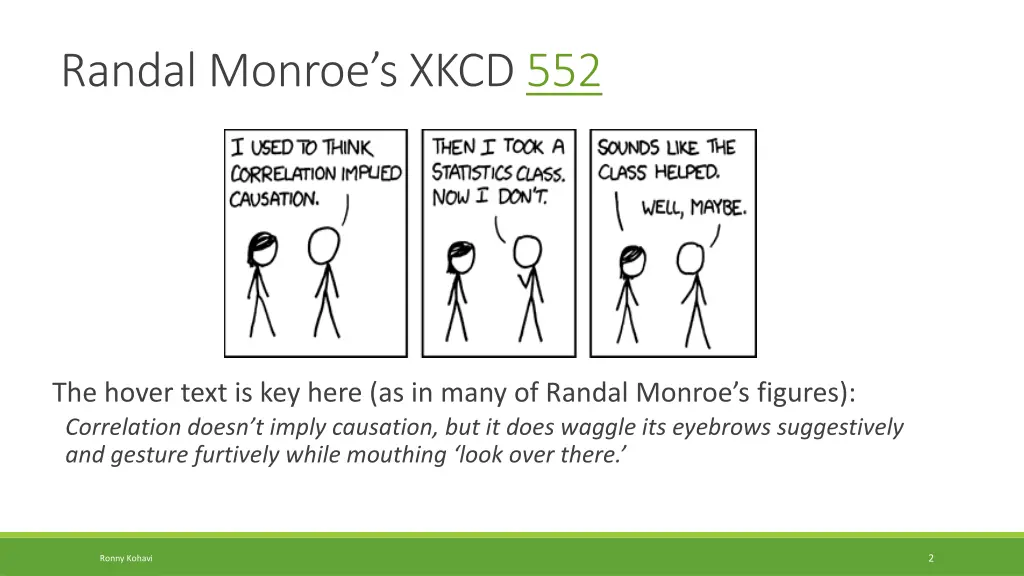
Randal Monroes XKCD 552 The hover text is key here (as in many of Randal Monroe s figures): Correlation doesn t imply causation, but it does waggle its eyebrows suggestively and gesture furtively while mouthing look over there. 2 Ronny Kohavi
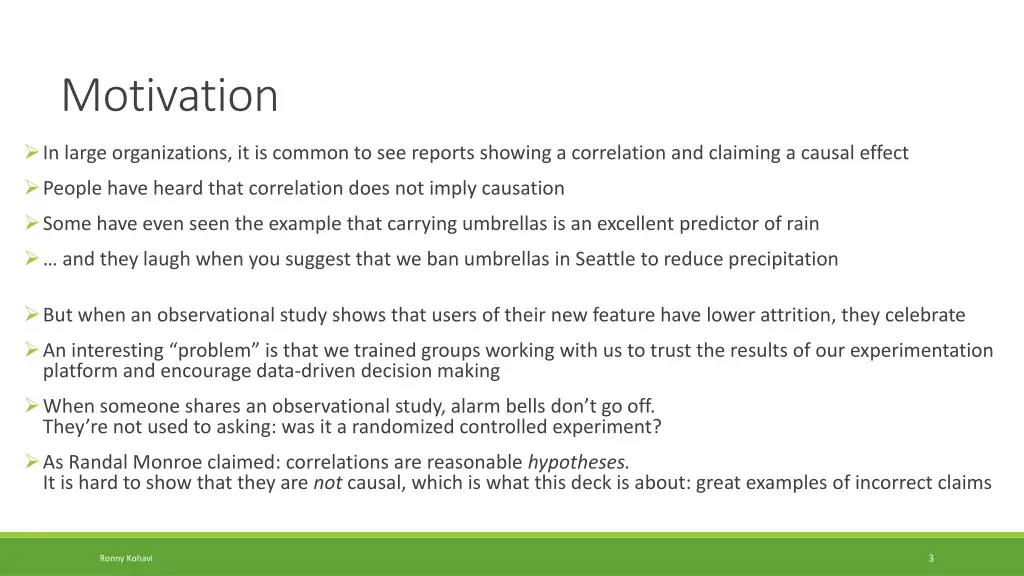
Motivation In large organizations, it is common to see reports showing a correlation and claiming a causal effect People have heard that correlation does not imply causation Some have even seen the example that carrying umbrellas is an excellent predictor of rain and they laugh when you suggest that we ban umbrellas in Seattle to reduce precipitation But when an observational study shows that users of their new feature have lower attrition, they celebrate An interesting problem is that we trained groups working with us to trust the results of our experimentation platform and encourage data-driven decision making When someone shares an observational study, alarm bells don t go off. They re not used to asking: was it a randomized controlled experiment? As Randal Monroe claimed: correlations are reasonable hypotheses. It is hard to show that they are not causal, which is what this deck is about: great examples of incorrect claims 3 Ronny Kohavi
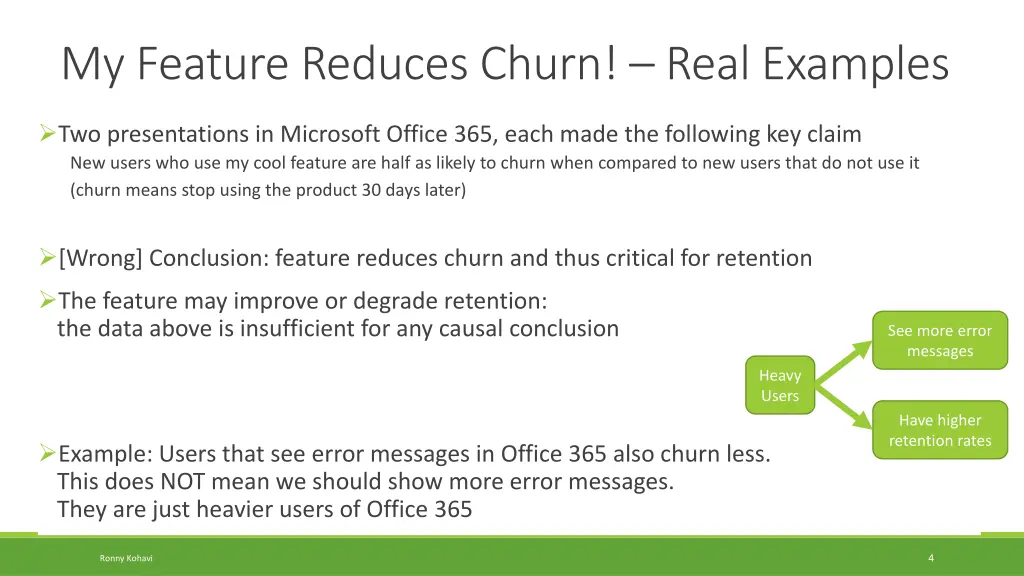
My Feature Reduces Churn! Real Examples Two presentations in Microsoft Office 365, each made the following key claim New users who use my cool feature are half as likely to churn when compared to new users that do not use it (churn means stop using the product 30 days later) [Wrong] Conclusion: feature reduces churn and thus critical for retention The feature may improve or degrade retention: the data above is insufficient for any causal conclusion See more error messages Heavy Users Have higher retention rates Example: Users that see error messages in Office 365 also churn less. This does NOT mean we should show more error messages. They are just heavier users of Office 365 4 Ronny Kohavi
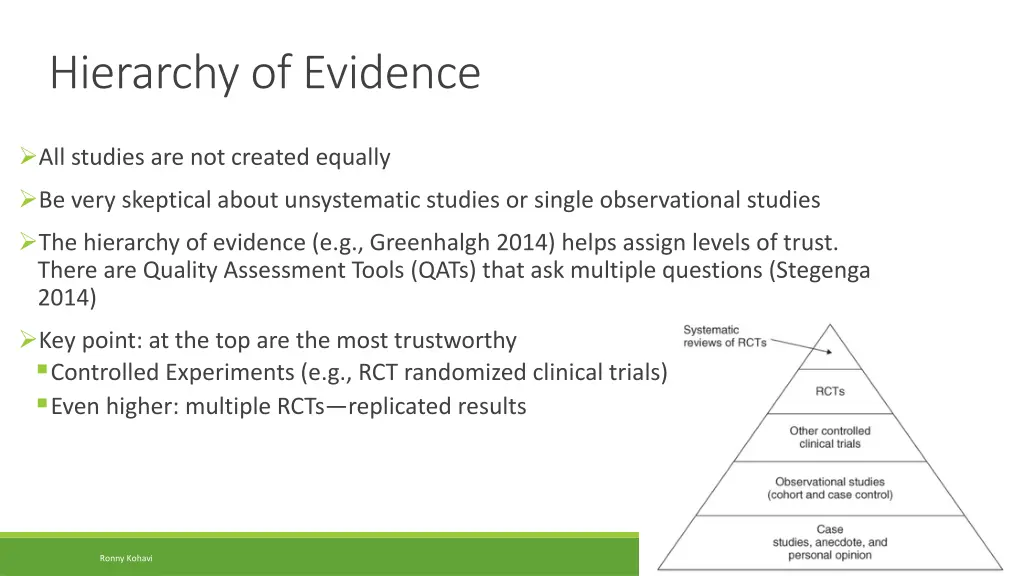
Hierarchy of Evidence All studies are not created equally Be very skeptical about unsystematic studies or single observational studies The hierarchy of evidence (e.g., Greenhalgh 2014) helps assign levels of trust. There are Quality Assessment Tools (QATs) that ask multiple questions (Stegenga 2014) Key point: at the top are the most trustworthy Controlled Experiments (e.g., RCT randomized clinical trials) Even higher: multiple RCTs replicated results 5 Ronny Kohavi
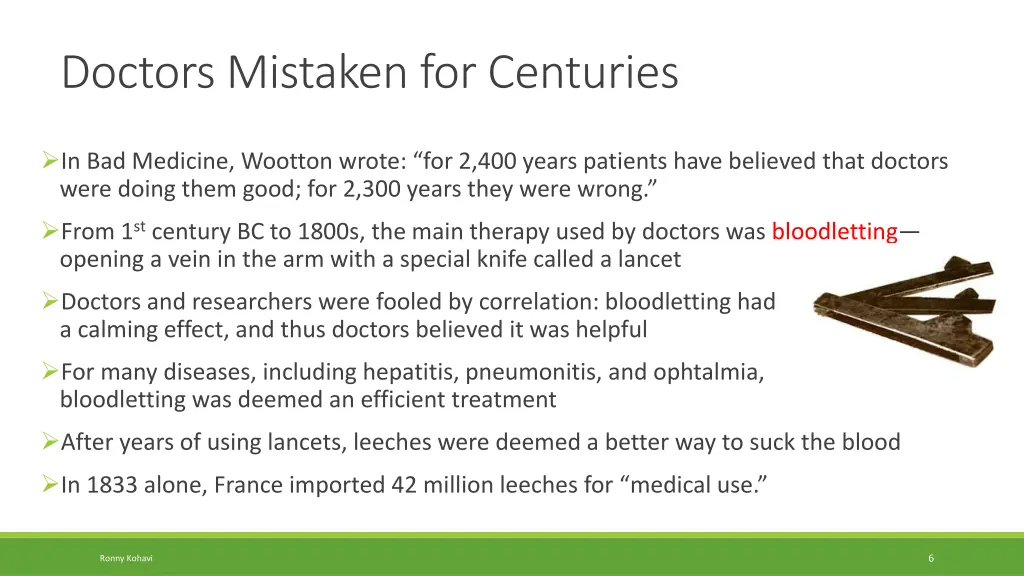
Doctors Mistaken for Centuries In Bad Medicine, Wootton wrote: for 2,400 years patients have believed that doctors were doing them good; for 2,300 years they were wrong. From 1st century BC to 1800s, the main therapy used by doctors was bloodletting opening a vein in the arm with a special knife called a lancet Doctors and researchers were fooled by correlation: bloodletting had a calming effect, and thus doctors believed it was helpful For many diseases, including hepatitis, pneumonitis, and ophtalmia, bloodletting was deemed an efficient treatment After years of using lancets, leeches were deemed a better way to suck the blood In 1833 alone, France imported 42 million leeches for medical use. 6 Ronny Kohavi
Bloodletting is Actually Bad for You In 1799, President George Washington died after three different doctors each performed bloodletting, ultimately extracting more than half his blood volume when he was sick It is now believed that this procedure led to preterminal anemia, hypovolemia, and hypotension and the premature death of the first US President In 1836, Pierre-Charles-Alexandre Louis took 77 patients from a very homogeneous group with the same, well-characterized form of pneumonia He analyzed the duration of the disease and the frequency of death by the timing of the first bloodletting (early in days 1-4, or later in days 5-9) Result: 44% of the patients who had been bled early died compared to 25% of those bled late Bloodletting, he concluded was really bad for you 7 Ronny Kohavi
Overestimates of Effects of Advertising (Lewis, Rao, and Reiley, 2011) Large study with 50 million users at Yahoo! Question: Given a display ad, what is the lift to the number of users who search using keywords related to the brand shown Straight observational study: 1198% Regression with some control variables: 894% Regression with more control variables: 871% Confidence intervals on above are about +/-10% Randomized controlled experiment... 5.4% Wait Wait Guess Users who actively visit Yahoo! on a given day are much more likely both to see the display ad and to do a Yahoo! search 8 Ronny Kohavi
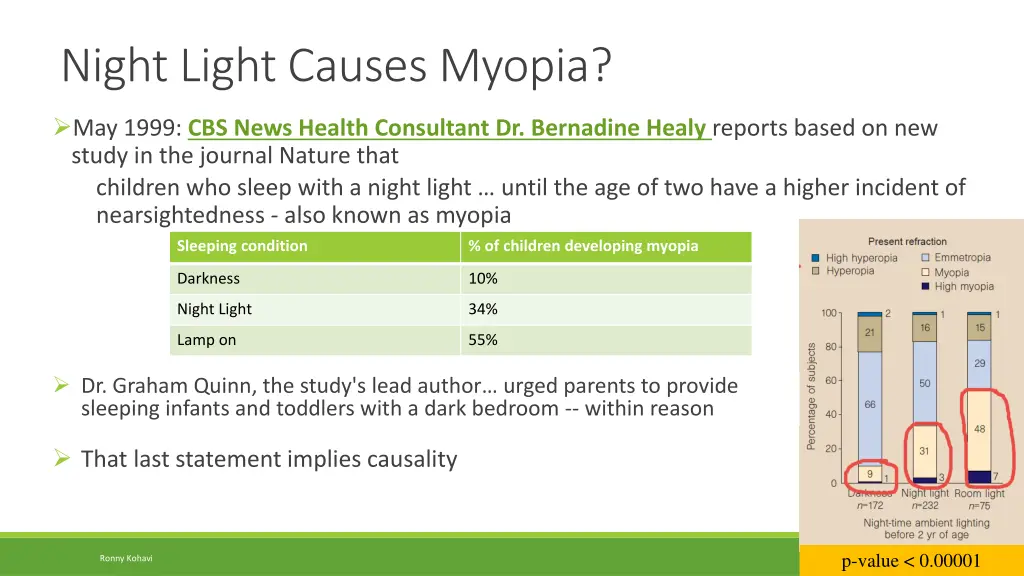
Night Light Causes Myopia? May 1999: CBS News Health Consultant Dr. Bernadine Healy reports based on new study in the journal Nature that children who sleep with a night light until the age of two have a higher incident of nearsightedness - also known as myopia Sleeping condition % of children developing myopia Darkness 10% Night Light 34% Lamp on 55% Dr. Graham Quinn, the study's lead author urged parents to provide sleeping infants and toddlers with a dark bedroom -- within reason That last statement implies causality p-value < 0.00001 9 Ronny Kohavi
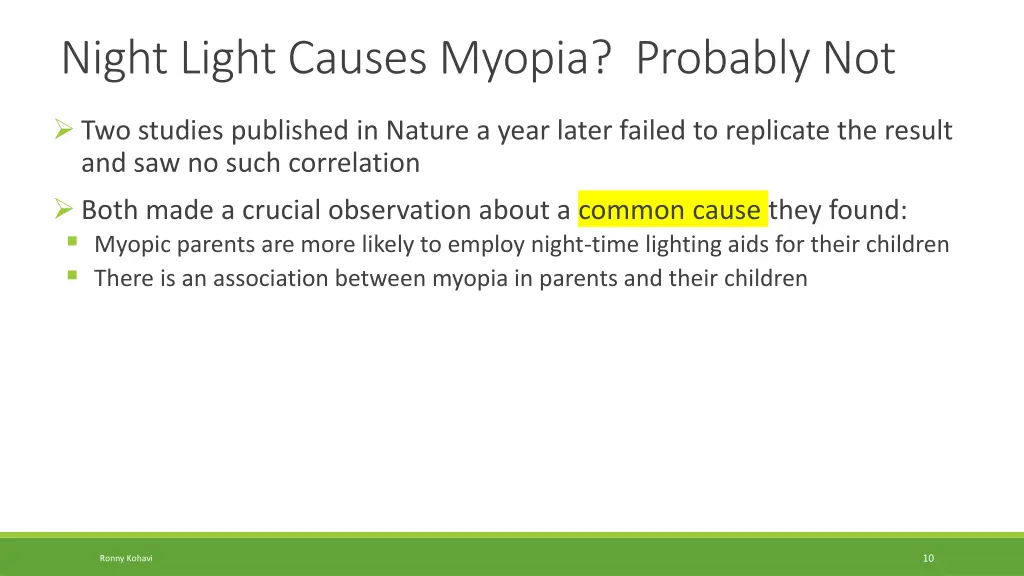
Night Light Causes Myopia? Probably Not Two studies published in Nature a year later failed to replicate the result and saw no such correlation Both made a crucial observation about a common cause they found: Myopic parents are more likely to employ night-time lighting aids for their children There is an association between myopia in parents and their children 10 Ronny Kohavi
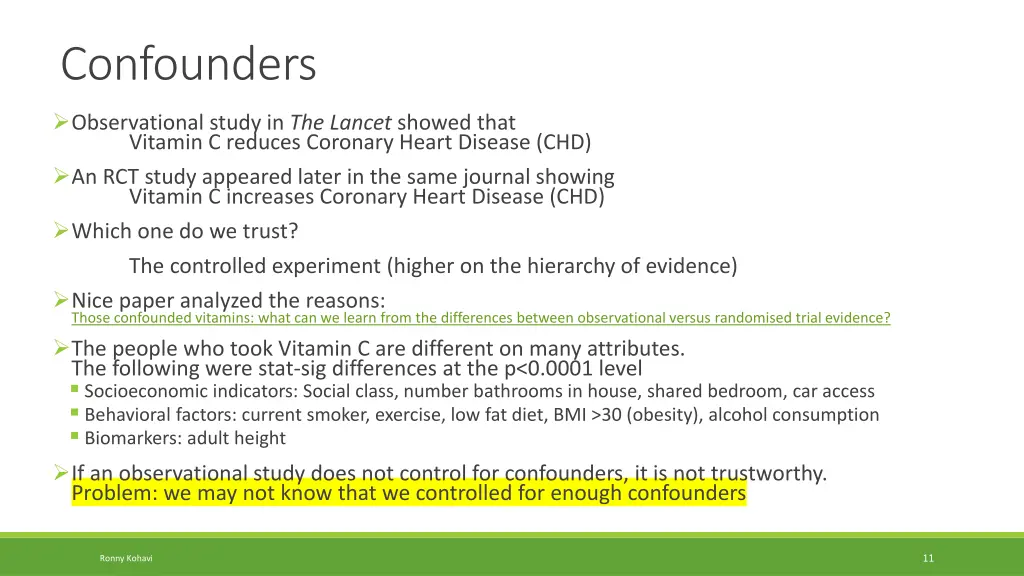
Confounders Observational study in The Lancet showed that Vitamin C reduces Coronary Heart Disease (CHD) An RCT study appeared later in the same journal showing Vitamin C increases Coronary Heart Disease (CHD) Which one do we trust? The controlled experiment (higher on the hierarchy of evidence) Nice paper analyzed the reasons: Those confounded vitamins: what can we learn from the differences between observational versus randomised trial evidence? The people who took Vitamin C are different on many attributes. The following were stat-sig differences at the p<0.0001 level Socioeconomic indicators: Social class, number bathrooms in house, shared bedroom, car access Behavioral factors: current smoker, exercise, low fat diet, BMI >30 (obesity), alcohol consumption Biomarkers: adult height If an observational study does not control for confounders, it is not trustworthy. Problem: we may not know that we controlled for enough confounders 11 Ronny Kohavi
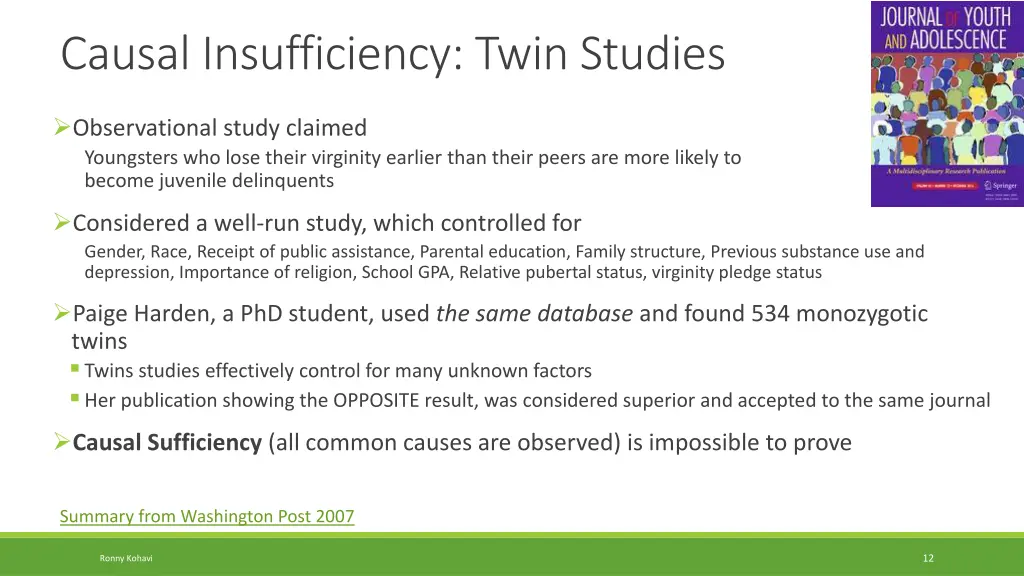
Causal Insufficiency: Twin Studies Observational study claimed Youngsters who lose their virginity earlier than their peers are more likely to become juvenile delinquents Considered a well-run study, which controlled for Gender, Race, Receipt of public assistance, Parental education, Family structure, Previous substance use and depression, Importance of religion, School GPA, Relative pubertal status, virginity pledge status Paige Harden, a PhD student, used the same database and found 534 monozygotic twins Twins studies effectively control for many unknown factors Her publication showing the OPPOSITE result, was considered superior and accepted to the same journal Causal Sufficiency (all common causes are observed) is impossible to prove Summary from Washington Post 2007 12 Ronny Kohavi
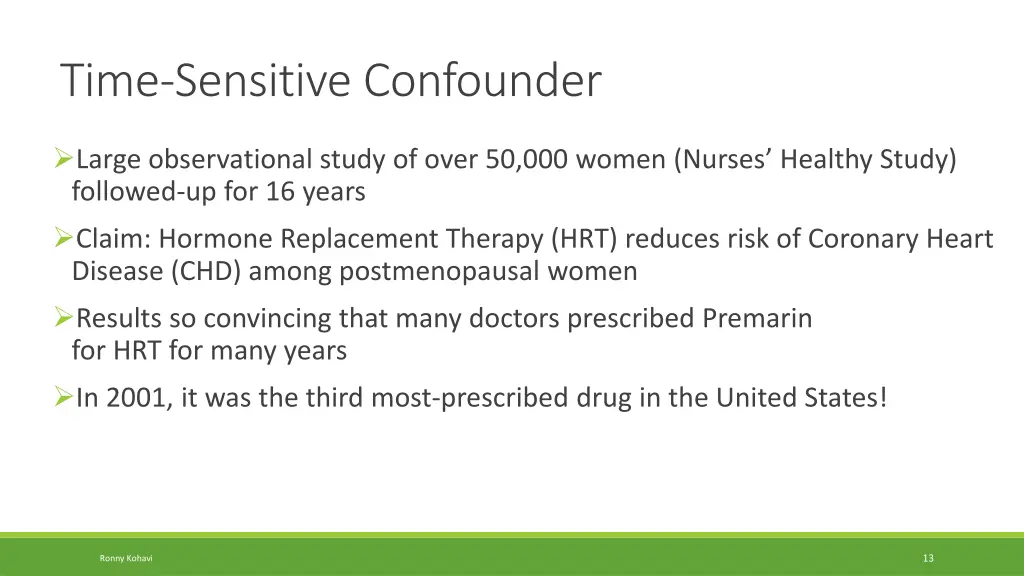
Time-Sensitive Confounder Large observational study of over 50,000 women (Nurses Healthy Study) followed-up for 16 years Claim: Hormone Replacement Therapy (HRT) reduces risk of Coronary Heart Disease (CHD) among postmenopausal women Results so convincing that many doctors prescribed Premarin for HRT for many years In 2001, it was the third most-prescribed drug in the United States! 13 Ronny Kohavi
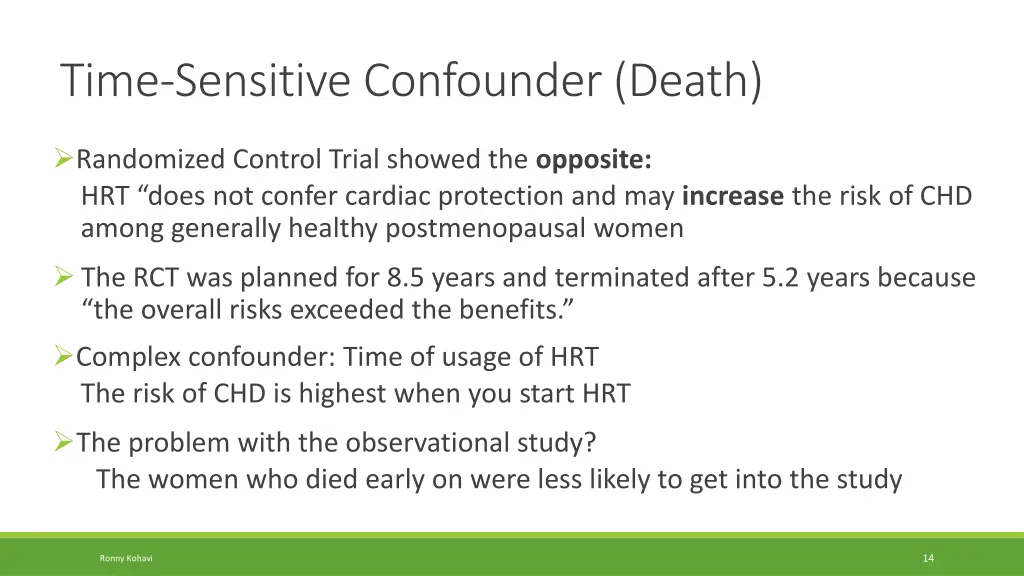
Time-Sensitive Confounder (Death) Randomized Control Trial showed the opposite: HRT does not confer cardiac protection and may increase the risk of CHD among generally healthy postmenopausal women The RCT was planned for 8.5 years and terminated after 5.2 years because the overall risks exceeded the benefits. Complex confounder: Time of usage of HRT The risk of CHD is highest when you start HRT The problem with the observational study? The women who died early on were less likely to get into the study 14 Ronny Kohavi
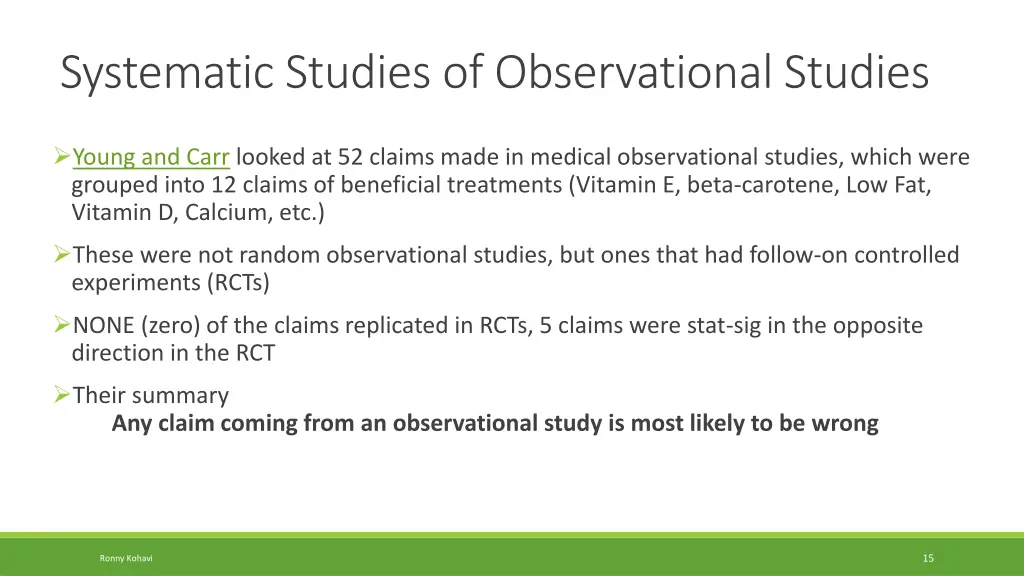
Systematic Studies of Observational Studies Young and Carr looked at 52 claims made in medical observational studies, which were grouped into 12 claims of beneficial treatments (Vitamin E, beta-carotene, Low Fat, Vitamin D, Calcium, etc.) These were not random observational studies, but ones that had follow-on controlled experiments (RCTs) NONE (zero) of the claims replicated in RCTs, 5 claims were stat-sig in the opposite direction in the RCT Their summary Any claim coming from an observational study is most likely to be wrong 15 Ronny Kohavi
My Ask I wrote an early version of this deck back in 2016 (https://twitter.com/ronnyk/status/800584797571514368) and it s available at http://bit.ly/refutedCausalClaims I will merge these CODE talk to the above If you know of other good examples, please tell me, and I ll add to the deck and acknowledge 16 Ronny Kohavi