Explore the fascinating world of laser wakefield acceleration (LWFA) and betatron radiation through a comprehensive study on plasma physics and controlled fusion. Discover the limits, results, and future plans in this cutting-edge field of research conducted by Lorenzo Magnisi at Laboratori Nazionali di Frascati.
Please find below an Image/Link to download the presentation.
The content on the website is provided AS IS for your information and personal use only. It may not be sold, licensed, or shared on other websites without obtaining consent from the author. If you encounter any issues during the download, it is possible that the publisher has removed the file from their server.
You are allowed to download the files provided on this website for personal or commercial use, subject to the condition that they are used lawfully. All files are the property of their respective owners.
The content on the website is provided AS IS for your information and personal use only. It may not be sold, licensed, or shared on other websites without obtaining consent from the author.
E N D
Presentation Transcript
Betatron radiation from LWFA Lorenzo Magnisi Plasma Physics and Controlled Fusion 56(8):084015 Laboratori Nazionali di Frascati
Outline Laser WakeField Acceleration (LWFA) Self-injection Betatron radiation from LWFA Limits of LWFA Results from betatron spectrum parameter scan Comparison with previous experiment Future plan and conclusions L. Magnisi 2
Outline Laser WakeField Acceleration (LWFA) Self-injection Betatron radiation from LWFA Limits of LWFA Results from betatron spectrum parameter scan Comparison with previous experiment Future plan and conclusions L. Magnisi 3
Laser WakeField Acceleration In Laser WakeField Acceleration (LWFA) a short (??), high power (??) laser is impinging in a gas-jet/gas-filled capillary to stimulate an electron plasma wave. Higher accelerating gradients than conventional RF structures More compact structures Optics and Photonics News, 2018, 29(42-49) L. Magnisi 4
Laser WakeField Acceleration Very small structures Higher accelerating gradients than conventional RF structures 1 ? ????????????? ??[??] 3.3 1010?0?? 3 2 96 ?0?? 3 ?0 ?? is the plasma wavelength ?0 is the plasma density LWFA RF Structures ?0= 1018?? 3 ?0 100 ??/? ?? 33 ?? ?0 150 ??/? ??? 10 ?? L. Magnisi 5
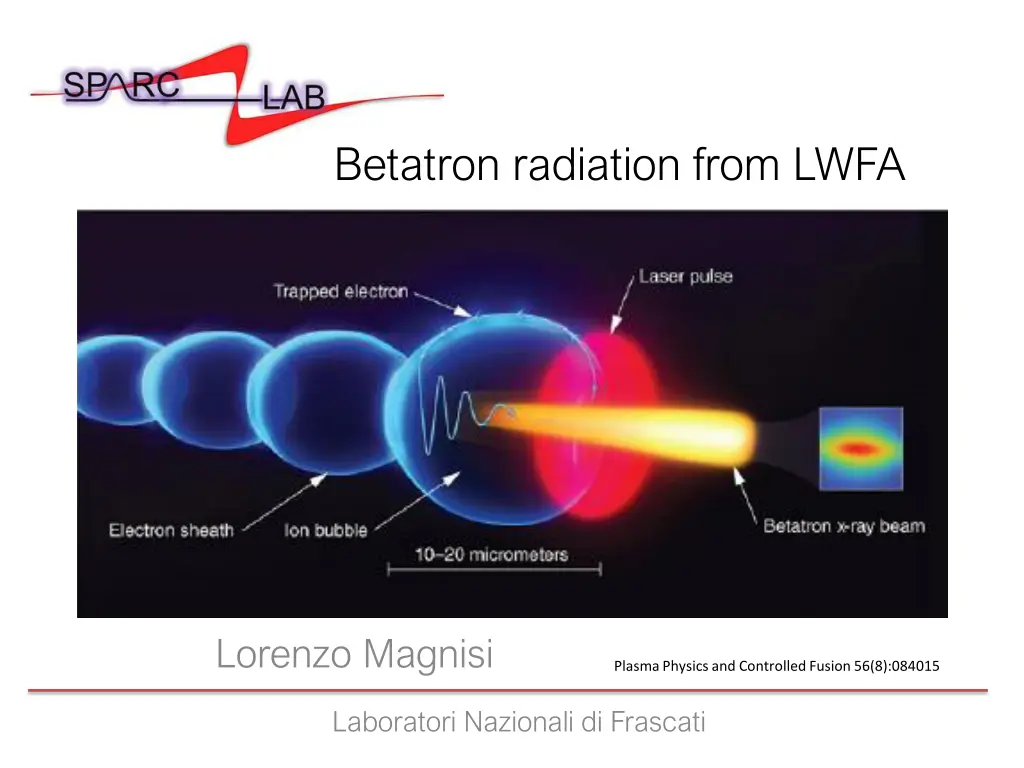
Self-injection in blowout regime The most efficient mechanism to accelerate electrons in a plasma wave is called bubble (or blowout) regime. a) Laser pulse ejects electrons from its path b) Electrons start to oscillate c) Strong fields in the laser direction occur d) Electrons can get trapped in these accelerating fields and accelerated (Self-Injection) Plasma Frequency ???2 ???0 ??= Max Born Institut, 2012 Laser Strength Parameter 1 2 ? ??2 ?0= 0.85 10 9???? ?? L. Magnisi 6
LWFA Betatron radiation Longitudinal Field accelerating Transverse Field betatron oscillation Electrons trapped and accelerated in the cavity are also transversally wiggled. ?? 2?21 +?2 2+ ?2?2 ? A collimated beam of x-ray radiation (betatron radiation) is emitted by the electron bunch. Femtosecond pulses keV range energy Reviews of Modern Physics, 85, 2013 L. Magnisi 7
LWFA Betatron radiation A routine has been developed to scan the betatron spectrum obtained in such interaction. Phys. Rev. Lett. 2004 Sep 24; 93(13): 135005 12???? ??0 ?0 ??2 is the minimal energy that an electron should have to be accelerated ?min 2 ????=2?0?? 2??2 is the maximal energy gain of the electron inside the plasma channel 3?? 2 ? ? =? ? ??2=???? ??21 1 ???? ? 1 ???? ???? is the equation for the energy gain over the acceleration axis z L. Magnisi 8 Reviews of Modern Physics, 85, 2013
LWFA acceleration limitations The length of electrons acceleration in plasma is limited by some factors: the diffraction of the laser, that occurs after its Rayleigh length: 2 ??=??0 ? the difference between the wave and the accelerated electrons velocities, that cause a dephasing because of which, after a certain distance, the electron passes in the decelerating part of the wave. This distance is called dephasing length: ???? 4 3? ?0 the laser loss of energy during the interaction: after a distance ???, called pump depletion length, the laser loses its energy and can t transfer energy to the plasma. The pump depletion length is the distance that the laser travels before losing half of its energy: ??? ?? ?? 2 ?? ?? 3 2 2?? L. Magnisi 9
Betatron radiation from LWFA The betatron radiation spectrum was modeled via the following integral: ? ?2E ??? ?? ??= 2? ??sin? 0 2 ???? ?2? ??d ??? ?0?2?0 3?3? ?? 1 +?2? ?2 ?2? ?2 1 + ?2? ?2?1 2? ? 2? ? ?2 + ?2? ???? 0 3 3 ? 3 2 1 + ?2? ?2 ? ? = ? ? is defined as: 2? ? 3?3? ?0?? ?? ?? ?????? ???? 3???? ??? = 1 2 1 2 3? ? Number of betatron oscillations Betatron wave number L. Magnisi 10 Reviews of Modern Physics, 85, 2013
X-rays diagnostics 2 ???? ?2? ??d ??? ?0?2?0 3?3? ?? 1 +?2? ?2 ?2? ?2 1 + ?2? ?2?1 2? ? 2? ? ?2 + ?2? ???? 0 3 3 ?? the electron bunch spot size inside the bubble. Thus it is possible to retrieve the measured spectrum of the betatron radiation to obtain the bunch spot size inside the bubble. Reconstruct the trace-space of the electron beam, therefore the emittance. L. Magnisi 11
Outline Laser WakeField Acceleration (LWFA) Self-injection Betatron radiation from LWFA Limits of LWFA Results from betatron spectrum parameter scan Comparison with previous experiment Future plan and conclusions L. Magnisi 12
Electron gamma factor along propagation Laser energy-plasma density 2D scan: ??= 1,1 4,5 ? and ??= 0,5 15 1018 ?? 3 with following parameters: ?0= 10 ?? and ??= 30 ?? ? ? =? ? ??2 ??= 1,5 1018 ?? 3 ??= 2,9 ? L. Magnisi 13
???? and ??? 2 2?? 2 ??? ?? ???? 4 ?? ?? 3? ?0 3 ?? The pump depletion length is greater than Rayleigh length (?? 0.3 ??), and for this values is lower than dephasing length. L. Magnisi 14
Modeled betatron spectra Increasing the laser energy, the spectrum peak shifts along the energy axis. Increasing the plasma density, the spectrum narrows. L. Magnisi 15
Outline Laser WakeField Acceleration (LWFA) Self-injection Betatron radiation from LWFA Limits of LWFA Results from betatron spectrum parameter scan Comparison with previous experiment Future plan and conclusions L. Magnisi 16
Comparison with experiment FLAME laser features: ? = 1.3 ? ????= 30 ?? Laser beam on a helium gas-jet Dipole X-ray diagnostics L. Magnisi 17
Comparison with experiment ??= ?.? ? ??= ?.? ???? ?? ? ????= 4.4 ??? ???? ????????= 6 ??? ???= 4.5 ??? ???? ???????= 5,6 ??? The tail of the spectrum depends on the model used for the scan. PHYSICAL REVIEW ACCELERATORS AND BEAMS 20, 012801 (2017) L. Magnisi 18
Outline Laser WakeField Acceleration (LWFA) Self-injection Betatron radiation from LWFA Limits of LWFA Results from betatron spectrum parameter scan Comparison with previous experiment Future plan and conclusions L. Magnisi 19
Future plan and conclusions A parameter scan of the betatron spectrum was performed, in order to retrieve the best performing parameters; An experimental setup will be developed in order to characterize the betatron radiation source. It should adopt: longer acceleration length menageable/compact setup to scan the betatron properties mimiked by the developed simulation tool. L. Magnisi 20
Capillary guiding AIM: Guide the laser inside the capillary for lenghts longer than Rayleigh length Accelerate electrons until the maximum energy gain, where the radiated energy is maximum and the divergence is minimized HOW: Match the laser spot size with the capillary radius ?? , following the equation 1 2?? 1 4 ??? 4.7 103?? Choose the length of the capillary approximately equal to the dephasing length L. Magnisi 23