BGP in 2020: Highlights and Projections
BGP in 2020 reveals crucial insights into IPv4 and IPv6 routing dynamics. Despite IPv4 address exhaustion, routing entries reached significant milestones, with a notable increase in the number of new ASes and the persistent growth of the IPv6 landscape. The analysis covers trends from 2011's address exhaustion to the effects of shorter prefixes being advertised, providing a comprehensive view of the growing Internet routing infrastructure.

Download Presentation

Please find below an Image/Link to download the presentation.
The content on the website is provided AS IS for your information and personal use only. It may not be sold, licensed, or shared on other websites without obtaining consent from the author.If you encounter any issues during the download, it is possible that the publisher has removed the file from their server.
You are allowed to download the files provided on this website for personal or commercial use, subject to the condition that they are used lawfully. All files are the property of their respective owners.
The content on the website is provided AS IS for your information and personal use only. It may not be sold, licensed, or shared on other websites without obtaining consent from the author.
E N D
Presentation Transcript
BGP in 2020 Geoff Huston APNIC Labs
The Highlights IPv4 FIB Summary IPv6 FIB Summary FIB Projections Churn Conclusions
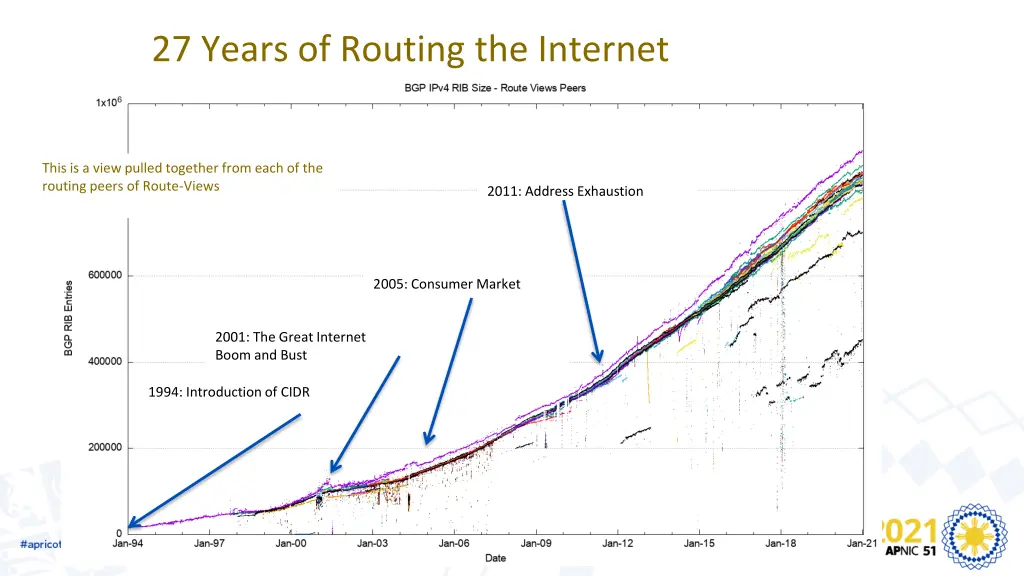
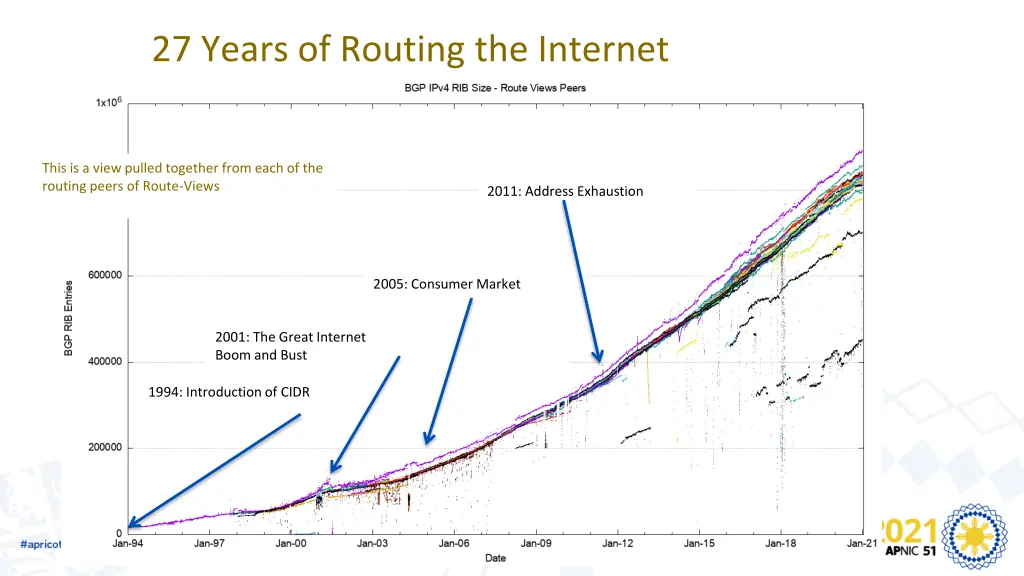
27 Years of Routing the Internet This is a view pulled together from each of the routing peers of Route-Views 2011: Address Exhaustion 2005: Consumer Market 2001: The Great Internet Boom and Bust 1994: Introduction of CIDR
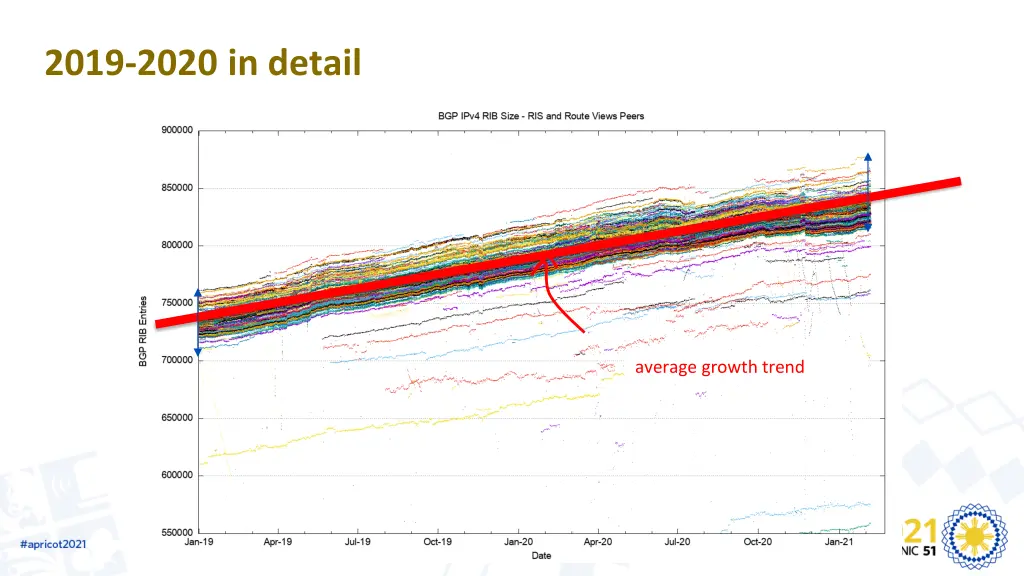
2019-2020 in detail average growth trend
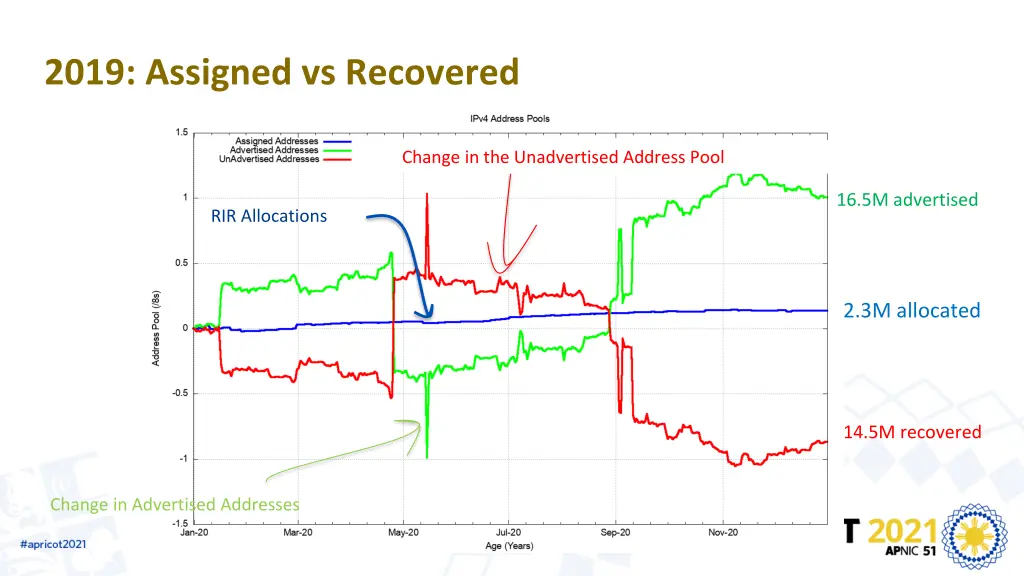
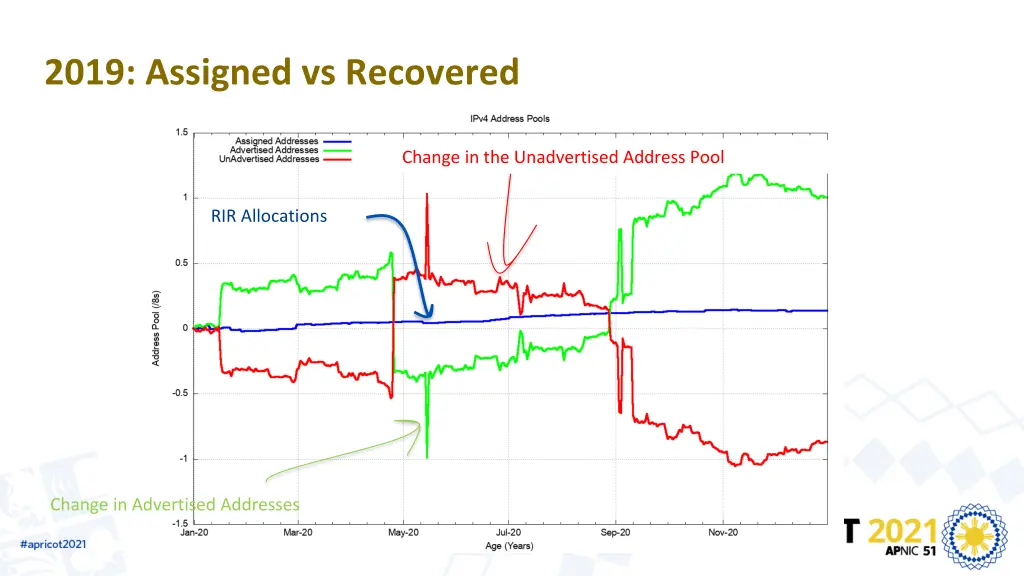
2019: Assigned vs Recovered Change in the Unadvertised Address Pool 16.5M advertised RIR Allocations 2.3M allocated 14.5M recovered Change in Advertised Addresses
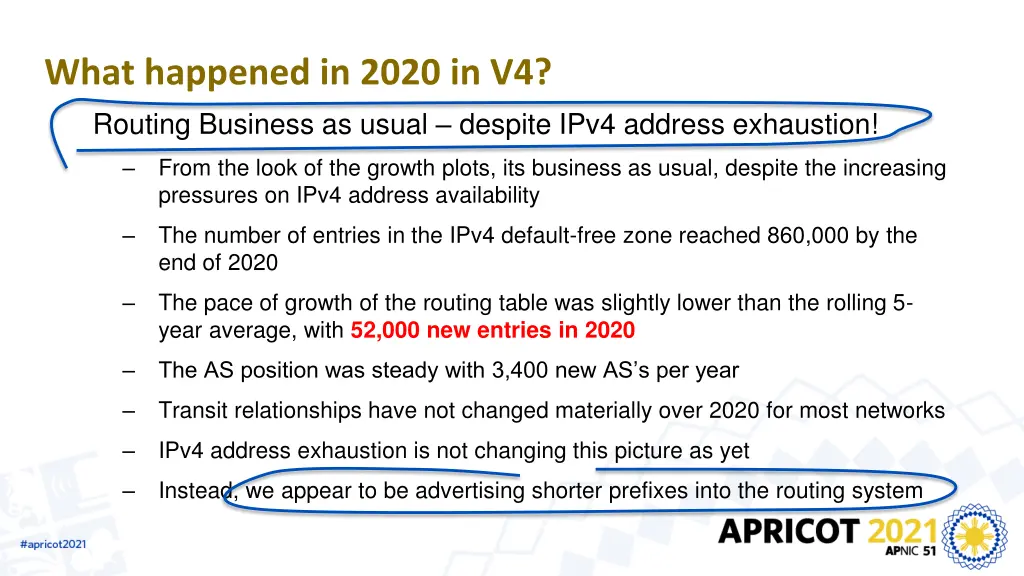
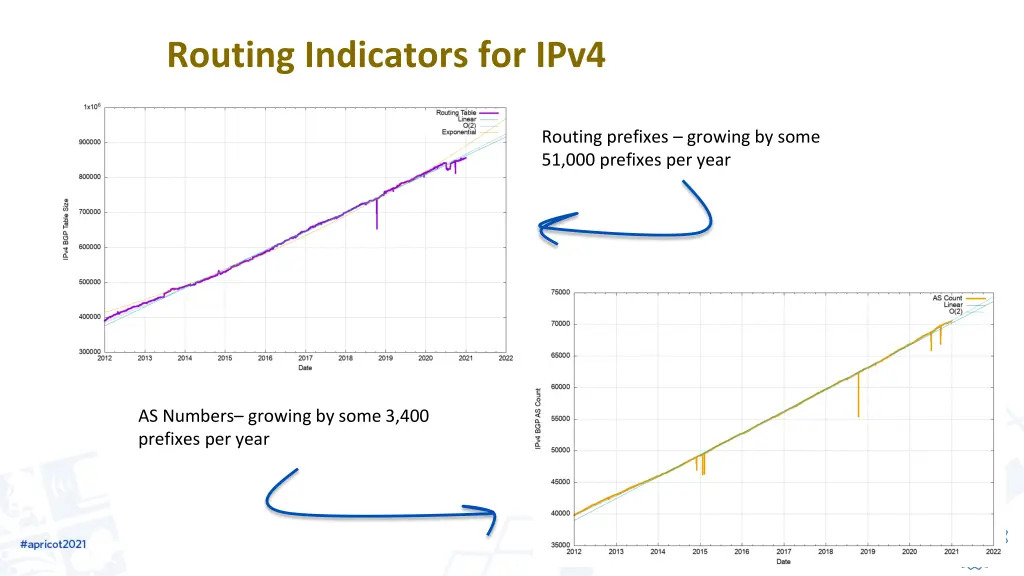
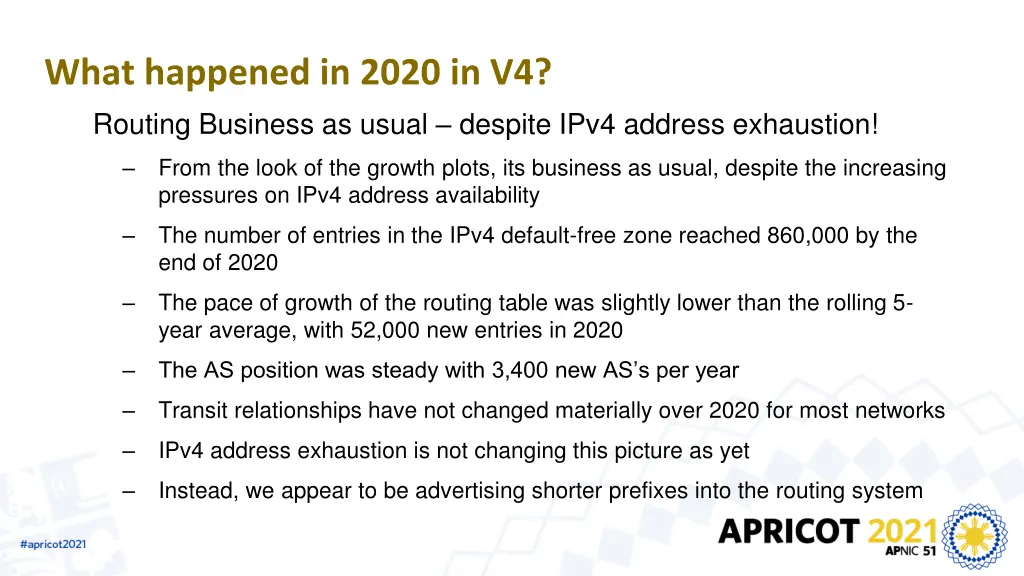
What happened in 2020 in V4? Routing Business as usual despite IPv4 address exhaustion! From the look of the growth plots, its business as usual, despite the increasing pressures on IPv4 address availability The number of entries in the IPv4 default-free zone reached 860,000 by the end of 2020 The pace of growth of the routing table was slightly lower than the rolling 5- year average, with 52,000 new entries in 2020 The AS position was steady with 3,400 new AS s per year Transit relationships have not changed materially over 2020 for most networks IPv4 address exhaustion is not changing this picture as yet Instead, we appear to be advertising shorter prefixes into the routing system
The Highlights IPv4 FIB Summary IPv6 FIB Summary FIB Projections Churn Conclusions
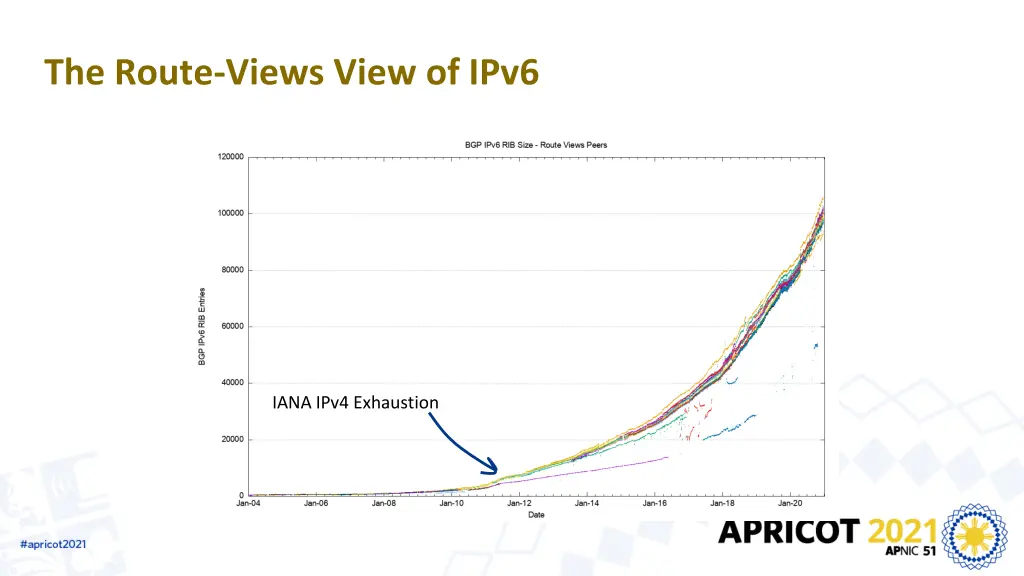
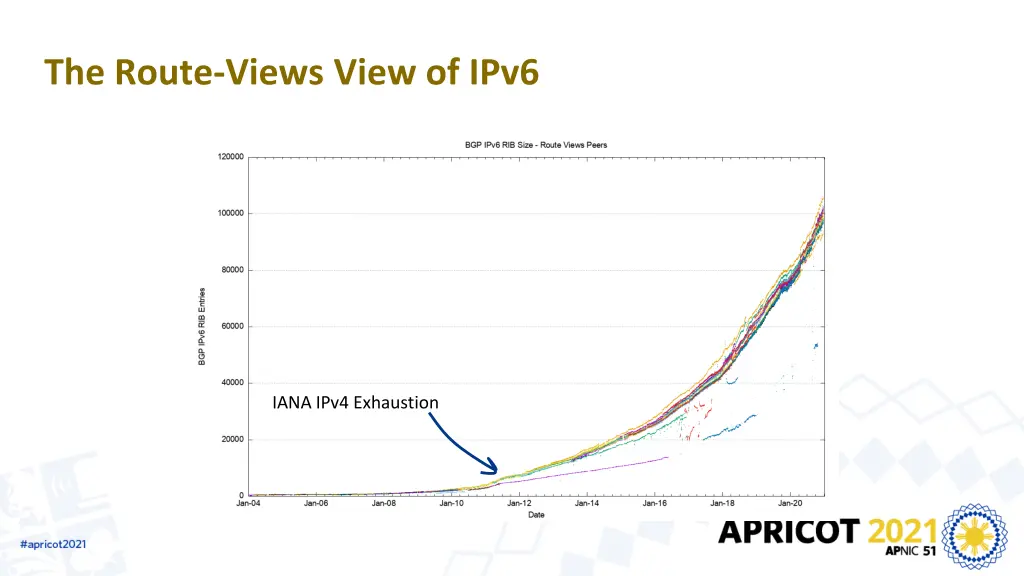
The Route-Views View of IPv6 IANA IPv4 Exhaustion
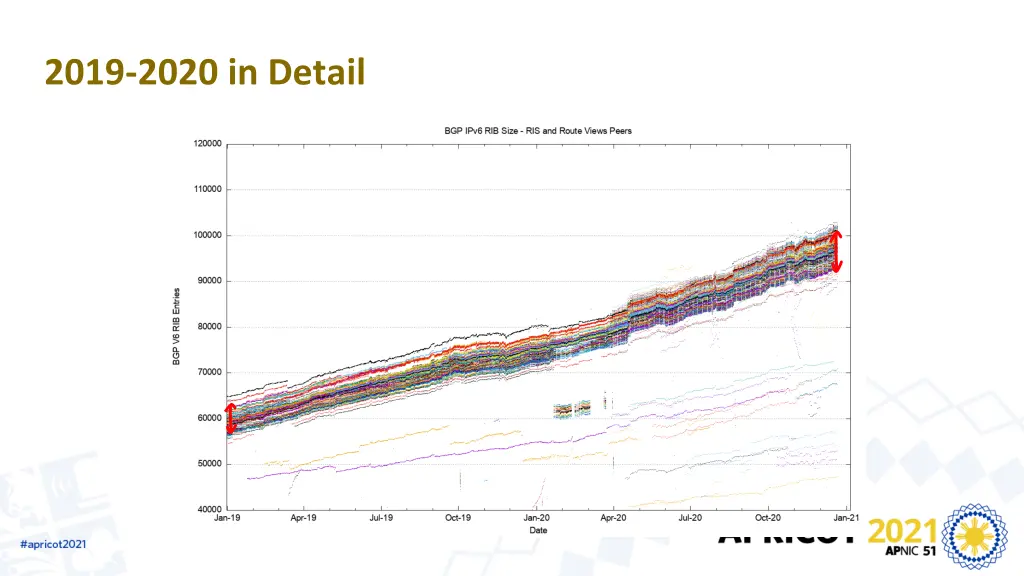
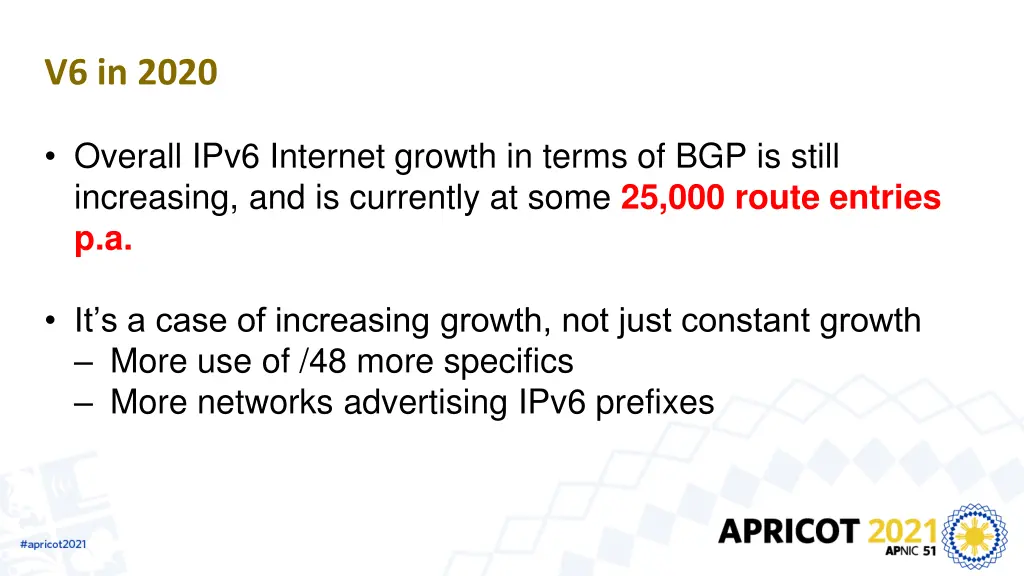
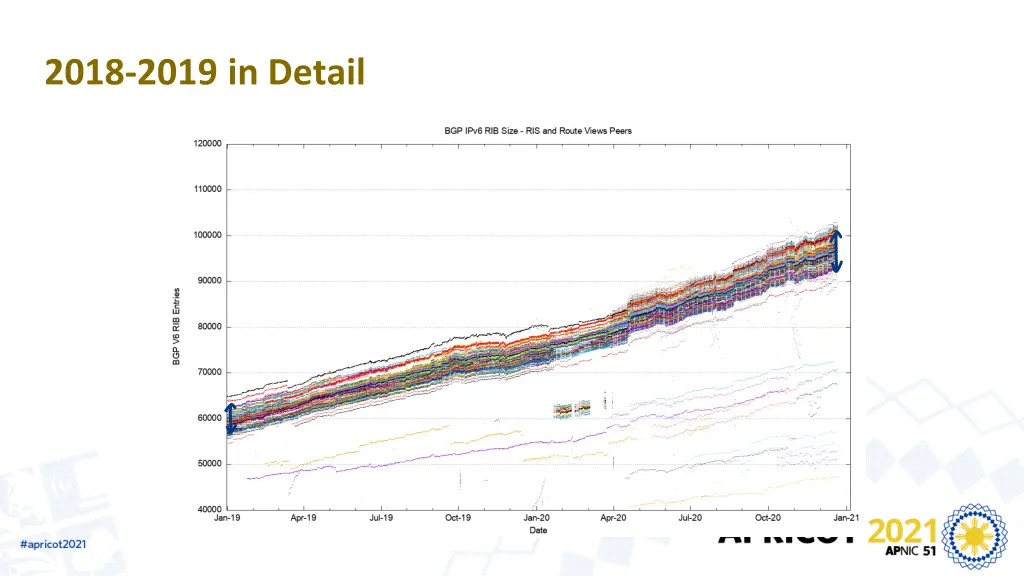
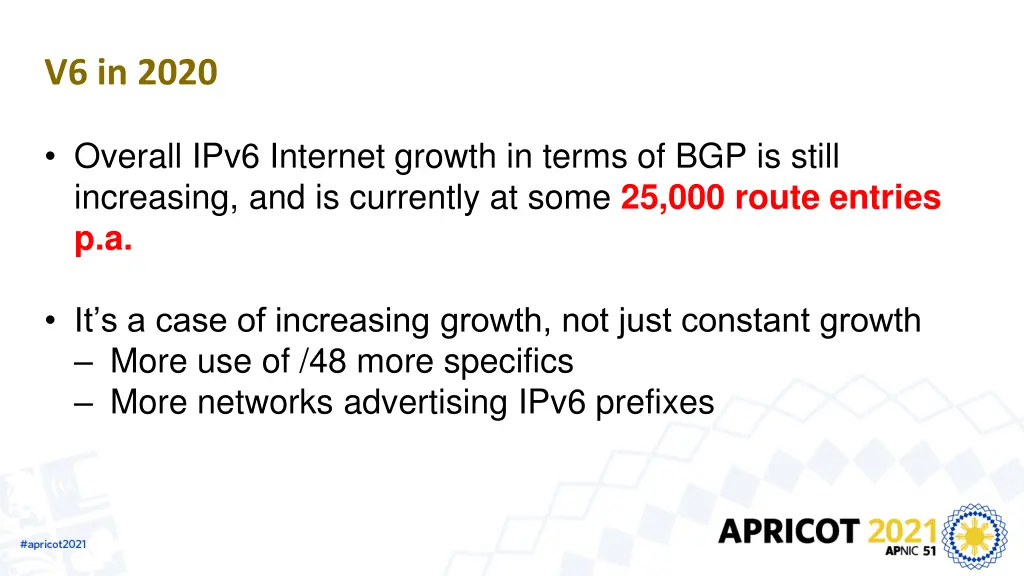
V6 in 2020 Overall IPv6 Internet growth in terms of BGP is still increasing, and is currently at some 25,000 route entries p.a. It s a case of increasing growth, not just constant growth More use of /48 more specifics More networks advertising IPv6 prefixes
The Highlights IPv4 FIB Summary IPv6 FIB Summary FIB Projections Churn Conclusions
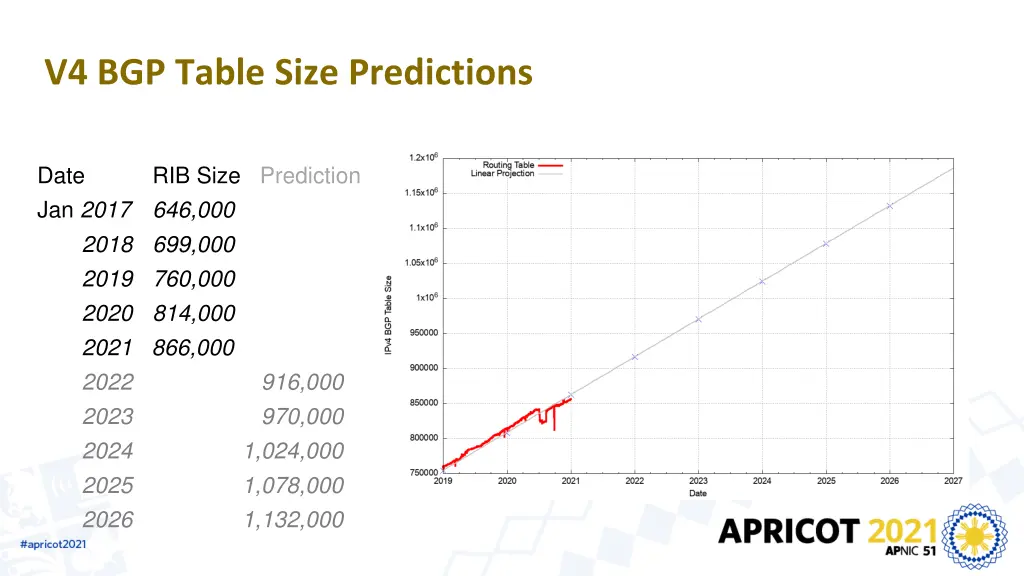
V4 BGP Table Size Predictions Date Jan 2017 2018 699,000 2019 760,000 2020 814,000 2021 866,000 2022 2023 2024 2025 2026 RIB Size Prediction 646,000 916,000 970,000 1,024,000 1,078,000 1,132,000
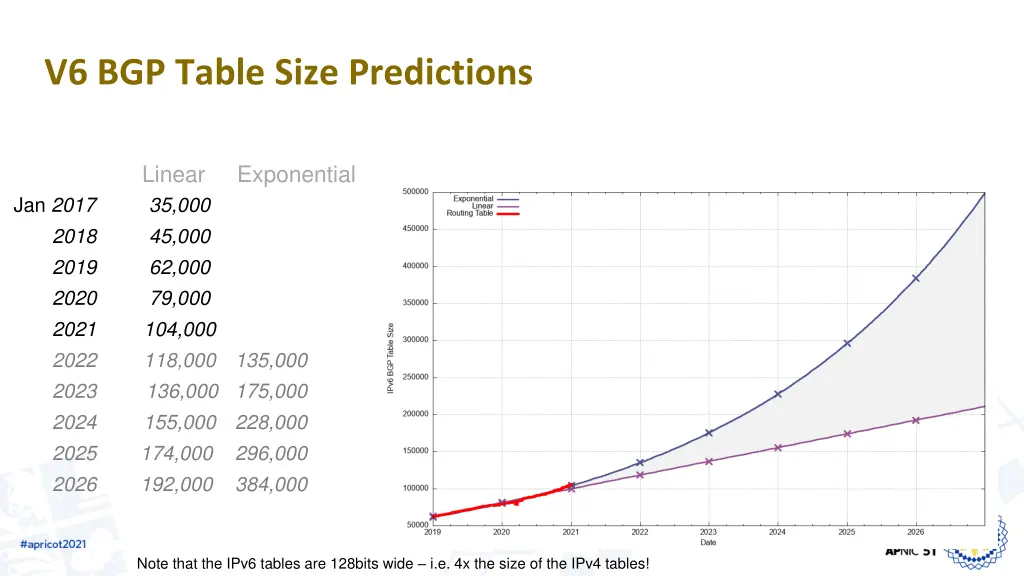
V6 BGP Table Size Predictions Linear Exponential Jan 2017 2018 2019 2020 2021 2022 2023 136,000 175,000 2024 155,000 2025 174,000 2026 192,000 35,000 45,000 62,000 79,000 104,000 118,000 135,000 228,000 296,000 384,000 Note that the IPv6 tables are 128bits wide i.e. 4x the size of the IPv4 tables!
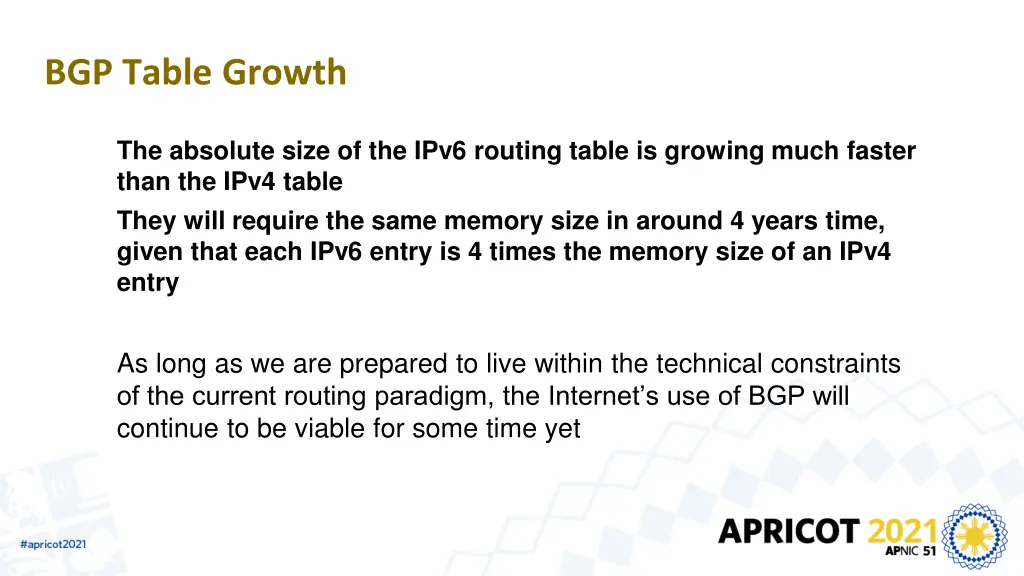
BGP Table Growth The absolute size of the IPv6 routing table is growing much faster than the IPv4 table They will require the same memory size in around 4 years time, given that each IPv6 entry is 4 times the memory size of an IPv4 entry As long as we are prepared to live within the technical constraints of the current routing paradigm, the Internet s use of BGP will continue to be viable for some time yet
The Highlights IPv4 FIB Summary IPv6 FIB Summary FIB Projections Churn Conclusions
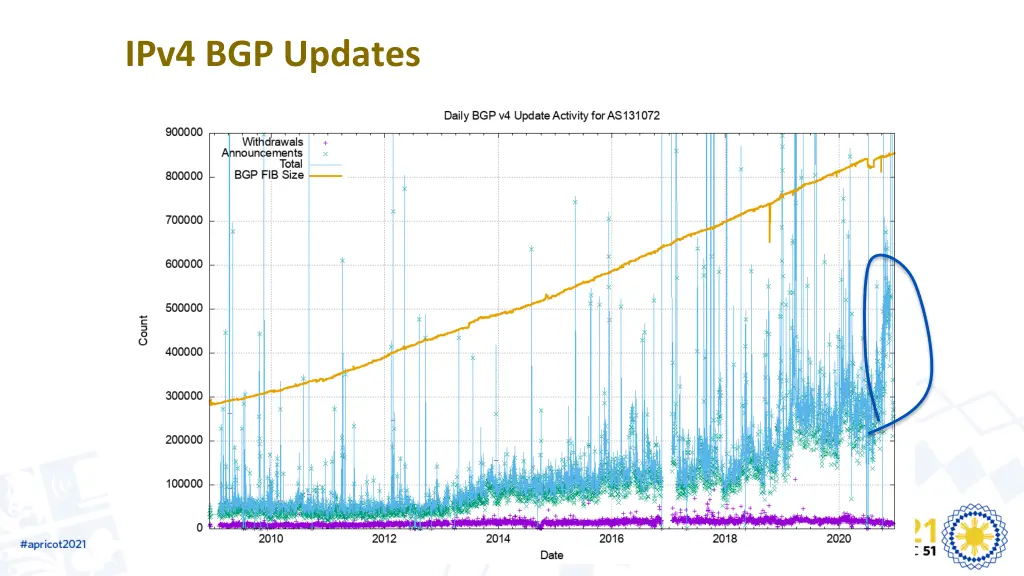
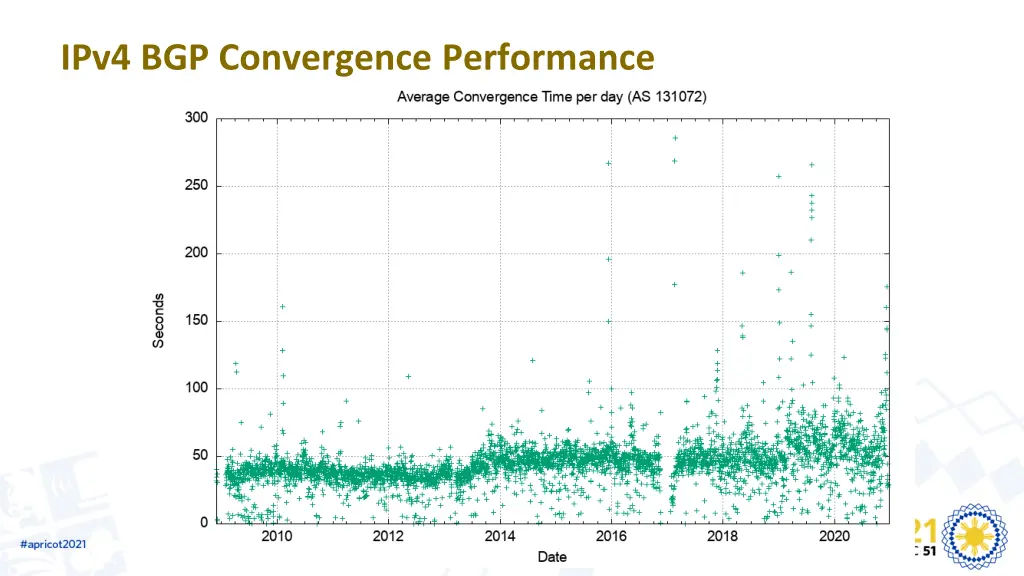
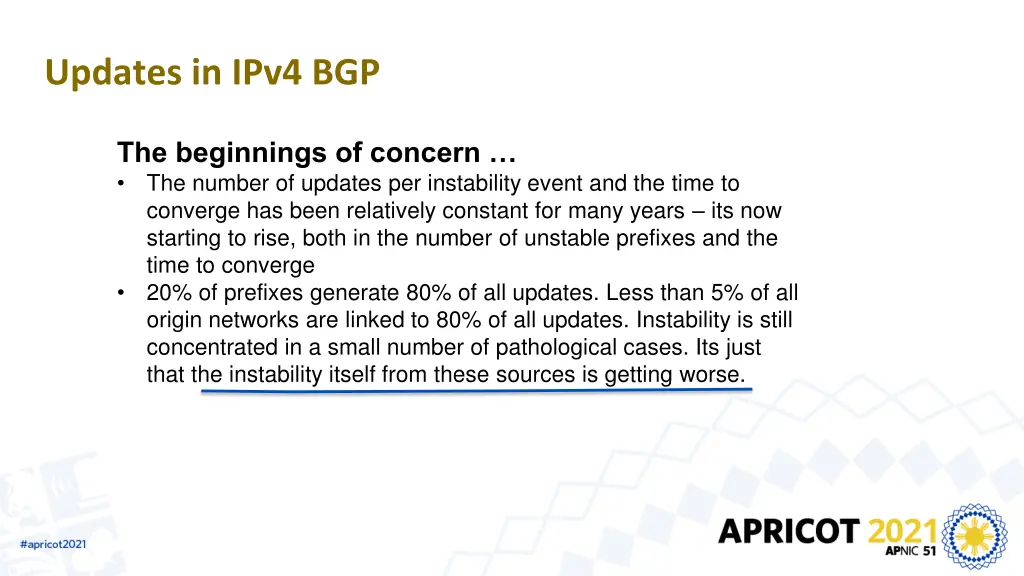
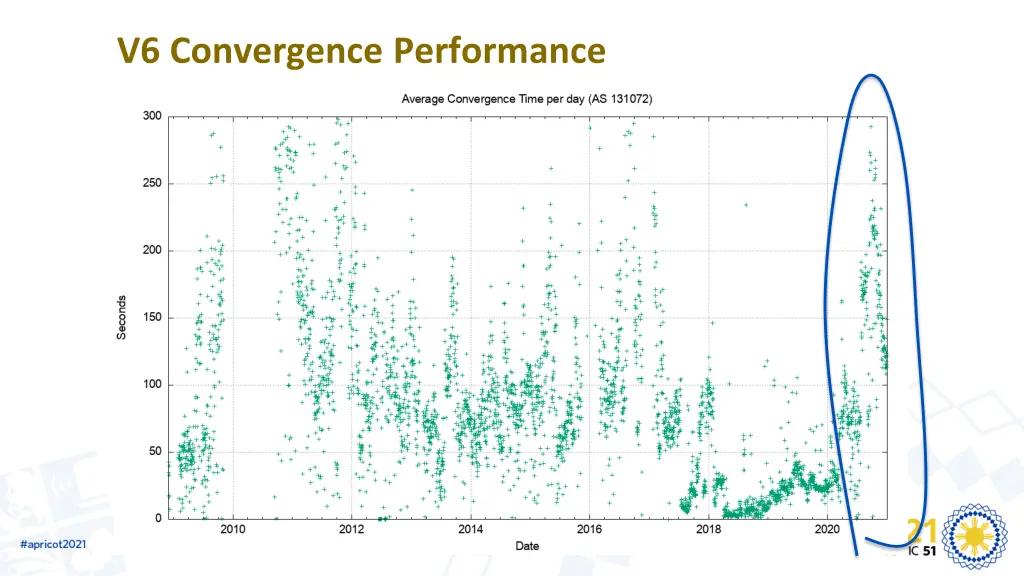
Updates in IPv4 BGP The beginnings of concern The number of updates per instability event and the time to converge has been relatively constant for many years its now starting to rise, both in the number of unstable prefixes and the time to converge 20% of prefixes generate 80% of all updates. Less than 5% of all origin networks are linked to 80% of all updates. Instability is still concentrated in a small number of pathological cases. Its just that the instability itself from these sources is getting worse.
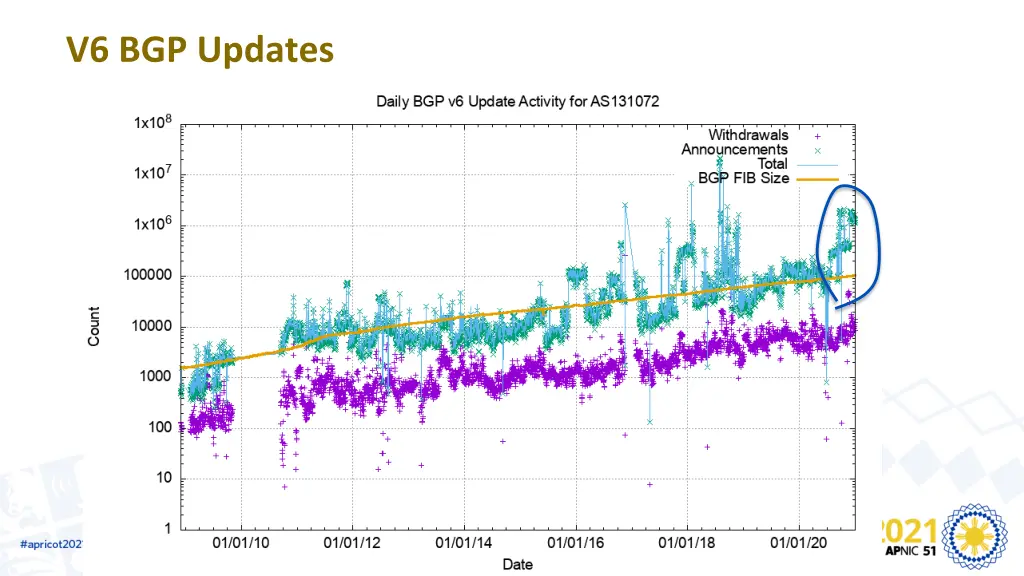
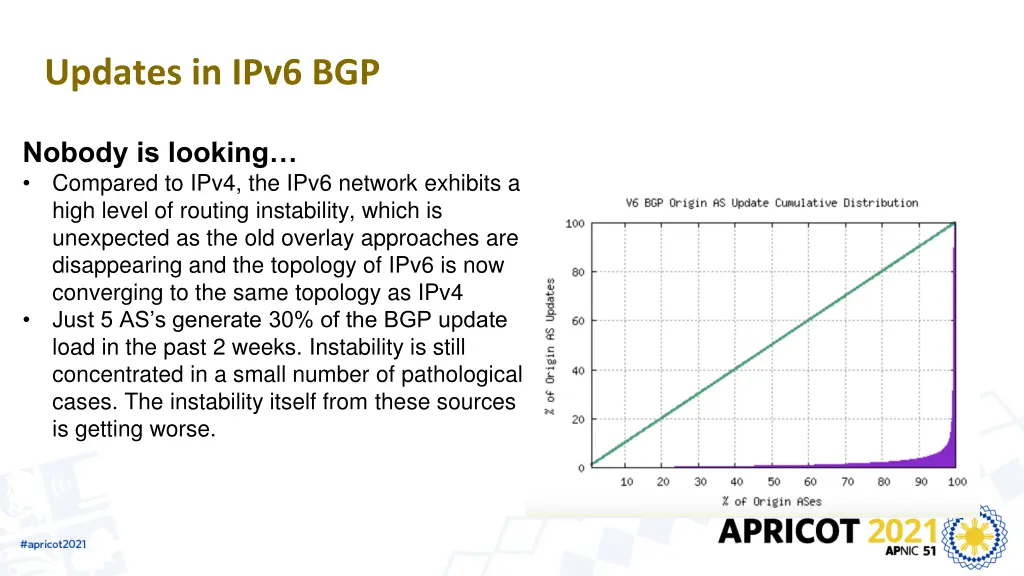
Updates in IPv6 BGP Nobody is looking Compared to IPv4, the IPv6 network exhibits a high level of routing instability, which is unexpected as the old overlay approaches are disappearing and the topology of IPv6 is now converging to the same topology as IPv4 Just 5 AS s generate 30% of the BGP update load in the past 2 weeks. Instability is still concentrated in a small number of pathological cases. The instability itself from these sources is getting worse.
The Highlights IPv4 FIB Summary IPv6 FIB Summary FIB Projections Churn Conclusions
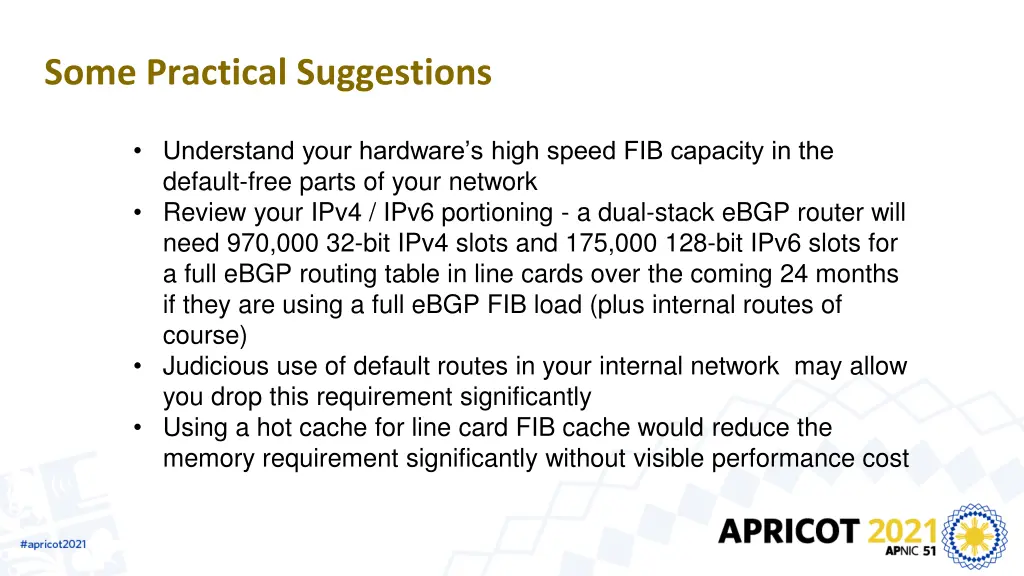
Routing Futures There is still little in the way of scaling pressure from BGP as a routing protocol the relatively compressed topology and stability of the infrastructure links tend to ensure that BGP remains effective in routing the internet. Instability levels are rising, generally driven by a small set of highly unstable super generators The issues of FIB size, line speeds and equipment cost of line cards represent a more significant issue for hardware suppliers we can expect cheaper line cards to to use far smaller LRU cache local FIBs in the high-speed switches and push less-used routes to a slower / cheaper lookup path. This approach may also become common in very high- capacity line cards
Some Practical Suggestions Understand your hardware s high speed FIB capacity in the default-free parts of your network Review your IPv4 / IPv6 portioning - a dual-stack eBGP router will need 970,000 32-bit IPv4 slots and 175,000 128-bit IPv6 slots for a full eBGP routing table in line cards over the coming 24 months if they are using a full eBGP FIB load (plus internal routes of course) Judicious use of default routes in your internal network may allow you drop this requirement significantly Using a hot cache for line card FIB cache would reduce the memory requirement significantly without visible performance cost
27 Years of Routing the Internet This is a view pulled together from each of the routing peers of Route-Views 2011: Address Exhaustion 2005: Consumer Market 2001: The Great Internet Boom and Bust 1994: Introduction of CIDR
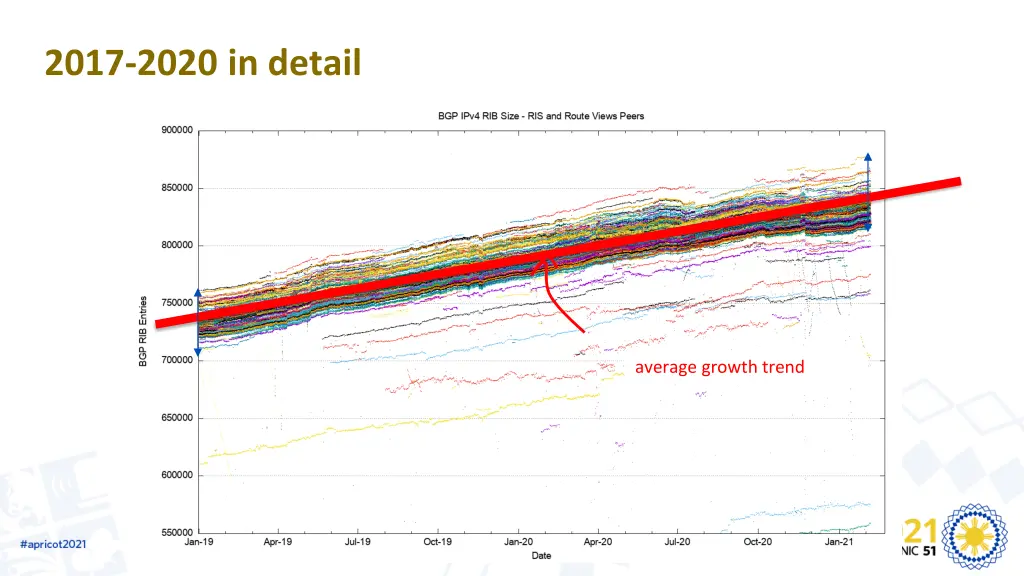
2017-2020 in detail average growth trend
Routing Indicators for IPv4 Routing prefixes growing by some 51,000 prefixes per year AS Numbers growing by some 3,400 prefixes per year
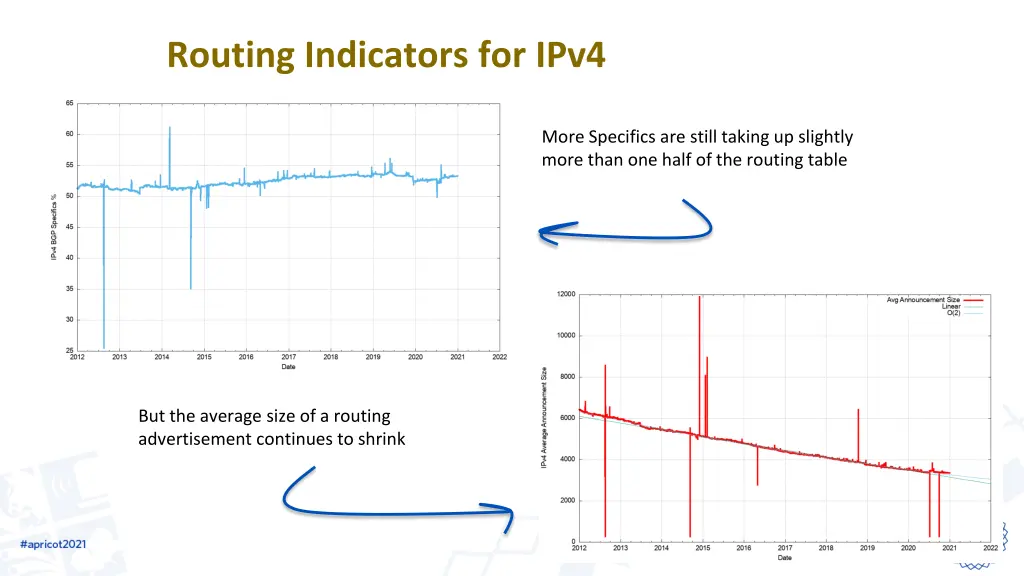
Routing Indicators for IPv4 More Specifics are still taking up slightly more than one half of the routing table But the average size of a routing advertisement continues to shrink
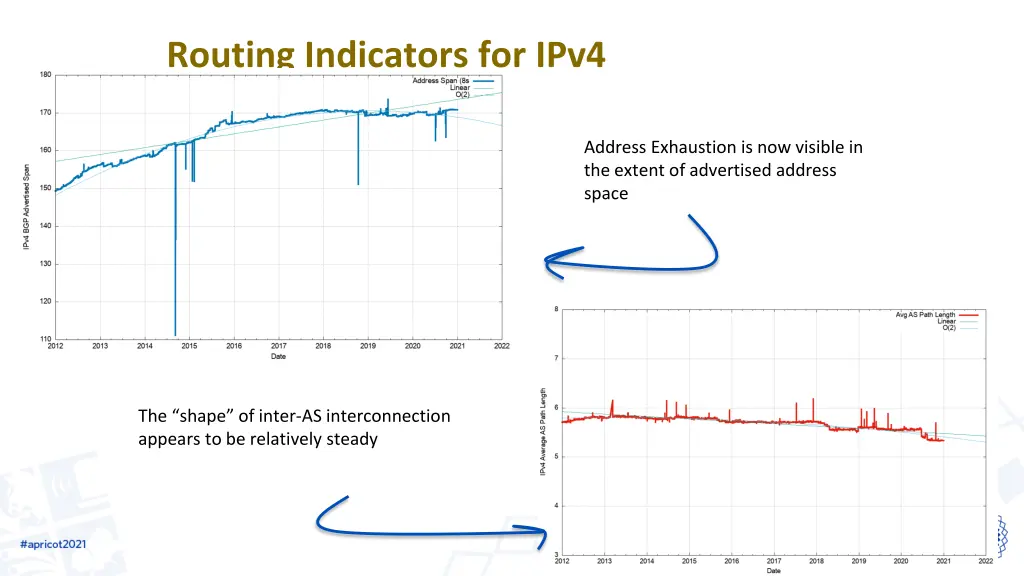
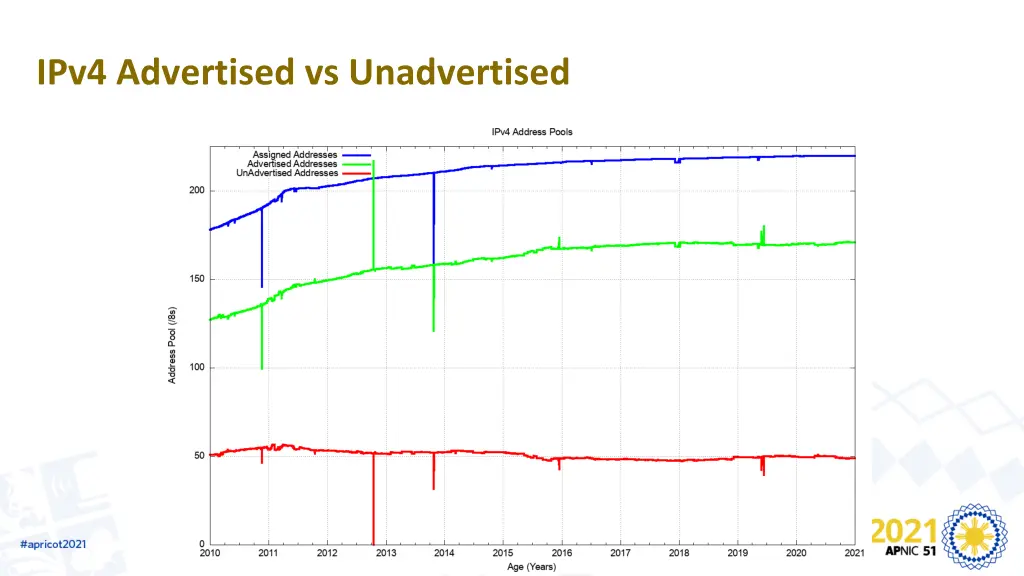
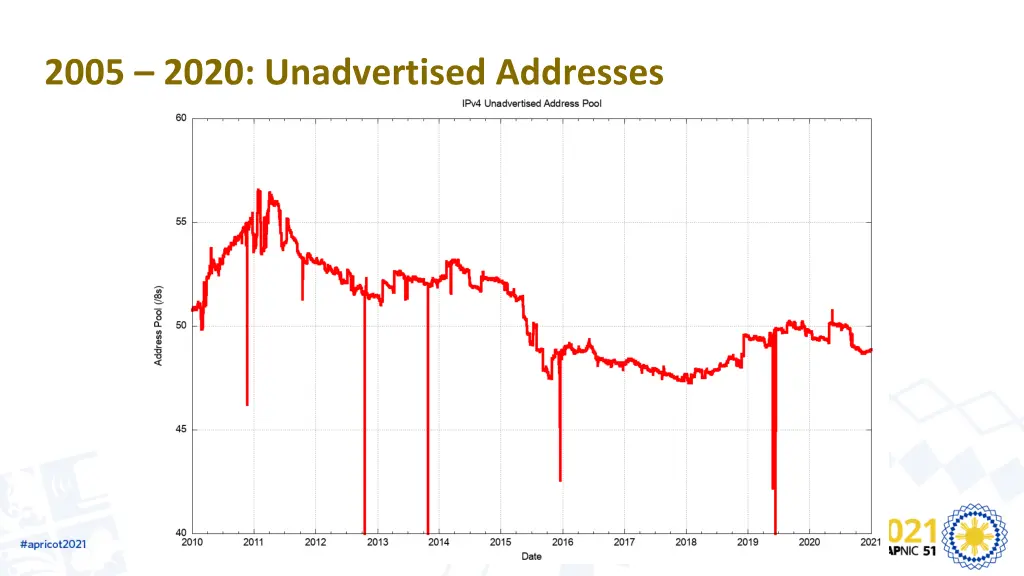
Routing Indicators for IPv4 Address Exhaustion is now visible in the extent of advertised address space The shape of inter-AS interconnection appears to be relatively steady
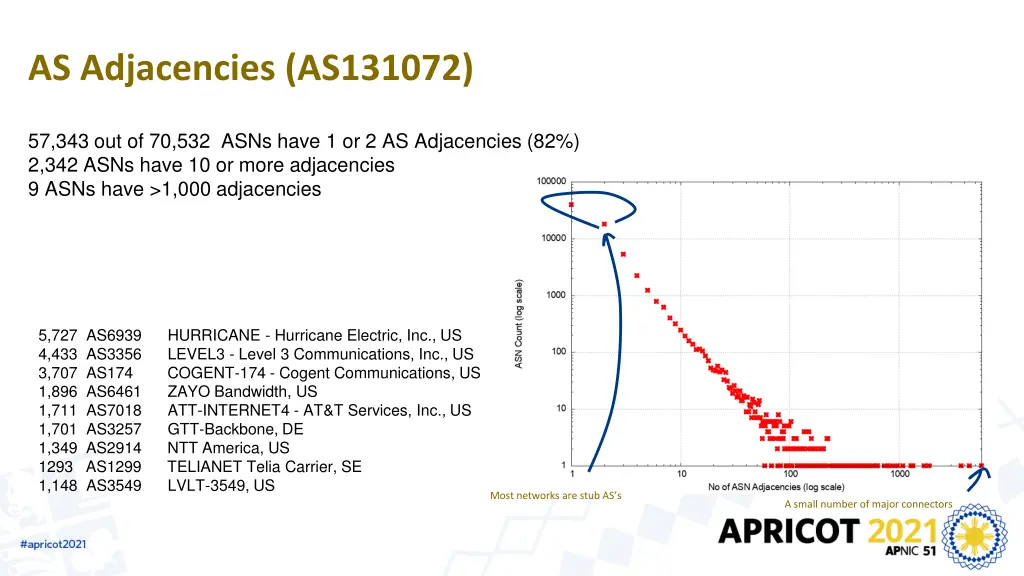
AS Adjacencies (AS131072) 57,343 out of 70,532 ASNs have 1 or 2 AS Adjacencies (82%) 2,342 ASNs have 10 or more adjacencies 9 ASNs have >1,000 adjacencies 5,727 AS6939 HURRICANE - Hurricane Electric, Inc., US 4,433 AS3356 LEVEL3 - Level 3 Communications, Inc., US 3,707 AS174 COGENT-174 - Cogent Communications, US 1,896 AS6461 ZAYO Bandwidth, US 1,711 AS7018 ATT-INTERNET4 - AT&T Services, Inc., US 1,701 AS3257 GTT-Backbone, DE 1,349 AS2914 NTT America, US 1293 AS1299 TELIANET Telia Carrier, SE 1,148 AS3549 LVLT-3549, US Most networks are stub AS s A small number of major connectors
What happened in 2020 in V4? Routing Business as usual despite IPv4 address exhaustion! From the look of the growth plots, its business as usual, despite the increasing pressures on IPv4 address availability The number of entries in the IPv4 default-free zone reached 860,000 by the end of 2020 The pace of growth of the routing table was slightly lower than the rolling 5- year average, with 52,000 new entries in 2020 The AS position was steady with 3,400 new AS s per year Transit relationships have not changed materially over 2020 for most networks IPv4 address exhaustion is not changing this picture as yet Instead, we appear to be advertising shorter prefixes into the routing system
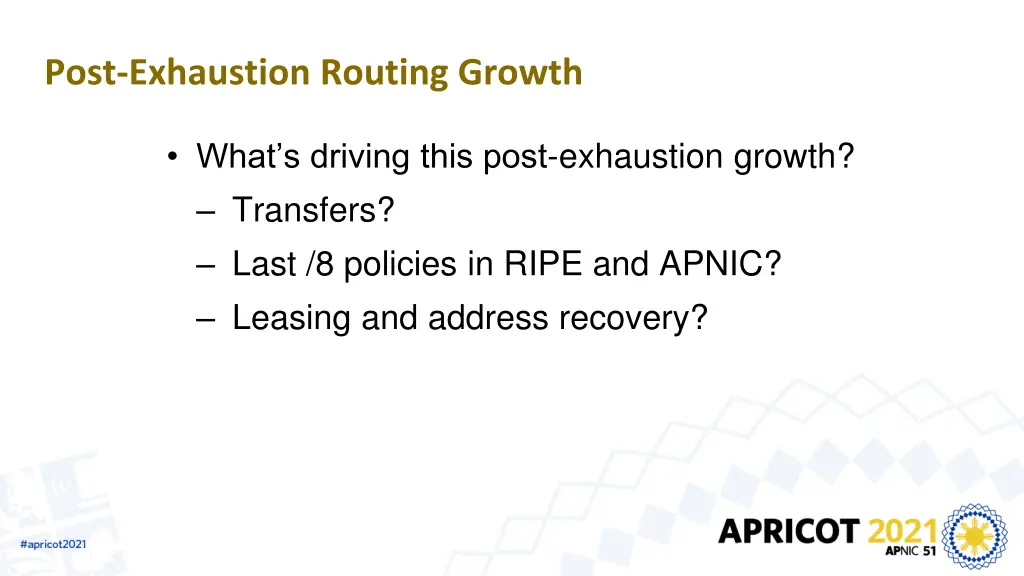
Post-Exhaustion Routing Growth What s driving this post-exhaustion growth? Transfers? Last /8 policies in RIPE and APNIC? Leasing and address recovery?
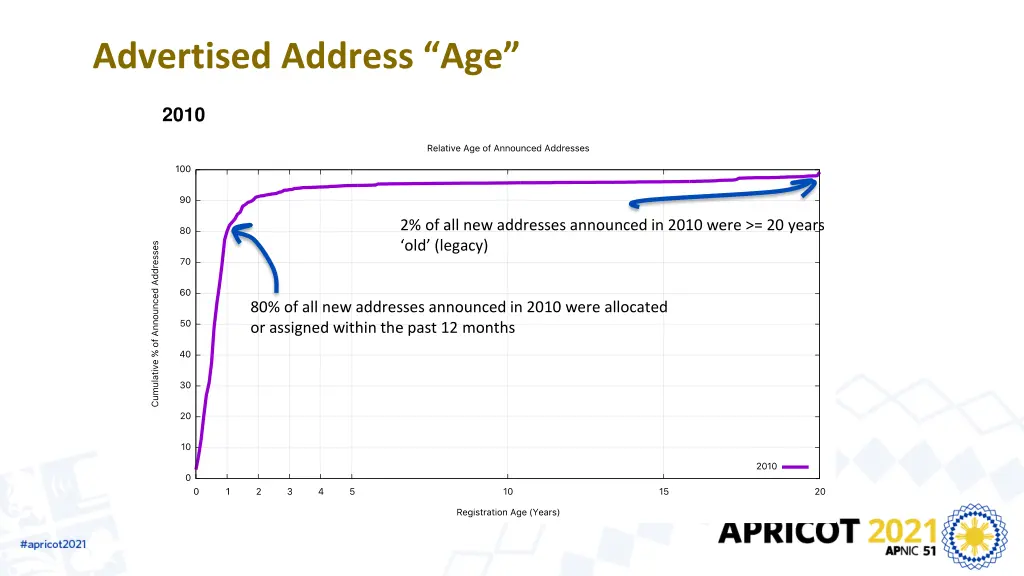
Advertised Address Age 2010 2% of all new addresses announced in 2010 were >= 20 years old (legacy) 80% of all new addresses announced in 2010 were allocated or assigned within the past 12 months
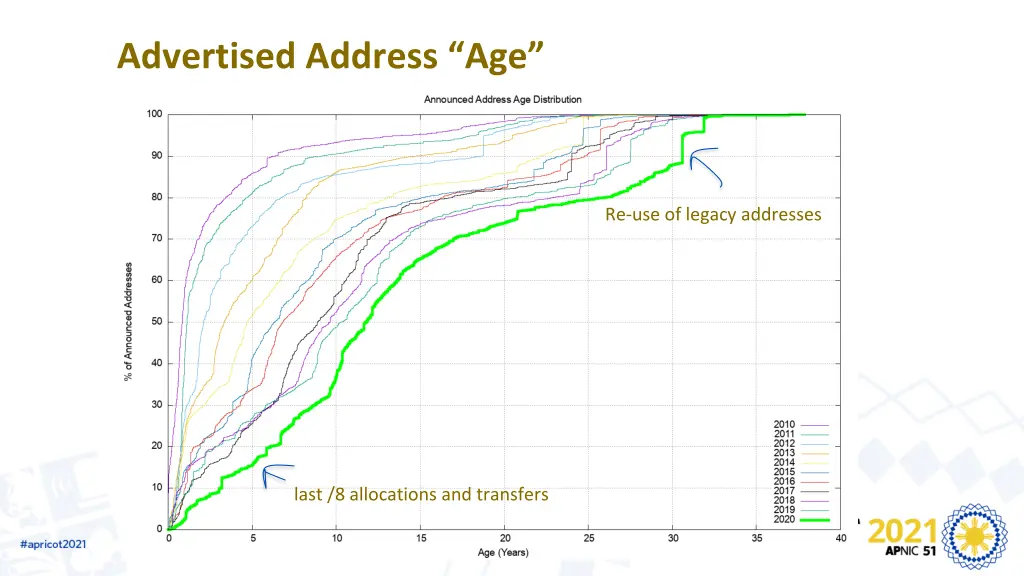
Advertised Address Age Re-use of legacy addresses last /8 allocations and transfers
2019: Assigned vs Recovered Change in the Unadvertised Address Pool RIR Allocations Change in Advertised Addresses
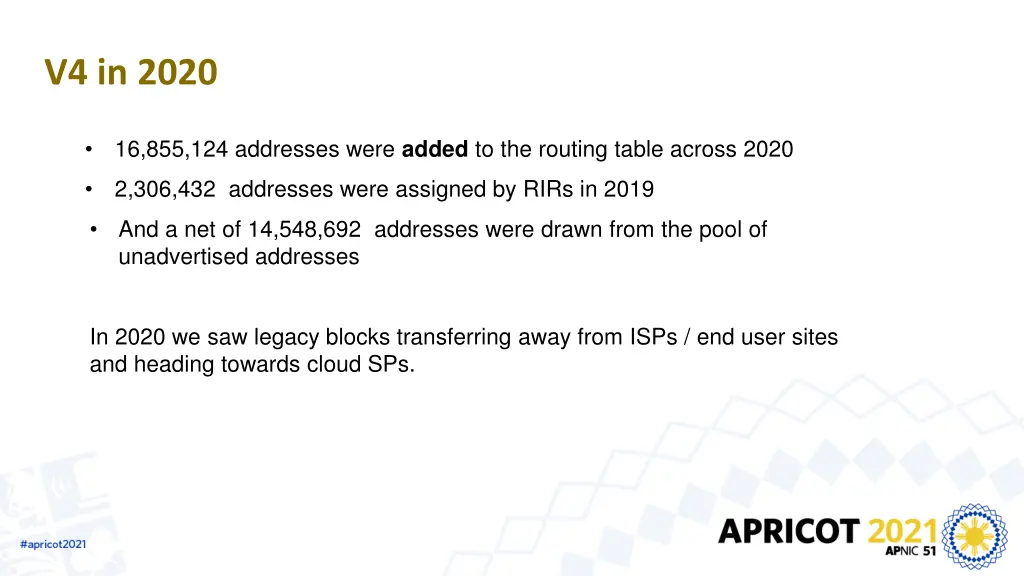
V4 in 2020 16,855,124 addresses were added to the routing table across 2020 2,306,432 addresses were assigned by RIRs in 2019 And a net of 14,548,692 addresses were drawn from the pool of unadvertised addresses In 2020 we saw legacy blocks transferring away from ISPs / end user sites and heading towards cloud SPs.
The Route-Views View of IPv6 IANA IPv4 Exhaustion
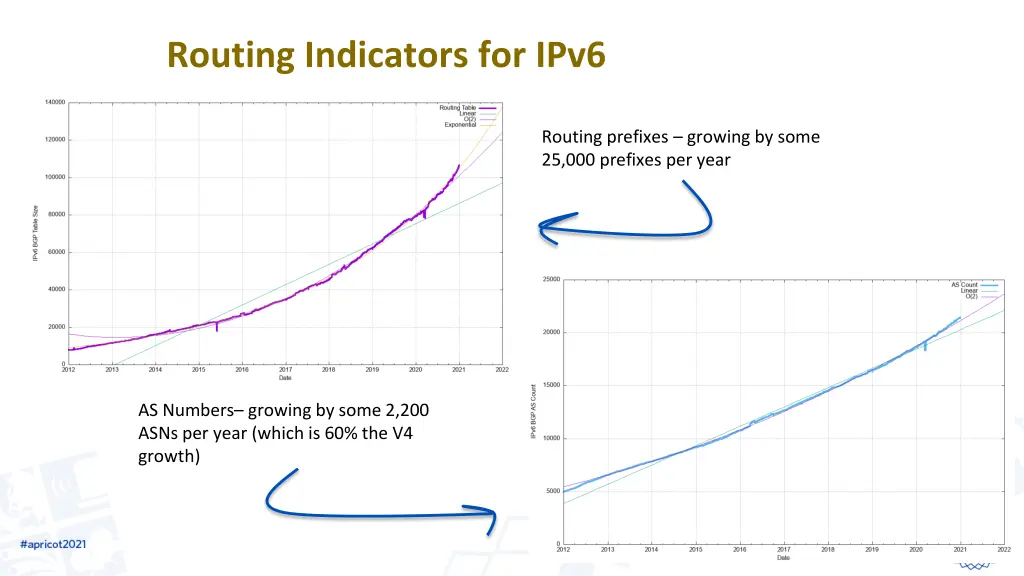
Routing Indicators for IPv6 Routing prefixes growing by some 25,000 prefixes per year AS Numbers growing by some 2,200 ASNs per year (which is 60% the V4 growth)
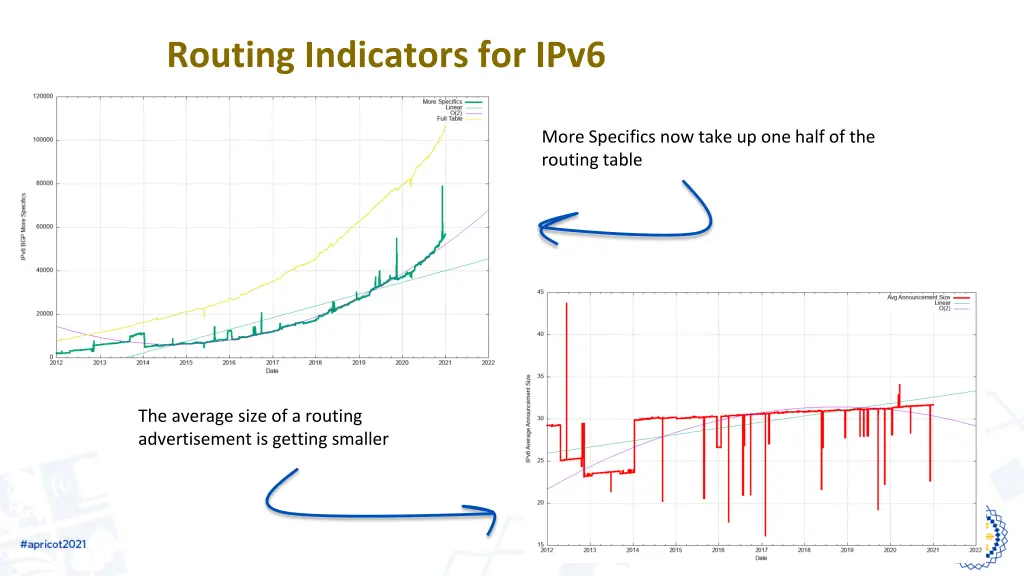
Routing Indicators for IPv6 More Specifics now take up one half of the routing table The average size of a routing advertisement is getting smaller
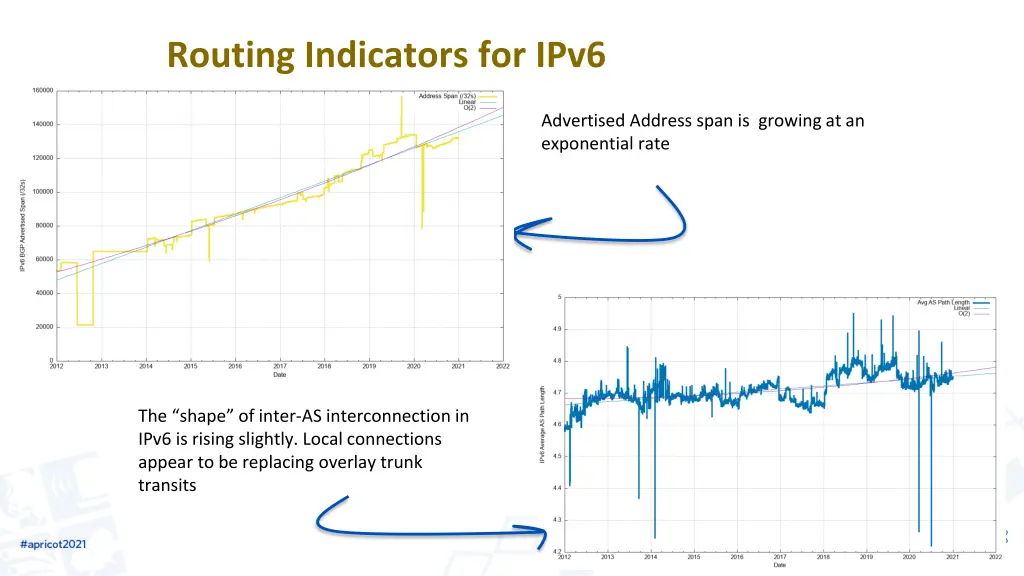
Routing Indicators for IPv6 Advertised Address span is growing at an exponential rate The shape of inter-AS interconnection in IPv6 is rising slightly. Local connections appear to be replacing overlay trunk transits
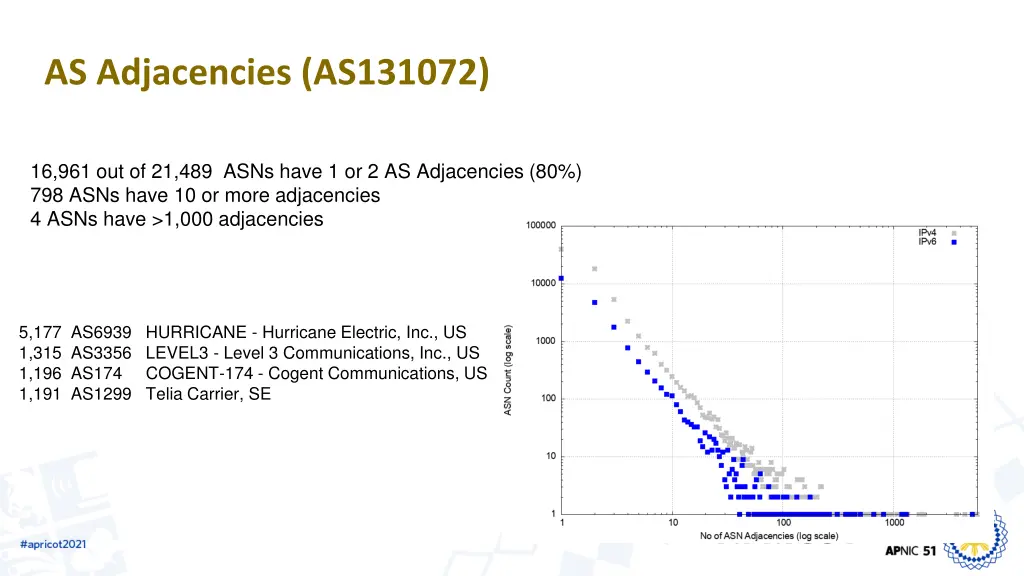
AS Adjacencies (AS131072) 16,961 out of 21,489 ASNs have 1 or 2 AS Adjacencies (80%) 798 ASNs have 10 or more adjacencies 4 ASNs have >1,000 adjacencies 5,177 AS6939 HURRICANE - Hurricane Electric, Inc., US 1,315 AS3356 LEVEL3 - Level 3 Communications, Inc., US 1,196 AS174 COGENT-174 - Cogent Communications, US 1,191 AS1299 Telia Carrier, SE
V6 in 2020 Overall IPv6 Internet growth in terms of BGP is still increasing, and is currently at some 25,000 route entries p.a. It s a case of increasing growth, not just constant growth More use of /48 more specifics More networks advertising IPv6 prefixes
BGP Size Projections How quickly is the routing space growing? What are the projections of future BGP FIB size?
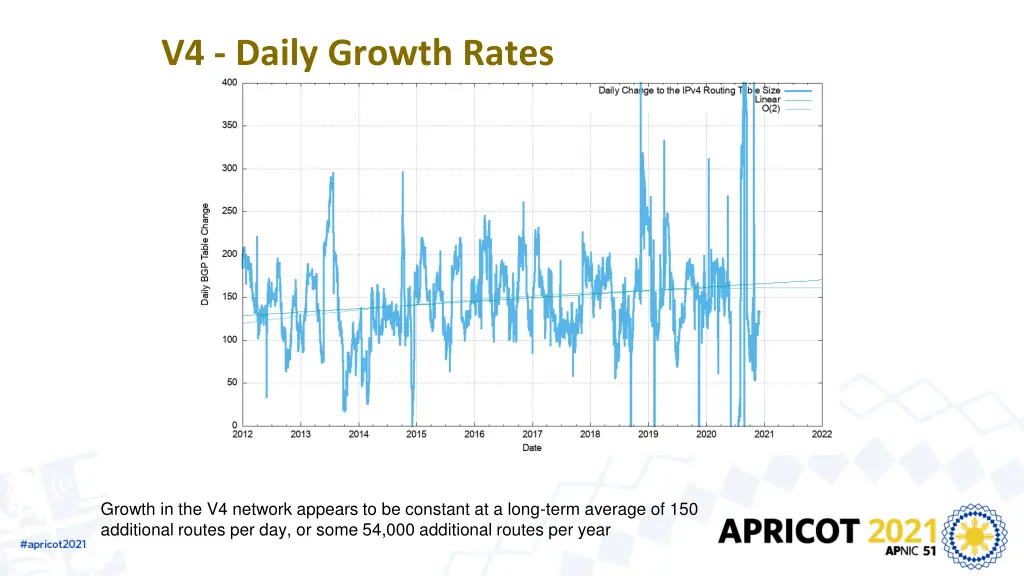
V4 - Daily Growth Rates Growth in the V4 network appears to be constant at a long-term average of 150 additional routes per day, or some 54,000 additional routes per year