Biological Bases of Human Behavior: Nervous System Overview
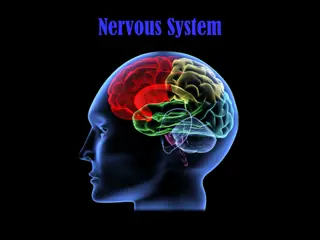
The brain, as the central command center of the nervous system, coordinates various bodily functions and processes information through neurons. The Central Nervous System (CNS) consists of the brain and spinal cord, responsible for sensory and motor functions. Neurons communicate through electrochemical signals, forming the basis of human behavior and cognition.

Download Presentation

Please find below an Image/Link to download the presentation.
The content on the website is provided AS IS for your information and personal use only. It may not be sold, licensed, or shared on other websites without obtaining consent from the author.If you encounter any issues during the download, it is possible that the publisher has removed the file from their server.
You are allowed to download the files provided on this website for personal or commercial use, subject to the condition that they are used lawfully. All files are the property of their respective owners.
The content on the website is provided AS IS for your information and personal use only. It may not be sold, licensed, or shared on other websites without obtaining consent from the author.
E N D
Presentation Transcript
Biological bases of human behaviour Nervous system, brain, endocrine system and genes SESSION 3 Dr. Chitrasena Padhy Associate Professor Agricultural Extension
The brain is the most complex part of the human body. It is the center of consciousness and also controls all involuntary movement functions. It communicates with each part of the body through the nervous system, a network of channels electrochemical signals. voluntary and and bodily that carry
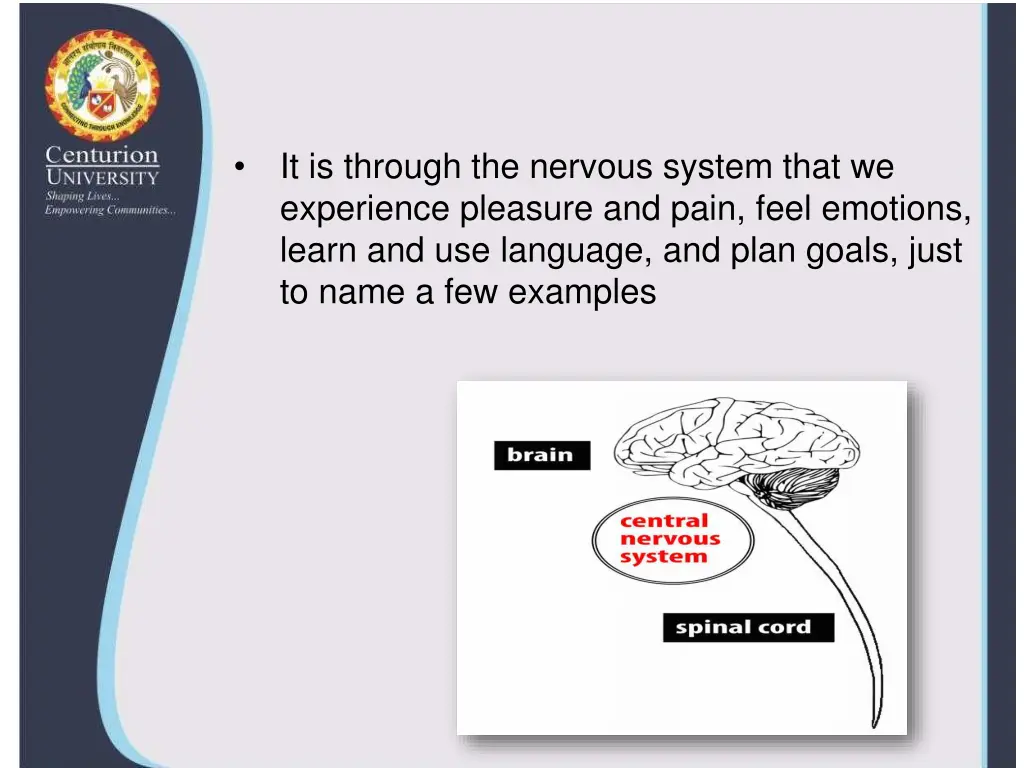
It is through the nervous system that we experience pleasure and pain, feel emotions, learn and use language, and plan goals, just to name a few examples
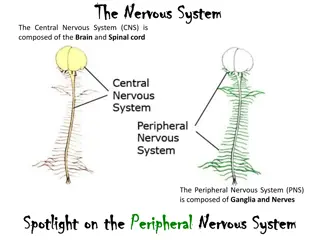
The Central Nervous System, or CNS for short, is made up of the brain and spinal cord (see Figure 1). The CNS is the portion of the nervous system that is encased in bone (the brain is protected by the skull and the spinal cord is protected by the spinal column). It is referred to as central because it is the brain and spinal cord that are primarily responsible for processing information touching a hot stove or seeing a rainbow, for example sensory
Sending signals to the peripheral nervous system for action. It communicates largely by sending electrical signals through individual nerve cells that make up the fundamental building blocks of the nervous system, called neurons. There are approximately 86 billion neurons in the human brain and each has many contacts with called synapses 2009). other (Herculano-Houzel, neurons,
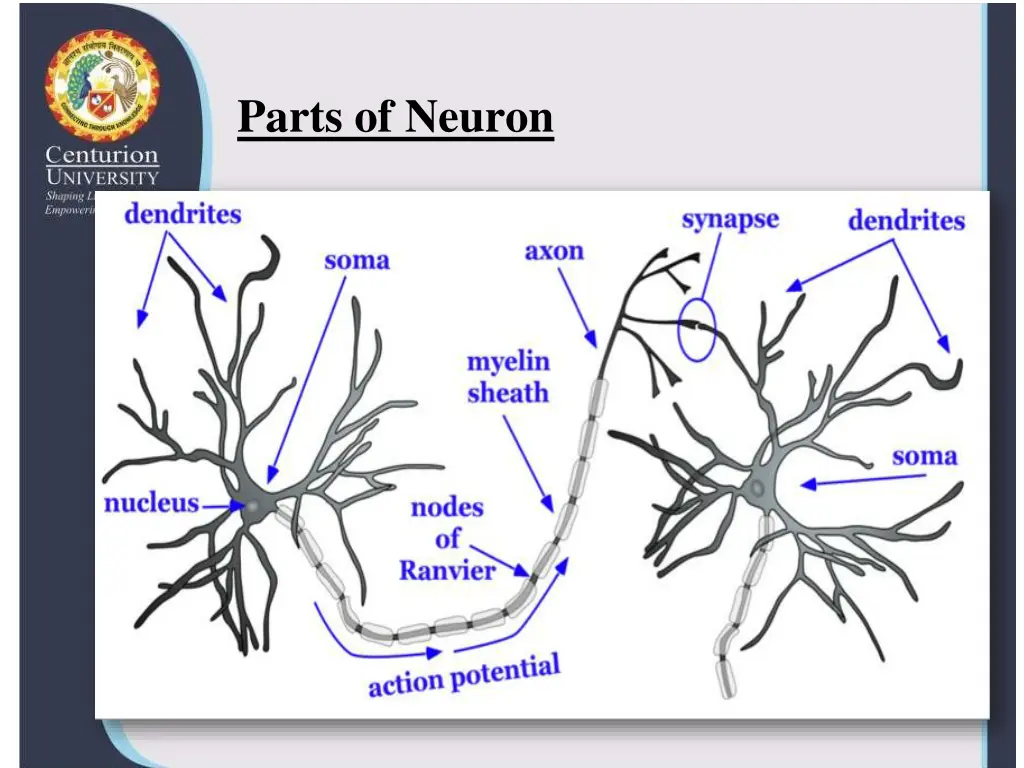
If we were able to magnify a view of individual neurons we would see that they are cells made from distinct parts (see Figure ). The three main components of a neuron are the dendrites, the soma, and the axon. Neurons communicate with one another by receiving information the dendrites, which act as an antenna. through
When the dendrites channel this information to the soma, or cell body, it builds up as an electro-chemical signal. This electrical part of the signal, called an action potential shoots down the axon, a long tail that leads away from the soma and toward the next neuron. When people talk about nerves in the nervous system, it typically refers to bundles of axons that form long neural wires along which electrical signals can travel. Cell-to-cell communication is helped by the fact that the axon is covered by a myelin sheath a layer of fatty cells that allow the signal to travel very rapidly from neuron to neuron (Kandel, Schwartz & Jessell, 2000)
Neurons Neuron is the basic unit of our nervous system. Neurons are specialised cells, which possess the unique property of converting various forms of stimuli into electrical impulses. They are also specialised for reception, conduction and transmission of information in the form of electrochemical signals. They receive information from sense organs or from other adjacent neurons, carry them to the central nervous system (brain and spinal cord), and bring motor information from the central nervous system to the motor organs (muscles and glands).
The neuron, or nerve cell, sends and receives signals that affect many aspects of behavior
Neural communication is the information system that helps connect our biological process to our psychological process as an information highway. Nerve cells are at the very basis of this communication. Each neuron consists of a cell body with extended branches. These branches are called dendrites, information to then carry it back to the cell body. and they receive
The central nervous system (CNS) consists of the brain and the spinal cord. Our brains have two primary functions, which are to control behavior and to regulate the body s physiological processes. However, the brain cannot do this alone as it needs to receive information from the body s sense receptors, which it achieves through communication with the spinal cord.
The CNS is named central because aside from occupying the central position of the body, the CNS is also the most important part of the nervous system for maintaining and producing behavior. The central nervous system (CNS) is comprised of the brain and spinal cord. The three broad functions of the CNS are to take in sensory information, process information, and send out motor signals. The CNS receives sensory information from the nervous system and controls the body's responses. The central nervous system plays a primary role in receiving information from various areas of the body and then coordinating this activity to produce the body's responses.
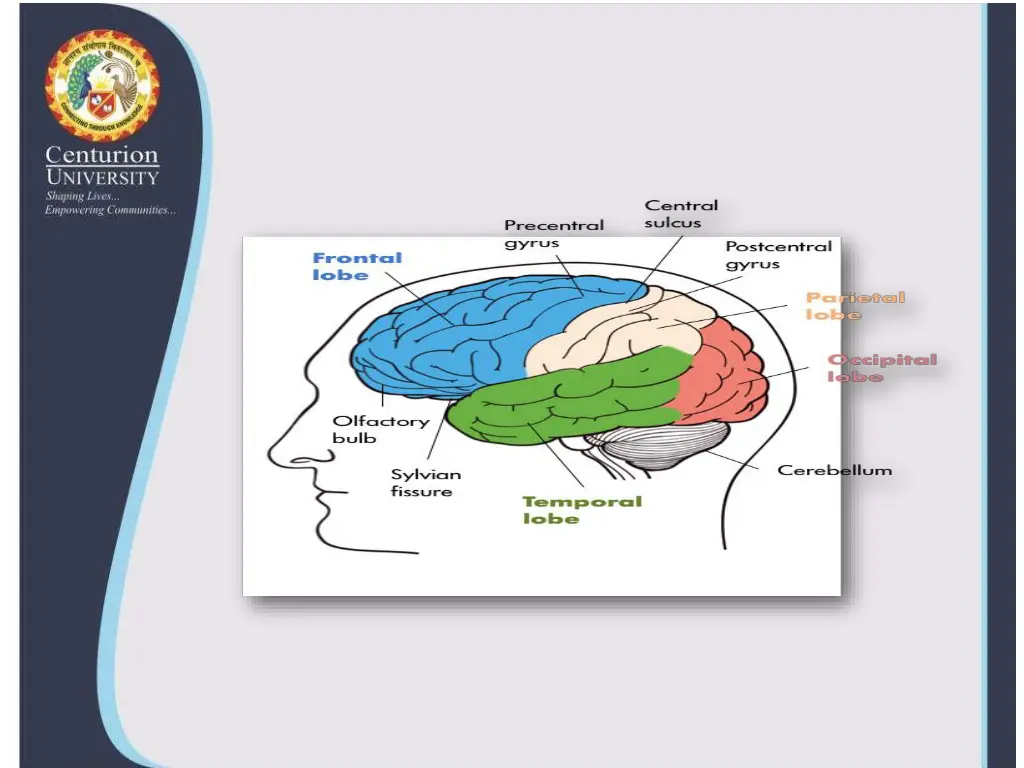
The Brain The brain controls many of the body's functions including movement, awareness, and memory. The surface of the brain is known as the cerebral cortex. The surface of the cortex appears bumpy thanks to the grooves and folds of the tissue. Each groove is known as a sulcus, while each bump is known as a gyrus. sensation, thought,
The largest part of the brain is the cerebrum. It is responsible for functions such as memory, behaviors, and thought The cerebrum is hemispheres, the right hemisphere and the left hemisphere. The right hemisphere controls movements on the body's left side, while the left hemisphere controls movements on the body's right side speech, voluntary divided into two
Each hemisphere of the brain is then divided into four interconnected lobes Frontal lobes are associated with higher cognition, voluntary language. Occipital lobes are associated with visual processes. Parietal lobes are processing sensory information. Temporal lobes are associated with hearing and interpreting sounds as well as the formation of memories. movements, and associated with
The cell body (or soma) is the bulbous end of a neuron, containing the cell nucleus. The soma makes use of nutrients to supply energy for neuronal activity. Axons are organelles that carry information away from the cell body. Axons may be as small as several microns or as long as several meters in giraffes and whales. The axons main job is to send a signal to the dendrites of another neuron, but some say that they may also receive signals in certain situations. Each neuron has only one axon, but the axon may have branches with what are called terminal buttons at its end. Dendrites are organelles that sense the neurotransmitter secreted by the axon of another neuron. Most neurons have more than one dendrite. Dendrites and axons do not directly touch each other; there is a gap, called a synapse.
The Transmission of the Signal The transmission of the signal is basically the same in all cells, the signal is sent across the synapse by the axon and the dendrite of the next cell picks up the signal. Synapse The synapse is a gap between two cells. Synapse are one way junctions between neurons and other cells. The neurotransmitter is emitted from the axon of one cell and usually goes to the dendrite of the next cell. Sometimes the signal goes to the soma or the axon of the next cell instead of the dendrite
The soma or cell body is the main body of the nerve cell. It contains the nucleus of the cell as well as other structures common to living cells of all types (Figure 3.1). The genetic material of the neuron is stored inside the nucleus and it becomes actively engaged during cell reproduction and protein synthesis. The soma also contains most of the cytoplasm (cellfluid) Dendrites are the branchlike specialised structures emanating from the soma. They are the receiving ends of a neuron of the neuron.
All human (and animal) behavior is a product of biological structures and processes, highly organized on multiple interconnected levels. Understanding these biological precursors of behavior can lead psychological disorders, such as drugs that influence neurotransmitter function. The nervous system is highly specialized and hierarchical in its structure, but neuroplasticity gives the brain some flexibility to adapt its structure and function. Though interconnected with and regulated by the nervous system, the endocrine system produces effects on behavior in a distinct way: endocrine glands secrete hormones into the bloodstream, allowing hormones to reach and interact directly with target organs. to treatments for
Biopsychological researchers use a variety of imaging technologies to view the structure and function of the brain, along with specialized research strategies that allow them to learn more about the brain s organization and the origin of psychological traits. While many behaviors are learned as a result of experience within a particular environment, the very capacity to learn such behaviors has a genetic basis, and such capacities only persist because they contribute to the fitness of organisms. Since the late psychologists have consciousness, including the awareness of one s self and environment, the ways consciousness can be altered, and the various levels and states of consciousness. nineteenth century, investigated
Sleep cycles through multiple stages that vary in levels of neural activity, muscle control, biological functions, and dreaming; sleep disorders cause disruptions to these processes. Psychoactive drugs, including depressants, narcotics, stimulants, and hallucinogens, affect brain chemistry to alter the perceptions and behavior of users; some psychoactive drugs are used recreationally, and some have a high potential for abuse. medicinally and/or
BIOLOGICAL BASES FOR BEHAVIOR KEY TERMS Neurons: The basic functional units of the nervous system; cells specialized structures to communicate signals. Soma/cell body: The part of a neuron that contains its nucleus and other standard cellular structures. Dendrites: The multiple thin, treelike fibers that branch off from a neuron s soma and contain receptors to accept incoming signals from other neurons. which contain
Axon: A long, tubular structure in a neuron that transmits action potentials. Myelin sheath: A fatty substance that coats an axon, insulating it and enhancing its ability to transmit action potentials. Terminal buttons: structures at the ends of axons that release neurotransmitters. The branching
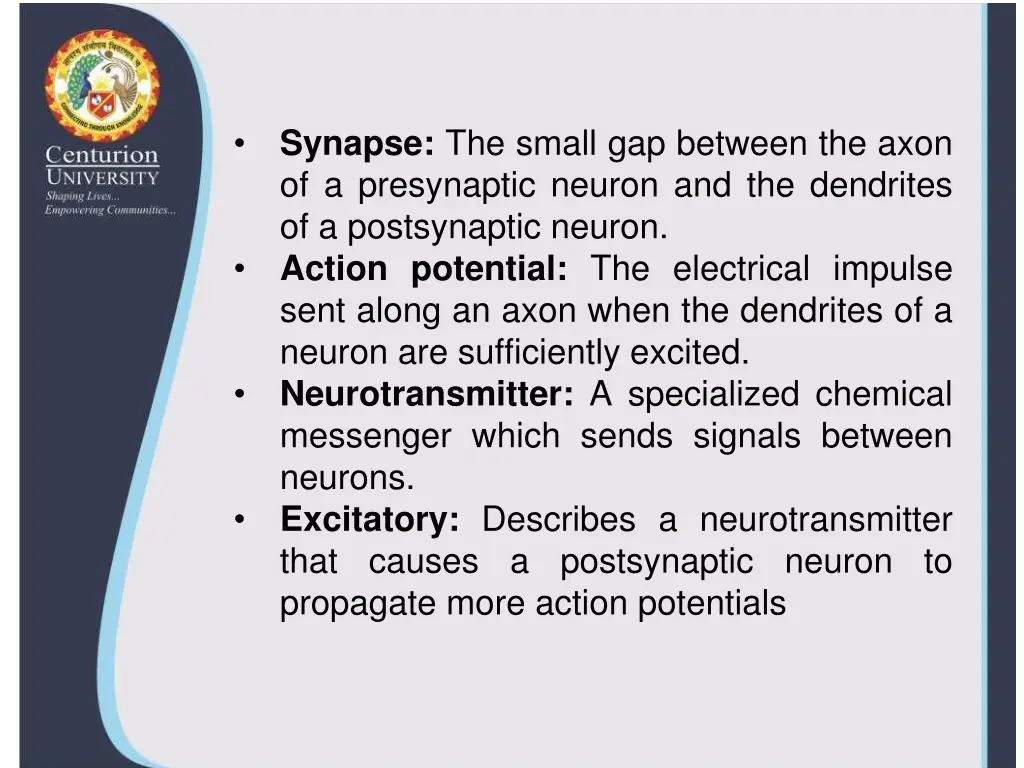
Synapse: The small gap between the axon of a presynaptic neuron and the dendrites of a postsynaptic neuron. Action potential: The electrical impulse sent along an axon when the dendrites of a neuron are sufficiently excited. Neurotransmitter: A specialized chemical messenger which sends signals between neurons. Excitatory: Describes a neurotransmitter that causes a postsynaptic neuron to propagate more action potentials
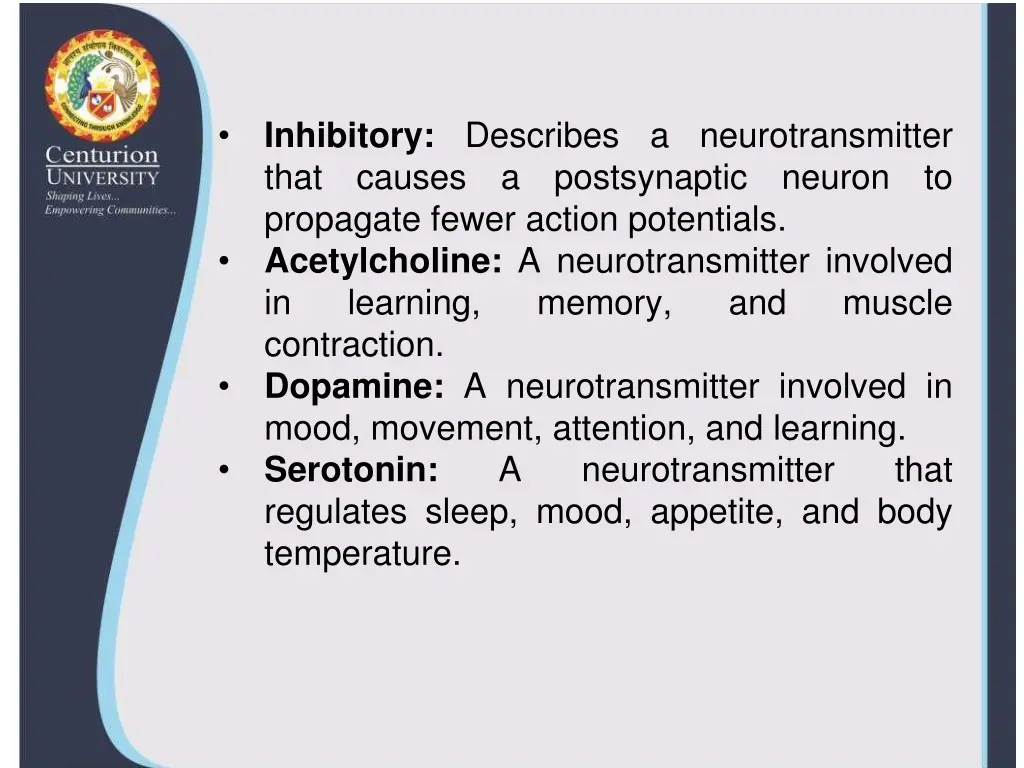
Inhibitory: Describes a neurotransmitter that causes a postsynaptic neuron to propagate fewer action potentials. Acetylcholine: A neurotransmitter involved in learning, memory, contraction. Dopamine: A neurotransmitter involved in mood, movement, attention, and learning. Serotonin: A neurotransmitter regulates sleep, mood, appetite, and body temperature. and muscle that
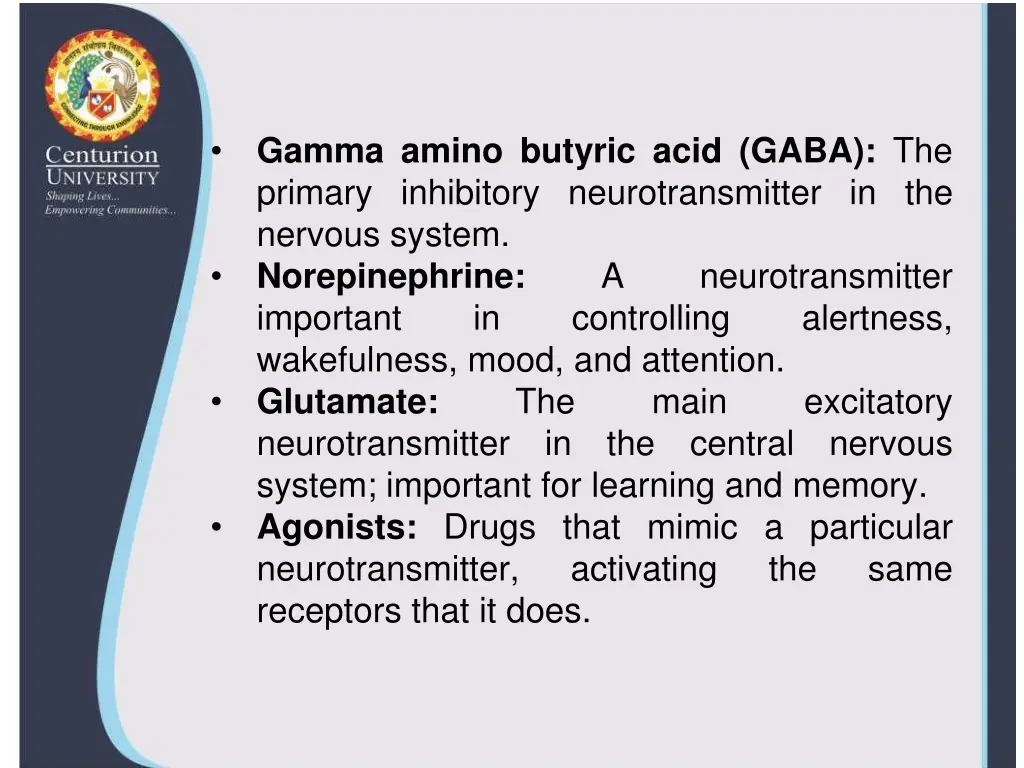
Gamma amino butyric acid (GABA): The primary inhibitory neurotransmitter in the nervous system. Norepinephrine: A important in controlling wakefulness, mood, and attention. Glutamate: The neurotransmitter in the central nervous system; important for learning and memory. Agonists: Drugs that mimic a particular neurotransmitter, activating receptors that it does. neurotransmitter alertness, main excitatory the same
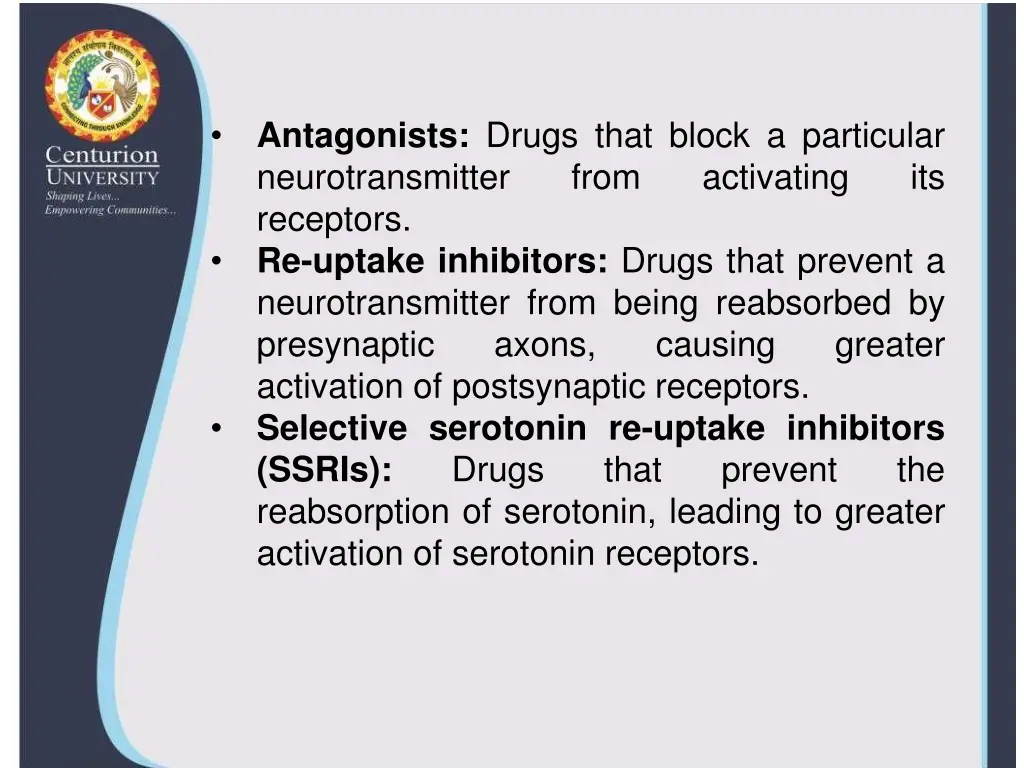
Antagonists: Drugs that block a particular neurotransmitter from receptors. Re-uptake inhibitors: Drugs that prevent a neurotransmitter from being reabsorbed by presynaptic axons, activation of postsynaptic receptors. Selective serotonin re-uptake inhibitors (SSRIs): Drugs that reabsorption of serotonin, leading to greater activation of serotonin receptors. activating its causing greater prevent the
The nervous system is the body's main communication system; synthesizes, and uses data from the environment. The most basic unit of the nervous system is the neuron, which serves as both a sensor and communicator of internal and external stimuli. The nervous system can be broken down into two major parts the central nervous system and the peripheral nervous system. it gathers,
The central nervous system, the main data center of the body, includes the brain and spinal cord. The peripheral nervous system includes all of the neurons that sense and communicate data to the central nervous system. The peripheral nervous system can be further divided into the autonomic system, which regulates involuntary actions, and the somatic system, which controls voluntary actions.