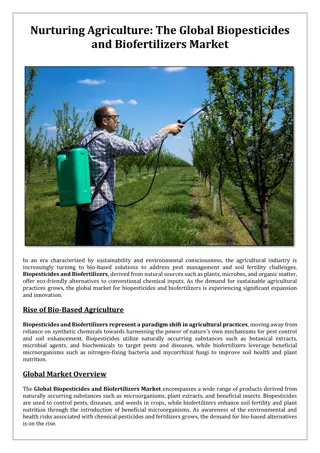
Researchers study biopesticides to enhance knowledge, innovate biocontrol products, develop platform technologies, and advance commercial applications. Strategies include fermentation, formulation, and field trials. The research and development model focuses on target pest selection, strategic screening programs, and industry partnerships for smooth innovation chains.
Please find below an Image/Link to download the presentation.
The content on the website is provided AS IS for your information and personal use only. It may not be sold, licensed, or shared on other websites without obtaining consent from the author. If you encounter any issues during the download, it is possible that the publisher has removed the file from their server.
You are allowed to download the files provided on this website for personal or commercial use, subject to the condition that they are used lawfully. All files are the property of their respective owners.
The content on the website is provided AS IS for your information and personal use only. It may not be sold, licensed, or shared on other websites without obtaining consent from the author.
E N D
Presentation Transcript
Developing Biopesticides from a Researcher s Perspective Susan M. Boyetchko Agriculture & Agri-Food Canada, Saskatoon, Saskatchewan, Canada Sue.Boyetchko@canada.ca
Reasons for Researchers to study biopesticides Scientific curiosity/academic exercise increase knowledge Investigate various pest-biological control-host interactions Study the nature (mechanism) of the biological control Develop a biological (biopesticide) product Screen for potential agents Investigate platform technologies (fermentation, formulation, application technology) Advance the study of biopesticides for a commercial product
Biopesticide Product Development Strategy Platform technologies: fermentation, formulation, spray application Formulation Biocontrol Agent (selection & improvement, mode of action) Application Technology Fermentation Validation of Technology Field Trials
A Solution for Delivery of Biopesticides Biopesticide Innovation Chain The Research & Development Model target pest: select appropriate target pest with large market potential and economic impact understand pest population dynamics and ecology, epidemiology, epizoology biopesticide: develop strategic screening program against target pest (no ad-hoc screening) focus on developing platform technologies (fermentation, formulation, application technology) build in Go vs. No-Go decision points establish industry and research partnerships create smooth transition through various stages of innovation chain
Biopesticides Science Innovation Chain Research & Development Model Deliverables large-scale field tests; product formulation manufacturing, process engineering fermentation, formulation, stability greenhouse, field efficacy biopesticide product markets & uses license agreements scientific knowledge product sales; client adoption Discovery and BCA selection Technology development Technology transfer Commercial scale-up Technology adoption Stage gates Proof of concept Market identification Application development Registration Bioprospecting Biopesticide Optimization Technology / Scale- Up Biological & Environmental Fate
Selection of target pest Based on economics/crop loss figures Niche market needs, with wide geographical use (local, regional, national, global) Single target pest vs. broad spectrum to increase markets Controls pest at population level (heterogeneous) Different market uses (e.g. agriculture, forestry, recreational, urban municipalities) Target selection based on pest surveys, pest- management issues/opportunities (e.g.pesticide- resistance, organic production, invasive species) Economics plays a role (i.e. market potential for investment in R&D and commercialization by industry partner)
Different levels of screening test biopesticide candidate(s) on heterogenous populations(s) rather than a single population use of mass through-put screening system establish standard operating procedure(s) microbial culture collections (bacterial, fungal) established by various AAFC scientists
Platform technology develop different types of fermentation and formulation know-how (does one size fit all?) based on nature of biopesticide candidate and delivery (bacteria vs. fungi; liquid vs. solid; soil vs. foliar) re-invent technology? or select from existing database of knowledge from in-house expertise share the technology and vision select best fit model; modify and/or refine technology that accommodates the biopesticide candidate
Partnerships & Collaborations Other AAFC studies Universities Other federal organizations PMRA, US-EPA, CFIA, NSERC Pest Management Centre (PMC) Provincial organizations Private Industry (national, international) Grower groups Internationally
How we establish partnerships Scientists research program/expertise When to approach? At what stage? Who initiates? large-scale field tests; product formulation Deliverables manufacturing, process engineering fermentation, formulation, stability greenhouse, field efficacy biopesticide product markets & uses license agreements scientific knowledge product sales; client adoption Discovery and BCA selection Technology development Technology transfer Commercial scale-up Technology adoption Stage gates Proof of concept Market identification Application development Registration Industry - Generation of efficacy data Industry registers AAFC technology Bioprospecting AAFC or industry Industry/AAFC IP
How we establish partnerships (contd) Office of Intellectual Property and Commercialization (OIPC) Confidentiality agreement Materials Transfer Agreement Collaborative Research and Development Agreement Science and Technology Branch (STB) review Proposal review committee In line with Departmental Mandate and Science Priorities Builds on Synergies (benefits to AAFC, universities, industry, society as a whole)
Role of Pest Management Centre (PMC) PMC part of AAFC Research/technology does not originate with PMC; will provide some funding to generate data for registration Review of projects via Canadian biopesticides and minor use pesticides priority setting workshop Input from provinces/stakeholders in priority setting Pesticide Risk Reduction Program: supports large-scale demonstrations of new technologies; funds projects which implement solutions identified in the strategies Provides regulatory advice to facilitate tech transfer of biopesticides to industry
Partnerships & Collaborations Other AAFC national studies Universities Other federal organizations PMRA, US EPA, CFIA, NSERC Pest Management Centre Provincial organizations Private Industry (national, international) Grower groups Internationally
The Research Strategy AAFC researchers have developed an R&D blueprint for delivery of new biopesticide products, from discovery, development of platform technologies, to industry development for commercialization and adoption. Maintain corporate knowledge of the technology Research in pre-commercialization stages is progressing. We are developing platform technologies; need to develop more commercial prototypes.
Strategy contd We need to foster a strong research environment (BPIA), establish science technology clusters, and create education and communication programs to strengthen the adoption of biopesticides in Canada. We are building our international collaborations and investigating various funding opportunities.