Blockguard: Adaptive Blockchain Security Overview
Blockguard introduces adaptive security algorithms for blockchain, ensuring transactions are securely recorded without a central authority. The system dynamically assigns security levels to transactions and processes them concurrently. Various consensus algorithms are also discussed, such as PBFT, PoW, and sharding, along with the evaluation of performance under different scenarios.

Download Presentation

Please find below an Image/Link to download the presentation.
The content on the website is provided AS IS for your information and personal use only. It may not be sold, licensed, or shared on other websites without obtaining consent from the author.If you encounter any issues during the download, it is possible that the publisher has removed the file from their server.
You are allowed to download the files provided on this website for personal or commercial use, subject to the condition that they are used lawfully. All files are the property of their respective owners.
The content on the website is provided AS IS for your information and personal use only. It may not be sold, licensed, or shared on other websites without obtaining consent from the author.
E N D
Presentation Transcript
Blockguard: Adaptive Blockchain Security Shishir Rai Kendric Hood Mikhail Nesterenko Gokarna Sharma picture, coming Pisa, Italy October 2019
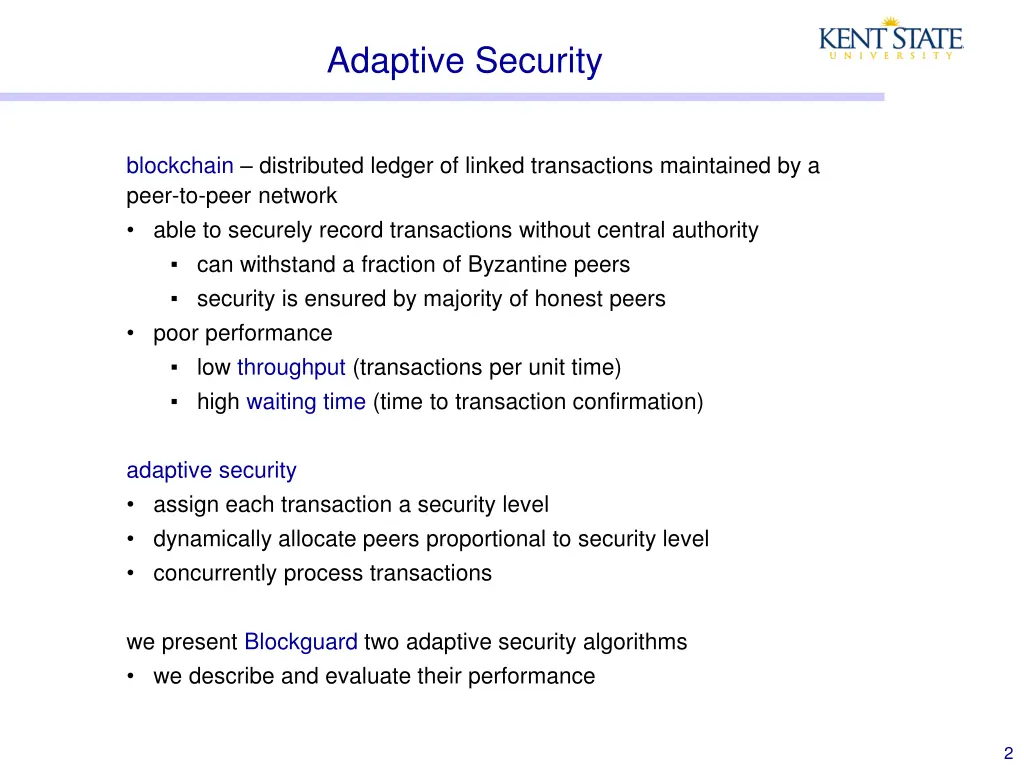
Adaptive Security blockchain distributed ledger of linked transactions maintained by a peer-to-peer network able to securely record transactions without central authority can withstand a fraction of Byzantine peers security is ensured by majority of honest peers poor performance low throughput (transactions per unit time) high waiting time (time to transaction confirmation) adaptive security assign each transaction a security level dynamically allocate peers proportional to security level concurrently process transactions we present Blockguard two adaptive security algorithms we describe and evaluate their performance 2
Notation peers are honest conform to algorithm Byzantine capable of arbitrary actions consensus set of processes cooperating to approve transaction despite actions of Byzantine peers classic peers exchange messages to achieve consensus PBFT practical byzantine fault tolerant algorithm asynchronous SBFT - synchronous byzantine-tolerant Proof-of-Work (PoW) Nakamoto-style with peers mining transactions, the longest chain of mined transactions is accepted both have some fixed tolerance to Byzantine peers sharding group a set of processes that maintain single blockchain committee - each committee runs a consensus algorithm 3
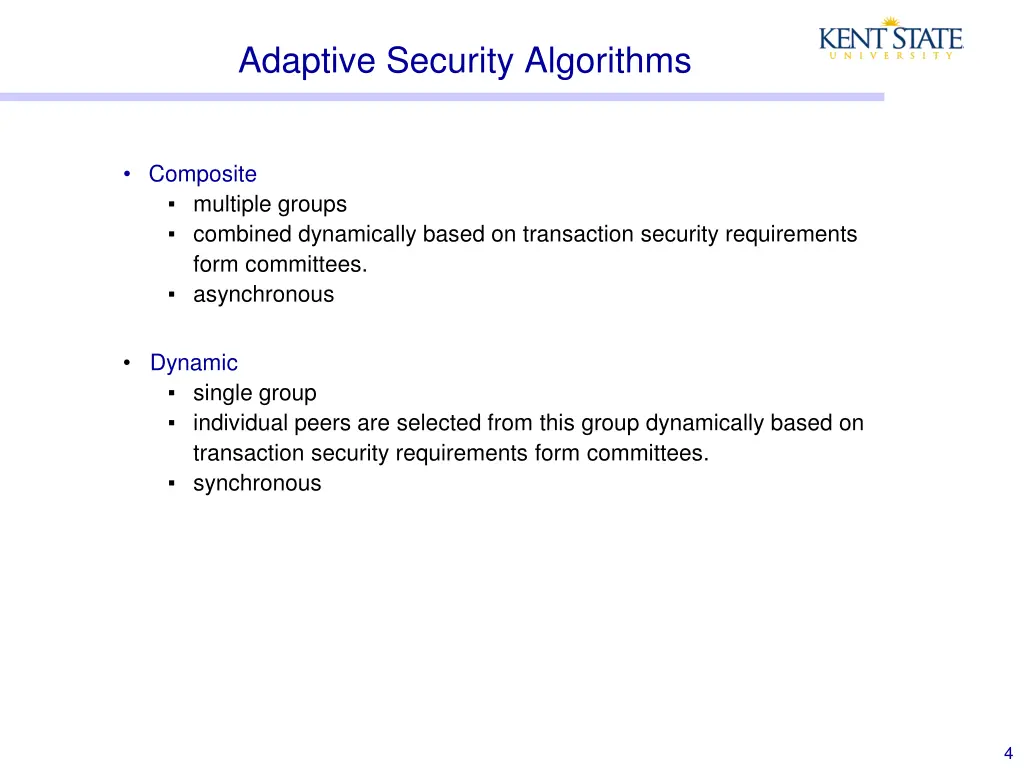
Adaptive Security Algorithms Composite multiple groups combined dynamically based on transaction security requirements form committees. asynchronous Dynamic single group individual peers are selected from this group dynamically based on transaction security requirements form committees. synchronous 4
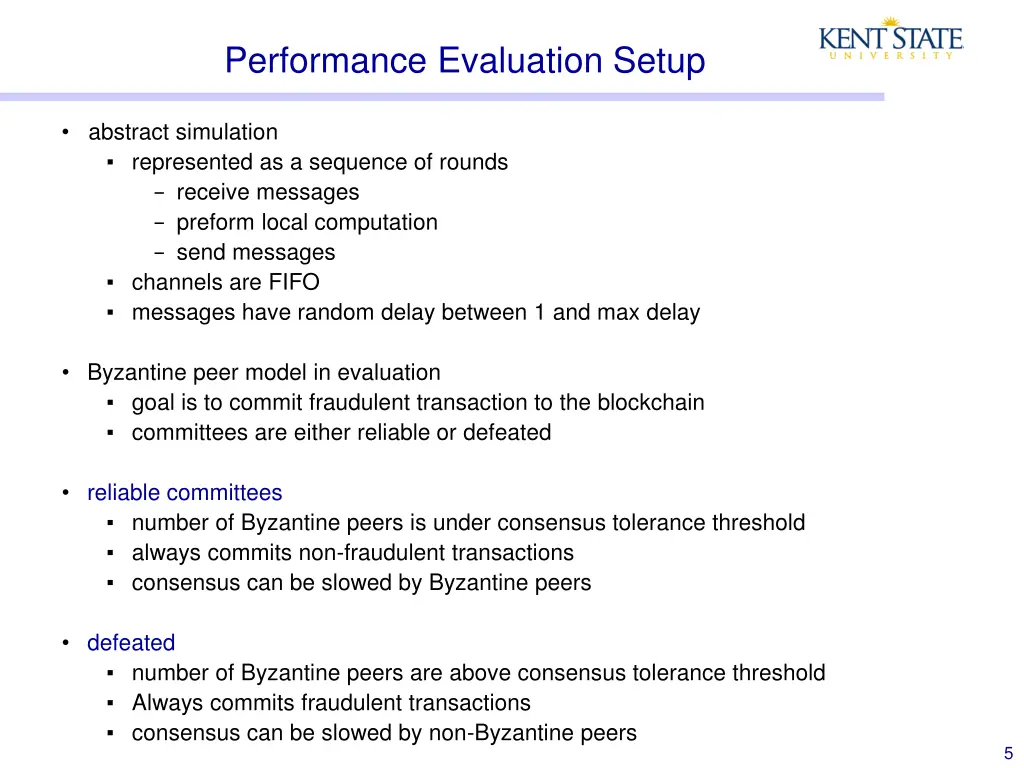
Performance Evaluation Setup abstract simulation represented as a sequence of rounds receive messages preform local computation send messages channels are FIFO messages have random delay between 1 and max delay Byzantine peer model in evaluation goal is to commit fraudulent transaction to the blockchain committees are either reliable or defeated reliable committees number of Byzantine peers is under consensus tolerance threshold always commits non-fraudulent transactions consensus can be slowed by Byzantine peers defeated number of Byzantine peers are above consensus tolerance threshold Always commits fraudulent transactions consensus can be slowed by non-Byzantine peers 5
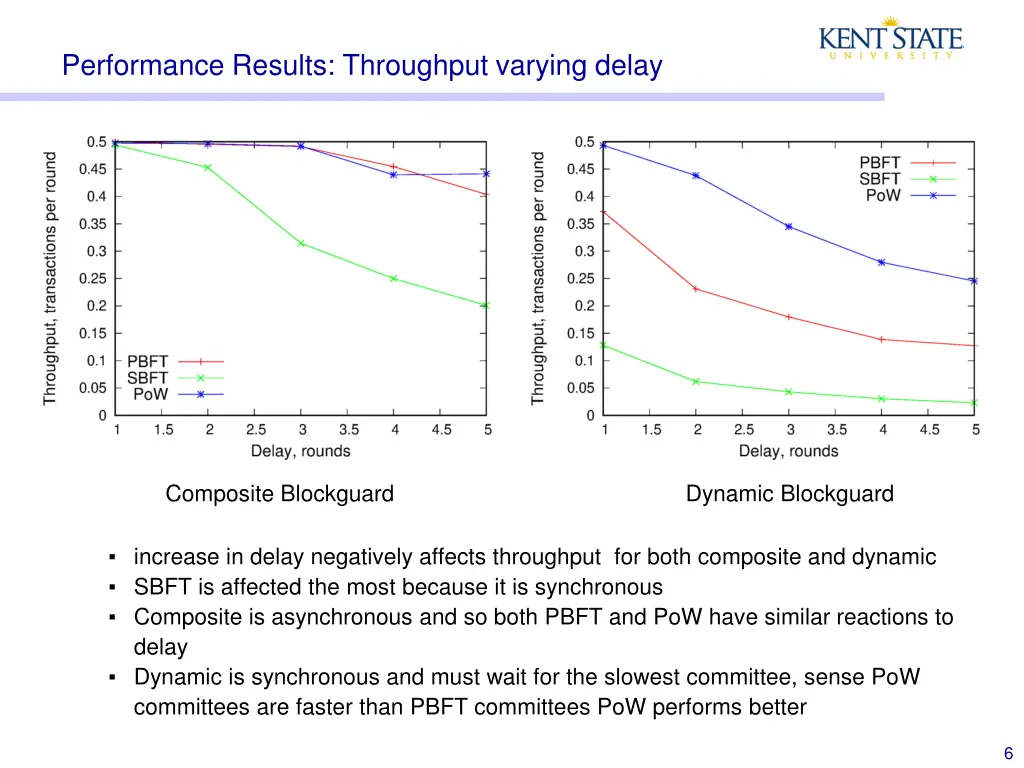
Performance Results: Throughput varying delay Composite Blockguard Dynamic Blockguard increase in delay negatively affects throughput for both composite and dynamic SBFT is affected the most because it is synchronous Composite is asynchronous and so both PBFT and PoW have similar reactions to delay Dynamic is synchronous and must wait for the slowest committee, sense PoW committees are faster than PBFT committees PoW performs better 6
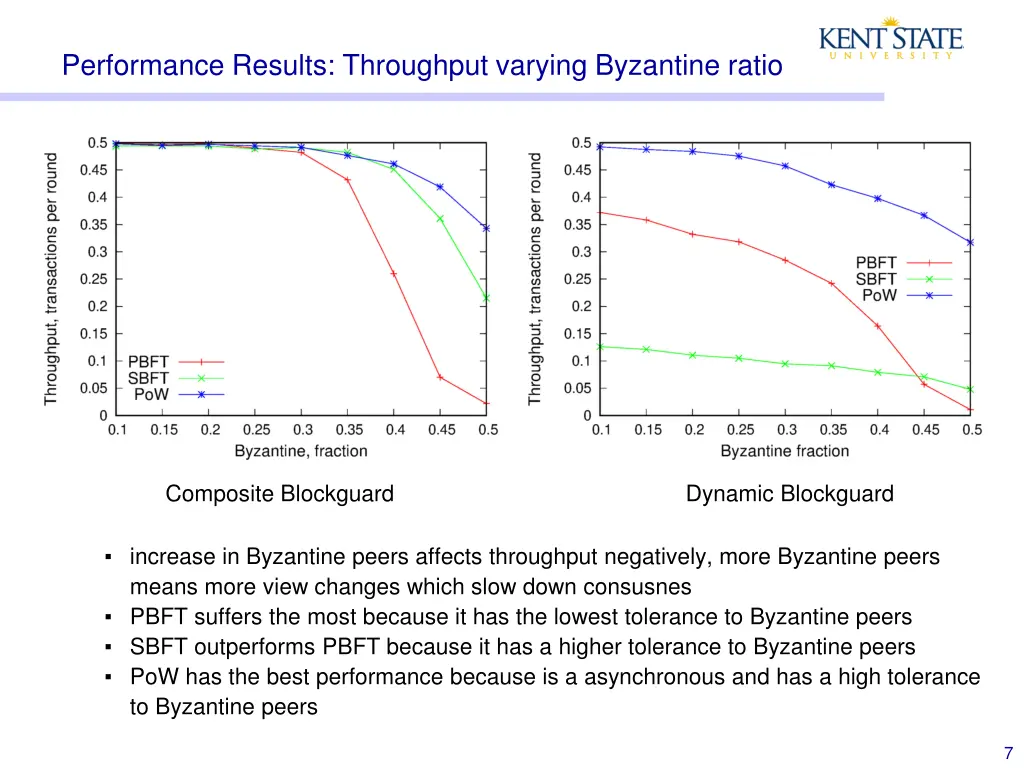
Performance Results: Throughput varying Byzantine ratio Composite Blockguard Dynamic Blockguard increase in Byzantine peers affects throughput negatively, more Byzantine peers means more view changes which slow down consusnes PBFT suffers the most because it has the lowest tolerance to Byzantine peers SBFT outperforms PBFT because it has a higher tolerance to Byzantine peers PoW has the best performance because is a asynchronous and has a high tolerance to Byzantine peers 7
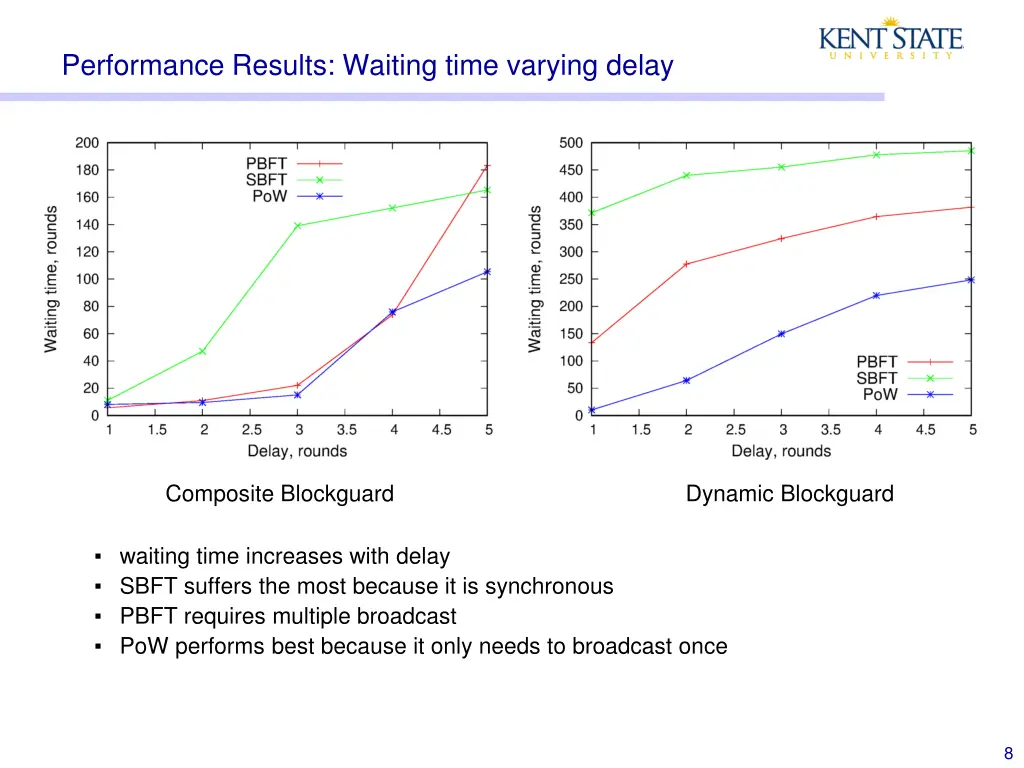
Performance Results: Waiting time varying delay Composite Blockguard Dynamic Blockguard waiting time increases with delay SBFT suffers the most because it is synchronous PBFT requires multiple broadcast PoW performs best because it only needs to broadcast once 8
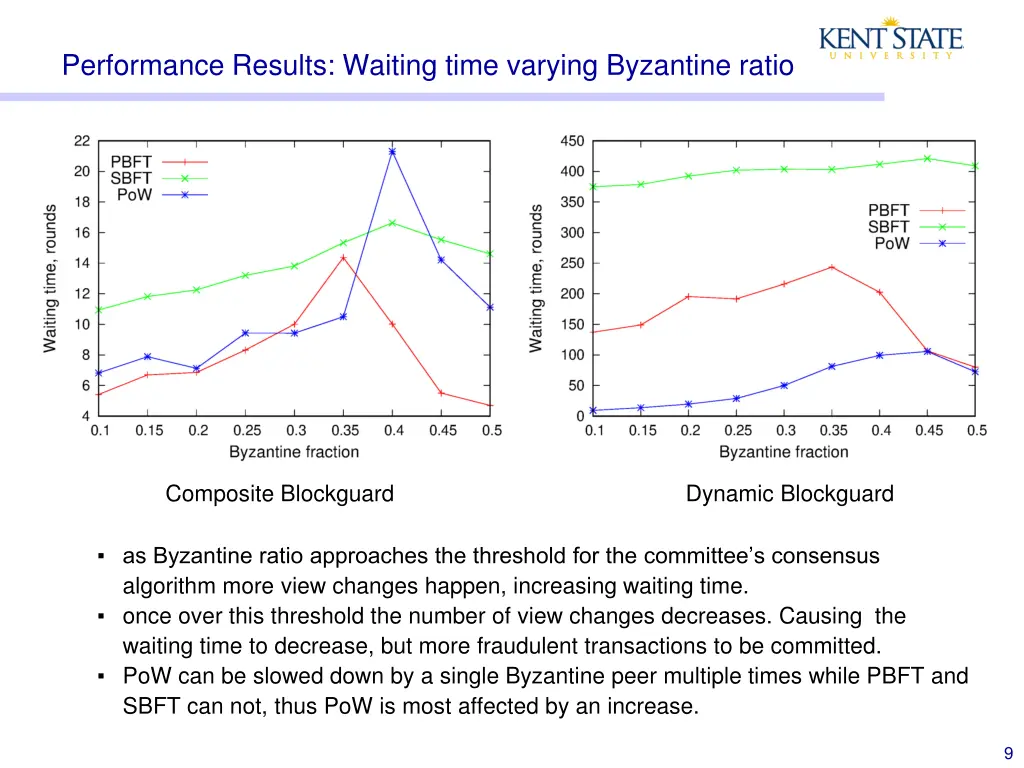
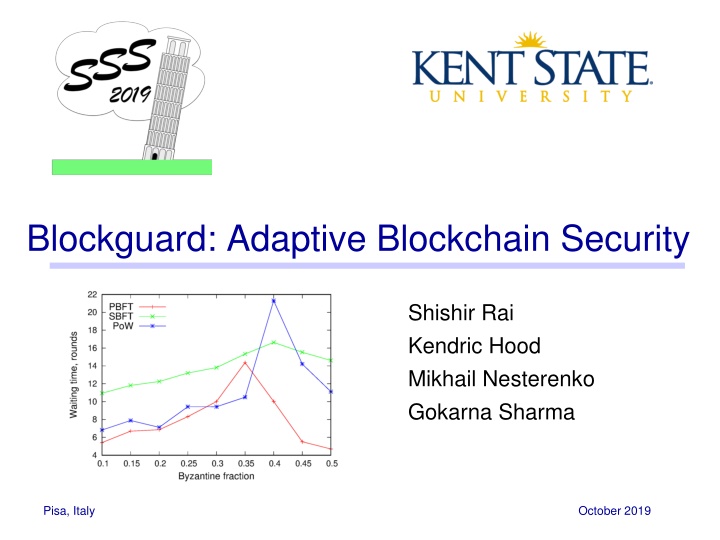
Performance Results: Waiting time varying Byzantine ratio Composite Blockguard Dynamic Blockguard as Byzantine ratio approaches the threshold for the committee s consensus algorithm more view changes happen, increasing waiting time. once over this threshold the number of view changes decreases. Causing the waiting time to decrease, but more fraudulent transactions to be committed. PoW can be slowed down by a single Byzantine peer multiple times while PBFT and SBFT can not, thus PoW is most affected by an increase. 9
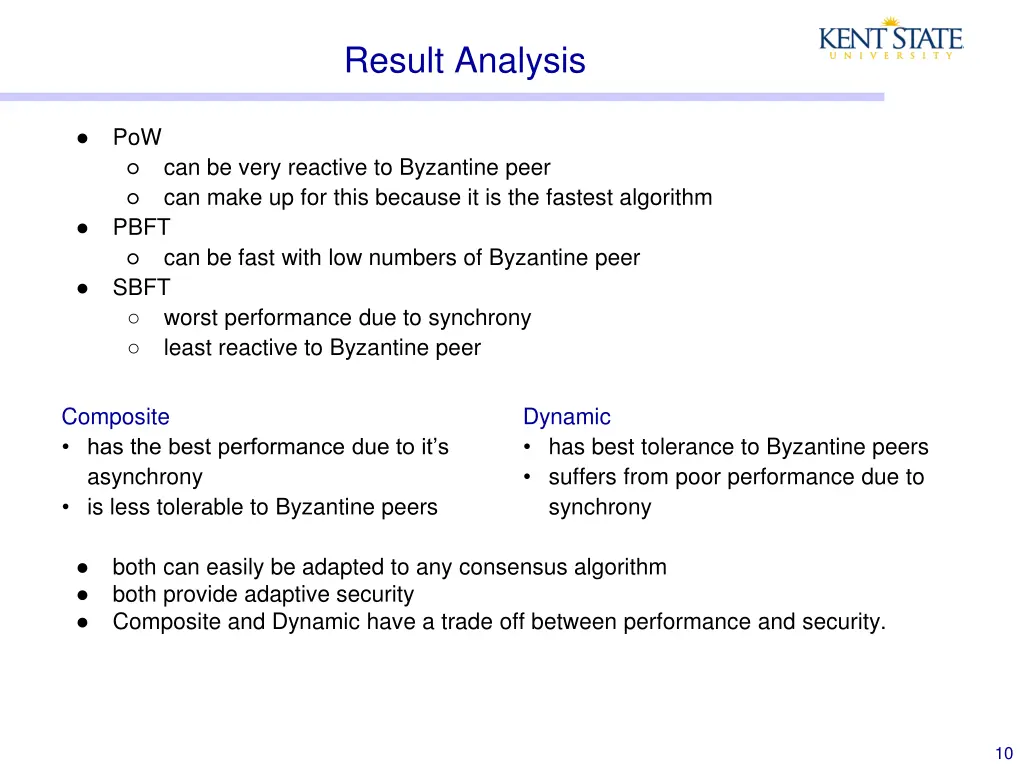
Result Analysis PoW PBFT SBFT can be very reactive to Byzantine peer can make up for this because it is the fastest algorithm can be fast with low numbers of Byzantine peer worst performance due to synchrony least reactive to Byzantine peer Composite has the best performance due to it s asynchrony is less tolerable to Byzantine peers Dynamic has best tolerance to Byzantine peers suffers from poor performance due to synchrony both can easily be adapted to any consensus algorithm both provide adaptive security Composite and Dynamic have a trade off between performance and security. 10
Conclusion Blockguard demonstrates that adaptive security is viable as a technique for achieving tradeoff between security and performance is applicable to major consensus algorithms should be implemented in practical systems Thank you! Questions? 11