Explore how a unique methodology is used to boost Artificial Intelligence in the game of Bridge, leading to significant success in computer-based Bridge competitions. Learn about the stochastic nature of the game and the strategies employed to improve AI performance.
Please find below an Image/Link to download the presentation.
The content on the website is provided AS IS for your information and personal use only. It may not be sold, licensed, or shared on other websites without obtaining consent from the author. If you encounter any issues during the download, it is possible that the publisher has removed the file from their server.
You are allowed to download the files provided on this website for personal or commercial use, subject to the condition that they are used lawfully. All files are the property of their respective owners.
The content on the website is provided AS IS for your information and personal use only. It may not be sold, licensed, or shared on other websites without obtaining consent from the author.
E N D
Presentation Transcript
Boosting a Bridge Artificial Intelligence Veronique Ventos, Yves Costel, Olivier Teytaud, and Sol ne Th paut Ventos IEEE 29th International Conference on Tools with Artificial Intelligence (ICTAI), 2017 Presenter: Yu-Yen Chu Date: Sept. 27, 2022
Abstract Bridge is an incomplete information game which is complex both for humans and for Computer-Bridge programs. The purpose of this paper is to present our work related to the adaptation to Bridge of a recent methodology used for boosting game Artificial Intelligence (AI) by seeking a random seed, or a probability distribution on random seeds, better than the others on a particular game. The Bridge AI Wbridge5 developed by Yves Costel has been boosted with the best seed found on the outcome of these experiments and has won the World Computer- Bridge Championship in September 2016.
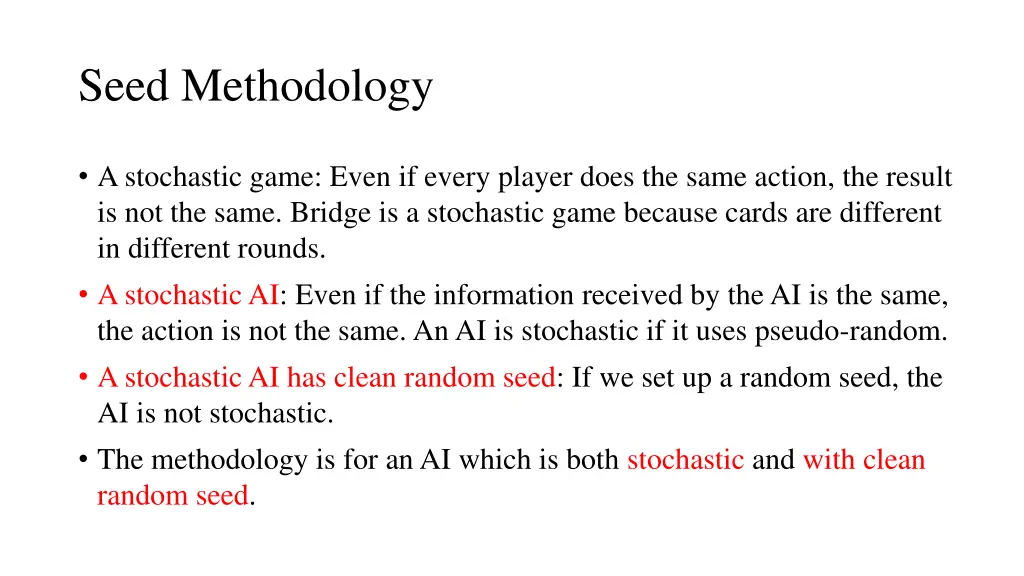
Seed Methodology A stochastic game: Even if every player does the same action, the result is not the same. Bridge is a stochastic game because cards are different in different rounds. A stochastic AI: Even if the information received by the AI is the same, the action is not the same. An AI is stochastic if it uses pseudo-random. A stochastic AI has clean random seed: If we set up a random seed, the AI is not stochastic. The methodology is for an AI which is both stochastic and with clean random seed.
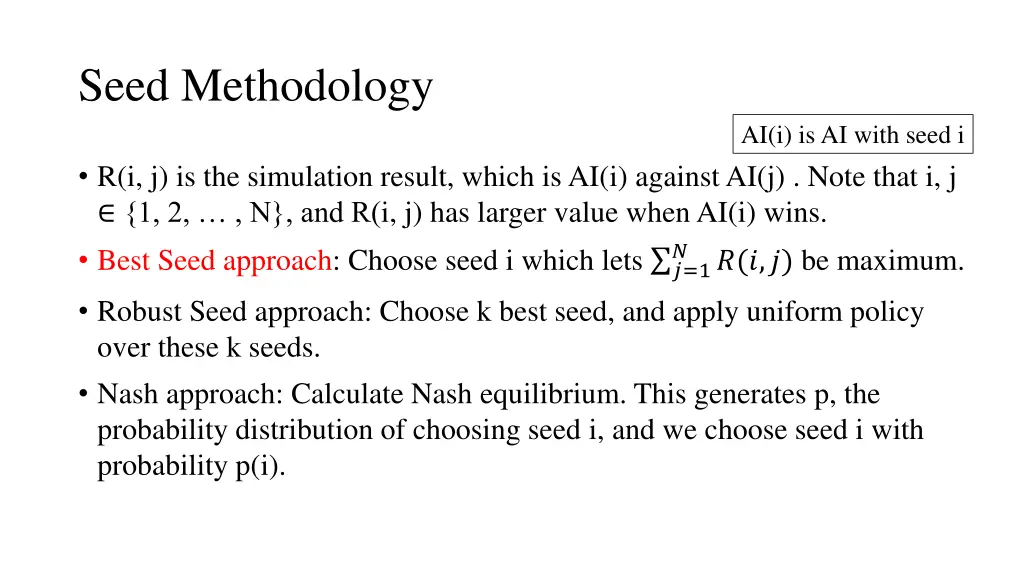
Seed Methodology AI(i) is AI with seed i R(i, j) is the simulation result, which is AI(i) against AI(j) . Note that i, j {1, 2, , N}, and R(i, j) has larger value when AI(i) wins. Best Seed approach: Choose seed i which lets ?=1 Robust Seed approach: Choose k best seed, and apply uniform policy over these k seeds. Nash approach: Calculate Nash equilibrium. This generates p, the probability distribution of choosing seed i, and we choose seed i with probability p(i). ? ?(?,?) be maximum.
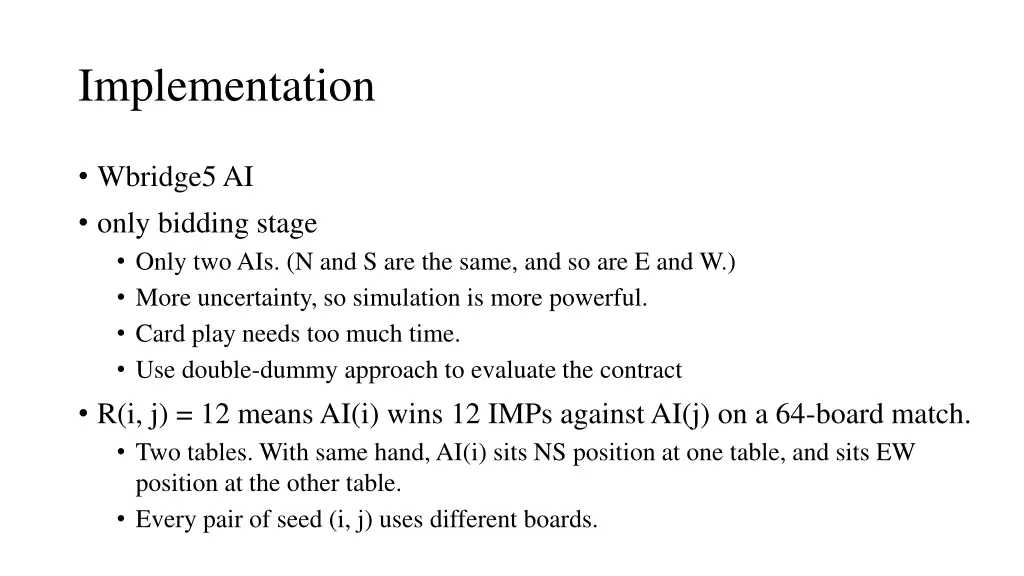
Implementation Wbridge5 AI only bidding stage Only two AIs. (N and S are the same, and so are E and W.) More uncertainty, so simulation is more powerful. Card play needs too much time. Use double-dummy approach to evaluate the contract R(i, j) = 12 means AI(i) wins 12 IMPs against AI(j) on a 64-board match. Two tables. With same hand, AI(i) sits NS position at one table, and sits EW position at the other table. Every pair of seed (i, j) uses different boards.
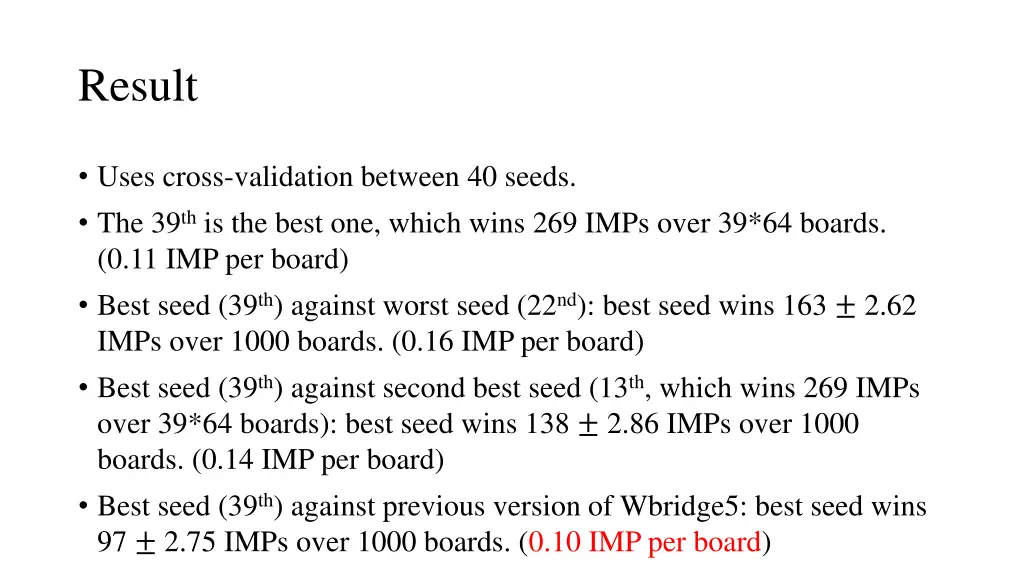
Result Uses cross-validation between 40 seeds. The 39th is the best one, which wins 269 IMPs over 39*64 boards. (0.11 IMP per board) Best seed (39th) against worst seed (22nd): best seed wins 163 2.62 IMPs over 1000 boards. (0.16 IMP per board) Best seed (39th) against second best seed (13th, which wins 269 IMPs over 39*64 boards): best seed wins 138 2.86 IMPs over 1000 boards. (0.14 IMP per board) Best seed (39th) against previous version of Wbridge5: best seed wins 97 2.75 IMPs over 1000 boards. (0.10 IMP per board)
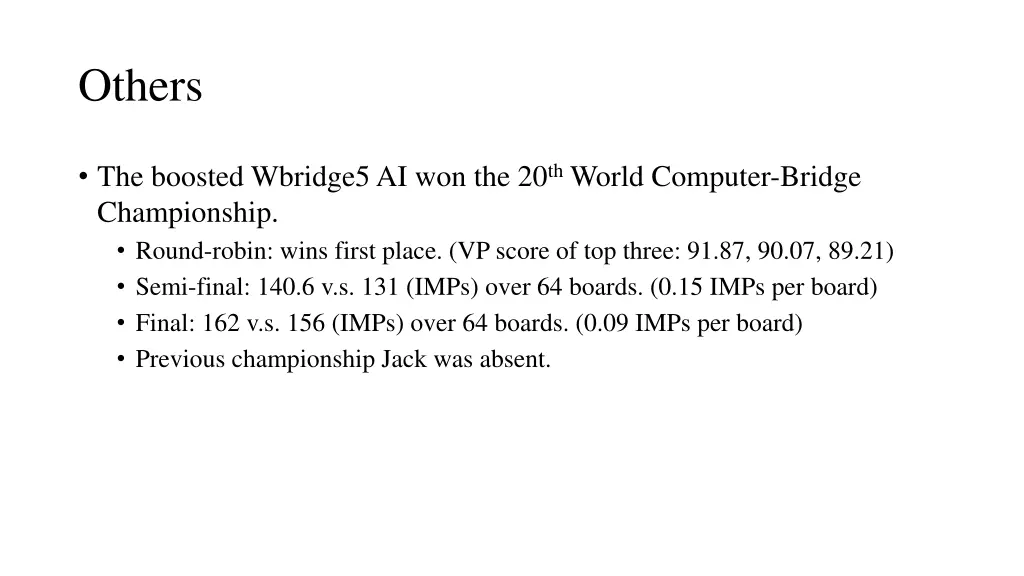
Others The boosted Wbridge5 AI won the 20th World Computer-Bridge Championship. Round-robin: wins first place. (VP score of top three: 91.87, 90.07, 89.21) Semi-final: 140.6 v.s. 131 (IMPs) over 64 boards. (0.15 IMPs per board) Final: 162 v.s. 156 (IMPs) over 64 boards. (0.09 IMPs per board) Previous championship Jack was absent.
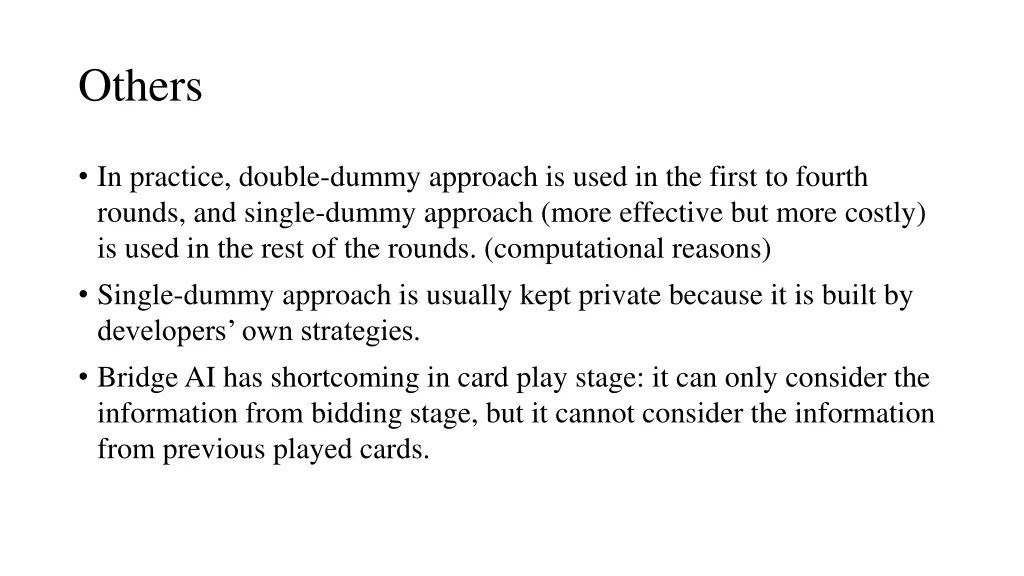
Others In practice, double-dummy approach is used in the first to fourth rounds, and single-dummy approach (more effective but more costly) is used in the rest of the rounds. (computational reasons) Single-dummy approach is usually kept private because it is built by developers own strategies. Bridge AI has shortcoming in card play stage: it can only consider the information from bidding stage, but it cannot consider the information from previous played cards.