Business Definition and Elements According to NCC
Explore the definition of a business according to Article 106 of the NCC, delving into the concept of incorporeal movables, goodwill, and the relationship between traders and businesses. Learn about the essential elements that constitute a business and the importance of preserving goodwill through legal avenues.

Download Presentation

Please find below an Image/Link to download the presentation.
The content on the website is provided AS IS for your information and personal use only. It may not be sold, licensed, or shared on other websites without obtaining consent from the author. If you encounter any issues during the download, it is possible that the publisher has removed the file from their server.
You are allowed to download the files provided on this website for personal or commercial use, subject to the condition that they are used lawfully. All files are the property of their respective owners.
The content on the website is provided AS IS for your information and personal use only. It may not be sold, licensed, or shared on other websites without obtaining consent from the author.
E N D
Presentation Transcript
Cont. Book I, TITLE FIVE, CHAPTER TWO Defining Business What is a business? Article 106 of NCC defined business as an incorporeal movable consisting of all movable property brought together and organized for the purpose of carrying out any of the commercial activities in Article 5 of this Code. Contents:
Cont. Incorporeal movable-to understand it read article 1127 of Civil C Incorporeal movables doesn t have material existence Eg. Look at Art.109(2) Movable-Read Art.1126 and 1130 of Civil C and Consisting Movables (Corporals)-Movables are contented with in business. Look at 110 Brought together and organized-Many types of movables are there To undertake any of the activities under article 5 of NCC-undertaking either of the activity is mandatory
Cont. Literature defines business as res, thing or object over which a persons can exercise property including ownership, usufract and lease. Relationship between trader and business. Every trader operates a business article 107 of NCC As can be understood from article 106 for a thing to be considered as a business there must be trade activity thus why it is said every trader operates business.
Cont. A single trader may operates several business and business as such can encompass several commercial activity. Elements of Business(CONSTITUENTS OF A BUSINESS) A. Article 109. A business consists mainly of goodwill. Article 112. As definition, the goodwill results from the creation and operation of a business and is of a value which arises from relations between a trader and third parties who may require from him goods or services.
Cont. It s the result of creation and operation of business It s the value which arise from the relation ship between trader and third parties Who may require from him goods or services. Goodwill requires preservation. required to preserve good will? Article 113 .A trader may preserve his goodwill by instituting proceedings for unfair competition or by setting up the legal or contractual prohibitions provided 29,39,53,118,130,131,166, and 167 of this Code. Why its in Article
Cont. Article 114. Unfair Commercial Competition 1/ A trader may claim damages under Article 2057 of the Civil Code from any person who commits an act of competition which amounts to a fault. tortious liability) protection of good will 2/ Without prejudice to the provisions of Sub-Article (1) of this Article, details on unfair commercial competition and its effects shall be prescribed by law-Trade competition and consumer protection proclamation No. 813/2013 There is also regulation .. (fault based
Cont. The proclamation regulates the issues through controlling: Abuse of market dominance Anti-competitive agreements, concerted practices and decisions Unfair competition Regulation of dominance
Cont. B. incorporeal elements such as: a) the trade name; b) trademark and any other designation under which the trade is carried on; c) the right to lease the premises in which the trade is carried on; d) intellectual property rights; (Patent right, copy right) e) Such special rights as attach to the business itself and not to the trader. A business may consist of other
Cont. Article Intellectual Property Rights The relevant provisions of the Civil Code . and special laws shall apply to the administration of a trader s trade name, trademarks and intellectual property rights. Proclamation No. concerning inventions, industrial designs. Proclamation No, 501/2006 Trademark registration and protection proclamation. Copy right and neighboring right proclamation 872/2014 and 410/2004 115. Trade name, Trademark and 123/1995 minor Proclamation inventions and
Cont. C. Corporeal Elements Article 110 of NCC A business may consist of corporeal elements such as equipment or goods any movables ..eg. Chairs of WAW Burger D. Negative Assets and Liabilities 1. A business shall normally not include the assets and debts of the trader, with the exception of the right to the lease of the premises article 111 of NCC
Cont. 2. Nothing in this Article shall affect the special rules provided in relevant law regarding the rights of a transferee of a property with insurance cover and the rights of employees regarding the continuation of employment contracts when the business organization is transferred article 111 of NCC
Cont. SALE OF A BUSINESS Article 122. Civil Code Applicable Without prejudice to the provisions of this chapter, the provisions of Article 2266-2367 of the Civil Code shall apply to the sale of a business. Article 123. Scope of Application of this Chapter 1/ The provisions of this chapter regarding the sale of a business shall apply:
Cont. a) to any sale or assignment, even under a disguised form; b) to any sale by auction at the request of joint owners; c) to any distribution compensation, where such sale, assignment or distribution relates to a business or its goodwill or to a branch or representative office assigned without the principal business being assigned or the goodwill of such branch or representative office. accompanied by
Cont. Sub-2. The provisions of this chapter shall not apply to the sale of individual parts of a business other than the goodwill, unless such sale entails or conceals the sale of the business or of the goodwill of a business. Formalities for Sale contract A. Article 124. Sale to be in Writing The sale of a business shall be null and void unless evidenced in writing.
Cont. B. Article 125. Particulars in the Contract of Sale The contract of sale shall specify: Sub-1 The turnover and profits made during the last three financial years or since the business was created or acquired by the seller, where such creation or acquisition took place less than three years before the sale; Sub-2 Where the business is carried on in premises let out for hire, the date on which the contract of lease was made and is to expire and the name and address of the lessor; Sub-3 The mortgage on the business, if any.
Cont. Article 126. Cancellation of the Contract 1/ The court may cancel the contract of sale on the application of the buyer where it is of the opinion that the buyer was injured by the failure to comply requirements provided in Article125. 2/ The court may cancel the contract of sale or reduce the price of the sale on the application of the buyer where it is of opinion that the buyer was injured statement made under Article 125. 3/ Proceedings under Sub-Article (1) and (2) of this Article shall be instituted within a year starting from the date on which the contract was made. with any of the by any inaccurate
Cont. Rights and duties of buyer visa vise Seller Read article 128-131 of NCC and article 132-135 of NCC and Civil Code part. 2266- 2367
Cont. Publication of the Sale Read articles 136-142
Cont. MORTGAGE OF A BUSINESS What is mortgage? a mortgage is the loan you take out topay fora home or other piece of real estate. Mortgages are real estate loans thatcomewith aspecified schedule of repayment, with the purchased propertyacting ascollateral. Article 143. Mortgage Possible 1/ A business may be mortgaged. 2/ Mortgage of a business flows from the law or a contract. 3/ Any mortgage, whether legal or contractual, may not be invoked against third parties unless it is registered pursuant to the relevant law. 4/ The provisions of this law shall apply to mortgage established on business without prejudice to special rules embodied in relevant laws concerning the establishment of security rights over movable property. Article 3041-3140Civil Code-immovable Pelage Article 2825-2874Civil Code Movables, Pro.1147/2019, NB Direc. MCR/01/2010 and
Cont. Article 144. Mortgage under the Law 1/ The following persons shall have their claims secured by a legal mortgage on the business: a) The seller of a business, for so long as the price of the sale has not been fully paid to him; b) The creditors of a bankrupt trader. 2/ The relevant provisions of Book Three of this Code shall apply to a mortgage under Sub-Article (1) (b) of this Article
Cont. Article 145. Legal Mortgage 1/ Where a person sells a business and the price of the sale is not fully paid to him, the payment of the price or such part thereof as is still due shall be secured by a legal mortgage on the business sold. 2/ The legal mortgage provided under Sub-Article (1) of this Article shall not apply unless the sale was made in writing and the mortgage has been registered in the manner provided by the relevant law. 3/ Particulars of the mortgage shall be prescribed by special law. registration of legal
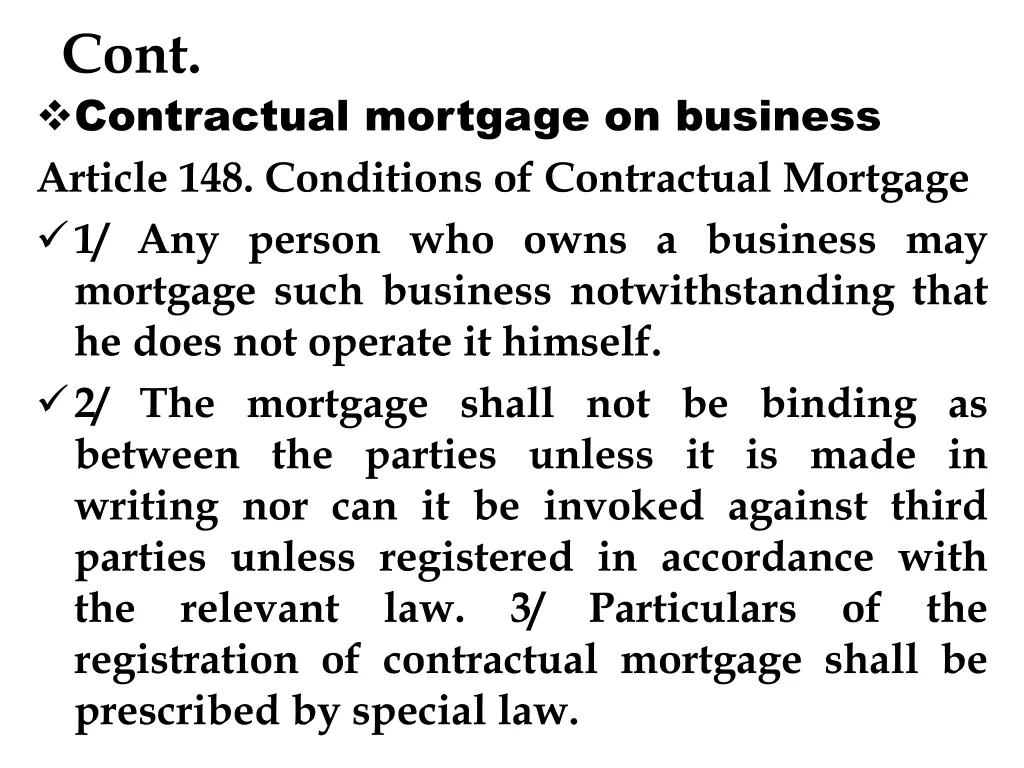
Cont. Contractual mortgage on business Article 148. Conditions of Contractual Mortgage 1/ Any person who owns a business may mortgage such business notwithstanding that he does not operate it himself. 2/ The mortgage shall not be binding as between the parties unless it is made in writing nor can it be invoked against third parties unless registered in accordance with the relevant law. 3/ registration of contractual mortgage shall be prescribed by special law. Particulars of the
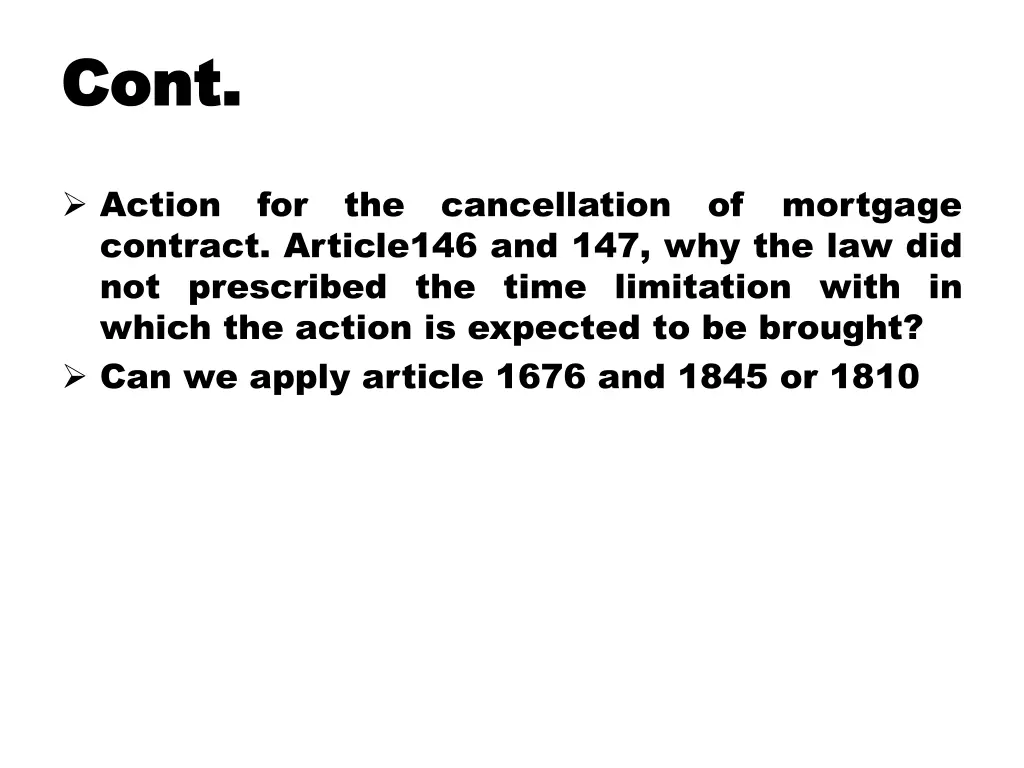
Cont Cont. . Action contract. Article146 and 147, why the law did not prescribed the time limitation with in which the action is expected to be brought? Can we apply article 1676 and 1845 or 1810 for the cancellation of mortgage
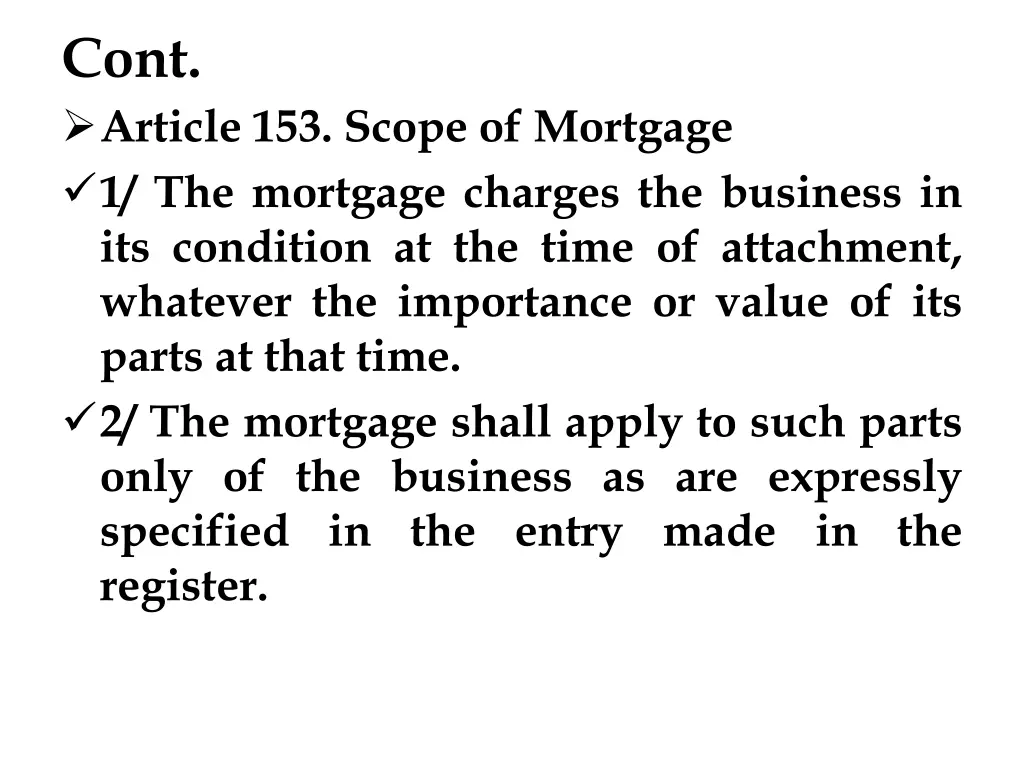
Cont. Article 153. Scope of Mortgage 1/ The mortgage charges the business in its condition at the time of attachment, whatever the importance or value of its parts at that time. 2/ The mortgage shall apply to such parts only of the business as are expressly specified in the entry made in the register.
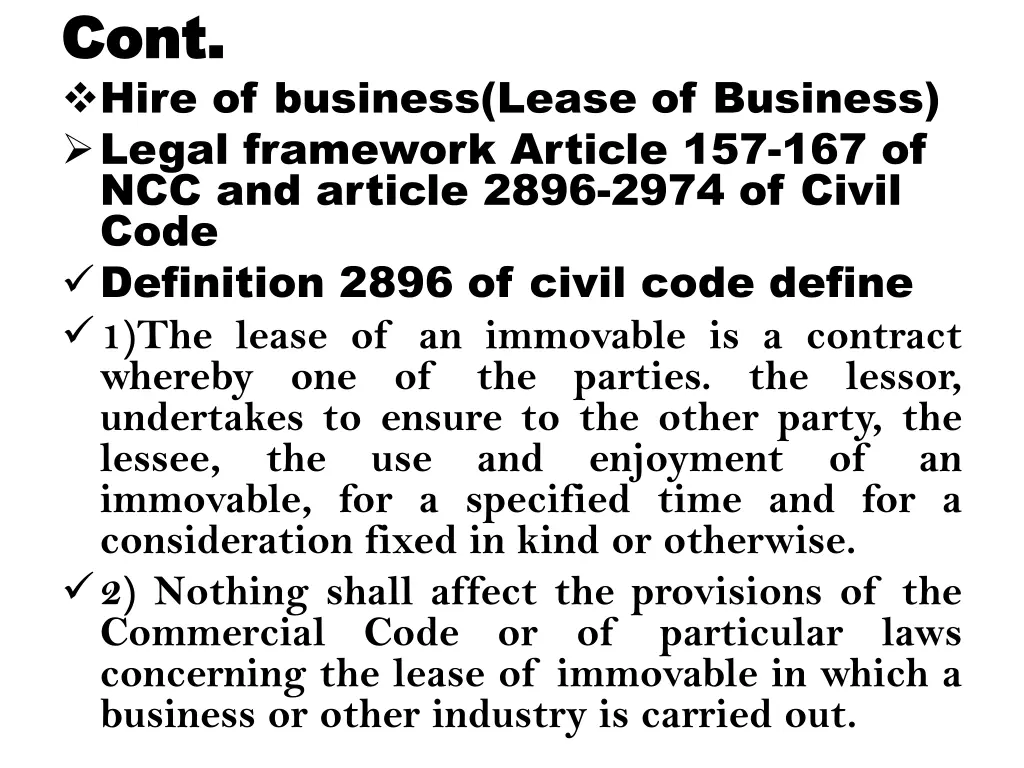
Cont. Cont. Hire of business(Lease of Business) Legal framework Article 157-167 of NCC and article 2896-2974 of Civil Code Definition 2896 of civil code define 1)The lease of an immovable is a contract whereby one of the parties. the lessor, undertakes to ensure to the other party, the lessee, the use and immovable, for a specified time and for a consideration fixed in kind or otherwise. 2) Nothing shall affect the provisions of the Commercial Code or concerning the lease of immovable in which a business or other industry is carried out. enjoyment of an of particular laws