Calculate Equivalent Continuous Noise Level from Multiple Sources
This document discusses the calculation of the equivalent continuous noise level (LAeq) from various sources operating under different conditions. It includes examples of noise levels generated by machinery and trains over specified time periods. Key calculations involve the use of dBA levels and operational times, emphasizing the impact of combined noise emissions on overall environmental noise levels. The content also addresses the permissible exposure limits for workers in noisy environments, ensuring safety standards are met.

Download Presentation

Please find below an Image/Link to download the presentation.
The content on the website is provided AS IS for your information and personal use only. It may not be sold, licensed, or shared on other websites without obtaining consent from the author.If you encounter any issues during the download, it is possible that the publisher has removed the file from their server.
You are allowed to download the files provided on this website for personal or commercial use, subject to the condition that they are used lawfully. All files are the property of their respective owners.
The content on the website is provided AS IS for your information and personal use only. It may not be sold, licensed, or shared on other websites without obtaining consent from the author.
E N D
Presentation Transcript
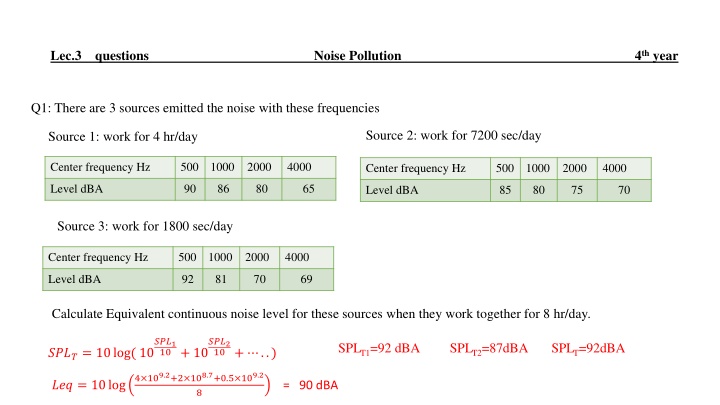
Lec.3 questions Noise Pollution 4thyear Q1: There are 3 sources emitted the noise with these frequencies Source 2: work for 7200 sec/day Source 1: work for 4 hr/day Center frequency Hz 500 1000 2000 4000 Center frequency Hz 500 1000 2000 4000 Level dBA 90 86 80 65 Level dBA 85 80 75 70 Source 3: work for 1800 sec/day Center frequency Hz 500 1000 2000 4000 Level dBA 92 81 70 69 Calculate Equivalent continuous noise level for these sources when they work together for 8 hr/day. ???1 10 + 10 ???2 10 + ..) SPLT1=92 dBA SPLT2=87dBA SPLT=92dBA ????= 10log( 10 4 109.2+2 108.7+0.5 109.2 8 ??? = 10log = 90 dBA
Q2:Noise from a building site is caused by five items of plant. The periods of operation of each item of plant during the working day and the noise level each produces at a noise sensitive property at the boundary of the site are shown below. Calculate the equivalent continuous noise level over a 12 hour working day and for 18 hour working day Compressor 83 dBA operating for 5 hr Excavator 85 dBA operating for 2 hr Dumper truck 76 dBA operating for 6 hr Pump 75 dBA operating for 7 hr Pile- driver 88 dBA operating for 1.5 hr 5 108.3+2 108.5+6 107.6+7 107.5+1.5 108.8 12 ????= 10 log = 84dB ????,?1 ????,?2=10????2 ?1 84 ????,T2=10 log (18/12) LAeq,T2= 82.2 ~ 82 dB
Q3:What is the maximum time for which an employee may spend in a particular workshop where the noise level is 101dBA without using hearing protection if his/her noise dose is not to exceed an LAeq of 85dBA over the period of the 8-hr working shift? Assume that for the rest of the shift the employee is subjected to a constant level of 80dBA? ? 1010.1+ 8 ? 108 8 ????,8 ?= 85 = 10 ??? = 0.138 hr =8.3 min. Q4: The noise level at a site on which it is proposed to build a housing estate arises mainly from trains on a nearby railway line. There are 3 types of train using the line-fast express trains, slower suburban trains and freight trains. It is proposed to predict the equivalent continuous noise level at the site over a 24-hr period from sample noise measurements of each of the three noise events. The results of these measurements are: for fast trains Leq=85dBA over a period of 12 s for slow trains Leq=78dBA over a period of 18 s for freight trains Leq= 76dBA over a period of 24 s During the 24-hr period there are 120 fast trains, 200 slow trains and 80freight trains. Cal. the LAeq,24hr
Method 1: 120 12 108.5 24 60 60 200 18 107.8 24 60 60 80 24 107.6 24 60 60 For fast trains , ????,24 ?= 10log = 67.2 ?? For slower trains , ????,24 ?= 10log = 64.2 ?? For freight trains , ????,24 ?= 10log = 59.5 ?? ????,24 ?= 10log 106.72+ 106.42+ 105.94= 69.4 ~69?? Method 2: 120 12 108.5+ 200 18 107.8+ 80 24 107.6 24 60 60 ????,24 ?= 10log = 69.4 ~69?? Method 3: ??? ???? ??????,???= 85 + 10???12 = 95.8??? ??? ???? ??????,???= 78 + 10???18 = 90.6??? ??? ????? ? ??????,???= 76 + 10???24 = 89.8??? 120 109.58+ 200 109.06+ 80 108.98 ????,24 ?= 10log = 69.4 ~69 ?? 24 60 60
Q5:24 individual one-hr LAeq values are given below. Calculate: LAeq,16hr(day), LAeq,8hr(night) , LAeq,24hr, Ldn ,Lden . LAeq,1hr LAeq,1hr LAeq,1hr LAeq,1hr Time Time Time Time 00-01 45.4 06-07 48.4 12-13 52.3 18-19 52.8 01-02 42.2 07-08 51.8 13-14 51.3 19-20 52.7 02-03 42.0 08-09 51.0 14-15 51.2 20-21 51.6 03-04 43.3 09-10 52.6 15-16 51.6 21-22 51.5 04-05 41.6 10-11 53.7 16-17 52.6 22-23 49.9 05-06 43.6 11-12 51.9 17-18 51.7 23-00 49.2 1 105.18+ 1 105.1+ + 1 105.15+ 1 104.99 16 1 104.92+ 1 104.54+ + 1 104.36+ 1 104.84 8 1 104.54+ 1 104.22+ + 1 104.99+ 1 104.92 24 ????,16 ? ??? =10log = 52 ?? ????,8 ? ??? ? =10log = 45.4 ?? ????,24 ?=10log = 50.7 ??
?? 10 + 9 10 24 ??+10 10 15 10 ???= 10log 1 105.18+ 1 105.1+ + 1 105.15 15 ??=10log = 52.08 ?? 1 104.99+ 1 104.92+ + 1 104.84 9 52. 10 +9 10 10 24 ??=10log = 46.2?? 56.2 15 10 ???= 10log = 54.1 54 dB ?? 10+4 10 ?????+5 10 ??+10 10 12 105.11+4 105.65+8 105.54 24 12 10 +8 10 ????= 10log = 10log =54.1 dB 24 1 105.18+ 1 105.1+ + 1 105.28 15 ??=10log = 51.1 ?? 1 105.27+ 1 105.16+ + 1 104.9.9 4 1 104.92+ 1 104.54+ + 1 104.84 8 ?????=10log = 51.5?? ??=10log = 45.4??