Calculating Normal Distribution Probabilities and Values
Learn how to calculate probabilities and find values in a normal distribution in statistics using examples from ITBS grade-equivalent vocabulary scores in Gary, Indiana. Understand how to determine probabilities like P(X < 4) and find percentile values. Master the process of drawing a normal distribution, standardizing values, and using technology or tables for calculations.

Download Presentation

Please find below an Image/Link to download the presentation.
The content on the website is provided AS IS for your information and personal use only. It may not be sold, licensed, or shared on other websites without obtaining consent from the author. If you encounter any issues during the download, it is possible that the publisher has removed the file from their server.
You are allowed to download the files provided on this website for personal or commercial use, subject to the condition that they are used lawfully. All files are the property of their respective owners.
The content on the website is provided AS IS for your information and personal use only. It may not be sold, licensed, or shared on other websites without obtaining consent from the author.
E N D
Presentation Transcript
Random Variables Lesson 5.7 Normal Distribution Calculations Statistics and Probability with Applications, 3rdEdition Starnes & Tabor Bedford Freeman Worth Publishers
Normal Distribution Calculations Learning Targets After this lesson, you should be able to: Calculate the probability that a value falls within a given interval in a normal distribution. Find a value corresponding to a given probability (area) in a normal distribution. Statistics and Probability with Applications, 3rdEdition 2 2
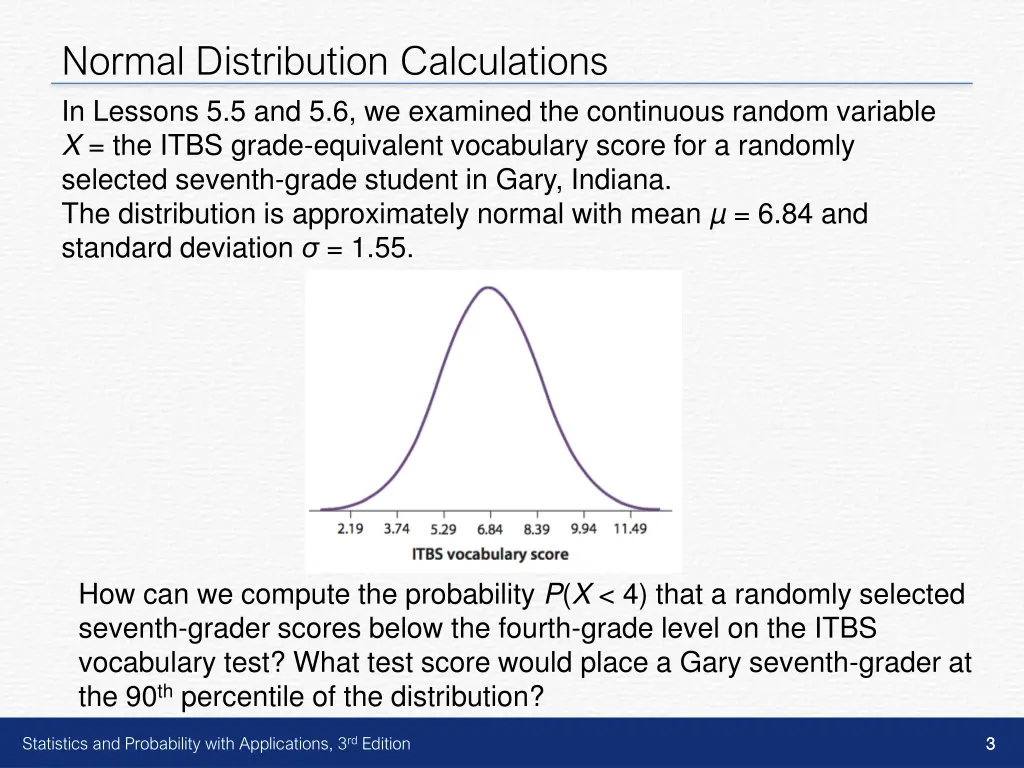
Normal Distribution Calculations In Lessons 5.5 and 5.6, we examined the continuous random variable X = the ITBS grade-equivalent vocabulary score for a randomly selected seventh-grade student in Gary, Indiana. The distribution is approximately normal with mean = 6.84 and standard deviation = 1.55. How can we compute the probability P(X < 4) that a randomly selected seventh-grader scores below the fourth-grade level on the ITBS vocabulary test? What test score would place a Gary seventh-grader at the 90th percentile of the distribution? Statistics and Probability with Applications, 3rdEdition 3 3
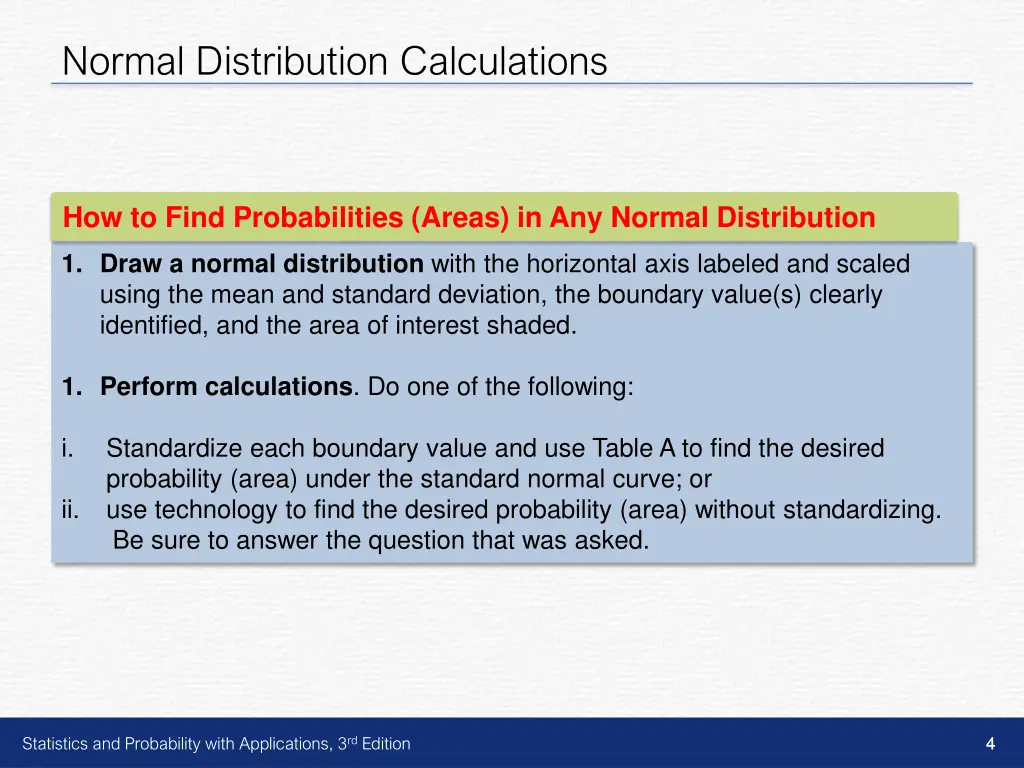
Normal Distribution Calculations How to Find Probabilities (Areas) in Any Normal Distribution 1. Draw a normal distribution with the horizontal axis labeled and scaled using the mean and standard deviation, the boundary value(s) clearly identified, and the area of interest shaded. 1. Perform calculations. Do one of the following: i. Standardize each boundary value and use Table A to find the desired probability (area) under the standard normal curve; or use technology to find the desired probability (area) without standardizing. Be sure to answer the question that was asked. ii. Statistics and Probability with Applications, 3rd Edition 4 4
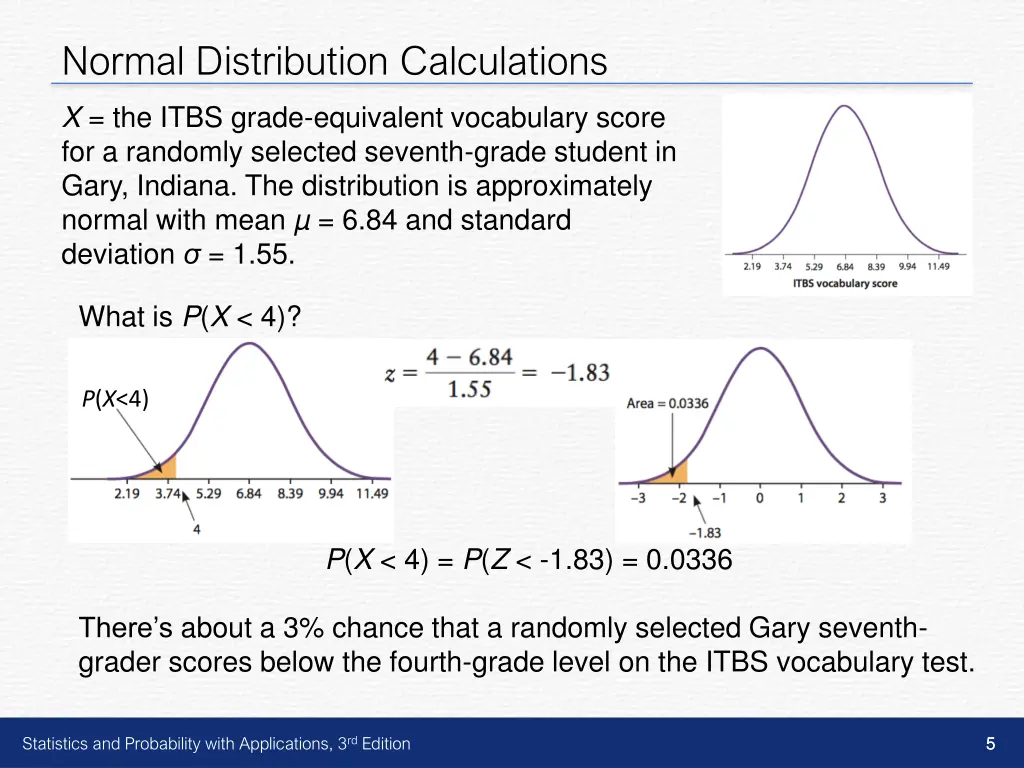
Normal Distribution Calculations X = the ITBS grade-equivalent vocabulary score for a randomly selected seventh-grade student in Gary, Indiana. The distribution is approximately normal with mean = 6.84 and standard deviation = 1.55. What is P(X < 4)? P(X<4) P(X < 4) = P(Z < -1.83) = 0.0336 There s about a 3% chance that a randomly selected Gary seventh- grader scores below the fourth-grade level on the ITBS vocabulary test. Statistics and Probability with Applications, 3rd Edition 5 5
Normal Distribution Calculations How to Find Values from Probabilities (Areas) in Any Normal Distribution 1. Draw a normal distribution with the horizontal axis labeled and scaled using the mean and standard deviation, with the horizontal axis labeled and scaled using the mean and standard deviation, the area of interest shaded, and unknown boundary value clearly marked. 1. Perform calculations. Do one of the following: i. Use Table A to find the value of z with the indicated area under the standard normal curve to the left of the boundary, then unstandardize to transform back to the original distribution; or use technology to find the boundary value from the probability (area) to the left of the boundary without standardizing. ii. Be sure to answer the question that was asked. Statistics and Probability with Applications, 3rd Edition 6 6
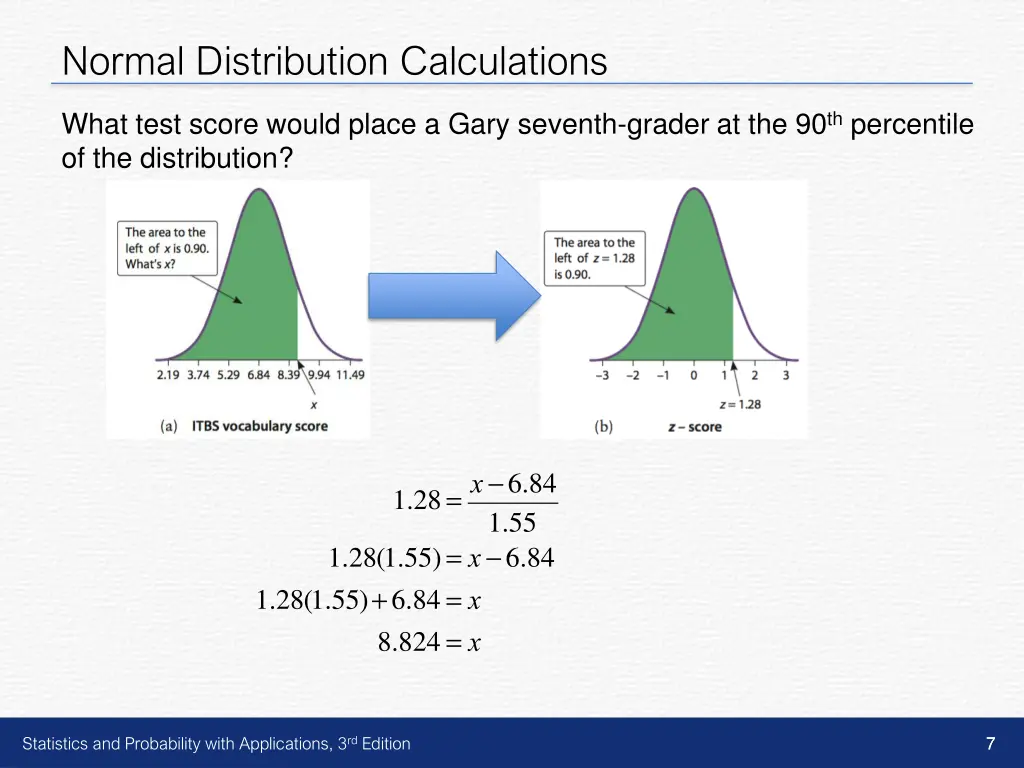
Normal Distribution Calculations What test score would place a Gary seventh-grader at the 90th percentile of the distribution? 1.28=x-6.84 1.55 1.28(1.55)= x-6.84 1.28(1.55)+6.84= x 8.824= x Statistics and Probability with Applications, 3rd Edition 7 7
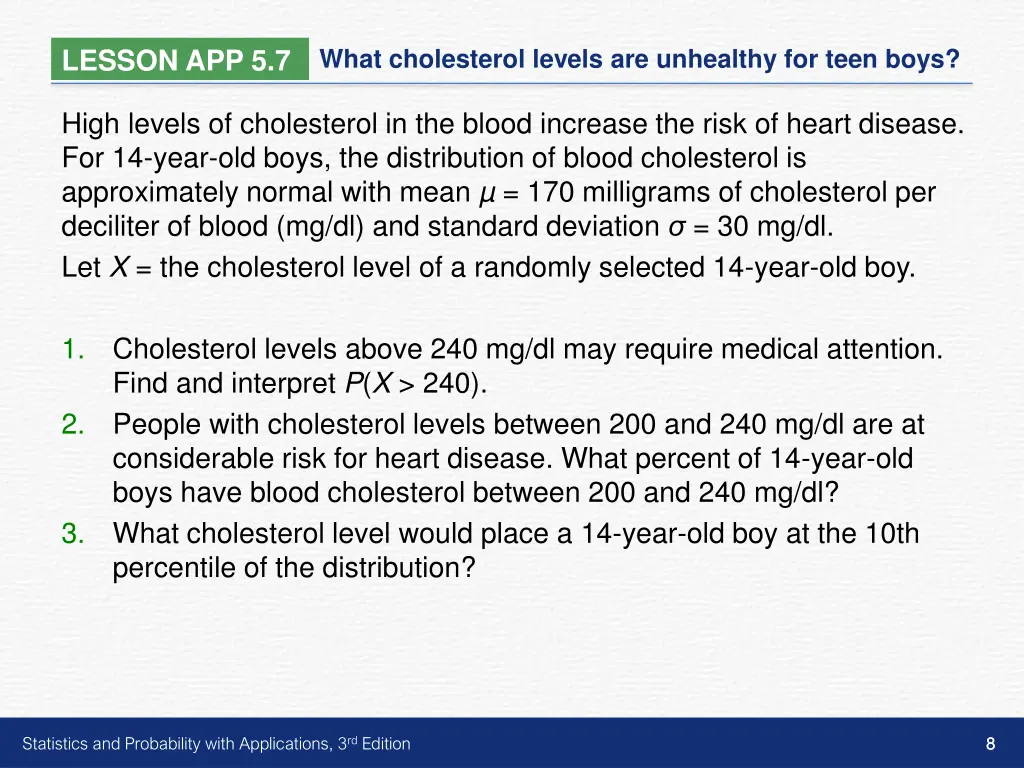
LESSON APP 5.7 What cholesterol levels are unhealthy for teen boys? High levels of cholesterol in the blood increase the risk of heart disease. For 14-year-old boys, the distribution of blood cholesterol is approximately normal with mean = 170 milligrams of cholesterol per deciliter of blood (mg/dl) and standard deviation = 30 mg/dl. Let X = the cholesterol level of a randomly selected 14-year-old boy. 1. Cholesterol levels above 240 mg/dl may require medical attention. Find and interpret P(X > 240). People with cholesterol levels between 200 and 240 mg/dl are at considerable risk for heart disease. What percent of 14-year-old boys have blood cholesterol between 200 and 240 mg/dl? What cholesterol level would place a 14-year-old boy at the 10th percentile of the distribution? 2. 3. Statistics and Probability with Applications, 3rd Edition 8 8
Normal Distribution Calculations Learning Targets After this lesson, you should be able to: Calculate the probability that a value falls within a given interval in a normal distribution. Find a value corresponding to a given probability (area) in a normal distribution. Statistics and Probability with Applications, 3rd Edition 9 9