In this lecture, Professor Kathleen Lynch from UCD delves into the importance of affective justice in the realm of social justice and politics. Discover how care intersects with capitalism and why it matters for creating a more equitable society. Gain insights into the complex dynamics at play and the implications for building a more just world. Explore the connections between emotions, power structures, and societal change, and uncover the vital role that affective justice plays in advancing equality.
Please find below an Image/Link to download the presentation.
The content on the website is provided AS IS for your information and personal use only. It may not be sold, licensed, or shared on other websites without obtaining consent from the author. If you encounter any issues during the download, it is possible that the publisher has removed the file from their server.
You are allowed to download the files provided on this website for personal or commercial use, subject to the condition that they are used lawfully. All files are the property of their respective owners.
The content on the website is provided AS IS for your information and personal use only. It may not be sold, licensed, or shared on other websites without obtaining consent from the author.
E N D
Presentation Transcript
Care and Capitalism: Why Affective Justice Matters for Social Justice and for Politics Professor Kathleen Lynch, UCD (University College Dublin) UCD Professor of Equality Studies Emerita & Professor in the UCD School of Education Lecture to Politics and Society Teachers Annual Meeting Nov. 14th2020. Based on forthcoming (2021) book Lynch, K. Care and Capitalism. Cambridge: Polity Press.
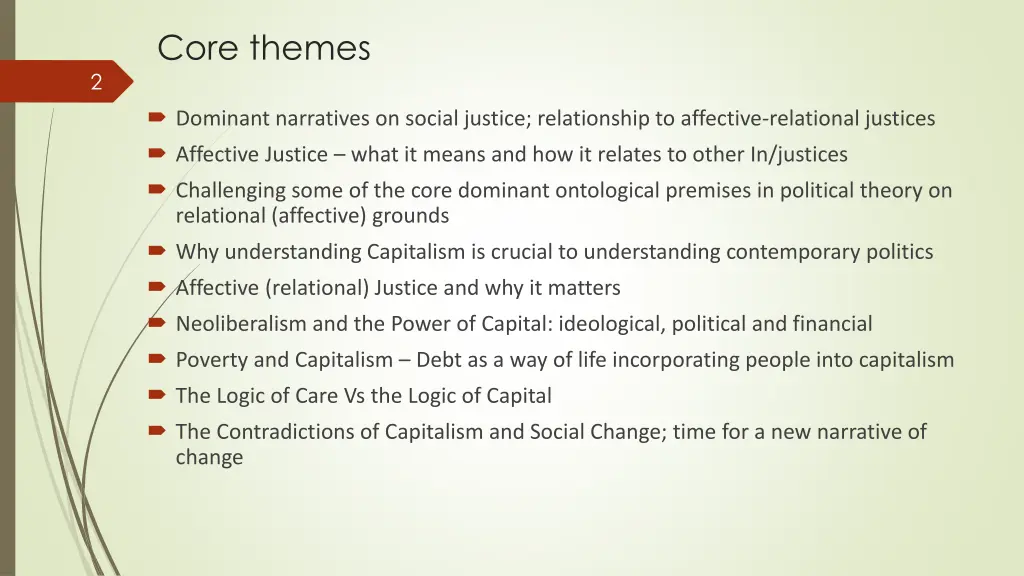
Core themes 2 Dominant narratives on social justice; relationship to affective-relational justices Affective Justice what it means and how it relates to other In/justices Challenging some of the core dominant ontological premises in political theory on relational (affective) grounds Why understanding Capitalism is crucial to understanding contemporary politics Affective (relational) Justice and why it matters Neoliberalism and the Power of Capital: ideological, political and financial Poverty and Capitalism Debt as a way of life incorporating people into capitalism The Logic of Care Vs the Logic of Capital The Contradictions of Capitalism and Social Change; time for a new narrative of change
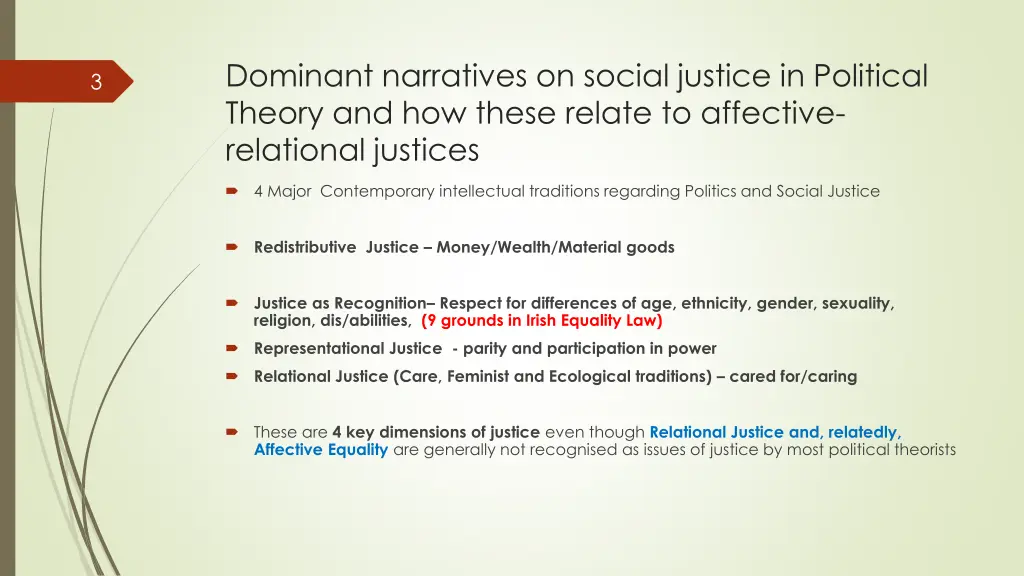
Dominant narratives on social justice in Political Theory and how these relate to affective- relational justices 3 4 Major Contemporary intellectual traditions regarding Politics and Social Justice Redistributive Justice Money/Wealth/Material goods Justice as Recognition Respect for differences of age, ethnicity, gender, sexuality, religion, dis/abilities, (9 grounds in Irish Equality Law) Representational Justice - parity and participation in power Relational Justice (Care, Feminist and Ecological traditions) cared for/caring These are 4 key dimensions of justice even though Relational Justice and, relatedly, Affective Equality are generally not recognised as issues of justice by most political theorists
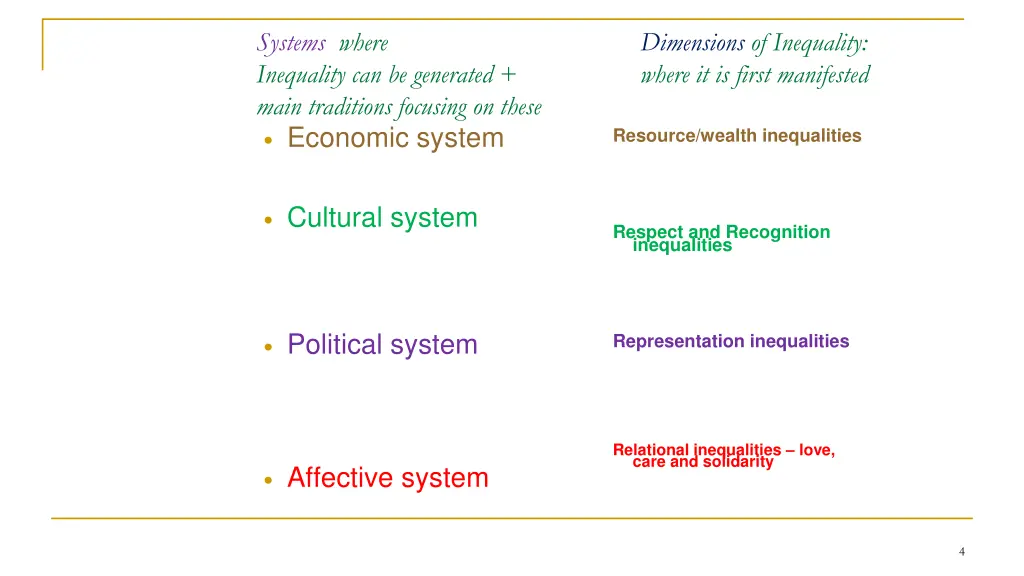
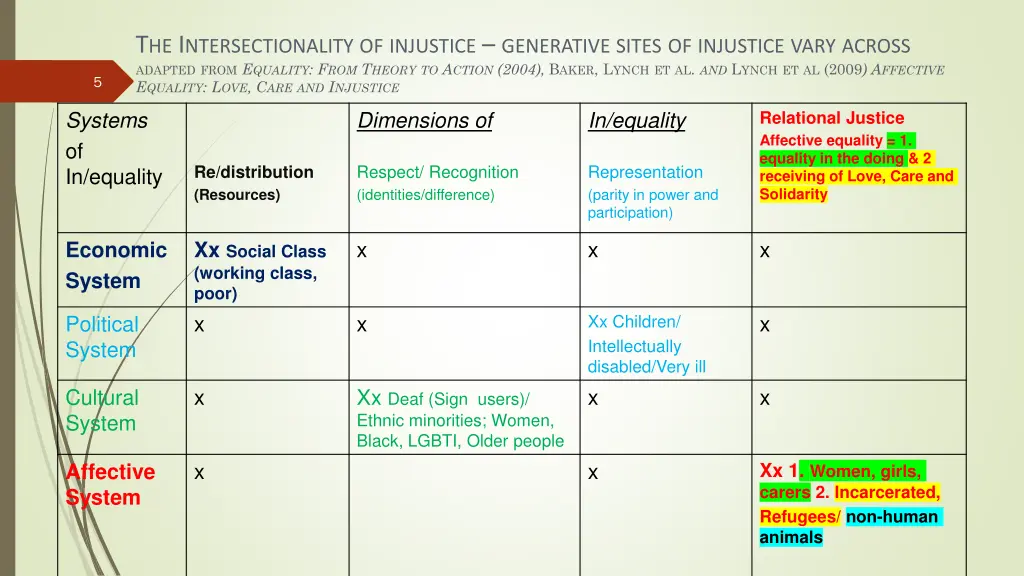
Systems where Inequality can be generated + main traditions focusing on these Economic system Dimensions of Inequality: where it is first manifested Resource/wealth inequalities Cultural system Respect and Recognition inequalities Political system Representation inequalities Relational inequalities love, care and solidarity Affective system 4
THE INTERSECTIONALITYOFINJUSTICEGENERATIVESITESOFINJUSTICEVARYACROSS ADAPTEDFROMEQUALITY: FROM THEORYTO ACTION (2004), BAKER, LYNCHETAL. ANDLYNCHETAL (2009) AFFECTIVE EQUALITY: LOVE, CAREAND INJUSTICE 5 Systems of In/equality Dimensions of In/equality Relational Justice Affective equality = 1. equality in the doing & 2 receiving of Love, Care and Solidarity Respect/ Recognition (identities/difference) Representation (parity in power and participation) Re/distribution (Resources) x x x Economic System Xx Social Class (working class, poor) x Political System x x Xx Children/ Intellectually disabled/Very ill x Cultural System x Xx Deaf (Sign users)/ Ethnic minorities; Women, Black, LGBTI, Older people x x x Affective System Xx 1. Women, girls, carers 2. Incarcerated, Refugees/ non-human animals
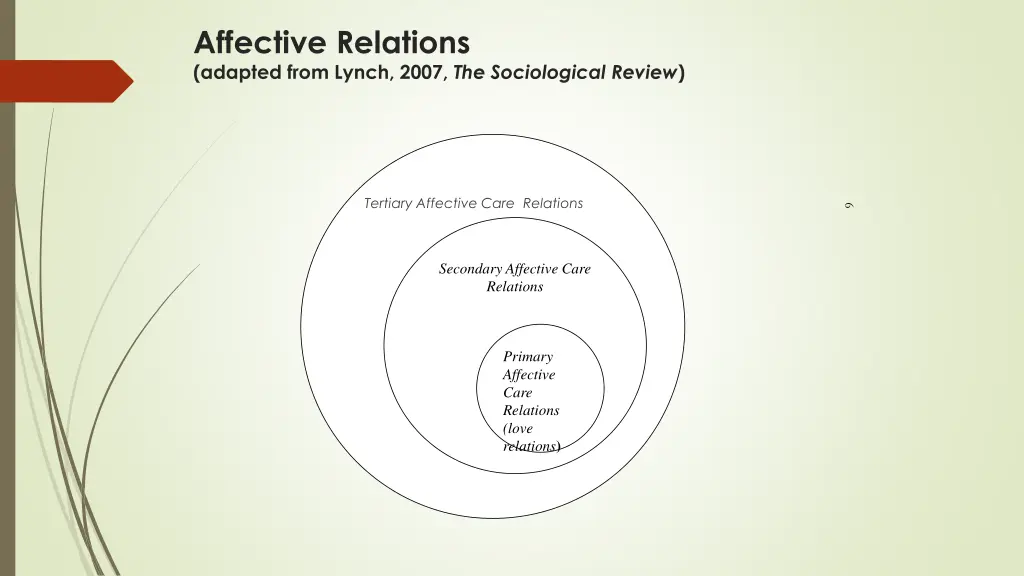
Affective Relations (adapted from Lynch, 2007, The Sociological Review) Tertiary Affective Care Relations 6 Secondary Affective Care Relations Primary Affective Care Relations (love relations)
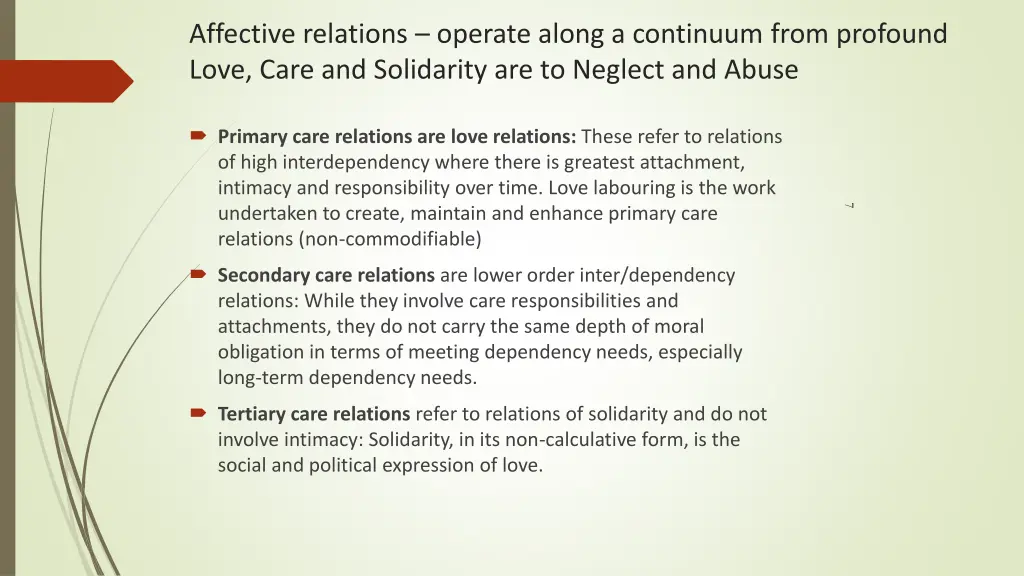
Affective relations operate along a continuum from profound Love, Care and Solidarity are to Neglect and Abuse Primary care relations are love relations: These refer to relations of high interdependency where there is greatest attachment, intimacy and responsibility over time. Love labouring is the work undertaken to create, maintain and enhance primary care relations (non-commodifiable) 7 Secondary care relations are lower order inter/dependency relations: While they involve care responsibilities and attachments, they do not carry the same depth of moral obligation in terms of meeting dependency needs, especially long-term dependency needs. Tertiary care relations refer to relations of solidarity and do not involve intimacy: Solidarity, in its non-calculative form, is the social and political expression of love.
Ontological Assumptions in Dominant Theories of Justice: Challenging these 8 1. Liberal Political theorists have upheld a highly individualistic view of the human person that informs their theories of justice this has enabled and facilitated the competitive individualism of neoliberal capitalism They largely ignore the reality of human dependency and interdependency that is endemic to the human condition and human s relationship to the environment 2. Western thinking on politics generally assumes that social actions are interest-led (power, status, money) it assumes humans utility maximising individuals The separatist, utility maximizing concept of the person, and the focus on contractual models of social relationsbetween strangers (as the focus of what matters in terms of justice) have combined to blind political theorists to the material significance of care relations as central matters of social and environmental justice
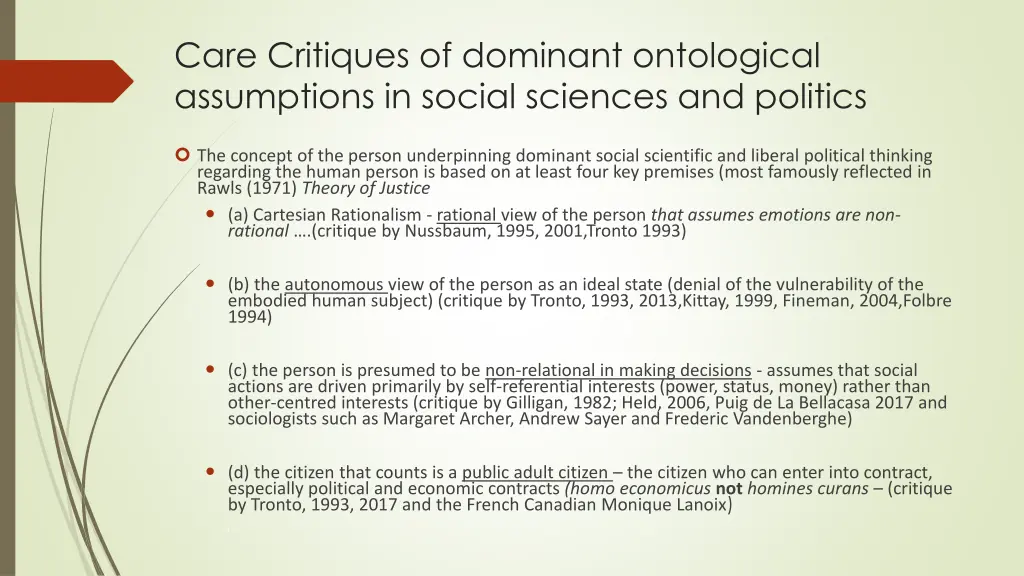
Care Critiques of dominant ontological assumptions in social sciences and politics The concept of the person underpinning dominant social scientific and liberal political thinking regarding the human person is based on at least four key premises (most famously reflected in Rawls (1971) Theory of Justice (a) Cartesian Rationalism - rational view of the person that assumes emotions are non- rational .(critique by Nussbaum, 1995, 2001,Tronto 1993) (b) the autonomous view of the person as an ideal state (denial of the vulnerability of the embodied human subject) (critique by Tronto, 1993, 2013,Kittay, 1999, Fineman, 2004,Folbre 1994) (c) the person is presumed to be non-relational in making decisions - assumes that social actions are driven primarily by self-referential interests (power, status, money) rather than other-centred interests (critique by Gilligan, 1982; Held, 2006, Puig de La Bellacasa 2017 and sociologists such as Margaret Archer, Andrew Sayer and Frederic Vandenberghe) (d) the citizen that counts is a public adult citizen the citizen who can enter into contract, especially political and economic contracts (homo economicus not homines curans (critique by Tronto, 1993, 2017 and the French Canadian Monique Lanoix) 9
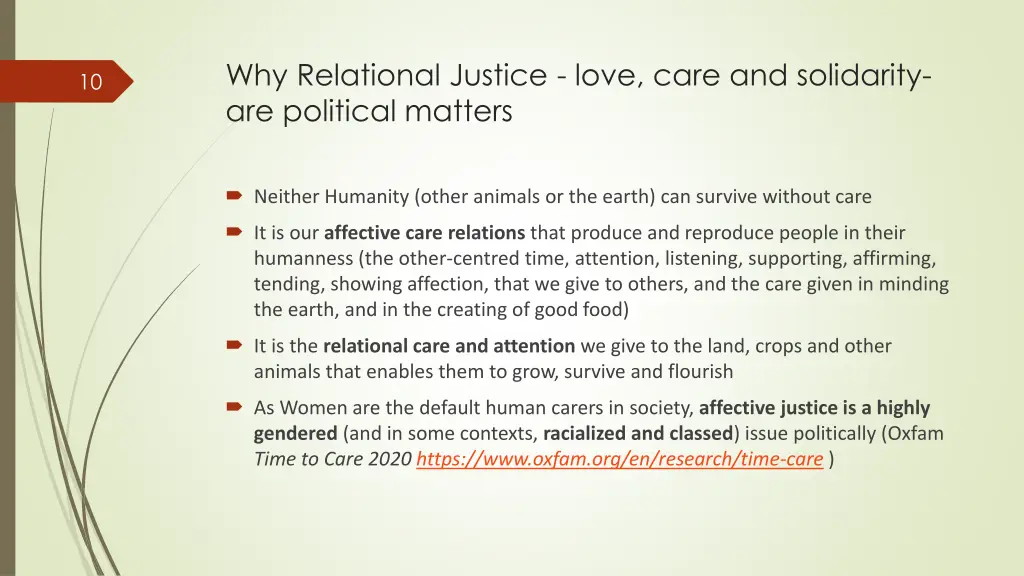
Why Relational Justice - love, care and solidarity- are political matters 10 Neither Humanity (other animals or the earth) can survive without care It is our affective care relations that produce and reproduce people in their humanness (the other-centred time, attention, listening, supporting, affirming, tending, showing affection, that we give to others, and the care given in minding the earth, and in the creating of good food) It is the relational care and attention we give to the land, crops and other animals that enables them to grow, survive and flourish As Women are the default human carers in society, affective justice is a highly gendered (and in some contexts, racialized and classed) issue politically (Oxfam Time to Care 2020 https://www.oxfam.org/en/research/time-care )
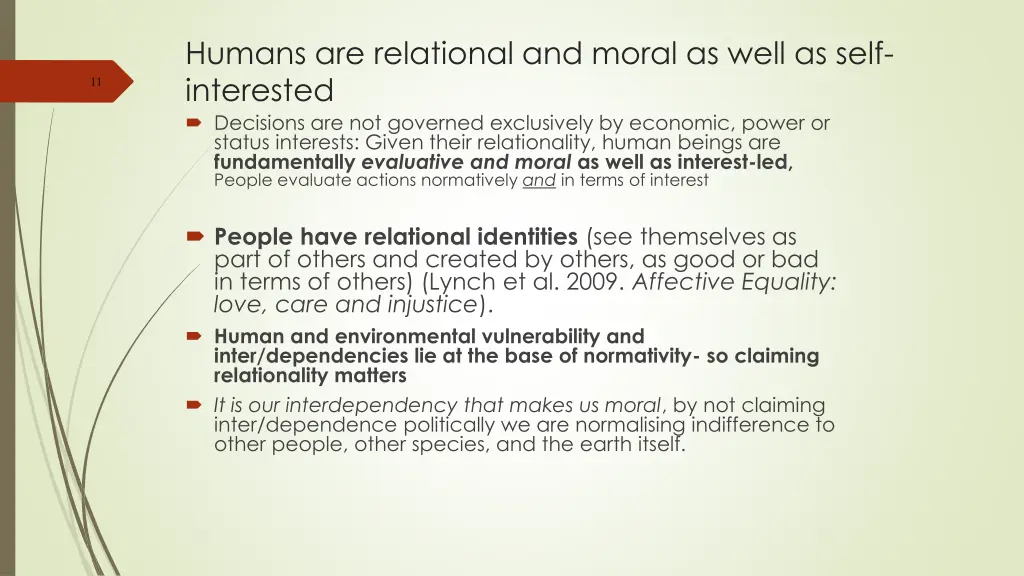
Humans are relational and moral as well as self- interested Decisions are not governed exclusively by economic, power or status interests: Given their relationality, human beings are fundamentally evaluative and moral as well as interest-led, People evaluate actions normatively and in terms of interest 11 People have relational identities (see themselves as part of others and created by others, as good or bad in terms of others) (Lynch et al. 2009. Affective Equality: love, care and injustice). Human and environmental vulnerability and inter/dependencies lie at the base of normativity- so claiming relationality matters It is our interdependency that makes us moral, by not claiming inter/dependence politically we are normalising indifference to other people, other species, and the earth itself.
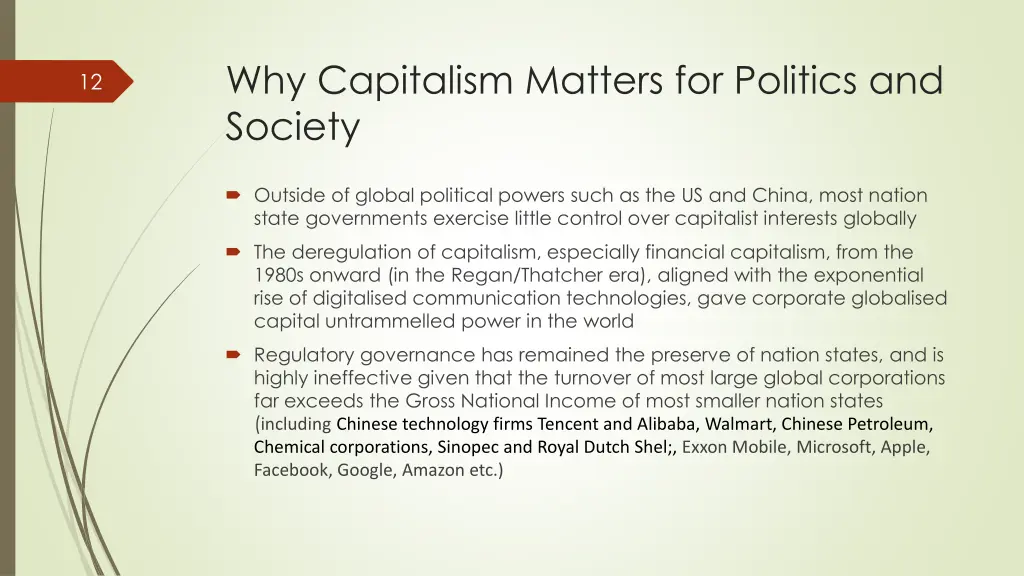
Why Capitalism Matters for Politics and Society 12 Outside of global political powers such as the US and China, most nation state governments exercise little control over capitalist interests globally The deregulation of capitalism, especially financial capitalism, from the 1980s onward (in the Regan/Thatcher era), aligned with the exponential rise of digitalised communication technologies, gave corporate globalised capital untrammelled power in the world Regulatory governance has remained the preserve of nation states, and is highly ineffective given that the turnover of most large global corporations far exceeds the Gross National Income of most smaller nation states (including Chinese technology firms Tencent and Alibaba, Walmart, Chinese Petroleum, Chemical corporations, Sinopec and Royal Dutch Shel;, Exxon Mobile, Microsoft, Apple, Facebook, Google, Amazon etc.)
Care Vs Capitalism 13 Human being are produced in their humanity through affective relations The creation, repair and maintenance of human, other animal, and environmental life cannot be undertaken without care; consequently, the affective relations that produce (or fail to produce) nurture are structural matters produce (or fail to produce) nurture are structural matters that are central to social justice and politics justice and politics. The everyday activities of properly functioning capitalism properly functioning capitalism do not produce forms of concern that lead to a sense of responsibility to others or the environment The logics of Capitalism are antithetical to Care - Driven by the ethic of profit, competitiveness, and incessant consumption even of goods that are not needed Neoliberal capitalism Neoliberal capitalism is predatory in character, exploiting and exacerbating crises in pursuit of profit in amoral ways that are deeply harmful to human beings, non- human animals and the environment the affective relations that central to social
Neo-liberalism is the governing ideology of our time: it is premised on a market capitalist view of citizenship 14 Difference between new (neo) liberalism and mainstream liberalism While classical liberalism sees the citizen as a person with rights that can be vindicated vis- -vis the State, neoliberalism is premised on the assumption that the citizen s relationship to the State is mediated via the Market citizens are redefined as customers rather than citizens with rights to care, welfare, health care etc. Neoliberalism is fundamentally Hobbesian in character Focus is on individual responsibility for failure and owning success It encourages the development of the actuarial self where you assess risks, gains, outputs etc.
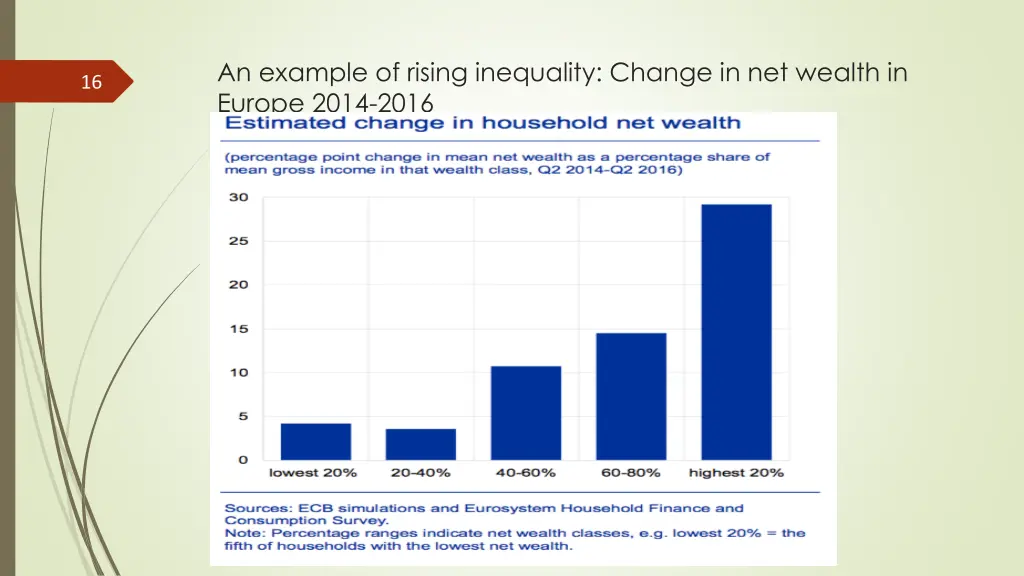
The Power of Globalised and Financialised Capitalism 15 Outcome economically: Rising income inequality, especially within nation states (Piketty, T. Capital in the Twenty-first Century, 2015) Outcomes politically: Polarisation of wealth/income differences, Rise of the Alienated Poor mobilised by the New Right (Rise in fascism and xenophobia in Europe) (see Hochschild, A. 2016 Strangers in Their Own Land. (on the reasons for the rise of the Tea party, and Trump- style politics in the US) Outcomes ideologically: increased control of public discourse by commercial media interests, especially social media control of consciousness (Capitalist surveillance of all forms of life via digitalised media) See Zouboff, S. The Age of Surveillance Capitalism (2019)
Rising Poverty leads to the Rise of Debtfare States* Indebtedness as a way of living * S. Soderberg 2014 (Debtfare and the Poverty Industry) 17 Being in Debt is encouraged Indebtedness enables poor people to buy goods and services they cannot afford they have the illusion of a living in a Commons through borrowed money (debt) Social power of money distorts the exploitative and unequal classed nature of the loans system class relations are invisibilised and legitimized through shared consumption on borrowed money Credit (Debt) mortgages, student loans, payday loans, credit card debts- is a secondary forms of classed exploitation Debt exercises disciplinary power over future life and work
Poor incorporated into society through Debt (credit) 18 Ideologies of Consumer power, Consumer protection, Consumer goods create the illusion of power and sovereignty The concept of the Consumer obfuscates the class and political relations involved in consumer credit and debt Credit money is priced via risk poorest pay most in interest over a shorter time frame Credit money is a way of managing the poor and making money for the poverty industry - encouraged to buy consumer goods you cannot afford but have learned to want (even if inessential) via advertising
Outcome of neoliberalism: Privatisation and Commercialisation of public goods 19 (1) Transfer of public assets to private ownership, through the sale or lease of public assets, land, infrastructure, and enterprises (e.g. water, public lands and parks, energy etc) 2) Ending public programmes which the private sector takes over (employment services for long-term unemployed have been commercialised in many countries (Germany, UK and Ireland) (3) Withdrawal of government from the direct provision of services,through contracting out Services: (care of the elderly and people with disabilities; hospitals, child care, and even universities are privatised, refugees put in establishments run by businesses (Ireland); (4) Withdrawal of government from financing services and corresponding increased reliance on private capital (roads, housing) and user charges (health care, education, water) (5) Introducing market norms into the governance of public bodies- new managerialist norms of surveillance, measurement, standardisation (governed by metrics)
Ideological success of neoliberal capitalism 20 It has encoded the pursuit of profit at-all-costs as an excitingindividual choice, a moral purpose governed by meritocratic principles, and a system that guarantees personal security for those who are worthy (deserving) (Boltanksi, L. and Chiapello, E. 2005. The New Spirit of Capitalism) One of its defining features neoliberalism its ability to conflate economic, moral, and political understandings. What was once regarded as ethically reprehensible is now regarded as normal. Neoliberal capitalism has won over hearts and minds - It has managed to colonise public discourses on morality; the pursuit of competitive self interest has become virtuous, not only with respect to others but with respect to future generations
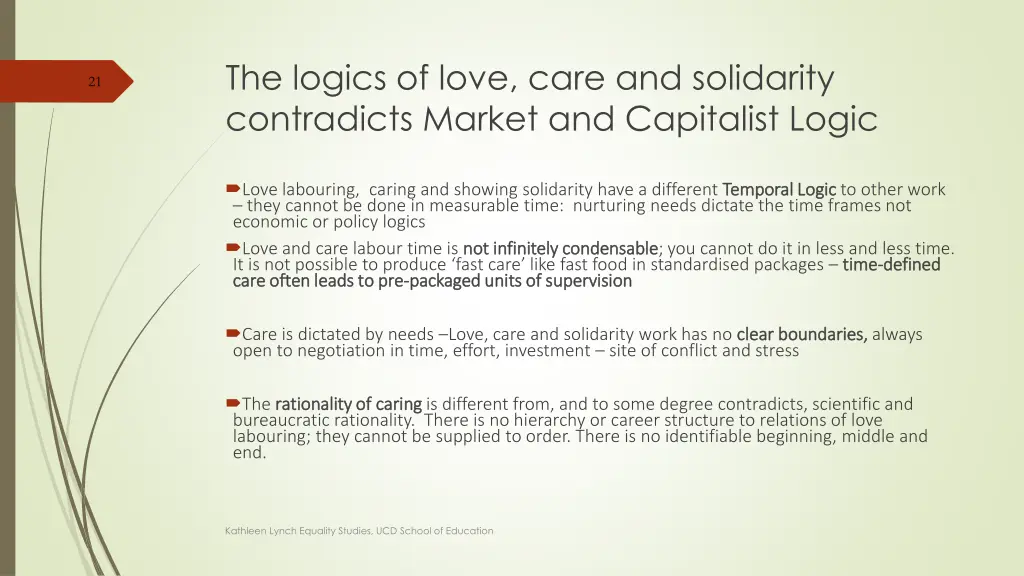
The logics of love, care and solidarity contradicts Market and Capitalist Logic 21 Love labouring, caring and showing solidarity have a different Temporal Logic they cannot be done in measurable time: nurturing needs dictate the time frames not economic or policy logics Love and care labour time is not infinitely condensable not infinitely condensable; you cannot do it in less and less time. It is not possible to produce fast care like fast food in standardised packages time care often leads to pre care often leads to pre- -packaged units of supervision packaged units of supervision Temporal Logic to other work time- -defined defined Care is dictated by needs Love, care and solidarity work has no clear boundaries, open to negotiation in time, effort, investment site of conflict and stress clear boundaries, always The rationality of caring rationality of caring is different from, and to some degree contradicts, scientific and bureaucratic rationality. There is no hierarchy or career structure to relations of love labouring; they cannot be supplied to order. There is no identifiable beginning, middle and end. Kathleen Lynch Equality Studies, UCD School of Education
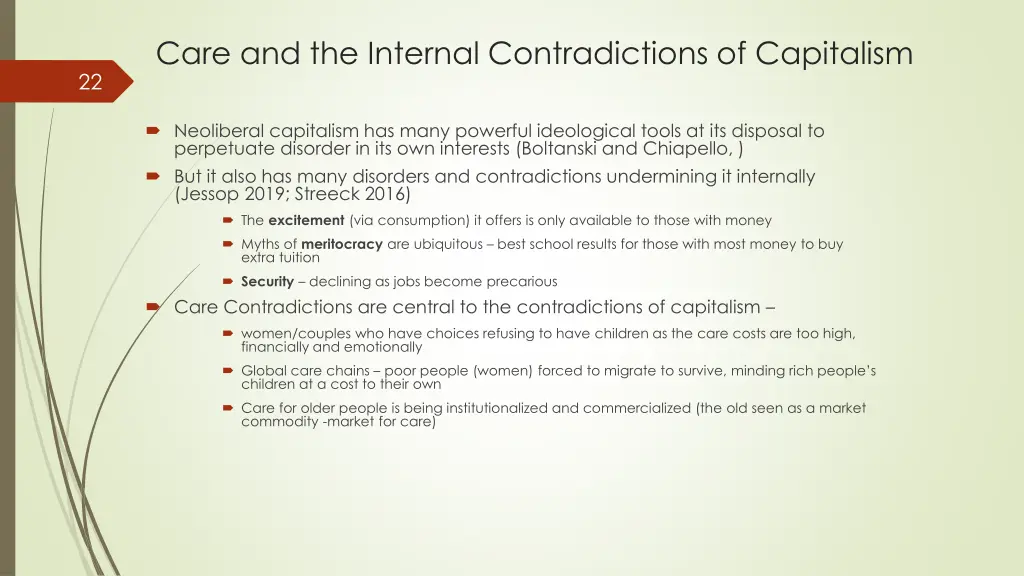
Care and the Internal Contradictions of Capitalism 22 Neoliberal capitalism has many powerful ideological tools at its disposal to perpetuate disorder in its own interests (Boltanski and Chiapello, ) But it also has many disorders and contradictions undermining it internally (Jessop 2019; Streeck 2016) The excitement (via consumption) it offers is only available to those with money Myths of meritocracy are ubiquitous best school results for those with most money to buy extra tuition Security declining as jobs become precarious Care Contradictions are central to the contradictions of capitalism women/couples who have choices refusing to have children as the care costs are too high, financially and emotionally Global care chains poor people (women) forced to migrate to survive, minding rich people s children at a cost to their own Care for older people is being institutionalized and commercialized (the old seen as a market commodity -market for care)
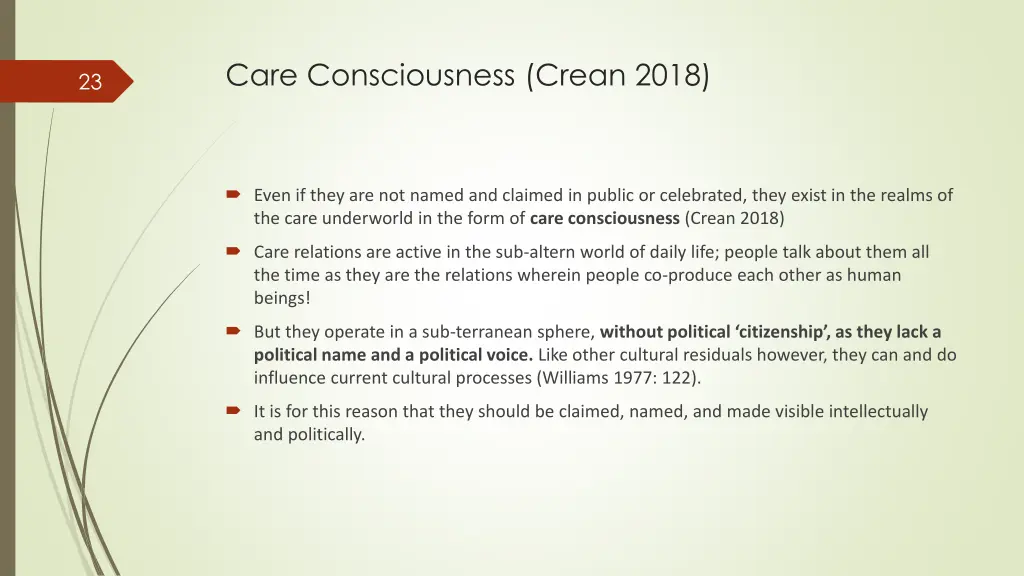
Care Consciousness (Crean 2018) 23 Even if they are not named and claimed in public or celebrated, they exist in the realms of the care underworld in the form of care consciousness (Crean 2018) Care relations are active in the sub-altern world of daily life; people talk about them all the time as they are the relations wherein people co-produce each other as human beings! But they operate in a sub-terranean sphere, without political citizenship , as they lack a political name and a political voice. Like other cultural residuals however, they can and do influence current cultural processes (Williams 1977: 122). It is for this reason that they should be claimed, named, and made visible intellectually and politically.
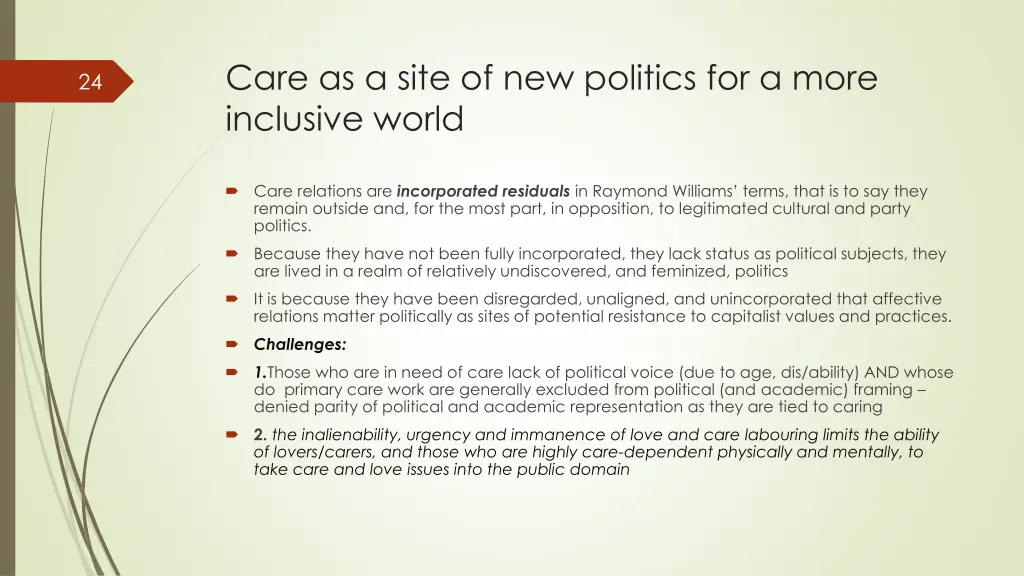
Care as a site of new politics for a more inclusive world 24 Care relations are incorporated residuals in Raymond Williams terms, that is to say they remain outside and, for the most part, in opposition, to legitimated cultural and party politics. Because they have not been fully incorporated, they lack status as political subjects, they are lived in a realm of relatively undiscovered, and feminized, politics It is because they have been disregarded, unaligned, and unincorporated that affective relations matter politically as sites of potential resistance to capitalist values and practices. Challenges: 1.Those who are in need of care lack of political voice (due to age, dis/ability) AND whose do primary care work are generally excluded from political (and academic) framing denied parity of political and academic representation as they are tied to caring 2. the inalienability, urgency and immanence of love and care labouring limits the ability of lovers/carers, and those who are highly care-dependent physically and mentally, to take care and love issues into the public domain