Explore the concepts of virtual memory, physical memory, page tables, translation with page tables, Translation Lookaside Buffer (TLB), and cache memory in computer systems as presented in Carnegie Mellon's lectures. Gain insights into the key steps for a READ operation and review fundamental parameters and symbols related to memory addressing. Discover the importance of different memory components and mechanisms in computer systems.
Please find below an Image/Link to download the presentation.
The content on the website is provided AS IS for your information and personal use only. It may not be sold, licensed, or shared on other websites without obtaining consent from the author. If you encounter any issues during the download, it is possible that the publisher has removed the file from their server.
You are allowed to download the files provided on this website for personal or commercial use, subject to the condition that they are used lawfully. All files are the property of their respective owners.
The content on the website is provided AS IS for your information and personal use only. It may not be sold, licensed, or shared on other websites without obtaining consent from the author.
E N D
Presentation Transcript
Carnegie Mellon 14-513 18 18- -613 613 1 Bryant and O Hallaron, Computer Systems: A Programmer s Perspective, Third Edition
Carnegie Mellon Virtual Memory: Systems 18-213/18-613: Introduction to Computer Systems 13th Lecture, October 10, 2023 2 Bryant and O Hallaron, Computer Systems: A Programmer s Perspective, Third Edition
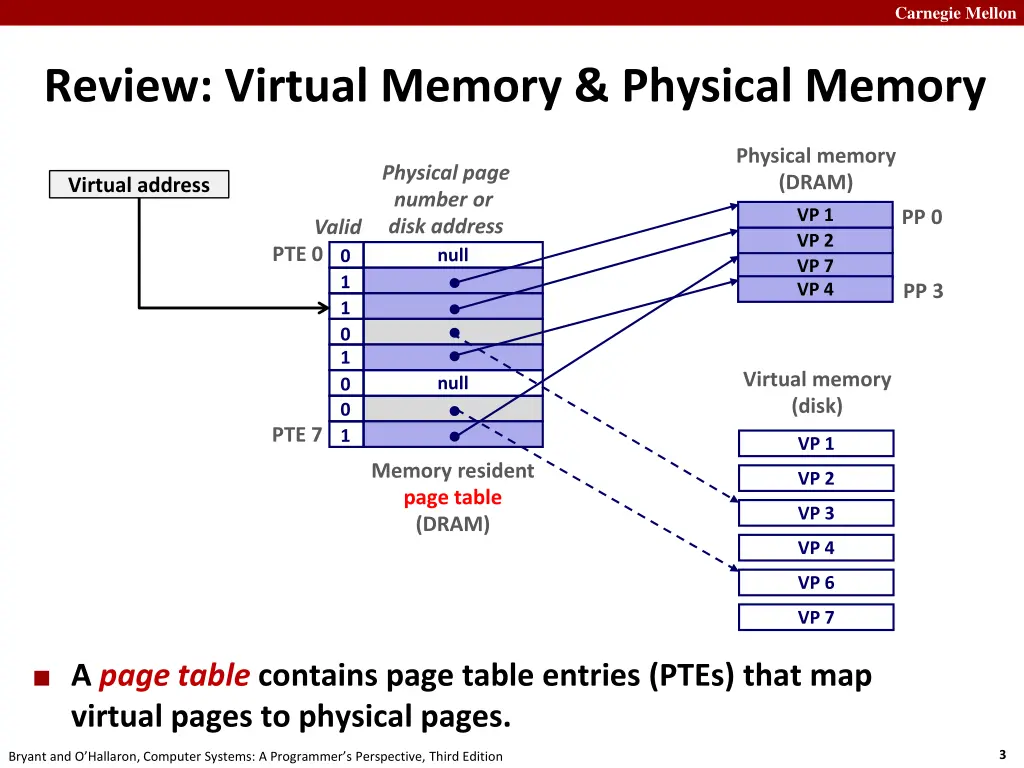
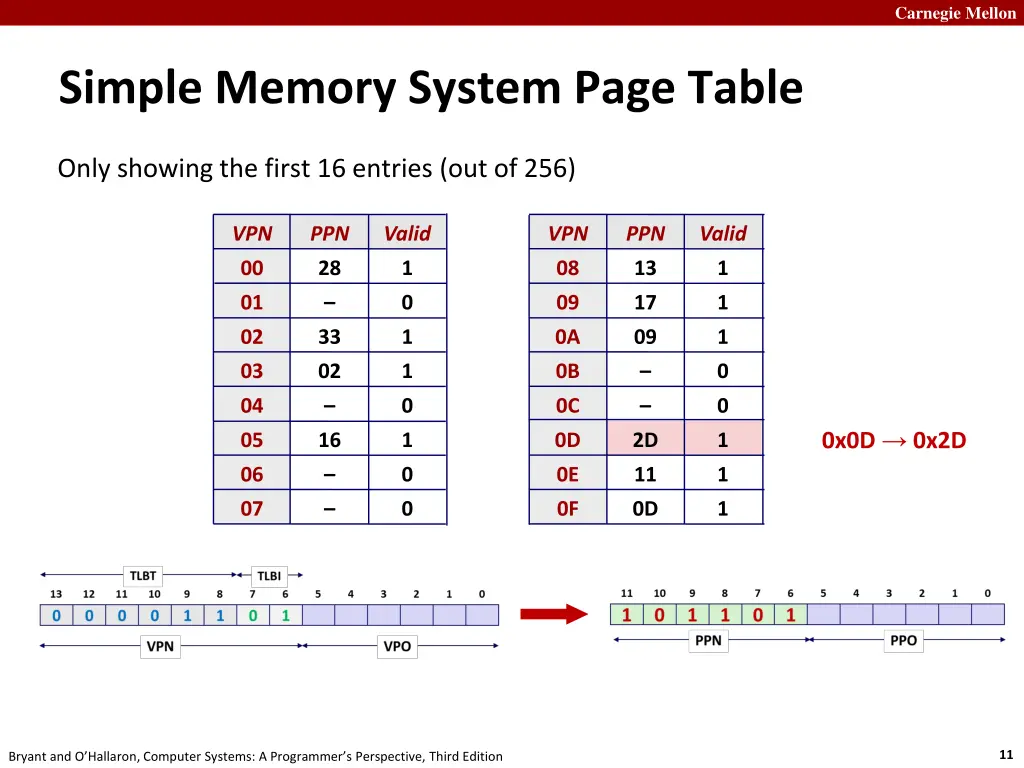
Carnegie Mellon Review: Virtual Memory & Physical Memory Physical memory (DRAM) Physical page number or disk address Virtual address VP 1 PP 0 Valid VP 2 PTE 0 null 0 1 1 VP 7 VP 4 PP 3 0 1 0 0 Virtual memory (disk) null PTE 7 1 VP 1 Memory resident page table (DRAM) VP 2 VP 3 VP 4 VP 6 VP 7 A page table contains page table entries (PTEs) that map virtual pages to physical pages. 3 Bryant and O Hallaron, Computer Systems: A Programmer s Perspective, Third Edition
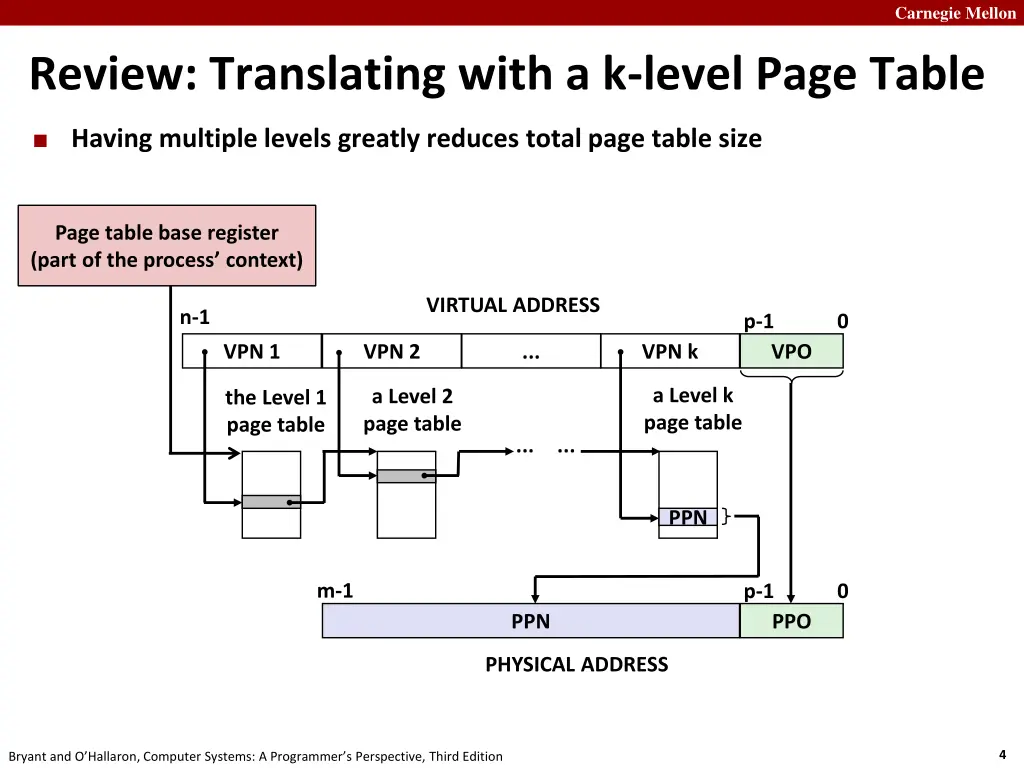
Carnegie Mellon Review: Translating with a k-level Page Table Having multiple levels greatly reduces total page table size Page table base register (part of the process context) VIRTUAL ADDRESS n-1 p-1 0 VPN 1 VPN 2 ... VPN k VPO a Level k page table a Level 2 page table the Level 1 page table ... ... PPN m-1 p-1 0 PPN PPO PHYSICAL ADDRESS 4 Bryant and O Hallaron, Computer Systems: A Programmer s Perspective, Third Edition
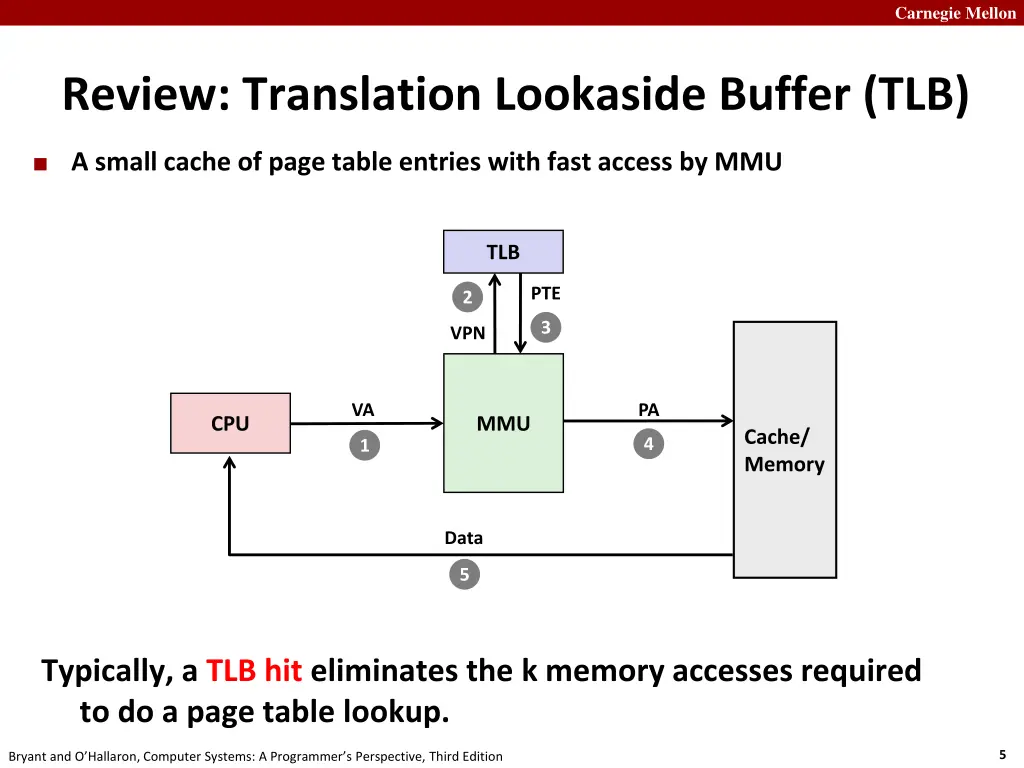
Carnegie Mellon Review: Translation Lookaside Buffer (TLB) A small cache of page table entries with fast access by MMU TLB PTE 2 3 VPN VA PA MMU CPU Cache/ Memory 4 1 Data 5 Typically, a TLB hit eliminates the k memory accesses required to do a page table lookup. 5 Bryant and O Hallaron, Computer Systems: A Programmer s Perspective, Third Edition
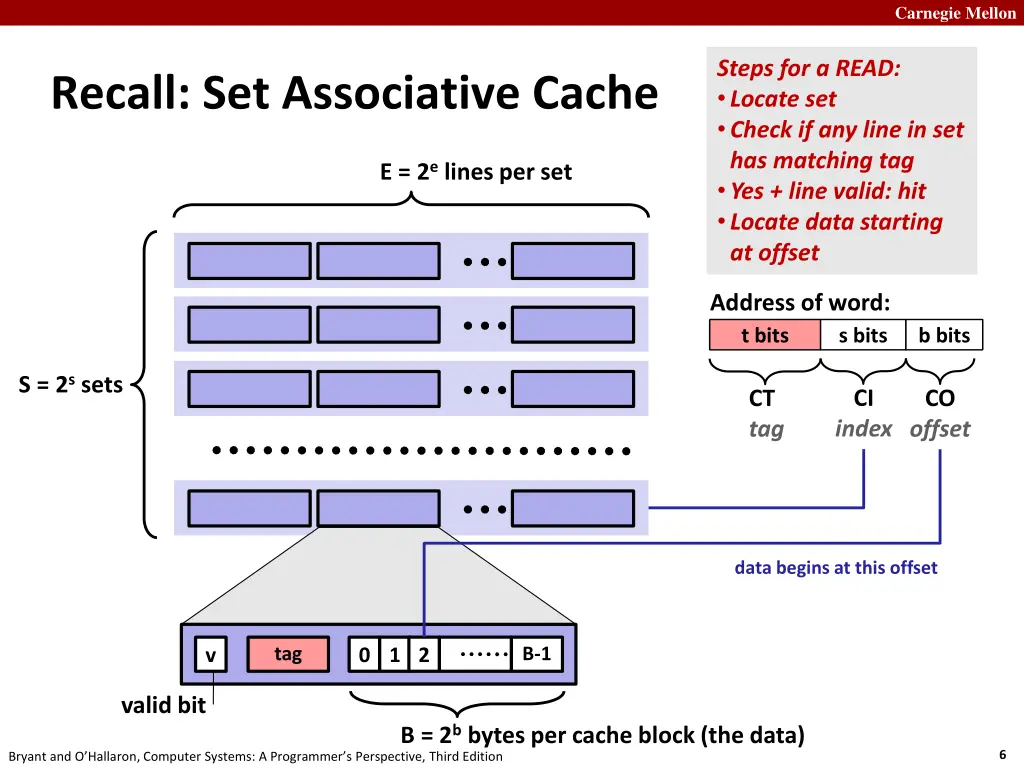
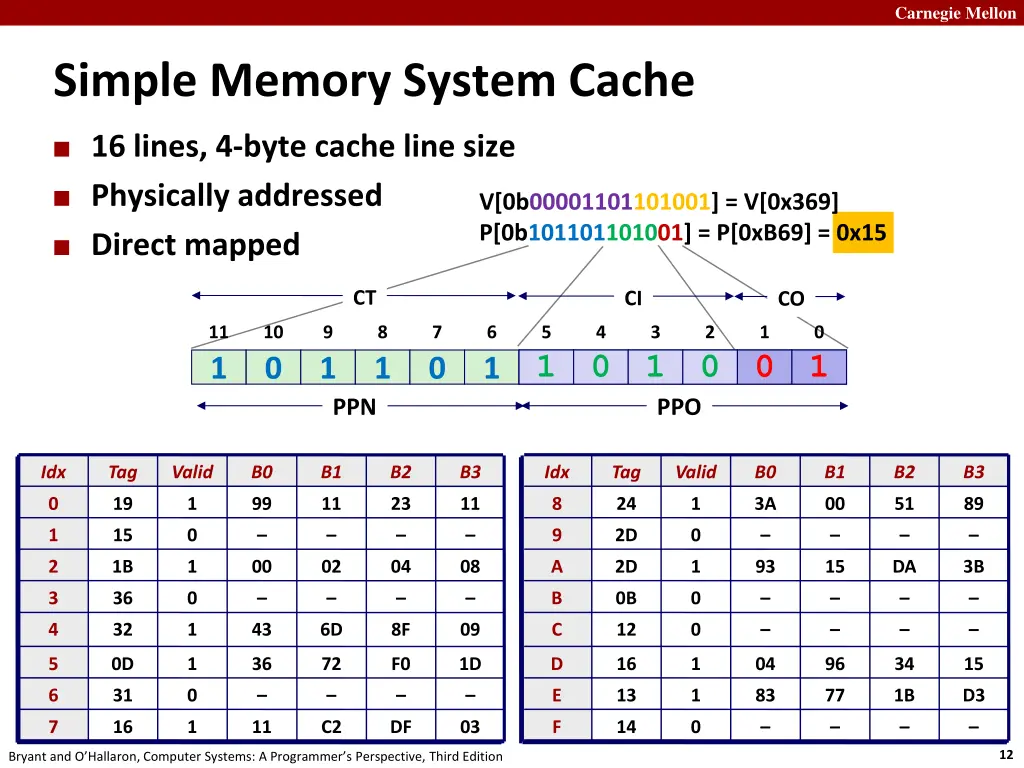
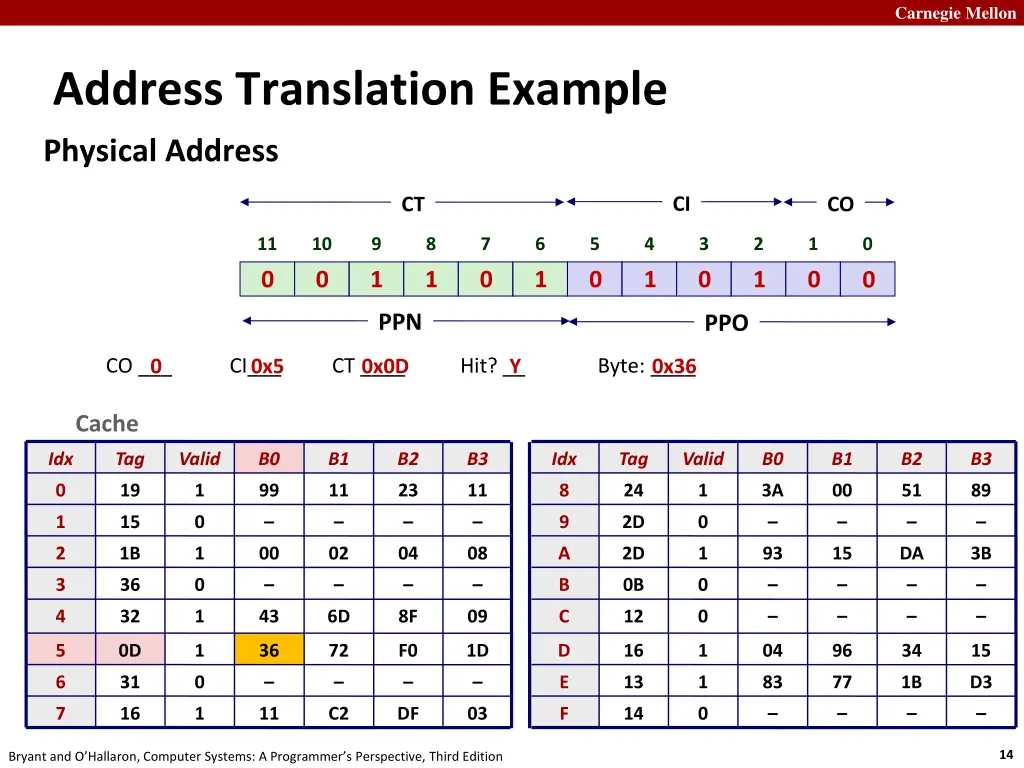
Carnegie Mellon Steps for a READ: Locate set Check if any line in set has matching tag Yes + line valid: hit Locate data starting at offset Recall: Set Associative Cache E = 2e lines per set Address of word: t bits s bits b bits S = 2s sets CI CT tag CO index offset data begins at this offset tag B-1 v 0 1 2 valid bit B = 2b bytes per cache block (the data) 6 Bryant and O Hallaron, Computer Systems: A Programmer s Perspective, Third Edition
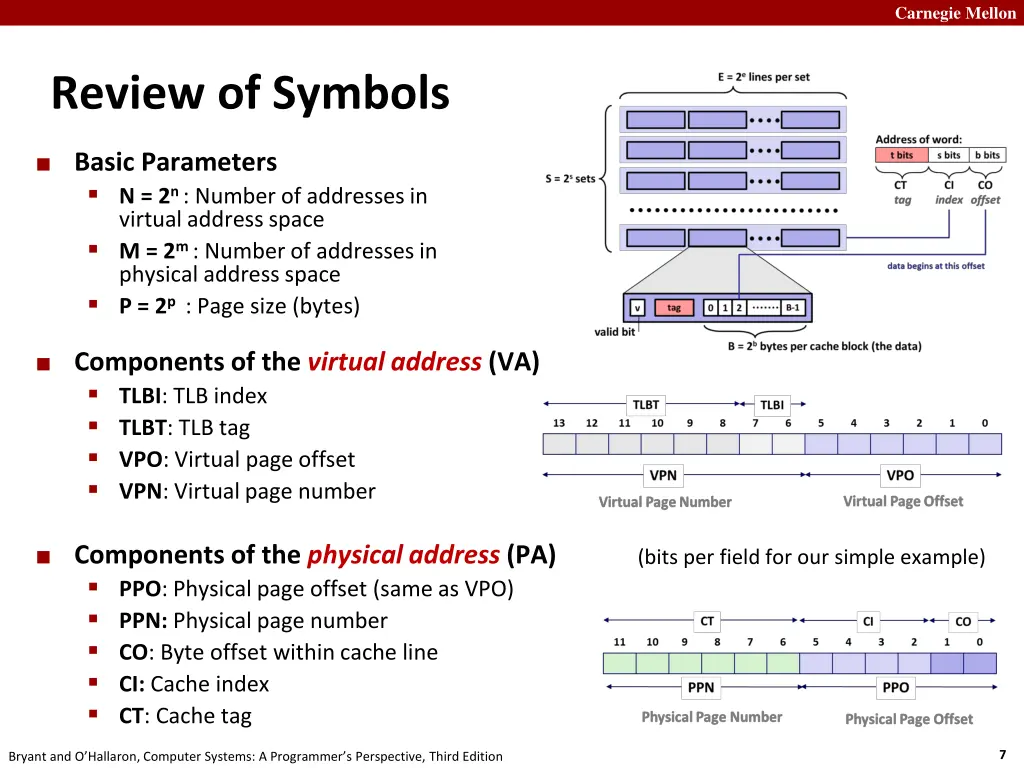
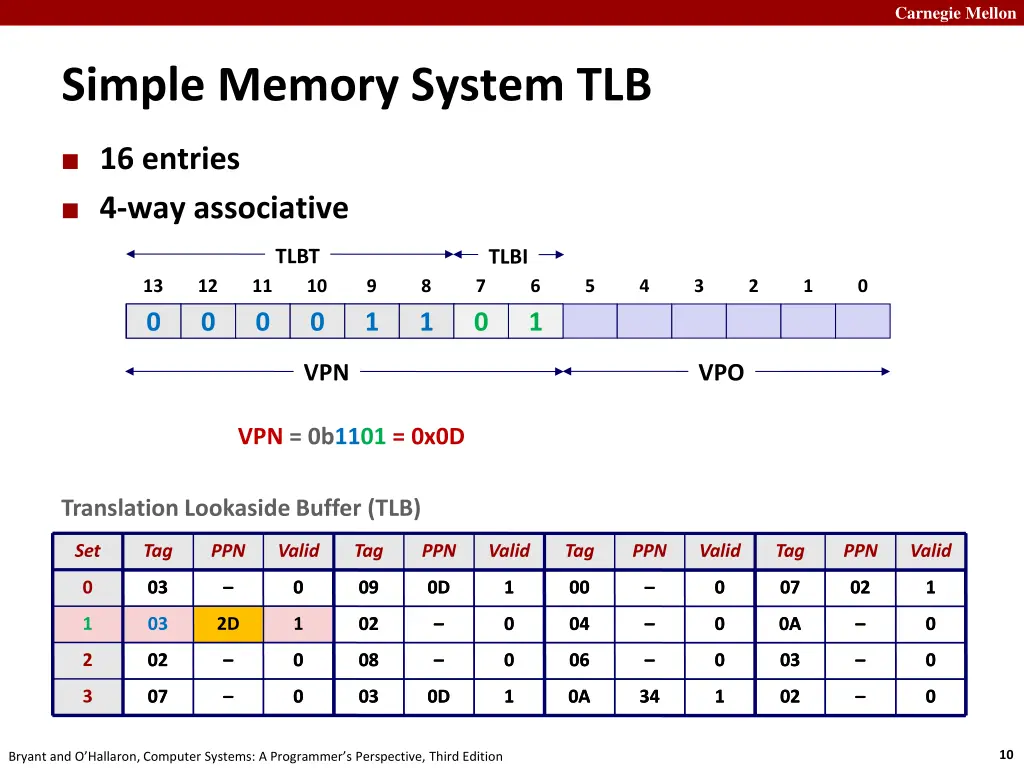
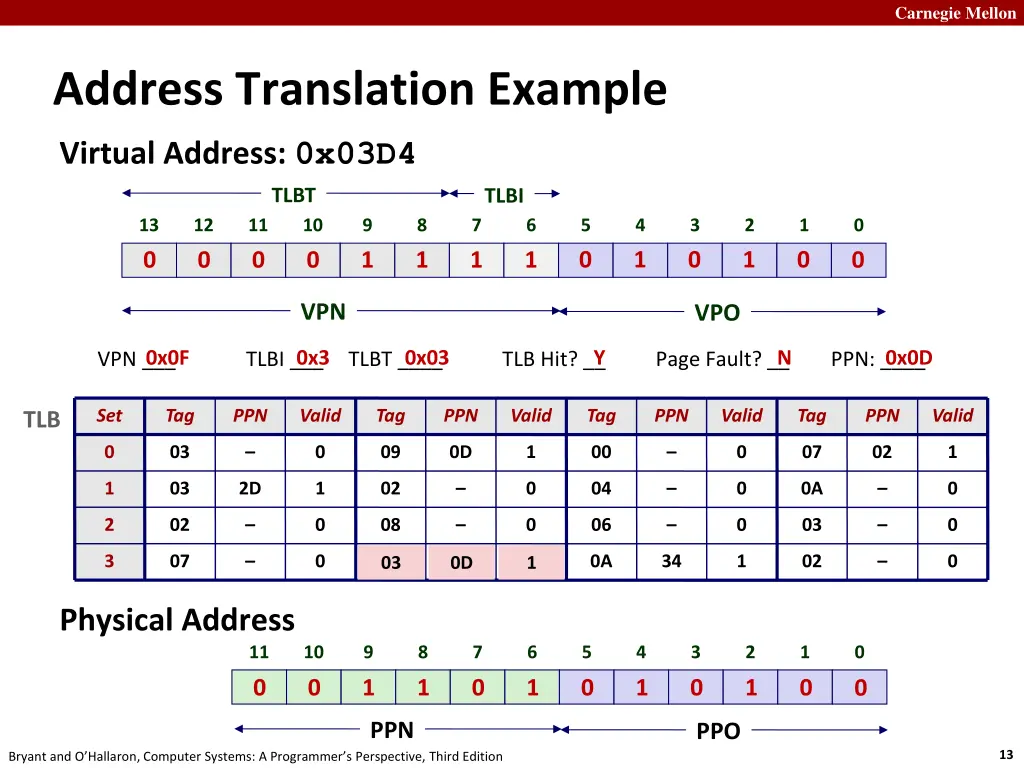
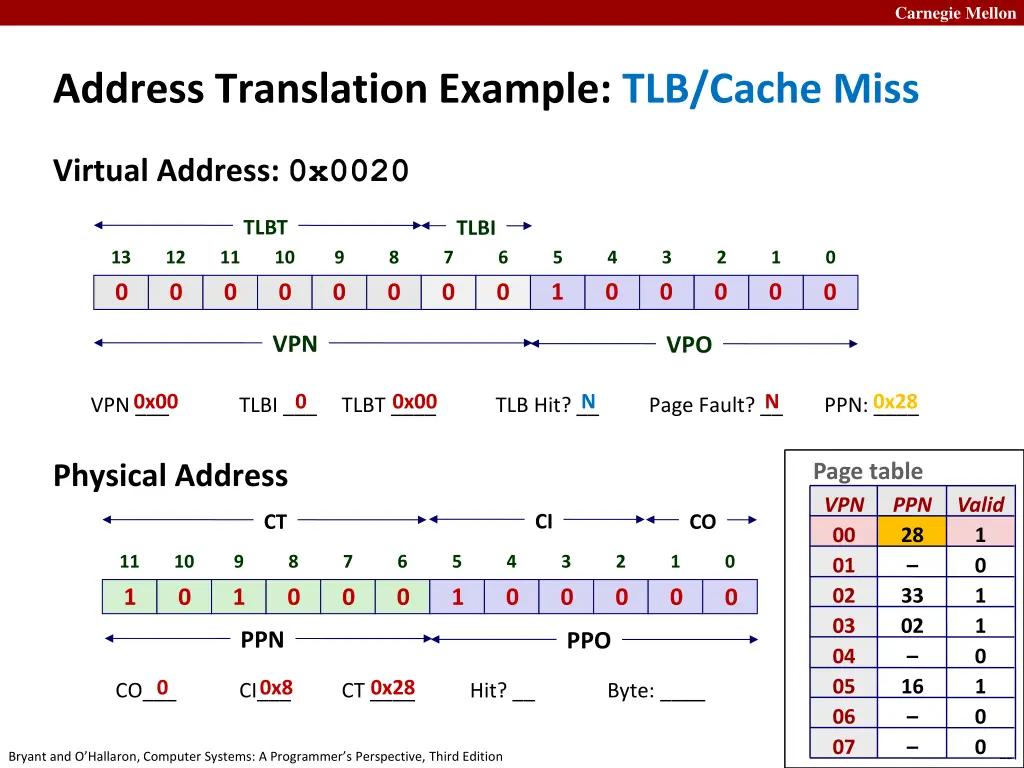
Carnegie Mellon Review of Symbols Basic Parameters N = 2n : Number of addresses in virtual address space M = 2m : Number of addresses in physical address space P = 2p : Page size (bytes) Components of the virtual address (VA) TLBI: TLB index TLBT: TLB tag VPO: Virtual page offset VPN: Virtual page number Components of the physical address (PA) PPO: Physical page offset (same as VPO) PPN: Physical page number CO: Byte offset within cache line CI: Cache index CT: Cache tag (bits per field for our simple example) 7 Bryant and O Hallaron, Computer Systems: A Programmer s Perspective, Third Edition
Carnegie Mellon Today Simple memory system example CSAPP 9.6.4 CSAPP 9.7 CSAPP 9.8 Case study: Core i7/Linux memory system Memory mapping 8 Bryant and O Hallaron, Computer Systems: A Programmer s Perspective, Third Edition
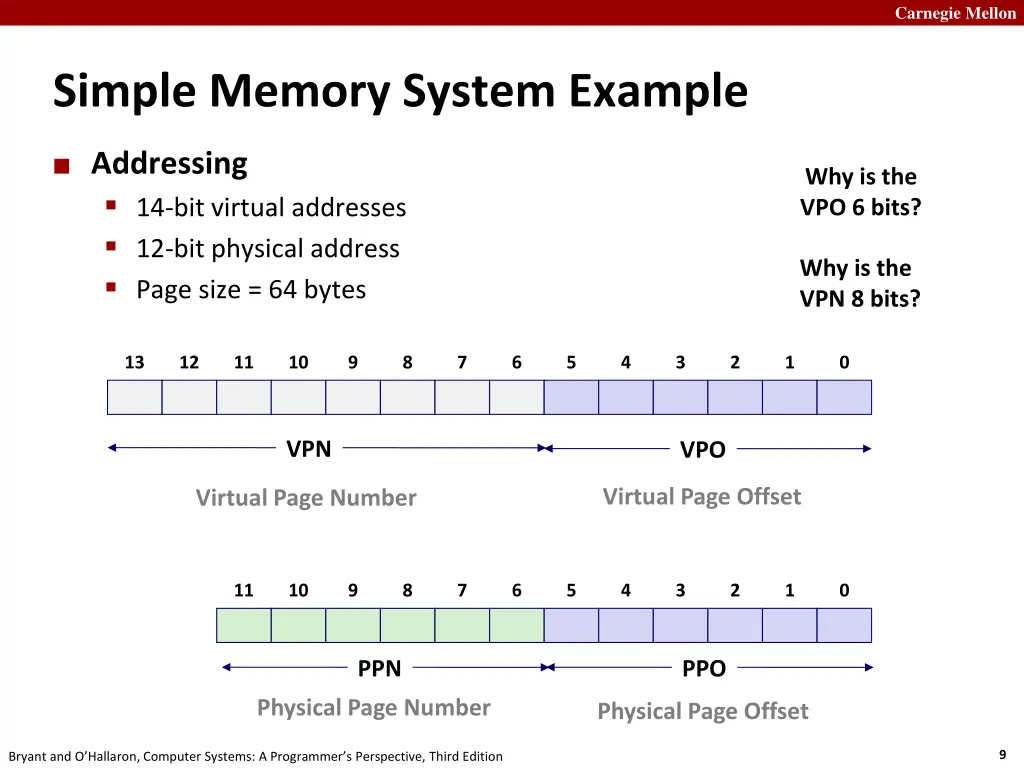
Carnegie Mellon Simple Memory System Example Why is the VPN 8 bits? Addressing 14-bit virtual addresses 12-bit physical address Page size = 64 bytes Why is the VPO 6 bits? Why is the VPN 8 bits? 13 12 11 10 9 8 7 6 5 4 3 2 1 0 VPN VPO Virtual Page Offset Virtual Page Number 11 10 9 8 7 6 5 4 3 2 1 0 PPN PPO Physical Page Number Physical Page Offset 9 Bryant and O Hallaron, Computer Systems: A Programmer s Perspective, Third Edition
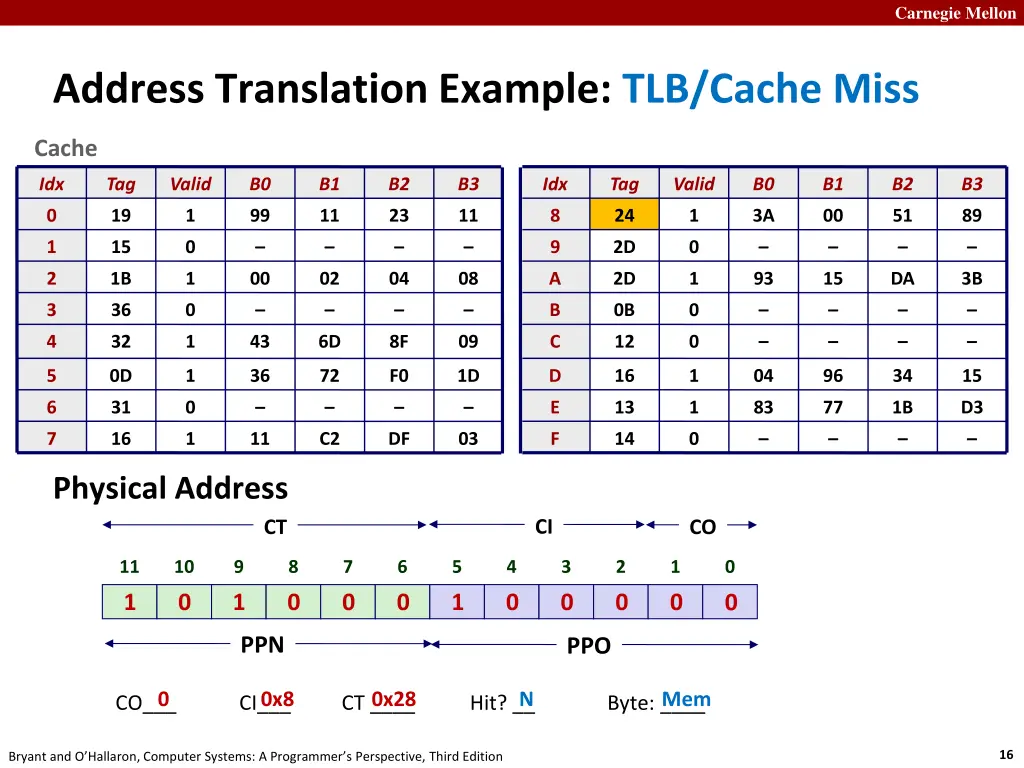
Carnegie Mellon Address Translation Example: TLB/Cache Miss Cache Idx Tag Valid B0 B1 B2 B3 Idx Tag Valid B0 B1 B2 B3 0 19 1 99 11 23 11 8 24 1 3A 00 51 89 1 15 0 9 2D 0 2 1B 1 00 02 04 08 A 2D 1 93 15 DA 3B 3 36 0 B 0B 0 4 32 1 43 6D 8F 09 C 12 0 5 0D 1 36 72 F0 1D D 16 1 04 96 34 15 6 31 0 E 13 1 83 77 1B D3 7 16 1 11 C2 DF 03 F 14 0 Physical Address CI CT CO 11 10 9 8 7 6 5 4 3 2 1 0 1 0 1 0 0 0 1 0 0 0 0 0 PPN PPO 0 CI___ 0x8 CT ____ 0x28 Hit? __ Byte: ____ N Mem CO___ 16 Bryant and O Hallaron, Computer Systems: A Programmer s Perspective, Third Edition
Carnegie Mellon Quiz Time! Canvas Quiz: Day 13 VM Systems 18 Bryant and O Hallaron, Computer Systems: A Programmer s Perspective, Third Edition
Carnegie Mellon Today Simple memory system example Case study: Core i7/Linux memory system Memory mapping 19 Bryant and O Hallaron, Computer Systems: A Programmer s Perspective, Third Edition
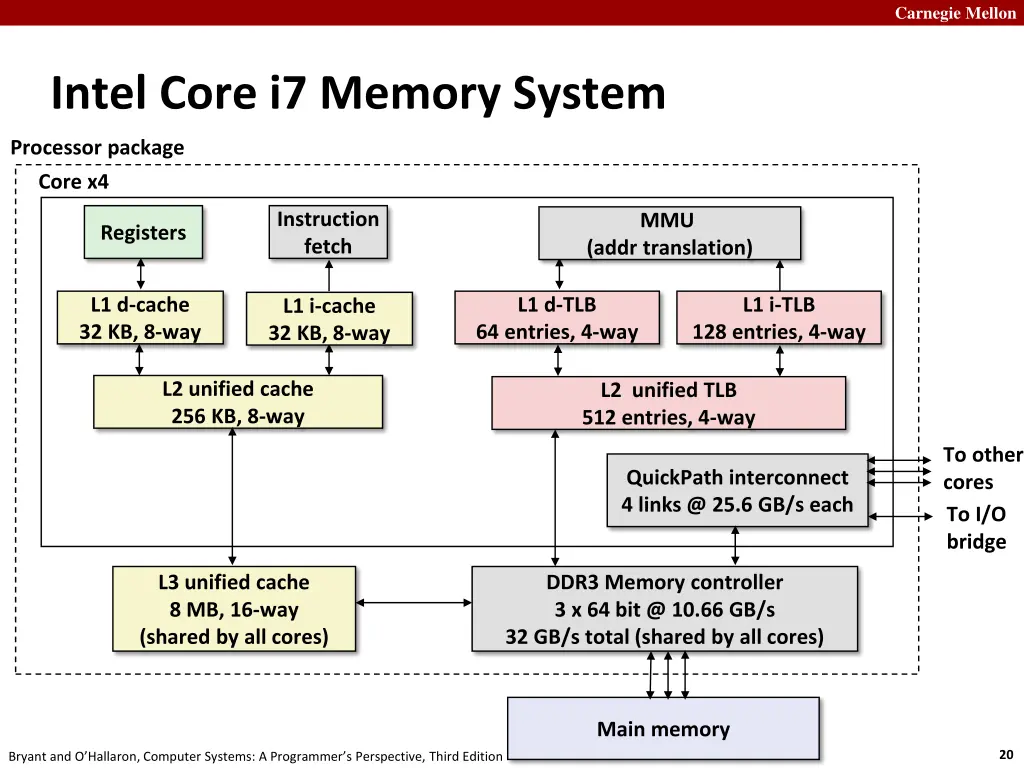
Carnegie Mellon Intel Core i7 Memory System Processor package Core x4 Instruction fetch MMU Registers (addr translation) L1 d-cache 32 KB, 8-way L1 d-TLB L1 i-TLB L1 i-cache 32 KB, 8-way 64 entries, 4-way 128 entries, 4-way L2 unified cache 256 KB, 8-way L2 unified TLB 512 entries, 4-way To other cores To I/O bridge QuickPath interconnect 4 links @ 25.6 GB/s each L3 unified cache 8 MB, 16-way (shared by all cores) DDR3 Memory controller 3 x 64 bit @ 10.66 GB/s 32 GB/s total (shared by all cores) Main memory 20 Bryant and O Hallaron, Computer Systems: A Programmer s Perspective, Third Edition
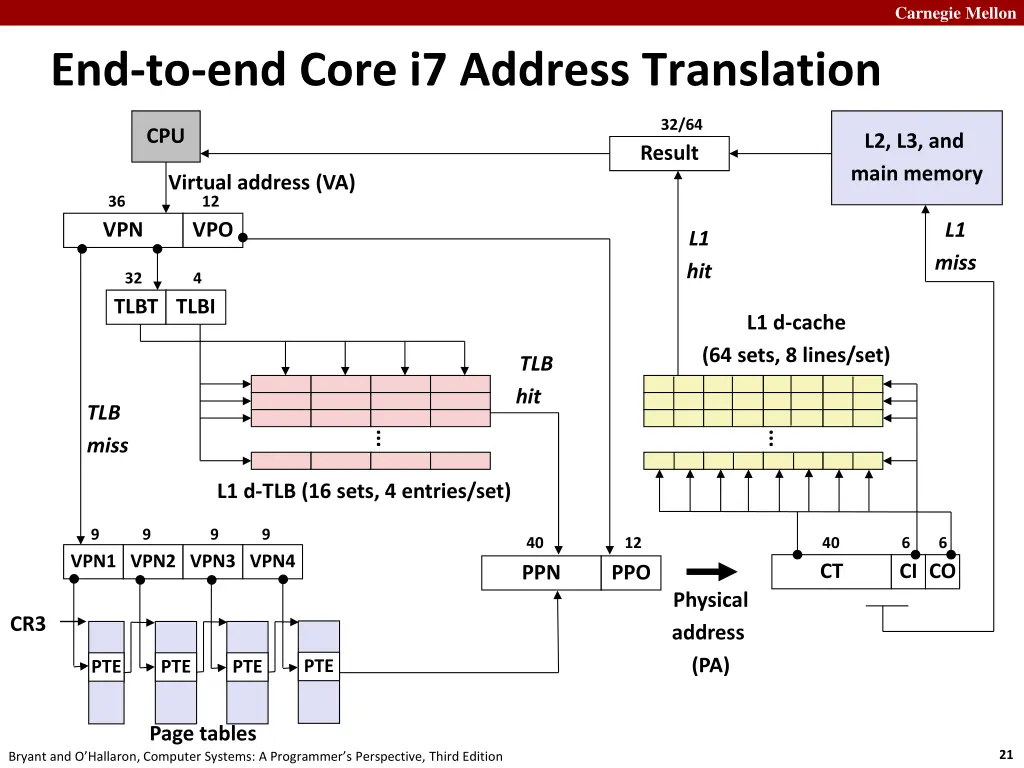
Carnegie Mellon End-to-end Core i7 Address Translation 32/64 CPU L2, L3, and main memory Result Virtual address (VA) 36 12 VPN VPO L1 miss L1 hit 32 4 TLBT TLBI L1 d-cache (64 sets, 8 lines/set) TLB hit TLB miss ... ... L1 d-TLB (16 sets, 4 entries/set) 9 9 9 9 40 12 40 6 6 VPN1 VPN2 VPN3 VPN4 CT CI CO PPN PPO Physical address (PA) CR3 PTE PTE PTE PTE Page tables 21 Bryant and O Hallaron, Computer Systems: A Programmer s Perspective, Third Edition
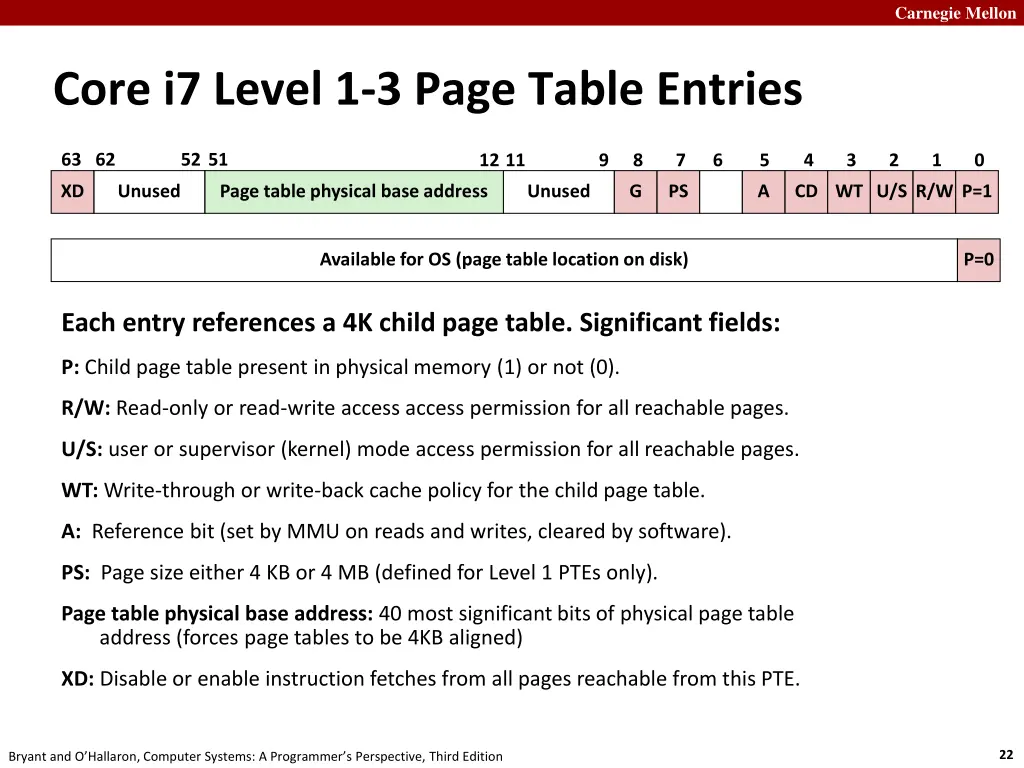
Carnegie Mellon Core i7 Level 1-3 Page Table Entries 63 62 52 51 12 11 9 8 7 6 5 4 3 2 1 0 XD Unused Page table physical base address Unused G PS A CD WT U/S R/W P=1 Available for OS (page table location on disk) P=0 Each entry references a 4K child page table. Significant fields: P: Child page table present in physical memory (1) or not (0). R/W: Read-only or read-write access access permission for all reachable pages. U/S: user or supervisor (kernel) mode access permission for all reachable pages. WT: Write-through or write-back cache policy for the child page table. A: Reference bit (set by MMU on reads and writes, cleared by software). PS: Page size either 4 KB or 4 MB (defined for Level 1 PTEs only). Page table physical base address: 40 most significant bits of physical page table address (forces page tables to be 4KB aligned) XD: Disable or enable instruction fetches from all pages reachable from this PTE. 22 Bryant and O Hallaron, Computer Systems: A Programmer s Perspective, Third Edition
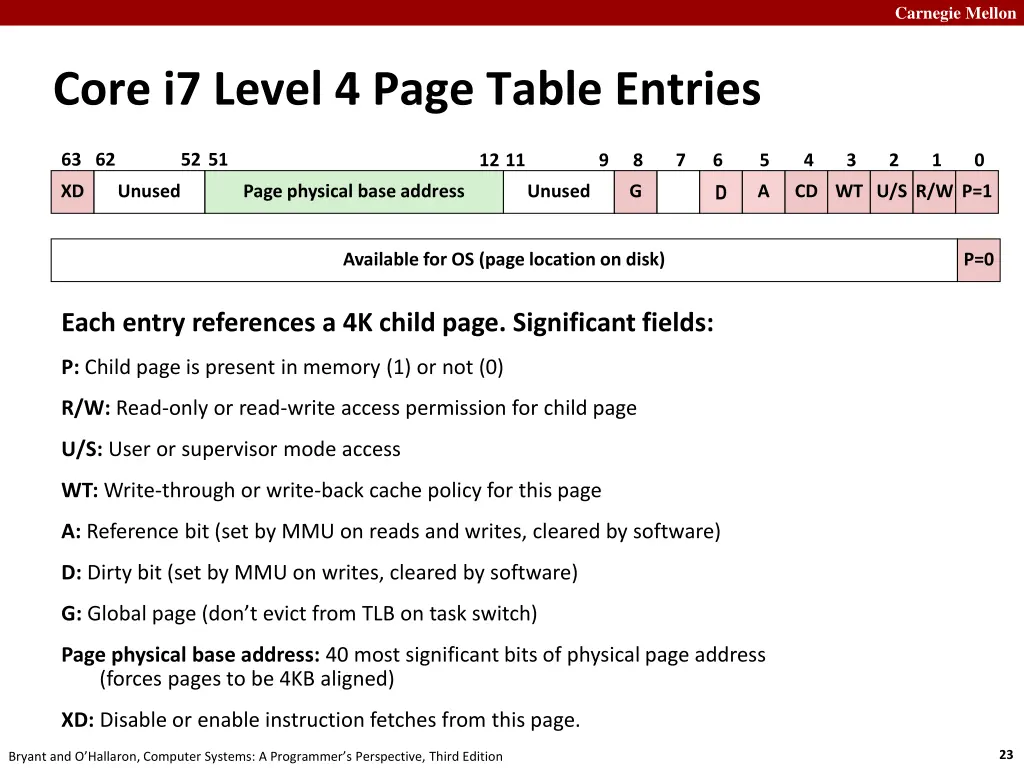
Carnegie Mellon Core i7 Level 4 Page Table Entries 63 62 52 51 12 11 9 8 7 6 5 4 3 2 1 0 D XD Unused Page physical base address Unused G A CD WT U/S R/W P=1 Available for OS (page location on disk) P=0 Each entry references a 4K child page. Significant fields: P: Child page is present in memory (1) or not (0) R/W: Read-only or read-write access permission for child page U/S: User or supervisor mode access WT: Write-through or write-back cache policy for this page A: Reference bit (set by MMU on reads and writes, cleared by software) D: Dirty bit (set by MMU on writes, cleared by software) G:Global page (don t evict from TLB on task switch) Page physical base address: 40 most significant bits of physical page address (forces pages to be 4KB aligned) XD: Disable or enable instruction fetches from this page. 23 Bryant and O Hallaron, Computer Systems: A Programmer s Perspective, Third Edition
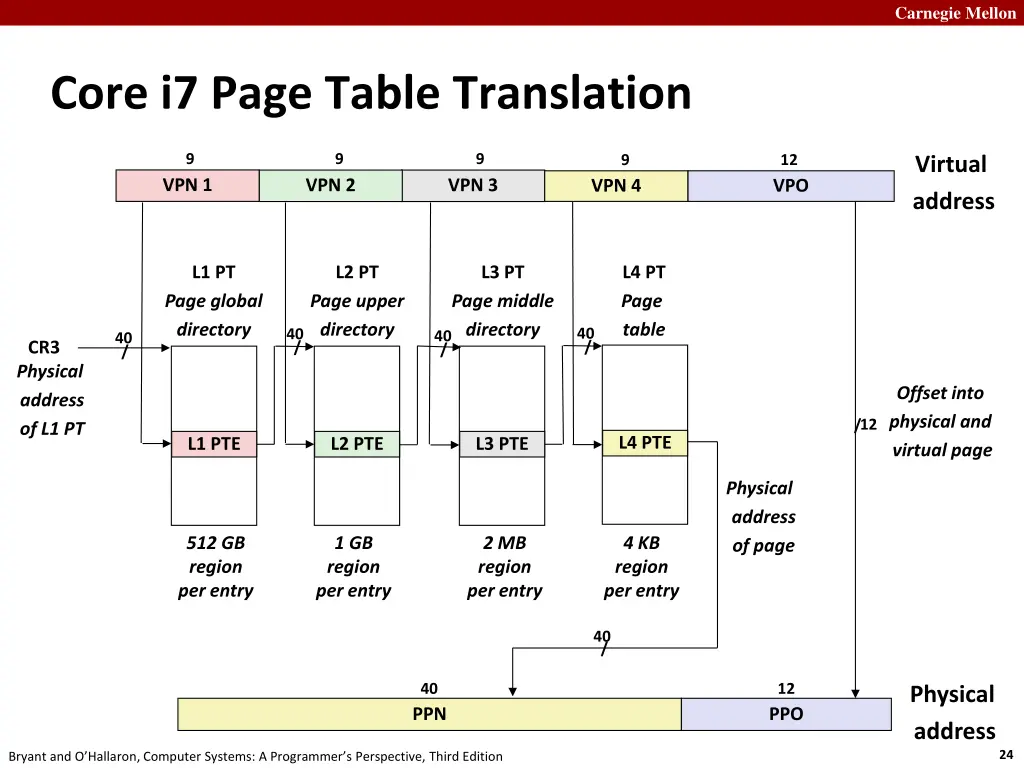
Carnegie Mellon Core i7 Page Table Translation 9 9 9 9 12 Virtual address VPN 1 VPN 2 VPN 3 VPN 4 VPO L1 PT L2 PT L3 PT L4 PT Page table Page global directory Page upper directory Page middle directory 40 / 40 / 40 / 40 / CR3 Physical address of L1 PT Offset into physical and virtual page 12 / L4 PTE L1 PTE L2 PTE L3 PTE Physical address of page 512 GB region per entry 1 GB region per entry 2 MB region per entry 4 KB region per entry 40 / 40 12 Physical address PPN PPO 24 Bryant and O Hallaron, Computer Systems: A Programmer s Perspective, Third Edition
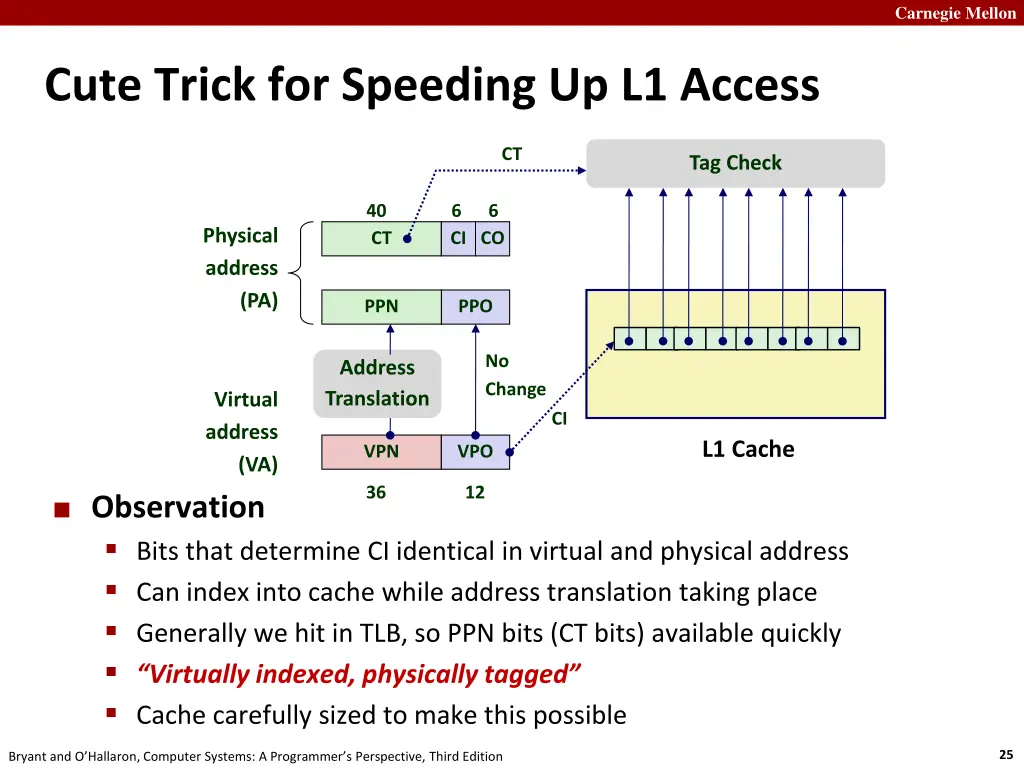
Carnegie Mellon Cute Trick for Speeding Up L1 Access CT Tag Check 40 6 6 Physical address (PA) CT CI CO PPN PPO No Change Address Translation Virtual address (VA) CI L1 Cache VPN VPO 36 12 Observation Bits that determine CI identical in virtual and physical address Can index into cache while address translation taking place Generally we hit in TLB, so PPN bits (CT bits) available quickly Virtually indexed, physically tagged Cache carefully sized to make this possible 25 Bryant and O Hallaron, Computer Systems: A Programmer s Perspective, Third Edition
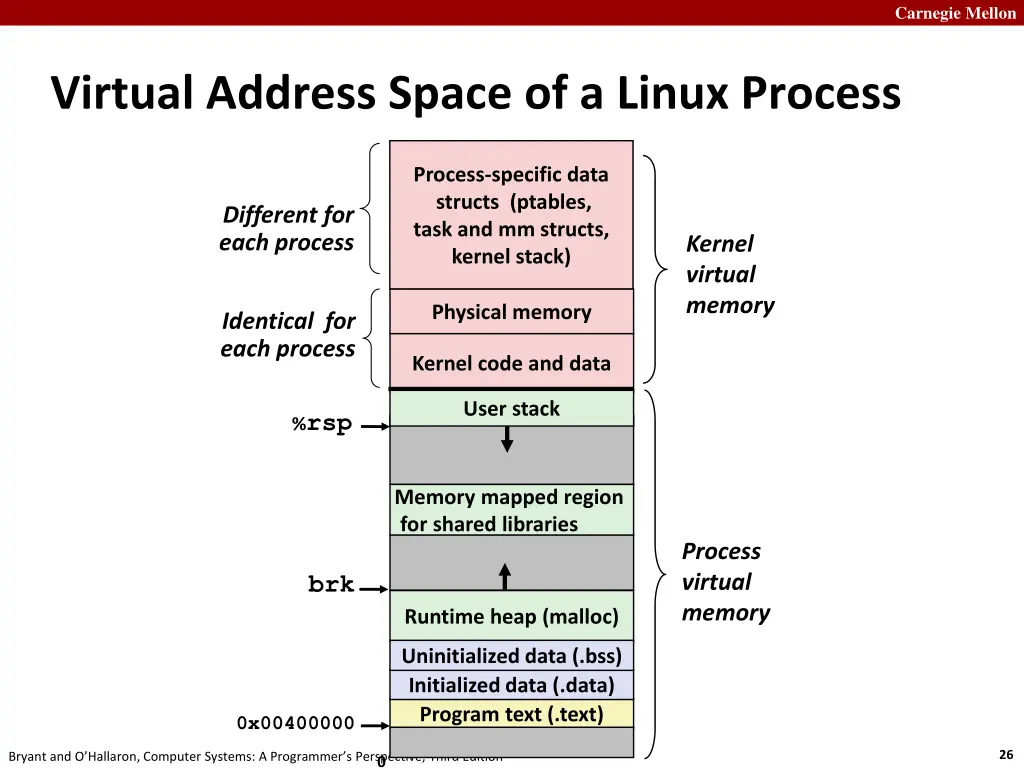
Carnegie Mellon Virtual Address Space of a Linux Process Process-specific data structs (ptables, task and mm structs, kernel stack) Different for each process Kernel virtual memory Physical memory Identical for each process Kernel code and data User stack %rsp Memory mapped region for shared libraries Process virtual memory brk Runtime heap (malloc) Uninitialized data (.bss) Initialized data (.data) Program text (.text) 0x00400000 26 Bryant and O Hallaron, Computer Systems: A Programmer s Perspective, Third Edition 0
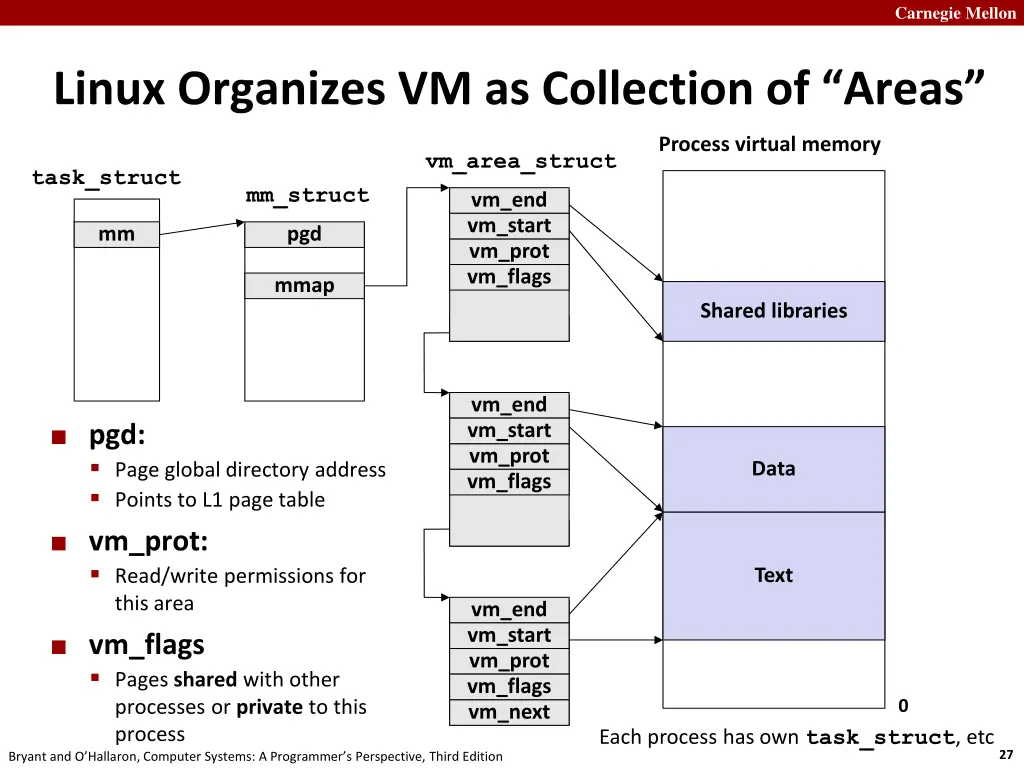
Carnegie Mellon Linux Organizes VM as Collection of Areas Process virtual memory vm_area_struct task_struct mm_struct vm_end vm_start mm pgd vm_prot vm_flags mmap Shared libraries vm_next vm_end vm_start pgd: Page global directory address Points to L1 page table vm_prot vm_flags Data vm_next vm_prot: Read/write permissions for this area Text vm_end vm_start vm_flags Pages shared with other processes or private to this process vm_prot vm_flags 0 vm_next Each process has own task_struct, etc 27 Bryant and O Hallaron, Computer Systems: A Programmer s Perspective, Third Edition
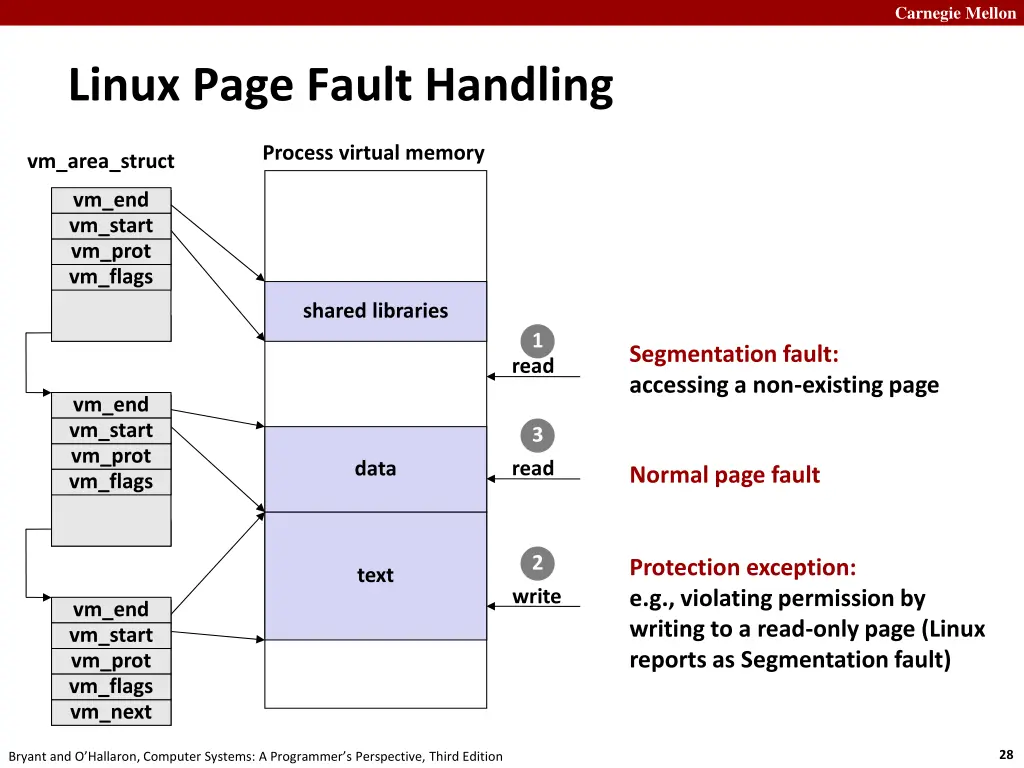
Carnegie Mellon Linux Page Fault Handling Process virtual memory vm_area_struct vm_end vm_start vm_prot vm_flags shared libraries vm_next 1 Segmentation fault: accessing a non-existing page read vm_end vm_start 3 vm_prot vm_flags read data Normal page fault vm_next 2 Protection exception: e.g., violating permission by writing to a read-only page (Linux reports as Segmentation fault) text write vm_end vm_start vm_prot vm_flags vm_next 28 Bryant and O Hallaron, Computer Systems: A Programmer s Perspective, Third Edition
Carnegie Mellon Today Simple memory system example Case study: Core i7/Linux memory system Memory mapping 29 Bryant and O Hallaron, Computer Systems: A Programmer s Perspective, Third Edition
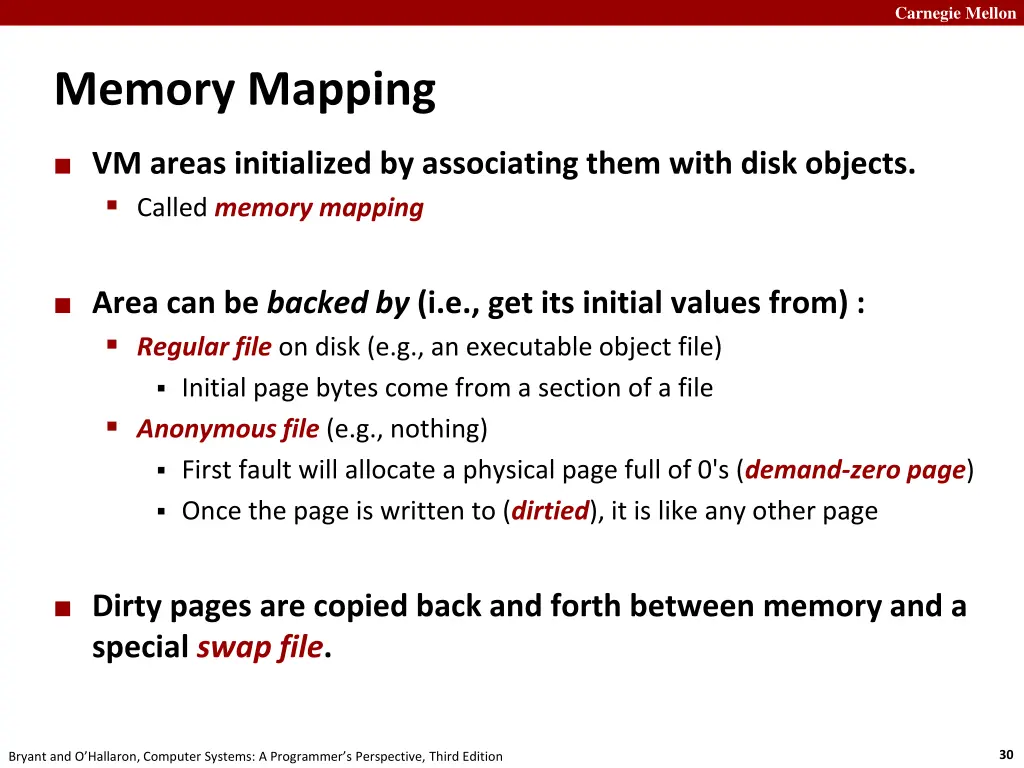
Carnegie Mellon Memory Mapping VM areas initialized by associating them with disk objects. Called memory mapping Area can be backed by (i.e., get its initial values from) : Regular fileon disk (e.g., an executable object file) Initial page bytes come from a section of a file Anonymous file (e.g., nothing) First fault will allocate a physical page full of 0's (demand-zero page) Once the page is written to (dirtied), it is like any other page Dirty pages are copied back and forth between memory and a special swap file. 30 Bryant and O Hallaron, Computer Systems: A Programmer s Perspective, Third Edition
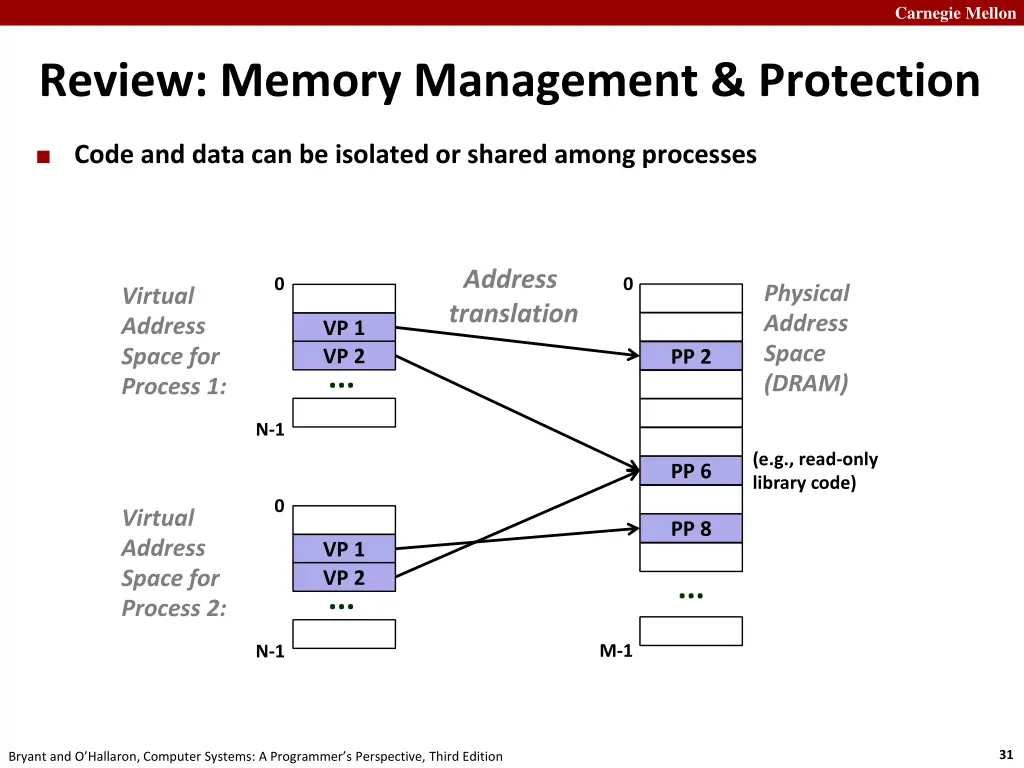
Carnegie Mellon Review: Memory Management & Protection Code and data can be isolated or shared among processes Address translation 0 0 Physical Address Space (DRAM) Virtual Address Space for Process 1: VP 1 VP 2 ... PP 2 N-1 (e.g., read-only library code) PP 6 0 Virtual Address Space for Process 2: PP 8 VP 1 VP 2 ... ... M-1 N-1 31 Bryant and O Hallaron, Computer Systems: A Programmer s Perspective, Third Edition
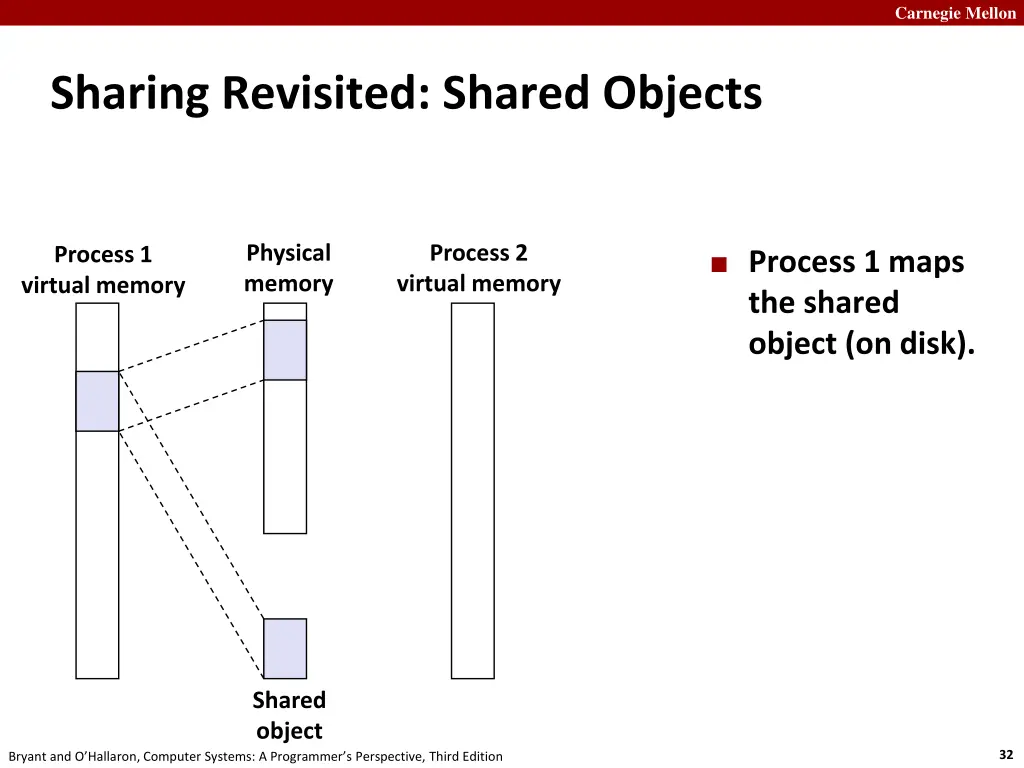
Carnegie Mellon Sharing Revisited: Shared Objects Physical memory Process 2 virtual memory Process 1 virtual memory Process 1 maps the shared object (on disk). Shared object 32 Bryant and O Hallaron, Computer Systems: A Programmer s Perspective, Third Edition
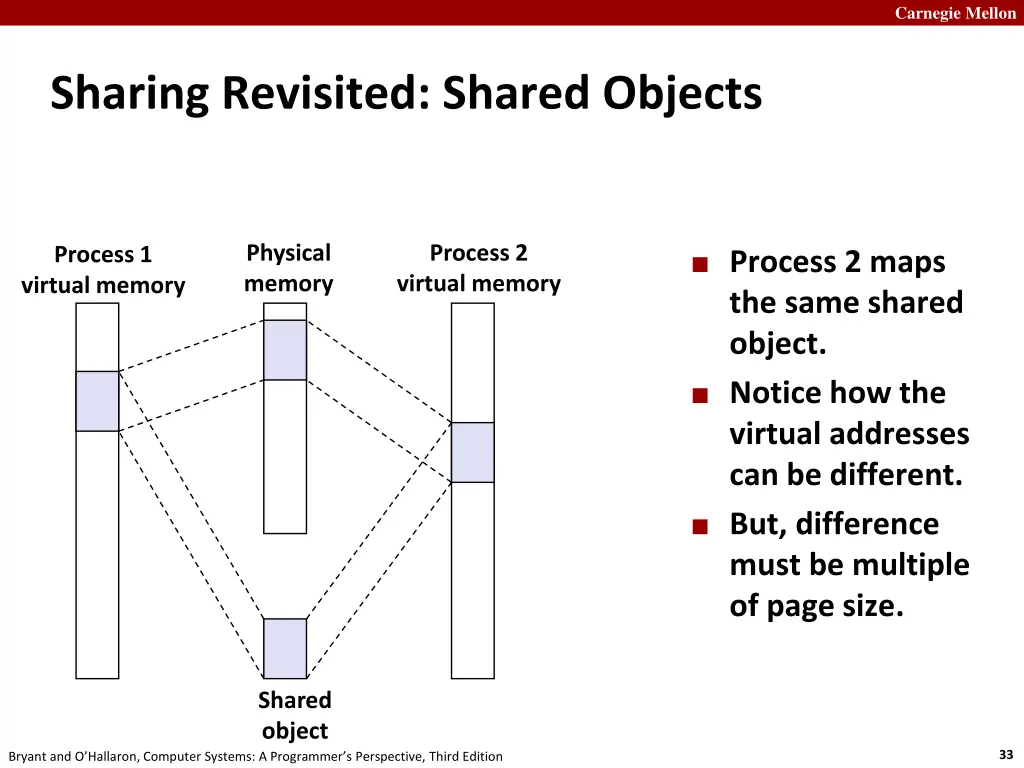
Carnegie Mellon Sharing Revisited: Shared Objects Physical memory Process 2 virtual memory Process 1 virtual memory Process 2 maps the same shared object. Notice how the virtual addresses can be different. But, difference must be multiple of page size. Shared object 33 Bryant and O Hallaron, Computer Systems: A Programmer s Perspective, Third Edition
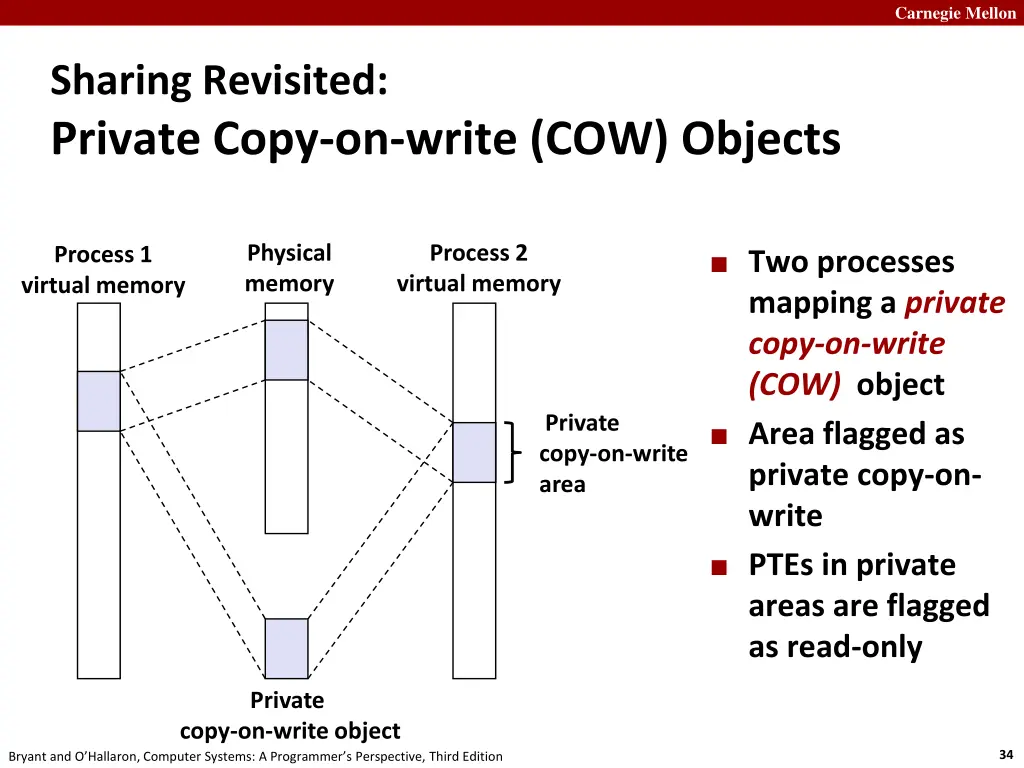
Carnegie Mellon Sharing Revisited: Private Copy-on-write (COW) Objects Physical memory Process 2 virtual memory Process 1 virtual memory Two processes mapping a private copy-on-write (COW) object Private copy-on-write area Area flagged as private copy-on- write PTEs in private areas are flagged as read-only Private copy-on-write object 34 Bryant and O Hallaron, Computer Systems: A Programmer s Perspective, Third Edition
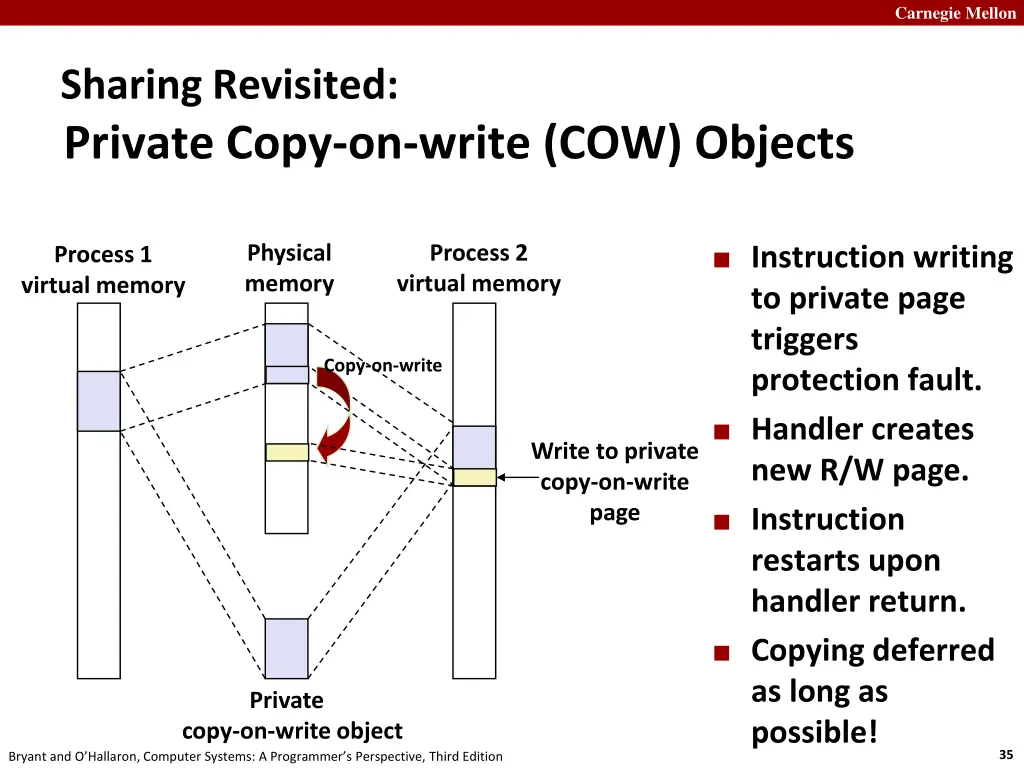
Carnegie Mellon Sharing Revisited: Private Copy-on-write (COW) Objects Physical memory Process 2 virtual memory Instruction writing to private page triggers protection fault. Process 1 virtual memory Copy-on-write Handler creates new R/W page. Write to private copy-on-write page Instruction restarts upon handler return. Copying deferred as long as possible! Private copy-on-write object 35 Bryant and O Hallaron, Computer Systems: A Programmer s Perspective, Third Edition
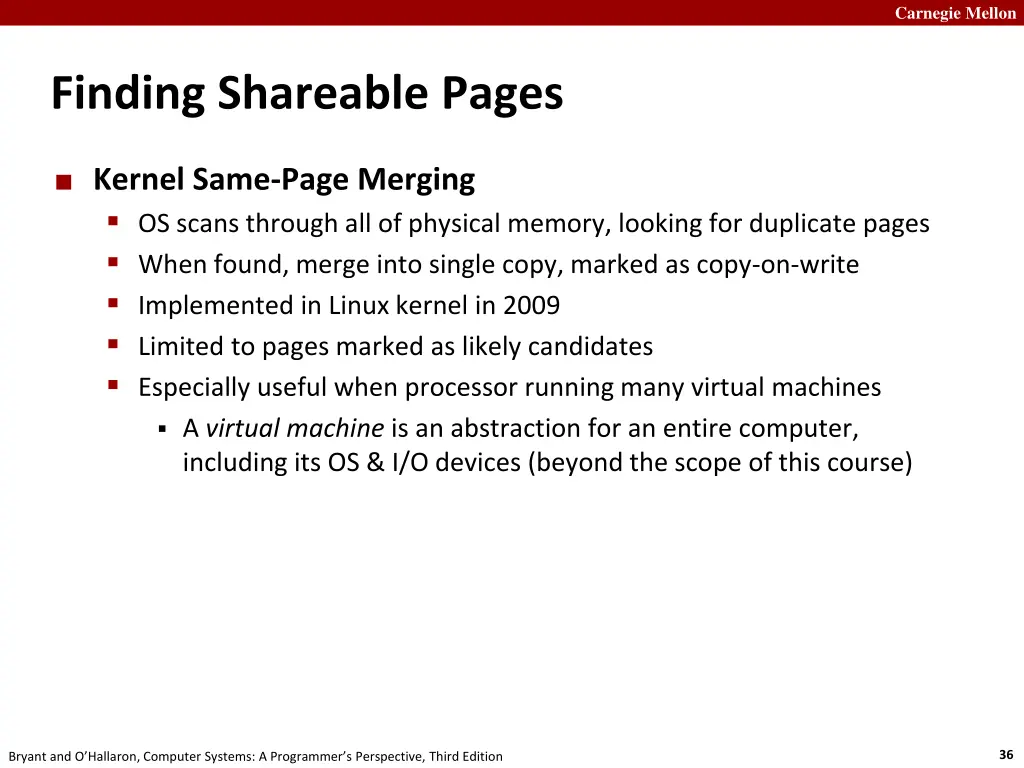
Carnegie Mellon Finding Shareable Pages Kernel Same-Page Merging OS scans through all of physical memory, looking for duplicate pages When found, merge into single copy, marked as copy-on-write Implemented in Linux kernel in 2009 Limited to pages marked as likely candidates Especially useful when processor running many virtual machines A virtual machine is an abstraction for an entire computer, including its OS & I/O devices (beyond the scope of this course) 36 Bryant and O Hallaron, Computer Systems: A Programmer s Perspective, Third Edition
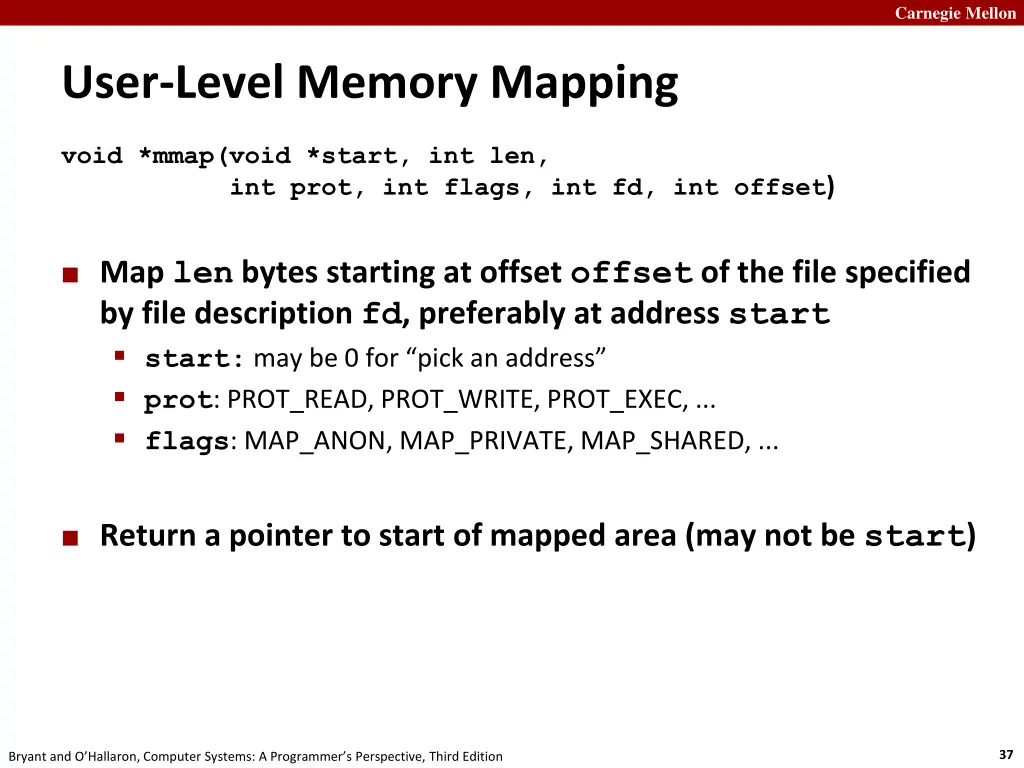
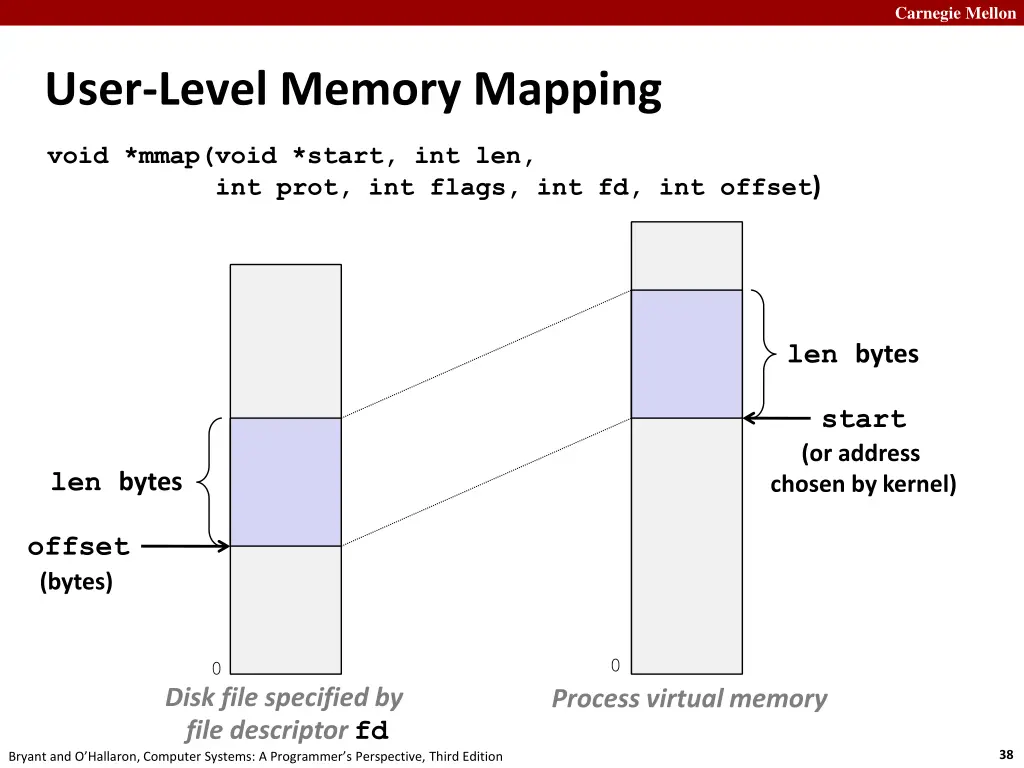
Carnegie Mellon User-Level Memory Mapping void *mmap(void *start, int len, int prot, int flags, int fd, int offset) Map len bytes starting at offset offset of the file specified by file description fd, preferably at address start start:may be 0 for pick an address prot: PROT_READ, PROT_WRITE, PROT_EXEC, ... flags: MAP_ANON, MAP_PRIVATE, MAP_SHARED, ... Return a pointer to start of mapped area (may not be start) 37 Bryant and O Hallaron, Computer Systems: A Programmer s Perspective, Third Edition
Carnegie Mellon User-Level Memory Mapping void *mmap(void *start, int len, int prot, int flags, int fd, int offset) len bytes start (or address chosen by kernel) len bytes offset (bytes) 0 0 Disk file specified by file descriptor fd Process virtual memory 38 Bryant and O Hallaron, Computer Systems: A Programmer s Perspective, Third Edition
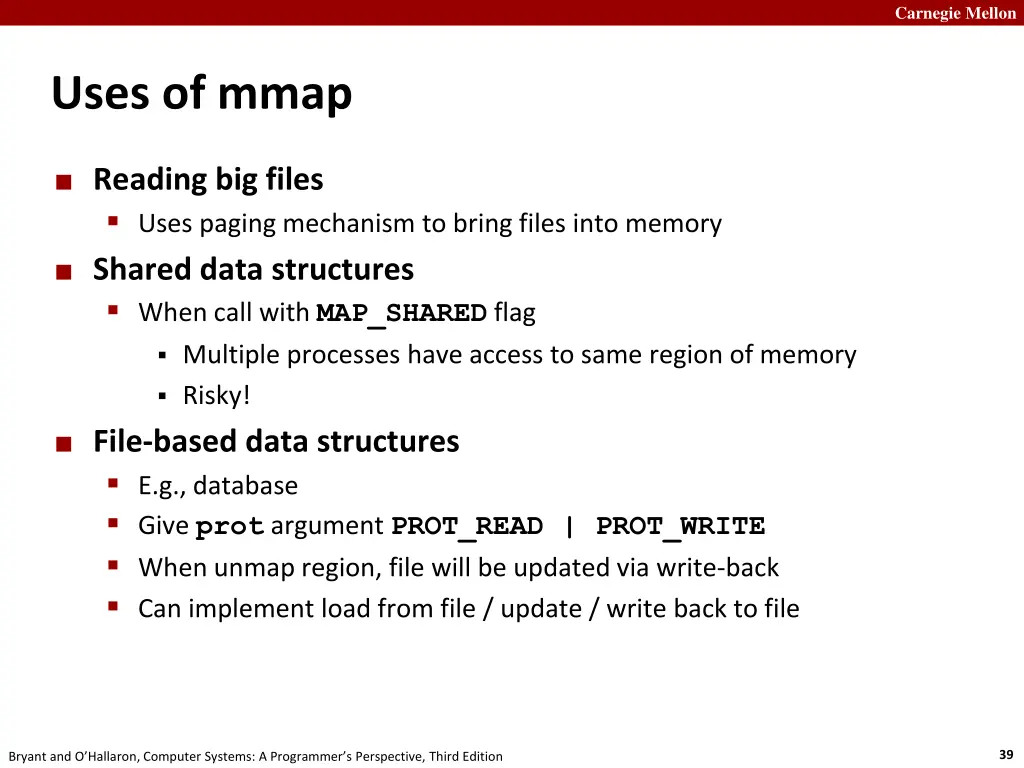
Carnegie Mellon Uses of mmap Reading big files Uses paging mechanism to bring files into memory Shared data structures When call with MAP_SHARED flag Multiple processes have access to same region of memory Risky! File-based data structures E.g., database Give prot argument PROT_READ | PROT_WRITE When unmap region, file will be updated via write-back Can implement load from file / update / write back to file 39 Bryant and O Hallaron, Computer Systems: A Programmer s Perspective, Third Edition
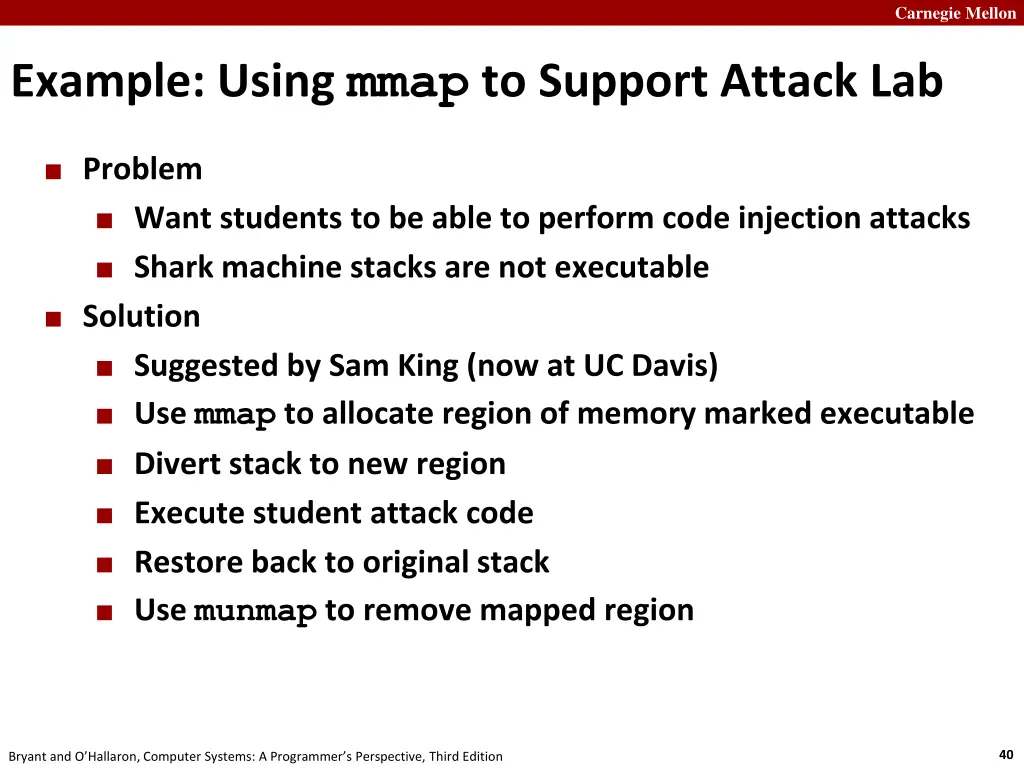
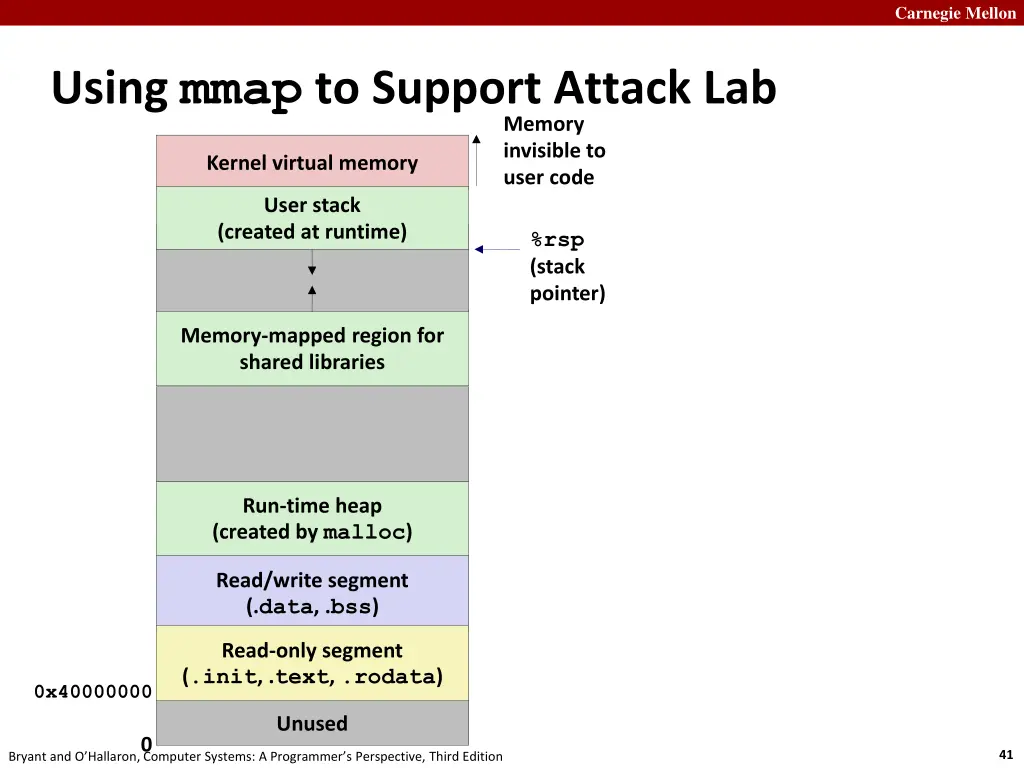
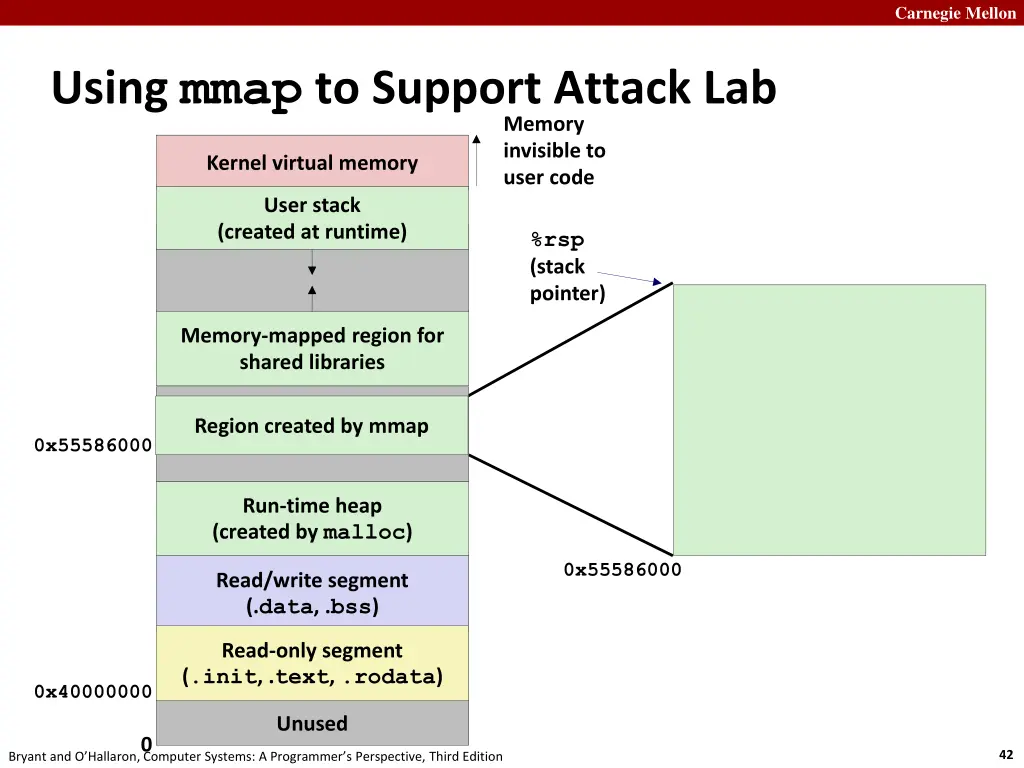
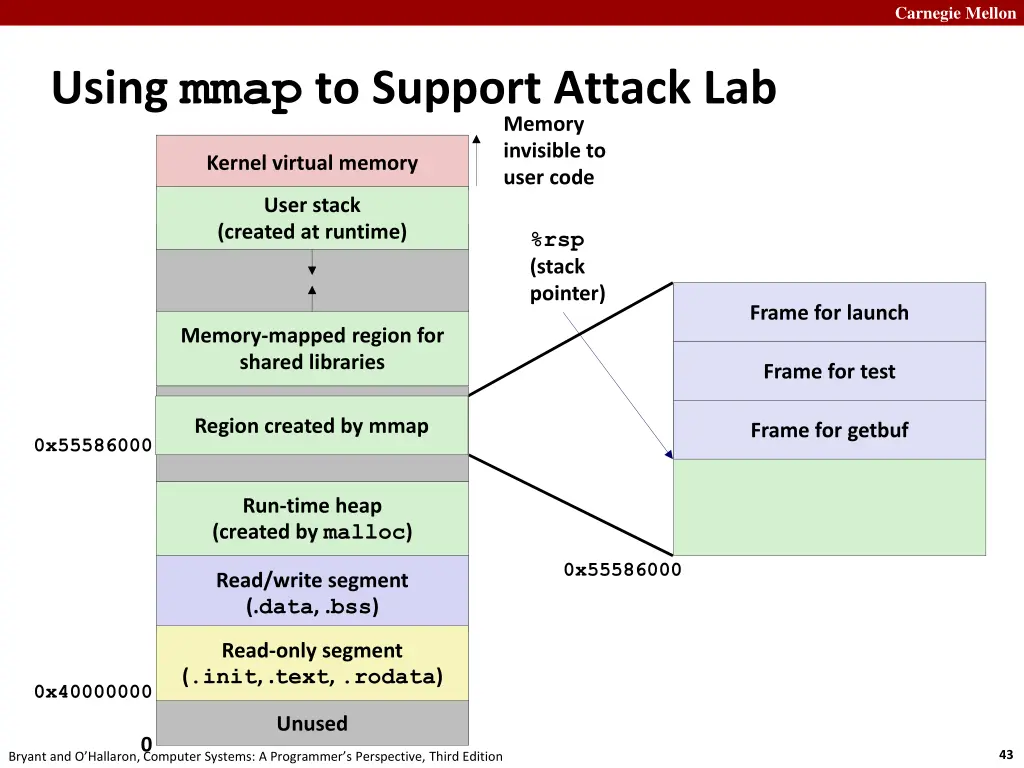
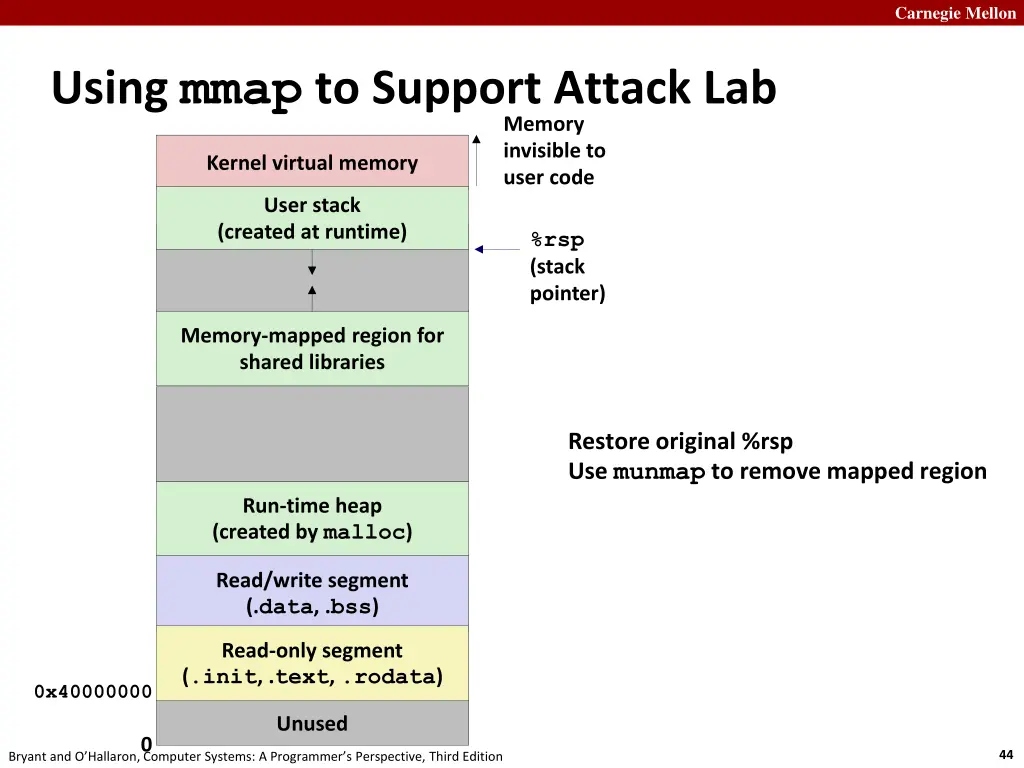
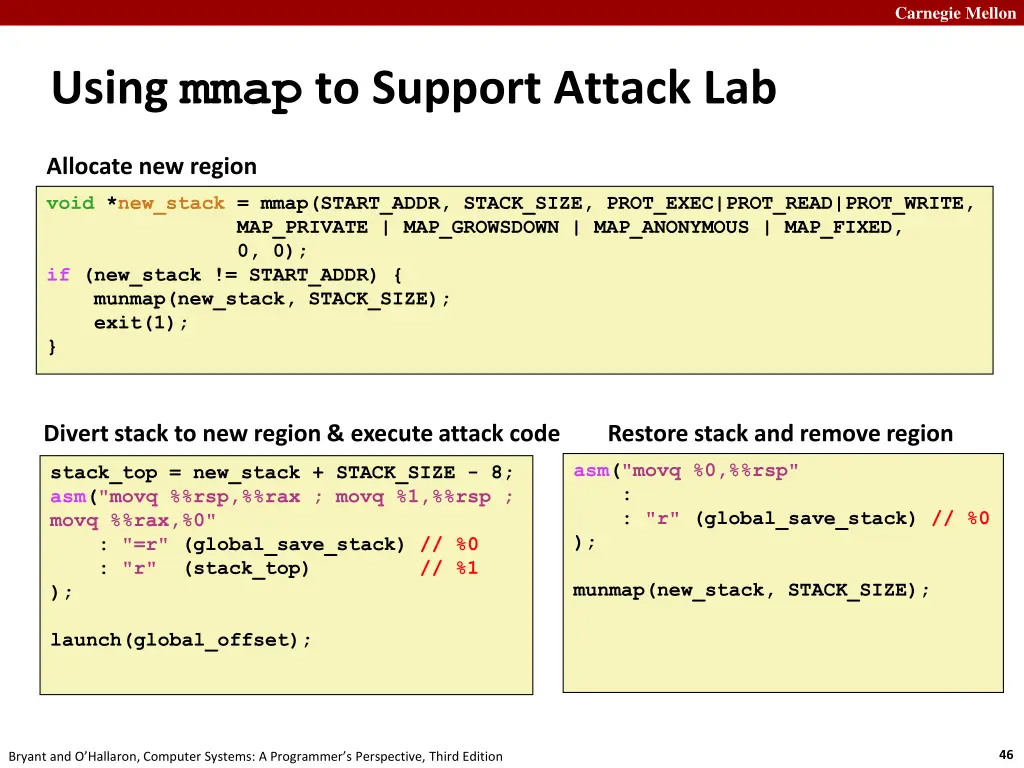
Carnegie Mellon Example: Using mmap to Support Attack Lab Problem Want students to be able to perform code injection attacks Shark machine stacks are not executable Solution Suggested by Sam King (now at UC Davis) Use mmap to allocate region of memory marked executable Divert stack to new region Execute student attack code Restore back to original stack Use munmap to remove mapped region 40 Bryant and O Hallaron, Computer Systems: A Programmer s Perspective, Third Edition
Carnegie Mellon Using mmap to Support Attack Lab Memory invisible to user code Kernel virtual memory User stack (created at runtime) %rsp (stack pointer) Memory-mapped region for shared libraries Run-time heap (created by malloc) Read/write segment (.data, .bss) Read-only segment (.init, .text, .rodata) 0x40000000 Unused Bryant and O Hallaron, Computer Systems: A Programmer s Perspective, Third Edition 0 41
Carnegie Mellon Using mmap to Support Attack Lab Memory invisible to user code Kernel virtual memory User stack (created at runtime) %rsp (stack pointer) Memory-mapped region for shared libraries Region created by mmap 0x55586000 Run-time heap (created by malloc) 0x55586000 Read/write segment (.data, .bss) Read-only segment (.init, .text, .rodata) 0x40000000 Unused Bryant and O Hallaron, Computer Systems: A Programmer s Perspective, Third Edition 0 42
Carnegie Mellon Using mmap to Support Attack Lab Memory invisible to user code Kernel virtual memory User stack (created at runtime) %rsp (stack pointer) Frame for launch Memory-mapped region for shared libraries Frame for test Region created by mmap Frame for getbuf 0x55586000 Run-time heap (created by malloc) 0x55586000 Read/write segment (.data, .bss) Read-only segment (.init, .text, .rodata) 0x40000000 Unused Bryant and O Hallaron, Computer Systems: A Programmer s Perspective, Third Edition 0 43
Carnegie Mellon Using mmap to Support Attack Lab Memory invisible to user code Kernel virtual memory User stack (created at runtime) %rsp (stack pointer) Memory-mapped region for shared libraries Restore original %rsp Use munmap to remove mapped region Run-time heap (created by malloc) Read/write segment (.data, .bss) Read-only segment (.init, .text, .rodata) 0x40000000 Unused Bryant and O Hallaron, Computer Systems: A Programmer s Perspective, Third Edition 0 44
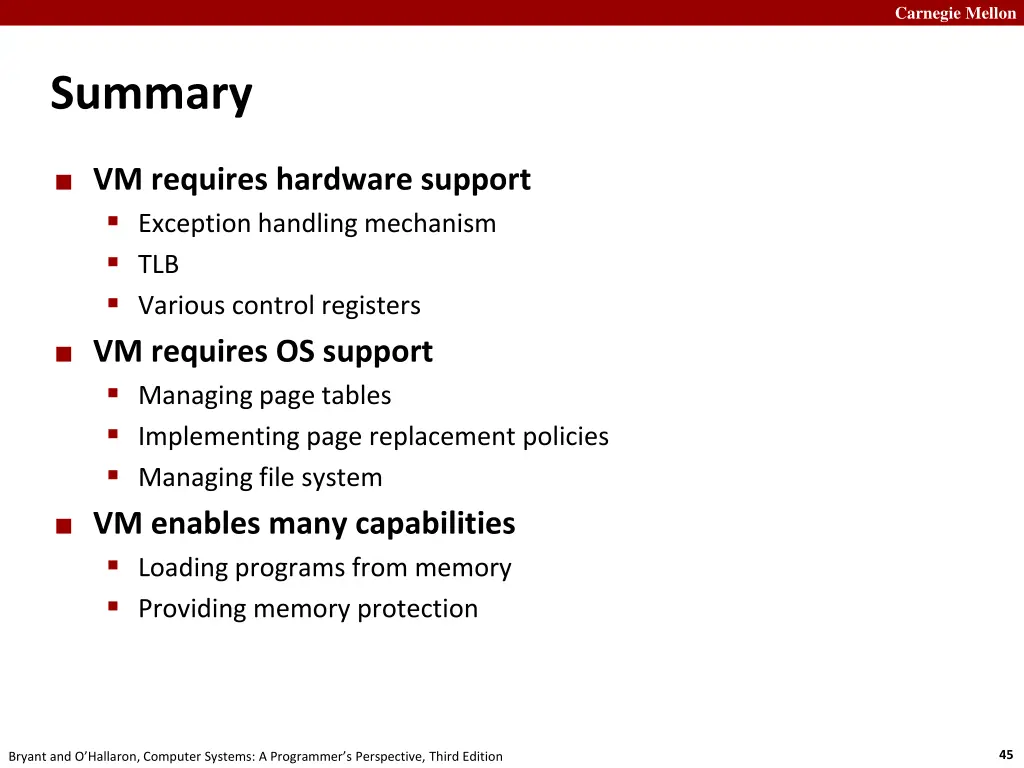
Carnegie Mellon Summary VM requires hardware support Exception handling mechanism TLB Various control registers VM requires OS support Managing page tables Implementing page replacement policies Managing file system VM enables many capabilities Loading programs from memory Providing memory protection 45 Bryant and O Hallaron, Computer Systems: A Programmer s Perspective, Third Edition
Carnegie Mellon Using mmap to Support Attack Lab Allocate new region void *new_stack = mmap(START_ADDR, STACK_SIZE, PROT_EXEC|PROT_READ|PROT_WRITE, MAP_PRIVATE | MAP_GROWSDOWN | MAP_ANONYMOUS | MAP_FIXED, 0, 0); if (new_stack != START_ADDR) { munmap(new_stack, STACK_SIZE); exit(1); } Divert stack to new region & execute attack code Restore stack and remove region asm("movq %0,%%rsp" : : "r" (global_save_stack) // %0 ); stack_top = new_stack + STACK_SIZE - 8; asm("movq %%rsp,%%rax ; movq %1,%%rsp ; movq %%rax,%0" : "=r" (global_save_stack) // %0 : "r" (stack_top) // %1 ); munmap(new_stack, STACK_SIZE); launch(global_offset); 46 Bryant and O Hallaron, Computer Systems: A Programmer s Perspective, Third Edition