CBC and Urine Analysis in Family Medicine
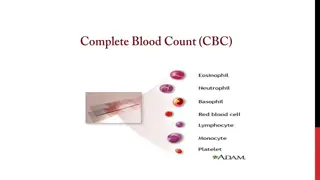
Learn about interpreting CBC and urine tests, focusing on anemia, polycythemia, thrombocytopenia, thrombocytosis, neutropenia, leukopenia, and pancytopenia. Discover safe approaches to CBC interpretation, diagnosis, and management of anemia. Explore parameters for diagnosing underlying causes of anemia, particularly microcytic anemia like iron deficiency anemia.

Download Presentation

Please find below an Image/Link to download the presentation.
The content on the website is provided AS IS for your information and personal use only. It may not be sold, licensed, or shared on other websites without obtaining consent from the author. If you encounter any issues during the download, it is possible that the publisher has removed the file from their server.
You are allowed to download the files provided on this website for personal or commercial use, subject to the condition that they are used lawfully. All files are the property of their respective owners.
The content on the website is provided AS IS for your information and personal use only. It may not be sold, licensed, or shared on other websites without obtaining consent from the author.
E N D
Presentation Transcript
Data interpretation (CBC and Urine) DR.ABDULLAH ALRASHEED CONSULTANT FAMILY MEDICINE AND DIABETOLOGY
CBC interpretation objectives Safe CBC interpretation Approach to Anemia Diagnosis and highlight about polycythemia Diagnosis and highlight about thrombocytopenia Diagnosis and highlight about Thrombocytosis Diagnosis and highlight about neutropenia and leukopenia. Diagnosis and highlight about Pancytopenia
Safe CBC interpretation The major components of CBC are: 1-Hb 2-WBC 3-plateltes If all major components are normal, then it is very less likely you miss a serious disease.
Safe CBC interpretation 1- look at Hb >>if low >> look at other major components ( WBCs and Platelets) to not miss bone marrow disease. 2- if there is no striking abnormality of WBC and platelet then check MCV to classify the anemia into microcytic, normocytic or macrocytic. 3- some references recommend to check reticulocyte before MCV to not miss hemolytic anemia but not practical.
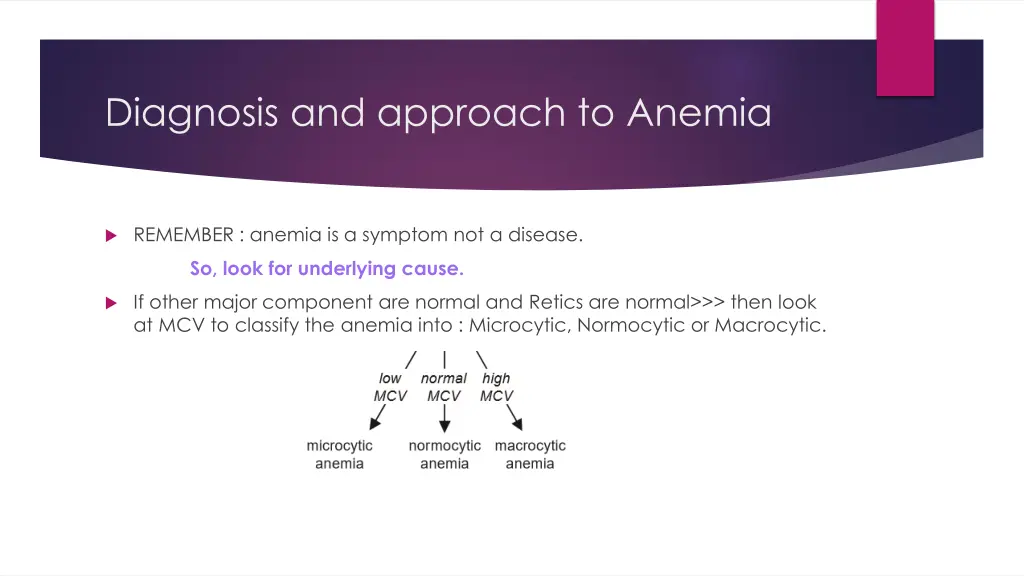
Diagnosis and approach to Anemia REMEMBER : anemia is a symptom not a disease. So, look for underlying cause. If other major component are normal and Retics are normal>>> then look at MCV to classify the anemia into : Microcytic, Normocytic or Macrocytic.
Helpful parameters to diagnose the underlying cause of anemia Size of red blood cells (MCV): (small/ normal/ big) Abnormal cells on microscopic examination( like blast cells in leukemia) Status of leukocytes and platelets ( bone marrow function) Reticulocyte count (ability of marrow to respond to anemia)>> can help in hemolytic anemia (if high) and in marrow suppression (if low). Evidence of destruction(hemolysis) >> (elevated LDH and indirect bilirubin)
Microcytic Anemia The most common
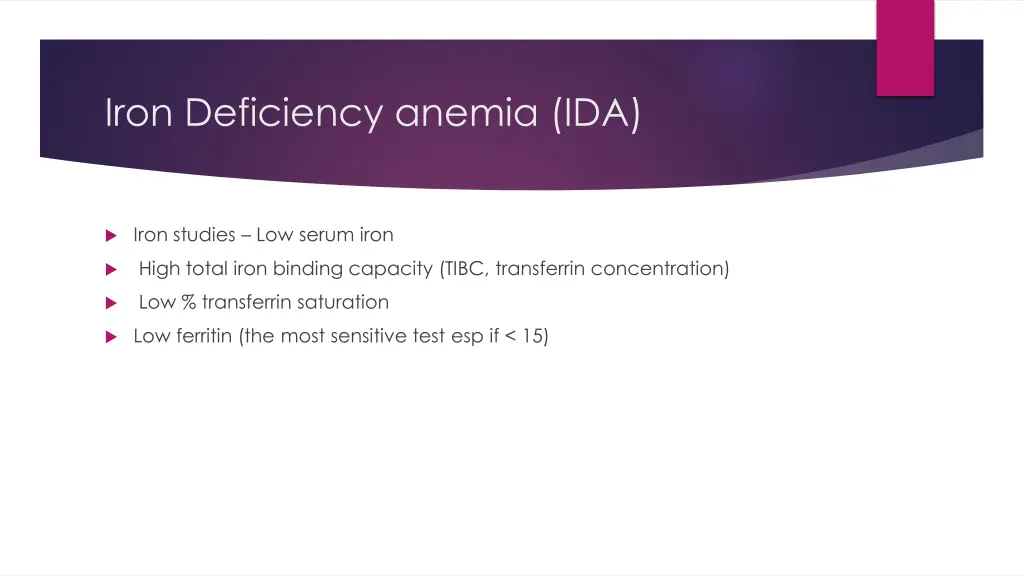
Iron Deficiency anemia (IDA) Iron studies Low serum iron High total iron binding capacity (TIBC, transferrin concentration) Low % transferrin saturation Low ferritin (the most sensitive test esp if < 15)
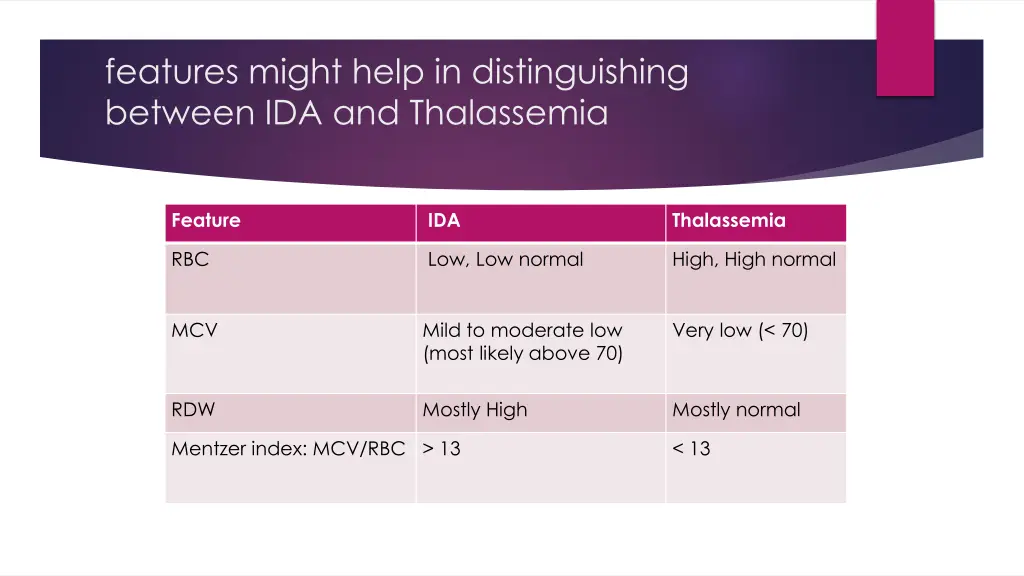
features might help in distinguishing between IDA and Thalassemia Feature IDA Thalassemia RBC Low, Low normal High, High normal MCV Mild to moderate low (most likely above 70) Very low (< 70) RDW Mostly High Mostly normal Mentzer index: MCV/RBC > 13 < 13
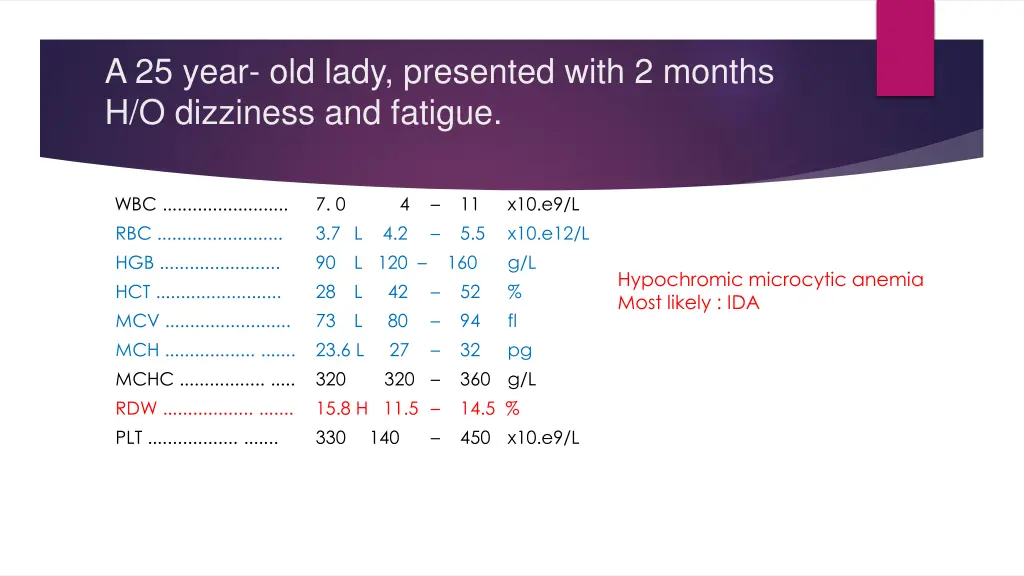
A 25 year- old lady, presented with 2 months H/O dizziness and fatigue. WBC ......................... RBC ......................... HGB ........................ HCT ......................... MCV ......................... MCH .................. ....... 23.6 L 27 32 MCHC ................. ..... 320 320 360 g/L RDW .................. ....... PLT .................. ....... 7. 0 4 11 3.7 L 4.2 90 L 120 160 28 L 42 52 73 L 80 94 x10.e9/L x10.e12/L g/L % fl pg 5.5 Hypochromic microcytic anemia Most likely : IDA 15.8 H 11.5 14.5 % 330 140 450 x10.e9/L
In the last patient (IDA) what do expect the following results? Ferritin : Especially if <15 TIBC : Fe: Transferrin saturation :
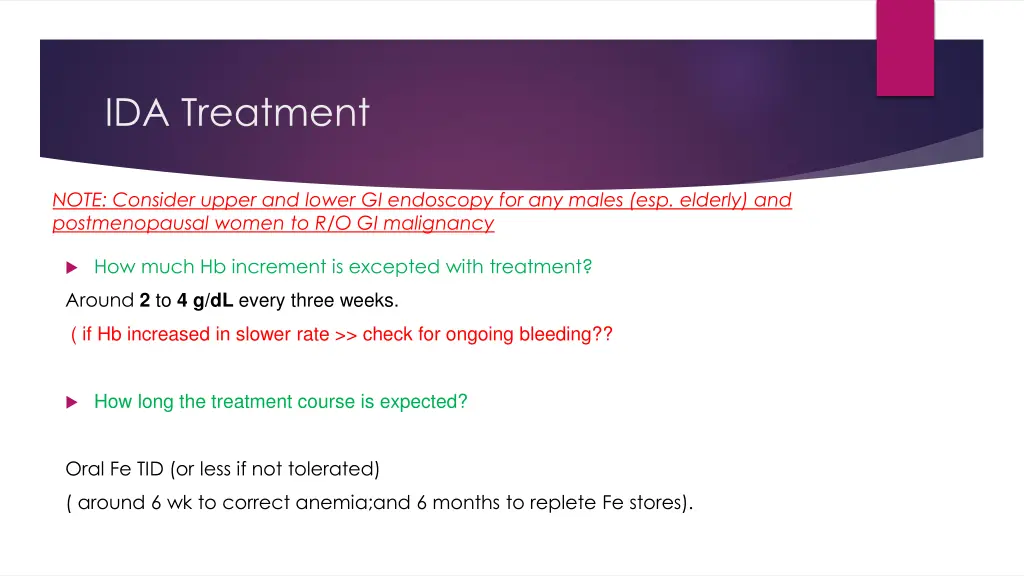
IDA Treatment NOTE: Consider upper and lower GI endoscopy for any males (esp. elderly) and postmenopausal women to R/O GI malignancy How much Hb increment is excepted with treatment? Around 2 to 4 g/dL every three weeks. ( if Hb increased in slower rate >> check for ongoing bleeding?? How long the treatment course is expected? Oral Fe TID (or less if not tolerated) ( around 6 wk to correct anemia;and 6 months to replete Fe stores).
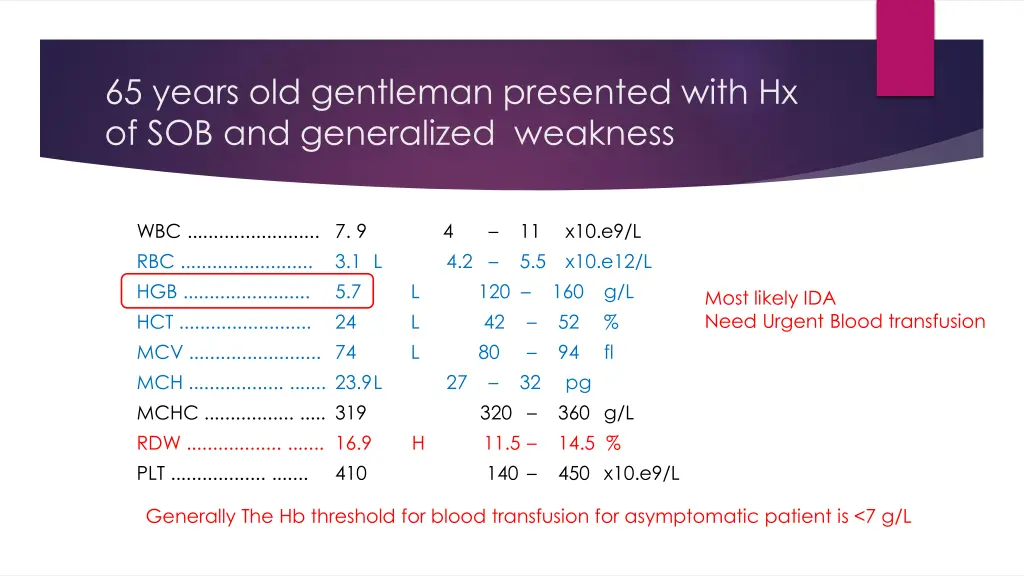
65 years old gentleman presented with Hx of SOB and generalized weakness WBC ......................... 7. 9 4 RBC ......................... 3.1 L 4.2 5.5 x10.e12/L HGB ........................ 5.7 L 120 160 g/L HCT ......................... 24 L 42 52 MCV ......................... 74 L 80 94 MCH .................. ....... 23.9 L 27 32 MCHC ................. ..... 319 320 360 g/L RDW .................. ....... 16.9 PLT .................. ....... 410 11 x10.e9/L Most likely IDA Need Urgent Blood transfusion % fl pg H 11.5 14.5 % 140 450 x10.e9/L Generally The Hb threshold for blood transfusion for asymptomatic patient is <7 g/L
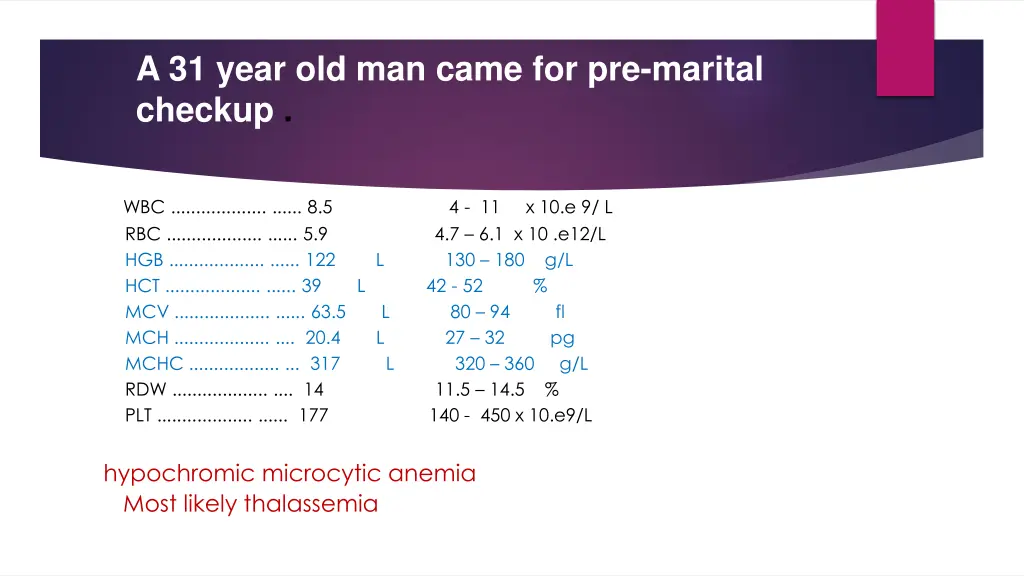
A 31 year old man came for pre-marital checkup . WBC ................... ...... 8.5 4 - 11 x 10.e 9/ L RBC ................... ...... 5.9 4.7 6.1 x 10 .e12/L HGB ................... ...... 122 L 130 180 g/L HCT ................... ...... 39 L 42 - 52 % MCV ................... ...... 63.5 L 80 94 fl MCH ................... .... 20.4 L 27 32 pg MCHC .................. ... 317 L RDW ................... .... 14 11.5 14.5 % PLT ................... ...... 177 hypochromic microcytic anemia Most likely thalassemia 320 360 g/L 140 - 450 x 10.e9/L
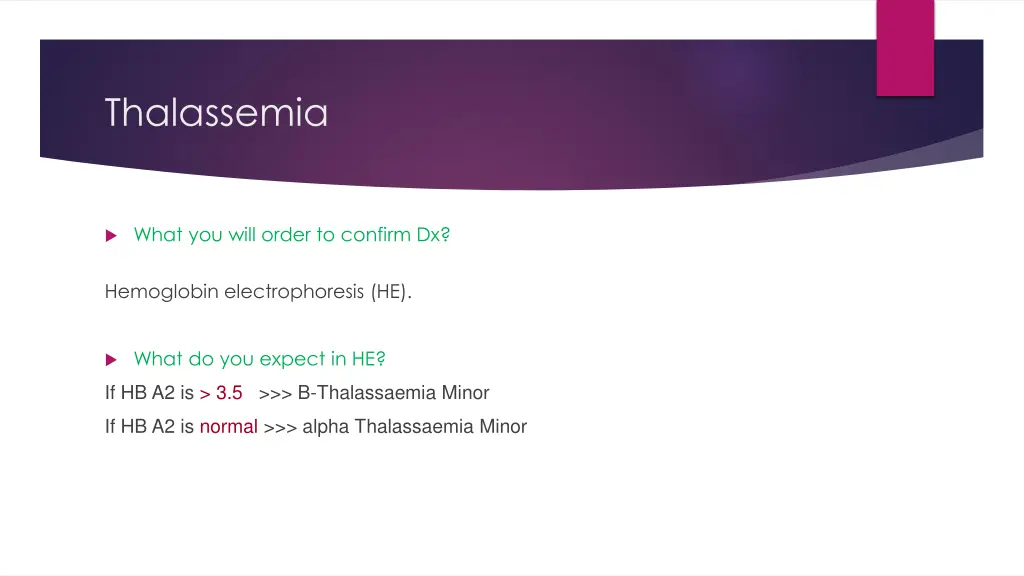
Thalassemia What you will order to confirm Dx? Hemoglobin electrophoresis (HE). What do you expect in HE? If HB A2 is > 3.5 >>> B-Thalassaemia Minor If HB A2 is normal >>> alpha Thalassaemia Minor
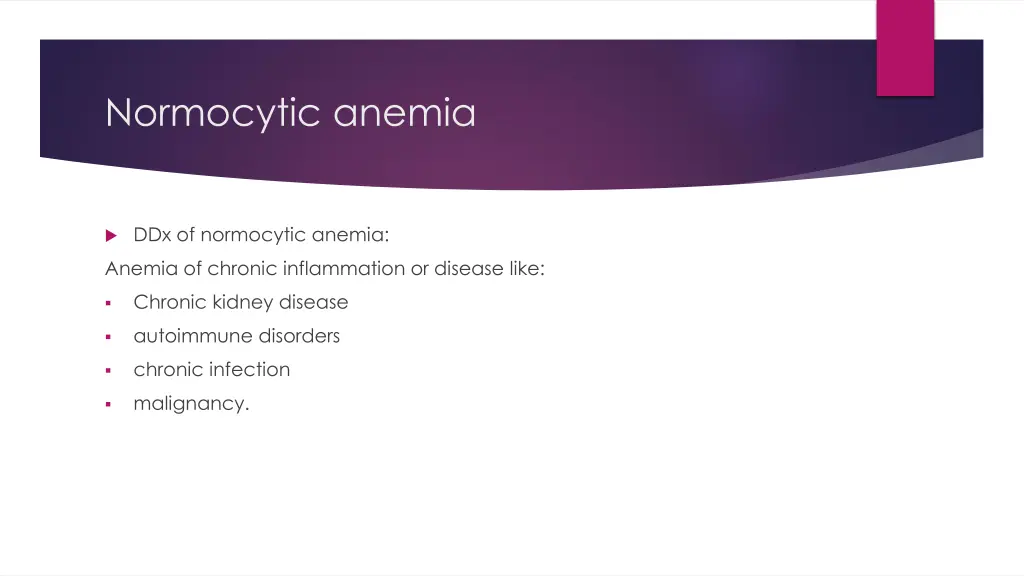
Normocytic anemia DDx of normocytic anemia: Anemia of chronic inflammation or disease like: Chronic kidney disease autoimmune disorders chronic infection malignancy.
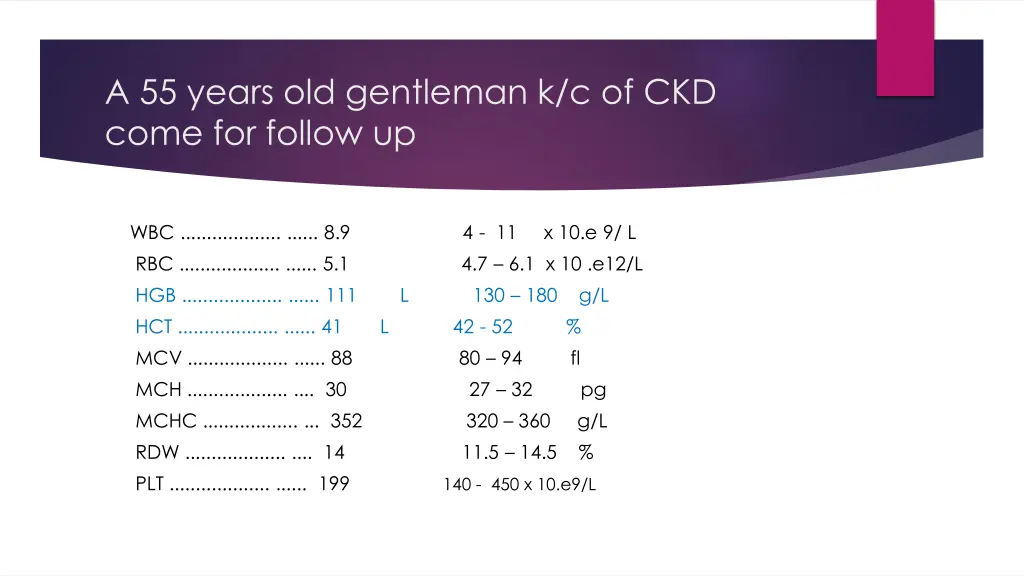
A 55 years old gentleman k/c of CKD come for follow up WBC ................... ...... 8.9 4 - 11 x 10.e 9/ L RBC ................... ...... 5.1 4.7 6.1 x 10 .e12/L HGB ................... ...... 111 L 130 180 g/L HCT ................... ...... 41 L 42 - 52 % MCV ................... ...... 88 80 94 fl MCH ................... .... 30 27 32 pg MCHC .................. ... 352 320 360 g/L RDW ................... .... 14 11.5 14.5 % PLT ................... ...... 199 140 - 450 x 10.e9/L
Continue Creatinine : 188 ..( 53-106 mol/L) Urea : 7 (2.5 to 7.1 mmol/L) eGFR: 34 mL/min/1.73 m2 what is the Dx: normocytic normochromic anemia most likely secondary to CKD. what is the stage of CKD?
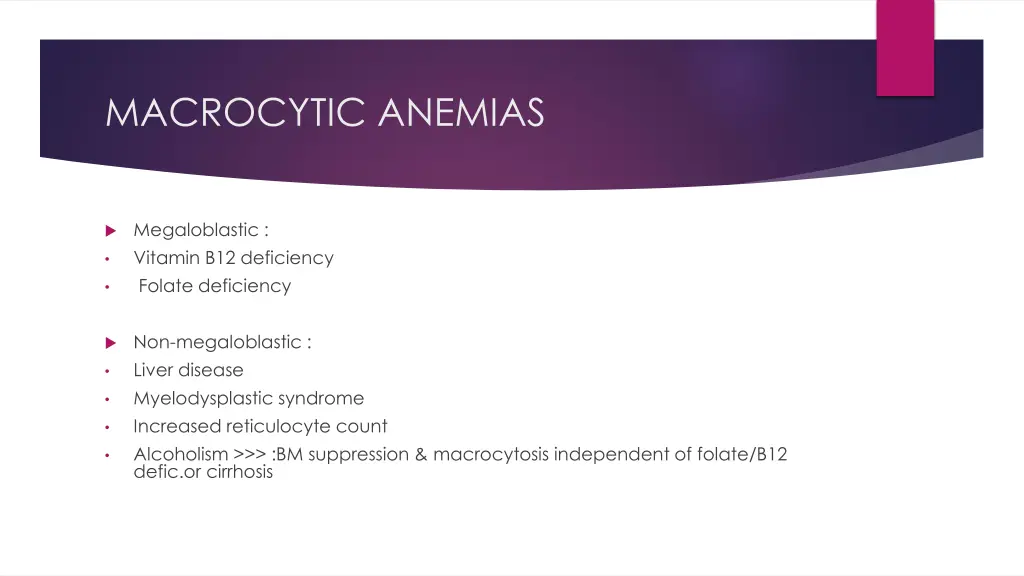
MACROCYTIC ANEMIAS Megaloblastic : Vitamin B12 deficiency Folate deficiency Non-megaloblastic : Liver disease Myelodysplastic syndrome Increased reticulocyte count Alcoholism >>> :BM suppression & macrocytosis independent of folate/B12 defic.or cirrhosis
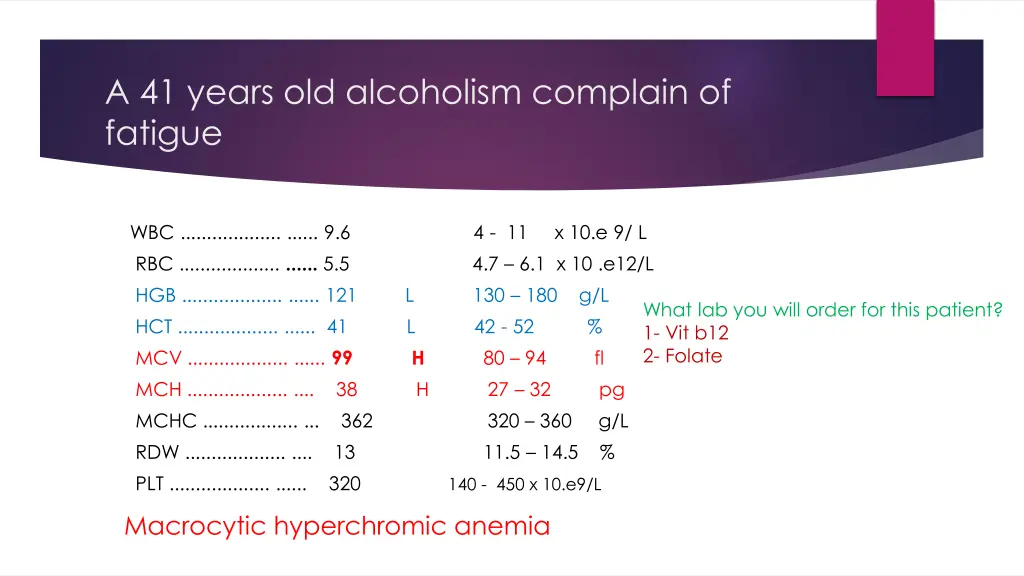
A 41 years old alcoholism complain of fatigue WBC ................... ...... 9.6 4 - 11 x 10.e 9/ L RBC ................... ...... 5.54.7 6.1 x 10 .e12/L HGB ................... ...... 121 L 130 180 g/L HCT ................... ...... 41 L 42 - 52 % MCV ................... ...... 99 H 80 94 fl MCH ................... .... 38 H 27 32 pg MCHC .................. ... 362 320 360 g/L RDW ................... .... 13 11.5 14.5 % PLT ................... ...... 320 140 - 450 x 10.e9/L What lab you will order for this patient? 1- Vit b12 2- Folate Macrocytic hyperchromic anemia
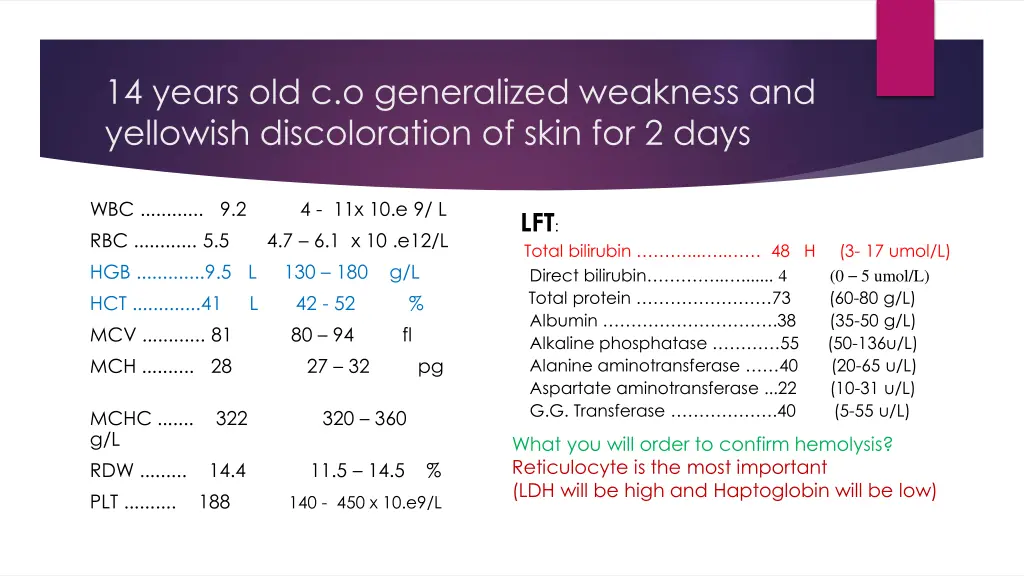
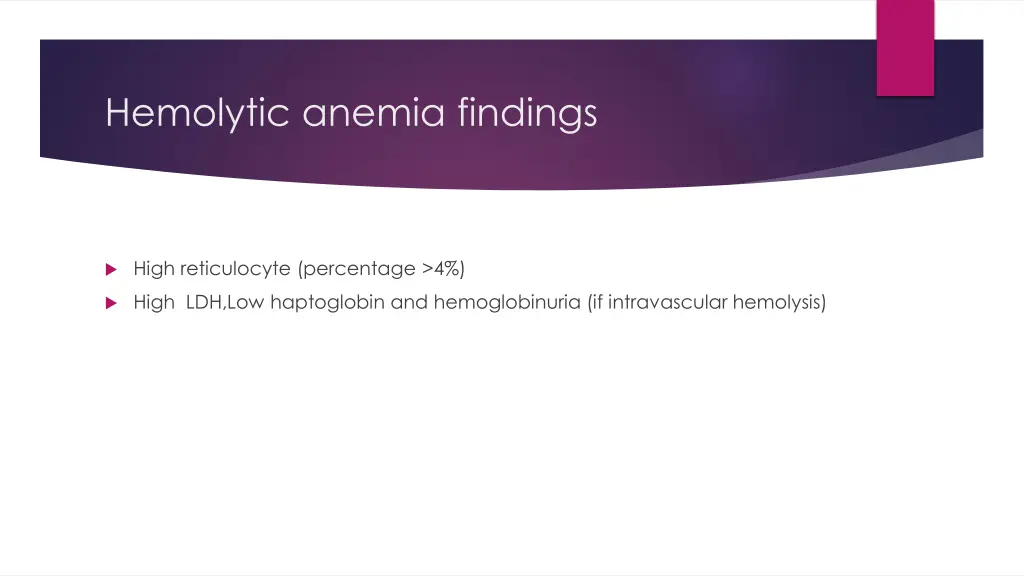
14 years old c.o generalized weakness and yellowish discoloration of skin for 2 days WBC ............ 9.2 4 - 11x 10.e 9/ L RBC ............ 5.5 4.7 6.1 x 10 .e12/L HGB .............9.5 L 130 180 g/L HCT .............41 L 42 - 52 % MCV ............ 81 80 94 fl MCH .......... 28 27 32 pg MCHC ....... 322 320 360 g/L RDW ......... 14.4 11.5 14.5 % PLT .......... 188 140 - 450 x 10.e9/L LFT: Total bilirubin ... .. 48 H (3- 17 umol/L) Direct bilirubin .. ....... 4 (0 5 umol/L) Total protein 73 (60-80 g/L) Albumin .38 (35-50 g/L) Alkaline phosphatase 55 (50-136u/L) Alanine aminotransferase 40 (20-65 u/L) Aspartate aminotransferase ...22 (10-31 u/L) G.G. Transferase .40 (5-55 u/L) What you will order to confirm hemolysis? Reticulocyte is the most important (LDH will be high and Haptoglobin will be low)
Hemolytic anemia findings High reticulocyte (percentage >4%) High LDH,Low haptoglobin and hemoglobinuria (if intravascular hemolysis)
A 51-year-old man presents with 2 month H/O of headache WBC .................. ..... 20.8 RBC ......................... 8.33 H 4.7 6.1 x10.e12/L HGB ......................... 201 H 130 180 g/L HCT ......................... 62.6 H 42 52 % MCV ......................... 82 80 94 fl MCH ......................... 28.9 27 32 pg MCHC .......................329 320 360 g/L RDW ........................ 14.0 11.5 14.5 % PLT ......................... 300 140 450 x10.e9/L polycythemia H 4 11 x10.e9/L
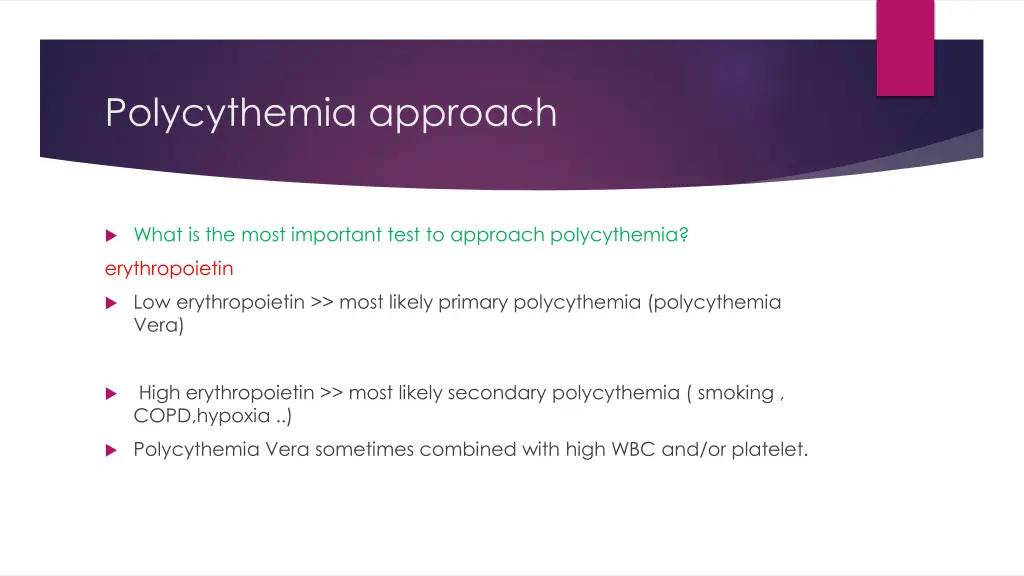
Polycythemia approach What is the most important test to approach polycythemia? erythropoietin Low erythropoietin >> most likely primary polycythemia (polycythemia Vera) High erythropoietin >> most likely secondary polycythemia ( smoking , COPD,hypoxia ..) Polycythemia Vera sometimes combined with high WBC and/or platelet.
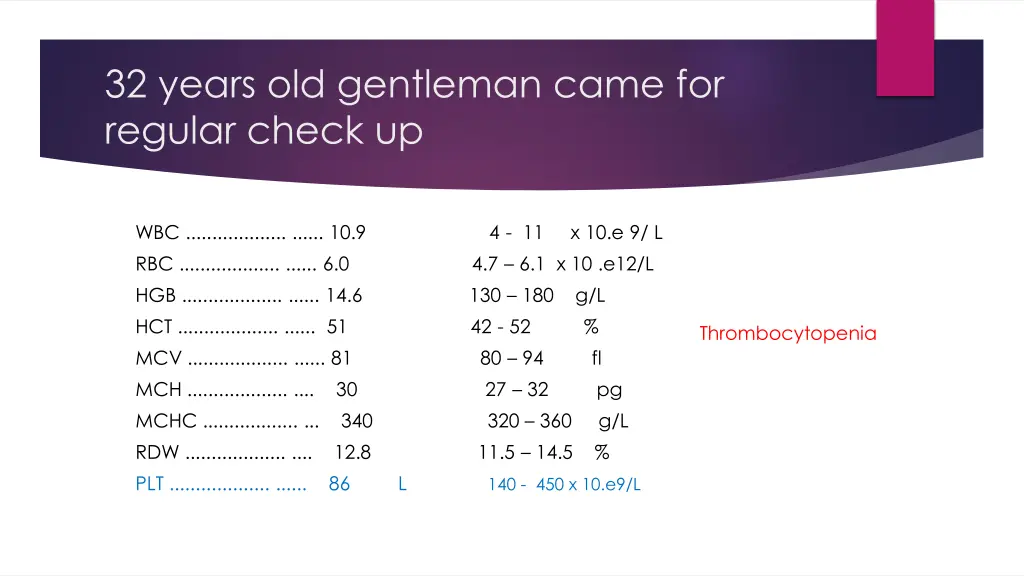
32 years old gentleman came for regular check up WBC ................... ...... 10.9 4 - 11 x 10.e 9/ L RBC ................... ...... 6.0 4.7 6.1 x 10 .e12/L HGB ................... ...... 14.6 130 180 g/L HCT ................... ...... 51 42 - 52 % MCV ................... ...... 81 80 94 fl MCH ................... .... 30 27 32 pg MCHC .................. ... 340 320 360 g/L RDW ................... .... 12.8 11.5 14.5 % PLT ................... ...... 86 L Thrombocytopenia 140 - 450 x 10.e9/L
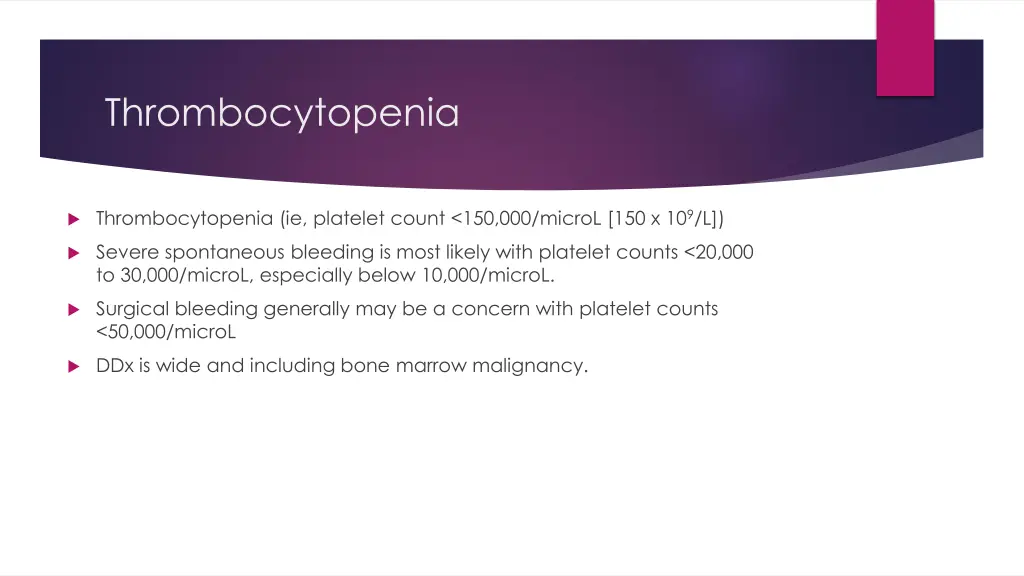
Thrombocytopenia Thrombocytopenia (ie, platelet count <150,000/microL [150 x 109/L]) Severe spontaneous bleeding is most likely with platelet counts <20,000 to 30,000/microL, especially below 10,000/microL. Surgical bleeding generally may be a concern with platelet counts <50,000/microL DDx is wide and including bone marrow malignancy.
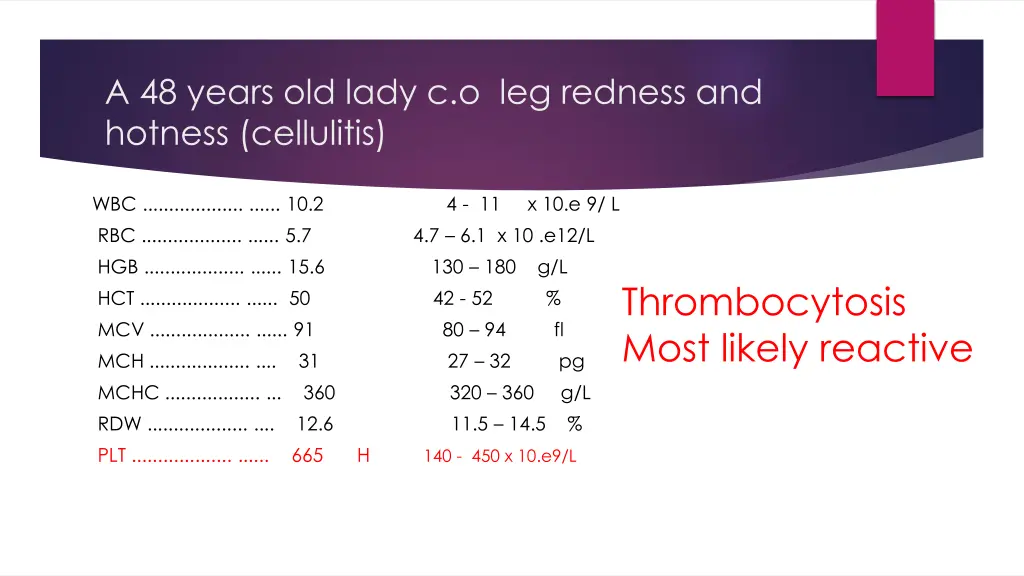
A 48 years old lady c.o leg redness and hotness (cellulitis) WBC ................... ...... 10.2 4 - 11 x 10.e 9/ L RBC ................... ...... 5.7 4.7 6.1 x 10 .e12/L HGB ................... ...... 15.6 130 180 g/L HCT ................... ...... 50 42 - 52 % MCV ................... ...... 91 80 94 fl MCH ................... .... 31 27 32 pg MCHC .................. ... 360 320 360 g/L RDW ................... .... 12.6 11.5 14.5 % PLT ................... ...... 665 H 140 - 450 x 10.e9/L Thrombocytosis Most likely reactive
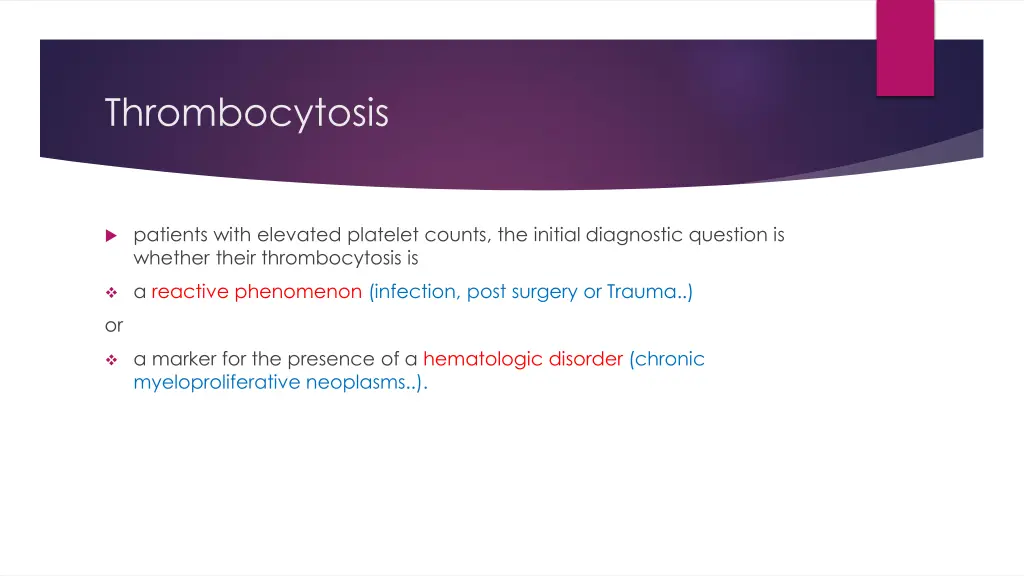
Thrombocytosis patients with elevated platelet counts, the initial diagnostic question is whether their thrombocytosis is a reactive phenomenon (infection, post surgery or Trauma..) or a marker for the presence of a hematologic disorder (chronic myeloproliferative neoplasms..).
A 28 y old gentleman k/c of AML on chemotherapy c.o Fever Neutrophil percentage Febrile Neutropenia Absolute neutrophil count
Neutropenia Vs leukopenia Leukopenia = low WBCs Neutropenia = low absolute neutrophils count (ANC) Leukopenia Neutropenia Febrile Neutropenia is a medical emergency Neutropenia classification is based on Absolute Neutrophil count (ANC) Mild < 1.5 K/uL ( 1500 cells / MicroL) Moderate <1.0 K/uL (1000 cells / MicroL) Sever < 0.5 K/uL ( 500 cells / MicroL)
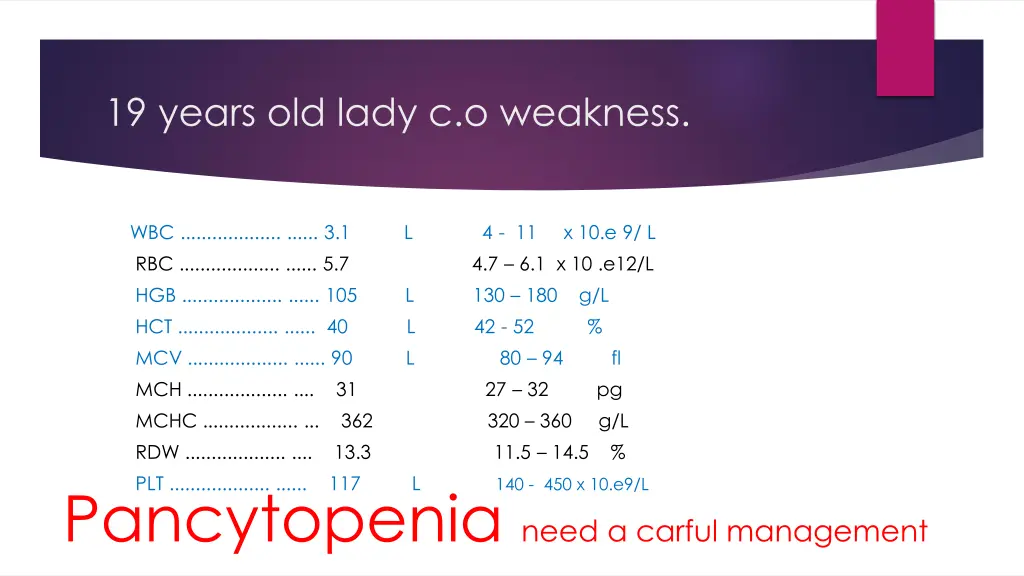
19 years old lady c.o weakness. WBC ................... ...... 3.1 L 4 - 11 x 10.e 9/ L RBC ................... ...... 5.7 4.7 6.1 x 10 .e12/L HGB ................... ...... 105 L 130 180 g/L HCT ................... ...... 40 L 42 - 52 % MCV ................... ...... 90 L 80 94 fl MCH ................... .... 31 27 32 pg MCHC .................. ... 362 320 360 g/L RDW ................... .... 13.3 11.5 14.5 % PLT ................... ...... 117 Pancytopenia need a carful management L 140 - 450 x 10.e9/L
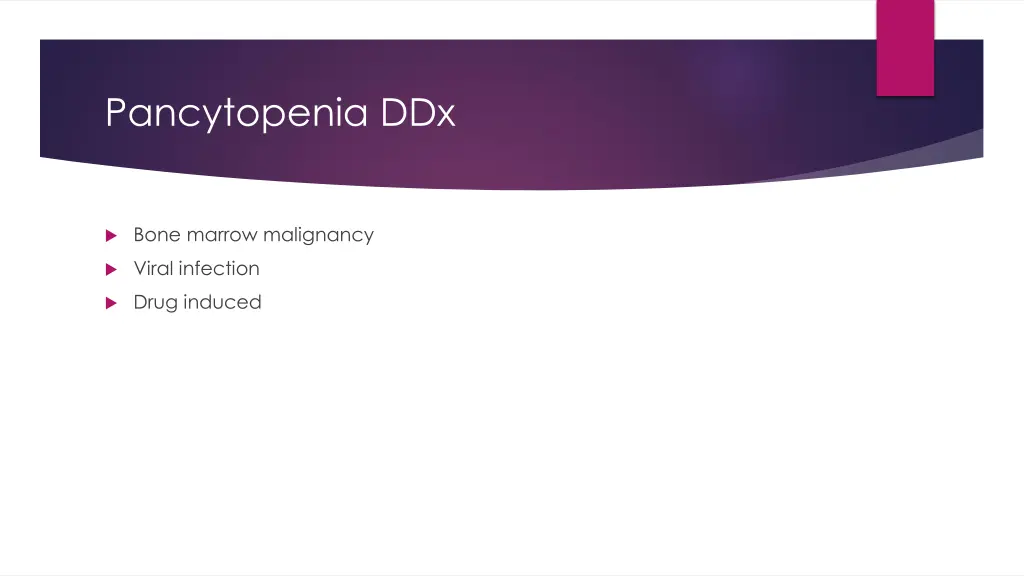
Pancytopenia DDx Bone marrow malignancy Viral infection Drug induced
kidney function assessment Assessing kidney function is differ from screening for a kidney diseas. Measured GFR is the best overall index of kidney function in health and disease. eGFR (estimated GFR) may be the best available way to assess kidney function despite having some limitations.
eGFR staging when there is evidence of kidney pathology (lab, image or histology)
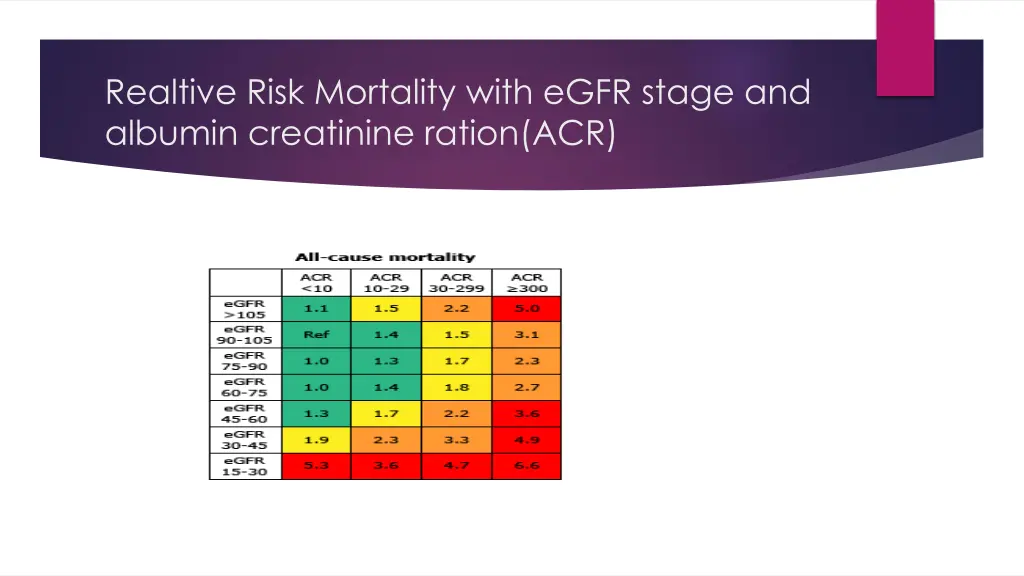
Realtive Risk Mortality with eGFR stage and albumin creatinine ration(ACR)
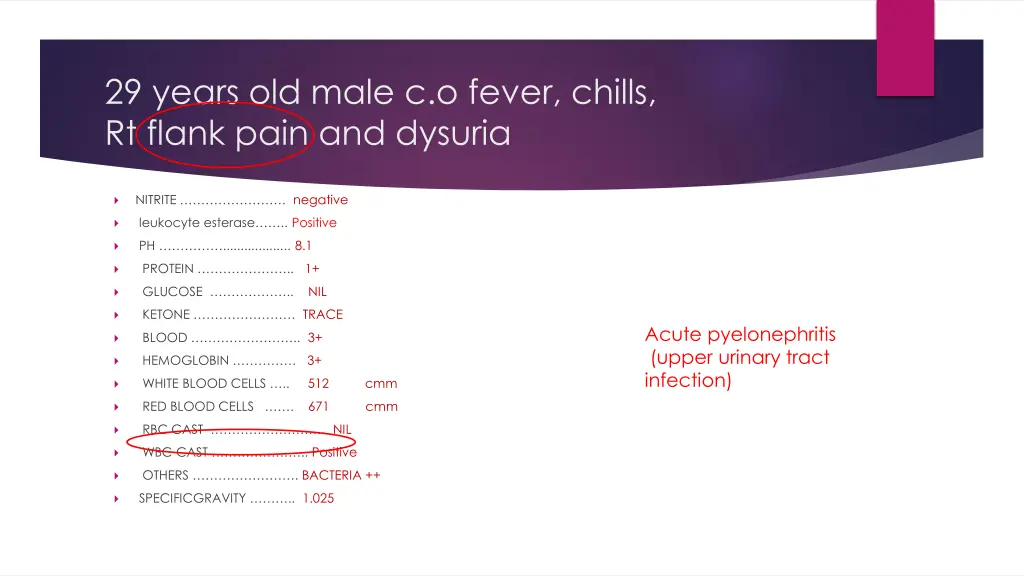
UTI What urine analysis finding could be seen in UTI: Positive WBCs :a number of leukocytes (WBCs) >10/microL indicate significant pyuria Positive Nitrite Positive leukocyte esterase ? Positive RBCs NOTE: presence of WBCs Cast indicate upper urinary tract infection (pyelonephritis) Urine culture: If > 100.000 (CFU)/mL indicate a positive urine culture
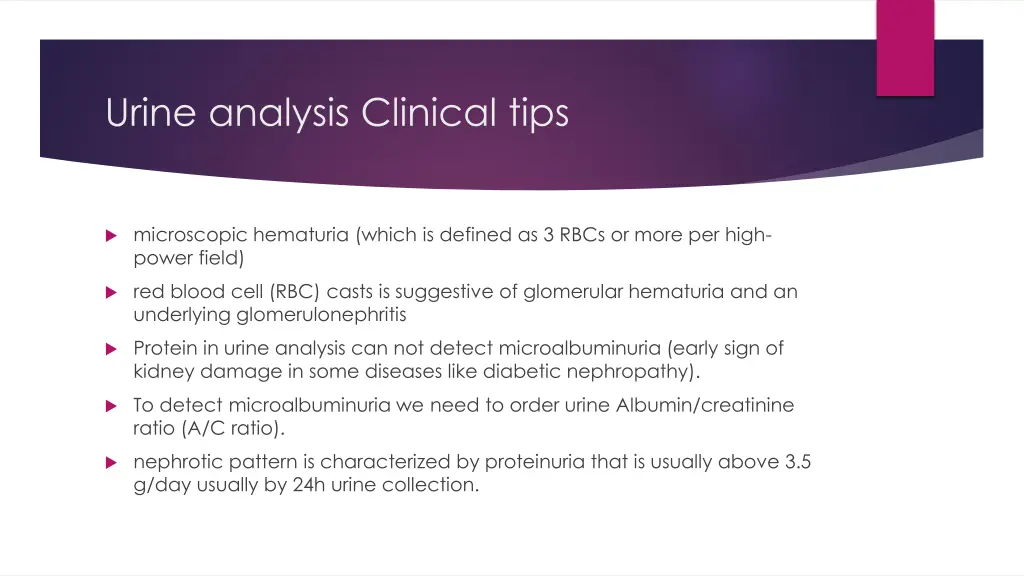
Urine analysis Clinical tips microscopic hematuria (which is defined as 3 RBCs or more per high- power field) red blood cell (RBC) casts is suggestive of glomerular hematuria and an underlying glomerulonephritis Protein in urine analysis can not detect microalbuminuria (early sign of kidney damage in some diseases like diabetic nephropathy). To detect microalbuminuria we need to order urine Albumin/creatinine ratio (A/C ratio). nephrotic pattern is characterized by proteinuria that is usually above 3.5 g/day usually by 24h urine collection.
A 42 year old lady presented with 2 days H/O lower abdominal pain and vomiting NITRITE . POSITIVE leukocyte esterase .. negative PH ................... 8.3 PROTEIN .. 1+ GLUCOSE .. NIL KETONE TRACE BLOOD .. 3+ HEMOGLOBIN 3+ WHITE BLOOD CELLS .. 442 cmm RED BLOOD CELLS . 830 cmm CAST NIL CRYSTAL .. NIL OTHERS . BACTERIA ++ SPECIFICGRAVITY .. 1.025 Lower Urinary tract infection
29 years old male c.o fever, chills, Rt flank pain and dysuria NITRITE . negative leukocyte esterase .. Positive PH ................... 8.1 PROTEIN .. 1+ GLUCOSE .. NIL KETONE TRACE Acute pyelonephritis (upper urinary tract infection) BLOOD .. 3+ HEMOGLOBIN 3+ WHITE BLOOD CELLS .. 512 cmm RED BLOOD CELLS . 671 cmm RBC CAST NIL WBC CAST .. Positive OTHERS . BACTERIA ++ SPECIFICGRAVITY .. 1.025
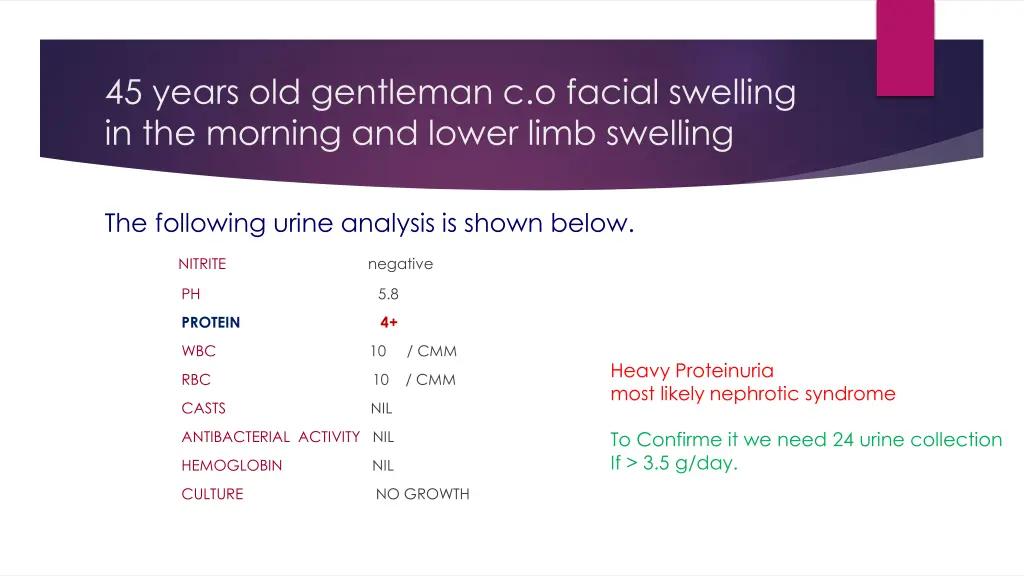
45 years old gentleman c.o facial swelling in the morning and lower limb swelling The following urine analysis is shown below. NITRITE negative PH 5.8 PROTEIN 4+ WBC 10 / CMM Heavy Proteinuria most likely nephrotic syndrome RBC 10 / CMM CASTS NIL ANTIBACTERIAL ACTIVITY NIL To Confirme it we need 24 urine collection If > 3.5 g/day. HEMOGLOBIN NIL CULTURE NO GROWTH
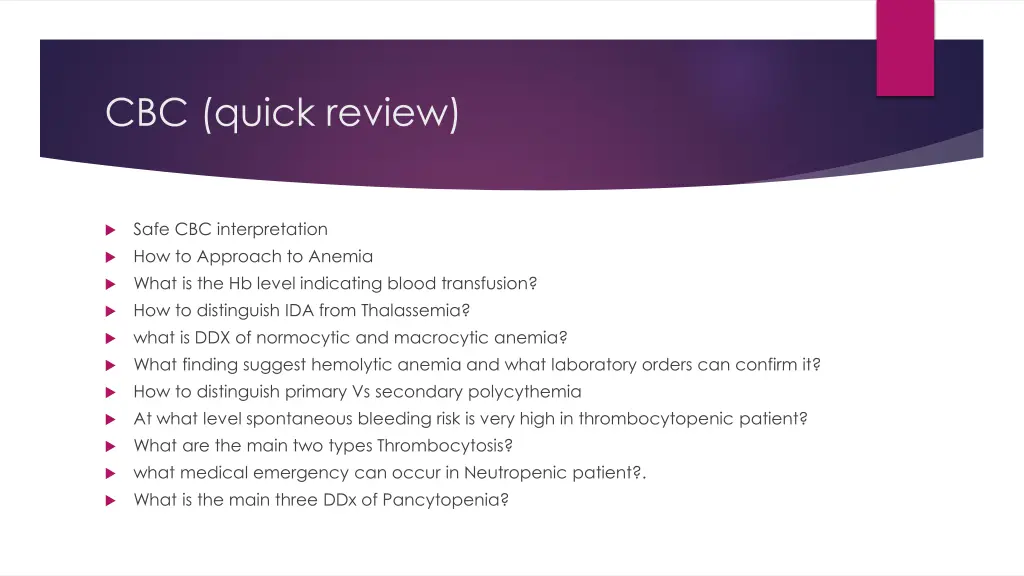
CBC (quick review) Safe CBC interpretation How to Approach to Anemia What is the Hb level indicating blood transfusion? How to distinguish IDA from Thalassemia? what is DDX of normocytic and macrocytic anemia? What finding suggest hemolytic anemia and what laboratory orders can confirm it? How to distinguish primary Vs secondary polycythemia At what level spontaneous bleeding risk is very high in thrombocytopenic patient? What are the main two types Thrombocytosis? what medical emergency can occur in Neutropenic patient?. What is the main three DDx of Pancytopenia?
Urine (quick review) How to assess kidney function? What are the urine analysis findings in UTI? What is the urine analysis finding indicating Pyelonephritis? What is the lowest abnormal value for RBC in microscopic urine analysis? At what level of protein nephrotic range start to be diagnosed?